
Commentary · Fr. Tadros Y. Malaty · Old Testament · Genesis

Genesis 50The Burial of Jacob

Jacob died a stranger in the land of Egypt after charging his sons to bury him in Canaan in the tomb of his fathers. It is as though, having perceived that the seed of the people of God had been planted in Egypt to grow and flourish, he asks this people that its heart remain attached to Canaan, the land of promise, until it enjoys God’s promises.

1. The Embalming of Jacob

KJV · Verses 1–6

1 And Joseph fell upon his father's face, and wept upon him, and kissed him. 2 And Joseph commanded his servants the physicians to embalm his father: and the physicians embalmed Israel. 3 And forty days were fulfilled for him; for so are fulfilled the days of those which are embalmed: and the Egyptians mourned for him threescore and ten days. 4 And when the days of his mourning were past, Joseph spake unto the house of Pharaoh, saying, If now I have found grace in your eyes, speak, I pray you, in the ears of Pharaoh, saying, 5 My father made me swear, saying, Lo, I die: in my grave which I have digged for me in the land of Canaan, there shalt thou bury me. Now therefore let me go up, I pray thee, and bury my father, and I will come again. 6 And Pharaoh said, Go up, and bury thy father, according as he made thee swear.
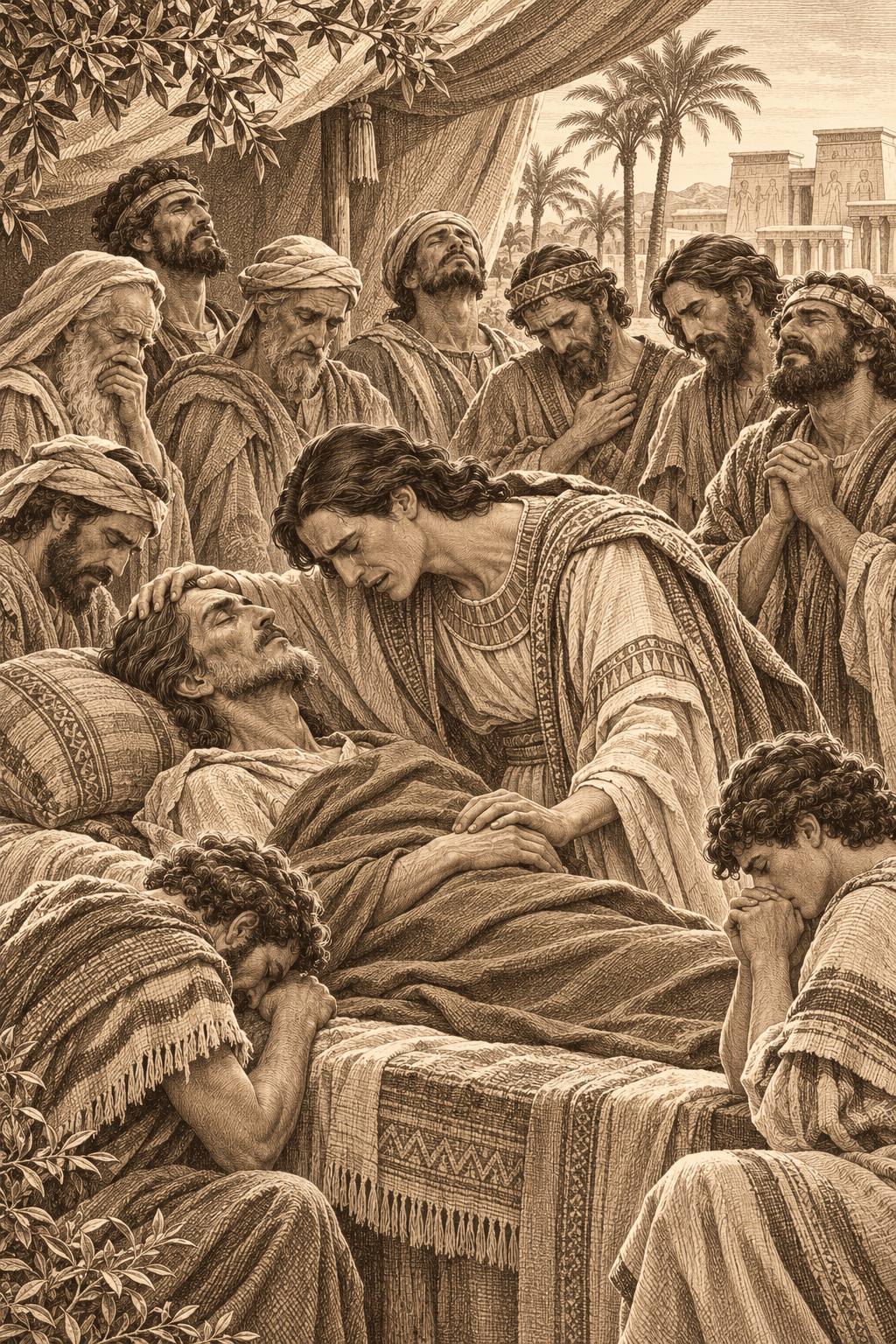
Joseph mourns Jacob
Joseph mourns Jacob

Jacob lived like his fathers as a stranger in tents, not settled in one place, and his life on earth ended while he was a stranger in Egypt. In his farewell charge he insisted on being buried in Canaan, in the cave of Machpelah, where Abraham, Sarah, Isaac, and Rebekah were buried… One may ask: why was the man of faith, the father of all the tribes, concerned with this matter, making it his farewell charge to all his sons? Does the body matter to him after his death?

First: The fathers affirm that the men of the Old Testament were concerned in their charge with the burial of their bodies in a particular place as a tangible handing on, through which their children would perceive the resurrection of the body… For these fathers lived as strangers, depriving their bodies of luxury and pampering, but waiting to bear it as a glorified body on the great day of the Lord.

Second: Jacob wished by his burial in Canaan to assure his sons… that though he lived his last days in Egypt, where Joseph saved the family from famine, his heart was in Canaan, which God had promised Abraham that his descendants would enjoy. It is as though Jacob asks his sons to live in Egypt working with faithfulness and striving, while their hearts cleave to God’s promises to them.

Third: He asked to be buried with his fathers to declare that his whole life proceeded in harmony and accord with the faith of his fathers handed down through the generations… especially his faith in the resurrection of the dead.

In any case, when Jacob died Joseph was deeply moved, for he “fell upon his father’s face, and wept upon him, and kissed him” (1), as though God’s promise was fulfilled when He said to him: “fear not to go down into Egypt; for I will there make of thee a great nation: I will go down with thee into Egypt; and I will also surely bring thee up again: and Joseph shall put his hand upon thine eyes” (Genesis 46:3–4), that is, put his hand on his eyes at his death to close them, as is the custom to this day.

Joseph commanded his servants the physicians to embalm his father so that he could carry him to Canaan, and he asked the house of Pharaoh to ask Pharaoh to allow them to carry his father’s body to Canaan according to his charge; for it was not possible for Joseph to meet Pharaoh in garments of mourning or with the beard he had let grow for the dead.

2. The Burial of Jacob in Canaan

KJV · Verses 7–13

7 And Joseph went up to bury his father: and with him went up all the servants of Pharaoh, the elders of his house, and all the elders of the land of Egypt, 8 And all the house of Joseph, and his brethren, and his father's house: only their little ones, and their flocks, and their herds, they left in the land of Goshen. 9 And there went up with him both chariots and horsemen: and it was a very great company. 10 And they came to the threshingfloor of Atad, which is beyond Jordan, and there they mourned with a great and very sore lamentation: and he made a mourning for his father seven days. 11 And when the inhabitants of the land, the Canaanites, saw the mourning in the floor of Atad, they said, This is a grievous mourning to the Egyptians: wherefore the name of it was called Abelmizraim, which is beyond Jordan. 12 And his sons did unto him according as he commanded them: 13 For his sons carried him into the land of Canaan, and buried him in the cave of the field of Machpelah, which Abraham bought with the field for a possession of a buryingplace of Ephron the Hittite, before Mamre.
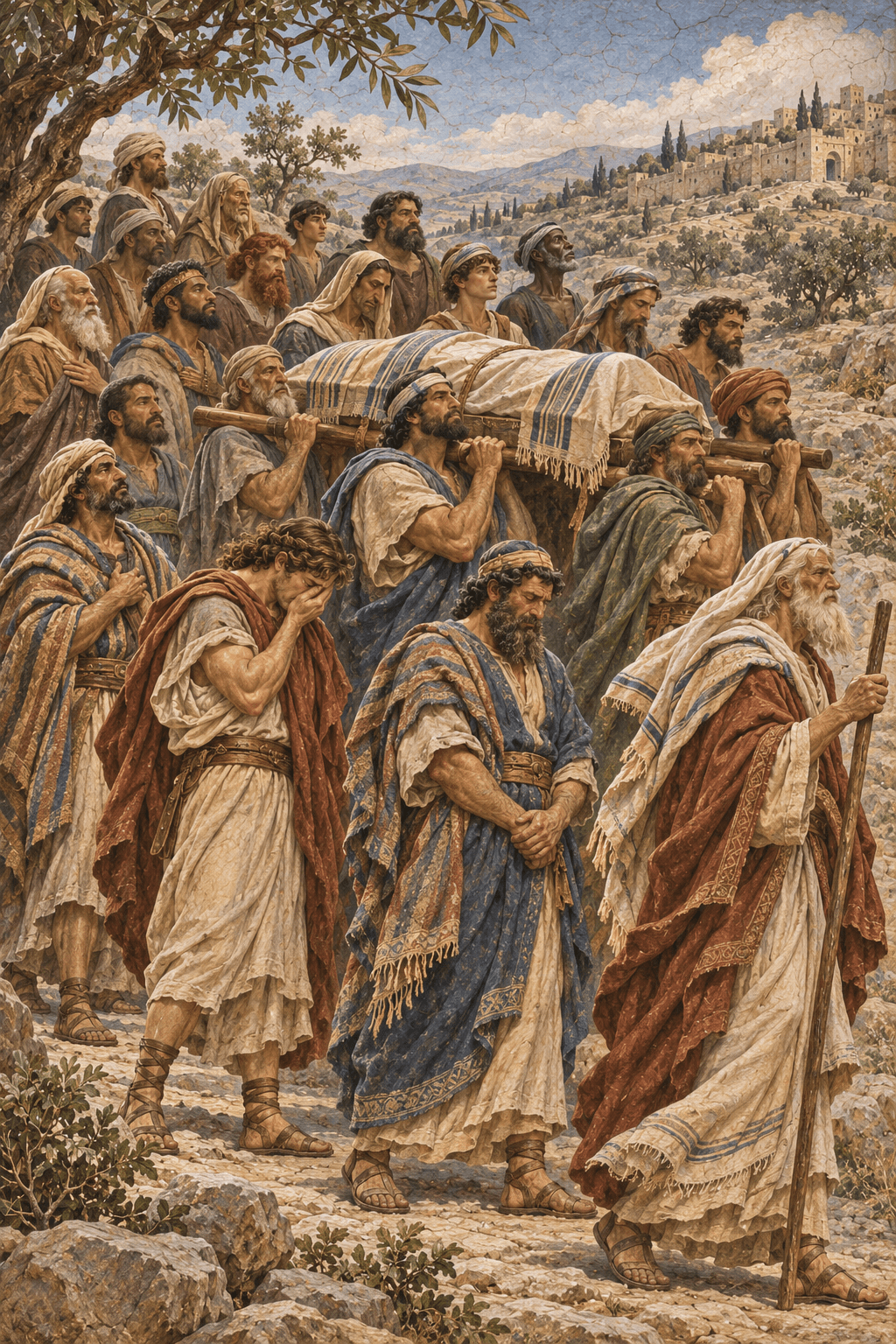
The burial procession travels to Canaan

The great procession set out from Goshen toward the land of Canaan to bury Israel, for Joseph said: “let me go up, I pray thee, and bury my father” (5). In Joseph’s eyes, as in the eyes of Pharaoh himself (6), the procession was a procession of going up, not down, for it bore a symbol of the Church’s rising toward the Jerusalem above, the true Canaan, to be with her Bridegroom forever.

The burial rites, or the movements of the procession, took place in three steps:

The first step: The setting out of the procession from Egypt, which Scripture describes: “and it was a very great company” (9). The procession included at its head Joseph, the true leader of our spiritual procession, victorious over darkness, as the Apostle says: “Now thanks be unto God, which always causeth us to triumph in Christ, and maketh manifest the savour of his knowledge by us in every place” (2 Corinthians 2:14). The procession also included all the servants of Pharaoh, the elders of his house, all the elders of the land of Egypt, all the house of Joseph, his brothers, and his father’s house; and there went up with him chariots and horsemen. It is the procession of the universal Church, which gathers all the men of faith from the Gentiles as from the Jews, gathering slaves with great elders. It set out with chariots and horsemen as a very great army, for it is in a state of continual war, not against flesh and blood but against spiritual wickedness in high places (Ephesians 6:12) — a spiritual war against sin and evil spirits. Many of the fathers spoke of this spiritual war and of our enjoyment of spiritual soldiership through the waters of baptism, to set out toward heaven in victory and triumph by the Holy Spirit. Saint Cyprian says:

I wished to fight bravely, keeping in mind the sacrament (sacramentum) that is mine, bearing the arms of devotion and faith. [464]

Saint John Chrysostom says:

As the seal is stamped on soldiers, so the Holy Spirit is stamped on the believer. [465]

Saint Cyril of Jerusalem says:

Now your name is inscribed, and you are called to enter the (spiritual) camp. [466]

In the symbolic Egypt, as the believer sets out like a very great army fighting countless sins, he lives amid tears and weeping, as the Egyptians did when they mourned seventy days (3). Our going out from the love of the world needs unceasing spiritual striving, until our depths are freed from temporal bonds by Christ Jesus, the leader of the procession.

The second step: The procession was beyond Jordan at “the threshingfloor of Atad,” and it represented the Church which longed to go out from the love of the world to the enjoyment of the heavenly life through crossing holy baptism. Here the procession stops seven days to make a bitter mourning, for it is said: “And when the inhabitants of the land, the Canaanites, saw the mourning in the floor of Atad, they said, This is a grievous mourning to the Egyptians: wherefore the name of it was called Abel-mizraim, which is beyond Jordan” (11). Baptism is joined with mourning for seven days, for our new birth in the holy font is joined with continual repentance all the days of our sojourning. As Saint Gregory of Nyssa says:

Whoever receives the washing of regeneration is like a young soldier who has been given a place among the combatants, but has not yet proved his worthiness of soldiership. [467]

The third step: When they reached the land of Canaan we hear of no tears or weeping, as though entering the heavenly Canaan removes the Church’s sufferings, as it is said in the Book of Revelation: “And God shall wipe away all tears from their eyes; and there shall be no more death, neither sorrow, nor crying, neither shall there be any more pain: for the former things are passed away” (Revelation 21:4).

Jacob entered the very cave in which his father Abraham was buried, as though the sojourning Church had come to rest and settle in Abraham’s bosom.

3. Joseph Comforts His Brothers

KJV · Verses 14–21

14 And Joseph returned into Egypt, he, and his brethren, and all that went up with him to bury his father, after he had buried his father. 15 And when Joseph's brethren saw that their father was dead, they said, Joseph will peradventure hate us, and will certainly requite us all the evil which we did unto him. 16 And they sent a messenger unto Joseph, saying, Thy father did command before he died, saying, 17 So shall ye say unto Joseph, Forgive, I pray thee now, the trespass of thy brethren, and their sin; for they did unto thee evil: and now, we pray thee, forgive the trespass of the servants of the God of thy father. And Joseph wept when they spake unto him. 18 And his brethren also went and fell down before his face; and they said, Behold, we be thy servants. 19 And Joseph said unto them, Fear not: for am I in the place of God? 20 But as for you, ye thought evil against me; but God meant it unto good, to bring to pass, as it is this day, to save much people alive. 21 Now therefore fear ye not: I will nourish you, and your little ones. And he comforted them, and spake kindly unto them.
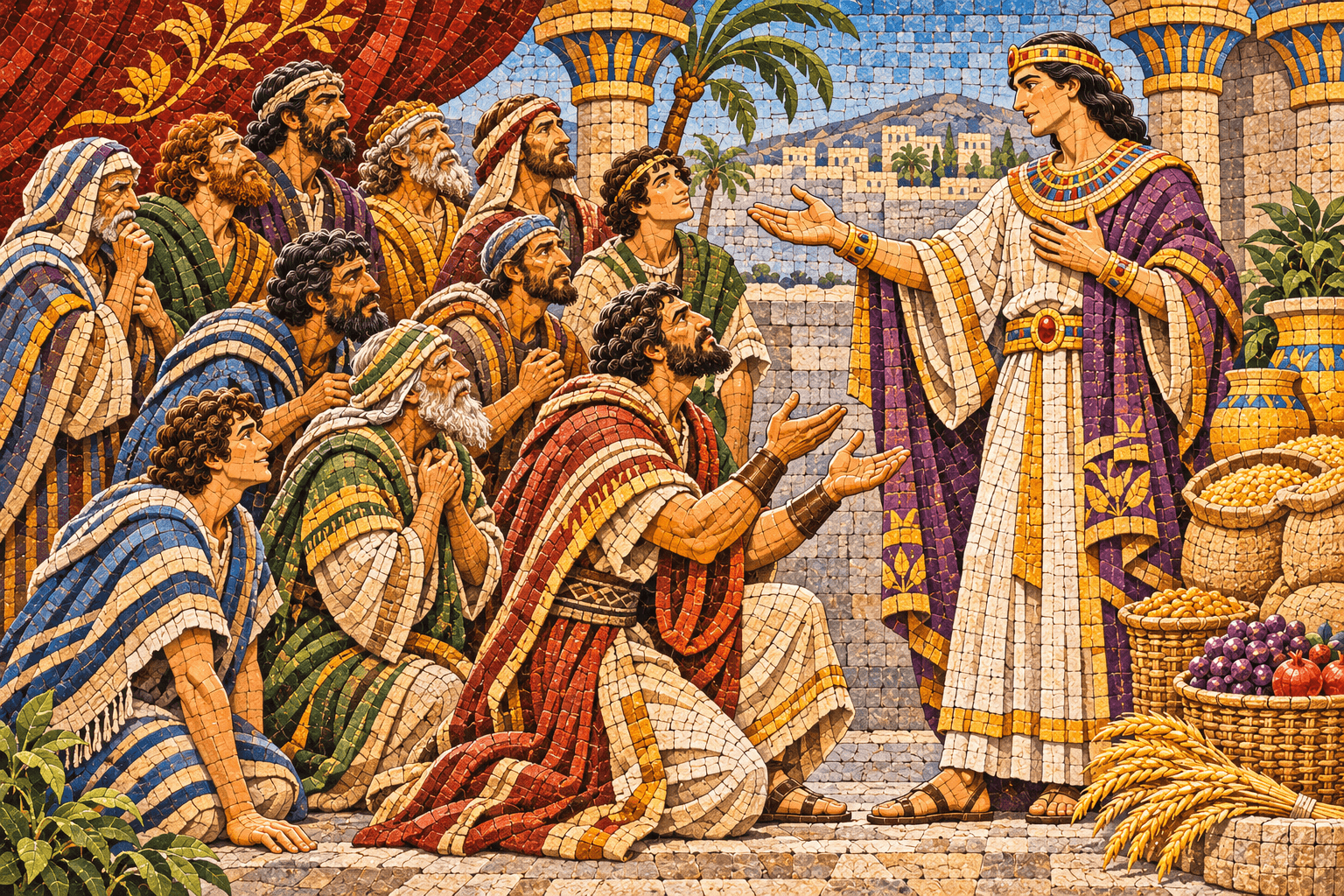
Joseph reassures his brothers and promises to provide for them

Jacob’s sons thought that Joseph would take revenge for himself after their father’s death and repay them the evil they had done to him, so they came to him asking, in their father’s name and according to his charge, that he forgive their sin. But he could not bear their pleading; with exceeding gentleness tears poured from his eyes. Here Joseph grew in dignity in his brothers’ eyes, and they bowed before him, saying: “Behold, we be thy servants” (18).

Joseph succeeded and was made great not by holding the second position in Egypt after Pharaoh, but by the largeness of his heart in love. He enjoyed not the righteousness of the Law through keeping its commandments, but fulfilled the evangelical commandment during the age of the Law. He did not return evil for evil, nor did he stop even at forgiving those who had wronged him; but he could not bear their humiliation, so he wept. He did not see their evil but the hand of God, which turned the evil into good for all, declaring his concern for them, his love for them, and his provision for them and their children. He fulfilled the commandments of the Gospel which the children of the New Covenant sometimes find heavy.

Joseph’s words to his brothers — “But as for you, ye thought evil against me; but God meant it unto good, to bring to pass, as it is this day, to save much people alive” (20) — became a living method in which spiritual people find a revelation of God’s mysteries and His dealings with them.

Perhaps the return of Joseph’s brothers to their brother in repentance points to the return of the Jews at the end of times to the faith by accepting the Lord Christ whom they rejected, after the completion of the Church of the Gentiles. They will ask forgiveness for what they committed, giving up their self-importance and their Zionist thinking, no longer living as a fanatical state but as believers who accept the One whom they previously persecuted.

4. Joseph’s Charge concerning His Bones

KJV · Verses 22–26

22 And Joseph dwelt in Egypt, he, and his father's house: and Joseph lived an hundred and ten years. 23 And Joseph saw Ephraim's children of the third generation: the children also of Machir the son of Manasseh were brought up upon Joseph's knees. 24 And Joseph said unto his brethren, I die: and God will surely visit you, and bring you out of this land unto the land which he sware to Abraham, to Isaac, and to Jacob. 25 And Joseph took an oath of the children of Israel, saying, God will surely visit you, and ye shall carry up my bones from hence. 26 So Joseph died, being an hundred and ten years old: and they embalmed him, and he was put in a coffin in Egypt.

If Joseph in his love for his brothers comforted them and set their minds at ease, saying, “fear ye not: I will nourish you, and your little ones” (21), he revealed to them in his farewell charge that God alone provides for them and cares for them, while he dies, for he says: “I die: and God will surely visit you, and bring you out of this land unto the land which he sware to Abraham, to Isaac, and to Jacob” (24) — which was fulfilled at the hands of Moses and Joshua.

He lived by the faith of his fathers, certain that his people must set out to the land of Canaan; therefore he made them swear, saying: “God will surely visit you, and ye shall carry up my bones from hence” (25), a sign of his desire to share with his people in the exodus from the land of bondage, even if through his bones.

Finally, the Book of Genesis ends with the death of Joseph, his embalming, and his being put in a coffin in Egypt… As we said before, this book began with creation, that is, the coming forth of life from nothing by God’s work, and ended with man’s entering the grave clothes in the land of Egypt, the land of embalming and huge pyramids, of arts and civilization — things that could not save him from death because of his inner corruption.

If God allowed the beginning of the formation of His chosen people as a leaven — amid the pagan peoples at that time — in the land of Egypt, this Hebrew people which represents the Church of the Old Covenant, and in it lived the first great patriarchs Abraham, Isaac, and Jacob, it is a spiritual sign that the land of Egypt and its patriarchs would be the seat and leadership of the Church of the New Covenant, which has kept the faith through the ages, offered thousands of martyrs, and to this day still shepherds the orthodox faith without deviating from it. Thanks be to our God and our Christ, to whom be all glory forever. Amen.

Notes and References

[464] Cyprian, De Lapsis 13.

[465] Chrysostom, PG 61, col. 48.

[466] Cyril of Jerusalem, PG 33, col. 333A.

[467] Gregory of Nyssa, PG 46, col. 429C.

Genesis 50
The Burial of Jacob

Jacob died a stranger in the land of Egypt after instructing his children to bury him in Canaan, in the tomb of his fathers. As though he knew that the seed of God’s people had been planted in Egypt to grow and flourish, he asked this people to keep its heart fixed on Canaan, the promised land, so that it might enjoy God’s promises.

1. The Embalming of Jacob

KJV · Verses 1–6

1 And Joseph fell upon his father’s face, and wept upon him, and kissed him. 2 And Joseph commanded his servants the physicians to embalm his father: and the physicians embalmed Israel. 3 And forty days were fulfilled for him; for so are fulfilled the days of those which are embalmed: and the Egyptians mourned for him threescore and ten days. 4 And when the days of his mourning were past, Joseph spake unto the house of Pharaoh, saying, If now I have found grace in your eyes, speak, I pray you, in the ears of Pharaoh, saying, 5 My father made me swear, saying, Lo, I die: in my grave which I have digged for me in the land of Canaan, there shalt thou bury me. Now therefore let me go up, I pray thee, and bury my father, and I will come again. 6 And Pharaoh said, Go up, and bury thy father, according as he made thee swear.

Joseph mourns Jacob
Joseph mourns Jacob

Like his fathers, Jacob lived as a stranger in tents, without settling in one place. His earthly life ended while he was a stranger in Egypt. In his final charge he insisted on being buried in Canaan, in the cave of Machpelah, where Abraham, Sarah, Isaac, and Rebekah had been buried. One might ask why this man of faith, the father of all the tribes, cared enough about this matter to make it his final charge to all his children. Did he care about his body after death?

First, the Fathers affirm that the men of the Old Testament took care to specify where their bodies should be buried. This was a tangible tradition through which their children could grasp the resurrection of the body. These patriarchs lived as strangers and denied their bodies luxury and indulgence, yet they looked forward to bearing a glorified body on the great day of the Lord.

Second, by being buried in Canaan, Jacob wanted to impress something on his children. Though he spent his last days in Egypt, where Joseph saved the family from famine, his heart was in Canaan, the land God had promised Abraham that his descendants would possess. It was as though Jacob asked his children to live and work in Egypt faithfully and diligently while keeping their hearts attached to God’s promises to them.

Third, he asked to be buried with his fathers to show that his whole life had been in harmony with the faith they had handed down through the generations, especially his faith in the resurrection from the dead.

When Jacob died, Joseph was deeply moved. He fell “upon his father’s face, and wept upon him, and kissed him” (Genesis 50:1). It was as though God’s promise to Jacob was fulfilled: “Fear not to go down into Egypt; for I will there make of thee a great nation: I will go down with thee into Egypt; and I will also surely bring thee up again: and Joseph shall put his hand upon thine eyes” (Genesis 46:3–4). That is, Joseph would lay his hand on Jacob’s eyes at his death to close them, as is still customary today.

Joseph ordered his servants, the physicians, to embalm his father so that he could carry him to Canaan. He asked Pharaoh’s household to seek Pharaoh’s permission to take his father’s body to Canaan in accordance with his final instructions. Joseph could not appear before Pharaoh in mourning clothes or with the beard he had let grow in mourning for the dead.

2. The Burial of Jacob in Canaan

KJV · Verses 7–13

7 And Joseph went up to bury his father: and with him went up all the servants of Pharaoh, the elders of his house, and all the elders of the land of Egypt, 8 And all the house of Joseph, and his brethren, and his father’s house: only their little ones, and their flocks, and their herds, they left in the land of Goshen. 9 And there went up with him both chariots and horsemen: and it was a very great company. 10 And they came to the threshingfloor of Atad, which is beyond Jordan, and there they mourned with a great and very sore lamentation: and he made a mourning for his father seven days. 11 And when the inhabitants of the land, the Canaanites, saw the mourning in the floor of Atad, they said, This is a grievous mourning to the Egyptians: wherefore the name of it was called Abel-mizraim, which is beyond Jordan. 12 And his sons did unto him according as he commanded them: 13 For his sons carried him into the land of Canaan, and buried him in the cave of the field of Machpelah, which Abraham bought with the field for a possession of a buryingplace of Ephron the Hittite, before Mamre.

The burial procession travels to Canaan

The great procession set out from Goshen for the land of Canaan to bury Israel. As Joseph said, “let me go up … and bury my father” (Genesis 50:5). In the eyes of Joseph and of Pharaoh himself (Genesis 50:6), the procession went up. Its ascent symbolized the Church rising toward Jerusalem above, the true Canaan, to be with her Bridegroom forever.

The burial rites, or the journey of the procession, took place in three stages.

First, the procession set out from Egypt. Scripture describes it as “a very great company” (Genesis 50:9). Joseph went at its head, pointing to the true leader of our spiritual procession, who conquers darkness. As the apostle says, “Now thanks be unto God, which always causeth us to triumph in Christ, and maketh manifest the savour of his knowledge by us in every place” (2 Corinthians 2:14). The company included all Pharaoh’s servants, the elders of his house and of all Egypt, Joseph’s household, his brothers, and his father’s household. Chariots and horsemen went up with him. This is the procession of the universal Church, which gathers all people of faith from the Gentiles and the Jews, servants and great elders alike. It set out with chariots and horsemen like a great army, engaged in a continual struggle against the spiritual forces of evil in heavenly places (Ephesians 6:12). The struggle is spiritual, against sin and evil spirits, and is not against flesh and blood. Many of the Fathers have spoken about this warfare and how, through the waters of baptism, we become spiritual soldiers and set out toward heaven, overcoming and triumphing by the Holy Spirit.

Saint Cyprian says:

“I wanted to fight courageously, mindful of my sacrament (sacramentum), bearing the weapons of consecration and faith.” [464]

Saint John Chrysostom says:

“Just as a seal is impressed upon soldiers, so the Holy Spirit is impressed upon the believer.” [465]

Saint Cyril of Jerusalem says:

“Now your name is inscribed and you are called to enter the spiritual camp.” [466]

In the Egypt of this spiritual reading, the believer sets out like a great army to fight countless sins and lives amid tears and weeping, as the Egyptians did when they mourned for seventy days (Genesis 50:3). Leaving behind the love of the world calls for unceasing spiritual struggle until our inmost being is freed from earthly attachments through Christ Jesus, the leader of the procession.

Second, the procession reached the threshingfloor of Atad beyond the Jordan. It represented the Church longing to leave behind the love of the world and to enjoy heavenly life by passing through holy baptism. Here the procession stopped for seven days of bitter mourning. When the Canaanites saw the mourning at Atad, they said, “This is a grievous mourning to the Egyptians,” and the place was called Abelmizraim, beyond the Jordan (Genesis 50:10–11). Baptism is joined to the seven days of mourning, just as our new birth in the holy font is joined to continual repentance throughout the days of our pilgrimage. As Saint Gregory of Nyssa says:

“One who receives the washing of regeneration is like a young soldier who has been given a place among the combatants but has yet to prove worthy of his calling as a soldier.” [467]

Third, when they reached the land of Canaan, we hear of no tears or weeping. It is as though entering heavenly Canaan strips the Church of her sufferings. As it is said in Revelation, “And God shall wipe away all tears from their eyes; and there shall be no more death, neither sorrow, nor crying, neither shall there be any more pain: for the former things are passed away” (Revelation 21:4).

Jacob entered the very cave where his forefather Abraham had been buried. It was as though the pilgrim Church had come to rest and found her home in Abraham’s bosom.

3. Joseph Reassures His Brothers

KJV · Verses 14–21

14 And Joseph returned into Egypt, he, and his brethren, and all that went up with him to bury his father, after he had buried his father. 15 And when Joseph’s brethren saw that their father was dead, they said, Joseph will peradventure hate us, and will certainly requite us all the evil which we did unto him. 16 And they sent a messenger unto Joseph, saying, Thy father did command before he died, saying, 17 So shall ye say unto Joseph, Forgive, I pray thee now, the trespass of thy brethren, and their sin; for they did unto thee evil: and now, we pray thee, forgive the trespass of the servants of the God of thy father. And Joseph wept when they spake unto him. 18 And his brethren also went and fell down before his face; and they said, Behold, we be thy servants. 19 And Joseph said unto them, Fear not: for am I in the place of God? 20 But as for you, ye thought evil against me; but God meant it unto good, to bring to pass, as it is this day, to save much people alive. 21 Now therefore fear ye not: I will nourish you, and your little ones. And he comforted them, and spake kindly unto them.

Joseph reassures his brothers and promises to provide for them

Jacob’s sons supposed that after their father’s death Joseph would avenge himself and repay them for the evil they had done to him. They came to him in his father’s name and, citing his final instructions, begged him to forgive their offense. Joseph could scarcely bear their gentle pleading, and tears streamed from his eyes. Joseph grew still greater in his brothers’ eyes. They bowed before him and said, “Behold, we be thy servants” (Genesis 50:18).

Joseph’s greatness came from the breadth of his love, beyond anything that came with holding the second position in Egypt after Pharaoh. Even in the age of the Law, he went beyond the righteousness of keeping its commandments and fulfilled the commandment of the Gospel. He did not repay evil with evil, and he went further than forgiving those who had wronged him. He could not bear to see them humbled and wept. He looked past their evil and saw the hand of God, who had turned it into good for everyone. He showed them his care and love by promising to provide for them and their children. He fulfilled commandments of the Gospel that children of the New Covenant themselves sometimes find difficult.

Joseph’s words to his brothers became a way of life in which those who live by the Spirit discover the mysteries of God and how He deals with them: “But as for you, ye thought evil against me; but God meant it unto good, to bring to pass, as it is this day, to save much people alive” (Genesis 50:20).

Perhaps the return of Joseph’s brothers to him in repentance points to the Jewish people coming to faith at the end of the ages, after the fullness of the Church of the Gentiles, by receiving the Lord Christ whom they had rejected. In this reading, they ask forgiveness for what they did, give up their self-regard and Zionist outlook, and live as believers who receive the one they had previously persecuted, leaving behind the life of a partisan nation.

4. Joseph Gives Instructions About His Bones

KJV · Verses 22–26

22 And Joseph dwelt in Egypt, he, and his father’s house: and Joseph lived an hundred and ten years. 23 And Joseph saw Ephraim’s children of the third generation: the children also of Machir the son of Manasseh were brought up upon Joseph’s knees. 24 And Joseph said unto his brethren, I die: and God will surely visit you, and bring you out of this land unto the land which he sware to Abraham, to Isaac, and to Jacob. 25 And Joseph took an oath of the children of Israel, saying, God will surely visit you, and ye shall carry up my bones from hence. 26 So Joseph died, being an hundred and ten years old: and they embalmed him, and he was put in a coffin in Egypt.

In his love for his brothers, Joseph had comforted and reassured them with the words, “fear ye not: I will nourish you, and your little ones” (Genesis 50:21). In his final charge he revealed to them that God alone would sustain them and care for them, while he himself would die. He said, “I die: and God will surely visit you, and bring you out of this land unto the land which he sware to Abraham, to Isaac, and to Jacob” (Genesis 50:24). This was fulfilled through Moses and Joshua.

Joseph lived by the faith of his fathers, certain that his people would set out for the land of Canaan. He therefore made them swear, saying, “God will surely visit you, and ye shall carry up my bones from hence” (Genesis 50:25). This showed his desire to share in his people’s departure from the land of bondage, even if only through his bones.

The Book of Genesis ends with Joseph’s death, his embalming, and his being placed in a coffin in Egypt. As we have already said, the book began with creation, with life brought forth from nothing by God’s work. It ends with a human being wrapped in burial cloths in Egypt. Embalming, great pyramids, the arts, and civilization could not save him from death because of the corruption within him.

God allowed His chosen people to begin taking shape like leaven among the pagan nations of that time, in the land of Egypt. This Hebrew people represents the Church of the Old Covenant, and among them lived the first great patriarchs, Abraham, Isaac, and Jacob. The author sees in this a spiritual sign that Egypt and its patriarchs would become a seat and leadership for the Church of the New Covenant, which has preserved the faith through the ages, offered thousands of martyrs, and continues today to nurture the orthodox faith without departing from it. Thanks be to our God and our Christ.

“Upon this rock I will build my church; and the gates of hell shall not prevail against it” (Matthew 16:18).

To Him be all glory forever. Amen.

Notes and References

[464] Saint Cyprian, On the Lapsed (De Lapsis), 13.

[465] Saint John Chrysostom, Patrologia Graeca 61, col. 48.

[466] Saint Cyril of Jerusalem, Patrologia Graeca 33, col. 333 A.

[467] Saint Gregory of Nyssa, Patrologia Graeca 46, col. 429 C.