
The Need for a Savior (Exodus 1:1–12:36)
This chapter speaks to us of the story of bondage.
The Story of Bondage
This book relates the story of bondage in great detail: first, because it represents the story of our bondage to sin, for which the Lord Christ came to set us free; second, because these details represent living aspects touching our life and our relationship with God; and the third reason is that we often forget, or pretend to forget, this deadly bondage. Therefore, when the Lord Christ declared His message, saying, “And ye shall know the truth, and the truth shall make you free” (John 8:32), the Jews answered Him: “We be Abraham’s seed, and were never in bondage to any man: how sayest thou, Ye shall be made free?” Saint Augustine comments on this answer, saying:
Even if we look at the freedom that is in the world (and not liberation from sin), where is the truth in their saying, “We be Abraham’s seed, and were never in bondage to any man”? Was not Joseph sold (Genesis 37:28)? Were not the holy prophets taken into captivity (2 Kings 24; Ezekiel 1:1)? And again, were they not that nation which was subject to harsh rulers, making bricks in Egypt, serving not only in gold and silver but in clay? If you were never in bondage to any man, why does God continually remind you that He is the one who delivered you from the house of bondage?! [20]
What is strange is that they uttered this at the very time they were enslaved to Roman rule. Such is human nature: it surrenders to bondage, submits to it meekly, and thinks it is free… Therefore the bondage of this people and their liberation were recorded, so that we may always remember our need for the Lord Christ as the Liberator of our souls from the captivity of sin.
1. The Rise of the Children of Israel in Egypt
KJV · Verses 1–7
1 Now these are the names of the children of Israel, which came into Egypt; every man and his household came with Jacob. 2 Reuben, Simeon, Levi, and Judah, 3 Issachar, Zebulun, and Benjamin, 4 Dan, and Naphtali, Gad, and Asher. 5 And all the souls that came out of the loins of Jacob were seventy souls: for Joseph was in Egypt already. 6 And Joseph died, and all his brethren, and all that generation. 7 And the children of Israel were fruitful, and increased abundantly, and multiplied, and waxed exceeding mighty; and the land was filled with them.
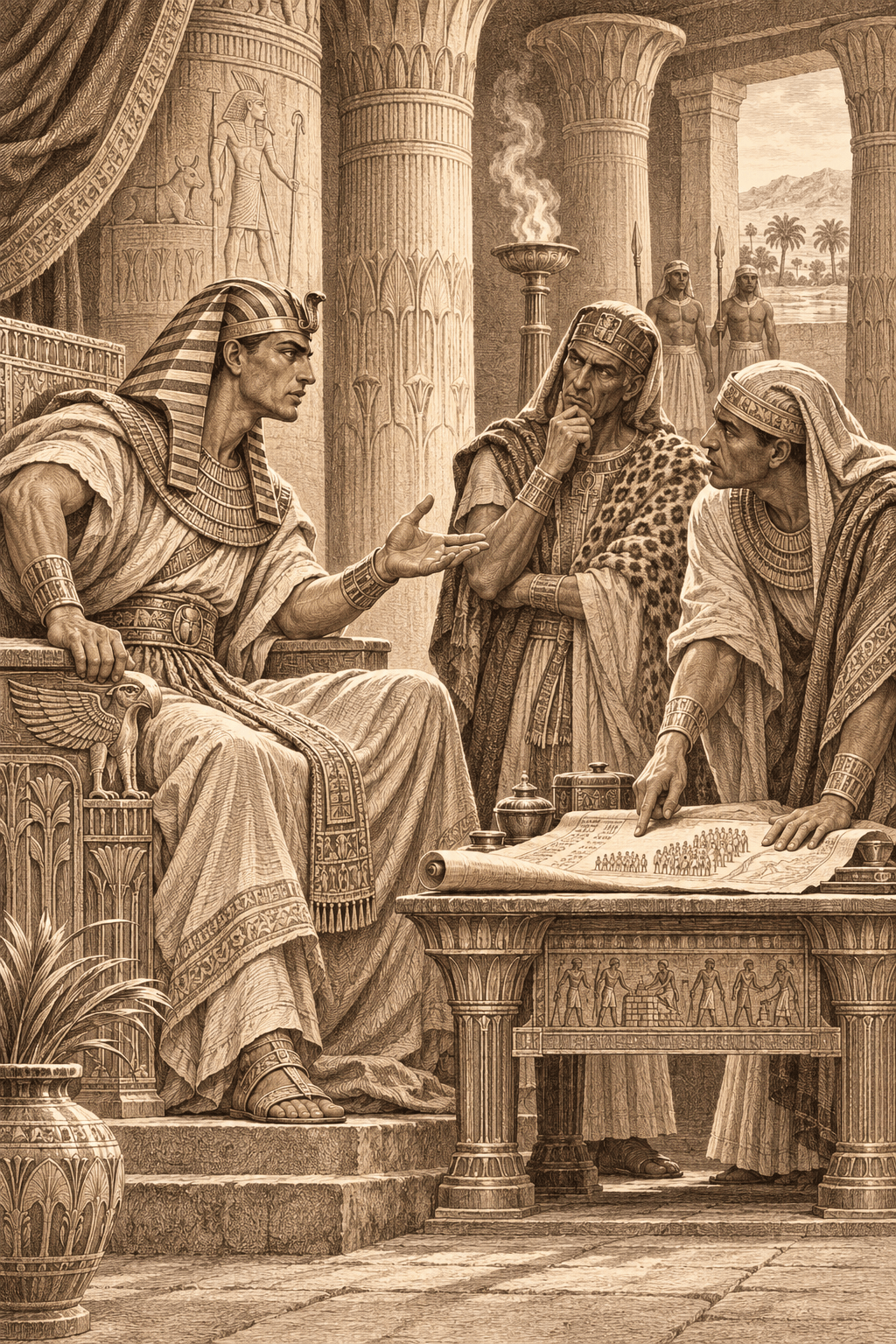
Though Jacob, his sons, and his grandsons entered Egypt as one family, the Jewish nation arose in Egypt and had its first leadership there (Moses the prophet). It flourished after Joseph’s death (7), and fell under Pharaoh’s oppression and the bondage of the Egyptians; but God prepared Moses and called him to struggle against Pharaoh, to bring the people out through the sacrifice of the Passover.
Jacob went down to Egypt, and with him the twelve fathers from his loins, to sojourn, as Isaiah the prophet says: “For thus saith the Lord GOD, My people went down aforetime into Egypt to sojourn there; and the Assyrian oppressed them without cause” (Isaiah 52:4). They sojourned and fell under humiliation and bondage; but we find their names recorded in the Book of Revelation on the gates of the heavenly Jerusalem (Revelation 21:12), and the number of the sealed from every tribe was counted as children of God enjoying the heavenly glories. So let the Assyrian oppress without cause; God keeps His children, counts them, and engraves their names in the book of life.
Origen the scholar comments on the words of Scripture, “And all the souls that came out of the loins of Jacob were seventy souls” (5), saying [21] that a man does not beget a soul, nor does a soul come out of his loins. At the beginning of creation, what does Adam say of Eve? “This is now bone of my bones, and flesh of my flesh” (Genesis 2:23); but he does not say, “This is soul of my soul.” Likewise Laban to Jacob: “Surely thou art my bone and my flesh” (Genesis 29:14); he did not dare speak of kinship of soul, but of bodily kinship according to flesh and bone. But here it says, “all the souls that came out of the loins of Jacob,” as though wishing to declare a new kind of kinship above the level of the body — wishing to bring us a spiritual kinship with which we should be concerned.
The soul does not beget unless it reaches the level of him who says: “For though ye have ten thousand instructors in Christ, yet have ye not many fathers: for in Christ Jesus I have begotten you through the gospel” (1 Corinthians 4:15). These are the ones who beget souls to live in the world by the spirit of the Gospel, bearing the marks of the Lord Christ in them; for he says in another place: “My little children, of whom I travail in birth again until Christ be formed in you” (Galatians 4:19).
This is the mark of the new Israel, that is, the Church: she is a fruitful mother, bearing holy souls that carry the marks of the Lord Christ.
The secret of growth lies in the following phrase: “And Joseph died, and all his brethren, and all that generation. And the children of Israel were fruitful, and increased abundantly, and multiplied, and waxed exceeding mighty; and the land was filled with them” (6–7).
This text links Joseph’s death with the fruitfulness of the children of Israel, their great multiplication, and the filling of the land with them. If Joseph bore a symbol of the Lord Christ in many respects, there is no growth for the Church — the new Israel — except through the death of the Lord Christ on the cross. The children of Israel also symbolize the virtues that dwell in the heart; there is no growth in the virtuous life nor filling of the heart with virtues except by the declaration of the power of Christ’s death and crucifixion within it.
Origen the scholar comments on this text, saying:
Before the death of Joseph, whom Judah, one of his brothers, sold for thirty pieces of silver, the number of the children of Israel was very small; but when He tasted death for all, “that through death he might destroy him that had the power of death, that is, the devil” (Hebrews 2:14), the believing people multiplied… For the Church could not have borne fruit and brought forth this harvest in all the earth had not the grain of wheat fallen into the ground and died (John 12:24). It fell into the ground and died, and through it came all this harvest of believers, for the voice of the apostles went out filling the whole earth and reached all the world (Psalm 19:4)… And as it is written, “And the word of God increased; and the number of the disciples multiplied… greatly” (Acts 6:7)…
This is the spiritual interpretation, but let us not fail to mention the moral side, for it builds up the souls of the hearers: If Joseph dies in you — I mean, if you bear about in your body “the dying of the Lord Jesus” (2 Corinthians 4:10) — if your members die to sin, the children of Israel multiply within you, that is, the lofty spiritual bonds. By the mortification of bodily lusts the bonds of the spirit grow. By daily dying to your sins your virtues increase, and the land is filled with good works, that is, they grow within the body.
Do you want me to prove this to you from Holy Scripture — in whom did the land bear fruit? Look at the words of the Apostle Paul: “But if I live in the flesh, this is the fruit of my labour: yet what I shall choose I wot not. For I am in a strait betwixt two, having a desire to depart, and to be with Christ; which is far better: nevertheless to abide in the flesh is more needful for you” (Philippians 1:22–24). Do you know how the land bore fruit in him? As long as he was on earth — that is, in the body — he bore the fruits of founding churches and winning a people for God by preaching the Gospel. [23]
2. Their Subjection to Bondage
KJV · Verses 8–14
8 Now there arose up a new king over Egypt, which knew not Joseph. 9 And he said unto his people, Behold, the people of the children of Israel are more and mightier than we: 10 Come on, let us deal wisely with them; lest they multiply, and it come to pass, that, when there falleth out any war, they join also unto our enemies, and fight against us, and so get them up out of the land. 11 Therefore they did set over them taskmasters to afflict them with their burdens. And they built for Pharaoh treasure cities, Pithom and Raamses. 12 But the more they afflicted them, the more they multiplied and grew. And they were grieved because of the children of Israel. 13 And the Egyptians made the children of Israel to serve with rigour: 14 And they made their lives bitter with hard bondage, in morter, and in brick, and in all manner of service in the field: all their service, wherein they made them serve, was with rigour.
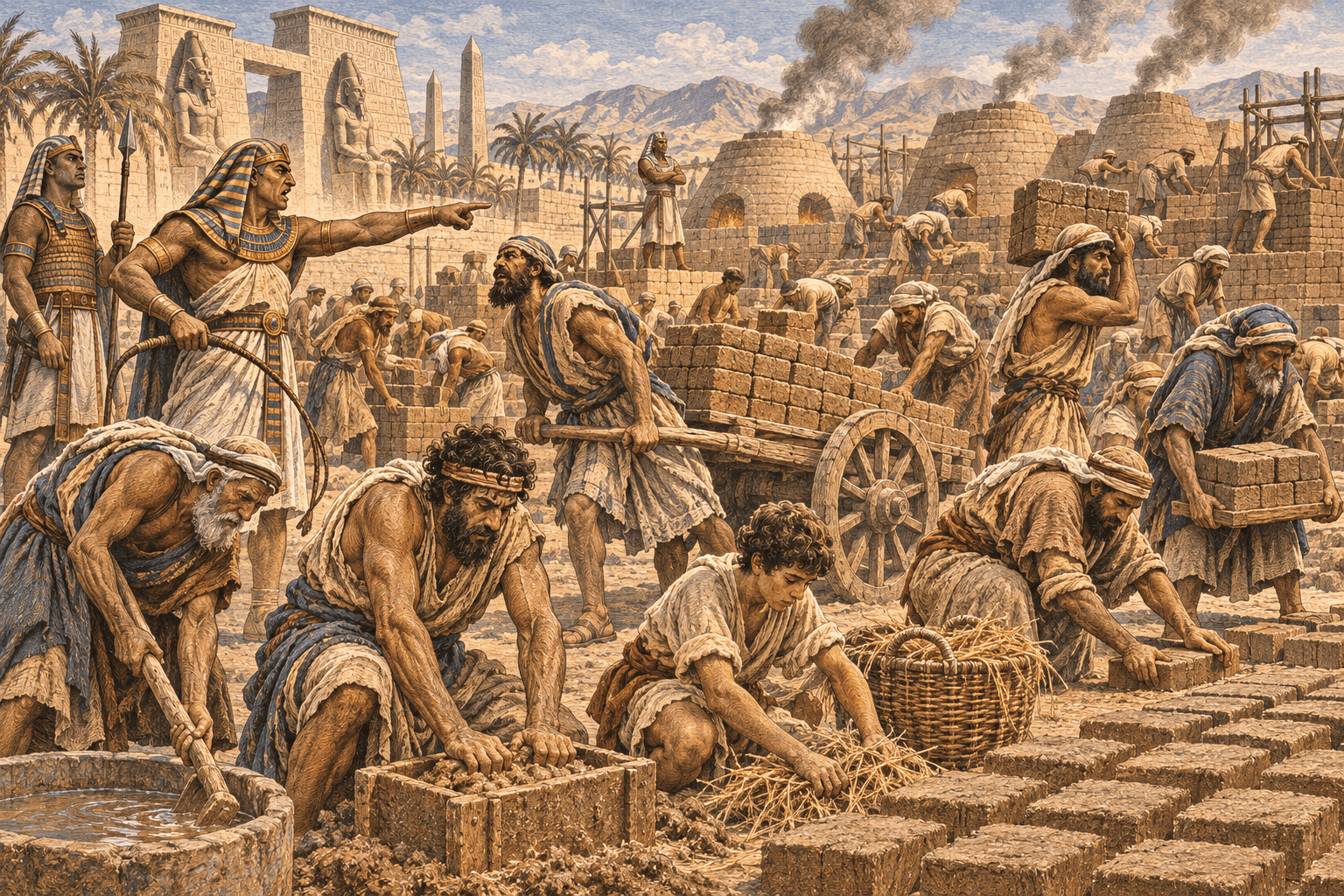
The natural result of the increasing growth through the crucifixion and death of Christ is the agitation and fury of the enemy of good, for Scripture says: “Now there arose up a new king over Egypt, which knew not Joseph. And he said unto his people, Behold, the people of the children of Israel are more and mightier than we: come on, let us deal wisely with them; lest they multiply, and it come to pass, that, when there falleth out any war, they join also unto our enemies, and fight against us, and so get them up out of the land. Therefore they did set over them taskmasters to afflict them with their burdens” (8–11).
Who is this new king but the devil, who is terrified whenever he sees the Lord reigning over the hearts of His children? He spends all his energies to dedicate his soldiers and his evil capacities to enslaving people and humiliating them with work in clay, that is, entangling them in earthly works.
Origen the scholar sees the devil in a state of terror at our following the Crucified, who spoiled him of all principality and power and made a show of him openly (Colossians 2:15). He says:
This thought makes him terrified, so he says: “lest they… fight against us, and so get them up out of the land” (10). For he does not want us to go up from the earth, but wants us to remain in the image of the earthy (1 Corinthians 15:49). If, then, we have passed over to his enemy, who brings us into the kingdom of heaven, we must leave the image of the earthy man and take the image of the heavenly. [24]
If Satan sets up taskmasters to humiliate us, for work in clay, our Lord Jesus has set up for us leaders of another kind to teach us, so that we leave the clay — that is, put off the works of the old man and live according to the new man, in the image of our true King.
The building of the cities Pithom and Raamses: “And they built for Pharaoh treasure cities, Pithom and Raamses” (11). Origen the scholar sees that “Raamses” means “the land of corruption,” as though the enemy of good wishes to humiliate us with work in clay for the sake of “corruption” and evil. Here the following question arises before us: Why does God allow His children to be in distress?!
A) For longing for the better life. Had the people remained at ease, they would not have set out for Canaan. So God allows us tribulations and troubles to prepare us for the better life and the enjoyment of the heavenly Canaan. Saint John Chrysostom says:
God is good and loving, not only when He gives gifts, but also when He disciplines us. For even His chastisements and punishments are part of His goodness, and a great manifestation of His help to us. [25]
B) That they might cleave to the Lord; for distress makes us feel our need for God’s work in us and with us.
C) Though God seemed to have left His people to humiliation, Scripture affirms: “But the more they afflicted them, the more they multiplied and grew” (12). Though the hand of bondage was hard, God did not leave them, but worked for their salvation in every way.
3. The Killing of the Males
KJV · Verses 15–22
15 And the king of Egypt spake to the Hebrew midwives, of which the name of the one was Shiphrah, and the name of the other Puah: 16 And he said, When ye do the office of a midwife to the Hebrew women, and see them upon the stools; if it be a son, then ye shall kill him: but if it be a daughter, then she shall live. 17 But the midwives feared God, and did not as the king of Egypt commanded them, but saved the men children alive. 18 And the king of Egypt called for the midwives, and said unto them, Why have ye done this thing, and have saved the men children alive? 19 And the midwives said unto Pharaoh, Because the Hebrew women are not as the Egyptian women; for they are lively, and are delivered ere the midwives come in unto them. 20 Therefore God dealt well with the midwives: and the people multiplied, and waxed very mighty. 21 And it came to pass, because the midwives feared God, that he made them houses. 22 And Pharaoh charged all his people, saying, Every son that is born ye shall cast into the river, and every daughter ye shall save alive.
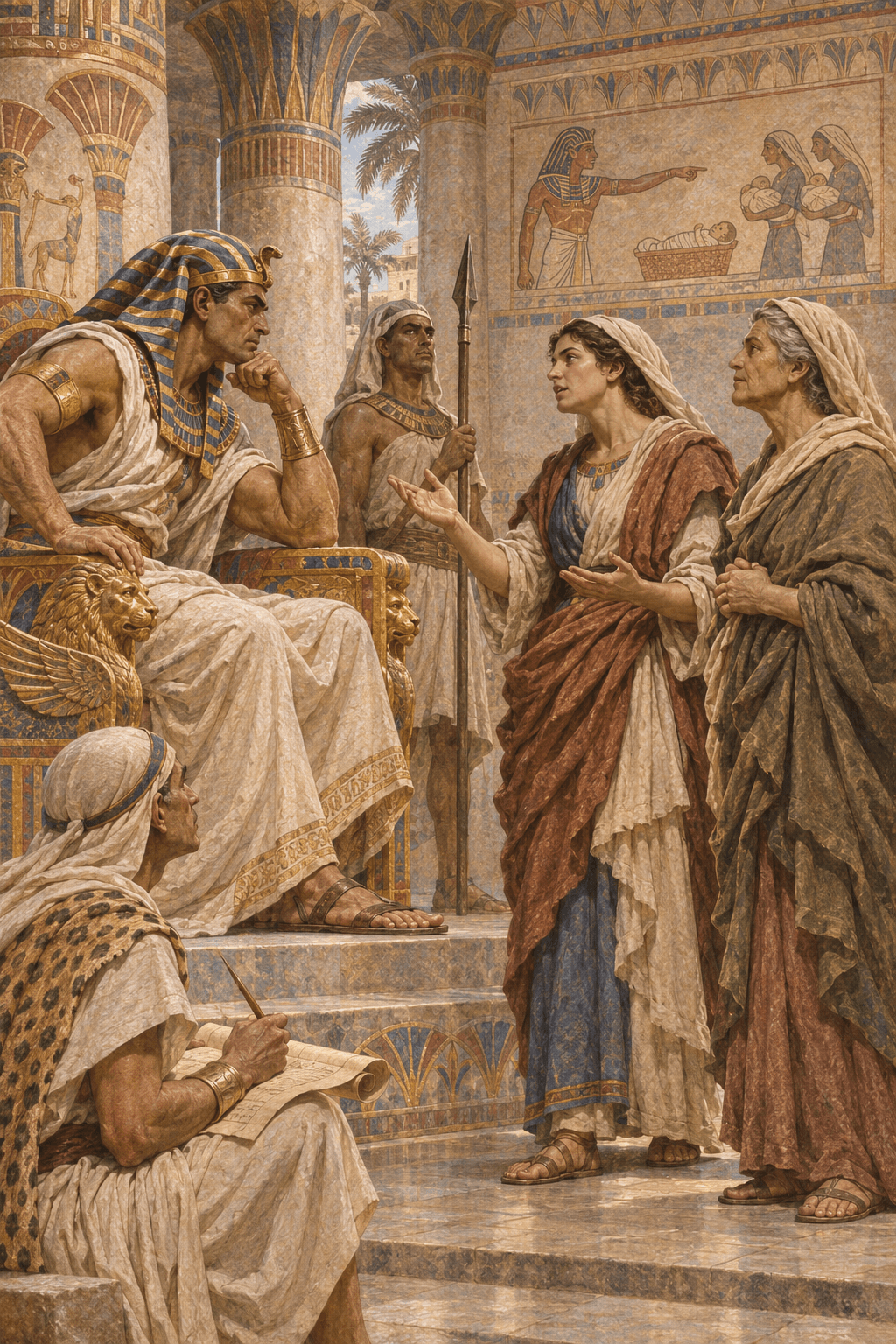
Pharaoh summoned the Hebrew midwives, Shiphrah and Puah, and asked them to kill every male child at birth and keep the daughters alive. This was easy, for the custom followed in Egypt at that time was that birth took place on a special stool, so that the midwife could kill the child before anyone saw him. But the midwives feared God and saved the males and females alive.
The Hebrews: The Jewish people were called Hebrews after Eber, one of Abraham’s ancestors (Genesis 10:21); therefore the word “Hebrew” pointed to the genuine Jew and distinguished him from the Jew who was a proselyte from the Gentiles. [26] Believers are also called Hebrews, because the nature of their life is continual “passing over”: the believer feels he is a stranger, ever setting out from earthly things toward heavenly things.
The Hebrew midwives: Saint Gregory of Nyssa sees that the “midwife” who delivers the Hebrew women points to the free will that brings forth virtue in the life of believers amid the bitter pains of labor. [27] For though the believer works by God, he has no fruit without his will; as though Pharaoh, who is the devil our enemy, cannot bear our “free will,” which God has given us and which works in Christ Jesus for our growth.
Origen the scholar [28] sees in the two midwives “knowledge,” which supports the children of God in bringing forth males as well as females; that is, they have fruit in divine mental contemplation and in the sanctification of the emotions, for the males point to the mind and the females to the emotion.
The two midwives also point to Holy Scripture in its two Testaments, the Old and the New, through which the children of God enjoy increasing fruit mentally and emotionally, or spiritually and bodily.
The names of the two midwives: Shiphrah and Puah are two Hebrew words, perhaps meaning “beauty” and “girl”; but Origen sees the word Shiphrah (“Sepphora”) as meaning “sparrow” or “bird,” and Puah as meaning “chaste” or “modest.” It is as though the two midwives work together in the Church for her fruitfulness: first by lifting up the heart and making it soar to heaven like a flying sparrow, and second by the spirit of modesty and chastity.
If the two midwives point to the two Testaments, the first Testament ought to be received like a sparrow, that is, we understand the Old Testament in a spiritual way and not through the killing letter. The New Testament represents modesty (the blushing of the face), a sign of being sprinkled with the blood of the Lord Christ, through whom we have fruitful knowledge in the world (20).
Killing the males and keeping the females alive: We said that the males point to the mind or the spirit, while the females point to the body or the emotions. [29] Pharaoh wanted knowledge — the mental understanding of Holy Scripture, or spiritual perception — to be killed, so that we would be concerned only with the material side… and our evangelical knowledge would become dry and deadly.
Satan’s war against the children of God is to make them lose balanced mental thinking and to stir up bodily emotion in them. But faithful evangelical knowledge binds the two together — the mental side with the emotional, the sanctification of spirit and body together; that is, we keep both the males and the females alive!
God’s reward to the midwives: Scripture says: “And it came to pass, because the midwives feared God, that he made them houses” (21). Does God make houses?! Since the midwives point to Holy Scripture, when it is studied in divine fear and believers live it as they should, God establishes a place for the Scripture in many places; that is, the field of ministry opens and houses of God are established. So the world needs to see in us the word of God working in our heart with divine fear, so that the Gospel finds a place in every heart.
This text has raised controversy: why does God reward the midwives when they lied to Pharaoh…? Is lying permitted, as Rahab the harlot also did…? Saint Augustine devoted two treatises to “lying,” in which he made clear that lying is not permitted even if it benefits others, for “the mouth that belieth slayeth the soul” (Wisdom 1:11). The Lord Christ Himself commanded us: “But let your communication be, Yea, yea; Nay, nay: for whatsoever is more than these cometh of evil” (Matthew 5:37), and the Apostle Paul warns us: “Wherefore putting away lying, speak every man truth with his neighbour” (Ephesians 4:25). The saint explained the Lord’s reward to the midwives by saying that He dealt with them according to their spiritual degree and their capacity to act. [30] On the other hand, he says that He rewarded them “not because they lied, but because they showed mercy to the people of God. It was not their deceit (of Pharaoh) that was rewarded in them, but their kindness, the tenderness of their mind, and not their error in lying.” [31]
Casting the children into the river: Scripture says: “And Pharaoh charged all his people, saying, Every son that is born ye shall cast into the river, and every daughter ye shall save alive” (22). Origen the scholar comments on this, saying:
Do you see what the prince of this world commands his servants? He commands them to steal our children and cast them into the river, and to set nets continually from their birth. He commands them to attack them from the moment they begin to touch the breasts of the Church, and seeks to tear them from her and pursue them until the waves of the world swallow them…
Consider the danger that threatens you from your birth — or rather from your new birth, that is, immediately from your receiving baptism… For Jesus was led up of the Spirit into the wilderness to be tempted of the devil (Matthew 4:1). This is Pharaoh’s command to his people concerning the Hebrews: to attack them and catch them at the moment of their birth and drown them… But Christ conquered to open for you the way of victory; He conquered while fasting, so that you too may grasp how to cast out this kind by fasting and prayer (Mark 9:29). [32]
Notes and References
[20] Augustine, On the Gospel of St. John, tractate 41:2.
[21] Origen, In Exod. hom. 1:3.
[23] Origen, In Exod. hom. 1:4.
[24] Ibid. 1:5.
[25] Fr. Tadros Yacoub Malaty, St. John Chrysostom: Does Satan Have Authority over You? (Arabic, 1972), p. 27.
[26] It seems the Egyptians applied the word “aperu” to every person who came as a captive to Egypt from the countries of the Middle East. Nelson, A New Catholic Commentary on Holy Scripture, p. 208.
[27] Gregory of Nyssa, The Life of Moses 2:5.
[28] Origen, In Exod. hom. 2:1, 2.
[29] Methodius, Banquet of the Ten Virgins 4:2.
[30] Augustine, On Lying 7.
[31] Augustine, To Consentius, Against Lying 32.
[32] Origen, In Exod. hom. 2:3.