
With the end of Jacob’s life on earth the age of the great patriarchs (Abraham, Isaac, and Jacob) ends, so that Israel sets out not as individuals but as a people and a leaven that was to leaven the whole lump with faith and prepare the world for the coming of the Messiah, the Savior. Therefore this age was sealed by offering a blessing to each tribe, carrying within it a prophecy of the Savior’s coming.
1. Jacob Calls His Sons
KJV · Verses 1–2
1 And Jacob called unto his sons, and said, Gather yourselves together, that I may tell you that which shall befall you in the last days. 2 Gather yourselves together, and hear, ye sons of Jacob; and hearken unto Israel your father.
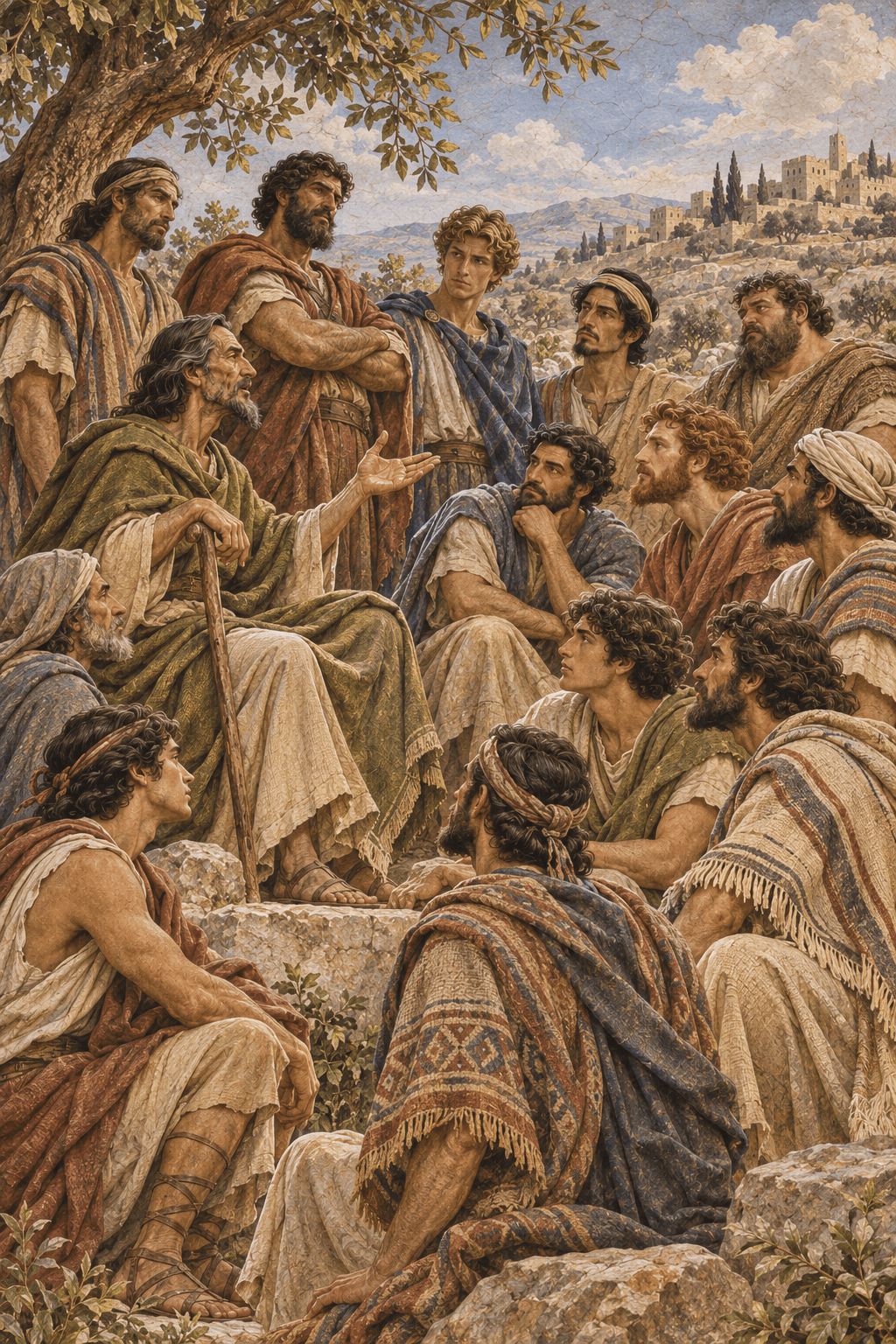
“And Jacob called unto his sons, and said, Gather yourselves together, that I may tell you that which shall befall you in the last days” (1).
After a life full of striving, in which Jacob took the blessing and the birthright and, despite his repeated weaknesses, was worthy to receive the promise of the coming of the Messiah, the Savior, from his seed — in whom all nations are blessed — he spent seventeen years in Egypt in silence and stillness… Now, as he passes from this earth, he looked upon his sons as tribes from whom the people of God would come forth to enjoy the land of promise, and the Messiah, the Savior, would come; so his tongue was loosed to utter what he saw through the spirit of prophecy, or through shadows. He is like Moses, who went up on Mount Nebo looking from afar at the land of promise, and his heart rejoiced for the people who would enjoy the fulfillment of the promise of which he himself was deprived.
He saw in the twelve tribes the Church enjoying the salvation of Christ and growing in the spirit. In Reuben, the firstborn son and his natural fruit from Leah, he saw the person who relies on the birthright of the flesh or the works of the Law, and so loses the birthright of the spirit; therefore he counted him as one who defiled his father’s bed, defiling the Church, the bride of Christ, through his self-righteousness.
In Simeon and Levi — from whom came the scribes and the priests who resisted the Lord Christ, the Word of God — he saw a pointer to the sin of evil conspiracies and councils of iniquity that corrupt the ministry and the work of God.
As for Judah, he saw him representing the crucified “Lamb,” and at the same time the lion victorious by the cross. He saw the Lord Christ coming forth from the tribe of Judah, granting the power of the resurrection to His believers. It is as though it is not enough for us to leave self-righteousness (Reuben) and reject the councils of evil (Simeon and Levi); we must cleave to the true Judah, to enjoy the power of His resurrection working in us. By this he sets out to “Zebulun,” who points to setting out toward the sea, or turning to the Gentiles to preach to them. For whoever bears the risen Judah within him cannot bear to see the Gentiles in their unbelief, but seeks the salvation of every soul.
As for Issachar, he likens him to the ass that bears the burdens of others. If we are accused of foolishness for bearing pain with joy and serving others, let us not flee but come forward to the work without weariness, imitating Him who said: “Come unto me, all ye that labour and are heavy laden, and I will give you rest” (Matthew 11:28).
The more the kingdom of God spreads among the nations, the more the enemy of good resists, until the “Antichrist” appears from the tribe of Dan, like a serpent by the way that bites to destroy.
After that he spoke of Gad as one attacked by a troop who overcomes at the last — a sign of the believer who is fought much but in the end is victorious. Therefore after him came “Asher” with his fat bread, that is, his abundant produce; for spiritual wars, though they reveal our weaknesses, give the soul strength and make it more fruitful.
After Asher he spoke of Naphtali as a hind let loose (the feminine of hart), swift in movement, whose words are sweet with all. As for Joseph, he bears in his loins two tribes, Manasseh and Ephraim; for “Joseph” means “growth,” and this through forgetting the cares of the world and enjoying increasing fruit (Ephraim).
Finally he speaks of “Benjamin,” which means “son of the right hand,” who enjoys fellowship in eternal glory.
In brief, we can say that Jacob, by the spirit of prophecy, saw in his sons a living image of the Church striving in Christ Jesus:
1. Reuben: departing from self-righteousness.
2. Simeon and Levi: departing from conspiracies.
3. Judah: cleaving to Christ.
4. Zebulun: setting out to preach.
5. Issachar: bearing the troubles of others.
6. Dan: resisting the devil.
7. Gad: spiritual striving.
8. Asher: the fruits of striving.
9. Naphtali: gentleness of speech.
10. Joseph: continual growth.
11. Benjamin: enjoying the Lord’s right hand.
2. Reuben
KJV · Verses 3–4
3 Reuben, thou art my firstborn, my might, and the beginning of my strength, the excellency of dignity, and the excellency of power: 4 Unstable as water, thou shalt not excel; because thou wentest up to thy father's bed; then defiledst thou it: he went up to my couch.
Since the blessing was through the shadow of the Law, Jacob began with his bodily firstborn, “Reuben,” who represents the strength of nature, for he was born of Leah. “Reuben” means “son of vision,” but unfortunately he did not keep the purity of his eyes to see heavenly things; he relied on himself and lost his spiritual birthright and his insight, so that “Judah” took the spiritual birthright, enjoying the coming of the Lord Christ, the true Firstborn, whom the Father smells as a savor of good pleasure and sees as the object of His delight.
Jacob blesses his firstborn according to the flesh and at the same time reproaches him: “Reuben, thou art my firstborn, my might, and the beginning of my strength, the excellency of dignity, and the excellency of power: unstable as water, thou shalt not excel; because thou wentest up to thy father’s bed; then defiledst thou it: he went up to my couch” (3–4). Though Jacob prides himself on his firstborn, calling him his might and the beginning of his strength, who obtained the best excellency of dignity and power, he does not forget that he lay with Bilhah, his father’s concubine (Genesis 35:22), and because of this lost his birthright, so that Joseph’s two sons received it (1 Chronicles 5:1), while Judah took the spiritual birthright. Reuben was defeated before his bodily lust and became like water that boils up only to cool again, losing his preeminence.
Reuben represented the Jewish people, who were counted firstborn in the knowledge of God, but by unbelief lost their birthright, and so lost their spiritual strength, dignity, and power, and were counted defiled by their attempt to corrupt the Church of God. In this Saint Hippolytus says:
There was a great role of manifesting God’s power on behalf of His firstborn people at their exodus from Egypt, for because of them Egypt was chastised in many ways. By saying, “my might and my firstborn,” he meant the first people, who are those of the circumcision.
But unfortunately they lost this privilege by refusing to believe in the Savior, and were counted defilers of the Church. And what happened with the Jews happens in the days of apostasy, when many deny the faith; for Father Hippolytus says:
In the last days people will assault the father’s bed, that is, the Church, the bride, with the aim of corrupting it — which happens in these days through blasphemy.
3. Simeon and Levi
KJV · Verses 5–7
5 Simeon and Levi are brethren; instruments of cruelty are in their habitations. 6 O my soul, come not thou into their secret; unto their assembly, mine honour, be not thou united: for in their anger they slew a man, and in their selfwill they digged down a wall. 7 Cursed be their anger, for it was fierce; and their wrath, for it was cruel: I will divide them in Jacob, and scatter them in Israel.
“Simeon and Levi are brethren; instruments of cruelty are in their habitations. O my soul, come not thou into their secret; unto their assembly, mine honour, be not thou united: for in their anger they slew a man, and in their selfwill they digged down a wall (hamstrung an ox). Cursed be their anger, for it was fierce; and their wrath, for it was cruel” (5–7).
What did Jacob see in his two sons, that he rejected their council and their union together? Saint Hippolytus says:
From Simeon came the scribes and from Levi the priests; and by their will the scribes and priests accomplished the evil of killing Christ with one mind.
Truly they are brothers, but in their union they did not honor God; rather they killed the Savior who came as a man, and hamstrung Him who came forward as a sacrifice (as an ox) to redeem them.
This is the spiritual meaning in which we reject every evil conspiracy so that we may live the kingdom of God in the Church. As for the literal side: Simeon and Levi were brothers, that is, alike in their traits. Each took his sword and came to the city of Shechem, where they killed every male in revenge for their sister Dinah, whom Shechem the son of Hamor the Hivite had defiled (Genesis 34); they did not observe justice in their revenge. They pretended calm, agreed together on evil, and caused trouble to their father.
4. Judah
KJV · Verses 8–12
8 Judah, thou art he whom thy brethren shall praise: thy hand shall be in the neck of thine enemies; thy father's children shall bow down before thee. 9 Judah is a lion's whelp: from the prey, my son, thou art gone up: he stooped down, he couched as a lion, and as an old lion; who shall rouse him up? 10 The sceptre shall not depart from Judah, nor a lawgiver from between his feet, until Shiloh come; and unto him shall the gathering of the people be. 11 Binding his foal unto the vine, and his ass's colt unto the choice vine; he washed his garments in wine, and his clothes in the blood of grapes: 12 His eyes shall be red with wine, and his teeth white with milk.
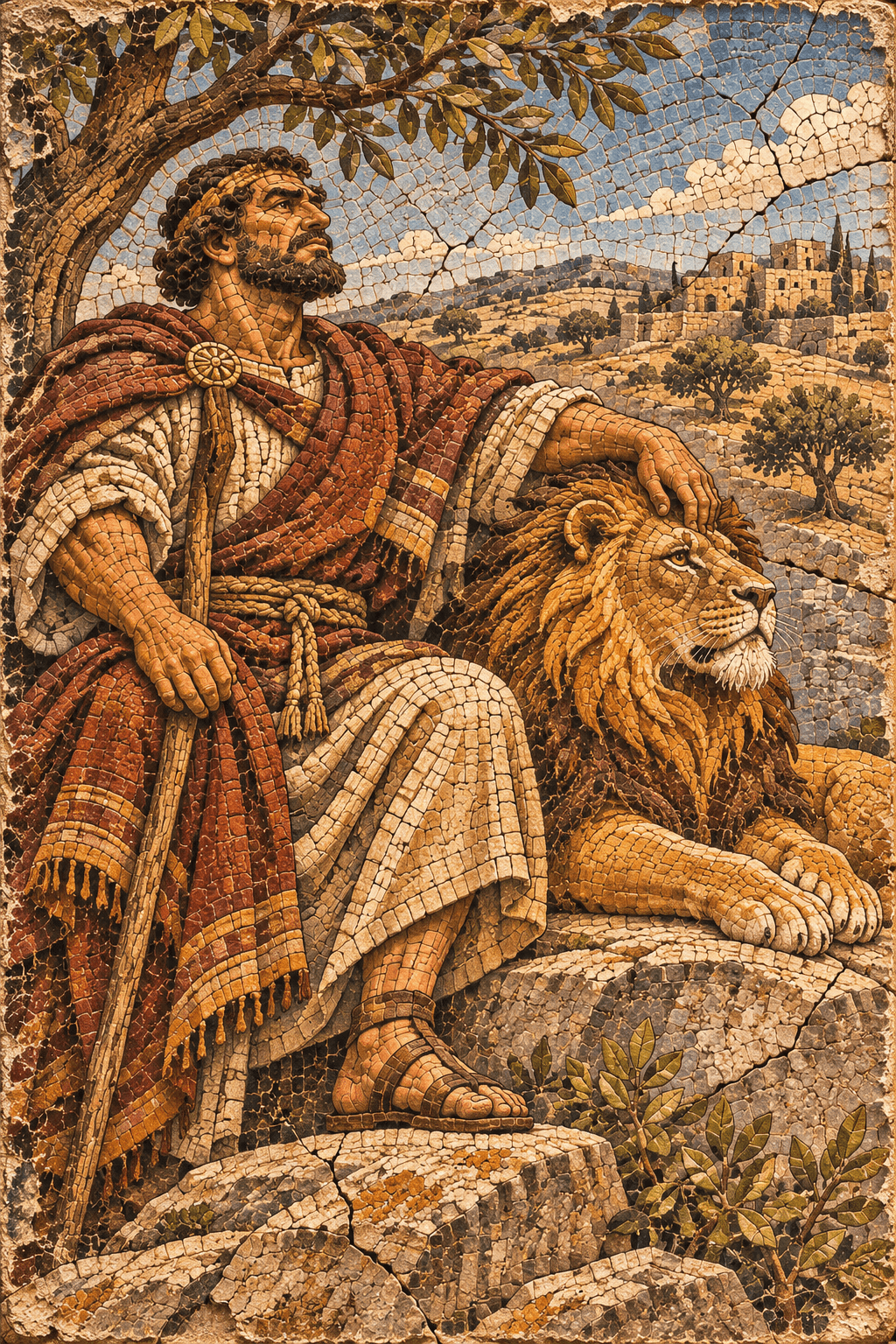
It is true that Judah did not receive the portion of two like his brother Joseph, who took the birthright from Reuben so that Joseph became two tribes, Manasseh and Ephraim, whom Jacob counted as his sons like Reuben and Simeon and reckoned to himself (Genesis 48:5). But Judah received the lion’s share in the blessing, for Jacob saw the Lord Christ, the King and Priest, coming from his seed, saying:
“Judah, thou art he whom thy brethren shall praise: thy hand shall be in the neck of thine enemies; thy father’s children shall bow down before thee” (8).
Who is this Judah whom his brothers praise and extol but the Lord Christ Himself, who came forth from the tribe of Judah, who by the cross put His hand on the neck of the devil, His enemy, and crushed him, freeing mankind from his authority, so that they worship Him in spirit and in truth.
Judah became the royal tribe, beginning with David, king and prophet, and crowned by the appearance of the King of kings, the Lord of glory, from it.
“Judah is a lion’s whelp: from the prey, my son, thou art gone up: he stooped down, he couched as a lion, and as an old lion; who shall rouse him up?” (9).
Since Jacob saw in Judah’s loins the Lord Christ, he called him the lion that came out of the war of the cross victorious over His spiritual enemies. He stooped down and couched on the cross… but even in His sleep on the cross He was a lion whom the enemy could not approach. In this Saint Augustine says:
He foretold the death of Christ by saying, “he couched,” showing that His death was voluntary and not compelled, for he symbolized Him by the lion. He declared this authority Himself in the Gospel when He said: “No man taketh it from me, but I lay it down of myself. I have power to lay it down, and I have power to take it again” (John 10:18). So the lion roared and fulfilled what He said. To this he added His power in the resurrection by saying, “who shall rouse him up?”, meaning that He raises Himself and no man raises Him. He said of His body: “Destroy this temple, and in three days I will raise it up” (John 2:19). He also spoke of the manner of His death, that is, the ascent on the cross, for it is said: “from the prey… thou art gone up”… [452]
Jacob continues his speech with Judah: “The sceptre shall not depart from Judah, nor a lawgiver from between his feet, until Shiloh come; and unto him shall the gathering of the people be” (10). It is a privilege Jacob gives his son, whose descendants bear the royal scepter, and from his sons (between his feet) is the rule that legislates until the Messiah, the Giver of peace (Shiloh), comes and gathers the peoples into His spiritual kingdom. Saint Augustine says:
The Jews were so called “Judah” because of Judah, one of the twelve sons of Jacob… from whose loins came the kingship… From this tribe came the kings, and from it came our Lord Jesus Christ. [453]
“Binding his foal unto the vine, and his ass’s colt unto the choice vine; he washed his garments in wine, and his clothes in the blood of grapes” (11). In our study of the Gospel of Matthew (Matthew 21) we saw that the ass points to the Jewish nation and the colt points to the Gentiles, who lost all reason because of pagan abominations. He declares by the spirit of prophecy that both — the Jews and the Gentiles — are bound together in the vine, or the choice vine, for they have become in Him one holy Church. As Saint Hippolytus comments on this phrase:
He calls those of the circumcision and those of the uncircumcision into one faith. [454]
The garment or clothing of Christ points to the Church cleaving to Him, as we saw in our discussion of the coat of many colors (Genesis 37:3); this garment the Lord washed with His pure blood… As Saint Cyprian says:
When the blood of the grape is mentioned, what else is meant but the wine of the cup of the blood of the Lord?! [455]
Saint Clement of Alexandria says:
The vine produces wine, and the Word offers blood; both bring health — wine to the body and blood to the spirit. [456]
Saint Augustine says:
What is this garment which He washes in wine, that is, washes in His blood from sin… but the Church? [457]
(On the literal level, these words point to the life of luxury and wealth lived by the kings of Judah.)
“His eyes shall be red with wine, and his teeth white with milk” (12). Saint Hippolytus comments on this phrase, saying:
His eyes are bright as with the word of truth, watching over what is believed; and his teeth are white as milk, expressing the power of his illuminating words; so he called them white and compared them with milk, which nourishes body and soul.
Saint Augustine says:
His eyes are red with wine — these are His spiritual people, inebriated with His cup; and His teeth whiter than milk — these are the words which the babes suck, who, as the Apostle says, were not yet fit for strong meat (1 Corinthians 3:2; 1 Peter 2:2). [458]
Saint Hippolytus also sees that the eyes point to the prophets and the milk to the commandments of Christ, saying:
What are the eyes of Christ but the prophets, who prophesied by the Spirit and declared beforehand the sufferings that would befall Him, and rejoiced as they saw Him in power through spiritual insight, refreshed by His word and grace…? And (the milk) points to the commandments that flow from the holy mouth of Christ, pure as milk. [459]
5. Zebulun
KJV · Verses 13
13 Zebulun shall dwell at the haven of the sea; and he shall be for an haven of ships; and his border shall be unto Zidon.
The tribe of Zebulun dwelt west of the river Jordan and west of the Sea of Galilee; they engaged in trade, and probably took possession of places adjoining the Mediterranean Sea… Saint Hippolytus sees that the saying, “Zebulun shall dwell at the haven of the sea” (13), carries a symbol of Israel’s joining with the sea, that is, with the Gentiles; for the sea is known as a symbol of the Gentiles and the river as a symbol of the Jews, [460] so the two are joined together as one flock. The saint says:
He is at the haven of ships, that is, in a safe harbor, pointing thereby to Christ, the anchor of hope. Here is a reference to the calling of the Gentiles, where the grace of Christ reaches the whole earth and the sea. By saying, “he shall be for an haven of ships; and his border shall be unto Zidon,” he gives a prophetic word about the Church of the Gentiles which appeared in the Gospel: “The land of Zabulon, and the land of Nephthalim, by the way of the sea, beyond Jordan, Galilee of the Gentiles; the people which sat in darkness saw great light” (Matthew 4:15–16). So by mentioning Zebulun and fixing his dwelling at the borders of the sea, he shows the joining of Israel with the Gentiles, that the two peoples may become one flock under the hand of the one great Shepherd, good by nature, Christ. Therefore in his blessing Moses says: “Rejoice, Zebulun” (Deuteronomy 33:18).
6. Issachar
KJV · Verses 14–15
14 Issachar is a strong ass couching down between two burdens: 15 And he saw that rest was good, and the land that it was pleasant; and bowed his shoulder to bear, and became a servant unto tribute.
“Issachar is a strong ass couching down between two burdens: and he saw that rest was good, and the land that it was pleasant; and bowed his shoulder to bear, and became a servant unto tribute” (14–15).
Issachar is likened to a strong, large ass, for this tribe engaged in farming and was marked by patience. The land was fertile, so the tribe was content with agriculture and rarely inclined to occupy itself with politics, and it was exposed to paying tribute or taxes…
Saint Hippolytus sees that the saying, “the land… was pleasant (rich),” points to the body of the Lord, rich in its gifts, which He offered us as an inheritance like the land of promise flowing with milk and honey, nourishing babes and the mature.
We said in the introduction to this chapter that Issachar resembles the ass that bears the burdens of others, bowing the shoulders of his love to the weary and enslaving himself to free others.
When Saul of Tarsus tasted that the land was pleasant and grasped the riches of the divine gifts given him through his membership in the body of Christ, he “bowed his shoulder to bear, and became a servant unto tribute.” He said: “For though I be free from all men, yet have I made myself servant unto all, that I might gain the more” (1 Corinthians 9:19). This is the tribute he paid, giving himself, though free, as a slave to free the slaves and gain them as children of God. He bowed his shoulder to the burden, saying: “Who is weak, and I am not weak? who is offended, and I burn not?” (2 Corinthians 11:29).
7. Dan
KJV · Verses 16–18
16 Dan shall judge his people, as one of the tribes of Israel. 17 Dan shall be a serpent by the way, an adder in the path, that biteth the horse heels, so that his rider shall fall backward. 18 I have waited for thy salvation, O Lord.
“Dan shall judge his people, as one of the tribes of Israel. Dan shall be a serpent by the way, an adder in the path, that biteth the horse heels, so that his rider shall fall backward. I have waited for thy salvation, O LORD” (16–18).
Since the prophecy carried bitterness, he began it with reproach, declaring that Dan is “as one of the tribes of Israel,” for he was counted a tribe though he was the first son of Jacob by a maid (Genesis 30:1–6). His descendants were known for cunning and craftiness; Moses likened him to a lion’s whelp leaping from Bashan (Deuteronomy 33:22).
Saint Irenaeus mentioned that the Antichrist will come forth from the tribe of Dan, and many of the fathers accepted this thought. Saint Hippolytus proved it from the words of Jeremiah the prophet: “The snorting of his horses was heard from Dan: the whole land trembled at the sound of the neighing of his strong ones; for they are come, and have devoured the land, and all that is in it; the city, and those that dwell therein. For, behold, I will send serpents, cockatrices, among you, which will not be charmed, and they shall bite you, saith the LORD” (Jeremiah 8:16–17), seeing that what Jeremiah describes here applies to the era of apostasy, when the Antichrist comes forth from the tribe of Dan with his army to fight the Church throughout the earth and bite the believers with the poisons of his blasphemies. He also proved it from the words of Moses the prophet: “Dan is a lion’s whelp: he shall leap from Bashan” (Deuteronomy 33:22). If the Lord Christ came from the tribe of Judah as a lion, the Antichrist spends all his energy to deceive mankind, coming forth from the tribe of Dan as a lion. Hippolytus says:
As Christ came from the tribe of Judah, the Antichrist will come from the tribe of Dan… What does he mean here by the serpent but the deceiving Antichrist, to whom reference was made in the Book of Genesis (Genesis 3:1), the serpent that deceived Eve and Adam?!
This is truly fulfilled in the tribe of Dan, for there will arise from it a tyrant, a king, and a terrible judge, the son of the devil. [461]
8. Gad
KJV · Verses 19
19 Gad, a troop shall overcome him: but he shall overcome at the last.
“Gad, a troop shall overcome him: but he shall overcome at the last” (19). The portion of the tribe of Gad was east of the Jordan, as they requested. Moses the prophet stipulated that the children of Gad and the children of Reuben cross over with their brethren and fight, and at the division they would take the land east of the Jordan (Numbers 32). Their choice of the land east of the Jordan made them exposed to fighting, so that their land was a battlefield between Syria and Israel (2 Kings 10:33). They were also exposed to invasion by the Ammonites and Amorites, but the children of Gad would pursue them, fight them, and recover their spoils.
The mighty men of the tribe of Gad accompanied David at Ziklag; it was said of them: “men of might, and men of war fit for the battle, that could handle shield and buckler, whose faces were like the faces of lions, and were as swift as the roes upon the mountains… one of the least was over an hundred, and the greatest over a thousand” (1 Chronicles 12:8–14).
So Gad represents the soul that is exposed to many spiritual wars but does not cease striving in the Lord; it hastens like the roe toward the Jerusalem above without hindrance and fights sins and abominations without fear!
9. Asher
KJV · Verses 20
20 Out of Asher his bread shall be fat, and he shall yield royal dainties.
“Out of Asher his bread shall be fat, and he shall yield royal dainties” (20). Jacob prophesied of Asher an abundance of good things, as Moses prophesied of him that he would dip his foot in oil (Deuteronomy 33:24); both prophecies were fulfilled, for the tribe of Asher enjoyed a fertile land rich in olive trees, from which oil is extracted. The produce of his land was abundant, so it was said that his bread was fat, and he exported it to the other tribes. Besides this, his dwelling by the sea enabled him to import goods and sell them to the rest of the tribes; therefore it was said, “he shall yield royal dainties”… This tribe points to the overflowing of grace in the life of spiritual strivers.
10. Naphtali
KJV · Verses 21
21 Naphtali is a hind let loose: he giveth goodly words.
“Naphtali is a hind let loose: he giveth goodly words” (21). In his love of freedom he is likened to the hind let loose in an open wilderness and in the valley without barriers, moving lightly and swiftly wherever she wishes. But this freedom is not an occasion for dissoluteness and evil; rather the tribe kept good relations with the other tribes, offering “goodly words.” In the Book of Judges Deborah sang: “Zebulun and Naphtali were a people that jeoparded their lives unto the death in the high places of the field” (Judges 5:18), perhaps pointing to the extent of their striving in war. Moses the prophet blessed them before his death: “O Naphtali, satisfied with favour, and full with the blessing of the LORD: possess thou the west and the south” (Deuteronomy 33:23)… So Naphtali came to represent the soul gentle in its dealings with its brethren, enjoying the Lord’s blessing.
11. Joseph
KJV · Verses 22–26
22 Joseph is a fruitful bough, even a fruitful bough by a well; whose branches run over the wall: 23 The archers have sorely grieved him, and shot at him, and hated him: 24 But his bow abode in strength, and the arms of his hands were made strong by the hands of the mighty God of Jacob; (from thence is the shepherd, the stone of Israel:) 25 Even by the God of thy father, who shall help thee; and by the Almighty, who shall bless thee with blessings of heaven above, blessings of the deep that lieth under, blessings of the breasts, and of the womb: 26 The blessings of thy father have prevailed above the blessings of my progenitors unto the utmost bound of the everlasting hills: they shall be on the head of Joseph, and on the crown of the head of him that was separate from his brethren.
Joseph, “the dreamer,” the firstborn son of Rachel, received praise more than all his brothers, for he was faithful in his relationship with God and loving toward all — as son, as brother, as slave, as hired servant, as prisoner, or as leader in the palace… Therefore his father called him “a fruitful bough,” and repeated the phrase twice, a sign that the fruit is the fruit of love. For the number 2, as Saint Augustine says, points to love, since it makes the two one. Joseph was a bough bearing heavenly love, rising upward, not hindered by the wall of surrounding circumstances or events, for he says:
“Joseph is a fruitful bough, even a fruitful bough by a well; whose branches run over the wall: the archers have sorely grieved him, and shot at him, and hated him: but his bow abode in strength, and the arms of his hands were made strong” (22–24).
Joseph represents the human soul faithful to the Lord, which does not cease offering spiritual love despite the many oppositions and the severity of the spiritual war. The soul in the Lord is a fruitful bough bound to the root, as the Lord said: “I am the vine, ye are the branches: He that abideth in me, and I in him, the same bringeth forth much fruit: for without me ye can do nothing” (John 15:5). It is the bough bound to the well of the water of the Holy Spirit, which gives it life and fruit; and it multiplies, becoming like “branches” that “run over the wall” of time, setting out toward heaven. Through this abiding in Christ and enjoyment of the work of the Holy Spirit, the soul faces from the devil and his hosts, “the archers,” a bitter war that reveals its victory and its proving.
Saint Hippolytus sees that the speech here applies most of all to the Lord Christ, whom His brothers envied and against whom “the archers,” that is, “the leaders of the people,” rose up with their bitter counsel; but their bows were broken and the arms of their hands collapsed, declaring the victory on the cross against the evil powers. The likening of the Lord Christ to a branch is repeated often, especially in the Book of Zechariah (Zechariah 3:8).
Jacob’s sons separated their brother Joseph from them and sold him as a slave to live far from them in humiliation; and behold, Jacob sees him as “him that was separate from his brethren” (the Nazirite of his brothers) (26), that is, the one consecrated to God apart from his brothers… He enjoyed supernal blessings and surpassing earthly good things, for his father blessed him thus:
“(From thence is the shepherd, the stone of Israel:) even by the God of thy father, who shall help thee; and by the Almighty, who shall bless thee with blessings of heaven above, blessings of the deep that lieth under, blessings of the breasts, and of the womb: the blessings of thy father have prevailed above the blessings of my progenitors unto the utmost bound of the everlasting hills: they shall be on the head of Joseph, and on the crown of the head of him that was separate from his brethren” (24–26).
Jacob asks for his son Joseph every possible blessing. He asks for him from God, “the mighty God of Jacob,” that is, his beloved God, the Shepherd and the Rock who helps him; he asks the Almighty to bless him with the blessings of heaven, the good things of the earth, and many descendants (the blessings of the breasts and the womb), that he may receive more than Isaac received from Abraham and Jacob from his father Isaac (“the blessings of thy father have prevailed above the blessings of my progenitors”), asking that the blessing reach to the utmost bound of the everlasting hills, to the farthest limits of the high hills that time does not consume.
Thus Jacob loved his son Joseph more than himself, asking his God to give him more than he himself had received of his father’s blessing, and that the blessing should encompass his soul (the blessings of heaven), his body (the blessings of the deep that lies beneath), and all his energies and gifts (the blessings of the breasts and the womb), so that he might be blessed eternally and a Nazirite for his brothers, interceding for them.
12. Benjamin
KJV · Verses 27
27 Benjamin shall ravin as a wolf: in the morning he shall devour the prey, and at night he shall divide the spoil.
“Benjamin shall ravin as a wolf: in the morning he shall devour the prey, and at night he shall divide the spoil” (27). The prophecy here points to the courage and strength of the tribe of Benjamin in wars; it was said of its warriors: “every one could sling stones at an hair breadth, and not miss” (Judges 20:16).
Saint Hippolytus sees that the prophecy here points to King Saul, who was of the tribe of Benjamin, for he was a wolf preying on King David; and it points to Saul of Tarsus, who set out in the morning of his life to devour the Church as prey, but believed and became submissive to her, offering himself as food (according to the Septuagint).
Saint Jerome presented the same thought when he said:
Paul, the persecutor of the Church, is the wolf that came out of Benjamin to devour; he bows his head before Ananias, one of Christ’s flock, and receives healing for his eyes when he accepted the remedy of baptism (Acts 9:17–18). [462]
He also says:
Paul, the persecutor of the Church, was in the morning a ravening wolf, and in the evening became food offered (according to the Septuagint), submissive to Ananias the lamb. [463]
13. The Farewell Charge
KJV · Verses 28–33
28 All these are the twelve tribes of Israel: and this is it that their father spake unto them, and blessed them; every one according to his blessing he blessed them. 29 And he charged them, and said unto them, I am to be gathered unto my people: bury me with my fathers in the cave that is in the field of Ephron the Hittite, 30 In the cave that is in the field of Machpelah, which is before Mamre, in the land of Canaan, which Abraham bought with the field of Ephron the Hittite for a possession of a buryingplace. 31 There they buried Abraham and Sarah his wife; there they buried Isaac and Rebekah his wife; and there I buried Leah. 32 The purchase of the field and of the cave that is therein was from the children of Heth. 33 And when Jacob had made an end of commanding his sons, he gathered up his feet into the bed, and yielded up the ghost, and was gathered unto his people.
Jacob had earlier charged his son Joseph to bury him with his father and mother and his grandfather and grandmother in Canaan, in the cave of Machpelah which Abraham bought from the sons of Heth; and here he repeats the charge to his twelve sons… He lived a stranger like his fathers, awaiting the fulfillment of God’s promises in his descendants… and finally he died in hope, for he gave up the spirit and was gathered to his people.
Notes and References
[452] Augustine, City of God 16:41.
[453] Augustine, On Ps. 76.
[454] Hippolytus, Treatise on Christ and Antichrist 10.
[455] Cyprian, Ep. 62:6.
[456] Clement of Alexandria, Instr. (Paedagogus) 1:5.
[457] Augustine, City of God 16:41.
[458] Ibid.
[459] Hippolytus, Treatise on Christ and Antichrist 12, 13.
[460] See the commentary on Habakkuk 3:8.
[461] Hippolytus, Treatise on Christ and Antichrist 14, 15.
[462] Jerome, Ep. 69:6.
[463] Jerome, Ep. 60:8.