
The divine command came to Moses the prophet to record a brief picture of the journey from its setting out from the land of Egypt until it reached the plains of Moab east of the Jordan, in readiness to enter the land of promise.
1. The Divine Command to Record the Journey
KJV · Verses 1–2
1 These are the journeys of the children of Israel, which went forth out of the land of Egypt with their armies under the hand of Moses and Aaron. 2 And Moses wrote their goings out according to their journeys by the commandment of the Lord: and these are their journeys according to their goings out.
“These are the journeys of the children of Israel, which went forth out of the land of Egypt with their armies under the hand of Moses and Aaron. And Moses wrote their goings out according to their journeys by the commandment of the LORD” (1–2).
Moses had already recorded these journeys in some detail in the books of Exodus and Numbers; so what need is there for this brief summary of the journey?
First: what Moses the prophet did was not of himself; he says, “by the commandment of the LORD,” that is, in response to a divine command. Perhaps, just as God commanded the numbering twice, the first at the beginning of the journey, in the second year at the beginning of the second month, and the second shortly before they entered the land of promise, so He allowed the journeys to be recorded twice: the first time presenting the details of God’s dealings with man, and the second also shortly before they entered the land of promise, as a reminder. As Moses the prophet says: “And thou shalt remember all the way which the LORD thy God led thee these forty years in the wilderness, to humble thee, and to prove thee, to know what was in thine heart, whether thou wouldest keep his commandments, or no” (Deuteronomy 8:2).
In the first record he presented to us the details of God’s dealings with us and man’s murmurings against Him, to stir up in us the spirit of struggle and victory, so that we may always be moving without ceasing, striving to reach the heavenly Jerusalem; the second record is like a hymn, or praise, to the Lord.
Second: in this brief record man’s movement in the wilderness of this world appears: at times he goes forward and at times he goes back; but as long as he is under the leadership of God Himself, who overshadows him as a cloud and lights the way for him as a pillar of fire, he will surely reach his goal and fulfil his mission. Truly God’s way is the safest of ways, even if it is not the shortest or the easiest.
Third: whoever looks at this chapter thinks at first glance that it contains names of towns, plains, hills and mountains, with mention of wells and palm trees… things some may think there is no profit in knowing. But Origen comments on this in a very long discourse, from which we take the following:
The passage before us seems hard to understand and of no use to read. But we cannot say that there is anything useless or superfluous in the writings of the Holy Spirit, even if it seems obscure to some. Rather we must turn the eyes of our understanding toward Him (the Lord) who commanded it to be written, and ask Him for its meaning. [294]
In short, Origen sees that some look at this account as something useless and superfluous. They are like the lion, which does not eat grass but flesh, and so sees the grass on the earth as something useless; while the cattle, eating the grass, find their fill in it and think other foods useless. So there is food for man, food for beasts of prey, for wild animals and for birds; the foods are varied so as to satisfy all. So also in Holy Scripture we find many foods that satisfy this one and that one; what one man thinks useless, another finds his delight and fill in. Origen gave examples of the profit of this chapter as a symbolic work of our salvation and our liberation from the land of bondage to the heavenly Canaan, since each name of a city, mountain, plain and so on carries a spiritual meaning on the way of our salvation.
Moses the prophet describes the journey by saying: “went forth out of the land of Egypt with their armies under the hand of Moses and Aaron.” They went forth as spiritual men of war under the leadership of Moses and Aaron, not fleeing in haste but under the leadership of God Himself, through His commandment (Moses) and His holy sacrifice (Aaron the priest). As Isaiah the prophet says: “For ye shall not go out with haste, nor go by flight: for the LORD will go before you; and the God of Israel will be your rereward” (Isaiah 52:12). They seemed to be fleeing, but their going out in its depths carried a divine plan whose fulfilment the Lord Himself took in hand.
2. The Stations of the Journey: From Rameses to Sinai
KJV · Verses 3–15
3 And they departed from Rameses in the first month, on the fifteenth day of the first month; on the morrow after the passover the children of Israel went out with an high hand in the sight of all the Egyptians. 4 For the Egyptians buried all their firstborn, which the Lord had smitten among them: upon their gods also the Lord executed judgments. 5 And the children of Israel removed from Rameses, and pitched in Succoth. 6 And they departed from Succoth, and pitched in Etham, which is in the edge of the wilderness. 7 And they removed from Etham, and turned again unto Pihahiroth, which is before Baalzephon: and they pitched before Migdol. 8 And they departed from before Pihahiroth, and passed through the midst of the sea into the wilderness, and went three days'journey in the wilderness of Etham, and pitched in Marah. 9 And they removed from Marah, and came unto Elim: and in Elim were twelve fountains of water, and threescore and ten palm trees; and they pitched there. 10 And they removed from Elim, and encamped by the Red sea. 11 And they removed from the Red sea, and encamped in the wilderness of Sin. 12 And they took their journey out of the wilderness of Sin, and encamped in Dophkah. 13 And they departed from Dophkah, and encamped in Alush. 14 And they removed from Alush, and encamped at Rephidim, where was no water for the people to drink. 15 And they departed from Rephidim, and pitched in the wilderness of Sinai.
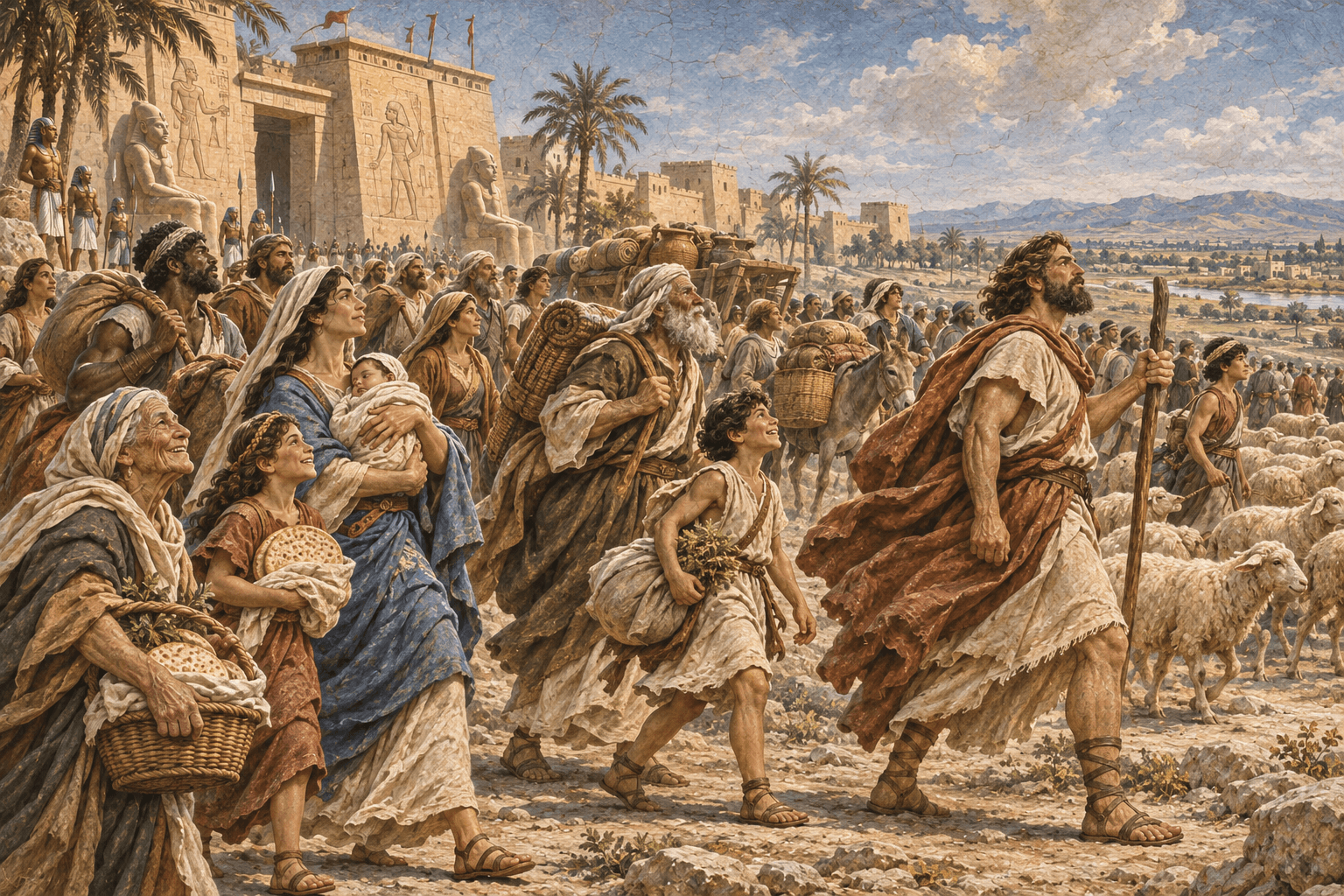
Moses the prophet recorded for us 42 stations, ending with their entry into the land of promise. This reminds us of the words of the Evangelist: “So all the generations from Abraham to David are fourteen generations; and from David until the carrying away into Babylon are fourteen generations; and from the carrying away into Babylon unto Christ are fourteen generations” (Matthew 1:17). It is as though the generations from Abraham, the father of the fathers, to Christ the Lord are 42 generations, matching the number of stations through which the people of old passed in their setting out from Egypt to Jerusalem. It is as though these stations represent salvation and its history through mankind. The children of Israel went out of Egypt with their armies, that is, carrying power for the spiritual struggle; this power in truth is Christ the Lord, who passed with mankind through history as the secret of their strength, until He appeared in His incarnation after forty-two generations.
So much for the number. As for the names of the stations, they carry a continuing symbolic work, lifting the soul from the state of bondage to carry it over to the heights of heaven. Therefore Origen calls them “a chariot made of mysterious words.” This chariot carries us “from strength to strength” (Psalm 84:7) and from glory to glory, interspersed with many sufferings and trials that increase our spiritual strength and our glories… What follows is a summary of the names of the forty-two stations in this chapter and the symbolic meanings they carry.
1. Rameses: an ancient Egyptian name meaning “son of the sun god (Ra),” and also “house of Rameses,” since Rameses II built it as a capital of the Delta on the eastern border of Egypt and named it after himself. It appears from Genesis 47:11 that it lay in the land of Goshen; today it is called San el-Hagar. Most likely it is one of the treasure cities that the Israelites built in Egypt (Exodus 1:11).
Origen holds that it means “a land of corruption” [295] or “troublesome disturbance,” or “disturbance by the moth.” [296] The journey begins by setting out from the place of corruption, the place of stumbling and sin, where the soul is in a state of disturbance. In this place the wicked bury their firstborn (4) and lose their peace; therefore the believers flee from it. Origen says:
Everything in the world falls prey to disturbance, anxiety and corruption, things represented by the moth. Therefore the soul must not stay in it (the love of the world and its enticements), but must depart from it to Succoth. [297]
2. Succoth: a Hebrew name meaning “booths” or “tents.” It most likely lay in Wadi Tumilat. Some have thought it the city around Pithom, but the more common opinion is that it is Tell el-Maskhuta at the eastern end of Wadi Tumilat. [298]
Symbolically, when the soul sets out from Rameses, where there is inner disturbance, it sets out to Succoth (the tents), to live as a stranger and a wanderer, not resting until it reaches the bosom of the heavenly Father, settled in Christ Jesus its Lord. Origen says:
When you shake off the rust of corruption and depart from the field of vice, you will dwell in tents, which we do not wish to put off but to be clothed upon (2 Corinthians 5:4). He dwells in tents who runs toward God free, without fetters or burdens. [299]
And also:
The first advance of the soul is to be rid of earthly disturbance and to know that it must dwell in a tent like the nomads, so as to be like a soldier under arms, ready to meet the (spiritual) enemies, watchful and untroubled. [300]
3. Etham: east of the city of Succoth (Tell el-Maskhuta), “in the edge of the wilderness,” at the eastern end of Wadi Tumilat. The wilderness of Etham lies east of Etham. Etham is thought to have been near the present-day city of Ismailia.
Origen holds that the word “Etham” means “a sign” [301] or “a strait.” [302] It is the third station of the journey; therefore Origen sees in it the symbol of Christ’s resurrection on the third day. On reaching this station they came to the edge of the wilderness and could enjoy the shadow of the life risen with Christ the Lord, for they saw God overshadowing them as a cloud by day and lighting the way for them by night as a pillar of fire. This is the sign of this journey, or this vision… it is the journey of resurrection with Christ the Lord, of which we have spoken before. [303]
Origen comments on the meaning of Etham as a strait, saying:
In the strait we must endure a great wrestling and declare war on the devil and his opposing powers. So Abraham fought in the vale of Siddim (Genesis 14:8) against wicked kings and overcame them. So our pilgrimage is a going down to the inhabitants of the depths and the lower places (the strait), not to linger there but to obtain the victory.
So our entering Etham is an entering into the risen life in Christ Jesus our Lord, in whom we overcome the devil who dwells in the lower depths, or the strait.
4. Pi-hahiroth: Père Abel thinks it lies in the marshes of Jeneffeh at the edge of the passage between the mountain and the Bitter Lake. [304] It lies between Migdol and the sea, before Baal-zephon (Exodus 14:2, 9). We have already presented the symbolic interpretation of this name and its location. Origen holds that “Pi-hahiroth” means “the hard” or “barren ascent,” and that it lies between Migdol, which means “tower” and points to the need of counting its cost (Luke 14:28), and the sea, which points to the waves of continuing trials; and that it lies before Baal-zephon, [305] which points to “ascending quickly” or “lightly.” This means that man, entering the wilderness, must accept the hard or barren ascent, setting before the eyes of his heart the counting of the cost, accepting unceasing trials, hastening in the struggle and not slackening in his spiritual life. [306]
This is a summary of what Origen offered us in his homilies on the Book of Exodus, but he returns to give another interpretation in his homilies on the Book of Numbers. He sees in “Pi-hahiroth” the meaning “the mouth of the villages,” that is, the entrance or mouth of the small places counted as villages, not cities. It is as though “Pi-hahiroth” means entering the small, narrow places, where there is no luxury of the great cities but austerity and asceticism. If this was the first station in the wilderness after setting out from Etham, the last border of Egypt at that time, we must go up to the mouth of narrowness, toil and pain, going up through the narrow villages toward the great city of God, the heavenly Jerusalem. As for its lying between Migdol and the sea: “Migdol” means “tower” and also “glory”; so the believer enters into narrowness looking to the heavenly glories as a motive for his continuing struggle, not afraid of the waves of the sea of this world.
5. Marah: a Hebrew name meaning “bitter” or “bitterness.” It is a spring of very bitter water that the people reached about three days after crossing the Red Sea. The bitterness of the water made the people realize how hard the journey was, so they murmured; but God commanded Moses the prophet to cast a tree into the water, and it became sweet (Exodus 15:23–26). This spring lies in the wilderness of Shur on the way to Sinai; most likely it is Ain Hawarah, about 47 miles from Suez, a few miles from the Red Sea, separated from it by a range of hills. The spring is about 25 feet deep, though it widens at depth. The soil of this region has a high proportion of soda, and its water is salty and bitter. [307]
When they had gone three days into the wilderness of Etham they met the bitter water, which through the tree became sweet and refreshing. This points to the believer’s enjoyment of the risen life in Christ Jesus through his burial in the waters of holy Baptism three times in the name of the Holy Trinity; so burial is turned into resurrection, the old man with his bitter works is crucified, and the new man appears, after the image of his Creator. Here too the believer drinks the waters of the Law and does not find them bitter through the killing letter, but sweet and refreshing through the grace of the Cross, the life-giving wood. [308]
6. Elim: a Hebrew name meaning great trees such as oaks, palms and terebinths. It is known today as the oasis of Wadi Gharandel, 63 miles from Suez, with palm trees, tamarisk and acacia. The people of old came to it after Marah and found there twelve wells of water and threescore and ten palm trees (Exodus 15:27; 16:1). This was a sign of the soul’s setting out from bitterness (Marah) to the rich evangelical life through the twelve disciples and the seventy apostles. It is the journey of the soul from the bitter letter of the Law to the sweetness of the spiritual, evangelical understanding. It is not enough for man to drink of the waters of the Law, even after they have become sweet through the wood of the Cross; he must draw from the evangelical, apostolic waters and enjoy the new food. [309]
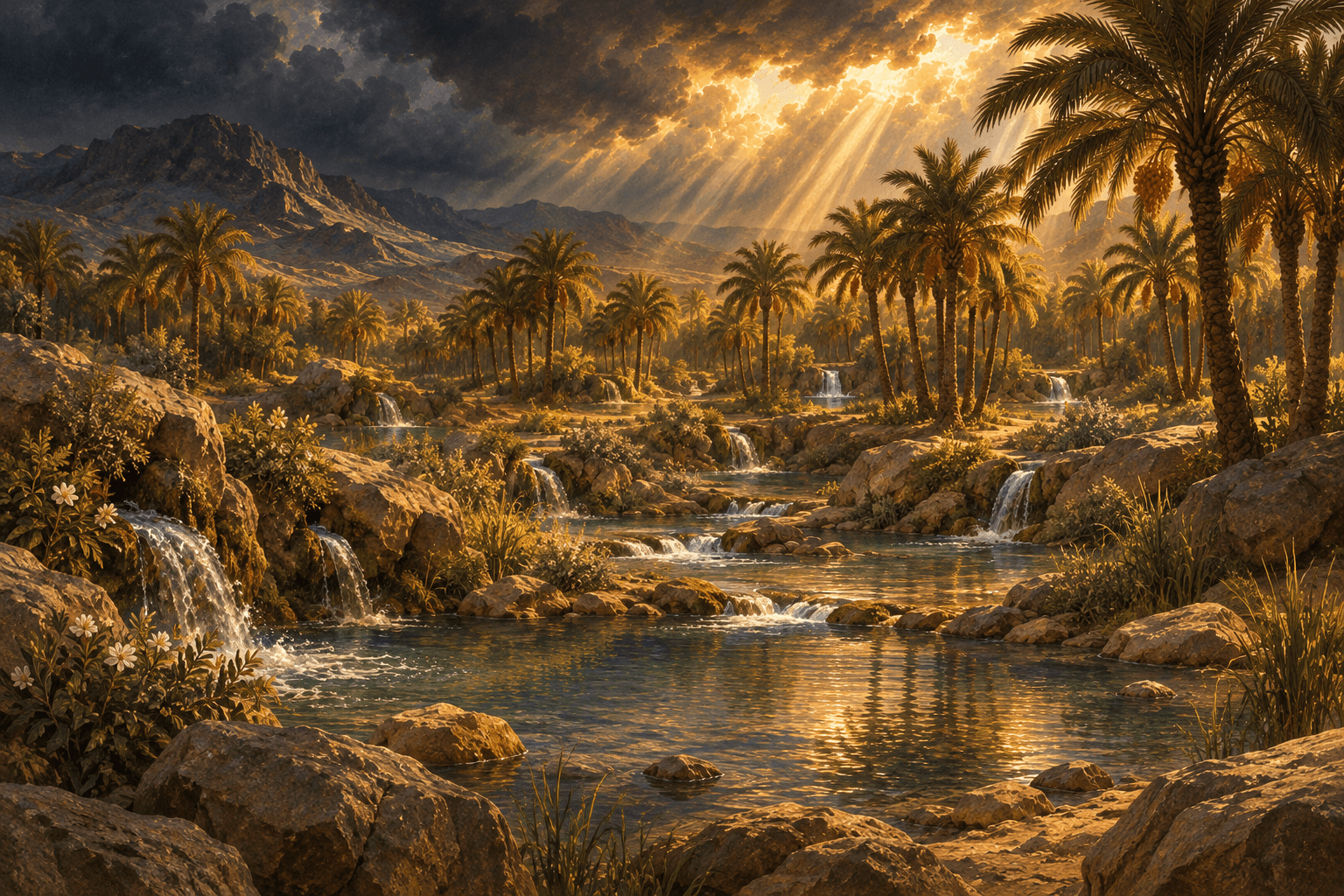
7. The shore of the Red Sea: “And they removed from Elim, and encamped by the Red sea” (10). We have said that “Suph” means “reeds,” because the northern part of the sea on the Egyptian side was a group of marshes surrounded by many reeds.
When the people had reached Elim and enjoyed the evangelical, apostolic life, they were bound not to cross the Red Sea again, but to encamp on its shore. They entered it once, pointing to Baptism, which is not repeated: even if a believer denies his faith and returns again by repentance, he does not go down into it, but encamps beside it through repentance, to recover its work in him. Therefore the Apostle Paul says: “For it is impossible for those who were once enlightened (who received Baptism, the mystery of enlightenment), and have tasted of the heavenly gift, and were made partakers of the Holy Ghost, and have tasted the good word of God, and the powers of the world to come, if they shall fall away, to renew them again (that is, their Baptism, the mystery of the renewal of nature is not repeated) unto repentance; seeing they crucify to themselves the Son of God afresh, and put him to an open shame” (Hebrews 6:4–6). Saint Cyril of Jerusalem says:
We do not receive Baptism twice or thrice… for there is “one Lord, one faith, one baptism” (Ephesians 4:5); only the baptism of heretics is repeated, since it is not counted a baptism. [310]
And Tertullian says:
The sacrament cannot be repeated. [311]
They camp on the seashore remembering God’s wonderful work through the holy waters: how He saved them from Pharaoh and crushed Satan and all his evil powers. Standing beside the sea also reminds them of the violent waves they are exposed to on their journey; yet they do not fear them, but remember their salvation.
8. The wilderness of Sin: this is not the wilderness of Zin. The word is most likely Akkadian, derived from the moon god “Sin.” Its place today is most likely Debbet er-Ramleh, a sand heap in the southwest of the interior of the peninsula at the foot of Jebel et-Tih. There God sent down the manna to the people for the first time.
Origen holds that “Sin” means “a bush” or “a trial,” and he links the two meanings together. When man goes down to the shores of the Red Sea and contemplates God’s works with him through the waters of Baptism, he remembers the bush, which points to the divine incarnation, the crucifixion and the resurrection, and hope in the true good things opens before him. He says:
Hope in the true good things begins to smile on you. But whence comes this hope? It is in the bush in which the Lord appeared and spoke with Moses; that was the first of God’s appearances to the children of Israel. [312]
And since “Sin” also means “trial,” when we look to the bush we must distinguish between the true vision that is from God and the deceptive vision with which Satan tempts us, he who transforms himself into an angel of light to deceive us (2 Corinthians 11:14). Therefore when Joshua the son of Nun saw a vision, he asked at once: “Art thou for us, or for our adversaries?” (Joshua 5:13). It is as though whoever reaches this eighth station must bear the spirit of discernment, to receive the divine visions and sift them, so as not to fall into the temptations and snares of the devil.
9. Dophkah: a Hebrew name most likely meaning “cattle market.” It lies on the way between the Red Sea and Rephidim, perhaps at Serabit el-Khadim or near Wadi Maghara. [313] Origen holds that “Dophkah” means “health” in Hebrew: the soul that enters the wilderness of Sin, is tried by temptations and has the spirit of discernment that sifts what is of God from what is of Satan, is healed of many spiritual diseases and enjoys health. Truly many of our spiritual diseases are the fruit of our lack of spiritual discernment.
In Dophkah the soul knows its Christ as its physician, and sings: “Bless the LORD, O my soul: and all that is within me, bless his holy name… Who forgiveth all thine iniquities; who healeth all thy diseases” (Psalm 103:1–3).
10. Alush: near Rephidim. Origen holds that it means “works.” When the soul enters Dophkah, that is, spiritual health, and praises the Lord who heals its diseases, it sets out to spiritual work with joy and without weariness, and it is said to the believer: “For thou shalt eat the labour of thine hands: happy shalt thou be, and it shall be well with thee” (Psalm 128:2).
11. Rephidim: a Hebrew name meaning “broad places,” [314] lying between the wilderness of Sin and Sinai (Exodus 17:1; 19:2). There was no water there, so the people murmured against Moses, who by divine command smote the rock with the rod, and water came out (Exodus 17:5–6). At Rephidim the battle against Amalek took place: when Moses held up his hands his people prevailed, and when he let them down they were overcome (Exodus 17:8–13). There Moses’ father-in-law came and worshipped the Lord with the elders of Israel (Exodus 18:1–12), matters we spoke of in our study of the Book of Exodus. As for its location, it may be Wadi Refayid northwest of Jebel Musa; there Wadi Redwa, a cool watercourse, joins Wadi Refayid, where there is an oasis at the foot of Jebel Refayid. [315]
As for the symbolic interpretation of Rephidim, in Origen’s view it means “praise of discernment.” He says:
It is right that praise should follow works. But what praise is this? It is praise for the spirit of discernment. For the soul becomes worthy of praise when it has good discernment, a sound judgment, so that it judges all things, yet it is itself judged of no man (1 Corinthians 2:15).
12. The wilderness of Sinai: the word “Sinai” is taken from the Akkadian word “Sin,” the moon god. [316] Note that the word “Sinai” is applied more generally to the wilderness of Sinai, as well as to Mount Sinai, which is also called Mount Horeb. This wilderness surrounding the mountain is eleven days’ journey from Kadesh-barnea by the way of mount Seir (Deuteronomy 1:2). It is wide enough for the people to camp at the foot of the mountain (Exodus 19:2), and it adjoins the mountain, so that the people could touch the mountain (Exodus 19:12), and the camp could see its summit (Exodus 19:16, 18, 20). On this mountain Moses received the Ten Commandments, and at its foot the covenant between God and His people was made (Exodus 20:1–24:8). Scripture later mentions no visit to this mountain except Elijah’s flight to it when wicked Jezebel threatened him (1 Kings 19:8).
There are many theories about Mount Sinai. Some see it as Jebel Serbal in Wadi Feiran, a view going back to Eusebius the historian. It is a very great, isolated mountain, 6,758 feet high, visible from far away, but there is no wilderness around it wide enough for the camp of the people. The other view goes back to Justinian, holding that Jebel Musa is Mount Sinai. It is very steep, and below it lies the plain of er-Raha, about four square miles, enough for the camp. This mountain has the greatest importance, for it is the mountain sanctified by God’s meeting with Moses on its summit to give him the Ten Commandments. On it and around it several Christian churches arose, especially the Monastery of Saint Catherine, rich in ancient manuscripts; in this monastery the Codex Sinaiticus of the Holy Bible, dating to the fourth century, was discovered.
In any case, if we return to the symbolic interpretation, it says that the soul, after entering Rephidim and becoming worthy of praise through the spirit of good discernment, can go up Mount Sinai to meet its God in a holy retreat, in which it receives His commandment, comes to know His mysteries and enjoys the reflections of His glory upon it.
3. The Stations of the Journey: From Sinai to Kadesh
KJV · Verses 16–36
16 And they removed from the desert of Sinai, and pitched at Kibrothhattaavah. 17 And they departed from Kibrothhattaavah, and encamped at Hazeroth. 18 And they departed from Hazeroth, and pitched in Rithmah. 19 And they departed from Rithmah, and pitched at Rimmonparez. 20 And they departed from Rimmonparez, and pitched in Libnah. 21 And they removed from Libnah, and pitched at Rissah. 22 And they journeyed from Rissah, and pitched in Kehelathah. 23 And they went from Kehelathah, and pitched in mount Shapher. 24 And they removed from mount Shapher, and encamped in Haradah. 25 And they removed from Haradah, and pitched in Makheloth. 26 And they removed from Makheloth, and encamped at Tahath. 27 And they departed from Tahath, and pitched at Tarah. 28 And they removed from Tarah, and pitched in Mithcah. 29 And they went from Mithcah, and pitched in Hashmonah. 30 And they departed from Hashmonah, and encamped at Moseroth. 31 And they departed from Moseroth, and pitched in Benejaakan. 32 And they removed from Benejaakan, and encamped at Horhagidgad. 33 And they went from Horhagidgad, and pitched in Jotbathah. 34 And they removed from Jotbathah, and encamped at Ebronah. 35 And they departed from Ebronah, and encamped at Eziongaber. 36 And they removed from Eziongaber, and pitched in the wilderness of Zin, which is Kadesh.
13. Kibroth-hattaavah: a place between Mount Sinai and Hazeroth, about 15 miles northeast of Sinai. There the people lusted for flesh, so God sent them quails to eat flesh a whole month; and since they ate with lust, He smote them with a plague.
“Kibroth-hattaavah” means “the graves of lust,” or “the graves of the people that lusted” (Numbers 11:34). Origen says:
It is without doubt the place where the lusts are buried and brought to nothing, where all evil desires are quenched, and the flesh no longer lusts against the Spirit (Galatians 5:17); rather we become dead to the law by the body of Christ (Romans 7:4).
14. Hazeroth: perhaps Ain Khadra, about 36 miles northeast of Mount Sinai. There Miriam and Aaron murmured against Moses, and she became leprous (Numbers 12).
The word “Hazeroth” means “settlement,” and Origen holds that it means “a complete (settled) building” or “blessedness.” Therefore he says:
Notice, O traveller, the succession of the journey’s progress: when you bury the lusts of the flesh and hand them over to death, you reach the greatness of the place (settlement) and obtain blessedness. Truly blessed is the soul that no bodily vice overcomes. [317]
Some hold that it means “courts” or “enclosures,” which is the same meaning, “settlement”: the soul cannot settle and feel at rest, like one safe in his own house, unless it first buries the lusts of the flesh by the Holy Spirit and kills them by the Cross!
15. Rithmah: a Hebrew name meaning “broom,” a desert shrub whose roots are eaten in famines, and whose stems and roots are used to make charcoal (“coals of juniper,” Psalm 120:4). Origen holds that the word means “a completed vision”: the soul that buries the bodily lusts and is worthy of blessedness and settlement enjoys a sound spiritual vision, coming to know the mysteries of the incarnation and the divine dispensation in a complete and deep way.
16. Rimmon-parez: perhaps Naqb el-Biyar. Its meaning is “the pomegranate of the breach,” that is, a pomegranate that grows on a cleft or breach. Origen holds that “parez” here means “cutting” or “dividing,” meaning that after the soul passes Rithmah and enjoys completed visions it is fitting for it to cut off the higher, heavenly things from the lower, earthly things, separating the eternal from the temporal.
17. Libnah: meaning “white.” When the soul enters Rimmon-parez and enjoys the separation between what is heavenly and what is earthly, it chooses what is heavenly and enjoys whiteness, the symbol of heaven. John the beloved saw the heavenly Christ, His head and His hairs white like wool, as white as snow (Revelation 1:14); Daniel saw Him in garments white as snow (Daniel 7:9); and in His transfiguration “his raiment was white as the light” (Matthew 17:2). In the events of the resurrection and the ascension the angels appeared in white apparel (Acts 1:10), and in the kingdom the victorious appear in white robes (Revelation 7:9): “These are they which… have washed their robes, and made them white in the blood of the Lamb” (Revelation 7:14). Therefore Daniel the prophet speaks of being purged and made white (Daniel 11:35).
So entering Libnah is accepting the holy, heavenly life and rejecting defiled things.
18. Rissah: perhaps at Kuntilet el-Jerafi between Kusaima and Aqaba, northwest of Jebel Rubsa en-Nejin. [318] It is a Hebrew name meaning “breaking,” or “dew” or “rain.” But Origen holds that it means “a visible trial,” which is close to the meaning “breaking”; he also holds that it means “worthy of praise.” Therefore he says:
However far the soul advances, trials will not leave it. Clearly trials follow it as a guard and protection. Just as meat, whatever its kind, spoils without salt, so the soul spoils if it is not salted with continual trials, for without them the soul grows careless and slack. For this reason it is said: “every oblation of thy meat offering shalt thou season with salt” (Leviticus 2:13). For this reason too the Apostle Paul says: “And lest I should be exalted above measure through the abundance of the revelations, there was given to me a thorn in the flesh, the messenger of Satan to buffet me, lest I should be exalted above measure” (2 Corinthians 12:7). These are the visible trials that make us worthy of praise. [319]
19. Kehelathah: most likely Kuntilet Qurayyah, also called Ajrud, where there are wells and a water reservoir, with a pass leading to Bir Main. [320]
“Kehelathah” is a Hebrew name meaning “assembly,” and also “headship” or “a rod.” [321] The soul’s entering Rissah, that is, into trials, does not weaken it as long as it bears the heavenly mark; on the contrary, it binds it the more to the assembly of the heavenly ones and gives it greater authority, so that it becomes like a queen, ruling over the heart, the mind and all the senses, accepting the thought it wishes and driving out what it will, governing all its inner depths with authority. It holds the rod, which is the Cross, by which it says in power: “the world is crucified unto me, and I unto the world” (Galatians 6:14). It hears the voice of its Bridegroom speaking to it: “thou wast exceeding beautiful, and thou didst prosper into a kingdom. And thy renown went forth among the heathen for thy beauty: for it was perfect through my comeliness, which I had put upon thee, saith the Lord GOD” (Ezekiel 16:13–14).
In Kehelathah the soul enters the assembly of heaven as a queen with headship, holding the rod of her Bridegroom, the secret of her strength and beauty, to reign with Him for ever.
20. Mount Shapher: possibly Jebel Arayif en-Naqa, south of Kadesh. The word “Shapher” means “beauty” or “elegance.” The soul that enters Kehelathah, is counted a member of the assembly of the heavenly ones and is given authority and the rod of the Cross, enters heavenly beauty and elegance at a surpassing level. It hears the voice of its heavenly Bridegroom: “Behold, thou art fair, my love; behold, thou art fair” (Song of Solomon 1:15), affirming His delight in it.
Origen holds that Shapher means “the sounds of trumpets.” When the soul reigns with Christ the Lord, it holds the sounds of the trumpet, which point to the word of God, the secret of its victory and heavenly splendour. With the divine word it blows trumpet sounds of victory and joy, to keep a heavenly feast without ceasing (Numbers 10).
21. Haradah: perhaps in Wadi Lussan, [322] or Wadi el-Ain, a day’s journey from Ain Hadra.
Haradah is a Hebrew word meaning “terror” or “fear.” However far man advances spiritually, even if he reaches Mount Shapher and has the spiritual beauty of Christ the Lord, he must walk in the fear of the Lord, working out his salvation with fear and trembling. Origen holds that the word Haradah means “making him worthy”: so whoever reaches Mount Shapher with the trumpets of God’s word is worthy of the crown.
22. Makheloth: perhaps it is Kehelathah itself, to which they returned again, or a town with a similar name, for some hold that it also means “assemblies” and think it most likely Kuntilet Qurayyah, which is called Ajrud. [323]
Perhaps Origen saw it as the congregation’s return to the same earlier town, so that he saw in it the symbolic meaning “from the beginning,” even though Makheloth means “assemblies.” He says that whoever inclines to meditate on the word of God (Mount Shapher) and holds fast to its trumpets to conquer must meditate on Him who was in the beginning, that is, on God the Word, and never be a stranger to Him.
23. Tahath: a Hebrew name meaning “that which is beneath.” Whoever wants to enjoy Makheloth, that is, the holy assemblies, meditating on Him who is from the beginning, must be last (beneath) all and servant of all. So he lives in peace with God and men.
Origen holds that Tahath means “establishment.” Whoever humbles himself and “goes down beneath” meditates on Him who was from the beginning, not in a theoretical meditation, but through abiding in Him (John 15:4). Tahath is thought to lie near Jebel et-Tih.
24. Tarah: most likely between Ain el-Hadra and Kusaima. The word “Tarah” is a Hebrew word meaning “ibex,” a kind of mountain goat. But Origen holds that it means “amazement,” or being caught up in the spirit (rapture). It is as though our abiding in Christ the Lord, “the Word of God,” brings us into the perception of His divine mysteries, unspeakable and incomprehensible; so we enter the city of amazement, where our spirits are caught up into His heavenly bridal chamber.
25. Mithcah: perhaps Wadi Abu Taqiyeh, which goes down from Naqb el-Arud to Wadi el-Jerafi. “Mithcah” is a Hebrew word meaning “sweetness,” as though it points to the sweetness of Christ Jesus through our abiding in Him.
Origen holds that it means “the new death.” The city of amazement, or the spirit’s being caught up into divine things, urges us the more to enjoy the death of Christ the Lord as a new death, not the fruit of sin that we committed or inherited, but the fruit of union with Christ the Lord, crucified and risen from the dead.
26. Hashmonah: most likely Wadi el-Hashim. The word Hashmonah means “fruitfulness.” If Mithcah means sweetness in Christ Jesus, Hashmonah means the fruitfulness of life and its bearing fruit in Him.
Origen holds that Hashmonah means “bones.” If Mithcah in his view is “the new death,” then by our dying with Christ we neither fear nor are troubled, for not one of our (spiritual) bones is broken.
27. Moseroth: its place is unknown, but it is near Mount Hor on the border of Edom. The word “Moseroth” means “bonds” or “fetters.” Therefore Origen holds that whoever enters the city of Moseroth binds the enemy, the devil, and casts him out, so that he has no place in us (Ephesians 4:27).
28. Bene-jaakan: that is, the sons of Jaakan, a Horite tribe of mount Seir dispossessed by the Edomites (Genesis 36:20–21, 27; 1 Chronicles 1:38, 42; Deuteronomy 2:12). In the days of the exodus the sons of Jaakan formed a tribe that occupied a district on the border of Edom near Mount Hor, where Aaron died, and the children of Israel camped at some of their wells.
Origen holds that Jaakan means “springs” or “purification.” When the devil is cast out bound and has no place in us, we must draw the more from God’s pure springs, that is, from His word or commandment, which purifies our inner depths.
29. Hor-hagidgad: that is, “the cave of Gidgad,” which is Gudgodah (Deuteronomy 10:6–7). It may lie on Wadi Ghadaghed, belonging to Wadi Jerafi, north of Kuntilet el-Jerafi.
Origen holds that “Gidgad” means “contraction” or “trial.” Many stations along the journey represent kinds of trials, without which the soul does not advance in virtue nor is adorned with crowns of glory. Therefore he says:
Trials are a strength for the soul and a protecting wall for it; they mingle well with the virtues, and without them the virtues are neither beautiful nor complete. In our advance toward the virtues we often find various stations of trials. [324]
30. Jotbathah: perhaps et-Taba, about 22 miles north of Aqaba, a place with abundant streams of water (Deuteronomy 10:7). The Hebrew word “Jotbathah” means “good things”: the more we enter the city of the trials of Gidgad, the more we enjoy good things and goodness, and the bitterness of the trial is turned into the delight of victory in Christ Jesus our Lord.
31. Ebronah: an oasis called today Ain Defiyeh, seven and a half miles north of Ezion-gaber. The word “Ebronah” means “crossing” or “passage.” The soul that enjoys spiritual good things (Jotbathah) must be in a state of continual crossing, passing from good to greater good and rising from glory to glory by the Holy Spirit of God.
32. Ezion-gaber: a city at the northern end of the Gulf of Aqaba, near Elath and perhaps west of it (Deuteronomy 2:8; 1 Kings 9:26–27; 10:22; 22:48; 2 Chronicles 8:17). It is thought to be Tell el-Kheleifeh, 500 yards from the seashore, midway between Aqaba on the eastern end of the gulf and Umm Rashrash on the western end, below a slope that inclines on the eastern side of the hills of Edom. It was an important centre for the trade in iron and copper (Deuteronomy 8:9). Solomon the wise built his fleet there, taking advantage of its location (1 Kings 9:26–28; 10:11, 22; 2 Chronicles 8:17); but Edom later took it, and then King Amaziah took it back from them and built the port of Elath [325] (2 Kings 14:22; 2 Chronicles 26:1–2).
Symbolically, Origen holds that it means “the counsels of men.” By entering Ebronah, that is, accepting the life of continual crossing, we set out from the stage of childhood to the maturity of men, or spiritual manhood. So we have the purposes and counsels of men, of which it is said: “Counsel in the heart of man is like deep water; but a man of understanding will draw it out” (Proverbs 20:5).
33. The wilderness of Zin: adjoining the southern border of Canaan, the border of Edom on the west and of Judah on the southeast (Joshua 15:1–3). It was part of the wilderness of Paran, or Kadesh was the border between them. It is different from the wilderness of Sin. [326]
It also means “trial.” So we set out on our journey from trial to trial; whoever has the purposes of men enters them and grows in maturity and splendour. He is like the honourable vessel that enters the fire and grows in purity and splendour. Origen says:
The goldsmith who wants to make a useful vessel brings it often near the fire and shapes it with the hammer, and refines it much, to make it purer and to give it the beautiful form the artist intends. [327]
34. Kadesh: a Semitic name meaning “holy,” also called Kadesh-barnea. It is an important oasis in the north of the wilderness of Sinai, at the edge of the wilderness of Zin (Numbers 20:1), west of the Arabah, near the southern border of the land of the tribe of Judah, or the southern border of the children of Israel, eleven days’ journey from Horeb by the way of mount Seir. It is not far from Mount Hor and the border of Edom. It played a central role in the journey immediately after Mount Sinai. At Kadesh the following took place:
A) The people murmured against Moses because of their thirst, and he smote the rock with the rod twice (Numbers 20).
B) The rebellion of Korah and his company took place (Numbers 16).
C) Miriam the sister of Aaron died (Numbers 20:1).
D) Moses sent the spies to Canaan, and they came to the congregation presenting the cluster of grapes borne on a staff as a pledge of the land that flows with milk and honey (Numbers 32:8; Deuteronomy 1:19–20).
E) Moses sent messengers to Edom asking leave to pass through his land to the land of Moab (Numbers 20:14–21).
F) The people spent the longest period of the journey at this place; therefore some hold that the tabernacle was pitched at Kadesh, and the congregation moved around it and returned there for worship and judgment.
Some hold that it is Ain Qadeis, 50 miles south of Beersheba; others that it is Ain el-Qudeirat, near it and larger than the first.
Symbolically, Kadesh, which represents the life of holiness, has no place except by the wilderness of Zin, that is, the wilderness of trials; outside suffering man does not enter the holy life. In this life we drink the waters of the living rock, which pours out the Holy Spirit for us through the rod (the Cross); in it all the rebellion and arrogance of Korah and his company is scattered; we accept death (Miriam) without grief; we enjoy the pledge of the kingdom (the cluster of grapes); and we enter into war with Satan (Edom)…
4. The Stations of the Journey: From Mount Hor to the Plains of Moab
KJV · Verses 37–49
37 And they removed from Kadesh, and pitched in mount Hor, in the edge of the land of Edom. 38 And Aaron the priest went up into mount Hor at the commandment of the Lord, and died there, in the fortieth year after the children of Israel were come out of the land of Egypt, in the first day of the fifth month. 39 And Aaron was an hundred and twenty and three years old when he died in mount Hor. 40 And king Arad the Canaanite, which dwelt in the south in the land of Canaan, heard of the coming of the children of Israel. 41 And they departed from mount Hor, and pitched in Zalmonah. 42 And they departed from Zalmonah, and pitched in Punon. 43 And they departed from Punon, and pitched in Oboth. 44 And they departed from Oboth, and pitched in Ijeabarim, in the border of Moab. 45 And they departed from Iim, and pitched in Dibongad. 46 And they removed from Dibongad, and encamped in Almondiblathaim. 47 And they removed from Almondiblathaim, and pitched in the mountains of Abarim, before Nebo. 48 And they departed from the mountains of Abarim, and pitched in the plains of Moab by Jordan near Jericho. 49 And they pitched by Jordan, from Bethjesimoth even unto Abelshittim in the plains of Moab.
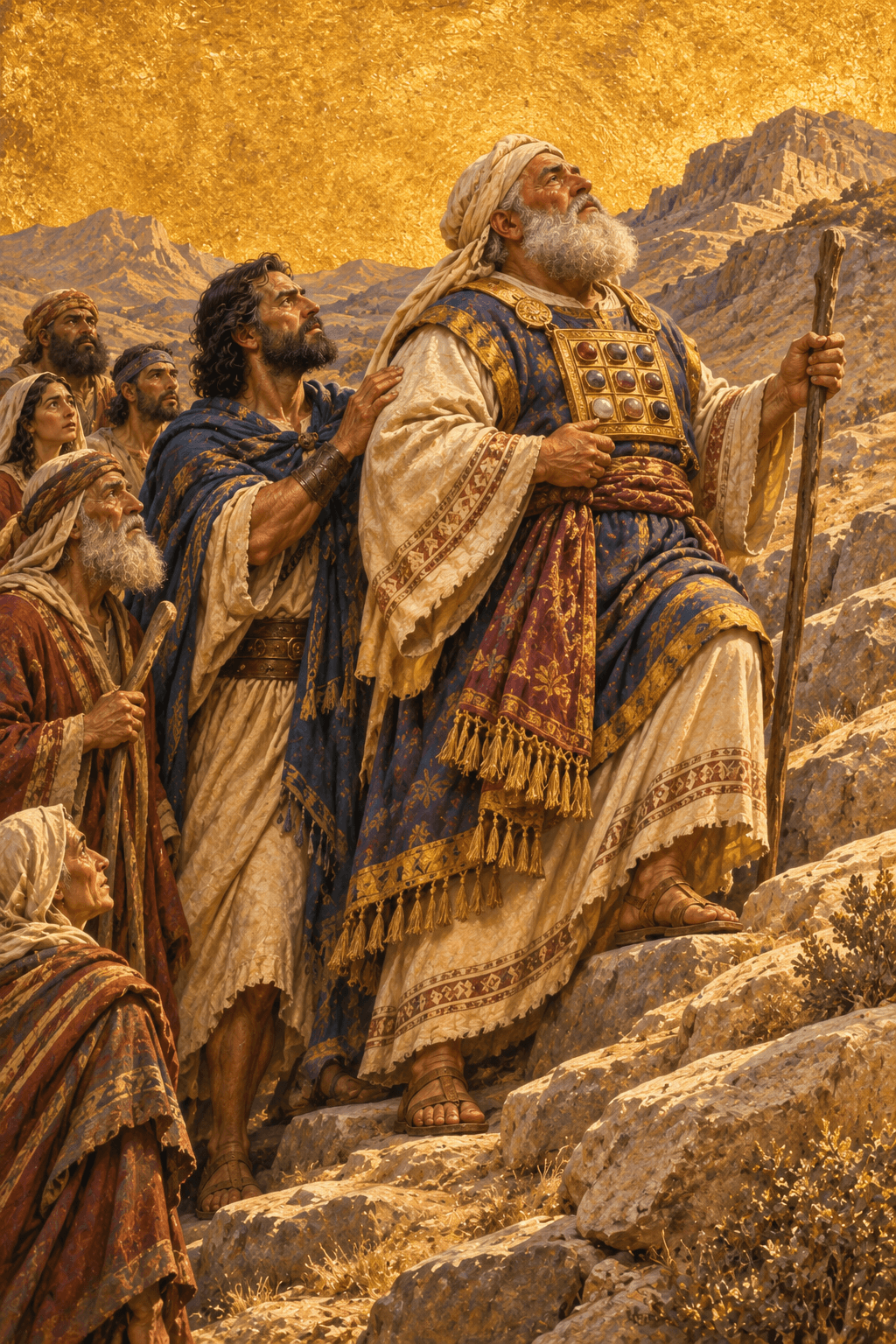
35. Mount Hor: on the border of the land of Edom. Aaron died on it and was buried there (Numbers 20:24–29; 33:37–39; Deuteronomy 32:50). The prevailing tradition, at least until the days of Josephus, [328] was that Jebel Harun (the mountain of Aaron) is Mount Hor. It lies midway between the Gulf of Aqaba and the southern end of the Dead Sea, a sandstone rock 4,780 feet high, with Petra close by to the west. But some modern scholars hold that Mount Hor is Jebel Madurah, 15 miles northeast of Kadesh on the road between Kadesh and Moab. They reason that Jebel Harun is in the middle of Edom, not on its border, so it would have been hard for the people at that time to cross to it; and the height of Jebel Harun would not have allowed the congregation to witness his death (Numbers 20:22–29).
The word “Hor” means “mountain.” It is as though Aaron, going up this mountain to die, rises to sleep and rest without caring for the name of the place; it is enough for him to rise and not go down like Korah and his company.
Whoever enters Kadesh, that is, the holy life, longs to rise up Mount Hor, to rest in the bosom of God for ever.
36. Zalmonah: perhaps east of Jebel Harun at Bir Madhkur. The word “Zalmonah” means “the shadow of the king.” Whoever rises up Mount Hor through his holy life in the Lord does not fall into pride and haughtiness, but lives hidden in the shadow of the heavenly King. Saint Mary enjoyed this shadow when she heard the annunciation: “the power of the Highest shall overshadow thee” (Luke 1:35). This is what every soul longs for, saying: “I sat down under his shadow with great delight” (Song of Solomon 2:3).
37. Punon: it is believed to lie on the eastern side of the Arabah, about five and a half miles east of Khirbet en-Nahas, a region famous for copper and iron. Origen holds that the word “Punon” means “keeping the tongue.” Therefore whoever rises to Mount Hor and sits under the shadow of the King Himself must keep his tongue holy, speaking the truth and not uttering an idle word.
38. Oboth: meaning “near the water.” It lies near the southeastern border of Moab, perhaps at Ain el-Weiba. Perhaps nearness to the water points to our drinking of the waters of the Holy Spirit, which support us always on our journey.
39. Ije-abarim: “Ije” is a Moabite word meaning “ruins.” It is on the southern border of the land of Moab, the same as Iim, perhaps el-Mahai, seven miles east of Dhat-Ras.
Origen holds that “Ije-abarim” means “the depth of the crossing” or “the gulf of the crossing.” As we draw near the end of the journey we enter the depths, into the bosom of our father Abraham, who says to the wicked: “between us and you there is a great gulf fixed” (Luke 16:26). In this fatherly bosom the soul rests in its continual crossing into the depths of the great other life.
40. Dibon-gad: we have already spoken of Dibon in chapter 32. If “Dibon” for Origen means “a hive,” then the watchful soul, the nearer it draws to the eternal crossing, grows the more active and earnest, becoming like the beehive that belongs to Gad (the one earnest in his life).
41. Almon-diblathaim: that is, “we know that the fig has withered.” This is the next-to-last station, between the river Arnon and the mountains of Abarim. Perhaps it is the same as Beth-diblathaim (Jeremiah 48:22); most likely it is Deleilat el-Gharbiyeh, two and a half miles northeast of Libb.
When we enter this place we realize that suffering has become like the fig tree that withered. We truly perceive: “Vanity of vanities; all is vanity… and vexation of spirit” (Ecclesiastes 1:2, 14). Therefore we no longer cover ourselves with fig leaves like our father Adam, but accept the sacrifice of Christ the Lord, who covers our weakness and sets out with us to the eternal inheritance.
42. The mountains of Abarim before Nebo: we have already spoken of them in chapter 32. This is the last stage, where we stand with Moses the prophet on the mountains of crossing and see Canaan before us, and we long to depart to join the company of the saints who have fallen asleep in the Lord.
This is the journey of the soul from Rameses, where there is disturbance and bondage, to the mountain of Abarim, where the vision of the heavenly Canaan becomes clear.
5. Preparing for the Crossing
KJV · Verses 50–56
50 And the Lord spake unto Moses in the plains of Moab by Jordan near Jericho, saying, 51 Speak unto the children of Israel, and say unto them, When ye are passed over Jordan into the land of Canaan; 52 Then ye shall drive out all the inhabitants of the land from before you, and destroy all their pictures, and destroy all their molten images, and quite pluck down all their high places: 53 And ye shall dispossess the inhabitants of the land, and dwell therein: for I have given you the land to possess it. 54 And ye shall divide the land by lot for an inheritance among your families: and to the more ye shall give the more inheritance, and to the fewer ye shall give the less inheritance: every man's inheritance shall be in the place where his lot falleth; according to the tribes of your fathers ye shall inherit. 55 But if ye will not drive out the inhabitants of the land from before you; then it shall come to pass, that those which ye let remain of them shall be pricks in your eyes, and thorns in your sides, and shall vex you in the land wherein ye dwell. 56 Moreover it shall come to pass, that I shall do unto you, as I thought to do unto them.
The journey ended beside the Jordan, the holy river, into which Christ the Lord came down to baptize the Church, giving her the spirit of prophecy and sanctifying her as His bride and a temple for His Holy Spirit.
Moses the prophet closed with the Lord’s strict charge not to leave the heathen in their midst, lest heathen worship creep in among them; otherwise these would be “pricks in your eyes, and thorns in your sides” (55), a cause of continual vexation; and indeed God Himself would do to them what He had thought to do to the wicked (56).
Notes and References
[294] Origen, Homilies on Numbers 26.
[295] See the author’s commentary on the Book of Exodus (1981), p. 81.
[296] Origen, Homilies on Numbers 27.
[297] Ibid.
[298] J. Hastings, Dictionary of the Bible, p. 942.
[299] Origen, Homilies on Exodus 5.2.
[300] Origen, Homilies on Numbers 27.
[301] See the author’s commentary on the Book of Exodus (1981), pp. 86–87.
[302] Origen, Homilies on Numbers 27.
[303] See the author’s commentary on Exodus, chapter 13.
[304] The New Westminster Dictionary of the Bible, p. 751.
[305] A Hebrew name meaning “Baal of the north,” most likely a shrine of the goddess “Baalath of the north.” It lay near the Gulf of Suez, on the western shore at Suez.
[306] See the author’s commentary on the Book of Exodus (1981), pp. 88–89.
[307] The New Westminster Dictionary of the Bible, p. 586.
[308] See the author’s commentary on the Book of Exodus (1981), p. 99.
[309] Ibid., p. 100.
[310] St. Cyril of Jerusalem, Procatechesis 7.
[311] Tertullian, De Oratione; Enchiridion Patristicum 208–314.
[312] Origen, Homilies on Numbers 27.
[313] The New Westminster Dictionary of the Bible, p. 231.
[314] Ibid., p. 798.
[315] Ibid., p. 799.
[316] Ibid., pp. 886–887.
[317] Origen, Homilies on Numbers 27.
[318] The New Westminster Dictionary of the Bible, p. 806.
[319] Origen, Homilies on Numbers 27.
[320] The New Westminster Dictionary of the Bible, p. 534.
[321] Origen, Homilies on Numbers 27.
[322] J. Hastings, Dictionary of the Bible, p. 364.
[323] The New Westminster Dictionary of the Bible, p. 581.
[324] Origen, Homilies on Numbers 27.
[325] The New Westminster Dictionary of the Bible, pp. 289–290.
[326] Ibid., pp. 1024–1025.
[327] Origen, Homilies on Numbers 27.
[328] Josephus, Antiquities 4.4.7.