
When the tents of the people were pitched in the plains of Moab, the two tribes of Reuben and Gad looked toward the land of Gilead and desired to possess it, because it was a land for grazing, and these two tribes owned great wealth in flocks.
1. The Request for the Land of Gilead
KJV · Verses 1–5
1 Now the children of Reuben and the children of Gad had a very great multitude of cattle: and when they saw the land of Jazer, and the land of Gilead, that, behold, the place was a place for cattle; 2 The children of Gad and the children of Reuben came and spake unto Moses, and to Eleazar the priest, and unto the princes of the congregation, saying, 3 Ataroth, and Dibon, and Jazer, and Nimrah, and Heshbon, and Elealeh, and Shebam, and Nebo, and Beon, 4 Even the country which the Lord smote before the congregation of Israel, is a land for cattle, and thy servants have cattle: 5 Wherefore, said they, if we have found grace in thy sight, let this land be given unto thy servants for a possession, and bring us not over Jordan.
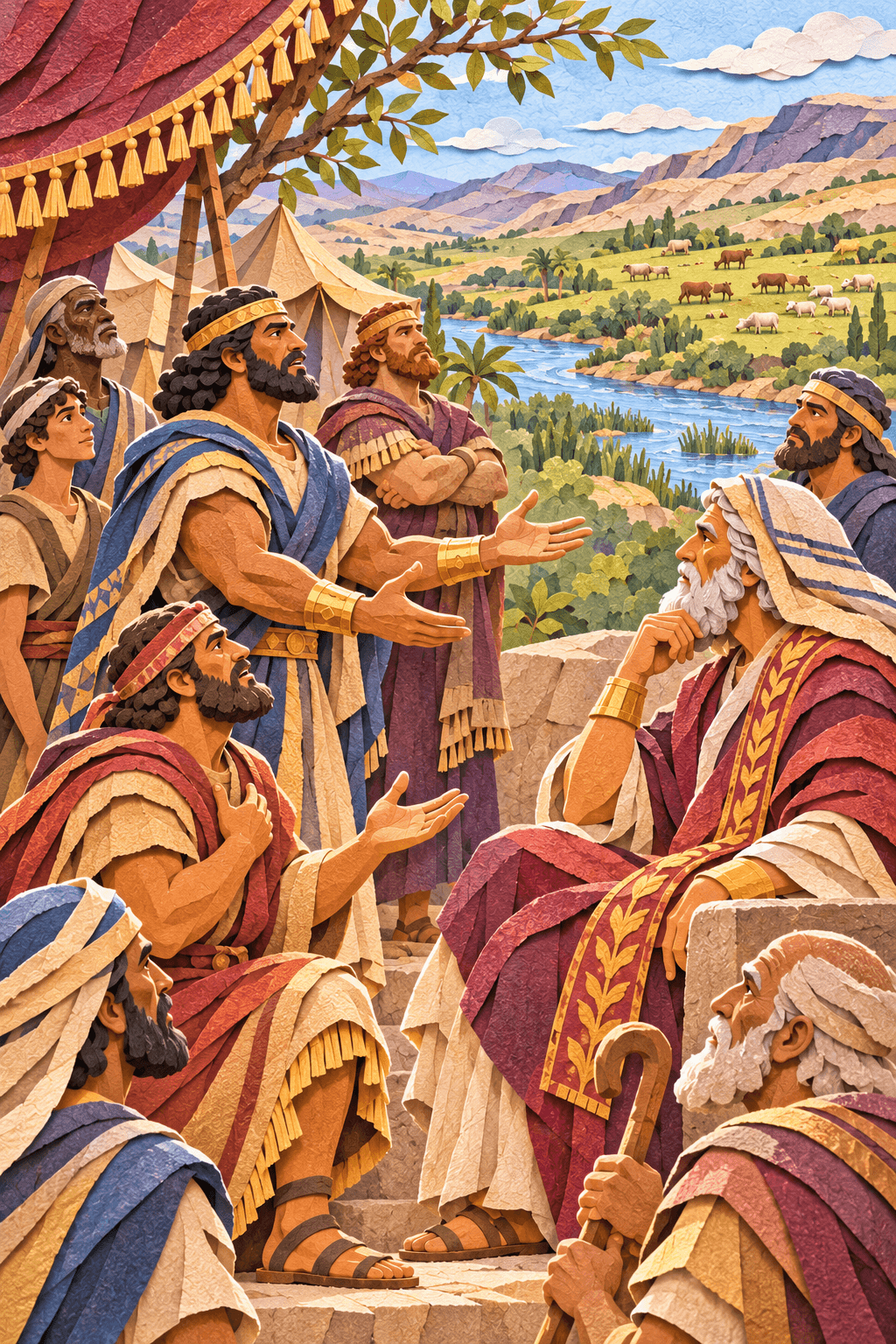
When the people had taken the region east of the Jordan on their way to cross the Jordan and enjoy the land of promise, the two tribes of Reuben and Gad asked to possess this land and not to cross the Jordan with the rest of the congregation (5) to share with them in the land of promise. Perhaps half the tribe of Manasseh also asked the same thing with them.
As for Gilead, some think the name is derived from the Arabic and means “rough” or “rugged”; [287] others think it means “the heap of witness” (Genesis 31:47), where Jacob set up a heap as a sign of the covenant made between him and his uncle. [288] Gilead carries a broad meaning that includes the whole region east of the Jordan (Deuteronomy 34:1; Joshua 22:9; Judges 20:1; 2 Samuel 2:9; 1 Maccabees 5:17, 24–27). In a more precise sense, Gilead is a mountainous region east of the Jordan that today includes the modern Balqa, west of Ammon, reaching roughly to the border of Heshbon on the south and to the Yarmuk on the north. It rises about 2,000 feet above sea level and includes in some areas forests as well as fields, valleys and streams. It is good for grazing, so that the Bridegroom likened His bride to “a flock of goats, that appear from mount Gilead” (Song of Solomon 4:1; 6:5). It is famous for a kind of tree from which comes a resinous substance called the balm of Gilead, of pleasant fragrance (Jeremiah 8:22; 46:11). Its juice is said to have been used as a remedy for inflammations, and its value was so high that in the time of Alexander it was reckoned at twice its weight in silver; the Book of Genesis (Genesis 37:25) shows that it was an important article of trade. When the prophets speak of restoring the new Israel in the messianic age, they mention Gilead as a place where its soul is satisfied (Jeremiah 50:19; Micah 7:14; Zechariah 10:10).
Let us return to the Book of Numbers to see the two tribes of Reuben and Gad, desiring this land, presenting to Moses the prophet, Eleazar the high priest and the princes of the congregation this reason: Ataroth, Dibon, Jazer, Nimrah, Heshbon, Elealeh, Shebam, Nebo and Beon, the country which the Lord smote before the congregation of Israel.
“Heshbon” is a Moabite name meaning “reckoning” or “device.” It is still known as Hesban, a ruined town on an isolated hill between the Arnon and the Jabbok, about seven and a half miles north of Medeba. There is a great water reservoir east of the ruins of the town, which may be one of the pools that were outside the walls of the city (Song of Solomon 7:4).
“Is a land for cattle, and thy servants have cattle: Wherefore, said they, if we have found grace in thy sight, let this land be given unto thy servants for a possession, and bring us not over Jordan” (4–5). They wanted to possess the region with its towns, especially the following:
A) Ataroth: a Hebrew name meaning “crowns”; [289] perhaps it means “sheepfolds.” [290] It is most likely the present-day Khirbet Attarus, on the western slope of Jebel Attarus, eight miles northwest of Dibon (Dhiban) and three miles northeast of Machaerus, where Saint John the Baptist was martyred.
B) Dibon: a Moabite name meaning “wasting.” It is a city that Sihon king of the Amorites took from Moab (Numbers 21:26–30). It is called Dhiban in Arabic, a ruin three miles north of the Arnon and two miles northwest of Aroer, about forty miles south of Amman. In 1868 the famous Moabite Stone was found in its ruins.
C) Jazer: meaning “helper.” The tribe of Gad took this city (Joshua 13:25) and rebuilt it, and it became a city of the Levites (Joshua 21:39; 1 Chronicles 6:81). The children of Moab took it (Isaiah 16:8–9; Jeremiah 48:32), and Judas Maccabeus recovered it from the Ammonites (1 Maccabees 5:8). Jazer was known for its vineyards (Isaiah 16:8; Jeremiah 48:32). According to Eusebius, Jazer lay 10 Roman miles west of Rabbath Ammon and 15 miles north of Heshbon.
D) Nimrah: or Beth-nimrah, meaning “house of the leopard.” [291] It is Tell el-Bleibil, near Tell Nimrin, ten miles north of the Dead Sea and three miles east of the course of the Jordan.
E) Elealeh: a Hebrew word meaning “God is exalted.” The tribe of Reuben rebuilt it, and it fell into the hands of the children of Moab (Isaiah 15:4; 16:9; Jeremiah 48:34). Its ruin, called el-Al, stands on the top of a hill about a mile north of Heshbon.
F) Shebam: also Shibmah (Numbers 32:38), meaning “cold” or “coolness.” It fell to Reuben (Joshua 13:19), and the children of Moab took it. It was known for its vineyards (Isaiah 16:8–9; Jeremiah 48:32). According to Saint Jerome it lay about half a mile from Heshbon. Today it is called Qurn el-Kibsh, between Hesban and Nebo, three miles northeast of Siyagha on Wadi Salameh.
G) Nebo: an Assyrian word meaning “proclaimer,” [292] the name of a Babylonian god who ruled over literature and learning, son and messenger of Bel Marduk, who interprets his will to mortals. The city bearing this name lies on or beside Mount Nebo, the mountain on which Moses the prophet stood to see Canaan (Deuteronomy 34:1). The city is five miles southeast of Hesban; today it is Khirbet al-Mukhayyat. The tribe of Reuben built it, that is, rebuilt it, and according to the Moabite Stone the king of Moab took it. It is mentioned among the cities of Moab in the prophecies against the children of Moab (Isaiah 15:2; Jeremiah 48:1, 22).
H) Beon: or Baal-meon, or Beth-baal-meon (Joshua 13:17), also Beth-meon (Jeremiah 48:23), meaning “Baal of the dwelling.” Today it is called Ma’in, 9 miles southwest of Hesban and about 5 miles southwest of Medeba (1 Maccabees 9:36).
2. Why Did Reuben, Gad and Half of Manasseh Want the Land of Gilead?
First: the plain reason was their longing for this land because it was well suited for grazing. The tribes of Reuben and Gad owned very abundant cattle, so they felt that they needed this land more than others. It is “the lust of the eyes, and the pride of life” (1 John 2:16) that made the two tribes lose their longing for the land that the Lord had given to the whole congregation, flowing with milk and honey. The two tribes chose with human eyes and did not realize that by this they would receive a land without natural borders, exposing them to the attacks of enemies, so that their brethren had to intervene to save them (1 Samuel 11; 1 Kings 22:3), besides the land being far from the congregation, so that they became as in isolation.
Man looks with a weak, short-sighted human view and desires for himself things that may harm him and deprive him of spiritual and temporal blessings at the same time.
Second: perhaps the hidden psychological reason for choosing this place was the feeling of Reuben, Jacob’s firstborn, that he had lost his birthright; and also Gad, the firstborn of Zilpah the handmaid; and Manasseh’s feeling that his younger brother Ephraim surpassed him in blessing… These three wanted in one way or another to make up for the loss of their birthright, so they desired to enjoy the firstfruits of victory, even though it lay outside the land of Canaan and far from the tabernacle.
Third: Origen sees a hidden mystery in these three choosing the land of Gilead east of the Jordan, while nine tribes and a half enjoyed the land of promise after crossing the Jordan and conquering more than thirty kings. He sees in the first group a living picture of the Church of the Old Testament, which was and still is an inseparable part of God’s one Church, yet does not have the rich blessings of the Church of the New Testament, which crossed the waters of holy Baptism and carried the holy things in its midst. It is a wonderful picture of believing mankind: one part received its portion through the Law (Moses), the victory being won at his hands, that is, in the days of his leadership; while the greater part was fulfilled at the hands of Joshua (Jesus), who brought them into the very land flowing with milk and honey. The first are firstborn but less excellent, so they received the inheritance of Moses; the others received the inheritance of Joshua (Christ our Lord). The Church of the Jews came before the Church of the New Testament, but it did not enjoy what the latter enjoyed, for he that is least in the kingdom of heaven is greater than John the Baptist (Matthew 11:11).
Origen says:
Notice carefully the reason why the former heirs take their portion beyond the river Jordan apart from the others: it was said of them that they had “a very great multitude of cattle” (Numbers 32:1–4). This is the reason why the men of the Old Testament could not attain the inheritance of the land that flows with milk and honey, that is, that shines with rays of honey beyond the other land. This is the reason why they could not grasp that “the Word was made flesh” (John 1:14): because they had a very great multitude of cattle. “But the natural man receiveth not the things of the Spirit of God: for they are foolishness unto him: neither can he know them” (1 Corinthians 2:14)… So he received his portion of the inheritance outside the streams of the Jordan and became a stranger to the holy land. [293]
Origen focuses on the very great multitude of cattle as a sign of the attachment of the people of the Old Testament to bodily, tangible things, so that they could not enjoy the fullness of the mystery of the New Testament but saw it from afar through the shadow and the symbol. The men of the New Testament also have cattle, but these do not hinder them; they set out with their cattle and flocks, as with their wives and children, to cross the Jordan and enjoy the holy promises. So their bodies (the wives) are sanctified, with their fruits (the children), their emotions (the cattle) and all their energies; these do not separate from the souls but are joined with them in the crossing, and the bodies inherit the blessings of the indwelling of the Holy Spirit and are sanctified as a dwelling place for the Lord.
3. Moses Rebukes the Two Tribes
KJV · Verses 6–15
6 And Moses said unto the children of Gad and to the children of Reuben, Shall your brethren go to war, and shall ye sit here? 7 And wherefore discourage ye the heart of the children of Israel from going over into the land which the Lord hath given them? 8 Thus did your fathers, when I sent them from Kadeshbarnea to see the land. 9 For when they went up unto the valley of Eshcol, and saw the land, they discouraged the heart of the children of Israel, that they should not go into the land which the Lord had given them. 10 And the Lord'S anger was kindled the same time, and he sware, saying, 11 Surely none of the men that came up out of Egypt, from twenty years old and upward, shall see the land which I sware unto Abraham, unto Isaac, and unto Jacob; because they have not wholly followed me: 12 Save Caleb the son of Jephunneh the Kenezite, and Joshua the son of Nun: for they have wholly followed the Lord. 13 And the Lord'S anger was kindled against Israel, and he made them wander in the wilderness forty years, until all the generation, that had done evil in the sight of the Lord, was consumed. 14 And, behold, ye are risen up in your fathers' stead, an increase of sinful men, to augment yet the fierce anger of the Lord toward Israel. 15 For if ye turn away from after him, he will yet again leave them in the wilderness; and ye shall destroy all this people.
Moses the prophet was not at ease with this request, but rebuked them with a severe and bitter rebuke. Yet he entered into a practical dialogue with them that ended in satisfying these men, though without flattery at the expense of the truth and the edification of the congregation.
Here Moses the prophet, even in his old age, appears as a firm and earnest man, full of flexibility, facing problems with an open heart, not to impose his will in a spirit of domination but to find solutions in a spirit of love and wisdom. This is especially remarkable since he had reached 120 years, and the old are known for inflexibility and for holding to their own opinion and experience… but this wonderful leader was flexible to the last breath of his life.
The secret of his rebuking and reproving them is this:
First: the men ended their words thus: “bring us not over Jordan” (5). This grieved the heart of this leader, who had spent forty years in bitterness longing to enter, he and all his people, into the land of promise. If the previous generation had been deprived because of its continual murmuring, and he and Aaron had been deprived of entering because of their weakness at the water of strife, how hard it was on his heart to see these men desiring not to enter while they stood at the gates! How hard to see the children of the promise despising the promise, and the heirs refusing God’s inheritance for the sake of their heart’s temporal lust!
Second: the men cared for their cattle and flocks and found in Gilead rich pasture for them, but cared neither for God’s promises to them nor for supporting their brethren in their coming struggle after crossing the river Jordan. Moses the prophet realized that the animal side of their lives, the lusts of the flesh, had blinded their eyes from seeing God’s graces upon them and made them lose their care for their brethren.
Third: perhaps God hid from His great prophet Moses the symbolism this act carried, that they represent the men of the Old Testament, while the nine tribes and a half who cross beyond the Jordan represent the men of the New Testament.
The stand of Moses the prophet was full of wisdom. In rebuking them he made clear the reason for the rebuke, asking them not to rest in the land of Gilead with their wives, children and cattle while their brethren went out to war (6), and not to imitate their fathers, who listened to the ten spies in unbelief of the words of the Lord, so that the anger of the Lord was kindled against them and their generation was consumed; else they would “augment yet the fierce anger of the LORD” (14). They would lose their brethren and lose the Lord at the same time!
4. Their Commitment to Fight alongside Their Brethren
KJV · Verses 16–27
16 And they came near unto him, and said, We will build sheepfolds here for our cattle, and cities for our little ones: 17 But we ourselves will go ready armed before the children of Israel, until we have brought them unto their place: and our little ones shall dwell in the fenced cities because of the inhabitants of the land. 18 We will not return unto our houses, until the children of Israel have inherited every man his inheritance. 19 For we will not inherit with them on yonder side Jordan, or forward; because our inheritance is fallen to us on this side Jordan eastward. 20 And Moses said unto them, If ye will do this thing, if ye will go armed before the Lord to war, 21 And will go all of you armed over Jordan before the Lord, until he hath driven out his enemies from before him, 22 And the land be subdued before the Lord: then afterward ye shall return, and be guiltless before the Lord, and before Israel; and this land shall be your possession before the Lord. 23 But if ye will not do so, behold, ye have sinned against the Lord: and be sure your sin will find you out. 24 Build you cities for your little ones, and folds for your sheep; and do that which hath proceeded out of your mouth. 25 And the children of Gad and the children of Reuben spake unto Moses, saying, Thy servants will do as my lord commandeth. 26 Our little ones, our wives, our flocks, and all our cattle, shall be there in the cities of Gilead: 27 But thy servants will pass over, every man armed for war, before the Lord to battle, as my lord saith.
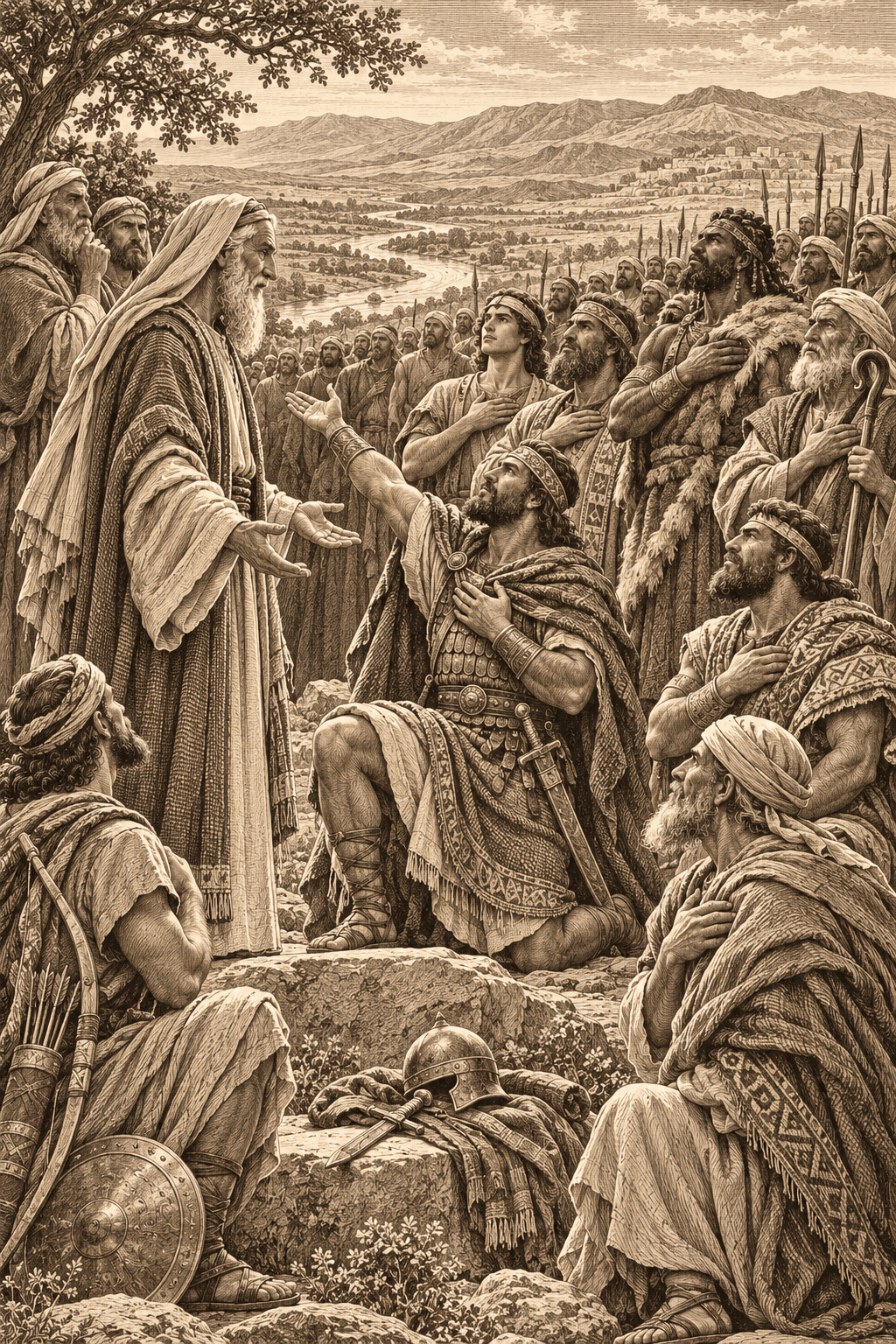
Before the firm, wise and clear words of Moses the prophet, which carried neither partiality nor domination, they were compelled to make a new offer, in which:
First: they withdrew their first offer about not crossing the Jordan, and asked instead to go at the front of the ranks of war: “But we ourselves will go ready armed before the children of Israel, until we have brought them unto their place” (17). They did not stop at sharing in the struggle; they wanted to go before them in it.
Second: they resolved not to return to their houses until the rest of the tribes had divided their lands, that is, until their brethren’s souls were at rest concerning them (18).
With this the heart of Moses the prophet was at rest, and he accepted their new offer. Indeed the heart of the Church is at rest concerning them, for they came truly to represent the men of the Old Testament who were full of faith. Though they did not set out to the land of promise with their wives, children and cattle, they crossed over as men of war supporting their brethren, the men of the New Testament. They crossed over to us to support us through their prophecies, their symbols and the Law they received. Truly the fathers and prophets of the Old Testament went at the head of the procession, to proclaim salvation through our Lord Jesus Christ!
The answer of Moses in agreeing was wonderful: he did not repeat what they had said, that they would go ready armed before the children of Israel (17), but stressed more than once, “if ye will go armed before the LORD to war” (20)… It is not merely support for your brethren; it is a declaration of submission and of a spiritual struggle in the Lord and before Him. He counted failure to carry it out as a sin against the Lord Himself (23)… So they returned to confirm their commitment to the new offer (27).
5. The Command of Moses concerning Them
KJV · Verses 28–42
28 So concerning them Moses commanded Eleazar the priest, and Joshua the son of Nun, and the chief fathers of the tribes of the children of Israel: 29 And Moses said unto them, If the children of Gad and the children of Reuben will pass with you over Jordan, every man armed to battle, before the Lord, and the land shall be subdued before you; then ye shall give them the land of Gilead for a possession: 30 But if they will not pass over with you armed, they shall have possessions among you in the land of Canaan. 31 And the children of Gad and the children of Reuben answered, saying, As the Lord hath said unto thy servants, so will we do. 32 We will pass over armed before the Lord into the land of Canaan, that the possession of our inheritance on this side Jordan may be our's. 33 And Moses gave unto them, even to the children of Gad, and to the children of Reuben, and unto half the tribe of Manasseh the son of Joseph, the kingdom of Sihon king of the Amorites, and the kingdom of Og king of Bashan, the land, with the cities thereof in the coasts, even the cities of the country round about. 34 And the children of Gad built Dibon, and Ataroth, and Aroer, 35 And Atroth, Shophan, and Jaazer, and Jogbehah, 36 And Bethnimrah, and Bethharan, fenced cities: and folds for sheep. 37 And the children of Reuben built Heshbon, and Elealeh, and Kirjathaim, 38 And Nebo, and Baalmeon, (their names being changed,) and Shibmah: and gave other names unto the cities which they builded. 39 And the children of Machir the son of Manasseh went to Gilead, and took it, and dispossessed the Amorite which was in it. 40 And Moses gave Gilead unto Machir the son of Manasseh; and he dwelt therein. 41 And Jair the son of Manasseh went and took the small towns thereof, and called them Havothjair. 42 And Nobah went and took Kenath, and the villages thereof, and called it Nobah, after his own name.
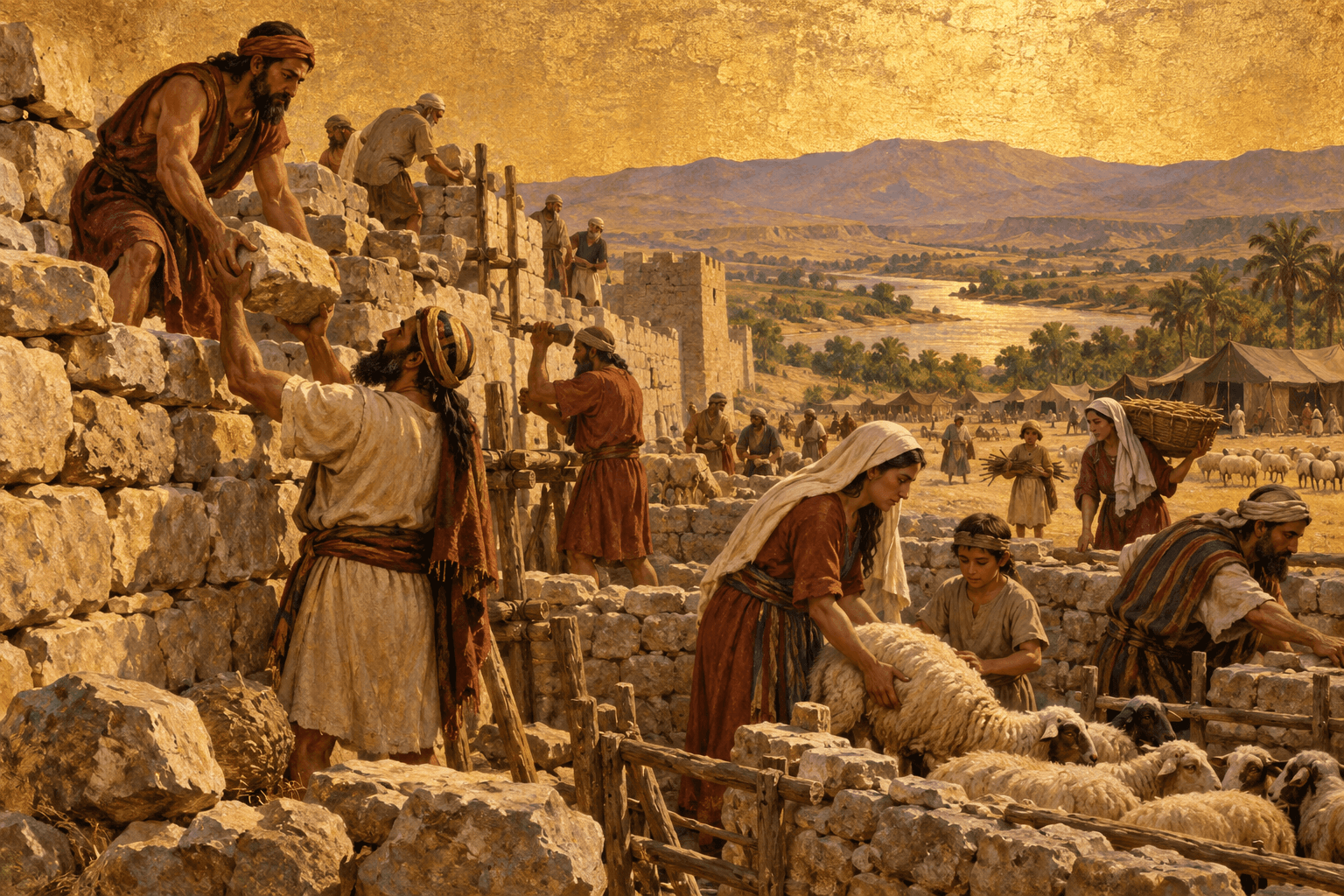
Since Moses knew that the time of his departure had come, he delivered the command into the hands of Eleazar the high priest, Joshua and the chief fathers of the tribes (28), repeating very clearly all that the men had pledged. Among them the half tribe of Manasseh appears for the first time.
These tribes built the cities and fortified them, to leave in them the wives and children with the cattle until their companions completed their struggle and returned to them. And Reuben changed the names of three cities when rebuilding them, Nebo, Baal-meon and Shibmah, because Nebo and Baal are the names of two heathen gods, and the divine command was: “make no mention of the name of other gods, neither let it be heard out of thy mouth” (Exodus 23:13). As for Shibmah, as we have seen, it means “cold.” It is not fitting for them to dwell in a cold life; rather their life should burn with the fire of divine love!
Notes and References
[287] The New Westminster Dictionary of the Bible, p. 331.
[288] J. L. McKenzie, Dictionary of the Bible, p. 310.
[289] The New Westminster Dictionary of the Bible, p. 76.
[290] McKenzie, p. 67.
[291] J. Hastings, Dictionary of the Bible, p. 100.
[292] J. Hastings, p. 692.
[293] Origen, Homilies on Numbers 26.