
After giving a quick summary of the journey in the wilderness and the closing charge shortly before they entered the land of promise, he declared the borders of this land, who would inherit it, and who would carry out the division.
1. The Borders of the Land of Promise
KJV · Verses 1–12
1 And the Lord spake unto Moses, saying, 2 Command the children of Israel, and say unto them, When ye come into the land of Canaan; (this is the land that shall fall unto you for an inheritance, even the land of Canaan with the coasts thereof:) 3 Then your south quarter shall be from the wilderness of Zin along by the coast of Edom, and your south border shall be the outmost coast of the salt sea eastward: 4 And your border shall turn from the south to the ascent of Akrabbim, and pass on to Zin: and the going forth thereof shall be from the south to Kadeshbarnea, and shall go on to Hazaraddar, and pass on to Azmon: 5 And the border shall fetch a compass from Azmon unto the river of Egypt, and the goings out of it shall be at the sea. 6 And as for the western border, ye shall even have the great sea for a border: this shall be your west border. 7 And this shall be your north border: from the great sea ye shall point out for you mount Hor: 8 From mount Hor ye shall point out your border unto the entrance of Hamath; and the goings forth of the border shall be to Zedad: 9 And the border shall go on to Ziphron, and the goings out of it shall be at Hazarenan: this shall be your north border. 10 And ye shall point out your east border from Hazarenan to Shepham: 11 And the coast shall go down from Shepham to Riblah, on the east side of Ain; and the border shall descend, and shall reach unto the side of the sea of Chinnereth eastward: 12 And the border shall go down to Jordan, and the goings out of it shall be at the salt sea: this shall be your land with the coasts thereof round about.
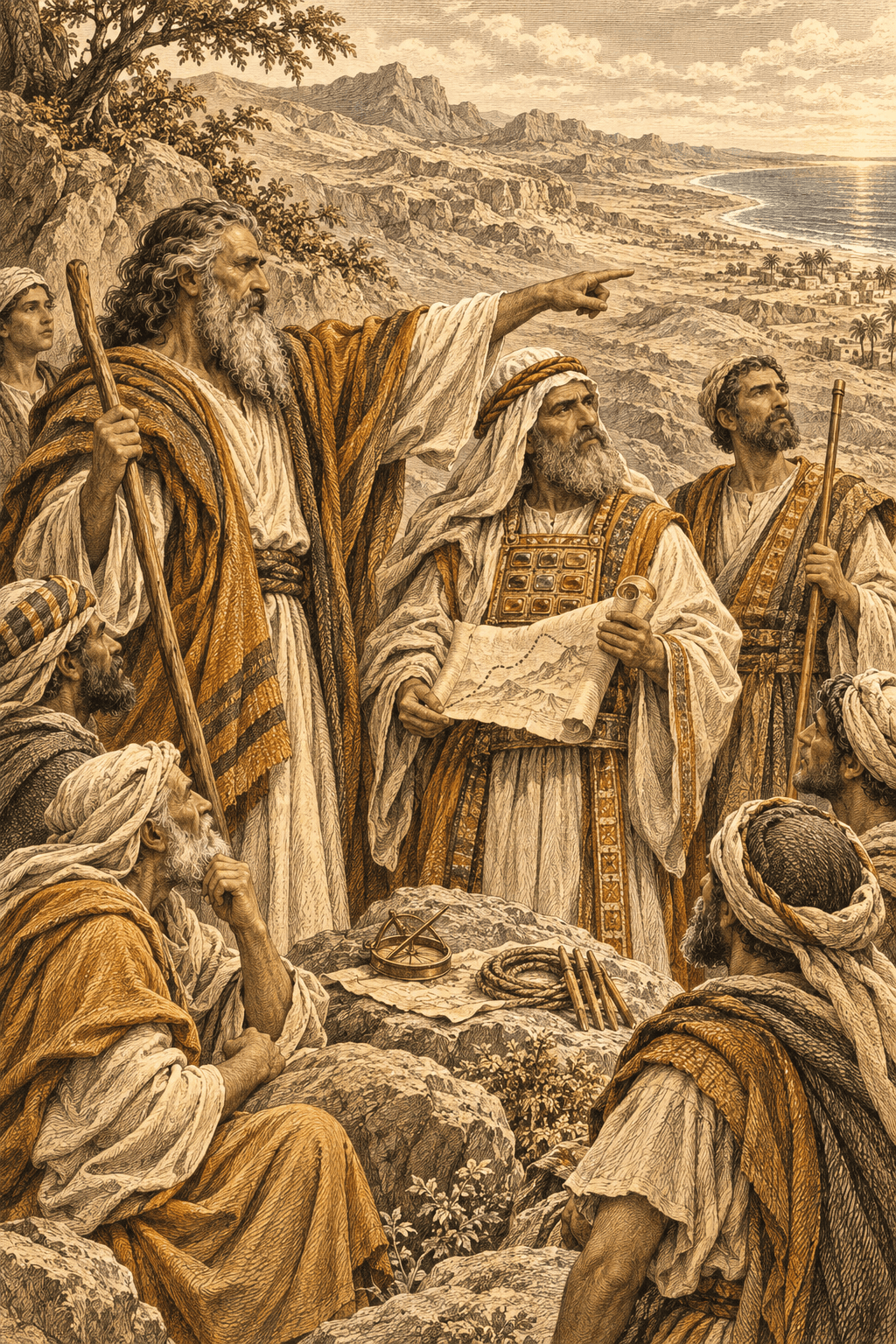
A) He did not leave the people to set its borders as they pleased, but defined its coasts in every direction, for in God’s eyes it has great importance, since it represents “a shadow of good things to come” and is a symbol of the heavenly Jerusalem. This land is very wide; the people did not possess it except in the days of David the prophet and Solomon the wise (2 Chronicles 9:26).
B) The secret of the land’s greatness is not in the extent of its borders nor in the power of its kings, but in its being the centre of divine worship for a time, until the rod should come forth out of the stem of Jesse and reign over the hearts of mankind. The Psalmist says: “In Judah is God known: his name is great in Israel. In Salem also is his tabernacle, and his dwelling place in Zion” (Psalm 76:1–2).

C) The existence of borders for the land points to the setting of certain conditions for those who enter the heavenly Jerusalem. Though it is wide and can hold all mankind, there shall in no wise enter into it anything that defileth (Revelation 21:27). It is “a glorious church, not having spot” (Ephesians 5:27). Therefore the commandment was very strict: “So ye shall not pollute the land wherein ye are… Defile not therefore the land which ye shall inhabit, wherein I dwell: for I the LORD dwell among the children of Israel” (Numbers 35:33–34). And in the Book of Jeremiah the Lord rebukes them, saying: “because they have defiled my land” (Jeremiah 16:18). These are the borders: it is His land and His dwelling place; whoever enters it in defilement storms the kingdom of God and His land!
D) He set natural borders and fortifications for them: the great sea (the Mediterranean) on the west, the salt sea, that is, the Dead Sea, on the east… and the wilderness of Zin on the south…
2. Those Who Inherit It
KJV · Verses 13–15
13 And Moses commanded the children of Israel, saying, This is the land which ye shall inherit by lot, which the Lord commanded to give unto the nine tribes, and to the half tribe: 14 For the tribe of the children of Reuben according to the house of their fathers, and the tribe of the children of Gad according to the house of their fathers, have received their inheritance; and half the tribe of Manasseh have received their inheritance: 15 The two tribes and the half tribe have received their inheritance on this side Jordan near Jericho eastward, toward the sunrising.
He defined those who would inherit it: the nine tribes and the other half of the tribe of Manasseh. As for the tribes of Reuben and Gad and the half tribe of Manasseh, they inherit nothing in it, for He says of them: “For the tribe of the children of Reuben… have received their inheritance… and half the tribe of Manasseh have received their inheritance: The two tribes and the half tribe have received their inheritance on this side Jordan near Jericho eastward” (14–15). He repeats three times that they chose the land they wanted for themselves; they chose for themselves, so they do not enjoy what the Lord chose for His people. Whoever appoints for himself by his own will is deprived of the blessings of the divine gifts.
3. The Committee for the Division
KJV · Verses 16–29
16 And the Lord spake unto Moses, saying, 17 These are the names of the men which shall divide the land unto you: Eleazar the priest, and Joshua the son of Nun. 18 And ye shall take one prince of every tribe, to divide the land by inheritance. 19 And the names of the men are these: Of the tribe of Judah, Caleb the son of Jephunneh. 20 And of the tribe of the children of Simeon, Shemuel the son of Ammihud. 21 Of the tribe of Benjamin, Elidad the son of Chislon. 22 And the prince of the tribe of the children of Dan, Bukki the son of Jogli. 23 The prince of the children of Joseph, for the tribe of the children of Manasseh, Hanniel the son of Ephod. 24 And the prince of the tribe of the children of Ephraim, Kemuel the son of Shiphtan. 25 And the prince of the tribe of the children of Zebulun, Elizaphan the son of Parnach. 26 And the prince of the tribe of the children of Issachar, Paltiel the son of Azzan. 27 And the prince of the tribe of the children of Asher, Ahihud the son of Shelomi. 28 And the prince of the tribe of the children of Naphtali, Pedahel the son of Ammihud. 29 These are they whom the Lord commanded to divide the inheritance unto the children of Israel in the land of Canaan.
The Lord defined the committee for the division by name: Eleazar the high priest, Joshua the son of Nun, the great leader, and a prince from each of the tribes inheriting the land, whom He defined by name. At their head there had to be Caleb the son of Jephunneh, who had come with Joshua many years before, bringing the cluster of grapes to the previous generation! The land is not strange to him; he had entered it before, tasted its fruit and borne witness to it, presenting a pledge of its fruits.
This is the work of the Christian: to enter the kingdom, live it and enjoy its fruit, presenting a pledge of it to his brethren… so that when the great day of the Lord comes, his name may shine like a bright star, and he may enter God’s bosom with boldness, because he has enjoyed Him before and is not a stranger to Him.
We have said that Joshua is a symbol of Jesus Christ, the great leader into the eternal kingdom; and Eleazar means “God has helped”: He helped us by His only-begotten Son, who came down to us and carried us in Himself, so that we may enjoy His kingdom. As for Caleb, it is derived from “heart,” and points to the sincerity of the heart and its zeal in enjoying the eternal inheritance. So also the rest of the names of the princes carry a meaning and reveal the features of those who enjoy the inheritance and support their brethren in enjoying it: “Shemuel” means “God has heard”; “Elidad” means “whom my God loves”; “Bukki” means “whom the Lord proves”; “Hanniel” means “God is gracious”; “Kemuel” means “the assembly of God”; “Elizaphan” means “my God has hidden”; “Paltiel” means “God has delivered”; “Ahihud” means “my brother is great”; “Pedahel” means “God has redeemed.”
In short, these names reveal the features of the eternal kingdom: it is the work of God the Redeemer, the fruit of God’s hearing us in His Son, the secret of His love for us in Him, and of His compassion toward us, who delivers us. It is given to the assembly of the saints in God, the assembly hidden in Him; in it each of us sees his brother great, and rejoices and is glad in the glories of others.