
Aaron and his sons stayed seven days, keeping to the tabernacle of the congregation. On the eighth day from the anointing they began, as the Lord commanded, to offer burnt offerings, peace offerings, meat offerings, and so on. The Lord appeared to them and revealed His glory to all the people, and fire came out from the Lord and consumed what was on the altar, which stirred the people, so that they shouted and fell on their faces.
1. The Work Begins on the Eighth Day
KJV · Verses 1
1 And it came to pass on the eighth day, that Moses called Aaron and his sons, and the elders of Israel;
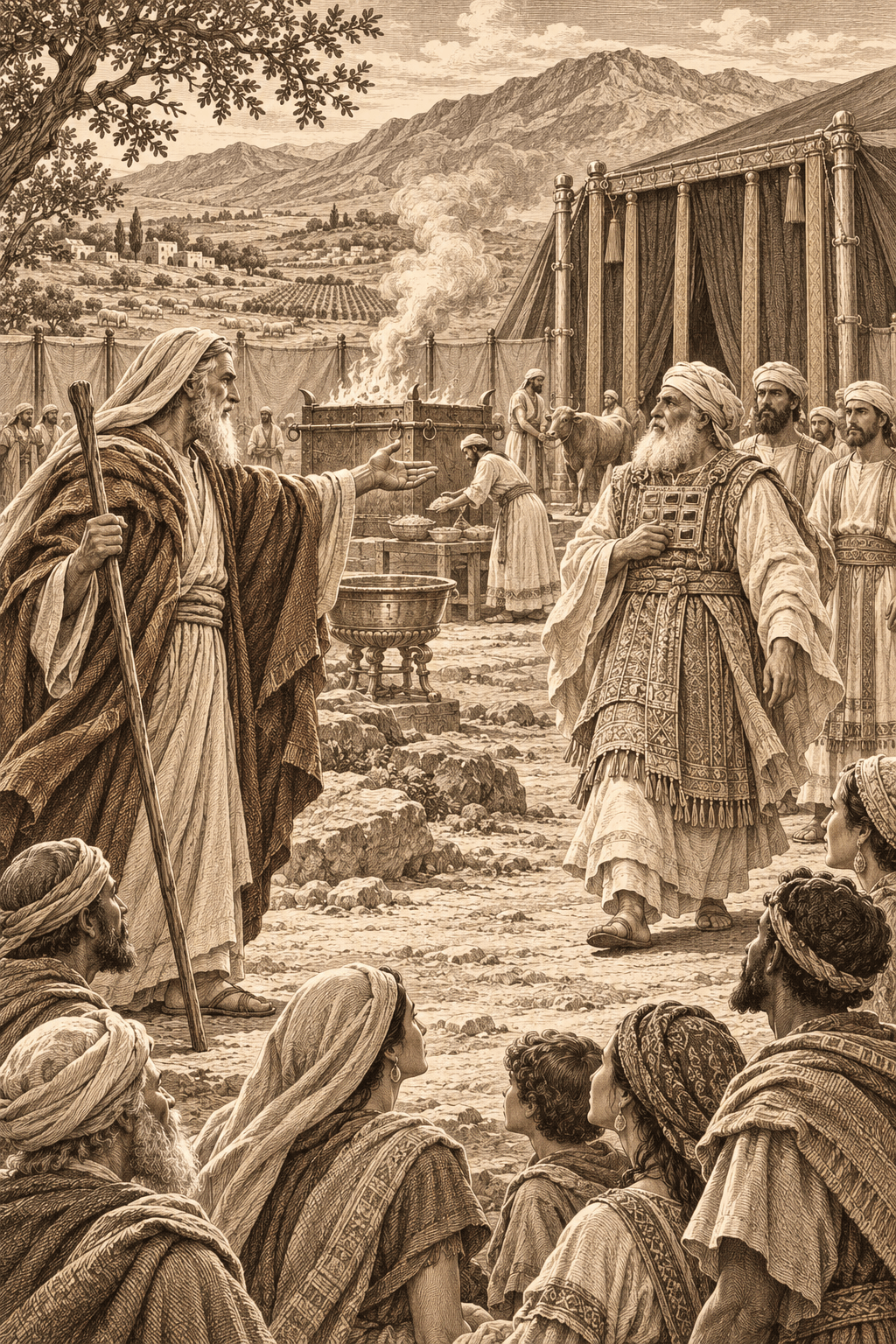
When the rite of ordaining Aaron and his sons as priests was completed, they did not practice the sacrificial work at once, but stayed by the tabernacle of the congregation seven full days, day and night. On the eighth day they began to practice this work for themselves and for the people. They waited to begin on the eighth day, which symbolizes the new, eternal life, the risen life in Christ Jesus; for the eighth day is the first day of the new week, and the Lord rose at the dawn of Sunday, the dawn of the eighth day.
It is as if the priest cannot practice his priestly work except by the Lord Christ risen from the dead, so that he goes forth to work in the power of the resurrection. Saint Augustine comments on the eighth day:
The Lord’s day is the eternal eighth day, sanctified by the resurrection of Christ, pointing to the eternal rest of body and soul. [123]
In the same thought we find the holy convocation of the Feast of Tabernacles held on the eighth day (Leviticus 23:36), when we put off the tabernacle (booth) of our earthly body to enjoy the eternal building not made with hands (2 Corinthians 5:1), by the power of the resurrection of our Lord Jesus. On the eighth day too the sacrifices of purification were offered for one with an issue (Leviticus 15:14, 29) and for the leper (Leviticus 14:10)… for by the Lord’s resurrection man receives the new creation in Christ Jesus (2 Corinthians 5:17), so that there is nothing unclean in us from the issue of evil or the leprosy of sin.
2. The Command to Offer the Sacrifices
KJV · Verses 2–7
2 And he said unto Aaron, Take thee a young calf for a sin offering, and a ram for a burnt offering, without blemish, and offer them before the Lord. 3 And unto the children of Israel thou shalt speak, saying, Take ye a kid of the goats for a sin offering; and a calf and a lamb, both of the first year, without blemish, for a burnt offering; 4 Also a bullock and a ram for peace offerings, to sacrifice before the Lord; and a meat offering mingled with oil: for to day the Lord will appear unto you. 5 And they brought that which Moses commanded before the tabernacle of the congregation: and all the congregation drew near and stood before the Lord. 6 And Moses said, This is the thing which the Lord commanded that ye should do: and the glory of the Lord shall appear unto you. 7 And Moses said unto Aaron, Go unto the altar, and offer thy sin offering, and thy burnt offering, and make an atonement for thyself, and for the people: and offer the offering of the people, and make an atonement for them; as the Lordcommanded.
In the first seven days Moses offered the sacrifices for Aaron and his sons; but on the eighth day, when the rites of their ordination were completed and they entered the eighth day as into the Lord’s resurrection, they were bound to offer sacrifices and offerings for themselves and for the people.
Some Jewish scholars hold that the calf they offered as a sin offering (2) was an atonement for the golden calf which Aaron made for the people (Exodus 32:4). [124] In any case, Aaron and his sons were bound to offer a calf as a sin offering and a ram as a burnt offering (2), from the goods of Aaron and his sons and not from the goods of the tabernacle or of the people, so that they would feel their need of atonement for their sins, known and unknown, together with their duty to offer their life as a perfect burnt offering of love to God. We have already spoken of these two sacrifices (chapters 1 and 4).
God always stresses these two thoughts to His priests: the sense of weakness together with all their brethren, and the duty to offer their whole life as a burnt offering of love to God in the service of their brethren!
Having offered these two sacrifices, they went on to offer for the people a sin offering, a burnt offering, a peace offering, and then a meat offering of flour mingled with oil (3–4). The order suits the people’s needs. The priest begins by asking forgiveness for sin through the sin offering, then declares his longing that the life of the whole people be accepted as a burnt offering of delight to the Lord. In this way the priest declares his thanks to God through the peace offering, and his acceptance of fellowship with the Lord Christ given for us through the meat offering of flour mingled with oil. He begins by entreating mercy through the merits of the blood and ends by receiving the life of Christ given for us as a divine gift which the Church lives through her union with her crucified Head!
3. Offering the Sacrifices and Offerings
KJV · Verses 8–21
8 Aaron therefore went unto the altar, and slew the calf of the sin offering, which was for himself. 9 And the sons of Aaron brought the blood unto him: and he dipped his finger in the blood, and put it upon the horns of the altar, and poured out the blood at the bottom of the altar: 10 But the fat, and the kidneys, and the caul above the liver of the sin offering, he burnt upon the altar; as the Lord commanded Moses. 11 And the flesh and the hide he burnt with fire without the camp. 12 And he slew the burnt offering; and Aaron's sons presented unto him the blood, which he sprinkled round about upon the altar. 13 And they presented the burnt offering unto him, with the pieces thereof, and the head: and he burnt them upon the altar. 14 And he did wash the inwards and the legs, and burnt them upon the burnt offering on the altar. 15 And he brought the people's offering, and took the goat, which was the sin offering for the people, and slew it, and offered it for sin, as the first. 16 And he brought the burnt offering, and offered it according to the manner. 17 And he brought the meat offering, and took an handful thereof, and burnt it upon the altar, beside the burnt sacrifice of the morning. 18 He slew also the bullock and the ram for a sacrifice of peace offerings, which was for the people: and Aaron's sons presented unto him the blood, which he sprinkled upon the altar round about, 19 And the fat of the bullock and of the ram, the rump, and that which covereth the inwards, and the kidneys, and the caul above the liver: 20 And they put the fat upon the breasts, and he burnt the fat upon the altar: 21 And the breasts and the right shoulder Aaron waved for a wave offering before the Lord; as Moses commanded.
Aaron and his sons carried out what the Lord commanded, offering sacrifices and offerings for themselves and for the people with an exact rite… We have already studied the spiritual meanings of these sacrifices and their rites in the first seven chapters.
4. The Blessing of the People and the Appearing of the Glory
KJV · Verses 22–23
22 And Aaron lifted up his hand toward the people, and blessed them, and came down from offering of the sin offering, and the burnt offering, and peace offerings. 23 And Moses and Aaron went into the tabernacle of the congregation, and came out, and blessed the people: and the glory of the Lord appeared unto all the people.
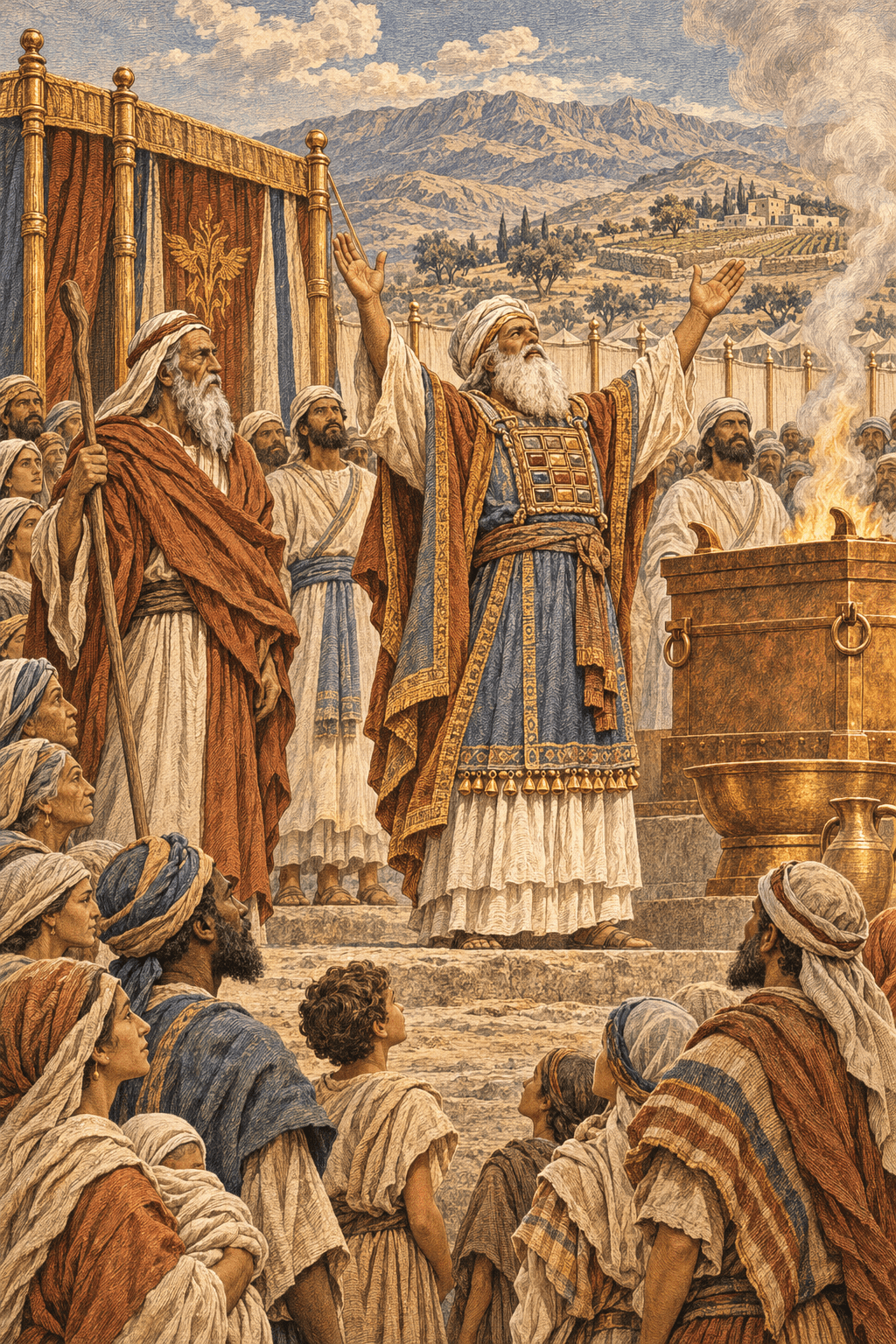
Aaron blessed the people twice. The first time, it is said: “And Aaron lifted up his hand toward the people, and blessed them, and came down from offering of the sin offering, and the burnt offering, and peace offerings” (22).
Notice in this blessing that Aaron lifted up his hand toward the people… Perhaps by this he declares the priestly authority God gave him; and perhaps lifting the hand points to the appearing of the Lord Christ, who is symbolized by the hand. [125] The blessing which the priest gives is the blessing that has become ours in Christ Jesus, who blessed our nature in Himself. The blessing came after the offering of the sacrifices… for humanity could not receive the Lord’s blessing except through the merits of the precious blood. Through the altar the priest meets the people to give the blessing, which is not his own but the blessing of the Lord who was given for us.
The text of the blessing is probably the one the Lord Himself gave to Moses: “The LORD bless thee, and keep thee: The LORD make his face shine upon thee, and be gracious unto thee: The LORD lift up his countenance upon thee, and give thee peace” (Numbers 6:24–26).
The second time was when Moses and Aaron went into the tabernacle of the congregation, then came out and blessed the people (23). The first time affirmed that the blessing comes through the holy sacrifice; here it affirms that the blessing is fulfilled through two things. The first is the meeting of Aaron with Moses, pointing to the meeting of the priesthood with the prophetic work, or of worship with the spiritual, evangelical understanding… There is no separation between our Aaron and our Moses, no isolation of the priestly work from the work of the Gospel. The second is their going into the tabernacle together, pointing to our receiving the blessing through the holy Church, for the priest is a member of the holy Church, which received the Holy Spirit as the gift of her heavenly Bridegroom. In this sense Saint Cyprian says that there is no salvation outside the Church.
From these two blessings we can say in short:
A) The blessing is the gift of the slain Christ through His priests.
B) The blessing is the gift of Christ through the Church, by the Holy Spirit given to her.
C) There is no separation between the blessing we receive through the priestly work (Aaron) and the enjoyment of the word of God (Moses the prophet).
The Appearing of the Divine Glory
When the people received the blessing at the hands of Aaron (and Moses) through the holy sacrifice within the Church, Scripture says: “And the glory of the LORD appeared unto all the people” (23)…
We do not know how the glory of the Lord appeared: was it in the form of a thick cloud surrounding God’s people? Or a pillar of fire? Or through some appearing toward the divine holy things…?! But what we know, when we enjoy the divine blessing, is that the Lord is manifest in His glory in our depths in a way the soul perceives and the heart feels!
The Apostle says: “God was manifest in the flesh… seen of angels” (1 Timothy 3:16). When we receive the Lord’s blessing we become like angels, and God appears in His glory in us.
5. The Divine Fire and the Shouting of the People
KJV · Verses 24
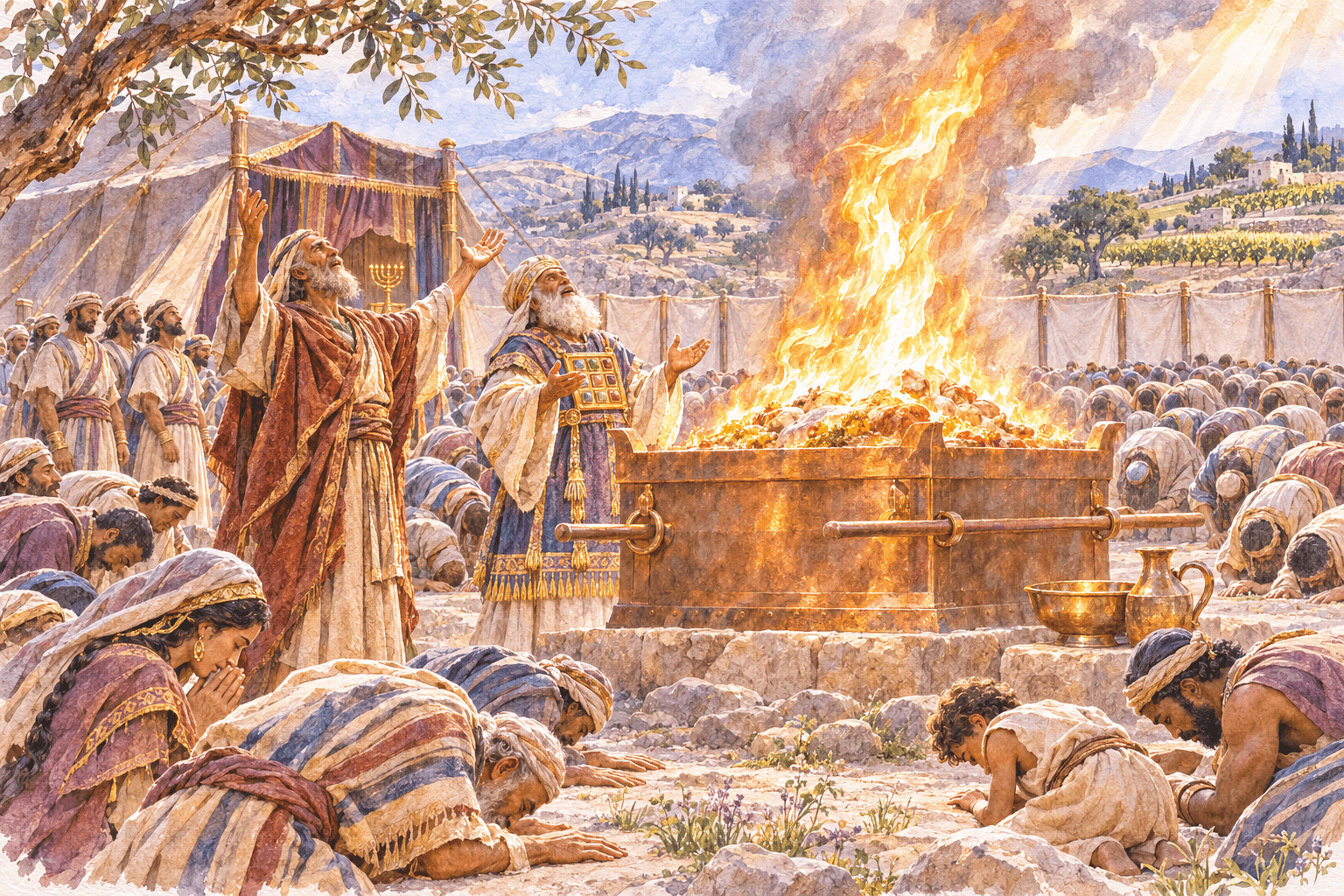
24 And there came a fire out from before the Lord, and consumed upon the altar the burnt offering and the fat: which when all the people saw, they shouted, and fell on their faces.
If sins are like a fire that burns the soul, as Saint Augustine says, [126] this fire is overcome only by the fire of the Holy Spirit, who burns up evil and sets the soul aflame with the holy life. So we exchange fire for fire!
When the people were blessed and the glory of the Lord appeared to them, fire came out from the Lord, declaring God’s acceptance of their sacrifice and His good pleasure toward them… and at the same time declaring the glory and majesty of God!
The Shouting of the People
When the people saw the glory of God and beheld the fire coming out from the Lord consuming the burnt offering, they could not restrain themselves, but “they shouted, and fell on their faces” (24). This shouting came as the natural fruit of the inner joy that filled their being. Their shouting was the fruit of receiving the Lord’s blessing, enjoying the divine glory, and seeing the holy fire. May our praise and shouting too be not merely the repeating of words of thanks and praise to God with our mouths, but the fruit of the soul’s rejoicing and of the purity and gladness of the heart, as we receive the true blessing, the glory of the Lord is manifest in us, and the fiery Spirit burns in our depths; so that the tongue speaks the true joy that our inner man bears.
The people shouted and fell on their faces, declaring their worship and complete submission to the Lord their God. It is as if our joy in the Lord and our rejoicing is the true motive of our worship of Him and our complete submission to His will.
Notes and References
[123] St. Augustine, City of God 22:30.
[124] See the interpretation of Leviticus 9 by Archdeacon Naguib Guirguis, p. 104.
[125] See Introductions to Patrology, 1974.
[126] St. Augustine, On Ps. 58.