
The eighth day of the ordination of Aaron and his sons was a joyful day for all the people. On it the glory of the Lord appeared to them, and fire came down from the Lord declaring His good pleasure toward them and His acceptance of their sacrifice; so all shouted and fell on their faces with glorious inner joy. But two of Aaron’s sons turned the joy into grief and the gladness into bitterness, for they used strange fire, and, it is thought, while drunk. So fire went out from the Lord and devoured them… which terrified everyone!
1. The Strange Fire
KJV · Verses 1
1 And Nadab and Abihu, the sons of Aaron, took either of them his censer, and put fire therein, and put incense thereon, and offered strange fire before the Lord, which he commanded them not.
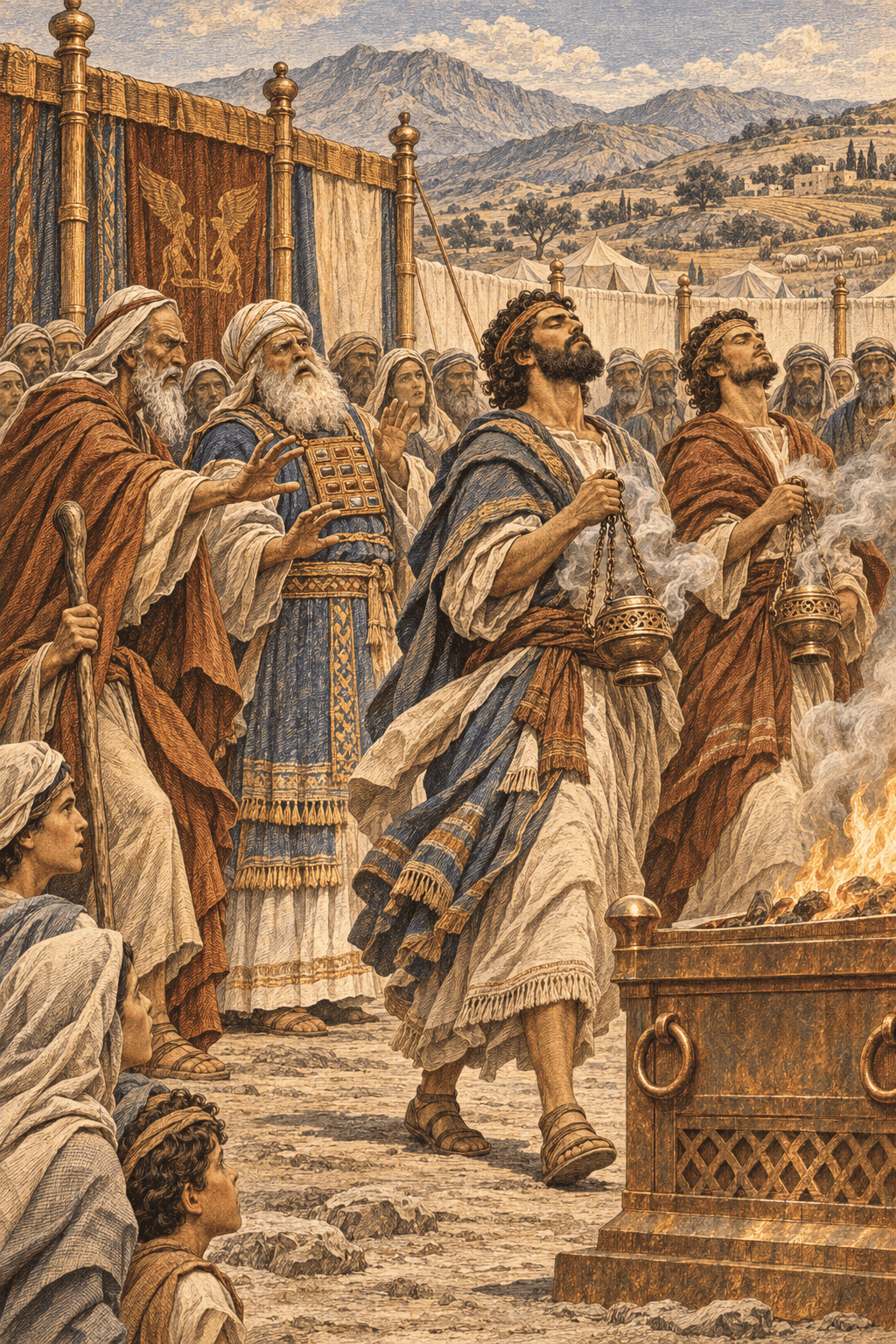
With the ordination of Aaron and his sons and the offering of the sacrifice, the glory of the Lord appeared to the people after they received the blessing, and all became as in paradise, full of gladness and shouting, for man had returned to God again as in a new friendship. But as disobedience spoiled the gladness of our first parents, so Aaron’s two sons, Nadab and Abihu, brought grief and sorrow on the people by their disobedience in offering strange fire. It seems this was done while they were drunk, for the commandment came at once forbidding the priests to drink wine or strong drink in the tabernacle (8–9)…
Saint Irenaeus comments on this event:
Truly the heretics bring strange fire to the altar of God, for they offer strange teachings, and they are burned by fire from heaven, as happened with Nadab and Abihu. [127]
And Origen says:
You have heard that those who offered unclean fire before the Lord died. And you, when you too are inflamed, when your anger fills you, rage burns you, and carnal love is kindled in you, become the victim of a shameful lust; for all this fire is uncleanness and against the Lord, and whoever kindles it will without doubt receive the portion of Nadab and Abihu. [128]
And Saint Augustine says:
Evil lust is like a burning and a fire. Does fire burn a garment, and the lust of fornication not burn the soul? [129]
2. Immediate Discipline
KJV · Verses 2–3
2 And there went out fire from the Lord, and devoured them, and they died before the Lord. 3 Then Moses said unto Aaron, This is it that the Lord spake, saying, I will be sanctified in them that come nigh me, and before all the people I will be glorified. And Aaron held his peace.
It was not easy for Aaron to see his two sons fall to the ground burned by fire before everyone… but God allowed this hard lesson at the beginning of the priestly work to show the seriousness of the priest’s role and his responsibility. If he stands as an intercessor for himself and for the people through the holy sacrifice, he must practice the holy life that befits him; otherwise he is exposed to harder and more public discipline than all the people, for the Lord says: “I will be sanctified in them that come nigh me, and before all the people I will be glorified” (3). The lesson was bitter, so that all might realize that God’s love for His priests and His hearing of their voice do not mean partiality toward them or leniency with them; rather, the nearer they come to Him, the more they must be sanctified, so that the Holy God may reveal Himself in them.
Saint John Chrysostom recorded the bitterness of his soul when he meditated on his responsibility before God to give account not only for his own sins but also for the sins of the people:
What hard punishment must a man expect who gives account not only for the sins he has committed, but bears a greater danger because of the sins others commit?! If we tremble because of our judgment for the evils we ourselves have done, sure that we cannot escape the fire that awaits us in the other world, what sufferings must he pass through who is to answer for the faults of many?! [130]
3. The Priest and Natural Feelings
KJV · Verses 4–7
4 And Moses called Mishael and Elzaphan, the sons of Uzziel the uncle of Aaron, and said unto them, Come near, carry your brethren from before the sanctuary out of the camp. 5 So they went near, and carried them in their coats out of the camp; as Moses had said. 6 And Moses said unto Aaron, and unto Eleazar and unto Ithamar, his sons, Uncover not your heads, neither rend your clothes; lest ye die, and lest wrath come upon all the people: but let your brethren, the whole house of Israel, bewail the burning which the Lord hath kindled. 7 And ye shall not go out from the door of the tabernacle of the congregation, lest ye die: for the anointing oil of the Lord is upon you. And they did according to the word of Moses.
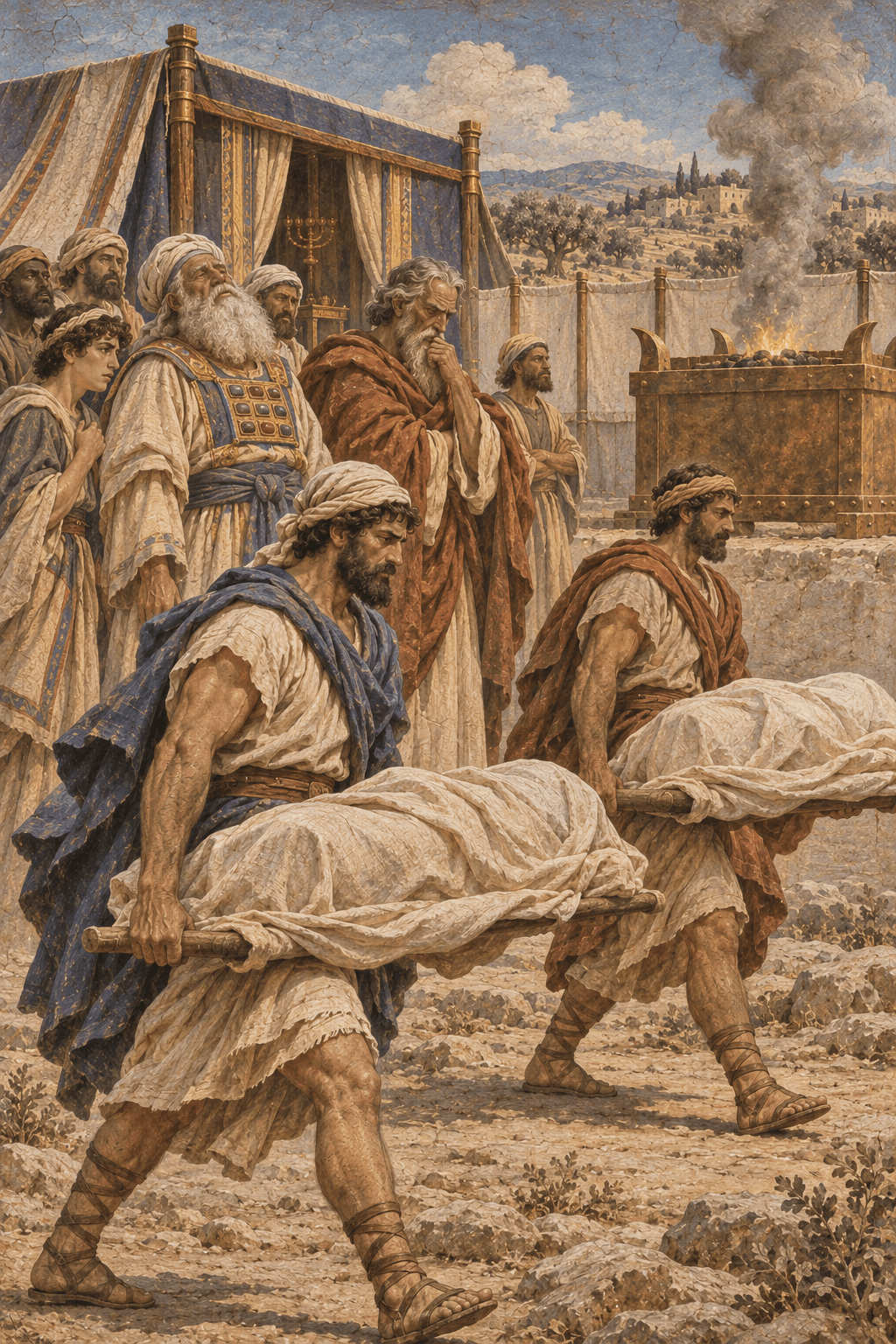
No doubt Aaron and his two sons were moved when they saw what happened to Aaron’s two other sons, Nadab and Abihu. The commandment came to lift them above natural feelings, for it was said to them: “Uncover not your heads, neither rend your clothes; lest ye die, and lest wrath come upon all the people: but let your brethren, the whole house of Israel, bewail the burning which the LORD hath kindled. And ye shall not go out from the door of the tabernacle of the congregation, lest ye die: for the anointing oil of the LORD is upon you” (6–7). As a father and as brothers they bear human feelings; but as priests of the Lord they do not suppress these feelings or crush them; rather they lift them up to offer them not only to their kin by blood but to all, so that they live serving the whole congregation as their brothers and children. The true priest lifts up all his senses and feelings to serve God in every person, and does not limit his heart to his brothers by blood.
Aaron and his two sons had to stay in the tabernacle for the service of God; as for their duties, even the burial of Nadab and Abihu, there were others to do it. This is what the Lord Christ said to the young man He called to the service: “Let the dead bury their dead: but go thou and preach the kingdom of God” (Luke 9:60).
Saint Jerome comments on this passage:
It is said: “Neither rend your clothes” (6), that is, do not grieve like the heathen, lest you die; for to us sin is death. And we find in the same book, Leviticus, a text that seems hard to some but is necessary for the faith: the high priest is forbidden to come near the dead bodies of his father or his mother, his brothers, or even his children (Leviticus 21:10–12), so that the soul occupied with offering sacrifice to God may not be distracted by any grief, but be wholly consecrated to the divine mysteries. Did we not learn the same lesson in the Gospel in other words? Was not the disciple forbidden to bid farewell to his house and to bury his dead father (Luke 9:59–62)? [131]
4. The Priest and Drinking Wine
KJV · Verses 8–11
8 And the Lord spake unto Aaron, saying, 9 Do not drink wine nor strong drink, thou, nor thy sons with thee, when ye go into the tabernacle of the congregation, lest ye die: it shall be a statute for ever throughout your generations: 10 And that ye may put difference between holy and unholy, and between unclean and clean; 11 And that ye may teach the children of Israel all the statutes which the Lordhath spoken unto them by the hand of Moses.
The commandment came to Aaron: “Do not drink wine nor strong drink, thou, nor thy sons with thee, when ye go into the tabernacle of the congregation, lest ye die: it shall be a statute for ever throughout your generations: And that ye may put difference between holy and unholy, and between unclean and clean; And that ye may teach the children of Israel all the statutes which the LORD hath spoken unto them by the hand of Moses” (9–11). It is as if the commandment did not forbid wine as a substance, for it could sometimes be used as medicine, but forbade it as an intoxicant, which makes the priest lose his balance and reason, so that he cannot distinguish between clean and unclean and loses his ability to teach the people the divine commandments. As Saint Jerome says:
So that God might keep their minds from the folly of drunkenness and enable them to understand the practice of their duties in the service of God. [132]
Saint Jerome sees in this commandment a kind of fast, [133] asking us to flee even from its smell:
Let your breath never smell of it, lest you hear the words of the philosopher: “Instead of offering a kiss, you have given me the taste of wine.” The Apostle condemns priests who drink wine (1 Timothy 3:2–3), as the old Law condemns them… And in this I do not condemn the creation of God. [134]
Origen gives two interpretations of the commandment, one literal and the other symbolic. In his literal interpretation he says:
God wants those whose inheritance He is (Numbers 18:20) to be sober, especially when they are before the altar to pray to the Lord and be sanctified by His presence. This commandment preserves their strength. The Apostle himself confirmed it in the law of the New Testament (1 Timothy 5:23)… for priests should not drink wine but be sober (Titus 1:7–8). If sobriety is the mother of the virtues, drunkenness is the mother of all vices. The Apostle declared plainly: “wine, wherein is excess” (Ephesians 5:18), showing that wine gives birth to its firstborn daughter, excess. [135]
Origen goes on at length in his symbolic interpretation of this commandment given to Aaron and his sons. We gather the following from it:
Aaron points to our Lord, “an high priest of good things to come” (Hebrews 9:11)… The sons of Aaron are the apostles, to whom He said: “Little children, yet a little while I am with you” (John 13:33). So what the Law commanded, that Aaron and his sons drink no wine or strong drink when they come near the sanctuary (9), can be applied to the true Priest, Jesus Christ our Lord, and to His sons the priests, our apostles. Let us state it this way: this priest (Aaron) with his priests drank before they came near the altar, but when they began to come near it and enter the tabernacle of the congregation, they abstained from wine… Now let us seek how our Lord and Saviour, the true Priest, with His disciples, the true priests, drink wine (spiritually) before they come near the altar, but abstain when they begin to come near.
The Saviour came into the world to offer His body as a ransom for our sins (Galatians 1:4). Before He offered it He was like one who drinks wine, for it was said of Him: “a man gluttonous, and a winebibber, a friend of publicans and sinners” (Matthew 11:19). But when the time of the crucifixion came and He drew near the altar to offer His body as a ransom, He took the cup, blessed it, and gave it to His disciples, saying: “Drink ye”; as if He said to them: “Drink, you who have not yet come near the altar; but I do not drink, for I have now come near the altar.” That is why He says: “But I say unto you, I will not drink henceforth of this fruit of the vine, until that day when I drink it new with you in my Father’s kingdom” (Matthew 26:29)…
What does this saying mean? We answer that this promise was given to the saints, that they would enjoy the new wine, for it is said: “My cup runneth over” (Psalm 23:5)… “Behold, my servants shall drink, but ye shall be thirsty” (Isaiah 65:13). Such wine is mentioned in Holy Scripture in the sense of the joy and rejoicing of the soul; so we must distinguish between the drunkenness of the night (1 Thessalonians 5:7) and the drunkenness of the day. Having understood the holy drunkenness, since the promise was made of their rejoicing, we grasp the meaning of our Saviour’s abstaining from drinking wine until the day He drinks it with His saints in the kingdom of God (Matthew 26:29). It means that my Saviour weeps over my sins and cannot taste joy as long as I continue in disobedience. Why? Because He is my Advocate with the Father, as His intimate friend John declares: “If any man sin, we have an advocate with the Father, Jesus Christ the righteous: And he is the propitiation for our sins” (1 John 2:1–2). How then, as Advocate for my sins, can He drink the wine of joy while I grieve Him with my sins?! How can He who comes near the sanctuary as a propitiation for me, the sinner, be joyful while the grief of my sins rises to Him without ceasing…?! He is in grief as long as we continue in sin…
If His Apostle says: “I shall bewail many which have sinned already, and have not repented of the uncleanness and fornication and lasciviousness which they have committed” (2 Corinthians 12:21), what shall we say of Him who is called “his dear Son” (Colossians 1:13), who “made himself of no reputation” (Philippians 2:7) because of His love for us?! He who, being equal with the Father, sought not His own (1 Corinthians 13:5) but what is for our good, emptying Himself for us?! Having sought our good, does He now cease to seek us and to think of our good?! Does He not grieve over our sins and weep over our loss and our wounds, He who wept over Jerusalem, saying to her: “How often would I have gathered thy children together, even as a hen gathereth her chickens under her wings, and ye would not!” (Matthew 23:37)? He who bore our wounds and suffered for us as the Physician of our souls and bodies, does He now neglect the inflammation of our wounds?! The prophet says: “My wounds stink and are corrupt because of my foolishness” (Psalm 38:5). For this reason He stands before the face of the Father interceding for us (Hebrews 9:24); He stands before the sanctuary to offer God a ransom as a propitiation for our service.
And as He comes near the sanctuary He says: “I will not drink henceforth of this fruit of the vine, until that day when I drink it new with you in my Father’s kingdom” (Matthew 26:29). He waits until we are changed, imitate Him, and bear His marks, so that He may rejoice with us and drink the wine (spiritual joy) with us in the Father’s kingdom. Now, since He is the God of mercy and forgiveness (Psalm 103:8), with a greater affection than His Apostle’s He weeps with those who weep, longing to rejoice with those who rejoice; and He mourns more than His Apostle over those who have sinned and have not yet repented (2 Corinthians 12:21). We must not think that Paul grieves and mourns over evildoers while our Lord ceases to weep as He comes near to the Father before the altar, offering Himself as a propitiation for us. We say that as He comes near the sanctuary He does not drink the wine of joy, but grieves over our sins… our negligence in our life postpones His joy! How long does He wait? Until He finishes His work (John 17:4). When does He finish His work? When He makes me, the last of all and the worst of sinners, perfect! His work is counted incomplete as long as I am not yet perfect, as long as I am not yet subject to the Father (1 Corinthians 15:28); for He is counted as one not subject to the Father because of me, and His work is not yet complete… [136]
Origen continues his discussion of the duty of Aaron and his sons the priests to abstain from wine when they come near to serve. After speaking of the Lord Christ, whom Aaron symbolizes, he speaks of the apostles and disciples, since the sons of Aaron are a symbol of them:
Let us not forget that not only Aaron does not drink wine, but his sons also do not drink when they enter the holy place; for the apostles too have not yet received their joy, but are waiting until we have a share with them in their joy. When the saints depart from here they do not receive the reward they deserve all at once, but wait for us despite our slowness, for they do not have the fullness of joy as long as they grieve over our sins and weep over us… And to have a witness to what I say, so that you do not doubt… after the Apostle listed the holy fathers who were justified, he added: “And these all, having obtained a good report through faith, received not the promise: God having provided some better thing for us, that they without us should not be made perfect” (Hebrews 11:39–40). So Abraham waits to enjoy the state of perfection, and Isaac and Jacob and all the prophets wait to obtain the eternal happiness with us… There is one body, which we say rises on the day of judgment… You will have joy on the day of your departure from this life, if you are a saint; but your joy will be complete when not a member of the body is missing, for you wait for your brethren as your brethren before you waited for you. [137]
5. The Priest and Eating the Portions
KJV · Verses 12–20
12 And Moses spake unto Aaron, and unto Eleazar and unto Ithamar, his sons that were left, Take the meat offering that remaineth of the offerings of the Lordmade by fire, and eat it without leaven beside the altar: for it is most holy: 13 And ye shall eat it in the holy place, because it is thy due, and thy sons' due, of the sacrifices of the Lord made by fire: for so I am commanded. 14 And the wave breast and heave shoulder shall ye eat in a clean place; thou, and thy sons, and thy daughters with thee: for they be thy due, and thy sons' due, which are given out of the sacrifices of peace offerings of the children of Israel. 15 The heave shoulder and the wave breast shall they bring with the offerings made by fire of the fat, to wave it for a wave offering before the Lord; and it shall be thine, and thy sons' with thee, by a statute for ever; as the Lord hath commanded. 16 And Moses diligently sought the goat of the sin offering, and, behold, it was burnt: and he was angry with Eleazar and Ithamar, the sons of Aaron which were left alive, saying, 17 Wherefore have ye not eaten the sin offering in the holy place, seeing it is most holy, and God hath given it you to bear the iniquity of the congregation, to make atonement for them before the Lord? 18 Behold, the blood of it was not brought in within the holy place: ye should indeed have eaten it in the holy place, as I commanded. 19 And Aaron said unto Moses, Behold, this day have they offered their sin offering and their burnt offering before the Lord; and such things have befallen me: and if I had eaten the sin offering to day, should it have been accepted in the sight of the Lord? 20 And when Moses heard that, he was content.
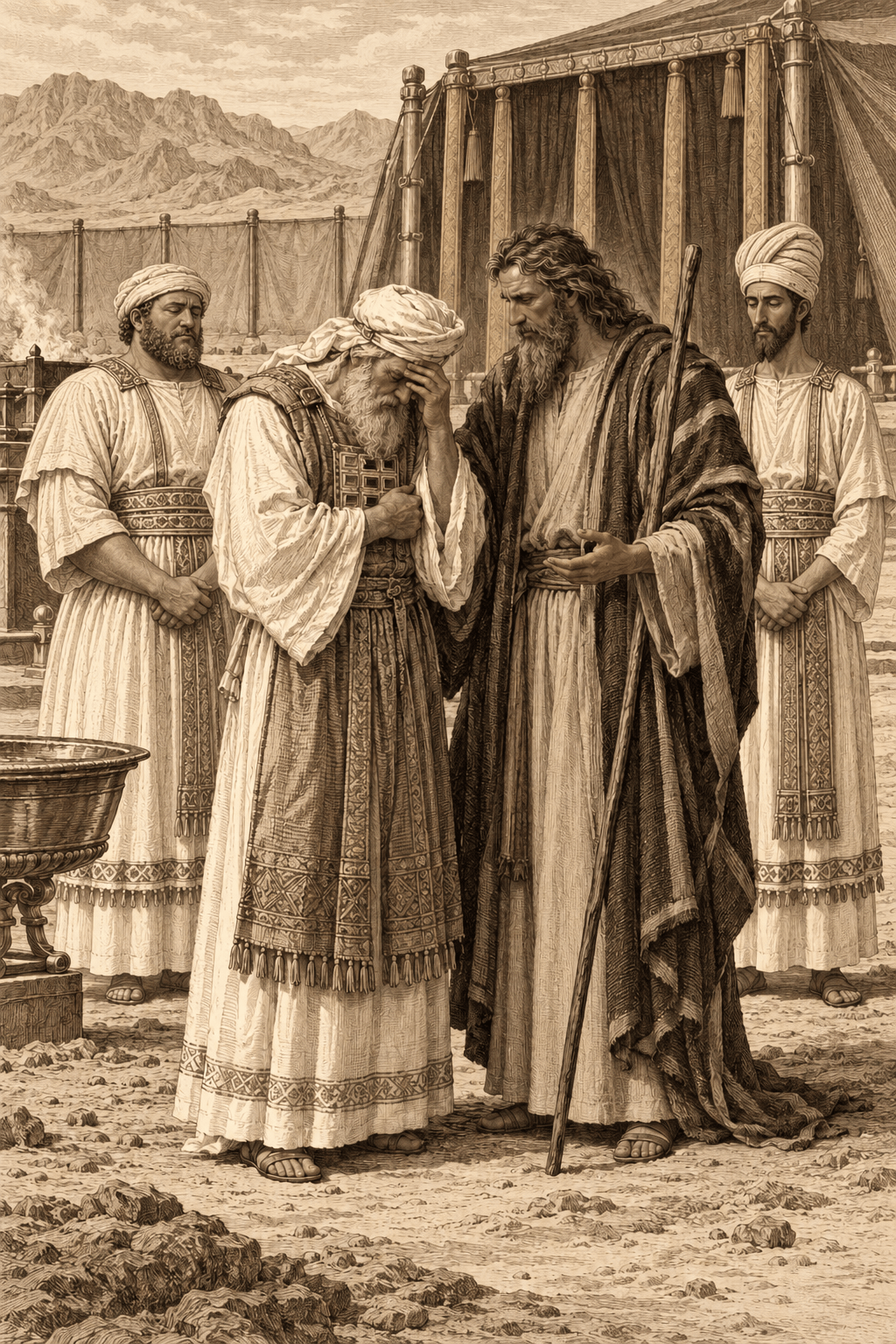
It seems that grief had filled the heart of Aaron and his two sons over what happened to Nadab and Abihu, or perhaps they were in fear and trembling, so they could not eat their portions. So Moses encouraged them to leave their grief and eat their portions of the offerings of the Lord made by fire, of the unleavened bread and of the peace offering, reminding them of the divine commandment about eating their portions with a certain rite. When Moses inquired about the goat of the sin offering, he found it had been wholly burned, contrary to the rite… They should have eaten their portion of it as a sign of God’s acceptance of the sacrifice. So Moses was angry with his two nephews, but not with Aaron, perhaps because of his position as high priest… But Aaron offered an excuse for them: it was not possible for them to eat on the day when this had befallen him in his sons. Perhaps he meant: our hearts are sad, and we feel that what Nadab and Abihu committed is a stain of shame on us; is it fitting for them to eat with hearts so stained with the shame of sin?!
When Moses heard Aaron’s excuse, “he was content” (20); he was convinced, appreciated the circumstances, and did not cling to his own opinion.
Notes and References
[127] St. Irenaeus, Adv. Haer. 4:26:2.
[128] Origen, In Lev. hom. 9:9.
[129] St. Augustine, On Ps. 58.
[130] Fr. Tadros Yacoub Malaty, Saint John Chrysostom, 1980.
[131] St. Jerome, Ep. 39:4.
[132] St. Jerome, Ep. 52:11.
[133] St. Jerome, Against Jovinian 2:15.
[134] St. Jerome, Ep. 52:11.
[135] Origen, In Lev. hom. 7:1.
[136] Ibid. 7:1–2.
[137] Ibid. 7:2.