
Chapters 8–10: The Consecration of Aaron and His Sons
In the Book of Exodus (chapters 25–30) Moses the prophet received the divine command to set up the tabernacle of the congregation and furnish it, to make the priestly garments, and to consecrate the priests. The following chapters (35–40) declare the carrying out of the divine command about the tabernacle, its setting up, and its acceptance by God. The matter of consecrating the priests was put off until after the laws of the sacrifices and offerings in Leviticus (chapters 1–7), to join the sacrifices to the priesthood and the priesthood to the sacrifices: there is no sacrifice without a priest, and no priestly work outside the sacrifice.
If the priesthood of Aaron and his sons bears a symbol and shadow of the priesthood of the Lord Christ, which rests not on the Levitical order but on the order of Melchizedek (Hebrews 7), the anointing of Aaron and his sons reveals in a symbolic way the priestly role of the Lord Christ.
These chapters also reveal the meaning of the life of consecration to the great High Priest, our Lord Jesus, since we are His anointed ones, united with our true Christ. This general consecration, which must mark every Christian, he accepted in the waters of baptism: to be for the Lord alone, handing his whole heart over to Him. So he becomes a priest to Him, not in the sense of the priesthood received in the sacrament of priesthood to practice the holy sacramental work, but in the general priesthood, through which every believer has the right to stretch out his hands to offer sacrifices of praise and glorification and offerings of prayers and supplications… Saint John Chrysostom, who received the sacrament of priesthood and left us his six books “On the Priesthood,” among the finest the fathers have given us on this subject, also writes of the general priesthood:
You too became a king, a priest, and a prophet in the font. You became a king, crushing the works of evil and killing your sins with authority; you became a priest, offering your life to God as one who sacrifices his body and so sacrifices himself, for it is said: “For if we be dead with him, we shall also live with him” (2 Timothy 2:11). And you became a prophet, knowing what will happen in the future, since you have been inspired by God and sealed (by the anointing). For as soldiers are sealed, so the Spirit seals the believers. [110]
The Rite of Consecration
The rite of consecration rested on an important principle: “sanctification by the blood of the sacrifice,” together with setting apart for the divine work by the Holy Spirit.
1. Preparing for the Rite of Consecration
KJV · Verses 1–5
1 And the Lord spake unto Moses, saying, 2 Take Aaron and his sons with him, and the garments, and the anointing oil, and a bullock for the sin offering, and two rams, and a basket of unleavened bread; 3 And gather thou all the congregation together unto the door of the tabernacle of the congregation. 4 And Moses did as the Lord commanded him; and the assembly was gathered together unto the door of the tabernacle of the congregation. 5 And Moses said unto the congregation, This is the thing which the Lordcommanded to be done.
Moses prepared everything to carry out the rite of consecration with great exactness, stressing two matters of the highest importance:
A) He prepared Aaron and his sons and brought them, as he prepared the priestly garments, the anointing oil, the animals for sacrifice, and the unleavened bread for the offering, and gathered the congregation at the door of the tabernacle of the congregation. What he did was in fulfillment of God’s orders, for the repeated refrain of this chapter is: “This is the thing which the LORD commanded to be done” (5), or “as the LORD commanded Moses” (4, 9, 13, 17, 21, 29, etc.).
Moses the prophet, the first leader of the people, had no right to act in choosing the priests or in arranging the rite of their consecration except according to God’s plan and arrangement. This declares that what was fulfilled by the coming of the Lord Christ was an eternal plan arranged by the Father Himself, for the Lord says: “For God so loved the world, that he gave his only begotten Son, that whosoever believeth in him should not perish, but have everlasting life” (John 3:16); and: “And this is life eternal, that they might know thee the only true God, and Jesus Christ, whom thou hast sent… and have known surely that I came out from thee, and they have believed that thou didst send me” (John 17:3, 8). This sending does not lessen the positive role of the Son, for the Apostle says: “Christ also hath loved us, and hath given himself for us an offering and a sacrifice to God for a sweetsmelling savour… even as Christ also loved the church, and gave himself for it” (Ephesians 5:2, 25). The Father made the plan and played a positive role, not as some Gnostics claimed, that the Lord Christ loves mankind while the God of the Old Testament is harsh and violent. Both the Father and the Son played their positive role in our salvation, and their wills agreed completely, for they are one in divinity, essence, and will.
If it was the Father who sent His Son, who bears the very will of the Father without any conflict, then in the ordination of priests, of whatever rank, we must leave the matter in God’s hands, for Him to choose and call whom He wills, to work His good will in them. That is why the Lord Christ commands us: “Pray ye therefore the Lord of the harvest, that he will send forth labourers into his harvest” (Matthew 9:38). In this spirit the Church entreats in the liturgy of the Eucharist: “Those who rightly divide the word of truth, grant them, O Lord, to Your Church, to shepherd Your flock in peace.”
It is the duty of every member of the Church, as a priest or as one of the people, to offer prayers and supplications with fasts and metanoias, that God may choose pastors after His own heart.
B) If the priest is God’s choice, and the rite of his ordination is by exact divine arrangement, God declared that the priest is ordained for the sake of the congregation. So He asked Moses to gather all the congregation to the door of the tabernacle of the congregation. In other words, the Church is not the company of the priests but the whole people, which includes the priests as servants of the people working for the kingdom of God, that is, for the holy congregation, and not for themselves. Saint John Chrysostom declared this in more than one place, affirming that the priest is a priest only for the sake of the people…
In this spirit the Church canons and the writings of the fathers affirmed the duty of the people not only to pray for the choice of the priest but also to play their part in the choice by the Spirit of God. So the commendation of the father patriarch says: “By the work of the Holy Spirit, with the agreement of all of us, with gladness of heart and the consent of the congregation.” [111] The Canons of the Apostles insist on the ordination of a bishop: “Let all the people, the presbyters, and the deacons gather.” [112] And the Canons of Hippolytus say: “Let the bishop be chosen by the people… and in the week in which he is ordained let all the clergy and the people say, We choose him.” [113]
Some scholars have noticed that the word “assembly” here, meaning “church” or ekklesia, appears here for the first time in Holy Scripture. It is as if the Church gathers for the first time at the anointing, to declare her existence through her Priest, our Lord Jesus Christ, anointed as her Head; for the body has no existence except through its union with the Head.
2. The Washing
KJV · Verses 6
6 And Moses brought Aaron and his sons, and washed them with water.
Before Aaron and his sons put on the priestly garments, Moses brought them and washed them with water (6), to assure them of two important sides of their priestly life. The first is that the Holy God works in His priests who are sanctified in Him and washed from every weakness; the second is that the priest, of whatever rank, is a man under weakness who needs to be washed first so that he can wash the feet of others. Saint John Chrysostom affirmed this for himself as for his brother priests, declaring the priest’s duty to care for the salvation of his own soul so that he can care for his spiritual children:
My words are more useful to my own life than to those who hear me. [114]
Origen sees in the washing of the priests before they put on the priestly garments a reference to the need for complete washing in the waters of baptism, that we may put on the Lord Christ, and the need for continual washing from evil by separating ourselves from it, that we may remain always clothed with our Lord Jesus Christ. He says:
Truly we cannot be clothed unless we are first washed. So “Wash you, make you clean; put away the evil of your doings” (Isaiah 1:16). If you are not washed in this way, you cannot put on the Lord Jesus Christ, as the Apostle says: “But put ye on the Lord Jesus Christ, and make not provision for the flesh, to fulfil the lusts thereof” (Romans 13:14). Let Moses wash you, and let him clothe you himself. How does Moses wash us? Moses in the Holy Scriptures represents the Law, as it is said in the Gospel: “They have Moses and the prophets; let them hear them” (Luke 16:29). So the Law of the Lord washes you and melts away your defilement if you listen to it… You who want to enjoy holy baptism and receive the grace of the Spirit must be purified by the Law, that is, hear the word of the Lord, put away your natural vices, and soften your savage natures, so that when you have gained humility and meekness you may enjoy the grace of the Holy Spirit. The Lord says by the prophets: “Where is the place of my rest?… but to this man will I look, even to him that is poor and of a contrite spirit, and trembleth at my word” (Isaiah 66:1–2). If you are not meek and humble and do not receive the word of God with trembling, the grace of the Spirit will not dwell in you, for the Holy Spirit flees from the proud and hypocritical soul. [115]
Saint John Chrysostom speaks to us of the inner washing:
To pray with unwashed hands is a trifling matter; but to pray with an unwashed mind is the worst of evils. Hear what was said to the Jews, who were occupied with outward defilement: “O Jerusalem, wash thine heart from wickedness… How long shall thy vain thoughts lodge within thee?” (Jeremiah 4:14). Let us too be washed, not with mud but with clean water, with almsgiving, not with greed. Let us depart from evil and do good (Psalm 37:27). [116]
3. The Priestly Garments
KJV · Verses 7–9
7 And he put upon him the coat, and girded him with the girdle, and clothed him with the robe, and put the ephod upon him, and he girded him with the curious girdle of the ephod, and bound it unto him therewith. 8 And he put the breastplate upon him: also he put in the breastplate the Urim and the Thummim. 9 And he put the mitre upon his head; also upon the mitre, even upon his forefront, did he put the golden plate, the holy crown; as the Lord commanded Moses.
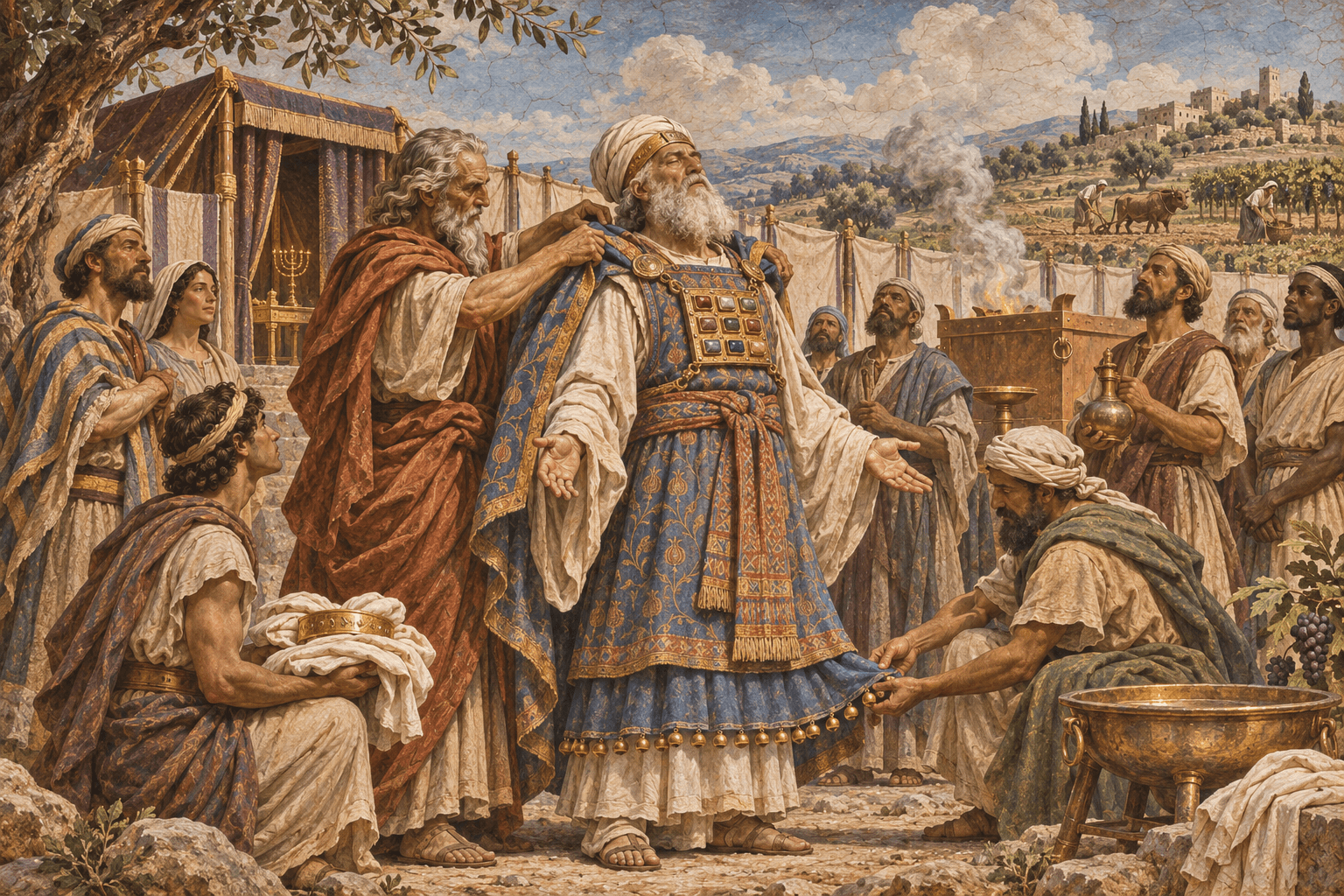
When Moses had washed Aaron and his sons, he clothed them with the priestly garments, so that they would appear before God not in a covering of fig leaves like the first Adam, nor in coats of animal skin declaring their need for covering, but clothed with the Lord Christ Himself and hidden in Him, since He is the great High Priest who works in His priests. As Saint John Chrysostom says:
It is the Lord Himself who works and who offers all. [117]
We fill the place of servants; but it is He Himself who blesses, and He who changes the offerings. [118]
What we say of the priests putting on the Lord Christ to practice the priestly work we repeat of every believer in the practice of the daily life of worship: without Him our worship is not accepted. Origen says:
I want to compare the tragedy that the first man put on when he sinned with that of holiness and faith. It is said that the LORD God made “unto Adam also and to his wife… coats of skins, and clothed them” (Genesis 3:21). These coats of skin taken from animals suit the sinner, for they were a symbol of the death that comes from sin, of his fall, and of the corruption of his body. But when you are washed by the Law of Moses and purified, Moses clothes you with incorruptible garments, so that your shame is not seen (Exodus 20:26), “that mortality might be swallowed up of life” (2 Corinthians 5:4). [119]
The priestly garments included the coat, the girdle, the robe, the ephod, the curious girdle of the ephod, the breastplate with the Urim and the Thummim, the mitre, and the golden plate, the holy crown (7–9). Since we have spoken of these garments and the symbols they carry in our study of the Book of Exodus, [120] I will give now only brief comments on these garments mentioned by Origen in his homilies on Leviticus: [121]
A) The priest wears two coats, perhaps meaning the coat and the robe. In the Old Testament the Law had to be practiced literally in its rite together with the spiritual understanding; but the Lord forbade the priests of the New Testament to have two coats (Luke 3:11), for they should not receive the letter but walk by the spirit. So when the apostles met together, they decided not to burden those of the Gentiles coming to the faith, and were content to give the people the garment of the spirit without the letter of the Law (Acts 15).
B) The priest girds himself with the girdle and the curious girdle, pointing to his duty to be guarded in speech as in action. As he preaches with the mouth, he should preach with action too, through a virtuous life and purity of body.
C) The Urim and the Thummim are put in the breastplate, pointing to the priest’s duty to have wisdom and understanding together, or truth and knowledge. “It is not enough for the priest to have wisdom only; he must also have knowledge… so that he can answer everyone who asks him the reason for the faith and the truth.”
D) The mitre or crown: “Then the crown is set on his head, and on his forehead the golden plate is placed (9), on which the name of the Lord is engraved (Exodus 28:36–38). The name of the Lord is inscribed on the ornament of the head… He is the head of all the members, and the adornment of all the members is set above the head.” “The fullness of the knowledge of God is what adorns your head.”
4. The Anointing with Oil
KJV · Verses 10–13
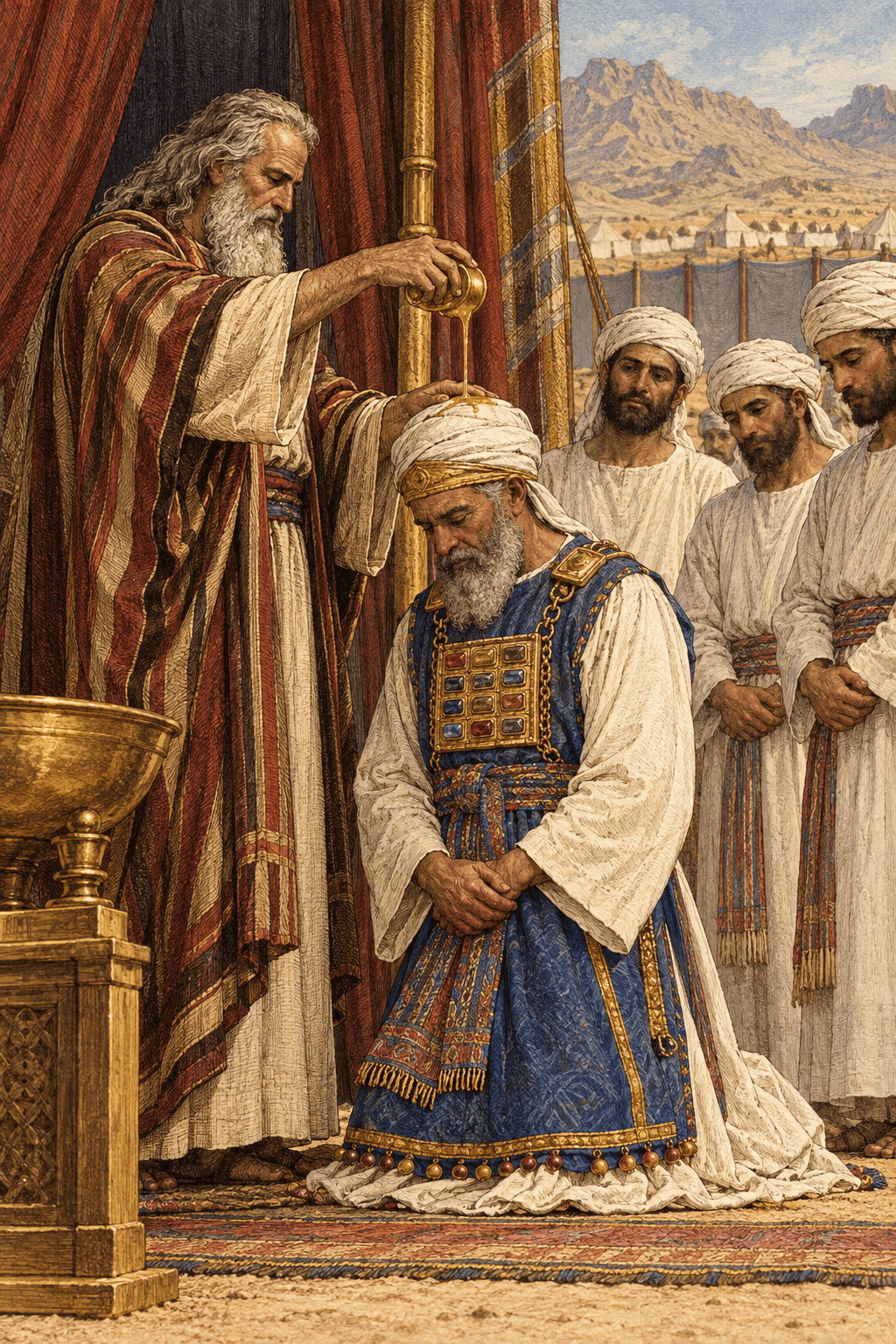
10 And Moses took the anointing oil, and anointed the tabernacle and all that was therein, and sanctified them. 11 And he sprinkled thereof upon the altar seven times, and anointed the altar and all his vessels, both the laver and his foot, to sanctify them. 12 And he poured of the anointing oil upon Aaron's head, and anointed him, to sanctify him. 13 And Moses brought Aaron's sons, and put coats upon them, and girded them with girdles, and put bonnets upon them; as the Lord commanded Moses.
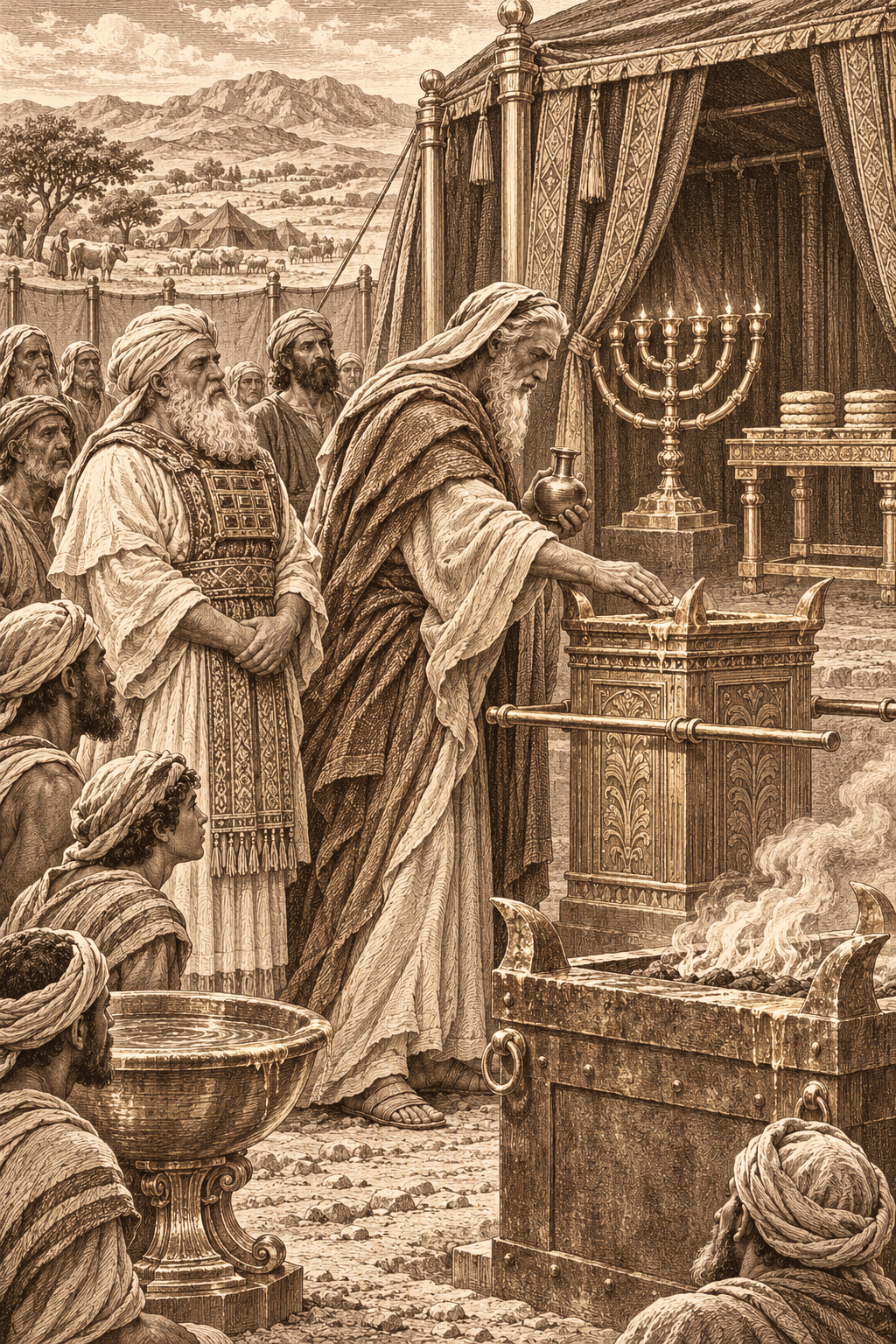
In the second chapter, speaking of the meat offering, we saw that the oil points to the anointing, and that the anointing which Aaron and his sons enjoyed was a symbol of the Lord Christ, who was anointed not with oil but with His Holy Spirit, as the great High Priest who offers His life as a burnt offering and a sacrifice of love for our sins.
Aaron and his sons were anointed so that they would have the right to offer sacrifices for themselves and for the people, and to practice prayers and supplications. But the Word of God became flesh for our sake, as our representative and great High Priest, who intercedes by His blood with the Father, praying for us, and dwells in us so that through Him we practice our prayers and worship, and He receives these prayers… As Saint Augustine says:
He prays for us, and in us, and is prayed to by us. He prays for us as our Priest; He prays in us as our Head; and He is prayed to by us as our God. [122]
5. Sanctification by the Sacrifice
KJV · Verses 14–32
14 And he brought the bullock for the sin offering: and Aaron and his sons laid their hands upon the head of the bullock for the sin offering. 15 And he slew it; and Moses took the blood, and put it upon the horns of the altar round about with his finger, and purified the altar, and poured the blood at the bottom of the altar, and sanctified it, to make reconciliation upon it. 16 And he took all the fat that was upon the inwards, and the caul above the liver, and the two kidneys, and their fat, and Moses burned it upon the altar. 17 But the bullock, and his hide, his flesh, and his dung, he burnt with fire without the camp; as the Lord commanded Moses. 18 And he brought the ram for the burnt offering: and Aaron and his sons laid their hands upon the head of the ram. 19 And he killed it; and Moses sprinkled the blood upon the altar round about. 20 And he cut the ram into pieces; and Moses burnt the head, and the pieces, and the fat. 21 And he washed the inwards and the legs in water; and Moses burnt the whole ram upon the altar: it was a burnt sacrifice for a sweet savour, and an offering made by fire unto the Lord; as the Lord commanded Moses. 22 And he brought the other ram, the ram of consecration: and Aaron and his sons laid their hands upon the head of the ram. 23 And he slew it; and Moses took of the blood of it, and put it upon the tip of Aaron's right ear, and upon the thumb of his right hand, and upon the great toe of his right foot. 24 And he brought Aaron's sons, and Moses put of the blood upon the tip of their right ear, and upon the thumbs of their right hands, and upon the great toes of their right feet: and Moses sprinkled the blood upon the altar round about. 25 And he took the fat, and the rump, and all the fat that was upon the inwards, and the caul above the liver, and the two kidneys, and their fat, and the right shoulder: 26 And out of the basket of unleavened bread, that was before the Lord, he took one unleavened cake, and a cake of oiled bread, and one wafer, and put them on the fat, and upon the right shoulder: 27 And he put all upon Aaron's hands, and upon his sons' hands, and waved them for a wave offering before the Lord. 28 And Moses took them from off their hands, and burnt them on the altar upon the burnt offering: they were consecrations for a sweet savour: it is an offering made by fire unto the Lord. 29 And Moses took the breast, and waved it for a wave offering before the Lord: for of the ram of consecration it was Moses' part; as the Lord commanded Moses. 30 And Moses took of the anointing oil, and of the blood which was upon the altar, and sprinkled it upon Aaron, and upon his garments, and upon his sons, and upon his sons' garments with him; and sanctified Aaron, and his garments, and his sons, and his sons' garments with him. 31 And Moses said unto Aaron and to his sons, Boil the flesh at the door of the tabernacle of the congregation: and there eat it with the bread that is in the basket of consecrations, as I commanded, saying, Aaron and his sons shall eat it. 32 And that which remaineth of the flesh and of the bread shall ye burn with fire.
The Lord Christ, the Priest after the order of Melchizedek, offered His life as a sacrifice on the cross for humanity, with no need to offer a sacrifice for Himself, for He is the Son of the living God, without blemish. But Aaron and his sons could not practice their priestly work unless they were sanctified through the sacrifice, their life, senses, and gifts sanctified for the kingdom of God. So on the day of their consecration the following sacrifices were offered:
- The bullock for the sin offering, on whose head Aaron and his sons laid their hands, so that it would bear their sins and weaknesses (14).
- The ram for the burnt offering (18).
- The ram of consecration, of whose blood Moses took and put on the tip of Aaron’s right ear, on the thumb of his right hand, and on the great toe of his right foot, and did the same with Aaron’s sons (22–24)… to declare the sanctification of their spiritual (right) ears to hear the words of the Lord with understanding and wisdom, as the Lord says: “He that hath ears to hear, let him hear”; the sanctification of their spiritual hands to work without slackness in the Lord’s field; and the sanctification of their spiritual feet to go forth with the people on the Lord’s way toward the heavenly things.
- Then he put on Aaron’s hands and on his sons’ hands one unleavened cake, a cake of oiled bread, and one wafer, as an offering to the Lord, and waved them for a wave offering before the Lord, then burned them as a burnt offering to the Lord (26–28)… Moses also waved the breast of the ram of consecration before the Lord (29).
We have already spoken of these sacrifices and offerings and their spiritual and theological meanings. As for waving before the Lord, some hold that the offering mentioned was put on their hands, and Moses put his hands under their hands and waved their hands with his before the Lord, by lifting the hands up and then moving them in all directions, pointing to witness to God, who is present everywhere as the Giver of graces and gifts to man.
6. Setting Apart
KJV · Verses 33–36
33 And ye shall not go out of the door of the tabernacle of the congregation in seven days, until the days of your consecration be at an end: for seven days shall he consecrate you. 34 As he hath done this day, so the Lord hath commanded to do, to make an atonement for you. 35 Therefore shall ye abide at the door of the tabernacle of the congregation day and night seven days, and keep the charge of the Lord, that ye die not: for so I am commanded. 36 So Aaron and his sons did all things which the Lord commanded by the hand of Moses.
Their ordination as priests of the Lord means in its essence the setting apart of all their inner life and outward conduct for the Lord Himself. So it was said: “Therefore shall ye abide at the door of the tabernacle of the congregation day and night seven days, and keep the charge of the LORD, that ye die not: for so I am commanded” (35). They abide day and night all the days of the week, knowing no rest and no place far from the Lord’s temple. They spend all the days of their life in the Lord’s service, without being troubled by material needs, their own or the service’s, for He is their portion and inheritance as they are His portion. He rejoices in their dwelling in His house and fills them abundantly.
Notes and References
[110] St. John Chrysostom, In 2 Cor. hom. 3:7.
[111] Hegumen Saleeb Sourial, Notes on the Rites, vol. 3, p. 171.
[112] Canons of the Apostles 52:1.
[113] Canons of Hippolytus 2.
[114] St. John Chrysostom, In 2 Thess., PG 62:498.
[115] Origen, In Lev. hom. 6:2.
[116] St. John Chrysostom, In Ioan. hom. 13:3.
[117] St. John Chrysostom, In 1 Cor. hom. 27:4.
[118] St. John Chrysostom, In Matt. hom. 82:5.
[119] Origen, In Lev. hom. 6:2.
[120] By the author: The Book of Exodus, 1981, pp. 188–195.
[121] Origen, In Lev. hom. 6:4–5.
[122] St. Augustine, On Ps. 86.