
Having addressed Aaron and his sons about some of the sacrifices and offerings, He continues the discussion in this chapter.
1. The Law of the Trespass Offering
KJV · Verses 1–10
1 Likewise this is the law of the trespass offering: it is most holy. 2 In the place where they kill the burnt offering shall they kill the trespass offering: and the blood thereof shall he sprinkle round about upon the altar. 3 And he shall offer of it all the fat thereof; the rump, and the fat that covereth the inwards, 4 And the two kidneys, and the fat that is on them, which is by the flanks, and the caul that is above the liver, with the kidneys, it shall he take away: 5 And the priest shall burn them upon the altar for an offering made by fire unto the Lord: it is a trespass offering. 6 Every male among the priests shall eat thereof: it shall be eaten in the holy place: it is most holy. 7 As the sin offering is, so is the trespass offering: there is one law for them: the priest that maketh atonement therewith shall have it. 8 And the priest that offereth any man's burnt offering, even the priest shall have to himself the skin of the burnt offering which he hath offered. 9 And all the meat offering that is baken in the oven, and all that is dressed in the fryingpan, and in the pan, shall be the priest's that offereth it. 10 And every meat offering, mingled with oil, and dry, shall all the sons of Aaron have, one as much as another.
He had already spoken to the children of Israel about the trespass offering (Leviticus 5:14–6:7), and we saw that it comes very close to the sin offering. Now, addressing the priests, He gives directions about this sacrifice that also come close to the directions for the sin offering… So the comments we give here are counted a completion of the discussion of the sin offering.
A) He had already set down that “in the place where the burnt offering is killed shall the sin offering be killed before the LORD: it is most holy” (Leviticus 6:25). Here too He says: “It is most holy. In the place where they kill the burnt offering shall they kill the trespass offering” (1–2). Why does He insist that the place where they kill the burnt offering is the very place where they kill the sin offering and the trespass offering?
- The burnt offering is “an offering made by fire, of a sweet savour unto the LORD” (Leviticus 1:9, 13, 17), while the sin and trespass offerings carry another meaning, representing the Lord Christ’s bearing of our sins and of the curse of the Law for us; yet the two sides are complementary and inseparable. If the first were killed in one place and the sin and trespass offerings in another, a distinction would arise among the sacrifices and they would lose their unity and completeness… We do not split the cross into sides isolated from one another. In other words, killing all these sacrifices in one place declares the one sacrifice of the cross, in which we enjoy the burnt offering as well as the sin and trespass offerings. In the cross we enjoy the good pleasure of the Father, who accepts the perfect obedience of the Son unto death, and in it we enjoy the forgiveness of our sins and the removal of the curse of the Law from us!
- Killing the sin and trespass offerings together with the burnt offerings gives hope to sinners. They come with their sacrifices with confidence in God, who is gentle with sinners and has appointed a place for them where He accepts the sacrifice for them; so they do not flee from His face nor wander lost on the earth like Cain.
That is why Origen says:
See the greatness of the forgiveness and the mercies of the Lord: in the place where the burnt offering is offered to the Lord alone, there He also commands the sin offering (and the trespass offering) to be killed! He commanded this so that repentant sinners might understand that they should turn to God (1 Thessalonians 1:9). So they stand in a holy place and share in what belongs to the Lord… and do not withdraw from before the Lord as Cain did, who was filled with fear and trembling (Genesis 4:14, 16). By this He gave assurance that the sinner should stand before the Lord and not flee from His face, nor go far from Him because of sin, but offer a sacrifice before the Lord, the one offered for sinners, since it is most holy. [104]
B) Of the sin offering it was said: “The priest that offereth it for sin shall eat it” (Leviticus 6:26); and of the trespass offering it is said: “Every male among the priests shall eat thereof: it shall be eaten in the holy place: it is most holy. As the sin offering is, so is the trespass offering: there is one law for them: the priest that maketh atonement therewith shall have it” (6–7).
The eating of it by the priest who makes atonement with it, as we saw before, points to God’s acceptance of the sin or trespass offering; for God would not allow His priests to share in such sacrifices unless He had wiped away the sin completely. As Philo the Jew says, the priest’s eating of the sacrifice gives assurance to the heart of the offerer that God has forgiven him the sin.
Origen holds that the priest who makes atonement with the sacrifice is the Lord Christ, who offers His blood as an atonement for our sins. How then does He eat the sacrifice?
Christ is the sacrifice offered for the sins of the whole world, and at the same time He is the Priest who offers it, as the Apostle explains when he says that He offered Himself to the Father (Hebrews 9:14). So He is the Priest who eats the sins of the world and takes them away, for it is said: “Thou art a priest for ever after the order of Melchizedek” (Psalm 110:4). So my Saviour and my God eats the sins of the world. How does He eat them? Hear the Scripture: “For the LORD thy God is a consuming fire” (Deuteronomy 4:24). What does the God who is fire eat? We would be utterly foolish to think that the Lord is a fire that eats wood and straw… He is a fire that eats the sins of the world, crushes and scatters them, and purifies us from them, for it is said elsewhere: “I will… purely purge away thy dross” (compare Isaiah 1:25). This is the eating of the sin by Him who offered the sin offering, for He bore our sins, and as fire He ate them and crushed them. To give an opposite example, we say that death swallows those who persist in their sins, as it is said that death shall feed on them (Psalm 49:14). But the Saviour says in the Gospel: “I am come to send fire on the earth; and what will I, if it be already kindled?” (Luke 12:49). I hope from heaven that my earth may be set on fire with the divine fire, so that it bears no thorns and thistles (Genesis 3:18). [105]
C) The priest eats the sin offering and also the trespass offering “in the holy place” (6).
If the Lord Christ by His divine fire burns our sins through His unique sacrifice, as one who eats them and scatters them, then the priests of Christ, as His children, share the work with Him. They never cease bringing the soul of every sinner into the circle of the cross until his sins are burned; in this way the priests too are counted as eating the sin offering and the trespass offering. The place of eating is “the holy place,” which is the Church of God.
If the earth was cursed because of sin (Genesis 3:17), through the cross the curse was removed, so that there is in it a holy place where we eat of the holy things, the Church of God. So He says: “In the holy place shall it be eaten, in the court of the tabernacle of the congregation” (Leviticus 6:26).
D) The skin was given to the officiating priest (8)… Some Jews hold that this skin reminds us of the coats of skins which God gave Adam and his wife after their disobedience, out of mercy for them, or as a reward for Adam’s priestly work, for they see Adam, like the head of every tribe, as a priest of the Lord offering sacrifices for the tribe.
E) The priest enjoys a portion of three kinds of offerings, for it is said: “And all the meat offering that is baken in the oven, and all that is dressed in the fryingpan, and in the pan, shall be the priest’s that offereth it” (9). Origen holds that these offerings given to the priest are the word of God, which God gives to His priests, who grasp it in the literal, moral, and spiritual understanding, that is, the three kinds of interpretation. [106]
As priests we must meet the word of God, receive it with literal, moral, and spiritual meanings, live it in our lives, eat it and be filled with it, and offer it to our brethren as holy spiritual food. Origen says that it is hard for the priest to offer the word of God to the people or the congregation unless it has been baked in the oven, that is, by the fire of the Holy Spirit burning in our hearts like an oven. The offering in the frying pan is the word of God offered with deep, inner thought; and that on the pan means the divine word uncovered after the veil of the letter has been removed. It is as if the three kinds of offering point to the divine word which the priests enjoy as food for their souls, and which they also offer to the people through the furnace of their hearts aflame with the Spirit, a deep word from which the veil of the letter is removed.
F) The priests also enjoy “every meat offering, mingled with oil, and dry” (10). The offering with oil is the meat offering (chapter 2); the dry one without oil is the offering that accompanies the sin offering, for it is offered for the forgiveness of sins without the oil of gladness (Psalm 45:7), without a sweet savour.
If the priest points to the Lord Christ, the great High Priest, He accepts the joyful meat offering bearing the oil of its sweet savour, as He accepts the tears of sinners and their repentance, which is without the oil of gladness. He delights in our joyful praise as in our tears!
2. The Law of the Peace Offering
KJV · Verses 11–34
11 And this is the law of the sacrifice of peace offerings, which he shall offer unto the Lord. 12 If he offer it for a thanksgiving, then he shall offer with the sacrifice of thanksgiving unleavened cakes mingled with oil, and unleavened wafers anointed with oil, and cakes mingled with oil, of fine flour, fried. 13 Besides the cakes, he shall offer for his offering leavened bread with the sacrifice of thanksgiving of his peace offerings. 14 And of it he shall offer one out of the whole oblation for an heave offering unto the Lord, and it shall be the priest's that sprinkleth the blood of the peace offerings. 15 And the flesh of the sacrifice of his peace offerings for thanksgiving shall be eaten the same day that it is offered; he shall not leave any of it until the morning. 16 But if the sacrifice of his offering be a vow, or a voluntary offering, it shall be eaten the same day that he offereth his sacrifice: and on the morrow also the remainder of it shall be eaten: 17 But the remainder of the flesh of the sacrifice on the third day shall be burnt with fire. 18 And if any of the flesh of the sacrifice of his peace offerings be eaten at all on the third day, it shall not be accepted, neither shall it be imputed unto him that offereth it: it shall be an abomination, and the soul that eateth of it shall bear his iniquity. 19 And the flesh that toucheth any unclean thing shall not be eaten; it shall be burnt with fire: and as for the flesh, all that be clean shall eat thereof. 20 But the soul that eateth of the flesh of the sacrifice of peace offerings, that pertain unto the Lord, having his uncleanness upon him, even that soul shall be cut off from his people. 21 Moreover the soul that shall touch any unclean thing, as the uncleanness of man, or any unclean beast, or any abominable unclean thing, and eat of the flesh of the sacrifice of peace offerings, which pertain unto the Lord, even that soul shall be cut off from his people. 22 And the Lord spake unto Moses, saying, 23 Speak unto the children of Israel, saying, Ye shall eat no manner of fat, of ox, or of sheep, or of goat. 24 And the fat of the beast that dieth of itself, and the fat of that which is torn with beasts, may be used in any other use: but ye shall in no wise eat of it. 25 For whosoever eateth the fat of the beast, of which men offer an offering made by fire unto the Lord, even the soul that eateth it shall be cut off from his people. 26 Moreover ye shall eat no manner of blood, whether it be of fowl or of beast, in any of your dwellings. 27 Whatsoever soul it be that eateth any manner of blood, even that soul shall be cut off from his people. 28 And the Lord spake unto Moses, saying, 29 Speak unto the children of Israel, saying, He that offereth the sacrifice of his peace offerings unto the Lord shall bring his oblation unto the Lord of the sacrifice of his peace offerings. 30 His own hands shall bring the offerings of the Lord made by fire, the fat with the breast, it shall he bring, that the breast may be waved for a wave offering before the Lord. 31 And the priest shall burn the fat upon the altar: but the breast shall be Aaron's and his sons'. 32 And the right shoulder shall ye give unto the priest for an heave offering of the sacrifices of your peace offerings. 33 He among the sons of Aaron, that offereth the blood of the peace offerings, and the fat, shall have the right shoulder for his part. 34 For the wave breast and the heave shoulder have I taken of the children of Israel from off the sacrifices of their peace offerings, and have given them unto Aaron the priest and unto his sons by a statute for ever from among the children of Israel.
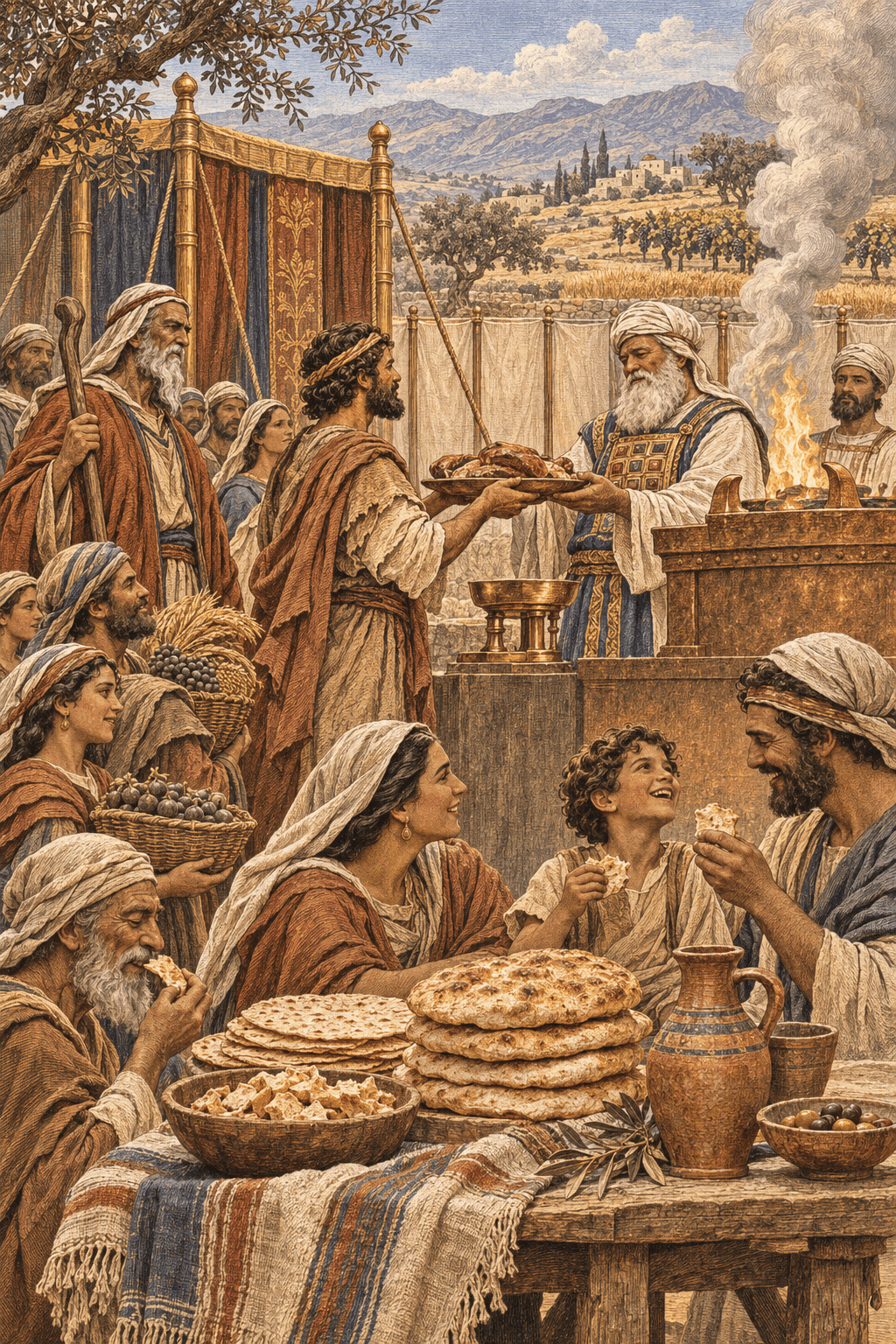
He had already spoken with the children of Israel about this sacrifice (chapter 3); here He focuses on the sides that concern the priests. In the law of this sacrifice we notice the following:
A) This is the only sacrifice in which the offerer shares (with others) in receiving a portion of it. So the Law defined exactly the Lord’s portion, the priest’s portion, and the offerer’s portion. It distinguished three kinds: the peace offering for thanksgiving, and another for a vow or a voluntary offering… The first is eaten wholly on the first day, nothing of it left until morning; the second and third may remain a second day only, but not to the third day. Perhaps the wisdom of this is, on the one hand, that its flesh not spoil, and on the other, that the offerer hasten to eat it with his friends, especially the poor, so that all rejoice together in this sacrifice. Perhaps it also points to the resurrection of the Lord Christ, who rose alive on the third day.
The vow and the voluntary offering are sacrifices or offerings made of one’s own will, which the Law did not impose on anyone. A vow is a voluntary pledge, which a person usually makes for something he hopes for from the Lord; a voluntary offering is usually offered in thanks to God for a success that came to him or something he gained. The vow is conditional, while the voluntary offering is not bound by any condition but is freely given. If an animal that was vowed died, was lost, or got a blemish, the one who vowed was bound to offer its equal in value; but if this happened to one offered as a voluntary offering, the owner was not bound to offer another, because he had pledged to offer that particular animal (Leviticus 22:17–25).
B) With the peace offering a food offering was offered, which included:
- Unleavened cakes mingled with oil, or unleavened wafers anointed with oil, or cakes of fine flour mingled with oil, fried… This offering has no leaven in it.
- Cakes of leavened bread, eaten with the meat. None of it is lifted up on the altar, for leaven may not be burned (Leviticus 2:11–12).
C) We can say that the peace offering for thanksgiving includes three kinds: the sacrifice, the meat offering, and the leavened bread. These three perhaps point to the duty of offering a life of thanksgiving through work, word, and thought, so that we do not thank God with our tongue while our heart or thought denies Him, or our works and conduct do not harmonize with our words. Let our whole life, inner and outer, sing on the harp of the Spirit, offering a complete sacrifice of thanksgiving that gladdens the heart of God.
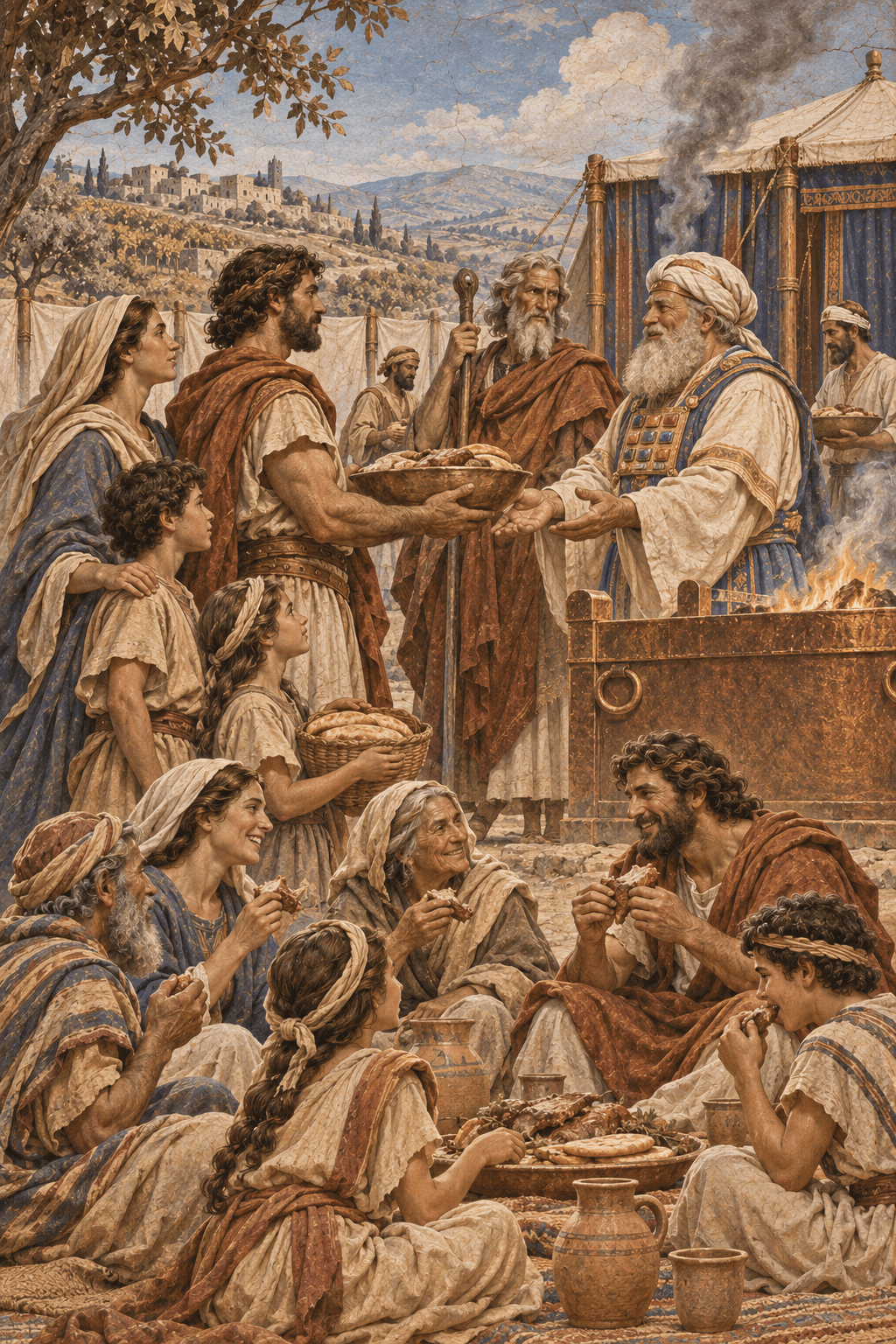
D) Origen sees in the thanksgiving sacrifice, of which the priest eats his portion and leaves none of it until morning, a reference to the priest’s duty to enjoy the word of God as though it were new every morning:
The flesh of the sacrifices given to the priests is the word of God, which they work with in the Church… When they preach to the people, they do not speak old, literal words, but by the grace of God they speak new words, always renewed as spiritual words. [107]
In other words, the priest aflame with the Spirit offers the word of God, which does not change, yet it is counted as new every morning. The secret of its renewal is the fiery heart that kindles the hearts of others and reveals to them the mysteries of God with a spiritual taste that does not grow old or age.
When the Lord gave the bread to His disciples, He said to them: “Take, eat” (Matthew 26:26), and He did not command that part of it be kept for the next day. This hidden meaning can be grasped in the commandment: “Take nothing for your journey” (Luke 9:3), so that you may always offer fresh food, the word of God that is within you. Finally, the Gibeonites of old became hewers of wood and drawers of water (Joshua 9:21–23) because they brought the Israelites old bread, while the spiritual law calls for always using fresh and new bread. [108]
E) As for the sacrifice of a vow or a voluntary offering, it may be eaten on the first day and on the second; but what remains to the third day is burned with fire (17)… whoever eats of it on that day, it is counted an abomination (18)! What does this mean? Origen says:
As far as I understand, I think the two days are to be understood as the two Testaments, in which we are allowed to search and meditate on the word of the Lord. [109]
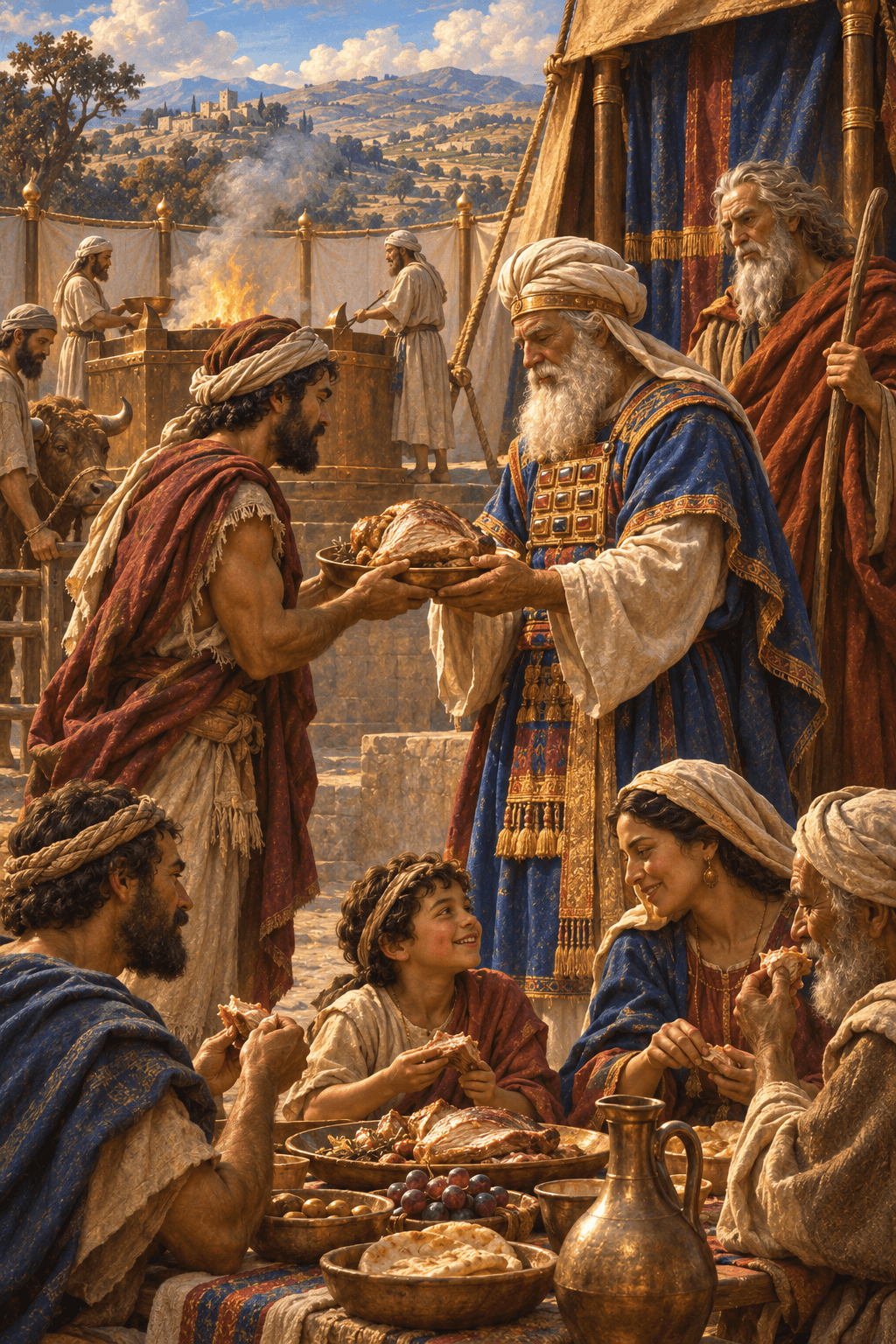
F) The law of the peace offering takes care that a person enjoy a pure life with nothing unclean or defiled in him. It warns us of three things:
- That the flesh of the sacrifice touch any unclean thing (19)… then the flesh is burned with fire and not eaten.
- That an unclean person eat the flesh; that soul shall be cut off from his people (20).
- If a person touched any unclean thing, he may not eat of it (21).
If the flesh points to the word of God and His teachings, we can say that the first prohibition points to refusing the word of God as the heretics interpret it, corrupting its holiness. The second points to the person himself, who cannot enjoy the holiness of the word of God unless he is cleansed by the blood and his works are purified. The third points to the effect of evil friendships on us, for they deprive us of enjoying the depths of the divine word and tasting its holiness. In other words, to enjoy the full power of the word of God in us, we must not receive it through heretical thought, nor receive it with a corrupt life within us, nor receive it while in fellowship with the wicked, who spoil the work of the word in us.
Let us receive the living and powerful word of God from the holy Church, with a pure mind and a holy heart, in a holy spiritual atmosphere… so that we enjoy the gladness of the peace offering!
G) The priest waves the breast of the sacrifice, and the right shoulder (thigh) is his portion… What does this mean? He puts the fat on the hands of the offerer or offerers, then lays the breast on the fat, and the priest puts his hands under the hands of the offerer to lift it, then moves it upward toward the four directions; and he does the same with the right shoulder. This points to the priest having offered the sacrifice to God and given thanks to Him who fills the world from east to west and from north to south; then he receives again from the hands of God the breast of the sacrifice and its right shoulder. He hands his breast to the Lord to receive it from Him again with a heart renewed in the Lord, and hands over his right hand to receive it from Him as a spiritual hand working for the Lord.
By this rite of “the wave breast and the heave shoulder” the priest declares his acceptance of God’s work in his inner life (the breast) and in his outward conduct (the heave shoulder), so that his whole life is consecrated to the Lord.
3. Conclusion
KJV · Verses 35–38
35 This is the portion of the anointing of Aaron, and of the anointing of his sons, out of the offerings of the Lord made by fire, in the day when he presented them to minister unto the Lord in the priest's office; 36 Which the Lord commanded to be given them of the children of Israel, in the day that he anointed them, by a statute for ever throughout their generations. 37 This is the law of the burnt offering, of the meat offering, and of the sin offering, and of the trespass offering, and of the consecrations, and of the sacrifice of the peace offerings; 38 Which the Lord commanded Moses in mount Sinai, in the day that he commanded the children of Israel to offer their oblations unto the Lord, in the wilderness of Sinai.
He closes His discussion by affirming the bond of the sacrifice with the priesthood and declaring that this law is the one “which the LORD commanded Moses”… It must be kept carefully because of its holiness.
Notes and References
[104] Origen, In Lev. hom. 5:3.
[105] Ibid.
[106] See our book: The First Fathers of the School of Alexandria: Origen (The Holy Scripture).
[107] Origen, In Lev. hom. 5:8.
[108] Ibid.
[109] Ibid. 5:9.