
The people triumphed over Jericho, the great fortified city, but they were defeated before the small town of Ai, because there was an accursed thing in their midst, and God was no longer among them until they purged out the corrupt leaven and sanctified themselves to Him.
1. The treachery of Achan (1).
2. The defeat before Ai (2–5).
3. Joshua the intercessor (6–9).
4. The secret of the defeat (10–15).
5. Purging out the corrupt leaven (16–26).
1. The Treachery of Achan
KJV · Verses 1
1 But the children of Israel committed a trespass in the accursed thing: for Achan, the son of Carmi, the son of Zabdi, the son of Zerah, of the tribe of Judah, took of the accursed thing: and the anger of the Lord was kindled against the children of Israel.
It is not strange that the transcendent victory over Jericho should end with Achan committing this accursed act and this treachery in the midst of God’s people. This deed represents the ugliness of human nature, which meets God’s transcendent and free gifts with ingratitude instead of thanksgiving. Before the towering walls of Jericho it stands humbled, awaiting God’s wonderful salvation; and when the walls collapse and the enemies submit, it turns again to betray God’s covenant!
Truly many were mighty and by grace were able to defeat Jericho and crush its might, yet through the corruption of their inner hearts they were crushed before the small town of Ai, because of the accursed thing that crept into the heart within.
In any case, God permitted the inheritance to begin with a mighty victory followed immediately by a painful defeat, as a lesson for all generations: victory comes from God, and failure is because of our wickedness. Whenever we triumph by divine grace, we must all the more, while thanking God for His gifts, beware lest evil creep in through our negligence, and we come to defeat before sins that seem small and trivial to us.
On this the Apostle Paul says: “But I keep under my body, and bring it into subjection: lest that by any means, when I have preached to others, I myself should be a castaway” (1 Corinthians 9:27). For this reason the writer of the Song warns us:
“Take us the foxes, the little foxes, that spoil the vines” (Song of Songs 2:15). It is as if, the more the Apostle preached and bore fruit in the lives of others, the more he kept his body under and brought it into subjection, fearing that he might fall; and the more the vineyard flourishes and its fruit appears, the more the vinedresser fears the little foxes that may spoil it … The more we gain victory over Jericho within us or in the lives of others, and enjoy God’s free graces, offering thanks to God as our certainty in His divine work increases, the more we must beware lest the enemy creep in upon us through small things. Saint Mark the Ascetic says:
“Satan presents to us small sins that seem trivial in our eyes; for without this he cannot lead us into great sins. [129]”
We observe in the text before us (Joshua 7:1) that Achan sinned, and the anger of the Lord fell on all the people. Origen says:
“We must not neglect this phrase: when one person commits a sin, he brings wrath on the whole people. How does this disaster come about? When the priests — the rulers of the people — want to appear tolerant toward sinners, because they fear their tongues lest they rise up against them, forgetting the firmness that befits their priesthood. In this way they refuse to carry out what is written: ‘Them that sin rebuke before all, that others also may fear’ (1 Timothy 5:20), and also: ‘Put away from among yourselves that wicked person’ (1 Corinthians 5:13). These priests are not aflame with zeal for the Lord, nor do they imitate the Apostle who commands ‘to deliver such an one unto Satan for the destruction of the flesh, that the spirit may be saved’ (1 Corinthians 5:5). They behave without regard for the counsels of the Gospel concerning sinners. When we see a sinner, let us go to him alone, then speak to him in the presence of two or three witnesses; but if he scorns even the rebuke of the Church and does not repent, let him be separated from the Church and counted as a heathen man and a publican (Matthew 18:15–17). [130]”
2. The Defeat before Ai
KJV · Verses 2–5
2 And Joshua sent men from Jericho to Ai, which is beside Bethaven, on the east of Bethel, and spake unto them, saying, Go up and view the country. And the men went up and viewed Ai. 3 And they returned to Joshua, and said unto him, Let not all the people go up; but let about two or three thousand men go up and smite Ai; and make not all the people to labour thither; for they are but few. 4 So there went up thither of the people about three thousand men: and they fled before the men of Ai. 5 And the men of Ai smote of them about thirty and six men: for they chased them from before the gate even unto Shebarim, and smote them in the going down: wherefore the hearts of the people melted, and became as water.
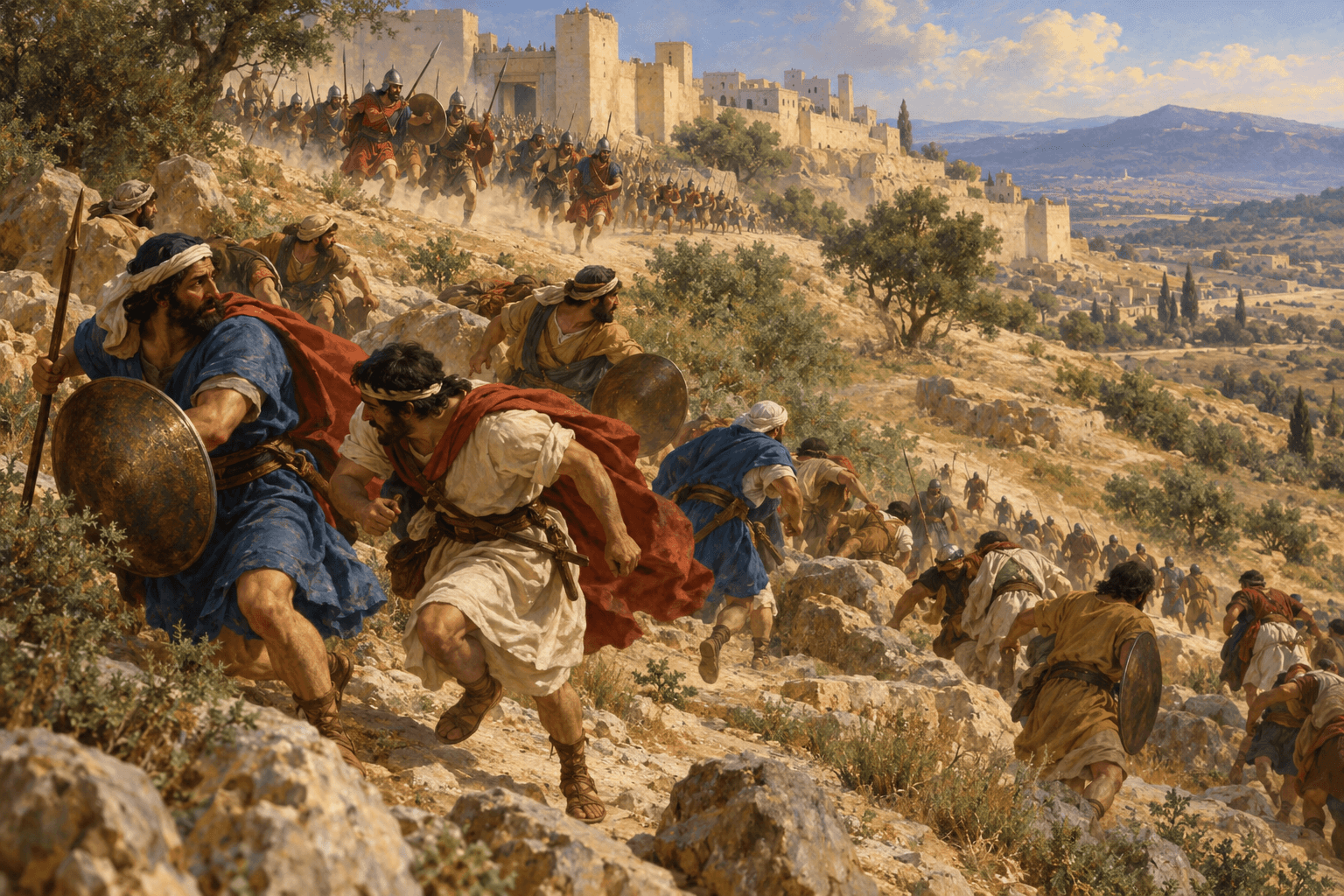
No movement toward fortified Jericho could take place until God had declared to Joshua:
“I have given into thine hand Jericho, and the king thereof, and the mighty men of valour” (Joshua 6:2). But here, when the accursed thing had crept into the midst of the people — and Ai was a small town — we do not hear the voice of the Lord declaring anything to Joshua, nor did Joshua consult the Lord before sending men up to spy or fixing the number of the men of war … Had Joshua consulted the Lord, the Lord would have kept him from doing anything before purging the corruption that had secretly crept into His people; and consequently the defeat before Ai would not have happened.
The spies made light of the town of Ai, saying to Joshua: “Let not all the people go up; but let about two or three thousand men go up and smite Ai; and make not all the people to labour thither; for they are but few” [3]. Truly the people of Ai were few; but God’s people, after God had abandoned them and departed from them, became not only few but as nothing. As the wise man says:
“The wicked flee when no man pursueth: but the righteous are bold as a lion” (Proverbs 28:1). This is what God had warned His people through the mouth of Moses the prophet: “But it shall come to pass, if thou wilt not hearken unto the voice of the Lord thy God … The Lord shall cause thee to be smitten before thine enemies: thou shalt go out one way against them, and flee seven ways before them: and shalt be removed into all the kingdoms of the earth. And thy carcase shall be meat unto all fowls of the air, and unto the beasts of the earth, and no man shall fray them away” (Deuteronomy 28:15, 25–26).
So the spies erred in their calculations, for they looked through a human lens and ignored the loss of the hidden secret of their victory, the holy life in the Lord! They thought two or three thousand could smite Ai, although Ai first required the striking down of the inner corruption among the people, and the going up of all the people with Joshua to the city, and the setting of two ambushes, of thirty thousand mighty men of valour and of five thousand (Joshua 8:3, 5, 12).
The men of Ai smote about thirty-six men of the people [5]. This is the same number as the signings in the sacrament of the Holy Myron, in which the priest anoints the newly baptized with 36 signings on all his members, from the crown of his head to the soles of his feet. It is as if weak Ai was able to kill all the members of man and scatter them, because of the accursed thing hidden within the heart! An evil thought that we consider simple and slight, once we give in to it, loses us the purity of the whole body — indeed, it loses us our whole life!
The fruit of all this was: “Wherefore the hearts of the people melted, and became as water” [5]. This is the work of sin: it crushed the whole people, robbed them of all courage and strength, and made their hearts like water flowing away, with no one able to help or support. So do not be surprised that Jeremiah the prophet, perceiving the bitter power of sin, says:
“My bowels, my bowels! I am pained at my very heart; my heart maketh a noise in me; I cannot hold my peace, because thou hast heard, O my soul, the sound of the trumpet, the alarm of war” (Jeremiah 4:19). And when the Lord bore our sins, He said through the prophet:
“I am poured out like water, and all my bones are out of joint: my heart is like wax; it is melted in the midst of my bowels” (Psalm 22:14). How hideous is sin!
3. Joshua the Intercessor
KJV · Verses 6–9
6 And Joshua rent his clothes, and fell to the earth upon his face before the ark of the Lord until the eventide, he and the elders of Israel, and put dust upon their heads. 7 And Joshua said, Alas, O Lord God, wherefore hast thou at all brought this people over Jordan, to deliver us into the hand of the Amorites, to destroy us? would to God we had been content, and dwelt on the other side Jordan! 8 O Lord, what shall I say, when Israel turneth their backs before their enemies! 9 For the Canaanites and all the inhabitants of the land shall hear of it, and shall environ us round, and cut off our name from the earth: and what wilt thou do unto thy great name?
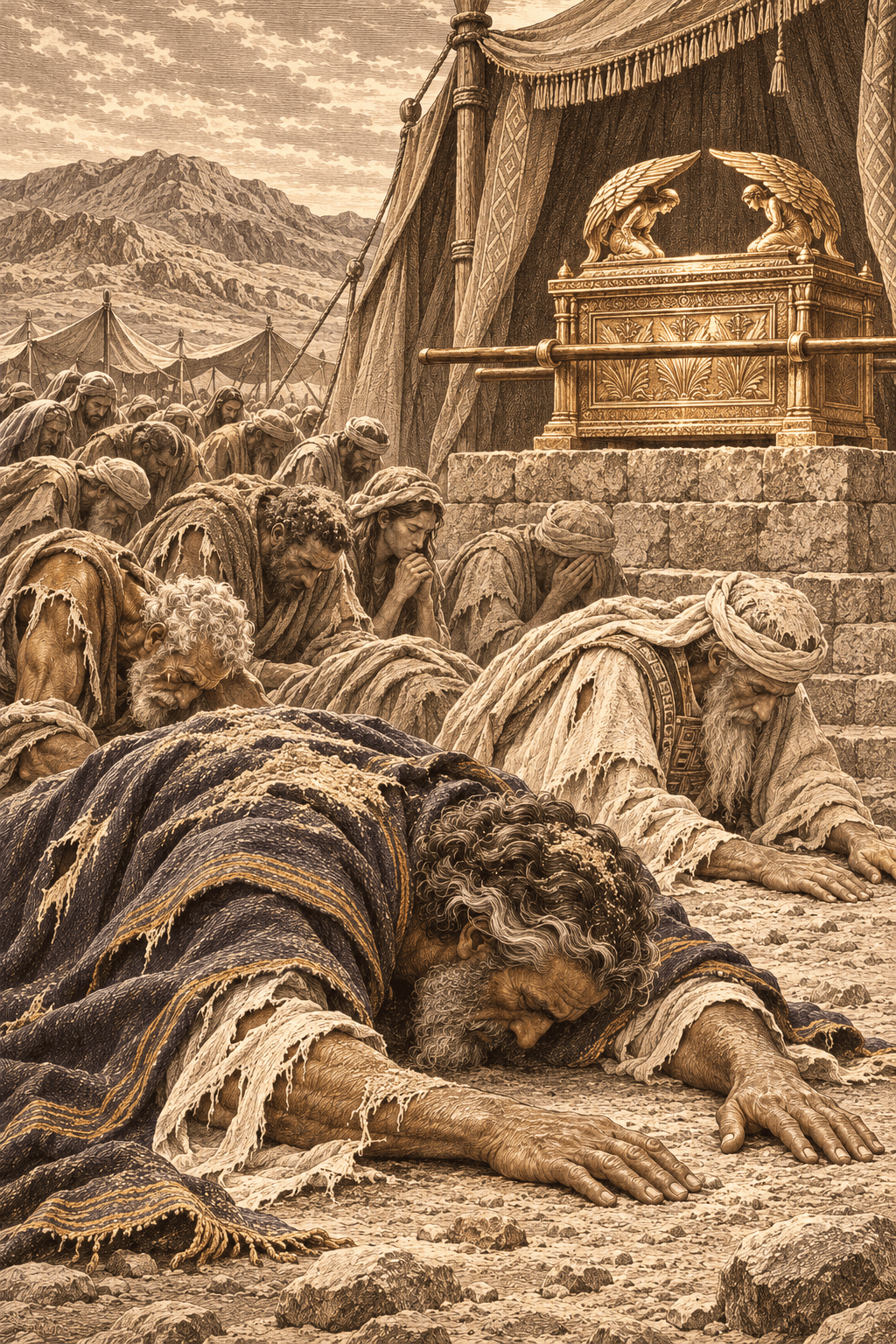
“And Joshua rent his clothes, and fell to the earth upon his face before the ark of the Lord until the eventide, he and the elders of Israel, and put dust upon their heads” [6].
Joshua stood as an intercessor for the people before God. He rent his clothes and fell on his face to the earth before the Ark until evening, bearing a symbolic picture of the atoning intercession of our Lord Jesus Christ, who emptied Himself, as if He had taken off the garment of His glory for our sake, and came down to the earth — He before whom the heavenly powers tremble — and declared the perfection of His love by accomplishing reconciliation on the cross in the evening. Isaiah the prophet says of Him:
“He hath poured out his soul unto death: and he was numbered with the transgressors; and he bare the sin of many, and made intercession for the transgressors” (Isaiah 53:12). And Saint John the Beloved says: “And if any man sin, we have an advocate with the Father, Jesus Christ the righteous: and he is the propitiation for our sins: and not for ours only, but also for the sins of the whole world” (1 John 2:1–2). And it is said:
“Wherefore he is able also to save them to the uttermost that come unto God by him, seeing he ever liveth to make intercession for them” (Hebrews 7:25).
The price of His intercession is not the rending of His garment or the falling of His face to the ground, as Joshua did. Rather, the Living and Eternal One took a body to pour out His soul unto death, bearing our iniquities and weaknesses to condemn them in His flesh, and He who knew no sin was numbered with the transgressors! He gives His life for humanity, which by its own will held enmity against Him; for He alone is able to give Himself up to death and at the same time able to rise.
He has become for us a living Intercessor, presenting us to His Father as members of His living body, so that we find a place of rest in His fatherly bosom. His intercession is not words or mere crying out; it is His bringing us in, so that in Him we are justified by His blood and counted as the object of the Father’s good pleasure!
Saint Augustine says that our Lord Jesus prays for us, and prays in us, at the very time we pray to Him:
“There is one Savior, our Lord Jesus Christ, the Son of God, who prays for us, and prays in us, and to whom we pray. He prays for us as our Priest; He prays in us as our Head; and we pray to Him as our God. [131]”
4. The Secret of the Defeat
KJV · Verses 10–15
10 And the Lord said unto Joshua, Get thee up; wherefore liest thou thus upon thy face? 11 Israel hath sinned, and they have also transgressed my covenant which I commanded them: for they have even taken of the accursed thing, and have also stolen, and dissembled also, and they have put it even among their own stuff. 12 Therefore the children of Israel could not stand before their enemies, but turned their backs before their enemies, because they were accursed: neither will I be with you any more, except ye destroy the accursed from among you. 13 Up, sanctify the people, and say, Sanctify yourselves against to morrow: for thus saith the Lord God of Israel, There is an accursed thing in the midst of thee, O Israel: thou canst not stand before thine enemies, until ye take away the accursed thing from among you. 14 In the morning therefore ye shall be brought according to your tribes: and it shall be, that the tribe which the Lord taketh shall come according to the families thereof; and the family which the Lord shall take shall come by households; and the household which the Lord shall take shall come man by man. 15 And it shall be, that he that is taken with the accursed thing shall be burnt with fire, he and all that he hath: because he hath transgressed the covenant of the Lord, and because he hath wrought folly in Israel.
God revealed to Joshua the secret of the defeat, and offered him the remedy (see verses 10–13 above).
We observe the following in these words:
First: God says to Joshua “Get thee up” twice: the first time, “Get thee up; wherefore liest thou thus upon thy face?” and the second, “Up, sanctify the people.” It is as if the Father, seeing the Son willingly bearing death for us, asks Him to rise … and by His resurrection He sanctifies the people. The incarnate Son rises and raises us with Him without sin! … The Book of Joshua is the book of the resurrection, for without it the inheritance will not be fulfilled for us, nor shall we have a share in the divine promises.
Second: the secret of the defeat is that the believers had become accursed, and the Lord had departed from them until they destroyed the accursed thing from their midst. When one of them seized what was accursed, he carried within himself the nature of that accursed thing; he became accursed and brought this upon all the people. Acquiring evil gives us its nature, while acquiring holy things makes us holy. Whoever acquires vain sin becomes vain; and whoever acquires God carries the divine life within him, and receives the new attributes after the image of his Creator.
Third: if the entrance of the accursed thing into our midst is the secret of our defeat, the remedy has two complementary sides: destroying the accursed thing from our midst, and acquiring holiness. The negative side, removing evil, is not enough; the positive work is needed, acquiring the Holy One Himself. That is why God tells Joshua to destroy the accursed thing and to rise up and sanctify the people.
5. Purging Out the Corrupt Leaven
KJV · Verses 16–26
16 So Joshua rose up early in the morning, and brought Israel by their tribes; and the tribe of Judah was taken: 17 And he brought the family of Judah; and he took the family of the Zarhites: and he brought the family of the Zarhites man by man; and Zabdi was taken: 18 And he brought his household man by man; and Achan, the son of Carmi, the son of Zabdi, the son of Zerah, of the tribe of Judah, was taken. 19 And Joshua said unto Achan, My son, give, I pray thee, glory to the Lord God of Israel, and make confession unto him; and tell me now what thou hast done; hide it not from me. 20 And Achan answered Joshua, and said, Indeed I have sinned against the Lord God of Israel, and thus and thus have I done: 21 When I saw among the spoils a goodly Babylonish garment, and two hundred shekels of silver, and a wedge of gold of fifty shekels weight, then I coveted them, and took them; and, behold, they are hid in the earth in the midst of my tent, and the silver under it. 22 So Joshua sent messengers, and they ran unto the tent; and, behold, it was hid in his tent, and the silver under it. 23 And they took them out of the midst of the tent, and brought them unto Joshua, and unto all the children of Israel, and laid them out before the Lord. 24 And Joshua, and all Israel with him, took Achan the son of Zerah, and the silver, and the garment, and the wedge of gold, and his sons, and his daughters, and his oxen, and his asses, and his sheep, and his tent, and all that he had: and they brought them unto the valley of Achor. 25 And Joshua said, Why hast thou troubled us? the Lord shall trouble thee this day. And all Israel stoned him with stones, and burned them with fire, after they had stoned them with stones. 26 And they raised over him a great heap of stones unto this day. So the Lordturned from the fierceness of his anger. Wherefore the name of that place was called, The valley of Achor, unto this day.
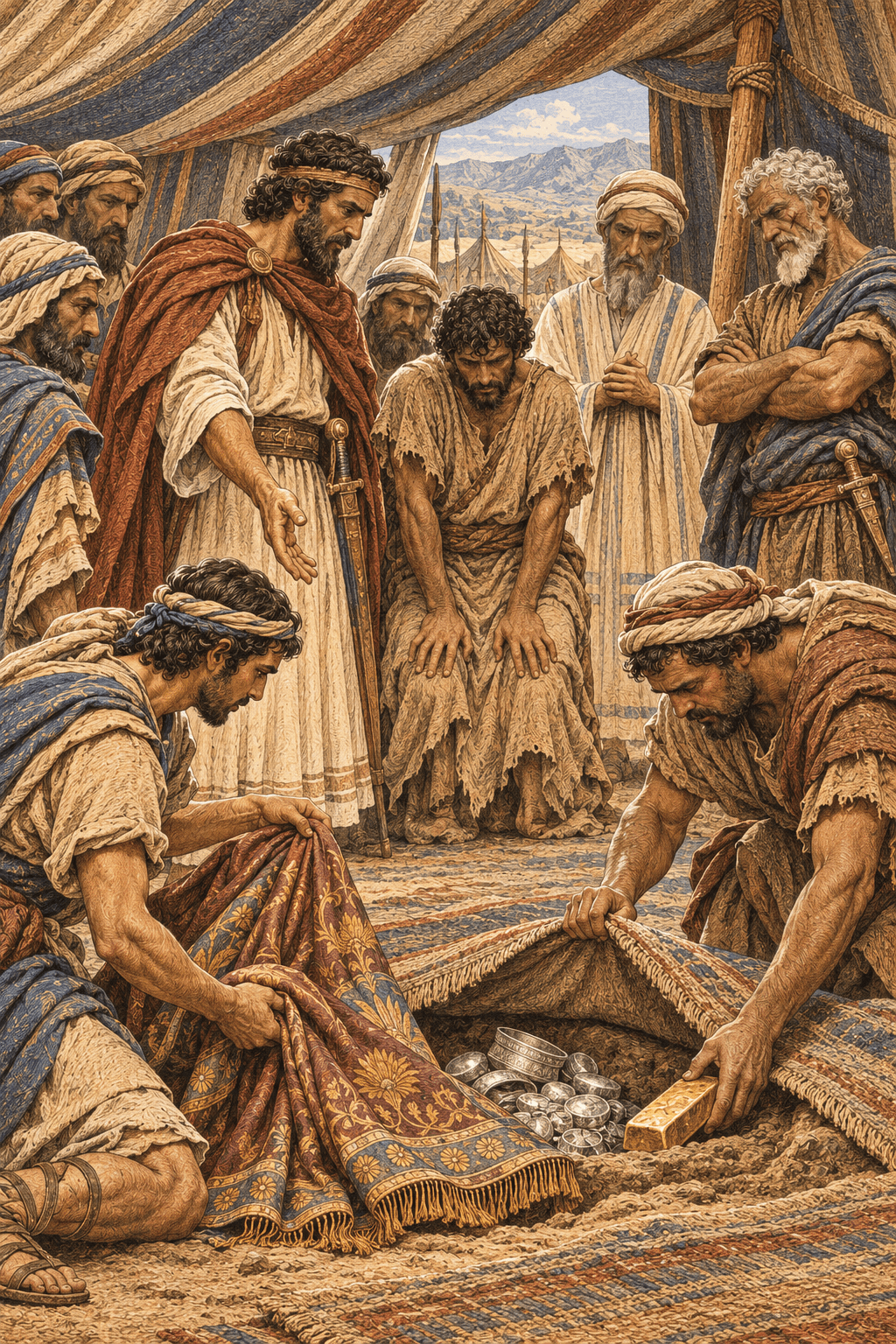
The people could not enjoy the holy, risen life unless the corrupt leaven that leavens the whole lump was removed from them (1 Corinthians 5:6). The accursed thing had to be destroyed completely, so that they might again enjoy God’s abiding presence. Here we observe the following:
First: sadly, from the tribe that gave us Saint Mary, who bowed her head in obedience to God to receive the indwelling of the Word in her womb, so that the Savior of the world, the Lion of the tribe of Judah, came forth — from this very tribe came Achan the son of Carmi, who caused the people to stumble and crushed them. Perhaps God permitted this so that we might beware of falling and not make light of any stumbling, however simple it may seem.
The tribe to which the promises were given produced this man who deserved destruction. God’s faithful promises and His free divine gifts grant us hope and certainty, but with watchfulness. For Achan saw, then coveted, then took, then hid [21], as he says: “When I saw among the spoils a goodly Babylonish garment, and two hundred shekels of silver, and a wedge of gold of fifty shekels weight, then I coveted them, and took them; and, behold, they are hid in the earth in the midst of my tent, and the silver under it.”
Stumbling begins with an unholy look, then lust, then the deed, then the hiding of the evil in the earth in the midst of the tent, so that no trace of the evil remains to be perceived.
Second: God did not pardon Achan, perhaps for several reasons. The first reason is that this act was the first of its kind after their entry into Canaan. God wanted from the beginning to give them a lesson that would bring out the ugliness of sin and affirm the need to cut it off. This is what happened with the man who gathered sticks on the Sabbath, the first to break the Sabbath, on whom the Lord’s judgment came:
“The man shall be surely put to death: all the congregation shall stone him with stones without the camp” (Numbers 15:35); and also with Ananias and Sapphira, the first family to lie to the Holy Spirit in the apostolic age (Acts 5:3). The second reason is that Achan had enjoyed the divine blessings and had seen with his own eyes the way opening in the river Jordan for him to cross, and the walls of Jericho collapsing so that he might inherit; therefore his punishment was bitter and severe.
Had he waited, he would have received his share of the spoils of Ai and of other battles, as he would have inherited the land of promise; but since he despised God’s blessings, caring for earthly things, he lost both! The third reason is that Achan felt no repentance and did not confess at first; he waited until God revealed the tribe that had sinned [16], then the family [17], then the household, and finally his name was known, and only then was he forced to confess … He hid the crime and did not repent even after the people had been broken …
In any case, Achan became a lesson for the whole Church through the generations. On the one hand, it revealed that the secret of defeat in the life of the believer or of the community is “the accursed thing” that finds a place among us! On the other hand, it became a warning to every sinner … that he has no excuse to offer. As Saint Athanasius the Apostolic says:
“When Achan was accused of theft, he did not plead that he had been zealous in the wars; but when his transgression was proved, the whole people stoned him. [132]”
Finally, it became a living lesson for all generations of the believer’s obligation to destroy every trace of sin in his life without argument. Joshua the son of Nun destroyed every trace of Achan and all that he had; so let us hand over our inner life and our conduct into the hands of God, our living Jesus, who alone is able to uproot our sins, so that He leaves in us no trace of evil or the appearance of evil. Let us hold fast to the cross of our Lord Jesus Christ, by which every stumbling block in us is cut off, so that we do not perish, remembering the Lord’s commandment to us:
“And if thy right eye offend thee, pluck it out, and cast it from thee: for it is profitable for thee that one of thy members should perish, and not that thy whole body should be cast into hell. And if thy right hand offend thee, cut it off, and cast it from thee …” (Matthew 5:29–30).
Third: the objects of the crime were:
A) A goodly Babylonish garment [21], that is, a garment imported from Shinar (near Babylon), the region where the tower of Babel was built (Genesis 11:2), and to which some of the Jews were carried captive (Isaiah 11:11; Zechariah 5:11). If the garment points to the body, coveting the Babylonish or Shinar garment points to the lust of the body for enjoying the things of the Gentiles and their pleasures. In the Book of Ezekiel God rebukes Judah because Israel her sister “doted upon the Assyrians her neighbours, captains and rulers clothed most gorgeously” (Ezekiel 23:12).
Achan carried the first seeds of the lusts of the flesh with the Gentiles; therefore they had to be destroyed at the very beginning of their growth … He defiled the body which God created holy!
B) Two hundred shekels of silver [21]. If the garment points to the lusts of the body, the two hundred shekels of silver point to the love of money … those who acquire silver at the expense of their deprived brethren. Silver also points to the word of God. As the wicked man abuses his holy body by defiling it, so he also misunderstands the word of God and buries it in the earth under his tent; that is, he uses it in an earthly sense for the sake of the tent of his body, instead of receiving it to lift him up to heavenly things for the sake of his spirit, as well as for the salvation of his body!
C) A wedge (literally, a tongue) of gold [21] points to the tongue of atheistic philosophers, which seems golden and glittering. Origen says:
“I do not think that stealing a little gold was a sin sufficient to defile His great Church … The tongue of gold is the corrupt doctrines of the philosophers, which seem brilliant. Take care lest the splendor of their craft entice you and the sweetness of their golden tongue deceive you. Remember Joshua’s command that everything golden in Jericho be accursed. If you read the brilliant essays of the poets that tell of the gods, do not let yourself be charmed by their eloquence. For if you take it and put it in your tent — that is, let their teachings enter your heart — the whole Church is defiled. This is what the wretched Valentinus and Basilides did: they stole the golden tongue that was in Jericho and tried to bring corrupt philosophical principles into the Church, and so defiled the whole Church of God. [133]”
D) Fifty shekels: the number 50 points to the spirit of freedom and unity. In the Tabernacle of the congregation the two curtains were joined together by fifty loops on one side of each curtain (Exodus 26:4–5), and all the loops were linked by fifty golden taches, pointing to the mystery of unity between the two peoples (the Jews and the Gentiles) through the descent of the Holy Spirit on the day of Pentecost, when they receive the spirit of freedom in Christ Jesus, who also grants unity.
In the Jubilee — the fiftieth year — Jewish slaves were set free, mortgaged land was redeemed, and all felt freedom … Here Achan takes freedom and buries it in the earth under his tent; that is, he uses holy freedom for the sake of his body and its temporal demands, so that it becomes license and recklessness.
In short, what Achan did was to profane the holy things, the gifts which God gave him for his rest and peace, using them for his own ruin and destruction:
He used the body (the garment) for lusts, instead of its being a help to the soul in the holy life;
He used the word of God with a wrong mind, instead of letting it lift him to heavenly things;
He used the mind in glittering, unedifying philosophies, instead of its working for the glory of God;
He used freedom as an occasion for the flesh, instead of its being the secret of his setting out to his Father’s bosom without hindrance or bonds.
Notes and References
[129] Mark the Ascetic, Philokalia (author’s translation, Arabic), 1966, p. 126.
[130] Origen, Homilies on Joshua 7:6.
[131] Augustine, On the Psalms 86.
[132] Athanasius, To the Bishops of Egypt 10.
[133] Origen, Homilies on Joshua 7:7.