
Because of sin the people were crushed before the weak town of Ai. Now that all had been sanctified and the accursed thing removed from their midst, they not only gained triumph and victory over it, but in the manner of their victory they presented a symbolic prophecy of God’s saving work.
1. Setting an ambush for Ai (1–17).
2. Smiting Ai (18–27).
3. Hanging the king of Ai (28–29).
4. Building an altar to the Lord (30–31).
5. Care for the law (32–35).
1. Setting an Ambush for Ai
KJV · Verses 1–17
1 And the Lord said unto Joshua, Fear not, neither be thou dismayed: take all the people of war with thee, and arise, go up to Ai: see, I have given into thy hand the king of Ai, and his people, and his city, and his land: 2 And thou shalt do to Ai and her king as thou didst unto Jericho and her king: only the spoil thereof, and the cattle thereof, shall ye take for a prey unto yourselves: lay thee an ambush for the city behind it. 3 So Joshua arose, and all the people of war, to go up against Ai: and Joshua chose out thirty thousand mighty men of valour, and sent them away by night. 4 And he commanded them, saying, Behold, ye shall lie in wait against the city, even behind the city: go not very far from the city, but be ye all ready: 5 And I, and all the people that are with me, will approach unto the city: and it shall come to pass, when they come out against us, as at the first, that we will flee before them, 6 (For they will come out after us) till we have drawn them from the city; for they will say, They flee before us, as at the first: therefore we will flee before them. 7 Then ye shall rise up from the ambush, and seize upon the city: for the Lordyour God will deliver it into your hand. 8 And it shall be, when ye have taken the city, that ye shall set the city on fire: according to the commandment of the Lord shall ye do. See, I have commanded you. 9 Joshua therefore sent them forth: and they went to lie in ambush, and abode between Bethel and Ai, on the west side of Ai: but Joshua lodged that night among the people. 10 And Joshua rose up early in the morning, and numbered the people, and went up, he and the elders of Israel, before the people to Ai. 11 And all the people, even the people of war that were with him, went up, and drew nigh, and came before the city, and pitched on the north side of Ai: now there was a valley between them and Ai. 12 And he took about five thousand men, and set them to lie in ambush between Bethel and Ai, on the west side of the city. 13 And when they had set the people, even all the host that was on the north of the city, and their liers in wait on the west of the city, Joshua went that night into the midst of the valley. 14 And it came to pass, when the king of Ai saw it, that they hasted and rose up early, and the men of the city went out against Israel to battle, he and all his people, at a time appointed, before the plain; but he wist not that there were liers in ambush against him behind the city. 15 And Joshua and all Israel made as if they were beaten before them, and fled by the way of the wilderness. 16 And all the people that were in Ai were called together to pursue after them: and they pursued after Joshua, and were drawn away from the city. 17 And there was not a man left in Ai or Bethel, that went not out after Israel: and they left the city open, and pursued after Israel.
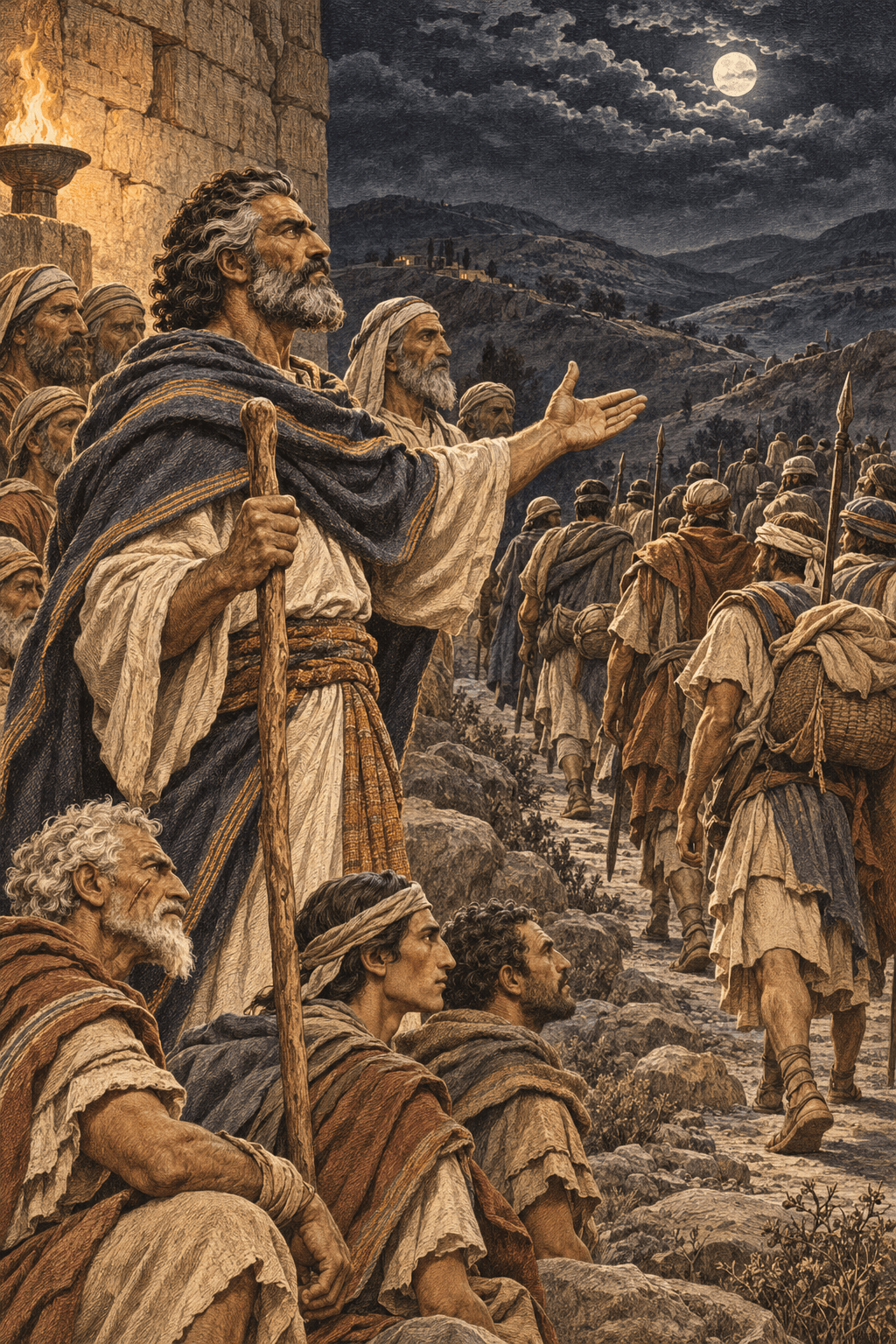
When the evil had been removed from the midst of the people, “the Lord said unto Joshua, Fear not, neither be thou dismayed: take all the people of war with thee, and arise, go up to Ai: see, I have given into thy hand the king of Ai, and his people, and his city, and his land” [1]. He commanded that the people be divided into two groups. The first group was to be an ambush hidden behind the city of Ai, on the west side, between it and Bethel.
This group, it seems, was itself divided into two parts: an ambush of 30,000 mighty men of valour [3], hidden near Bethel so as to repel any movement of the people of Bethel to rescue Ai; and another of about five thousand men [12], lying in wait near Ai to storm it when Joshua gave them the signal. The second group was the visible one, which under Joshua’s leadership set out toward Ai by its front entrance. When the people of Ai came out to meet them, they were to flee before them, so that the whole city of Ai would come out after them, leaving the city empty; then the ambush would rise up and take it, fighting the people of Ai from behind.
This action bore a living picture of God’s saving work on the level of the Church of the New Testament as a whole, and on the level of each of its members. It represents the victory of the universal Church over Satan, “the king of Ai,” and the stripping from him of all his authority and power; and it also represents the victory of each soul over him.
As for the Church as a whole, the two groups represent two elements in the Church of the New Testament: a community of Jewish origin and another of Gentile origin. The group under Joshua’s leadership, which approached the entrance of Ai from the front but pretended to flee in order to draw the king of Ai with all his army and people out of the city, represents the community of Jewish origin which accepted faith in Jesus.
It came openly before the city, for it came through the law and the prophets, to attack the kingdom of darkness by its Jesus and crush Satan, its prince. This is the community of which the Lord said:
“I am not sent but unto the lost sheep of the house of Israel” (Matthew 15:24), and of which the Apostle said:
“But glory, honour, and peace, to every man that worketh good, to the Jew first, and also to the Gentile” (Romans 2:10). As for their pretended flight before the city of Ai, Origen says:
“All those who followed Joshua pretended to flee, for they fled from the burden of the law, from keeping the Sabbath according to the law, from the circumcision of the flesh and from offering bloody sacrifices. But when we consider their second movement, we find that those who followed the perfect Joshua, who fulfilled the law, did not flee, ‘but turned again, and entered into the city.’ [134]”
They pretended to flee until the king of Ai and his people came out of their city; then they turned on them and overcame them. So the Jews who accepted faith in the Lord Christ appeared, under the leadership of the true Joshua, to retreat from the law and its works; but they came back to understand the law and its works by the spirit, not the letter. They were set free from under the law, to live not as breakers of the law or despisers of its works and the rites of its ordinances, but to enter into its spiritual mysteries, understand its depths and fulfill its purpose under the leadership of “the true Joshua,” who bore the curse of the law for us.
The other group represents two ambushes: one of 30,000 men of valour near Bethel, behind Ai, and the other of about 5,000 men directly behind Ai. These two ambushes represent the community of believers of Gentile origin. Joshua directed them and chose them, but he was not bodily in their midst — like the Gentiles, among whom the Lord of glory Jesus did not dwell bodily as He did among the Jews; they heard of Him by the hearing of the ear and came to know Him through the preaching of the disciples and apostles.
These too did not approach the city from the front, but were hidden behind it … for they had neither the law nor the prophets, and no covenants or promises had been given to them. As the Apostle says:
“The Gentiles, which followed not after righteousness [by the law], have attained to righteousness, even the righteousness which is of faith” (Romans 9:30). They came from behind, with no previous knowledge of the law, the ordinances and the prophecies; but by the faith in their hearts they stormed the city, crushed the powers of darkness and stripped the devil of his authority and might … and their work was joined with the whole first group under the leadership of Joshua himself!
Perhaps the two numbers 30,000 and 5,000, belonging to the two ambushes that overcame the devil and all his soldiers, carry spiritual meanings. The number 30,000 is the product of 3 × 10 × 1000. If the number 3 points to faith in the Holy Trinity, or to the mystery of the resurrection with Christ, as we saw in the previous chapters, and the number 10 points to the law, with its ten commandments, and the number 1000 to the heavenly life, then this number as a whole means that this group of Gentiles, which did not receive the Mosaic law nor know it, became through faith in the Holy Trinity and through enjoying the risen life in Christ Jesus a fulfiller of the law (10), but in a spiritual or heavenly way (1000).
The (believing) Gentiles did not break the law nor despise it; rather, by faith in Christ Jesus risen from the dead they became justified, as those who have completed the commandments and fulfilled them with a spiritual mind. As for the number 5,000 (5 × 1000), it points to the sanctification of the senses of these believers, who formerly lived in darkness and wallowed in defilement; by a living faith their five senses were sanctified and received the spiritual, heavenly mark (1000).
As the plan was integrated, so that neither group could succeed alone but the two worked together, so the Church appears integrated by receiving members of Jewish origin and others of Gentile origin, in spite of differences of culture, thought and circumstance.
If we look at this plan which God gave Joshua for overcoming Ai and taking it as representing the spiritual warfare in the life of each of us, we too need a similar plan. We fight spiritually through visible struggle under Joshua’s leadership, such as liturgical worship, fasting, family and personal prayer, sharing in giving, making metanoias (prostrations), and so on … All this is joined with the hidden, secret life, which works as an ambush set by the soul against sin and its kingdom under the care of Jesus Christ the Savior Himself: the sighs of the heart, arrow prayers (the continual Jesus Prayer), the sanctification of the will and the feelings, and so on … things which no one sees or perceives except the Lord Himself.
In other words, our spiritual struggle against the kingdom of darkness is through the sanctification of the body and its visible works and the sanctification of the soul with its hidden works. The body in its holiness is not separated from the spirit, nor is there conflict between them, so long as both walk by the Spirit under the leadership of our one Lord Jesus. So our visible life is joined with our hidden life as one integrated life.
All our conduct is in harmony, whether in church, at home, at work, with friends or with those who trouble us, so that we work with one harmonious spirit befitting our spiritual Leader, the Lover of mankind. Our life, in its entirety and from every side, becomes one harmonious life, like a harp on which the Lord of glory Jesus plays by His Holy Spirit; from every string comes its own note, yet in harmony and integration with the other strings, contributing to the ineffable symphony of love which the Leader offers to His heavenly Father by His Holy Spirit.
2. Smiting Ai
KJV · Verses 18–27
18 And the Lord said unto Joshua, Stretch out the spear that is in thy hand toward Ai; for I will give it into thine hand. And Joshua stretched out the spear that he had in his hand toward the city. 19 And the ambush arose quickly out of their place, and they ran as soon as he had stretched out his hand: and they entered into the city, and took it, and hasted and set the city on fire. 20 And when the men of Ai looked behind them, they saw, and, behold, the smoke of the city ascended up to heaven, and they had no power to flee this way or that way: and the people that fled to the wilderness turned back upon the pursuers. 21 And when Joshua and all Israel saw that the ambush had taken the city, and that the smoke of the city ascended, then they turned again, and slew the men of Ai. 22 And the other issued out of the city against them; so they were in the midst of Israel, some on this side, and some on that side: and they smote them, so that they let none of them remain or escape. 23 And the king of Ai they took alive, and brought him to Joshua. 24 And it came to pass, when Israel had made an end of slaying all the inhabitants of Ai in the field, in the wilderness wherein they chased them, and when they were all fallen on the edge of the sword, until they were consumed, that all the Israelites returned unto Ai, and smote it with the edge of the sword. 25 And so it was, that all that fell that day, both of men and women, were twelve thousand, even all the men of Ai. 26 For Joshua drew not his hand back, wherewith he stretched out the spear, until he had utterly destroyed all the inhabitants of Ai. 27 Only the cattle and the spoil of that city Israel took for a prey unto themselves, according unto the word of the Lord which he commanded Joshua.
The smiting of Ai was not by a human trick, but by a divine plan in which God used His servants and His people, though it was He who planned it and He who gave the victory. At the beginning He commanded His servant Joshua to arise and go up to Ai [1], declaring that He would give him the victory [1], and giving him the very plan of battle [2] … And the Lord Himself followed every step, for it says: “And the Lord said unto Joshua, Stretch out the spear that is in thy hand toward Ai; for I will give it into thine hand … And the ambush arose quickly out of their place, and they ran as soon as he had stretched out his hand: and they entered into the city, and took it, and hasted and set the city on fire” [18–19].
God was the One working in the midst of His people, but not without them! He rejoices and is pleased to work for them, through them and with them as well! He esteems man and raises his worth; He grants him salvation freely as a divine grace, yet without ignoring the human side, the human will, and indeed human work!
The divine command was that Joshua should stretch out his hand with the spear, or dart, toward Ai, so that the Lord would give it into his hand … This command symbolizes the divine work of the Incarnation, in which “the hand” points to the Person of the Son, and stretching it out means His revealing Himself … It is as if the Son revealed Himself through the Incarnation, aiming His cross like a spear with which He tears down the strongholds of the devil and burns his kingdom with the fire of His Holy Spirit!
Holy Scripture affirms: “They smote them, so that they let none of them remain or escape” [22]. Origen comments on this phrase:
“This text contains mysteries. The meaning we draw from it here is that we must not leave a single demon alive, but kill them all to the end … The saints are those who kill the inhabitants of Ai and destroy them, and let none of them escape. Yes, this makes their heart watchful, so that no evil thought comes out of it (Mark 7:21); and they watch their mouths, so that no corrupt word proceeds from them (Ephesians 4:29). Come then, let us fight thus, and smite Ai with the edge of the sword, driving out the hostile powers. I too can shake the heart of the sinner with the sword of my mouth, striking at fornication and vice; and if any evil remains, I remove it with the edge of the sword, that is, by the words of my mouth, so that none of them remains or escapes. Ah! On the day on which all the enemies (that is, the sins) pass away, God is glorified as at a feast, and before the failure of our enemies we rejoice with solemn joy. This, I think, is what the prophet meant when he said in his psalm: ‘I will early destroy all the wicked of the land; that I may cut off all wicked doers from the city of the Lord’ (Psalm 101:8), that is, he cuts off the enemy Satan, who drives mankind to do iniquity. When we hear ‘the city of God,’ let us remember the soul of each of us, for we are ‘lively stones’ (1 Peter 2:5), built up with virtues of every kind … Perhaps you do not trust my words when I speak of the war against sin; but trust Saint Paul, who says to us: ‘Ye have not yet resisted unto blood, striving against sin’ (Hebrews 12:4). When he sets before you the war against sin unto blood, does it not mean that you must carry it on to the end? This is what the divine Scripture affirms when it says: Sanctify war … ‘Fight the Lord’s battles’ (1 Samuel 18:17). What does sanctifying war mean, if not that we kill all the enemies of our souls, that is, the deadly lusts? ‘Mortify therefore your members which are upon the earth’ (Colossians 3:5); that is, put away from you all your evil lusts! [135]”
3. Hanging the King of Ai
KJV · Verses 28–29
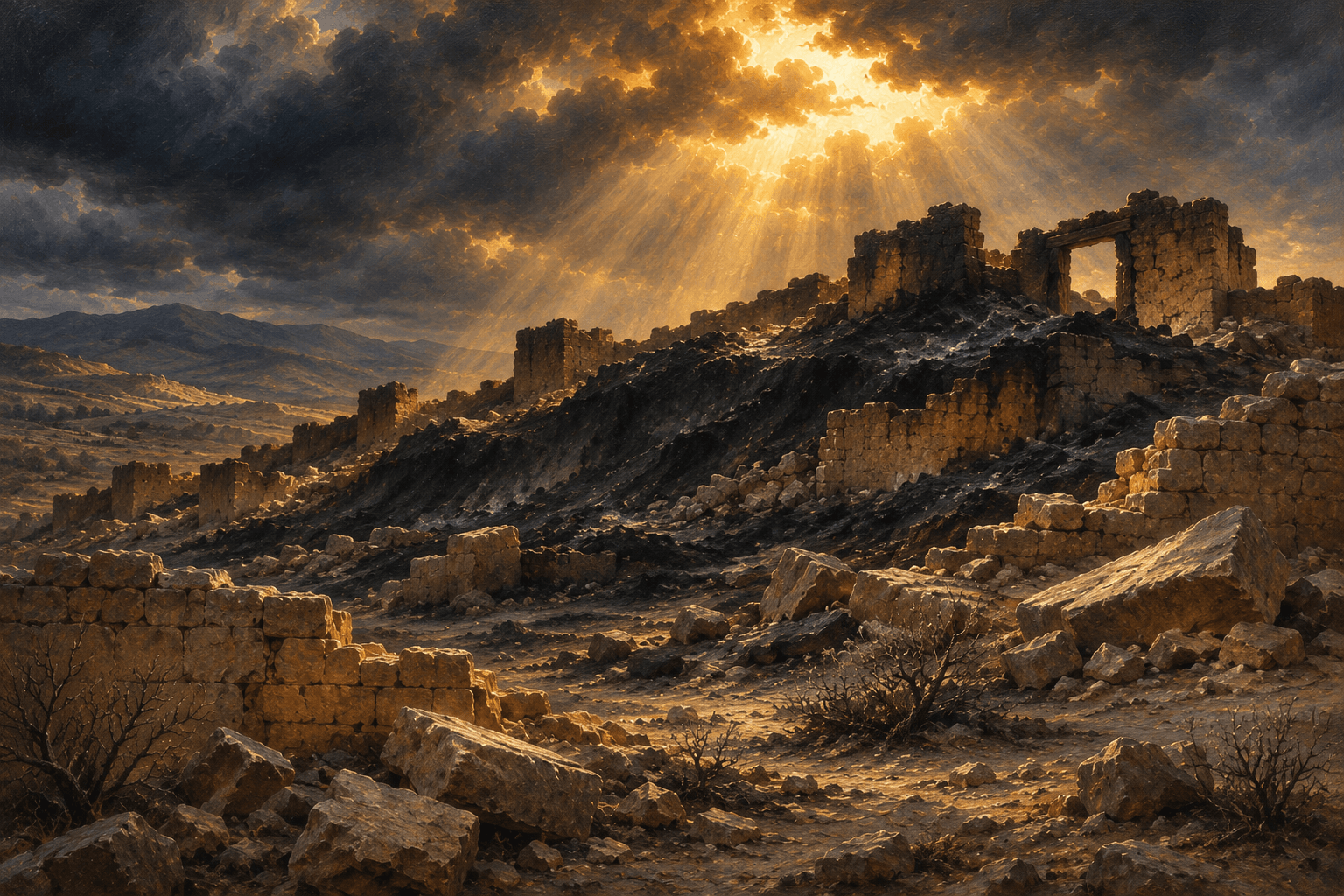
28 And Joshua burnt Ai, and made it an heap for ever, even a desolation unto this day. 29 And the king of Ai he hanged on a tree until eventide: and as soon as the sun was down, Joshua commanded that they should take his carcase down from the tree, and cast it at the entering of the gate of the city, and raise thereon a great heap of stones, that remaineth unto this day.
Origen comments on this action:
“We have already said that the king of Ai can be compared to the devil. How, then, was the latter hanged on a tree? The crucifixion of Jesus had two aspects … The Son of God was crucified in the flesh in a visible way, while the devil was crucified in an invisible way, for ‘having spoiled principalities and powers, he made a shew of them openly’ (Colossians 2:15) … And the Apostle declares: ‘Blotting out the handwriting of ordinances that was against us, which was contrary to us, and took it out of the way, nailing it to his cross’ (Colossians 2:14). So there are two meanings of the cross of God. The first is mentioned by Peter the Apostle: ‘Because Christ also suffered for us, leaving us an example’ (1 Peter 2:21); the other is that the cross presents the cup of Christ’s victory over the devil. [136]”
If the Lord Christ was hanged on the wood of the cross to declare the perfection of God’s love — “For God so loved the world, that he gave his only begotten Son, that whosoever believeth in him should not perish, but have everlasting life” (John 3:16) — then on the cross the Lord also nailed our eternal debt and crushed the power of the devil, snatching us out of his kingdom, so that he no longer has authority over us (Colossians 2:14–15).
By the cross we have accepted to be crucified with our Lord Jesus, so that every evil lust and every vain temporal love is crucified in us. That is why the Apostle says:
“But God forbid that I should glory, save in the cross of our Lord Jesus Christ, by whom the world is crucified unto me, and I unto the world” (Galatians 6:14). It is as if the cross has two faces: the face of divine love, which the only-begotten Son offered by accepting it gladly for our sake in obedience to His Father — which moves us to accept the fellowship of the cross with Him as a declaration of our love for Him; and the other face, the nailing of the devil, his works, his darkness and his deceits, so that they have no authority over us!
In other words, the Lord Christ was hanged on the cross, drawing us by His love and nailing our spiritual enemy! Saint Jerome says:
“On the cross is the shame of Satan and all his army. Certainly Christ was crucified in the body, and by Him Satan is crucified on the cross. [137]”
Wonderfully, the hanging of the king of Ai on the tree was linked with the burning of Ai and making it a heap for ever; as if the crucifixion of the powers of darkness and the stripping of their kingdom were also accomplished by the opening of the fires of hell for the devil and his angels (Matthew 25:41). Origen comments on the words “And Joshua burnt Ai, and made it an heap for ever, even a desolation unto this day” [28]:
“This phrase applies to the spiritual meaning more than to the historical event; for the place occupied by the devil becomes a desolation and his kingdom is burnt, when the Lord reigns and judges the world, and no one sins any more, nor has sin any place. For it will be said to the victors from both groups (the Jews and the Gentiles): ‘Come, ye blessed of my Father, inherit the kingdom prepared for you from the foundation of the world’ (Matthew 25:34); and to the others: ‘Depart from me, ye cursed, into everlasting fire, prepared for the devil and his angels’ (Matthew 25:41).”
Would that our true Joshua might enter our heart as Victor and Conqueror! If He finds in it a place for the devil (the inner Ai), may He burn it with the fire of His Holy Spirit and make it a heap for ever and a desolation, no longer knowing a place for sin; and may its king be crucified, so that he has no authority in us! May our Joshua lift him up on a tree, so that we see it as “the tree of knowledge of good and evil” (Genesis 2:9), on which the Lord Christ, the greatest Good, is hanged, granting us the power of life (2 Corinthians 13:4), and on which evil is hanged, to perish and die away from us!
4. Building an Altar to the Lord
KJV · Verses 30–31
30 Then Joshua built an altar unto the Lord God of Israel in mount Ebal, 31 As Moses the servant of the Lord commanded the children of Israel, as it is written in the book of the law of Moses, an altar of whole stones, over which no man hath lift up any iron: and they offered thereon burnt offerings unto the Lord, and sacrificed peace offerings.
When Joshua had entered the land of promise and victory over Jericho and Ai had been granted him, he carried out what Moses had commanded concerning the building of an altar of stones: “And Moses with the elders of Israel commanded the people, saying, Keep all the commandments which I command you this day. And it shall be on the day when ye shall pass over Jordan unto the land which the Lord thy God giveth thee, that thou shalt set thee up great stones, and plaister them with plaister: and thou shalt write upon them all the words of this law, when thou art passed over, that thou mayest go in unto the land which the Lord thy God giveth thee, a land that floweth with milk and honey” (Deuteronomy 27:1–3).
He had specified precisely the place where it was to be built, the manner of building it and its purpose (Deuteronomy 27:4–8).
We observe the following in the building of this altar:
First: God had specified in advance the place where it was to be built, “Mount Ebal,” and the time of its building: after crossing the Jordan and before finishing the wars and enjoying rest (Deuteronomy 27:4). Mount Ebal is now Jebel Sulemiyeh, on the north side of Nablus. It is known for its height (about 3,077 feet above sea level); its top is rocky, and olives grow only at its foot. It lies parallel to Mount Gerizim, separated from it only by a narrow valley (Deuteronomy 27:12–13), near the plains of Moreh (Deuteronomy 11:30) and near Shechem (Genesis 12:6; 35:4). [138]
God chose this mountain so that the people might go up on it after taking Jericho and Ai, and before entering the rest of the wars, so that their hearts might rise upward from the very beginning of their enjoyment of God’s promises, and not be occupied with the land itself or with its material fruit of milk and honey, but go up to the heights seeking heavenly things, offering thanks to God and asking His help to complete their struggle and enjoy the fullness of the inheritance.
They were not to wait until all the wars were over and build the altar of the Lord in Jerusalem; from the beginning they must enjoy the meeting with God through the sacrifice, so that they might enjoy the fullness of His promises.
The altar of the Lord in Jerusalem would later be built by Solomon, when settlement was complete. It represents our entering heaven itself, to enjoy being in the presence of the Lord face to face through His eternal sacrifice. But the altar of the Lord on Ebal points to our entering the pledge of heaven during our struggle on earth, to enjoy abiding in the presence of the Lord by faith, not by sight, through His holy sacrifice!
How much we need, in the midst of our struggle — after our victory over Jericho and our fall and rising again at Ai — to go up on Mount Ebal to offer a sacrifice of thanksgiving to God, so that we may enjoy Him personally as the goal of our struggle and the secret of our spiritual victory … In this way our goal is set in the midst of our spiritual struggle, so that we do not turn aside until we complete all the days of our sojourning and set out to the altar of the heavenly Jerusalem!
Second: this altar was built of whole stones, “over which no man hath lift up any iron” [31]. What are these whole stones, over which no one has lifted up iron, if not the believing souls who have gathered around their Christ, so that He has made them living stones united together through Him, “the chief corner stone”; who have become whole in Him after the enemy of good had broken them; over whom no one has lifted up iron, for they have come to belong to their Bridegroom, the Lord of glory Jesus, so that the enemy cannot come near them with his evil as with iron?
Rather, they are kept in the hands of their Savior (John 10:28), and “that wicked one toucheth him not” (1 John 5:18). These are the stones that are united as living, holy stones, so that they appear as one altar to the Lord and a holy temple for Him, in which He dwells by His Spirit!
Origen speaks of these living stones:
“All of us who believe in Jesus Christ are called ‘living stones,’ as Scripture says: ‘Ye also, as lively stones, are built up a spiritual house, an holy priesthood, to offer up spiritual sacrifices, acceptable to God by Jesus Christ’ (1 Peter 2:5). As for earthly stones, we lay the hardest and strongest stones first, so that the whole building can be set on them; the stones that follow are less strong, and so on, until at the end we find the weakest at the top, almost near the roof. This is also how we understand the living stones of our spiritual building. What are the stones laid on the foundation? They are ‘the apostles and prophets,’ as Paul says: ‘And are built upon the foundation of the apostles and prophets, Jesus Christ himself being the chief corner stone’ (Ephesians 2:20). In order to be placed next to these stones resting on the foundation, you must know that Christ Himself is the foundation on which the building stands, as Paul the Apostle affirms: ‘For other foundation can no man lay than that is laid, which is Jesus Christ’ (1 Corinthians 3:11). Blessed are those who are able to raise a holy, pure building on a foundation more pure still. [139]”
He also says:
“But in this building, that is, the Church, there must be an altar. I believe that whoever among you is a ‘living stone’ can be an altar, if he gives himself to prayer, offers his supplications night and day, and slays the sacrifice of his petitions; with such God builds His altar. [140]”
And he speaks of the meaning of the whole stones over which no one has lifted up iron:
“What do you think the whole stones mean? They are the conscience, which ought to be whole in everyone, without uncleanness or defilement of body or spirit. Such a one is counted among those over whom no one has lifted up iron, that is, those who have not received ‘the fiery darts of the wicked’ but have quenched them and blunted them with the shield of faith; those who have never received the iron of war, nor the iron of fighting and quarrels, but live in peace and quietness, as befits the humility of Christ. These are the living stones with which Christ our Savior builds His altar — whole stones over which no one has lifted up iron — on which He wishes to offer burnt offerings to the Lord and a sacrifice of peace. And I think that the whole stones without blemish may be the holy apostles, who together and all of them form one altar, through the unity of their hearts and souls. Scripture says: ‘These all continued with one accord in prayer and supplication’ (Acts 1:14). They opened their mouths saying: ‘Thou, Lord, which knowest the hearts of all men’ (Acts 1:24). They were able to pray together in complete agreement, with one voice and one spirit; therefore they could easily build one altar, on which Jesus could be offered as a sacrifice to the Father! As for us, we must strive to have the same speech, the same soul and the same mind (1 Corinthians 1:10), doing nothing ‘through strife or vainglory’ (Philippians 2:3). [141]”
May our true Joshua receive each believer among us as a living stone joined to Him and sanctified in Him by His Holy Spirit, so that we may be counted whole stones without blemish, united together in love, in harmony and integration, as one altar on which His holy sacrifice is offered, the object of His Father’s good pleasure!
Third: “And he wrote there upon the stones a copy of the law of Moses …” [32]. Thus the altar is joined to the law, or worship to the commandment. Our life is not accepted as a sacrifice of love to God through worship alone without obedience to the divine commandment, nor is there obedience to the commandment unless God works in us through the sacrifice and worship. Our life with God is one unity; it cannot be divided into a life of worship and a life of conduct, but it is a life in the one Christ Jesus.
When we worship God we offer our conduct as a sacrifice to God in Christ Jesus, the unique Sacrifice; and in our Christian conduct we practice this conduct so as to offer it as a sacrifice to God in Christ Jesus, the Leader of our souls.
If through our true Joshua we become living stones in His holy altar, it is so that we may carry within us our Lord Jesus Christ, the Sacrifice. And if our Joshua writes His commandment on us, it is so that we may receive within us our Lord Jesus, the living Word of God. He is the Sacrifice and He is the Commandment; He is revealed in us through the sacrifice of His cross, as He is revealed through His commandment. What Joshua did in writing the law of Moses on the stones of the altar points to the sacrament of the Eucharist, in which the holy sacrifice is offered to us, not separated from the word of the Gospel and the commandment.
That is why this sacrament is not celebrated without the Liturgy of the Catechumens, in which we receive the word written and proclaimed through Holy Scripture. [142]
5. Care for the Law
KJV · Verses 32–35
32 And he wrote there upon the stones a copy of the law of Moses, which he wrote in the presence of the children of Israel. 33 And all Israel, and their elders, and officers, and their judges, stood on this side the ark and on that side before the priests the Levites, which bare the ark of the covenant of the Lord, as well the stranger, as he that was born among them; half of them over against mount Gerizim, and half of them over against mount Ebal; as Moses the servant of the Lord had commanded before, that they should bless the people of Israel. 34 And afterward he read all the words of the law, the blessings and cursings, according to all that is written in the book of the law. 35 There was not a word of all that Moses commanded, which Joshua read not before all the congregation of Israel, with the women, and the little ones, and the strangers that were conversant among them.
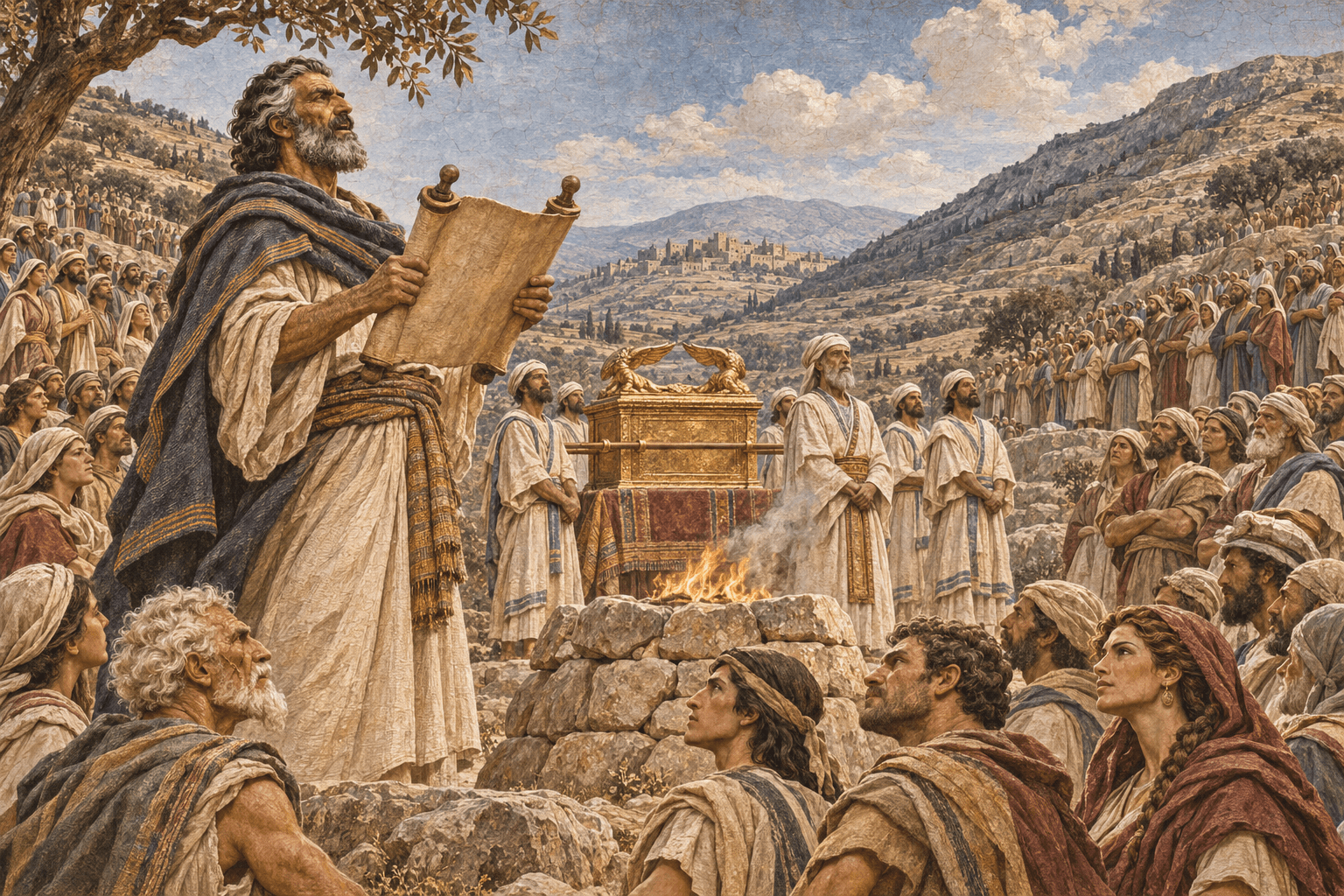
When Joshua had built an altar to the Lord on Mount Ebal and written a copy of the law of Moses before the children of Israel, inspiration says (see verses 33–34 above).
So a solemn assembly was held, in which six tribes stood on Mount Ebal — Reuben, Gad, Asher, Zebulun, Dan and Naphtali — and six tribes on Mount Gerizim. They read alternately: the group on Mount Gerizim read the blessing and the other group the curse. The first group declared the Lord’s blessing on those who obey the commandment, and the other declared the curse on those who commit crimes and iniquities and turn aside from the Lord’s commandments.
We have already spoken of Mount Ebal. As for Mount Gerizim, it is rocky and steep, forming the southern boundary of the valley in which Nablus, or Shechem, lies. Its height is about 2,849 feet above the level of the Mediterranean Sea and 700 feet above the city, and it is about 40 miles north of Jerusalem. Josephus [143] says that in the time of Alexander the Great, Sanballat built a temple on Mount Gerizim opposite the temple of Jerusalem, because the Jewish priests had threatened his daughter’s husband, Manasseh, the brother of Jaddua the high priest, that they would not receive him in the temple unless he divorced Sanballat’s daughter; so Sanballat built this temple for him so that he would not divorce her.
This temple is considered the origin of the Samaritan temple to which the Samaritan woman referred in her conversation with the Lord Christ (John 4:20–21). Jacob’s well was at the foot of the mountain, which is now called Jebel et-Tur. [144]
Truly Moses received the law on two tablets of stone, but now Joshua writes the law on the stones of the altar. Why? Origen says:
“If you want to see how the first law became unprofitable, so that Joshua wrote the second law, hear what the Gospel says: ‘Ye have heard that it was said by them of old time … But I say unto you’ (Matthew 5:33–34) … This is the law which Joshua wrote on living and whole stones, so that you are shown to be ‘the epistle of Christ ministered by us, written not with ink, but with the Spirit of the living God; not in tables of stone, but in fleshy tables of the heart’ (2 Corinthians 3:3). [145]”
So after Moses had received the law on two tablets separate from the altar, Joshua came, representing Jesus our Lord, to write the law on the whole, living stones, that is, in our inner hearts, the hidden altar of God. Origen continues his comment on this:
“Even now Joshua writes the law, through our words, in the hearts of those who receive the word with a sound faith and with all their spirit, with a sound ear, a sound heart and an untainted mind, so that they see by faith, hear, and hold fast to what you tell them; for the law must be written on ‘whole stones.’ [146]”
After the law was written on the living stones, the solemn assembly was held. One group went up on Mount Gerizim, the mountain of blessing, and the other on Mount Ebal, the mountain of the curse that threatens sinners. It should be noted that the more honorable and noble tribes went up to Mount Gerizim to pronounce the blessing that comes upon believers who walk in obedience to the law, while the other, less noble tribes went up on Mount Ebal to repeat the curse that comes upon the wicked and disobedient.
Origen sees this assembly as pointing to the existence of two groups of believers, one more zealous than the other and more eager toward the Savior:
“The first group is aflame with longing for the heavenly promises; it shows great enthusiasm and energy, so that eternal blessedness may not escape it. It wishes not only to gain the blessing and to have ‘the inheritance of the saints’ (Colossians 1:12), but to be always in the divine presence, ever with the Lord. The second group also seeks salvation, but with a love less ardent than the first, content not to go into the eternal fire and not to be cast ‘into outer darkness’ (Matthew 8:12) … Those who go to Mount Gerizim are chosen for the blessing; they come forward not out of fear of punishment, but out of longing for the blessing and for carrying out the commandments. But the others who go to Mount Ebal, to whom the word ‘curse’ is applied, represent those who come forward for fear of punishment and dread of torments; they fulfill what is written in the law and reach the Savior by this path. The Lord alone knows who among us does good for its own sake, and who, on the contrary, seeks Him out of fear of hell. [147]”
Divine inspiration affirms that it was Joshua the son of Nun who read the book of the law, the law of Moses, before all the congregation of Israel, with the women, the little ones and the strangers that were conversant among them [34–35]. Here we observe:
First: Joshua himself read the law of Moses, as if he represented our true Joshua, our Lord Jesus, who rose to reign in us after the death of the Mosaic letter, to read the Mosaic law to us — not through the veil, nor through symbols and shadows, but bringing us into its hidden mysteries with a transcendent spiritual mind. Origen says:
“Joshua read the law when he revealed the mystery of the law. For we, members of the Catholic Church, do not despise the law of Moses, but accept it, on condition that Jesus reads it; for we do not understand it as we should unless Christ reads it, so that we perceive its judgments and its outlook. Yes, did not Paul receive the mind of Jesus when he said: ‘Now we have received, not the spirit of the world, but the spirit which is of God; that we might know the things that are freely given to us of God’? And also the two disciples of Emmaus ‘said one to another, Did not our heart burn within us, while he talked with us by the way, and while he opened to us the scriptures?’ (Luke 24:32), when Christ, ‘beginning at Moses and all the prophets, he expounded unto them in all the scriptures the things concerning himself’ (Luke 24:27). [148]”
Second: our Lord Jesus speaks to “all the congregation of Israel, with the women, and the little ones, and the strangers that were conversant among them” [35]. What does He mean by these groups?
A) He speaks of the Israelite men as “the congregation of Israel.” As we said in the Book of Numbers, every member of the Church, or of “the congregation of the new Israel,” whether man or woman, old man or child, young man or boy … must hold fast to spiritual manhood or maturity, knowing neither the pampering of women nor the helplessness of children. That is why the apostolic commandment to all the members came: “Quit you like men.” And for this reason the ancient census of the people included men, without women and children (Numbers 1:2–3).
B) If Joshua speaks to the congregation of Israel as mature men who receive the divine commandment — those who enjoy strong meat because by reason of use they have their senses exercised to discern both good and evil (Hebrews 5:14) — he also offers food suited to the women and milk suited to the children. As Origen says: “The group of women, children and strangers represents weak souls that still need milk.” [149] If the men represent strong souls with exercised senses, the women represent weak souls that need someone to support them, so that they may imitate the strong souls.
Our true Jesus does not reject even these souls, but speaks with them Himself, to raise them from pampering and luxury to perseverance and maturity. As for those who are spiritually children, our Lord Jesus does not despise them, but embraces them and feeds them with milk until they mature and become able to enjoy strong meat. And the Lord does not abandon even the strangers, that is, the catechumens who wish to enter the holy community; He speaks with them, to hasten them into membership of His holy body, so that they may be counted true children of God.
Origen, fearing that the text before us might be understood as making a distinction between the sexes, male and female, said:
“Holy Scripture in fact makes no distinction between men and women according to sex; before Christ there is no difference between the sexes. Rather, the difference lies in the heart, which divides (believers) into men and women. How many women stand before God as strong men, and how many men are counted as slothful women?! Do you not agree with me that among the women should be counted those men who say: ‘I cannot sell all that I have and give it to the poor; I cannot turn my cheek to the one who strikes me, nor bless him that curses me, nor pray for those who despitefully use me, nor bear with him who persecutes me’? [150]”
In any case, whatever the state of our souls, we must listen to the true Joshua as He speaks with us. If we are men, let us listen so that we may abide in Him and grow to the measure of the stature of His fullness. If we are women, let us listen so that He may remove our slackness and bring us into spiritual maturity. If we are children, let us run to Him so that He may raise us to spiritual manhood. And if we are still strangers, let us come to Him, so that He may draw us near to Himself and carry us in Himself to His heavenly Father.
Notes and References
[134] Origen, Homilies on Joshua 8:2.
[135] Origen, ibid. 8:7, 8.
[136] Origen, ibid. 8:3.
[137] Jerome, Homilies on the Psalms 21.
[138] The Westminster Dictionary of the Bible, p. 236.
[139] Origen, Homilies on Joshua 9:1.
[140] Origen, ibid.
[141] Origen, ibid. 9:2.
[142] See our book Christ in the Sacrament of the Eucharist (Arabic).
[143] Josephus, Antiquities 11:8, 2, 7.
[144] The New Westminster Dictionary of the Bible, p. 325.
[145] Origen, Homilies on Joshua 9:3.
[146] Origen, ibid.
[147] Origen, ibid. 9:7.
[148] Origen, ibid. 9:8.
[149] Origen, ibid. 9:9.
[150] Origen, ibid.