
God had given His people, under the leadership of Joshua, every means for enjoying the inheritance. He had brought them across the Jordan, and they stood before Jericho, a city famous through the generations and fortified with walls. Jericho had to fall before the people for God’s promises to be fulfilled … Here too God gives them new means of triumph and victory!
1. The city of Jericho.
2. Circling the city (1).
3. Blowing the trumpets (2–4).
4. The shout of the people (5–16).
5. The law of the accursed thing (17–21).
6. The saving of Rahab (22–25).
7. The curse on Jericho (26–27).
The City of Jericho
“Jericho” means “city of the moon” or “place of fragrance.” It lies five miles west of the river Jordan and seventeen miles northeast of Jerusalem. The Jericho mentioned in this book is now at “Tell es-Sultan,” a mile west of modern Jericho, which is now called er-Riha, and the hills of Abu el-Alayiq.
From ancient times Jericho was famous for the cultivation of palm trees (Deuteronomy 34:1, 3; Judges 3:13), bananas, oranges and roses (Sirach 24:18), sycamore trees (Luke 19:4), balsam and many fruit trees.
Jericho was given as part of the lot of Benjamin, on the border between Benjamin and Ephraim (Joshua 16:1, 7; 18:12–13). Eglon king of Moab lived there when he struck Israel and humbled them because of their evil (Judges 3:12–13). There David’s messengers stayed, whom he had sent to Hanun king of the children of Ammon, who shaved off their beards and cut off their garments in the middle; they remained there until their beards had grown and then returned (2 Samuel 10:1–5).
In the days of Ahab the son of Omri, king of Israel, Hiel the Bethelite built Jericho, and lost his firstborn when he laid the foundations and his youngest son when he set up the gates, because of Joshua’s prophecy (Joshua 6:26; 1 Kings 16:34). In Jericho Elijah and Elisha visited the company of the prophets before Elijah was taken up, and Elisha returned to these prophets (2 Kings 2:4, 15). The spring that Elisha healed by casting salt into it (2 Kings 2:21) seems to be Ain es-Sultan.
When the captives of Judah taken by the army of Israel under Pekah the son of Remaliah were released, they were brought to Jericho (2 Chronicles 28:15). Near it the Babylonians captured Zedekiah king of Judah (Jeremiah 52:8). With Zerubbabel, 345 persons of the former inhabitants of Jericho and their descendants returned from the captivity (Ezra 2:34; Nehemiah 7:36), and some of them helped build the wall of Jerusalem (Nehemiah 3:2).
Herod the Great built a fortress near Jericho and died there. In the days of the Lord Christ a course of priests lived in Jericho and often traveled from Jerusalem to Jericho, as appears from the parable of the Good Samaritan (Luke 10:30–31). In Jericho the Lord Christ restored sight to Bartimaeus and his companion (Matthew 20:29; Mark 10:46; Luke 18:35), and there too the Lord Christ visited the house of Zacchaeus (Luke 19:1–10).
1. Circling the City
KJV · Verses 1
1 Now Jericho was straitly shut up because of the children of Israel: none went out, and none came in.
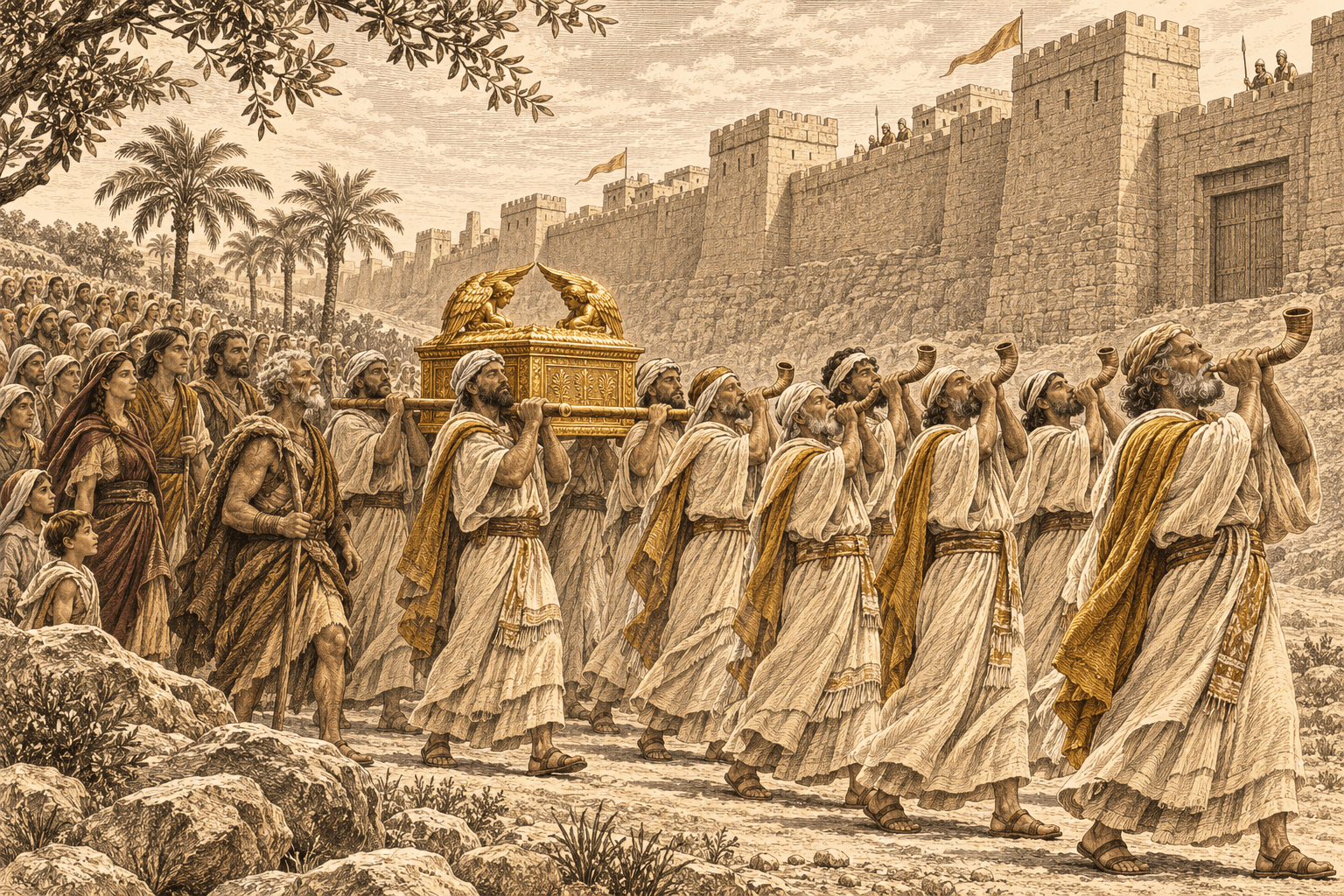
Jericho, as the first fortified city facing the ancient people on the way to enjoying the inheritance, represents the world that lies in the evil one; or, more precisely, it represents love of the temporal world as an obstacle that keeps the soul from setting out toward eternity to enjoy the true inheritance, weighing it down so that it does not rise on the wings of the Holy Spirit from glory to glory. At the same time it also represents the ego, the most dangerous obstacle facing religious people — if the expression is permissible — robbing them of their fellowship with God, the Giver of victory and Bestower of the eternal inheritance.
Two dangers face man in his spiritual struggle: love of the world, or of temporal things, which represents the blow from the left; and the ego, or self, which represents the blow from the right, when a man counts himself better and more righteous than others!
Origen speaks of Jericho as representing the world that lies in the evil one, or evil itself, saying:
“It is said in the Gospel: ‘A certain man went down from Jerusalem to Jericho, and fell among thieves’ (Luke 10:30). Here we clearly recognize the image of Adam, who fell from Jerusalem and went down into the exile of this world. And the two blind men who were of Jericho (Matthew 20:30), whom Jesus met and to whom He gave sight — do they not represent the men of this world, struck with the blindness of ignorance, for whom the Son of God came? So the city of Jericho is this world in which we are, and which must be destroyed. [110]”
He speaks of the battle of Jericho as a battle against the evil of this world, whose battlefield is the heart:
“Let us go to war, and attack the most dangerous city in this world, that is, evil, and let us destroy the arrogant walls of sin. Are you looking around you to learn the way you must take and the field of battle you should choose …? Confine your search within yourself; the battle you fight is in you. There is the building of evil that must be torn down! Let your enemy be driven out of the depths of your heart! I do not say this of myself but from Christ. Listen to Him: ‘For out of the heart proceed evil thoughts, murders, adulteries, fornications, thefts, false witness, blasphemies’ (Matthew 15:19). Do you perceive how great is this army hostile to you, advancing against you in the depths of your heart? These are our enemies whom we must slay in the first battle and bury in the dust in the front line, if we are able to tear down their walls and root them out, so that not one breath of them remains (Joshua 11:14), and not one of them remains to rest in us, to live again and rise up in our thoughts. In this way Jesus gives us the great rest: ‘They shall sit every man under his vine and under his fig tree; and none shall make them afraid’ (Micah 4:4). [111]”
Holy Scripture describes Jericho thus: “Now Jericho was straitly shut up because of the children of Israel: none went out, and none came in” [1]. It represents the person shut up within himself, whose heart does not open in giving and receiving, but is like a closed city from which no one goes out and into which no one comes. It is utterly without love! But the person whose heart is enlarged by Christ, the Lover of mankind, lives with an open mind, opening his depths to every person with divine wisdom, and from his heart goes out a satisfying love for others.
This is Jericho, representing the world that lies in the evil one, or evil itself, especially the ego. God used a unique way of overcoming Jericho, which was not repeated in the other wars or in the capture of other cities. The battle of Jericho — if the expression is permissible — is considered the first battle in the land of promise after crossing the river Jordan, and God wished to declare in a tangible way that the war is His and the victory is from Him, and that their true and essential weapon is faith. The Apostle Paul says: “By faith the walls of Jericho fell down, after they were compassed about seven days” (Hebrews 11:30).
In the fall of Jericho God did not use military plans, human wisdom, men of war or weapons, although He required the people to use these things in the battles that followed. He wished to assure them from the beginning that, though He values human wisdom and uses human work when it is sanctified, God alone remains the secret of our victory over sin! He commanded them to go around the city once each day for six days, until their strength was exhausted; and on the seventh day to go around the city seven times, until they had no strength left to walk.
Then they were to shout with a great shout, declaring their faith in God, the Giver of victory, so that He would fight for them and give them what He had promised.
Perhaps the circling points to “entering into eternity,” since eternity represents the life without end, like a circle. Through the eternal life that has become ours in Christ Jesus our Lord we are able to tear down the proud walls of Jericho and its lofty houses, so that the world with all its enticements cannot draw our hearts, nor evil with all its deceits pull our thoughts to itself, nor the self with all its scepter take the soul captive and shut it in.
“Eternity,” or “life with the eternal Christ,” is the way of triumph, of inner victory. Through it mortal time is swallowed up, and before it all the illusions of the evil world and of vainglory flee … Truly our entering heaven while we are still on earth lifts us above every weakness and uproots from within us the hidden roots of evil!
Also, the circling once each day during the first six days points to continual work at all our times (the working days of the week), while the circling seven times on the seventh day means that on our day of rest, the seventh day, we work doubly for the Lord and struggle a complete struggle (the number 7 points to perfection). Through this struggle the Sabbath is kept spiritually, that is, the rest on the Lord’s Day.
Truly the Lord’s Day, the day of rest, is not a day of slackness or laziness, but a day of continual struggle by the free grace working in us, until the satanic strongholds are completely torn down, the ego is crucified in us, and our true Joshua reigns within us and rests in our heart as on His throne while we rest in Him, and sin has no dominion over us.
Saint John Chrysostom says: “It appears that the Sabbath was broken here literally, but it was kept spiritually; for the work greatly increased, and the victory increased more than on any other day.” [112] Saint Augustine says: “Whoever does not sin truly keeps the Sabbath.” [113] Saint Clement of Alexandria says: “We keep the spiritual Sabbath until the coming of the Savior, if we rest from sin.” [114] And Saint Jerome says: “The Jews did not kindle a fire on the Sabbath; but we, on the contrary, must kindle the fire of the Holy Spirit and burn up every vice and sin.” [115]
Origen has a wonderful expression of the meaning of the Lord’s Day: “The perfect man is he who is always occupied with the words, works and thoughts of the Lord; so he lives always in the Lord’s days, and all his days become days of the Lord.” [116]
It was truly a day of the Lord when they went around Jericho seven times, blew the trumpets and shouted, and shouted to the Lord who crushed the powers of evil and its dominion, so that Joshua and all his children with him might reign!
2. Blowing the Trumpets
KJV · Verses 2–4
2 And the Lord said unto Joshua, See, I have given into thine hand Jericho, and the king thereof, and the mighty men of valour. 3 And ye shall compass the city, all ye men of war, and go round about the city once. Thus shalt thou do six days. 4 And seven priests shall bear before the ark seven trumpets of rams' horns: and the seventh day ye shall compass the city seven times, and the priests shall blow with the trumpets.
On the seventh day, as they went around the city seven times, the priests blew the trumpets in the seventh round [4, 16]. In our study of the Book of Numbers (10:1–10) we spoke of the language of the trumpets as the word of God which the priests continually proclaim, able to grant believers a life of spiritual victory and to stir up in them inner joy and exultation of heart. [117] Saint Ambrose says:
“Not everyone has the right to blow the trumpet or to call others to the holy assembly; this privilege was granted to the priests alone. [118]”
Origen speaks of the priests’ trumpets that were blown to tear down the walls of Jericho:
“Jericho represents the present world; the strength of its walls is torn down when the priests sound the trumpets. The strong wall that serves this world is the worship of idols and ascribing divinity to things made, through satanic deception, and the works of false soothsayers and magicians … Add to this the various (atheistic) ideas of the philosophers, and also the teachings that arose from disputes … All this was like a high wall supporting the world. But when the Lord Jesus came — whom Joshua the son of Nun represents — He sent the priests and apostles to blow the trumpet of silver (Numbers 10:2; Psalm 98:6), that is, to present the lofty, heavenly teachings in preaching. The first priestly trumpet was blown in the Gospel of Matthew, and also in Mark, Luke and John; each blew with the trumpets of the priests. Peter also blew two trumpets in his two epistles, and so did James and Jude, and John in his epistles, and Luke in the Book of Acts. And the last (Paul) blew the trumpets through his fourteen epistles, hurling thunderbolts at the walls of Jericho to bring them down to the ground, demolishing its buildings and smashing all its engines of war — the worship of idols and the opinions of the philosophers. [119]”
Bishop Caesarius speaks of the priests’ trumpets:
“Jericho points to this world. As its walls fell at the blowing of the trumpets, so now the city of this world falls — that is, pride, with its towers, which are greed, envy and debauchery, together with all its people; that is, every evil lust must be crushed and destroyed through the continual preaching of the priests. Therefore the priests ought not to be silent in the church, but rather fulfill the word of the Lord: ‘Cry aloud, spare not, lift up thy voice like a trumpet, and shew my people their transgression’ (Isaiah 58:1). We are required to cry out and call with a loud voice without ceasing, so that we may preserve our salvation. He says ‘cry aloud’ and ‘spare not,’ lest you perish by your silence because of the sinner’s wickedness. While you spare his feelings out of shyness, you fail to care for his (spiritual) health. Do not let his wounds grow worse through your silence, for they must be healed by your crying out. This is why we must call out, and call with a loud voice, so that no one may say that he did not hear the voice, or that the voice of the priest was unknown to him. [120]”
He also says:
“The trumpet is important for sinners, not only to pierce their ears but to shake their hearts, not only to gladden them but to rebuke them. The sound of the trumpet should encourage the watchful to do good, and terrify the negligent over their sins. As in battle the trumpet terrifies the fearful soldier while it fires the spirit of the brave, so the priest’s trumpet humbles the mind of the sinner and encourages the spirit of the righteous … This is the work of the trumpet: it scatters the doings of sinners and strengthens the works of the righteous. [121]”
And again he speaks of the priests’ trumpets:
“The blessed Paul says: ‘For the weapons of our warfare are not carnal, but mighty through God to the pulling down of strong holds; casting down imaginations, and every high thing that exalteth itself against the knowledge of God, and bringing into captivity every thought to the obedience of Christ’ (2 Corinthians 10:4–5). Do you not see that the tongues of priests, according to the words of the Apostle, are weapons of speech that scatter vain thoughts and take lofty pride captive? [122]”
3. The Shout of the People
KJV · Verses 5–16
5 And it shall come to pass, that when they make a long blast with the ram's horn, and when ye hear the sound of the trumpet, all the people shall shout with a great shout; and the wall of the city shall fall down flat, and the people shall ascend up every man straight before him. 6 And Joshua the son of Nun called the priests, and said unto them, Take up the ark of the covenant, and let seven priests bear seven trumpets of rams' horns before the ark of the Lord. 7 And he said unto the people, Pass on, and compass the city, and let him that is armed pass on before the ark of the Lord. 8 And it came to pass, when Joshua had spoken unto the people, that the seven priests bearing the seven trumpets of rams' horns passed on before the Lord, and blew with the trumpets: and the ark of the covenant of the Lord followed them. 9 And the armed men went before the priests that blew with the trumpets, and the rereward came after the ark, the priests going on, and blowing with the trumpets. 10 And Joshua had commanded the people, saying, Ye shall not shout, nor make any noise with your voice, neither shall any word proceed out of your mouth, until the day I bid you shout; then shall ye shout. 11 So the ark of the Lord compassed the city, going about it once: and they came into the camp, and lodged in the camp. 12 And Joshua rose early in the morning, and the priests took up the ark of the Lord. 13 And seven priests bearing seven trumpets of rams' horns before the ark of the Lord went on continually, and blew with the trumpets: and the armed men went before them; but the rereward came after the ark of the Lord, the priests going on, and blowing with the trumpets. 14 And the second day they compassed the city once, and returned into the camp: so they did six days. 15 And it came to pass on the seventh day, that they rose early about the dawning of the day, and compassed the city after the same manner seven times: only on that day they compassed the city seven times. 16 And it came to pass at the seventh time, when the priests blew with the trumpets, Joshua said unto the people, Shout; for the Lord hath given you the city.
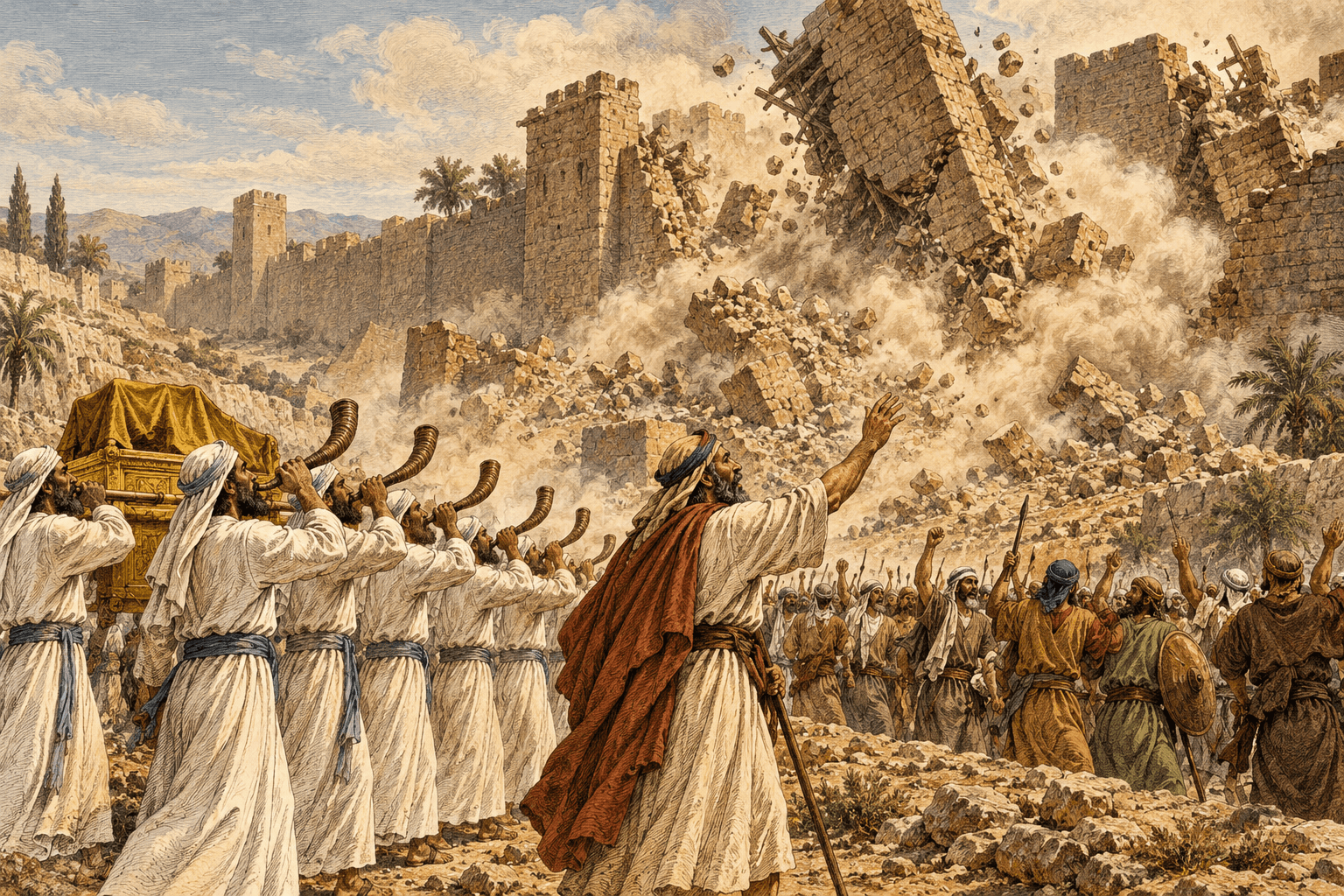
God asked Joshua that “all the people shall shout with a great shout” [5] when they heard the sound of the trumpet blown by the priests, “and the wall of the city shall fall down flat, and the people shall ascend up every man straight before him” [5]. Some have translated the word “shout” as “shouts of joy,” while others, such as Origen, see it as the shout of unity which soldiers cry together with one spirit when they are fired up in battle.
It is as if the fall of the walls of Jericho, or the tearing down of the devil’s kingdom, does not require the joyful life of the individual isolated from the community, but the shout of victory going up from the whole community with one spirit. Truly it is the shout of spiritual struggle against sin and the kingdom of the devil, full of hope and joy through unity together. That is why the Psalmist says:
“Make a joyful noise unto the Lord, all ye lands. Serve the Lord with gladness” (Psalm 100:1–2), and also: “Blessed is the people that know the joyful sound” (Psalm 89:15).
Having gone around Jericho seven times, they were physically exhausted and became as those under sentence of death, completely unable not only to fight but even to walk. Since this points to circling into eternal life, we say that their death was swallowed up by the triumph and victory of eternity, as the Apostle says: “Then shall be brought to pass the saying that is written, Death is swallowed up in victory” (1 Corinthians 15:54).
It is as if all, having enjoyed eternity in Christ Jesus, burst out with shouts of joy and exultation, a sign of victory over death and of enjoying the triumph of eternity, saying with the Apostle: “O death, where is thy sting? O grave, where is thy victory? … But thanks be to God, which giveth us the victory through our Lord Jesus Christ” (1 Corinthians 15:55, 57). So their exhausting struggle is mingled with the exultation of their hearts, and the spiritual warfare is joined with the experience of heavenly joy!
That is why the Fathers of the Church — even the ascetics among them — spoke of the life of inner joy in Christ Jesus, and of exultation amid the tears of repentance and the labors of spiritual struggle, warning against falling under the spirit of gloom, which leads us into despair and destroys our faith. They affirm that we are bound to the great inner shout amid our exhausting struggle. Bishop Ignatius Brianchaninov says:
“If a thought or feeling of gloom comes to you, it is profitable to remember the power of faith, and the words of the Lord who forbade us to fear or be gloomy, declaring and assuring us of God’s promises that even the hairs of our heads are all numbered, and that nothing can happen to us without His providence and permission. [123]”
Saint John Chrysostom says:
“Sin does not destroy as despair does. For whoever sins, if he is watchful, quickly repents and amends what has happened; but whoever has learned despair and impenitence fails to amend the matter, because he does not accept the remedies of repentance. [124]”
He also speaks of our rising above the sorrow and bitterness of afflictions by offering joyful shouts of thanksgiving:
“Let us not be drowned in our afflictions, but give thanks in everything, and so gain great profit; for we please God who permits the afflictions. Affliction is a great good. This we learn from our children, who without affliction learn nothing useful; and we need affliction more than they do. [125]”
Origen focuses on the unity of spirit in the joyful shout, commenting on the Psalmist’s words, “Blessed is the people that know the joyful sound” (Psalm 89:15):
“He did not say, Blessed is the people that practices righteousness, nor the people that knows the mysteries, nor whoever has knowledge of heaven and earth and the stars, but ‘Blessed is the people that know the joyful sound.’ Sometimes the fear of God grants a person joy (a shout), but it grants it to one person; so, for example, it is said, ‘Blessed is the man that feareth the Lord’ (Psalm 112:1) … But here the blessedness is given in abundance … Why? Because the whole people shares in it; all know the company of exultation. So it seems to me that the shout of joy means unity of heart and the binding together of spirit … When the people lift up their voice with one accord, there is fulfilled in them what happened in the Book of Acts, an earthquake (Acts 4:24, 31) … and everything is torn down and this world comes to nothing. [126]”
If the priests’ trumpets point to the word of God and the unceasing work of preaching, the shout of the people means the oneness of heart that brings forth joy and exultation through victory over the kingdom of darkness. The priests preach repentance, and the people enjoy God’s gifts and His victory over the world through the unity of true love! That is why Scripture says: “All the people shall shout with a great shout” [5]. Our Christianity, then, is founded on the personal relationship between God and the human soul, but not in isolation and solitude; rather, through its union with the other members in one spirit through the one Head.
Origen connects the priests’ trumpets and the shouts of the people within the soul. He sees the true Joshua entering the soul to conquer it as His kingdom, crushing the inner walls of Jericho. He says that as priests we ought to carry the trumpets within us and blow them to drive away unseemly thoughts and words; we blow the trumpets, that is, we praise “in psalms and hymns and spiritual songs” (Colossians 3:16), or we blow the trumpets of the mysteries of the law, the symbols of the prophets and the teachings of the apostles, which work together in harmony within us … All these burst forth within us as a people shouting with a great shout, so that our thoughts, our emotions and all that is within us shout for joy, with no defilement, guile or falsehood in them.
What is in us shouts with a harmonious and integrated spirit; then the walls of love of the world in us are torn down and our Jesus reigns within us, so that we say with the Apostle:
“But God forbid that I should glory, save in the cross of our Lord Jesus Christ, by whom the world is crucified unto me, and I unto the world” (Galatians 6:14).
The blowing of the trumpets of the Old Testament (the law and the prophets) in harmony with the trumpets of the New Testament — that is, the study of Holy Scripture as one unity, in a spiritual and edifying way — also creates a harmonious shout in man. The body shouts with the holiness of its members, together with the soul with the holiness of its energies, its feelings, emotions and talents … all working together in the spirit of unity under the leadership of the Holy Spirit, with true joy, as our Lord Jesus reigns over them.
4. The Law of the Accursed Thing
KJV · Verses 17–21
17 And the city shall be accursed, even it, and all that are therein, to the Lord: only Rahab the harlot shall live, she and all that are with her in the house, because she hid the messengers that we sent. 18 And ye, in any wise keep yourselves from the accursed thing, lest ye make yourselves accursed, when ye take of the accursed thing, and make the camp of Israel a curse, and trouble it. 19 But all the silver, and gold, and vessels of brass and iron, are consecrated unto the Lord: they shall come into the treasury of the Lord. 20 So the people shouted when the priests blew with the trumpets: and it came to pass, when the people heard the sound of the trumpet, and the people shouted with a great shout, that the wall fell down flat, so that the people went up into the city, every man straight before him, and they took the city. 21 And they utterly destroyed all that was in the city, both man and woman, young and old, and ox, and sheep, and ass, with the edge of the sword.
At the beginning of their inheritance the Lord did not want their hearts, minds and time to be turned to plunder and material gain. So He forbade them to take anything from Jericho; but in the later battles He permitted them the spoil, assuring them that if they turned away from temporal things at Jericho, He would give them spiritual things and temporal things as well in the wars that followed. As the Lord Himself says: “Seek ye first the kingdom of God, and his righteousness; and all these things shall be added unto you” (Matthew 6:33).
Origen comments on this law of the accursed thing:
“Truly Joshua said: ‘And ye, in any wise keep yourselves from the accursed thing, lest ye make yourselves accursed, when ye take of the accursed thing, and make the camp of Israel a curse, and trouble it.’ Here is the meaning of these words: Take care that you keep nothing of the world within you, lest the vicious habits of the world come into the community of believers … Do not mix the things of the world with what belongs to Christ, nor bring the necessities of the world into the holy things of the Church. John warns us of the same thing, sounding the trumpet in his epistle: ‘Love not the world, neither the things that are in the world’ (1 John 2:15). And Paul says the same: ‘Be not conformed to this world’ (Romans 12:2). For when we walk after the manner of the people of the world, we have welcomed the accursed things. We mention, for example, that taking part in the feasts of the pagans after we have become Christians means bringing the accursed thing into the Church; and likewise the study of astrology and the observation of the flight of birds … is bringing the accursed thing from Jericho into the camp of the Lord and defiling it, which leads to the defeat of God’s people …”
5. The Saving of Rahab
KJV · Verses 22–25
22 But Joshua had said unto the two men that had spied out the country, Go into the harlot's house, and bring out thence the woman, and all that she hath, as ye sware unto her. 23 And the young men that were spies went in, and brought out Rahab, and her father, and her mother, and her brethren, and all that she had; and they brought out all her kindred, and left them without the camp of Israel. 24 And they burnt the city with fire, and all that was therein: only the silver, and the gold, and the vessels of brass and of iron, they put into the treasury of the house of the Lord. 25 And Joshua saved Rahab the harlot alive, and her father's household, and all that she had; and she dwelleth in Israel even unto this day; because she hid the messengers, which Joshua sent to spy out Jericho.
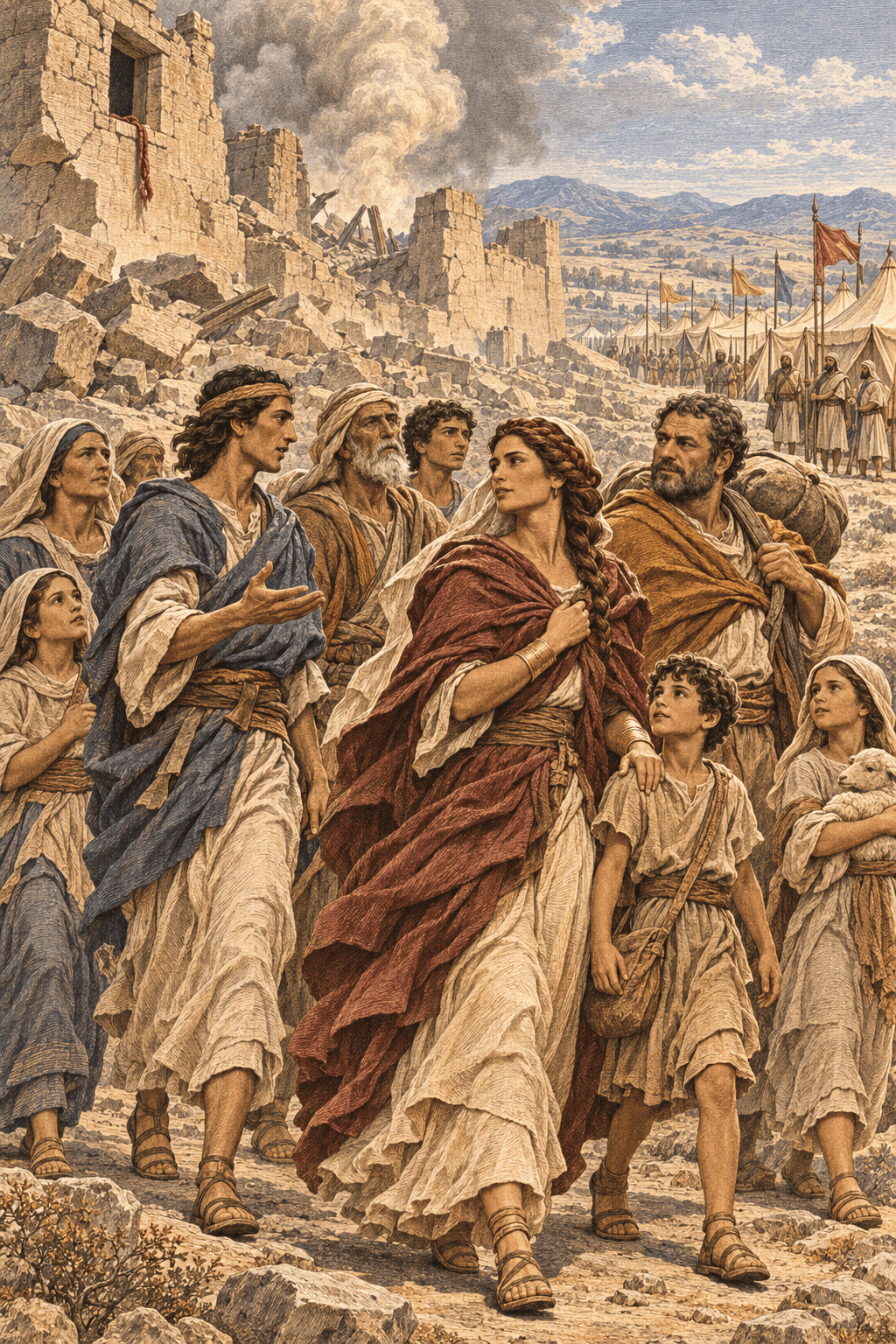
“But Joshua had said unto the two men that had spied out the country, Go into the harlot’s house, and bring out thence the woman, and all that she hath, as ye sware unto her … And Joshua saved Rahab the harlot alive, and her father’s household, and all that she had; and she dwelleth in Israel even unto this day” [22, 25].
By faith Rahab alone, with all her father’s house, was saved from destruction; indeed, this Gentile woman entered into the midst of Israel, to be grafted into the true olive tree.
Origen says:
“In what way are we to understand that Rahab ‘dwelleth in Israel even unto this day’? Scripture usually uses the expression ‘unto this day’ when it speaks of something remaining to the end of life. For example, when it says, ‘the same is the father of the Moabites unto this day’ (Genesis 19:37), it means ‘to the end of the world.’ And in the Gospel too: ‘This saying is commonly reported … until this day’ (Matthew 28:15), meaning to the end and consummation of the world. But how can we say that Rahab ‘dwelleth in Israel even unto this day’? Do we not understand from this that she joined the true Israel (the Church of the New Testament) unto this day? If you want illumination to understand the way in which Rahab joined Israel, notice how ‘thou, being a wild olive tree, wert graffed in among them, and with them partakest of the root and fatness of the olive tree’ (Romans 11:17) … For we, who were branches of a wild olive tree, came from various nations and were established in the root. We who used to live in fornication and worship stones and wood instead of the true God (Deuteronomy 4:28) have come to faith in the Lord Christ, and have become unto this day the people from above, while the other people (the Jews), because of their lack of faith, have become from below … The first have become last (Matthew 19:30). [127]”
6. The Curse on Jericho
KJV · Verses 26–27
26 And Joshua adjured them at that time, saying, Cursed be the man before the Lord, that riseth up and buildeth this city Jericho: he shall lay the foundation thereof in his firstborn, and in his youngest son shall he set up the gates of it. 27 So the Lord was with Joshua; and his fame was noised throughout all the country.
Since Jericho came to represent evil, which must be completely torn down and destroyed, “Joshua adjured them at that time, saying, Cursed be the man before the Lord, that riseth up and buildeth this city Jericho: he shall lay the foundation thereof in his firstborn, and in his youngest son shall he set up the gates of it” [26]. This was fulfilled literally when Hiel the Bethelite built it, for Scripture says: “He laid the foundation thereof in Abiram his firstborn, and set up the gates thereof in his youngest son Segub, according to the word of the Lord, which he spake by Joshua the son of Nun” (1 Kings 16:34).
Jericho with its lofty walls was destroyed forever, a sign of the crushing of evil and the tearing down of unbelief. Saint Augustine says:
“How long will these walls stand? They will not remain forever! For the Ark goes around the walls of Jericho, and a time comes — at its seventh circuit — when all the walls of the city of unbelief and contradictions are torn down. But until this is fulfilled, man ought to toil in his practices, bearing with his opponents, so as to choose wings on which to fly … [128]”
Truly, let Jericho be destroyed forever and Rahab the harlot be saved; that is, let the evil that has overcome the world pass away — as Scripture says, “the whole world lieth in wickedness” (1 John 5:19), “for all that is in the world, the lust of the flesh, and the lust of the eyes, and the pride of life” (1 John 2:16) — so that evil is torn down and does not rise again, and Rahab, who was a harlot, may live as a holy and chaste bride of the Lord (2 Corinthians 11:2).
Thus the harlot no longer walks in her harlotry, but in the holiness of the Lord, as the Apostle says: “And such were some of you: but ye are washed, but ye are sanctified, but ye are justified in the name of the Lord Jesus, and by the Spirit of our God” (1 Corinthians 6:11).
Notes and References
[110] Origen, Homilies on Joshua 6:4.
[111] Origen, ibid. 5:2.
[112] John Chrysostom, Homilies on Matthew 39.
[113] Augustine, Sermon 38, PL 270:1242.
[114] Clement of Alexandria, Library of the Fathers of the Church, vol. 43.
[115] Jerome, PL 39:2058.
[116] Origen, Against Celsus 8:21.
[117] Fr. Tadros Y. Malaty, Commentary on Numbers (Arabic), 1981, pp. 54–55.
[118] Ambrose, On Belief in the Resurrection 2:111.
[119] Origen, Homilies on Joshua 7:1.
[120] Caesarius of Arles, Sermon 115:5.
[121] Caesarius of Arles, ibid.
[122] Caesarius of Arles, ibid. 115:6.
[123] Ignatius Brianchaninov, The Arena, p. 208.
[124] John Chrysostom, Homilies on Matthew 86.
[125] John Chrysostom, Homilies on Acts 42.
[126] Origen, Homilies on Joshua 7:2.
[127] Origen, ibid. 7:4.
[128] Augustine, On the Psalms 55.