
This chapter speaks of:
- The bush burning with fire (1–4).
- Putting off the shoes (5).
- The call of Moses to service (6–10).
- Moses’ excuse (11–13).
- The name of God (14–17).
- The mystery of the three days (18).
- The mighty hand of God (19–22).
1. The Bush Burning with Fire
KJV · Verses 1–4
1 Now Moses kept the flock of Jethro his father in law, the priest of Midian: and he led the flock to the backside of the desert, and came to the mountain of God, even to Horeb. 2 And the angel of the Lord appeared unto him in a flame of fire out of the midst of a bush: and he looked, and, behold, the bush burned with fire, and the bush was not consumed. 3 And Moses said, I will now turn aside, and see this great sight, why the bush is not burnt. 4 And when the Lord saw that he turned aside to see, God called unto him out of the midst of the bush, and said, Moses, Moses. And he said, Here am I.

While Moses was keeping the flock of Jethro his father-in-law, he led the flock to the backside of the desert and came to the mountain of God, Horeb. There he saw a bush burning with fire, yet not consumed, and he said: “I will now turn aside, and see this great sight, why the bush is not burnt” (3). Here Moses the prophet entered a new stage, the stage of meeting God, who is the secret of strength, the hidden Shepherd who works for the salvation of the world and the building up of the Church.
Now, to what does this burning bush point?
A) The Hebrew word for “bush” in verses 2–3 means “the bush full of thorns,” the thorny bush. [50] Therefore the Jews saw in this bush a symbol of Israel, surrounded by the thorns and hardships that befell it. [51] Some of the early fathers took the same thought: Tertullian [52] saw in the bush a sign of the Church, in which the fire of persecution burns without destroying her, and Saint Hilary of Poitiers held the same view. [53]
Saint Hippolytus of Rome says:
God speaks with His saints in the Church as in the bush. [54]
It is as if Moses the prophet saw in the bush the suffering Church of the Lord Christ, surrounded by thorns, yet aflame with the fire of the divine Spirit, so that death does not touch her… This is the service to which he was called!
B) Saint Augustine sees that it points to the glory of God which dwelt among the Jewish people, yet did not destroy the hardness of their heart, full of thorns. [55]
C) Saint Clement of Alexandria [56] sees in the bush a revelation of the virgin birth: the Lord Christ was born of the Virgin, and by His birth her virginity was not undone. This is also what Saint Gregory of Nyssa meant when he said:
The light of the Godhead which shone from her into human life through her giving birth (to Jesus Christ) did not burn the burning bush, just as the flower of her virginity did not wither by her bearing the Child. [57]
Theodoret also held the same view. [58]
D) Saint Cyril of Alexandria [59] sees that the bush carried the mystery of the divine Incarnation, for the Godhead was united with the manhood without the manhood being swallowed up. Moses the prophet could not have begun this work of salvation had he not touched the shadows of the divine Incarnation and come to know the divine Word incarnate as the Friend of mankind, who became one of us and lived among us bearing our body and our humanity, so as to bring us into His divine glories. On this Saint Gregory of Nyssa says:
The light did not shine through a luminous star but through an earthly bush, yet it surpassed the heavenly lights in its brilliance; and at the same time, so that no one would think it did not come from tangible matter. [60]
That is, lest anyone deny the reality of His Incarnation.
E) Finally, Saint John Chrysostom saw in the bush a living image of the resurrection of the Lord Christ, who bore a real body and truly died, yet was not held by death forever. [61]
On this occasion we recall what Saint Jerome wrote to Abigaus, a priest in Baetica in Spain, comforting him because he was blind and could not see:
You should not grieve that you are deprived of the bodily eyes, which ants, flying insects, and reptiles share with man; rather, rejoice that you have the eye spoken of in the Song of Songs… the eye by which you see God, and to which Moses referred when he said: “I will now turn aside, and see this great sight” (3). [62]
Note that Scripture says: “And the angel of the LORD appeared unto him in a flame of fire out of the midst of a bush” (2). Here the word “angel” means “one who is sent,” and it points to the second Hypostasis, the Son, who was sent by the Father to declare this work and to send Moses the prophet… For had the One who appeared been an angel and not the second Hypostasis, it would not have said: “God called unto him out of the midst of the bush… Moreover he said, I am the God of thy father, the God of Abraham, the God of Isaac, and the God of Jacob. And Moses hid his face; for he was afraid to look upon God” (4–6).
Some of the fathers see that the Father is not seen, but His Word is revealed here in the bush as a burning fire; and He is the very One who comes at the end of the ages incarnate, to “declare” the Father!
2. Putting Off the Shoes
KJV · Verses 5
5 And he said, Draw not nigh hither: put off thy shoes from off thy feet, for the place whereon thou standest is holy ground.
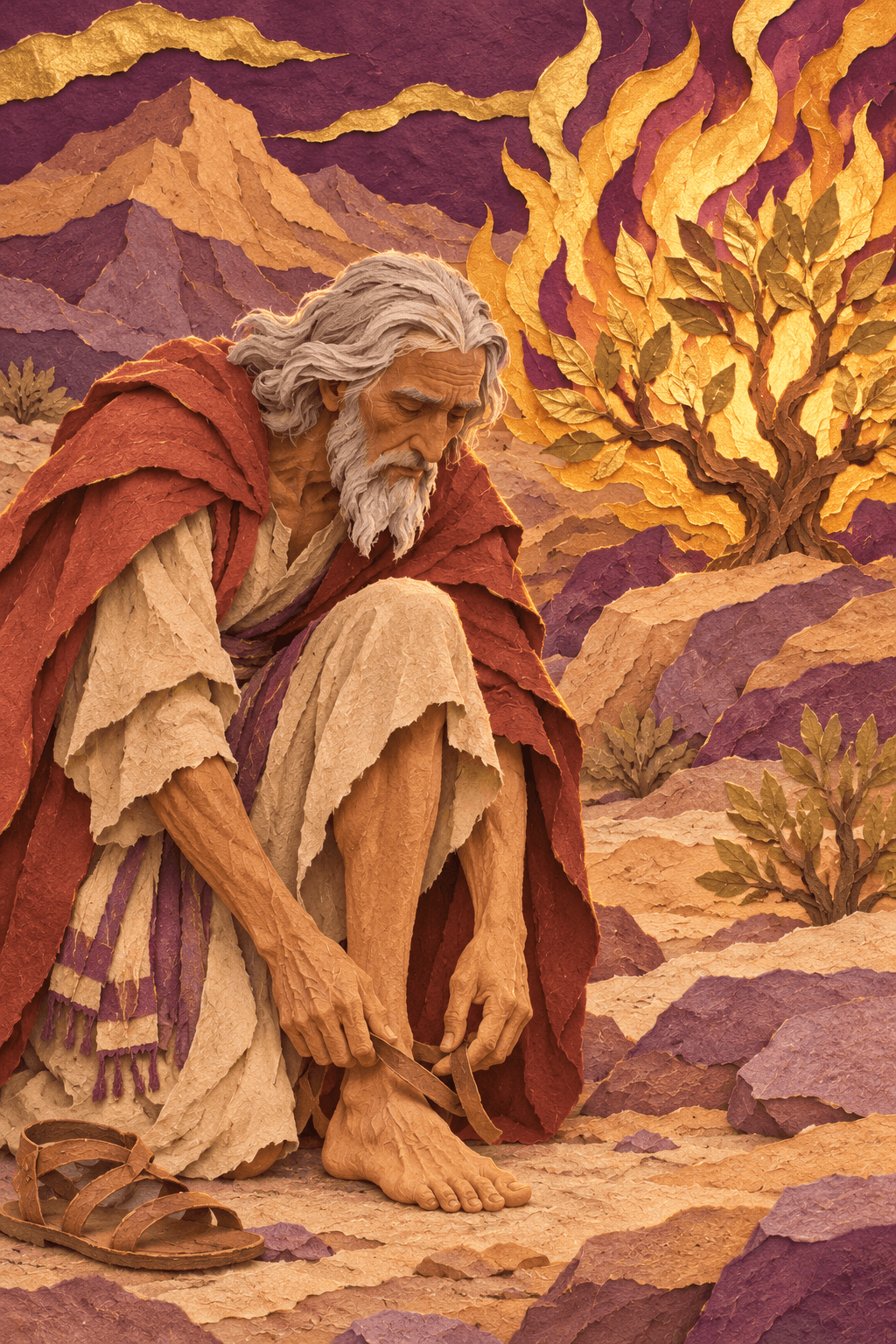
The Lord says to Moses: “Draw not nigh hither: put off thy shoes from off thy feet, for the place whereon thou standest is holy ground” (5).
In our discussion of the holiness of the sanctuary [63] we said that to this day we enter the sanctuary barefoot, according to the Lord’s command to Moses the prophet. Putting off the shoes points to the sense of our unworthiness even to stand in this holy place, in which the awesome sacrifice is offered, into which the angels desire to look. For the fathers, putting off the shoes also carries many other deep meanings, among them:
A) In ancient times shoes were made from the skin of dead animals. It is as if God, by this command, asks us to put off from us the love of dead, temporal things and to cleave to the everlasting heavenly things, so that we may meet Him. This is what Origen taught, and many fathers took it from him. Saint Augustine says:
What holy ground is like the Church of God?! Let us then stand in it with our shoes put off, that is, renouncing dead works. [64]
Saint Ambrose says:
Moses, a figure of the people, was not shod with the Lord’s shoe (Matthew 3:11), but with the sandal of his own feet! Therefore the Lord commanded him to put it off, that he might free the steps of his heart and soul from the bonds and fetters of the body, and walk in the way of the spirit. [65]
Saint Gregory of Nazianzus says:
Let him who draws near to the holy ground, which is the sanctuary of God, put off his sandals as Moses did, so that he may not bring anything dead in there, and that nothing may stand between him and God… But let him who flees from Egypt (the love of the world) and the things in it be shod for his safety, so that the scorpions and the many serpents found there may not sting him, and that which lies in wait for his heel (Genesis 3:15) may not harm him, but rather, as he has been commanded, he may tread upon it with his feet (Luke 10:19). [66]
B) The skin from which shoes are made, as Origen says, is used for drums. Here is a hint that we should not use drums, or love of display, in worship; rather, through spiritual struggle full of humility the soul can enter the divine holy places and meet its God.
C) Origen also sees that the one who puts off his sandals is connected with what is found in the Old Testament: if a man refused to marry his brother’s widow, according to God’s commandment, to raise up seed for his dead brother, the widow would come to him in the presence of the elders and loose his shoe from off his foot, and his house would be called “The house of him that hath his shoe loosed” (Deuteronomy 25:5–10). So when Moses put off his sandals, he declared that he was not the Bridegroom of the Church. Every time the bishop, priest, or deacon takes off his shoes on entering the sanctuary, he recognizes the truth about himself: he is not the true Bridegroom of the Church, but the friend of the Bridegroom and His servant.
Saint Ambrose took the same view from Origen, the Alexandrian scholar, and said:
Moses was not the Bridegroom, therefore it was said to him: “Put off thy shoes from off thy feet,” so that he might give place to his Lord. Nor was Joshua the son of Nun the Bridegroom, therefore it was said to him: “Loose thy shoe from off thy foot” (Joshua 5:15), lest, because of the likeness of his name (Jesus), he should think himself to be Jesus Christ, the Bridegroom of the Church. No one is the Bridegroom except the Lord Christ, of whom alone John said: “He that hath the bride is the bridegroom” (John 3:29). Therefore these put off their shoes from their feet; but the shoe of the Lord Christ cannot be loosed, for Saint John said: “whose shoe’s latchet I am not worthy to unloose” (John 1:27). [67]
D) Saint Gregory of Nyssa connected putting off the leather shoe with the two coats of skins which Adam and Eve put on (Genesis 3:21) after their fall into disobedience. He says:
This light (of the bush) teaches us that we ought to stand before the true Light. But feet that have shoes on them cannot rise to the height from which the truth is seen. Therefore we must put off from the feet of the soul the dead, earthly covering of skin, which was placed around our nature at the beginning when we were stripped naked because of our disobedience to the divine will. In this way we shall have the knowledge of the truth, which reveals itself to us; and we attain the perfect knowledge of the things that exist (the truth) by purifying our thoughts from the things that do not exist (what is not true, or evil). [68]
Saint Gregory’s teaching on the “coats of skins” holds an important place in his writings. He says, for example:
Circumcision means putting off the dead skin which we put on when we were driven out of the supernatural life after our disobedience. [69]
So in his view baptism is putting off this coat of skin that surrounds our nature, that is, putting off the works of the old man, which bear witness to our death and to the lusts that entered into us after we had been in the image of God. [70]
3. The Call of Moses
KJV · Verses 6–10
6 Moreover he said, I am the God of thy father, the God of Abraham, the God of Isaac, and the God of Jacob. And Moses hid his face; for he was afraid to look upon God. 7 And the Lord said, I have surely seen the affliction of my people which are in Egypt, and have heard their cry by reason of their taskmasters; for I know their sorrows; 8 And I am come down to deliver them out of the hand of the Egyptians, and to bring them up out of that land unto a good land and a large, unto a land flowing with milk and honey; unto the place of the Canaanites, and the Hittites, and the Amorites, and the Perizzites, and the Hivites, and the Jebusites. 9 Now therefore, behold, the cry of the children of Israel is come unto me: and I have also seen the oppression wherewith the Egyptians oppress them. 10 Come now therefore, and I will send thee unto Pharaoh, that thou mayest bring forth my people the children of Israel out of Egypt.
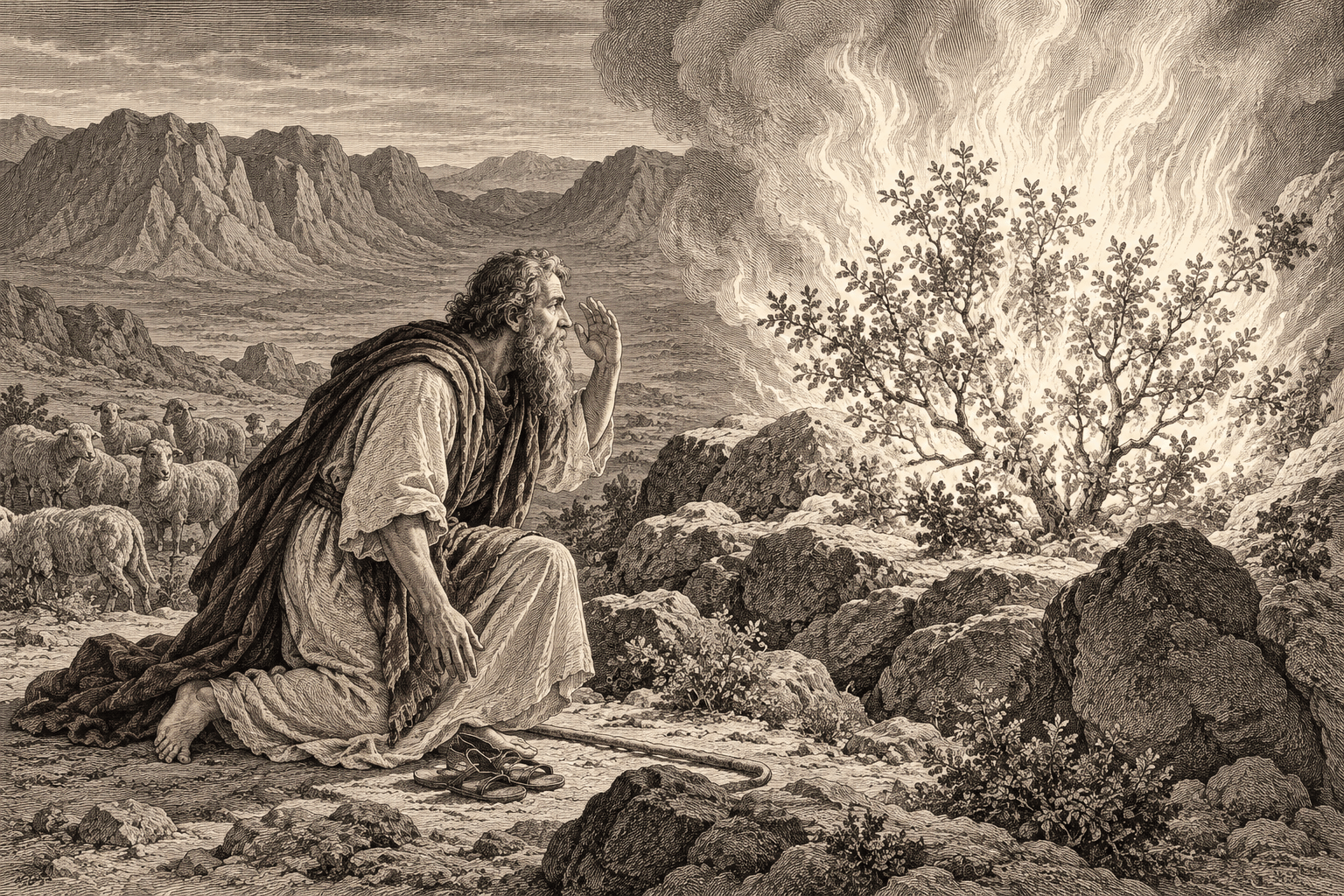
Through the bush burning with fire, Moses, standing barefoot, was called to receive the service of God’s people. Here we notice:
A) Moses the prophet looked at the bush, and it was all thorns, yet the divine fire was burning through it without consuming it… Perhaps he saw in this the fiery work of God, who uses us with all the thorns that are in us, sets our hearts aflame, and works through us in spite of all our weaknesses. As Saint Ambrose says:
Why should we despair? God speaks in men, He who spoke in the bush full of thorns! He did not despise the bush! He shines in my thorns! [71]
Truly the One who speaks is a consuming fire (Isaiah 30:27), and the call came from the divine fire; yet it did not harm Moses, but supported him and set him aflame… as the fiery Holy Spirit did in the disciples, burning up their weaknesses and giving them power for the new life of preaching (Matthew 3:11; Acts 2).
B) When God called Moses the prophet, He did not speak to him of his qualifications for service or his human abilities, but spoke to him of Himself, of the divine resources offered to him, saying: “I am the God of thy father, the God of Abraham, the God of Isaac, and the God of Jacob” (6). These words went out with authority and fiery power, so that “Moses hid his face; for he was afraid” (6). He also spoke of His own work of salvation: He had seen, heard, and known the affliction of His people, so He came down to deliver them…
As for the secret of Moses’ strength, it is: “Certainly I will be with thee” (12). This is the same promise He gives to all His prophets and apostles and all who work in His vineyard. He says to Joshua the son of Nun: “As I was with Moses, so I will be with thee: I will not fail thee, nor forsake thee” (Joshua 1:5). He assures Jeremiah the prophet: “For I am with thee, saith the LORD, to deliver thee” (Jeremiah 1:19). And He says to His disciples: “Lo, I am with you alway, even unto the end of the world” (Matthew 28:20).
4. Moses’ Excuse
KJV · Verses 11–13
11 And Moses said unto God, Who am I, that I should go unto Pharaoh, and that I should bring forth the children of Israel out of Egypt? 12 And he said, Certainly I will be with thee; and this shall be a token unto thee, that I have sent thee: When thou hast brought forth the people out of Egypt, ye shall serve God upon this mountain. 13 And Moses said unto God, Behold, when I come unto the children of Israel, and shall say unto them, The God of your fathers hath sent me unto you; and they shall say to me, What is his name? what shall I say unto them?
Moses wanted to excuse himself from the service, saying: “Who am I, that I should go unto Pharaoh, and that I should bring forth the children of Israel out of Egypt?” (11).
The weak nature of Moses, though he was a man of faith, made him hesitate to accept the call. Perhaps this was an effect of his first failure, when he went out to serve relying on his human arm. He should not have said, “Who am I?” after he knew that God Himself was sending him, and that He was the One coming down to save.
Moses insisted on being excused more than once. At one time he raised questions and objections, saying: “They shall say to me, What is his name? what shall I say unto them?” (13), and the Lord answered him. At another he said: “But, behold, they will not believe me” (Exodus 4:1), so the Lord gave him the ability to work signs and wonders… and so on. A third time he objected because of his personal weakness, saying: “I am slow of speech, and of a slow tongue” (Exodus 4:10). God assured him that He is the Creator of the mouth and the tongue: “Now therefore go, and I will be with thy mouth, and teach thee what thou shalt say” (Exodus 4:12). When he could find no more excuses, he said: “O my Lord, send, I pray thee, by the hand of him whom thou wilt send” (Exodus 4:13), until the anger of the Lord was kindled (Exodus 4:14), and He gave him Aaron as a partner with him in the service.
So when God calls us to service, He does not let us excuse ourselves, but gives us practical answers to all our questions, supports every weakness in us, and makes up every lack in our abilities, for He is the hidden Shepherd of His holy flock.
5. The Name of God
KJV · Verses 14–17
14 And God said unto Moses, I Am That I Am: and he said, Thus shalt thou say unto the children of Israel, I Am hath sent me unto you. 15 And God said moreover unto Moses, Thus shalt thou say unto the children of Israel, the Lord God of your fathers, the God of Abraham, the God of Isaac, and the God of Jacob, hath sent me unto you: this is my name for ever, and this is my memorial unto all generations. 16 Go, and gather the elders of Israel together, and say unto them, The Lord God of your fathers, the God of Abraham, of Isaac, and of Jacob, appeared unto me, saying, I have surely visited you, and seen that which is done to you in Egypt: 17 And I have said, I will bring you up out of the affliction of Egypt unto the land of the Canaanites, and the Hittites, and the Amorites, and the Perizzites, and the Hivites, and the Jebusites, unto a land flowing with milk and honey.
Moses knew that the One speaking to him was God, so he asked Him His name: “And God said unto Moses, I AM THAT I AM: and he said, Thus shalt thou say unto the children of Israel, I AM hath sent me unto you… The LORD God of your fathers, the God of Abraham, the God of Isaac, and the God of Jacob, hath sent me unto you” (14–15).
God’s answer to Moses had two parts:
First: that God is incomprehensible and above every name: “I AM” (Ehyeh), that is, “I am He.”
Second: that He is the God who belongs to mankind, who is joined to His own beloved: “the God of Abraham, the God of Isaac, and the God of Jacob.”
First: I AM THAT I AM
Philo, the Jew of Alexandria, sees that this name “I AM” reveals two aspects of God: first, that He alone is the One who exists, beside whom all things are as though they did not exist; second, that there is no name that can express Him. He says: “Tell them first that I am He who is, so that they may know the difference between Him who is and that which is not. And He also gave them the further lesson, that no name at all can properly be used of Me, to whom alone existence belongs.” [72]
Saint Augustine sees that this phrase means that when all temporal things are compared with God they become “vanity” [73] or “nothing,” and that it declares God to be the first, supreme, and unchangeable Being. [74]
This phrase shows God to be ever present: in Him there is no past that has ended nor a future that is awaited; He is above time, an “eternal present”… In this eternal present, this present eternity, “we find a refuge; we flee to it from all the changes of time and abide in it forever.” [75]
If God is everlasting Being, then:
whoever takes the direction opposite to God is walking toward nothingness. [76]
Speaking of virginity and the greatness of Christian righteousness, Saint Methodius says:
No one can see with his eyes the greatness, form, or beauty of righteousness itself, or of understanding, or of peace; but all these appear perfect and clear in Him who said that His name is “I AM.” [77]
Second: The God of Your Fathers
God said to Moses: “The LORD God of your fathers, the God of Abraham, the God of Isaac, and the God of Jacob” (15). Its repetition three times in this meeting between God and the first leader of the people (6, 15, 16) drew the hearts of the fathers of the Church. Saint Clement of Alexandria saw in it a sign of divine friendship with mankind: though God is the God of the whole world, the God of the heavenly and the earthly, yet He attributes Himself to His own, His friends. He does not wish to be a master but a friend. So we see Him speak to Moses “face to face, as a man speaketh unto his friend” (Exodus 33:11), and ask him: “Present thyself there to me” (Exodus 34:2).
Saint Aphrahat says:
The names of God are many and honored… But the name He holds fast to, which is great and honored, is not the one that concerns His righteousness, but the one that concerns His relationship with men as His creatures, “His own.” [78]
Saint Augustine says:
In His mercy He bound His grace to men, saying: “I am the God of Abraham, the God of Isaac, and the God of Jacob,” so that it might be understood from this that those whose God He is live with Him forever. He speaks thus so that His children may understand that, by the power of love, they must know how to seek His face forever, and grasp, as far as they are able, Him who is “I AM THAT I AM.” [79]
Now, joining the two names together, “I AM” and “the God of your fathers,” we say that the incomprehensible and unchangeable God, who is above all the limits of time, offers Himself to mankind, that they may know Him as their own God, who satisfies all their needs. Therefore no prophet ever spoke of himself as something people possess; but the Lord Christ, “the Word of God,” came offering Himself in more than one place, saying: “I am”… He presented Himself as the Friend and the Bridegroom, the Firstborn Brother and the Savior, the Bread that came down from heaven and the Living Fountain, the Resurrection and the Door, the Way, the Truth, and the Life; and finally He said: “I am Alpha and Omega,” that is, the One who satisfies our whole life. [80]
Finally, we notice that the Lord Christ used the second name to affirm the resurrection to the Sadducees: God is the God of Abraham, the God of Isaac, and the God of Jacob; “God is not the God of the dead, but of the living” (Matthew 22:31–32). If God, the Living One, attributes Himself to us, He grants us life, that we may abide with Him forever. [81]
6. The Mystery of the Three Days
KJV · Verses 18
18 And they shall hearken to thy voice: and thou shalt come, thou and the elders of Israel, unto the king of Egypt, and ye shall say unto him, The Lord God of the Hebrews hath met with us: and now let us go, we beseech thee, three days' journey into the wilderness, that we may sacrifice to the Lord our God.
God commanded Moses to ask Pharaoh, together with the elders, saying: “The LORD God of the Hebrews hath met with us: and now let us go, we beseech thee, three days’ journey into the wilderness, that we may sacrifice to the LORD our God” (18).
The Lord asked them to go out three days’ journey into the wilderness and sacrifice to the Lord. Pharaoh asked Moses and Aaron to offer the sacrifices in the land of Egypt, but Moses answered him: “It is not meet so to do… We will go three days’ journey into the wilderness, and sacrifice to the LORD our God, as he shall command us” (Exodus 8:26–27). At last he allowed them to go out, but he told them: “Only ye shall not go very far away” (Exodus 8:28). Moses, however, insisted on the three days’ journey… Why?
The way by which the people go out to offer a sacrifice to God is the Lord Christ Himself, who rose on the third day; through His resurrection every act of worship and every offering of ours is accepted by the Father.
Origen has long discourses on the mystery of the three days, from which we take the following passages:
We must go out of Egypt and leave the world if we want to serve Him! We do not leave it bodily, but we leave it in our thoughts; not by going out along ordinary, tangible roads, but by the movement of faith. Hear what Saint John says on this matter: “My little children… Love not the world, neither the things that are in the world… For all that is in the world, the lust of the flesh, and the lust of the eyes…” (1 John 2:1, 15–16)…
What is this way that is travelled in three days to go out of Egypt and come to the place where we must sacrifice to the Lord? It is the Lord Himself, who says: “I am the way, the truth, and the life” (John 14:6). We must walk on this way three days, for “if thou shalt confess with thy mouth the Lord Jesus, and shalt believe in thine heart that God hath raised him from the dead, thou shalt be saved” (Romans 10:9). These are the three days you travel on the way to reach the place where sacrifice is made to the Lord, and to offer “the sacrifice of praise” (Hebrews 13:15).
This is the mystical meaning. As for the moral meaning, which is more important: we leave Egypt by a three days’ journey when we are pure in body and spirit, as the Apostle says: “Keep this commandment without spot, unrebukeable, until the appearing of our Lord Jesus Christ” (1 Timothy 6:14). We leave Egypt by a three days’ journey when we separate our mind, our nature, and our senses from the things of this life, to cleave to the commandments of God. We leave Egypt three days when our deeds, our words, and our thoughts are purified, for there are three occasions for sin (through deed, word, and thought). [82]
The devil (Pharaoh) wants us not to go very far, not to travel three days (Exodus 8:28)… for the work of the enemy of good is to deprive us of enjoying the power of the resurrection of the Lord Christ within us. That is on one side. On the other, he wants us not to walk in the Lord three days, that is, not to be purified in our deeds, words, and thoughts. He wants to have a place in us: if not by deed, then by word; and if not by the tongue, then by thought. In the words of Origen:
He wants to make sure that they sin, if not in deed, then in word, or at least in their thought. He does not want them to go away from him three whole days. He wants to see that he has in us at least one day; for in some people he has two days, and in others he has all three days. But blessed is he who separates from him for all three days, and in whom he has not a single day. [83]
By our going out three days, we enter into the knowledge of “the resurrection,” and our inner sight is enlightened with the light of true knowledge. If Pharaoh represents the devil, “the rulers of the darkness of this world” (Ephesians 6:12), he does not want you to go out of the circle of darkness into the light of knowledge. He wants you to remain in the darkness of the tomb and not enjoy the light of the resurrection. Therefore we find him, in his conversation with Moses, confessing his lack of knowledge, that is, his darkness, saying: “I know not the LORD” (Exodus 5:2).
The experience of the three days, that is, the resurrection with the Lord Christ, was known before by Abraham the father of the fathers. He went out from his home three days, and then he saw the sign and offered his son as a sacrifice of love to God (Genesis 22:4). What is this sign through which Abraham offered his only son Isaac but the sign of the resurrection of the Crucified? Therefore our teacher Paul the Apostle says of him that he was “accounting that God was able to raise him up, even from the dead” (Hebrews 11:19). He saw the resurrection of the Lord Christ, so he offered his son Isaac, believing that God was able to raise him from the dead.
7. The Mighty Hand of God
KJV · Verses 19–22
19 And I am sure that the king of Egypt will not let you go, no, not by a mighty hand. 20 And I will stretch out my hand, and smite Egypt with all my wonders which I will do in the midst thereof: and after that he will let you go. 21 And I will give this people favour in the sight of the Egyptians: and it shall come to pass, that, when ye go, ye shall not go empty. 22 But every woman shall borrow of her neighbour, and of her that sojourneth in her house, jewels of silver, and jewels of gold, and raiment: and ye shall put them upon your sons, and upon your daughters; and ye shall spoil the Egyptians.
From time to time God assures Moses of His power to save, saying: “And I will stretch out my hand, and smite Egypt with all my wonders which I will do in the midst thereof: and after that he will let you go” (20).
In their going out He does not send them out empty, but gives them favor in the sight of the people, who lend them jewels of silver, jewels of gold, and raiment (22)… First, this points to the power of salvation in the believer’s life: not only is his soul sanctified, but in his going out toward the heavenly Canaan he carries with him much spoil: his inner energies, his emotions, his feelings, and his motives. All that is within him, which had been devoted to evil and was a cause of death to him, becomes sanctified and blessed. On the other hand, since the people had been robbed of their wages and humiliated in forced labor and in building houses for the Egyptians, God gives them favor in their eyes so that they offer them these things willingly: gold, silver, and raiment. [84]
The goal of this divine work of salvation is: “I will bring you up… unto a land flowing with milk and honey” (17). There the simple little ones find their nourishment, and the strong and mature their food. Milk and honey point to the life of fullness and spiritual delight. Therefore, in the early Church, the newly baptized drank milk and ate honey during the rite of baptism, for by baptism they had gained the right to enter the promised heavenly Canaan. [85]
Notes and References
[50] Philo, Life of Moses 1:12:65; Clement of Alexandria, Paedagogus 2:8:75.
[51] Midrash Rabbah: Exodus 2:5; Philo, Life of Moses 1:12:65.
[52] Tertullian, Ad Gnost.
[53] Hilary of Poitiers, Treatise on the Mysteries 1:30.
[54] Hippolytus, On the Blessings of Moses.
[55] N.P.N.F., vol. 1, p. 229 (n).
[56] Adv. Anthropomorph. 26, P.G. 76:1129A.
[57] Gregory of Nyssa, Life of Moses 2:21.
[58] N.P.N.F., vol. 1, p. 229 (n).
[59] Cyril of Alexandria, In Exod.
[60] Gregory of Nyssa, Life of Moses 2:20.
[61] St. John Chrysostom, In 1 Cor. hom. 38.
[62] St. Jerome, Epistle 76:2.
[63] Fr. Tadros Yacoub Malaty, The Church, the House of God (Arabic, 1979), pp. 96, 97.
[64] St. Augustine, Sermons on New Testament Lessons, Sermon 52:7.
[65] St. Ambrose, Commentary on the Gospel of Luke. In his discourse On Repentance 2:11 he says: “How much more fitting is it for us also to free the feet of our souls from the bonds of the body, and to cleanse our steps from all the bonds of this world!”
[66] Gregory of Nazianzus, Second Oration on Easter, 19.
[67] St. Ambrose, Of the Christian Faith 3:10.
[68] Gregory of Nyssa, Life of Moses 2:22.
[69] Gregory of Nyssa, De beatitudinibus 8, P.G. 44:1292B.
[70] The saint speaks of the coats of skins in many of his works, among them: In Inscript. Ps. 1:7, P.G. 44:456C; Or. Cat. 8, P.G. 45:33C, D; De Virg. 12, 13, P.G. 46:373D, 376B; De Mel. Epis., P.G. 46:861B.
[71] St. Ambrose, Concerning Virgins 1:1. Gregory of Nyssa, In Cant. 11, P.G. 44:1004D, 1005C.
[72] Philo, Life of Moses 1:14:75.
[73] St. Augustine, On Psalm 144.
[74] St. Augustine, City of God 12:2; On Christian Doctrine 1:32. Many of the fathers interpreted this phrase to mean that God is incomprehensible, and that when creation is compared with Him it is counted as though it did not exist (St. Jerome, Epistle 48:14).
[75] St. Augustine, On Psalm 90.
[76] St. Augustine, On Psalm 39.
[77] Methodius, Banquet of the Ten Virgins, Discourse 8, ch. 8.
[78] Aphrahat, Demonstration 17, Of Christ the Son of God, ch. 5.
[79] St. Augustine, On Psalm 110.
[80] St. John Chrysostom has a delightful discourse on this; see our book The Church Loves You.
[81] St. Augustine, On the Gospel of St. John, tractate 12:2.
[82] Origen, In Exod. hom. 3:3.
[83] Ibid.
[84] Tertullian says (Against Marcion 4:24): If God commands that the ox that treadeth out the corn should not be muzzled, would He leave these deprived of the wages of their labor?!
[85] Fr. Tadros Yacoub Malaty, Saint Cyril of Jerusalem (Arabic).