
After Moses met God through the bush burning with fire, Moses the prophet had to leave Midian to meet Aaron his brother and his people in Egypt.
1. Three Miracles for His People
KJV · Verses 1–9
1 And Moses answered and said, But, behold, they will not believe me, nor hearken unto my voice: for they will say, The Lord hath not appeared unto thee. 2 And the Lord said unto him, What is that in thine hand? And he said, A rod. 3 And he said, Cast it on the ground. And he cast it on the ground, and it became a serpent; and Moses fled from before it. 4 And the Lord said unto Moses, Put forth thine hand, and take it by the tail. And he put forth his hand, and caught it, and it became a rod in his hand: 5 That they may believe that the Lord God of their fathers, the God of Abraham, the God of Isaac, and the God of Jacob, hath appeared unto thee. 6 And the Lord said furthermore unto him, Put now thine hand into thy bosom. And he put his hand into his bosom: and when he took it out, behold, his hand was leprous as snow. 7 And he said, Put thine hand into thy bosom again. And he put his hand into his bosom again; and plucked it out of his bosom, and, behold, it was turned again as his other flesh. 8 And it shall come to pass, if they will not believe thee, neither hearken to the voice of the first sign, that they will believe the voice of the latter sign. 9 And it shall come to pass, if they will not believe also these two signs, neither hearken unto thy voice, that thou shalt take of the water of the river, and pour it upon the dry land: and the water which thou takest out of the river shall become blood upon the dry land.
As God appeared to Moses through the burning bush, declaring to him the mystery of salvation through the divine Incarnation, the virgin birth, and suffering, it was necessary for Him to give Moses the ability to perform some miracles that carry a shadow of this mystery, that is, salvation through the divine Incarnation and the Cross. He granted him three miracles to perform before his people, not merely to show a power beyond nature, but to declare God’s surpassing work toward man. These miracles are: turning the rod into a serpent, making his right hand leprous, and turning the water into blood.
First: Turning the Rod into a Serpent
God asked Moses: “What is that in thine hand? And he said, A rod” (2).
Did God not know what was in Moses’ hand? Why then did He ask him this? Saint John Chrysostom answers:
So that even when he sees it a serpent, he will not forget that it was a rod, remembering his own words about it, and so be amazed at what happened. [86]
This is God’s way of dealing with us, as when He asked about Lazarus, “Where have ye laid him?” (John 11:34), so that when He raised him the Jews themselves would bear witness that He had raised him from the tomb.
The Lord commanded Moses to cast his rod, which was later called “the rod of God” (20), on the ground, and it became a serpent that would swallow all the serpents of the Egyptians. God the Word is the rod of God and His power, who came down to earth for our sake: “He hath made him to be sin for us, who knew no sin” (2 Corinthians 5:21), to slay all our sins. That is, the miracle carried shadows of the mysteries of the Incarnation and the Cross.
Saint Gregory of Nyssa says:
Let not the turning of the rod into a serpent trouble the lovers of Christ, if we receive the teaching about the Incarnation through so unfitting an animal as a serpent. For the Truth Himself did not reject this comparison, when He said: “And as Moses lifted up the serpent in the wilderness, even so must the Son of man be lifted up” (John 3:14). The teaching is clear: if the father of sin is called by Holy Scripture a “serpent,” then what is born of the serpent is certainly a serpent; so sin is a name shared with the one who begets it. The apostolic word testifies that the Lord was made sin for us, by putting on (the likeness of) our sinful nature (2 Corinthians 5:21). This figure, then, rightly applies to the Lord. For if sin is a serpent, and the Lord became sin, the logical conclusion is clear to all: by becoming sin He also became a serpent, which is nothing other than sin. For our sake He became a serpent, that He might devour and destroy the serpents of the Egyptians produced by the sorcerers. [87]
Saint Augustine also says:
To what did the serpent entice man? To death (Genesis 3:1). Therefore death came from the serpent… So the rod that became a serpent is Christ, who entered into death… [88]
Saint Irenaeus [89] and Saint Cyril of Alexandria [90] also spoke of this rod turned into a serpent as a symbol of the divine Incarnation, and Saint Justin Martyr [91] and Saint Ambrose [92] as a symbol of the Cross. But Tertullian [93] and Saint Ambrose [94] as well saw in it a symbol of the resurrection. The latter says: Could He who made a serpent of a rod not, by His divine will, restore the bones and bring life back to the dead?!
Saint Augustine comments on Moses’ fear of the rod turned into a serpent and his fleeing from it, saying:
What is this, brethren, but what we know happened in the Gospel? Christ died, and the disciples were afraid and fled. [95]
Saint John Chrysostom also compared Moses’ fear here with the fear of the disciples when they saw the Lord walking on the sea (Matthew 14:25–26); man fears and trembles when he perceives the power of the divine work. [96]
The rod also points to faith, for Saint Gregory of Nyssa says:
With this rod, the word of faith, which was in his hand, he overcame the serpents of the Egyptians. [97]
Our faith in the incarnate, crucified Word of God, though it is foolishness to the Greeks and a stumbling block to the Jews, has swallowed up the wisdom of the world and its human philosophies, and offers true healing for man’s wounds. As Saint Paul the Apostle says: “For after that in the wisdom of God the world by wisdom knew not God, it pleased God by the foolishness of preaching to save them that believe… Because the foolishness of God is wiser than men; and the weakness of God is stronger than men” (1 Corinthians 1:21, 25).
Saint Ambrose speaks of the healing power of faith through this serpent, saying:
This means that the Word was made flesh to destroy the poison of the deadly serpents, for the forgiveness of sins. For the rod represents the Word. This is true: He is a royal rod, possessing authority, and glorious in wisdom. The rod became a serpent, because the Son of God, begotten of the Father, became the Son of man, born of a woman, and was lifted up like the serpent on the Cross, and poured out the healing medicine for man’s wounds, as the Lord Himself said: “And as Moses lifted up the serpent in the wilderness, even so must the Son of man be lifted up” (John 3:14). [98]
Finally, the serpent’s turning back into a rod points to the Lord Christ ascending into heaven, to His glories, after He had torn up the handwriting that was against us, that He might raise us with Him and make us sit with Him in the heavenly places, partners with Him in the glory, resting in His Father’s bosom through His righteousness.
Second: His Leprous Right Hand
Saint Ambrose [99] says that the right hand of God the Father is the Son who sits at His right hand, that is, the power of the Father, the One who is in His bosom. He came down to us bearing our sins (leprosy points to sin) to wash us and sanctify us, then returns with us to His Father’s bosom, healthy and without sin. It is as if this sign confirms the previous one.
Saint Jerome sees in this miracle a declaration of the death of the Lord Christ in the flesh, when the hand became white, and of His resurrection, when the hand returned to what it had been. [100]
Saint Augustine sees in the words of the psalmist, “Why withdrawest thou thy hand, even thy right hand? pluck it out of thy bosom. For God is my King of old, working salvation in the midst of the earth” (Psalm 74:11–12), cries addressed to God the Father, asking Him to send His only-begotten Son, “His right hand,” who is in His bosom, to destroy evil and grant salvation in the midst of all the nations. The saint says:
The Jews were struck with blindness, so that they did not know the Lord Christ as Savior, until the salvation of the Gentiles should be completed. [101]
Third: Turning the Water into Blood
This miracle came to confirm the two previous miracles, for there is no salvation for us except through the blood of the Lord Christ, which sanctifies the cold waters of our heart.
2. I Am Slow of Speech
KJV · Verses 10–13
10 And Moses said unto the Lord, O my Lord, I am not eloquent, neither heretofore, nor since thou hast spoken unto thy servant: but I am slow of speech, and of a slow tongue. 11 And the Lord said unto him, Who hath made man's mouth? or who maketh the dumb, or deaf, or the seeing, or the blind? have not I the Lord? 12 Now therefore go, and I will be with thy mouth, and teach thee what thou shalt say. 13 And he said, O my Lord, send, I pray thee, by the hand of him whom thou wilt send.
Moses the prophet excused himself from the service, saying: “O my Lord, I am not eloquent, neither heretofore, nor since thou hast spoken unto thy servant: but I am slow of speech, and of a slow tongue. And the LORD said unto him, Who hath made man’s mouth? or who maketh the dumb, or deaf, or the seeing, or the blind? have not I the LORD? Now therefore go, and I will be with thy mouth, and teach thee what thou shalt say” (10–12).
When did Moses feel that he was slow of speech and of a slow tongue? When he was in the palace as the son of the princess, Pharaoh’s daughter, being trained in all the wisdom of the Egyptians, he felt he was able to speak. But now that he was in the presence of the Lord Himself, he felt he was slow of speech and of a slow tongue! As Origen says:
While he lived in Egypt, when he was learned in all the wisdom of the Egyptians (Acts 7:22), Moses was not slow of speech and of a slow tongue, for he used eloquence when he spoke of himself. In the eyes of the Egyptians he had a resounding voice and an eloquence beyond compare. But when he heard the voice of God and the divine commandments, he felt he was dumb; that was when he began to perceive the true Word, who was with God in the beginning (John 1:1). To make this easier I use the following comparison: before the irrational animals a man seems rational, even if he is uncultured and unlearned; he appears eloquent, because the animals have neither speech nor reason. But if he is compared with learned and eloquent men who speak with every kind of speech, he appears barren and dumb. So, when you contemplate the very Word of God and lift your eyes to the divine Wisdom itself, then whatever your work and your wisdom, you will confess before God that you are like a dumb animal, and even more so. This is the feeling that came over blessed David himself when he compared himself in the field of divine wisdom and said: “So foolish was I, and ignorant: I was as a beast before thee” (Psalm 73:22). This is what Moses, the greatest of the prophets, meant by saying, “I am slow of speech, and of a slow tongue,” I am not able to speak. In comparison with God the Word, all men become not only without eloquence, but dumb. [102]
By standing before God, Moses the prophet discovered the slowness of his mouth and tongue. He was broken within, excusing himself from the service, and so he became all the more fit for God to fill his mouth to serve. The fathers spoke much of the humility of Moses. Saint Clement of Rome says:
Moses was called “faithful in all his house” (Numbers 12:7; Hebrews 3:2)… Though he received such great honor, he did not use the language of greatness; but when the divine word came to him from the bush, he said: “Who am I, that I should go? I am slow of speech, and of a slow tongue” (Exodus 3:11; 4:10). And again he says: “I am but as smoke from a pot.” [103]
Saint Gregory of Nazianzus says:
It is good for you to hold back from God for a while (in His call to you to service), as the great Moses did of old (Exodus 4:10), and Jeremiah (Jeremiah 1:6); and after that to run to Him at once, as Aaron did (Exodus 4:27), and Isaiah (Isaiah 6:8). But we must do both in a spirit of submission: the first from a sense of our need for strength, and the second because of the power of Him who called us… [104]
He also says:
Aaron was eager (for the service), but Moses resisted. Isaiah submitted at once, but Jeremiah was afraid because of his youth and did not dare to prophesy until he received from God a promise and a strength beyond his years. [105]
Origen also says:
When (Moses) reached the depth of understanding, which is “knowledge of himself”… grace rewarded him with such great gifts as these: “I will be with thy mouth, and teach thee what thou shalt say” (12). Blessed are those whose mouths God opens to speak! He opens the mouths of the prophets and fills them with His eloquence, as is said here… And as God said by the mouth of David: “Open thy mouth wide, and I will fill it” (Psalm 81:10). In the same sense Saint Paul the Apostle says: “that utterance may be given unto me, that I may open my mouth” (Ephesians 6:19). So it is God who opens the mouth of those who speak the divine words. [106]
Not only was Moses’ mouth opened for God to speak in it, but also the mouth of his brother Aaron, who met Moses at the mount of God (27). It is as if everyone who wants his mouth opened, and to enjoy the words of the Lord and divine knowledge, must meet Moses (the Law) spiritually on the mount of God, that is, within the holy, divine Church. On this Origen says:
Peter, James, and John went up the mountain of God, to be counted worthy to see Jesus transfigured, and with Him Moses and Elijah in glory. You too, if you do not go up the mountain of God and meet Moses, that is, if you do not rise to the spiritual understanding of the Law, if you do not reach the summit of spiritual perception, the Lord will not open your mouth. But if you stop at the hateful literal meaning, and become entangled in the historical narration of the details of Jewish events, you will not join Moses on the mountain of God, nor will God open your mouth or teach you what to say. [107]
God not only opens our mouths to fill them with His words, but also opens our eyes to be enlightened by the Holy Spirit and see the divine glories; He opens our ears to hear His divine voice without stubbornness, and opens our senses and inner energies to be wholly swallowed up in divine things. Origen says:
As God opens the mouths of the saints, so He opens their ears to hear the divine words. Isaiah the prophet bears witness to this, saying: “The Lord GOD hath opened mine ear, and I was not rebellious” (Isaiah 50:5)… The Lord also opens the eyes, as He opened the eyes of Hagar to see the well of living water, and as Elisha the prophet said: “LORD, I pray thee, open his eyes, that he may see. And the LORD opened the eyes of the young man; and he saw: and, behold, the mountain was full of horses and chariots of fire round about Elisha” (2 Kings 6:17)… So God opens the mouth, the ears, and the eyes, that we may speak, hear, and see divine things. [108]
As the children of God open their senses and their depths to receive God’s work in them, so the children of the devil open their senses and their depths to their father, to receive his work in them and for his account. Origen says:
See what is written of Judas: “Then entered Satan into Judas” (Luke 22:3). He opened his mouth to speak with the chief priests and captains, how he might betray Him to them after he had taken the silver. [109]
Someone may ask: Who opens our mouth? Do we open it and God fills it, or does He open it and fill it? In his reply to two letters of the Pelagians, Saint Augustine says:
Although without His help we can do nothing, and cannot open our mouths, yet we open them with His help while doing our part; but it is God who fills it, without our having any part in that. [110]
3. Aaron as a Support for Moses
KJV · Verses 14–17
14 And the anger of the Lord was kindled against Moses, and he said, Is not Aaron the Levite thy brother? I know that he can speak well. And also, behold, he cometh forth to meet thee: and when he seeth thee, he will be glad in his heart. 15 And thou shalt speak unto him, and put words in his mouth: and I will be with thy mouth, and with his mouth, and will teach you what ye shall do. 16 And he shall be thy spokesman unto the people: and he shall be, even he shall be to thee instead of a mouth, and thou shalt be to him instead of God. 17 And thou shalt take this rod in thine hand, wherewith thou shalt do signs.
In spite of all God’s assurances to Moses that He is the One working in him, and that He is committed to prospering his way, Moses returned to say: “O my Lord, send, I pray thee, by the hand of him whom thou wilt send” (13). Truly, how wearisome the human heart is when it is weary! The anger of the Lord was kindled (14), and Moses lost his being alone in the mission, and God gave him a partner. Truly, partnership in service is beautiful and joyful, for the Lord sent His disciples two by two; but what happened with Moses was the fruit of his weakness and his insistence on fleeing from responsibility.
In any case, God turned even this weakness to good, for Aaron became a support for Moses and a symbol of the guardian angel. Just as Moses had an evil angel (Pharaoh, who represents the devil) resisting him, he also had the guardian angel as a brother, Aaron, who became a priest interceding for the people and supporting Moses in his service. As Saint Gregory of Nyssa says:
There is a teaching which draws its strength from the tradition of the fathers, which says that God did not neglect our nature after it fell into sin, but supported it with His providence. On the one hand, He appointed an angel of incorruptible nature to support the life of man; on the other, He also appointed the corrupter, who is an evil and murderous demon, to oppose the nature of man. So man finds himself between these two, who carry opposite purposes, and it is in his power to make one prevail over the other. The good angel, by his reasoning, reveals the benefits of virtue, to fill with hope those who walk uprightly, while his adversary displays the tangible pleasures, which give no hope of the good things to come… If a man withdraws from those who entice him toward evil, using his reason and turning toward the virtuous life, turning his back on evil and setting out toward the hope of good things as one who looks into a mirror, then upon his pure soul are impressed the images and impressions of virtue which God reveals to him. To such a one his brother (Aaron) gives help and accompanies him; for the angel, who in a certain way is a brother to the rational and well-ordered soul, appears to him and stands with him when he approaches Pharaoh. [111]
Aaron also points to the priestly work of worship; his cleaving to Moses symbolizes the union of the commandment with worship, to work by the Spirit of the Lord for the salvation of the world. Preaching rests on declaring the commandment, or the divine word, in a spirit of godly worship.
4. Leaving Midian
KJV · Verses 18–23
18 And Moses went and returned to Jethro his father in law, and said unto him, Let me go, I pray thee, and return unto my brethren which are in Egypt, and see whether they be yet alive. And Jethro said to Moses, Go in peace. 19 And the Lord said unto Moses in Midian, Go, return into Egypt: for all the men are dead which sought thy life. 20 And Moses took his wife and his sons, and set them upon an ass, and he returned to the land of Egypt: and Moses took the rod of God in his hand. 21 And the Lord said unto Moses, When thou goest to return into Egypt, see that thou do all those wonders before Pharaoh, which I have put in thine hand: but I will harden his heart, that he shall not let the people go. 22 And thou shalt say unto Pharaoh, Thus saith the Lord, Israel is my son, even my firstborn: 23 And I say unto thee, Let my son go, that he may serve me: and if thou refuse to let him go, behold, I will slay thy son, even thy firstborn.
When God commanded Moses to return to Egypt to bring out the people, He said to him: “See that thou do all those wonders before Pharaoh, which I have put in thine hand: but I will harden his heart, that he shall not let the people go” (21). So God told him beforehand of the resources He had given him, and also of the trials that would surround him, so that he would not faint in the way of struggle. This is what the Lord Christ did with us: He assured us, “Be of good cheer; I have overcome the world” (John 16:33), and at the same time He said: “Behold, I send you forth as sheep in the midst of wolves” (Matthew 10:16).
Does God harden the heart? It appears from the words of Scripture (Exodus 8:32) that Pharaoh hardened his heart in complete freedom of will; yet here the Lord says that He hardens Pharaoh’s heart. By this we know that God, in His just judgment, leaves Pharaoh to carry out his free will, which is hardness of heart, and does not prevent him, so that He may be glorified in him. In the words of the Apostle, God gave him up to the lusts of his heart and to a reprobate mind (see Romans 1:24, 28).
5. The Circumcision of Moses’ Son
KJV · Verses 24–26
24 And it came to pass by the way in the inn, that the Lord met him, and sought to kill him. 25 Then Zipporah took a sharp stone, and cut off the foreskin of her son, and cast it at his feet, and said, Surely a bloody husband art thou to me. 26 So he let him go: then she said, A bloody husband thou art, because of the circumcision.
It seems that Moses’ wife, Zipporah the daughter of Jethro, who was of a foreign race, feared for her son because of circumcision, and Moses the prophet yielded to her opinion… So even the giants in the spiritual life are exposed to weaknesses that may drive them to utter destruction.
Moses had to set out with his wife from Midian to work in the Lord’s vineyard, and he had to circumcise the son, the fruit of his union with this wife. This is a living picture of the Church, which did not despise the foreign wife: she did not stand in enmity toward philosophy, but embraced it and was bound to bring it out from its father’s house and to circumcise the fruit of her union with it, so that its defects are removed and its errors cast out, lest the faithful perish. On this Saint Gregory of Nyssa says:
The foreign woman follows him, for there are some things in secular learning which we do not despise, since they aim at the begetting of virtue. Indeed, moral and natural philosophy may at some time become a companion, friend, and partner of the higher life, provided that the fruit of the union with it brings in nothing defiled or foreign. [112]
He also says:
Since his son was not yet circumcised, that is, not everything harmful and defiled had been completely removed from him, the angel who met them terrified them; but his wife appeased the angel by presenting her son pure, having completely removed from him the mark of foreigners (the foreskin). [113]
Saint Gregory took this thought from Origen the Alexandrian scholar, who saw in marrying foreign women a symbol of the use of philosophy. [114]
6. The Work Begins
KJV · Verses 27–31
27 And the Lord said to Aaron, Go into the wilderness to meet Moses. And he went, and met him in the mount of God, and kissed him. 28 And Moses told Aaron all the words of the Lord who had sent him, and all the signs which he had commanded him. 29 And Moses and Aaron went and gathered together all the elders of the children of Israel: 30 And Aaron spake all the words which the Lord had spoken unto Moses, and did the signs in the sight of the people. 31 And the people believed: and when they heard that the Lord had visited the children of Israel, and that he had looked upon their affliction, then they bowed their heads and worshipped.
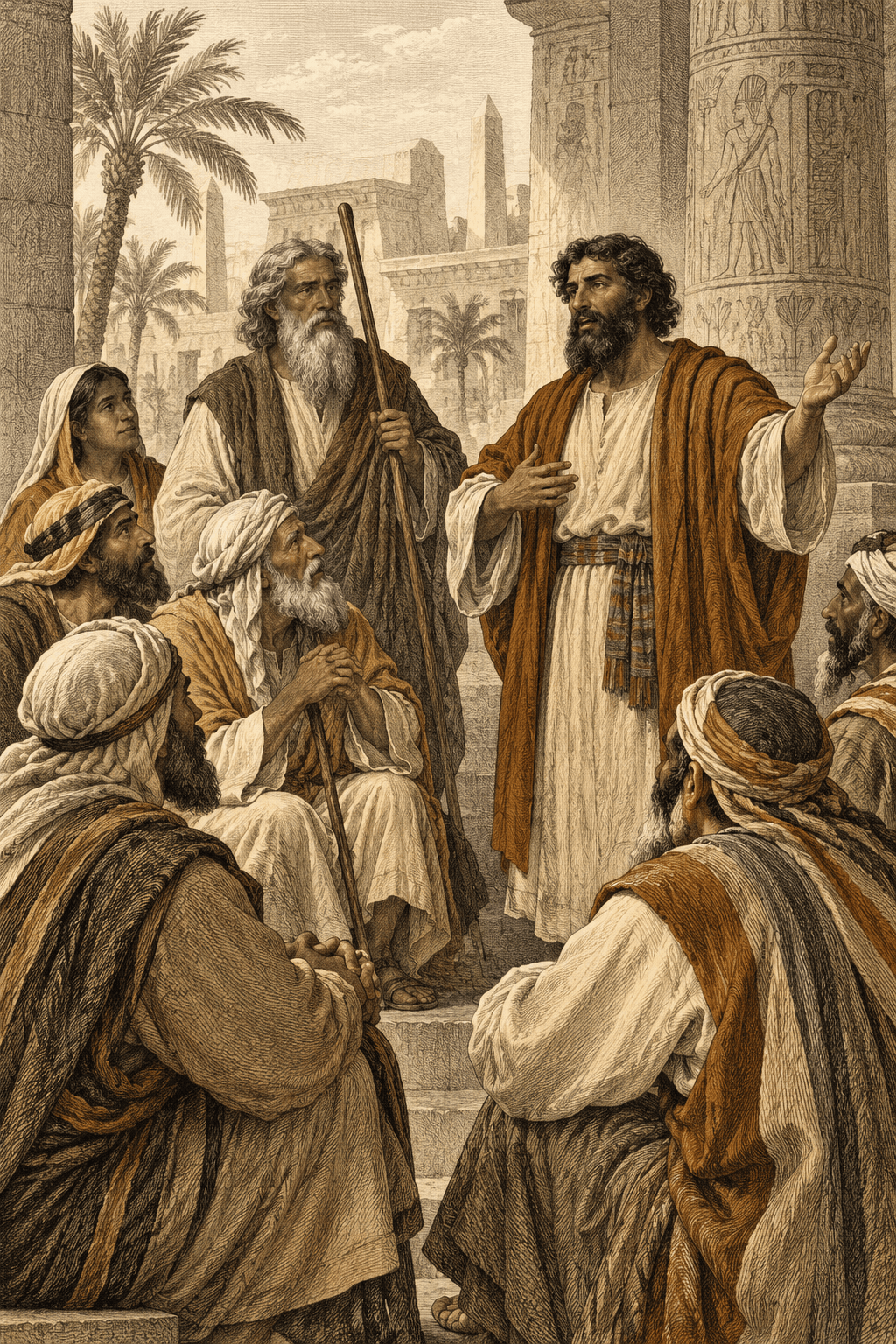
Moses and Aaron met, that is, the divine commandment and pious priestly worship, and together they met all the elders, who submitted to the work of God and His words. As for the people, when they heard, “they bowed their heads and worshipped” (31). It is a living picture of the submission of all the energies of soul and body to the divine work, through receiving the word of God and worship.
Truly, how much we need to work in the heart, God’s holy vineyard, through the word of God and in a spirit of worship, so that the whole heart becomes holy to the Lord and submissive to Him!
Notes and References
[86] St. John Chrysostom, In Matt. hom. 31.
[87] Gregory of Nyssa, Life of Moses 2:31–33.
[88] St. Augustine, On Psalm 74.
[89] Irenaeus, Against Heresies 3:28.
[90] Cyril of Alexandria, Glaphyra in Exod. 2:299.
[91] Justin Martyr, Dialogue with Trypho 86.
[92] St. Ambrose, Duties of the Clergy 3:15.
[93] Tertullian, On the Resurrection of the Flesh 28.
[94] St. Ambrose, On Belief in the Resurrection.
[95] St. Augustine, On Psalm 74.
[96] St. John Chrysostom, In Matt. hom. 28.
[97] Gregory of Nyssa, Life of Moses 2:36.
[98] St. Ambrose, Duties of the Clergy 3:15.
[99] Ibid.
[100] St. Jerome, To Pammachius against John of Jerusalem 33.
[101] St. Augustine, On Psalm 74.
[102] Origen, In Exod. hom. 3:1.
[103] Clement of Rome, Epistle to the Corinthians 17.
[104] Gregory of Nazianzus, Oration 1:1.
[105] Gregory of Nazianzus, Oration 2:114.
[106] Origen, In Exod. hom. 3:2.
[107] Ibid. 3:2.
[108] Ibid. 3:2.
[109] Ibid. 3:2.
[110] St. Augustine, Against Two Letters of the Pelagians, ch. 20.
[111] Gregory of Nyssa, Life of Moses 2:45, 46.
[112] Ibid. 2:37.
[113] Ibid. 2:38.
[114] Origen, In Gen. hom. 11:2.