
After the first chapter revealed the need for a Savior, chapters 2–4 speak of the preparation of Moses the prophet for service.
1. Moses in the River
KJV · Verses 1–4
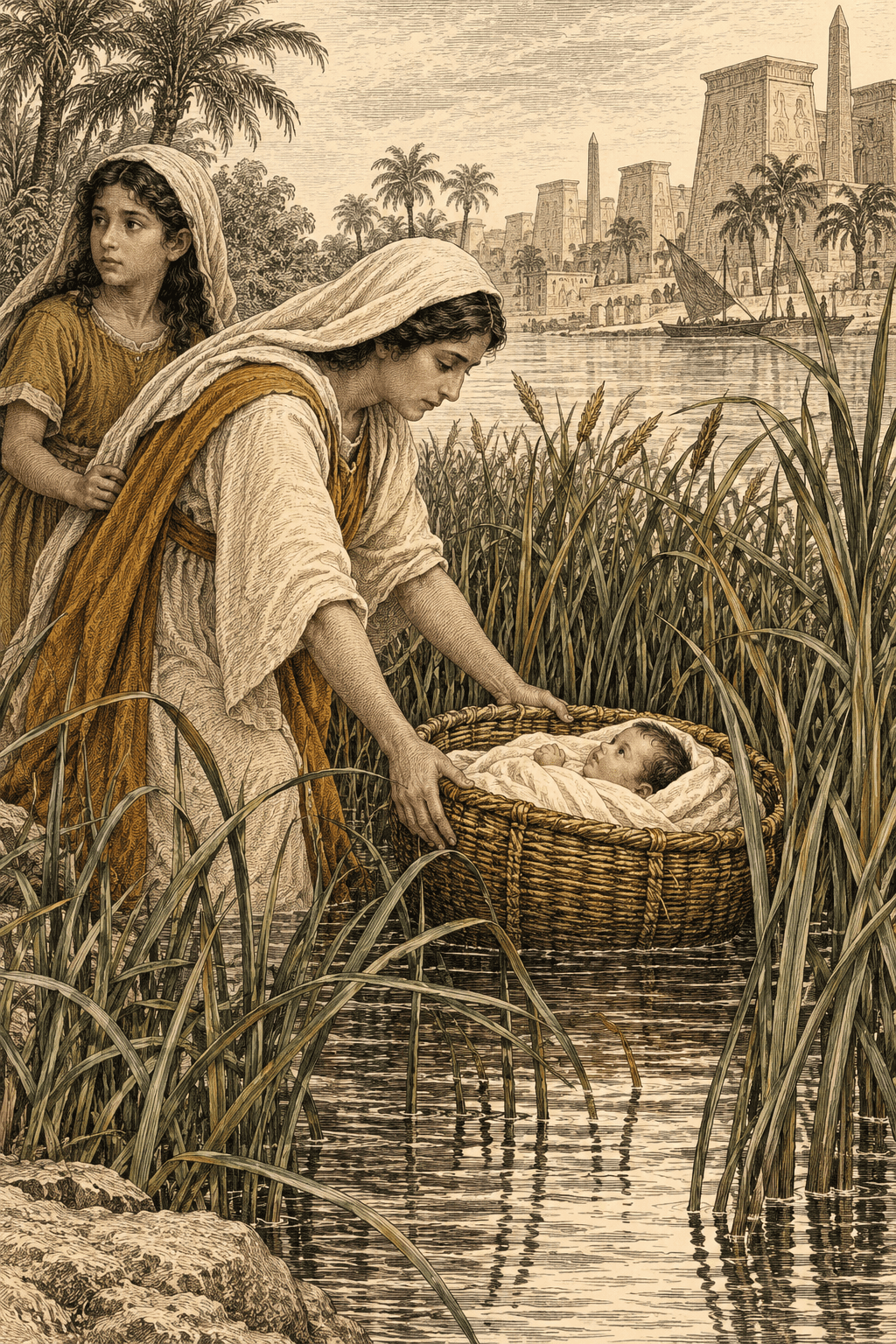
1 And there went a man of the house of Levi, and took to wife a daughter of Levi. 2 And the woman conceived, and bare a son: and when she saw him that he was a goodly child, she hid him three months. 3 And when she could not longer hide him, she took for him an ark of bulrushes, and daubed it with slime and with pitch, and put the child therein; and she laid it in the flags by the river's brink. 4 And his sister stood afar off, to wit what would be done to him.
Divine providence allowed the people to pass through a harsh trial, and at the same time it was preparing a deliverer for them (1 Corinthians 10:13). God prepared Moses for them and trained him over a period of eighty years, leading him through three stages:
The first stage: Moses lived forty years in the palace of Pharaoh’s daughter, being educated in the wisdom and learning of the Egyptians, while at the same time he was nursed on the milk of his own Hebrew people. In this period he thought he was able to serve God by relying on the eloquence of his tongue, his ability to manage, and his wisdom… but he failed.
The second stage: he spent forty years in the wilderness, being trained to know himself, that without God he is worth nothing… In it he came to know himself as “slow of speech, and of a slow tongue” (Exodus 4:10), unable to work by himself (Exodus 4:14).
The third stage began with his meeting with the thorn bush burning with fire, where he came to know the God who works in nothingness to raise up glorious works.
After this introduction we return to Moses in his childhood. Our teacher Paul the Apostle speaks of his parents as heroes of faith, saying: “By faith Moses, when he was born, was hid three months of his parents, because they saw he was a proper child; and they were not afraid of the king’s commandment” (Hebrews 11:23). We too, before God who sees our works in secret, must hide every virtue, lest it become a prey for Pharaoh (the devil) and be swallowed by the waves of the river.
Saint John Chrysostom sees how God brought a blessing for Moses out of Pharaoh’s command, saying:
Had the children not been cast into the river, Moses would not have been saved, nor would he have been brought up within the palace. When he was in safety he was not in honor; but when he was cast into the river, he came into honor. [33]
The saint saw that in all events, even the violent ones directed against the children of God, the Lord used them as part of His plan for their salvation.
The ark of bulrushes: Scripture says: “And when she could not longer hide him, she took for him an ark of bulrushes, and daubed it with slime and with pitch, and put the child therein; and she laid it in the flags by the river’s brink” (3).
Saint Gregory of Nyssa sees that Moses represents the virtuous life, which free will brings forth through the pain of labor and bitterness. It must be placed in an ark of bulrushes, or in a chest made of various boards, so that this virtuous life may remain safe from the waves of the river. [34] This ark is “learning”: the person who is constantly concerned to learn, and who longs for spiritual knowledge that is ever renewed and growing, is like Moses, kept safe from every destructive current. The waves cannot swallow him; rather, they push him toward the shore, far from the turmoil. [35]
His mother’s tears: The ark was the visible guardian of the child, but his mother’s tears were the hidden guardian. On this Saint Gregory of Nyssa says:
Whoever flees from such things must imitate Moses and not cease from tears; for even if he is safe within the ark, tears remain the strong guard of one who has been saved by virtue. [36]
The tears of repentance are the guardian of every hidden virtue within the heart, and its support, so that the enemy of good does not devour it.
2. Moses in the Palace
KJV · Verses 5–10
5 And the daughter of Pharaoh came down to wash herself at the river; and her maidens walked along by the river's side; and when she saw the ark among the flags, she sent her maid to fetch it. 6 And when she had opened it, she saw the child: and, behold, the babe wept. And she had compassion on him, and said, This is one of the Hebrews' children. 7 Then said his sister to Pharaoh's daughter, Shall I go and call to thee a nurse of the Hebrew women, that she may nurse the child for thee? 8 And Pharaoh's daughter said to her, Go. And the maid went and called the child's mother. 9 And Pharaoh's daughter said unto her, Take this child away, and nurse it for me, and I will give thee thy wages. And the women took the child, and nursed it. 10 And the child grew, and she brought him unto Pharaoh's daughter, and he became her son. And she called his name Moses: and she said, Because I drew him out of the water.
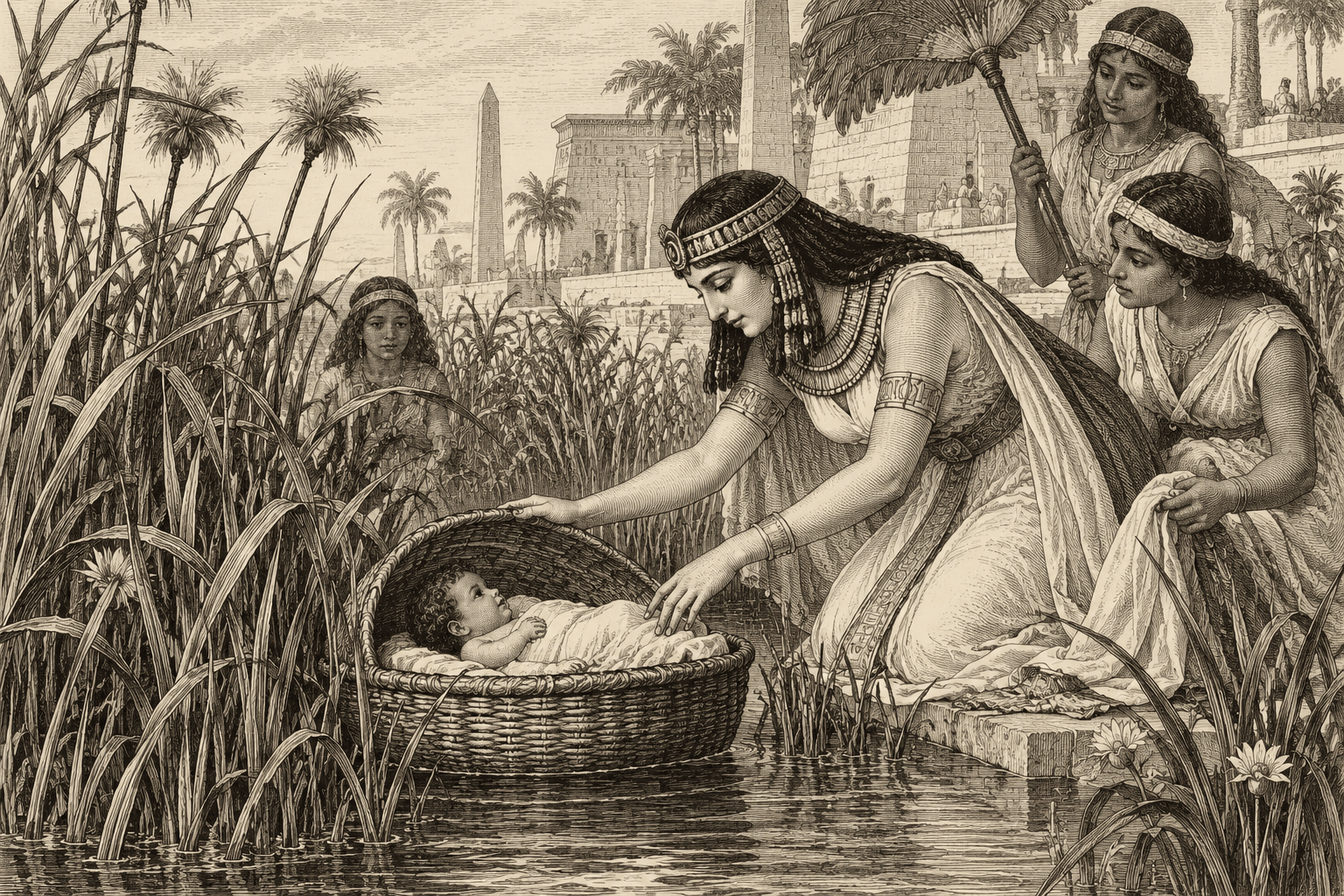
Pharaoh’s daughter: Saint Gregory of Nyssa sees that Pharaoh’s daughter represents worldly philosophies. They are barren and fruitless, like Pharaoh’s barren daughter, who is in labor but never gives birth. [37] Truly, like the princess, Pharaoh’s daughter, they have their beauty, authority, wealth, and attraction, and many frequent them and seek their favor; but, being barren, they do not satisfy the soul. At the same time the Church does not take a hostile stance toward them. Just as Moses entered her palace, though he grew up nursing on his mother’s milk, so we receive philosophy and the sciences and do not despise them, but we hold fast to the tradition of the Church our mother, her Gospel, her teachings, her mind, and her whole life.
From the beginning of its work, the Christian School of Alexandria was concerned with this task: receiving philosophy without deviating from the mind of the Gospel. The historian Schaff says: “The aim of Alexandrian theology was to reconcile Christianity with philosophy… establishing this unity on the foundation of Holy Scripture and the teachings of the Church.” [38] Saint Clement of Alexandria held that there is no enmity between Christianity and philosophy, [39] and that philosophy is not a work of darkness; rather, upon each of its schools shines a ray of light [40] from the Logos. He criticized those who say that philosophy is evil. [41] He made clear that God used philosophy among the Greeks to bring them to the knowledge of Christ, “the Truth.”
Origen the scholar sees that Pharaoh’s daughter also points to the Church of the Gentiles, which received Moses (the Law) from the Jews through the river (baptism) and understood him in a new way, for she carried him with her to her palace. He says:
I think that Pharaoh’s daughter represents the Church gathered from all the nations. Although her father was unjust and a pagan, it is said to her: “Hearken, O daughter, and consider, and incline thine ear; forget also thine own people, and thy father’s house; so shall the king greatly desire thy beauty” (Psalm 45:10–11). She goes out from her father’s house and comes to the waters to wash herself of the sins she committed in her father’s house; then she acquires “bowels of mercies” and has compassion on the child. This is the Church coming from the Gentiles to find in the river Moses, whom his own had rejected. She is brought a nurse of his own race, with whom he spends his childhood and grows up. Moses is brought to her, and she adopts him.
I have often explained that Moses represents the Law. When the Church comes to the waters of baptism, she takes the Law that had been hidden in an ark of bulrushes daubed with slime and pitch… for the Law was lying asleep in such a place, a captive of the defiled (carnal) senses of the Jews, until the Church of the Gentiles came to draw him out from the slime and settle him in the royal court of the palace of wisdom. Thus the Law passed from his own people, because they did not know how to hear it spiritually, while it was still small like an infant nursing on milk. But when it was presented to the Church and entered the house, it grew and became strong; it did not wear the garment of lowliness and meanness, but came to wear all that is great, lofty, and beautiful. What is this greatness but loftiness in spiritual things?! Let us, then, pray to our Lord Jesus Christ that He may reveal Himself to us and show us also the greatness and loftiness of Moses. [42]
His name: Pharaoh’s daughter called him “Moses”: “And she called his name Moses: and she said, Because I drew him out of the water” (10). This is the name by which God Himself called him. As Saint Gregory of Nyssa says:
God did not disdain to call His servant by this name, nor did He consider it unfitting to leave him the name given him by a foreign woman to express what suited the prophet. [43]
Saint Clement of Alexandria [44] sees that “Moses” is the Egyptian name and means “drawn out of the water,” while his Hebrew name given at his circumcision was Joachim. In the view of those who interpret symbolically, he has a third name in heaven, “Melchi” (Deuteronomy 33:5).
3. Moses Serves with Human Zeal
KJV · Verses 11–15
11 And it came to pass in those days, when Moses was grown, that he went out unto his brethren, and looked on their burdens: and he spied an Egyptian smiting an Hebrew, one of his brethren. 12 And he looked this way and that way, and when he saw that there was no man, he slew the Egyptian, and hid him in the sand. 13 And when he went out the second day, behold, two men of the Hebrews strove together: and he said to him that did the wrong, Wherefore smitest thou thy fellow? 14 And he said, Who made thee a prince and a judge over us? intendest thou to kill me, as thou killedst the Egyptian? And Moses feared, and said, Surely this thing is known. 15 Now when Pharaoh heard this thing, he sought to slay Moses. But Moses fled from the face of Pharaoh, and dwelt in the land of Midian: and he sat down by a well.
Having been educated in the wisdom of the Egyptians for nearly forty years, Moses thought he was able to serve God, relying on his eloquence and wisdom. He thought himself to be something, and so he became confused in his service: “And he looked this way and that way” (12), concerned with how people saw him. Yet the servant of God is not concerned with people’s hatred or their approval of his service, as long as he knows that God is the One who sent him… Moses went out to serve relying on his own ability, so he was afraid and fled from the service (15).
It should be noted that what Moses faced is what everyone faces who sets it in his heart to consecrate his life to God. He meets two wars: a war on the left and a war on the right.
A) The war on the left: This is the war against obvious evil. Moses saw the struggle between a man of a foreign race and one of his own people, and he struck the first a fatal blow and hid him in the sand. This is a symbolic picture of the believer who does not strike a human being, but strikes every evil in his heart and buries it, so that sin, which is foreign to our nature, may have no place within us.
B) The war on the right: This is the war with self-righteousness, when a person thinks of himself that he has become righteous, better than others, having no obvious sins. This war is more bitter: it is between the Hebrew and his brother, that is, between a person and his own self, the “ego.”
Likewise the believer faces two wars: the war against sin, which is visible and relatively easy, and the war of inner division within the Church, which is more dangerous and harsher… It leads many to flee from service, as Moses was forced to do.
Saint John Chrysostom comments on the words of the Hebrew, “Who made thee a prince and a judge over us? intendest thou to kill me, as thou killedst the Egyptian?” (14), saying: [45]
The people were like a sick man who sees that the skilled physician has taken a scalpel in his hand; in his agitation and fear he says: Who appointed you a physician and gave you a scalpel to use?!
That is one side. On the other side, God used this matter for the benefit of Moses, so that he fled to learn philosophy in the wilderness and to see the vision. [46]
4. Moses in the Land of Midian
KJV · Verses 16–25
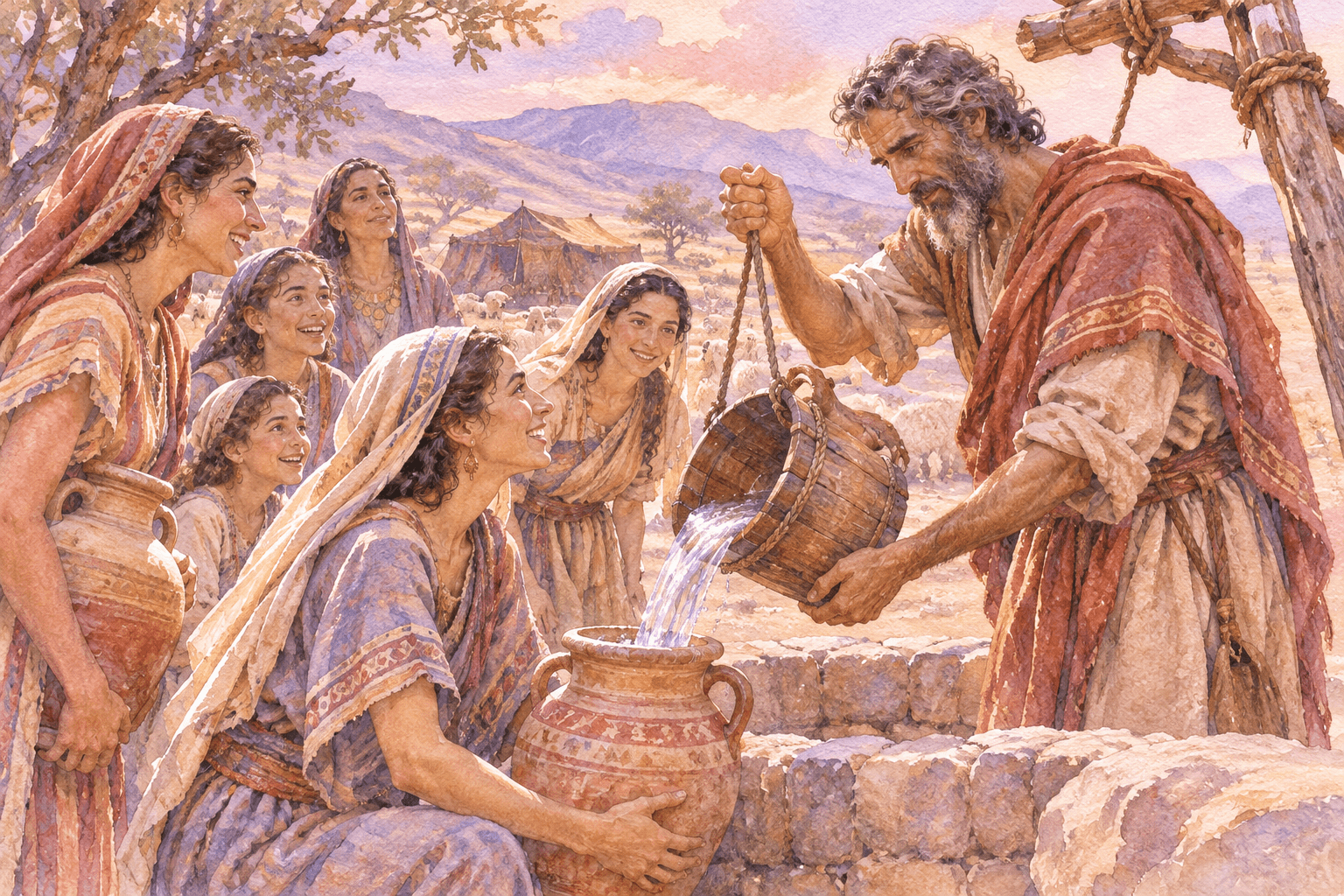
16 Now the priest of Midian had seven daughters: and they came and drew water, and filled the troughs to water their father's flock. 17 And the shepherds came and drove them away: but Moses stood up and helped them, and watered their flock. 18 And when they came to Reuel their father, he said, How is it that ye are come so soon to day? 19 And they said, An Egyptian delivered us out of the hand of the shepherds, and also drew water enough for us, and watered the flock. 20 And he said unto his daughters, And where is he? why is it that ye have left the man? call him, that he may eat bread. 21 And Moses was content to dwell with the man: and he gave Moses Zipporah his daughter. 22 And she bare him a son, and he called his name Gershom: for he said, I have been a stranger in a strange land. 23 And it came to pass in process of time, that the king of Egypt died: and the children of Israel sighed by reason of the bondage, and they cried, and their cry came up unto God by reason of the bondage. 24 And God heard their groaning, and God remembered his covenant with Abraham, with Isaac, and with Jacob. 25 And God looked upon the children of Israel, and God had respect unto them.
After forty years Moses moved to the wilderness to be trained in knowing the truth about himself, that he is nothing… so that he says: “Who am I, that I should go unto Pharaoh?” (Exodus 3:11). By this he became qualified to receive divine power.
How much the servant needs to leave the place of service and set out for “the life of solitude,” practicing his union with God, so that he may be made fit for a heart enlarged all the more to love those he serves!
There in the wilderness lived Reuel, whose name means “God is a friend.” Moses married Zipporah, whose name means “a little bird,” and from her he begot Gershom, which means “a stranger.” It is as if Moses here represents the servant who in his solitude meets God as a friend, whose life is united with the little bird, that is, with the heavenly mind that flies in the heights, and who gives birth to a constant sense of being a stranger…
It should be noted that his father-in-law Reuel was called Jethro (Exodus 3:1), probably as a title of honor as priest of Midian; the name means “excelling in eminence.” [47] In Numbers 10:29 he is called “Hobab, the son of Raguel,” and perhaps Hobab also means Reuel. He is most likely a descendant of Abraham and Keturah (Genesis 25:2).
As for Moses’ work, it was shepherding the sheep. Saint Clement of Alexandria [48] and Origen the scholar [49] saw in this work an image of the Lord Christ, the Good Shepherd, who shepherds the inner movements of the soul like a flock.
Notes and References
[33] St. John Chrysostom, In Act. hom. 54.
[34] Gregory of Nyssa, The Life of Moses 2:7.
[35] Ibid. 2:8.
[36] Ibid. 2:9.
[37] Ibid. 2:11.
[38] Schaff, vol. 2, p. 77; Fr. Tadros Yacoub Malaty, The Early Fathers of the School of Alexandria (Arabic, 1980), pp. 14, 15, 48–49, 72–76, 181–184.
[39] Fr. Tadros Yacoub Malaty, The Early Fathers of the School of Alexandria, pp. 73–76.
[40] Clement of Alexandria, Stromata 1:13.
[41] Ibid. 1:4.
[42] Origen, In Exod. hom. 2:4.
[43] Gregory of Nyssa, Answer to Eunomius, Second Book. N.P.N.F., Series 2, vol. 5, 79.
[44] Clement of Alexandria, Stromata 1:23.
[45] St. John Chrysostom, In 2 Cor. hom. 15.
[46] St. John Chrysostom, In Act. hom. 54.
[47] J. Hastings, Dictionary of the Bible, p. 496.
[48] Clement of Alexandria, Stromata 1:23.
[49] Origen, In Jer. hom. 5:6.