
In the previous chapters we see God’s continual movement toward His people. He prepared Moses as their deliverer, He moved Pharaoh’s heart, He brought them through the Red Sea and destroyed their enemy (the devil and his soldiers), He fed them with the heavenly manna, turned the bitterness of the waters into sweetness, and so on… Finally He gave them His commandments and laws as a support for them. Now the Church is bound to move toward God, with His support. This chapter reveals the work of the Church in God, which may be summed up in these points: the communal spirit (1–2); a spiritual, not a fleshly, bond (1–2); the role of the people (3–4); the role of the young men (5); sanctification by blood (6–8); joining the heavenly life with temporal reality (9–11); the spirit of discipleship (13); working in the spirit of prayer with wisdom (14); and Moses on the mount forty days (12–18).
1. The Communal Spirit and a Spiritual Bond
KJV · Verses 1–2
1 And he said unto Moses, Come up unto the Lord, thou, and Aaron, Nadab, and Abihu, and seventy of the elders of Israel; and worship ye afar off. 2 And Moses alone shall come near the Lord: but they shall not come nigh; neither shall the people go up with him.
The Communal Spirit
Though Moses “alone shall come near the LORD” (2), and the people were not to go up with him, God commanded Moses to come up, and with him Aaron, Nadab, Abihu, and seventy of the elders (1). The Church does not know individualism. The spiritual leaders, with their many gifts and different works, must meet in one spirit: Moses, who received the Law, meets with Aaron the high priest and his two sons Nadab and Abihu, representing the priests and the Levites, and with the seventy elders, representing the leaders of the people. On this the Apostle says: “For as we have many members in one body, and all members have not the same office: So we, being many, are one body in Christ, and every one members one of another. Having then gifts differing according to the grace that is given to us, whether prophecy, let us prophesy according to the proportion of faith; Or ministry, let us wait on our ministering: or he that teacheth, on teaching; Or he that exhorteth, on exhortation: he that giveth, let him do it with simplicity; he that ruleth, with diligence; he that sheweth mercy, with cheerfulness” (Romans 12:4–8).
So all work together in one spirit, with different gifts. No one should boast of his gift over others, nor despise the talents the Lord has given him! Let him work neither in the spirit of pride nor with faintheartedness! As Saint John Chrysostom says:
Let us take these things into account, and neither envy nor bear malice toward those who have greater gifts, nor at the same time despise those who have lesser gifts. [326]
A Spiritual, Not a Fleshly, Bond
Moses did not take one of his own two sons; indeed, we never hear of his sons receiving any particular responsibility. Rather, he took with him Aaron and his two sons Nadab and Abihu (1). Here appears the living spiritual leadership that works for God alone: he does not hand his sons according to the flesh a responsibility they are not able to bear; but when God commanded him that his brother Aaron work with him, he did not refuse.
Nadab is Aaron’s firstborn son, and his name means “generous”; he was one of those consecrated as priests to the Lord. Abihu means “he is my father.” Sadly, both died when they offered strange fire before the Lord (Leviticus 10:1; Numbers 26:61), perhaps because they were drunk. In any case these two men became fearful examples for the priests of the Lord. Though they accompanied Moses and Aaron with the seventy elders and saw the Lord (9–10), with heavenly glories under His feet, and shared in the priestly work from its very beginning, they deprived themselves of the enjoyment of God by offering strange fire. So we are not surprised that the Apostle warns us: “Wherefore let him that thinketh he standeth take heed lest he fall” (1 Corinthians 10:12); and he says: “But I keep under my body, and bring it into subjection: lest that by any means, when I have preached to others, I myself should be a castaway” (1 Corinthians 9:27).
2. The Role of the People and of the Young Men
KJV · Verses 3–5
3 And Moses came and told the people all the words of the Lord, and all the judgments: and all the people answered with one voice, and said, All the words which the Lord hath said will we do. 4 And Moses wrote all the words of the Lord, and rose up early in the morning, and builded an altar under the hill, and twelve pillars, according to the twelve tribes of Israel. 5 And he sent young men of the children of Israel, which offered burnt offerings, and sacrificed peace offerings of oxen unto the Lord.
The Role of the People
Though Moses the leader of the people went up, with Aaron his priest and his sons, and the seventy elders, the leaders of the people, church life cannot rest on the passivity of the people. Before Moses offered burnt offerings and peace offerings to the Lord, and before he sprinkled the blood on the altar and the people, he spoke with them about “all the words of the LORD,” and they accepted them with full consent: “All the words which the LORD hath said will we do” (3). For the sake of the people Moses came, and for their sake the priesthood and the leaders were set up… Therefore theirs is the first and direct word in their relationship with God.
In the Church the people play a positive role. The Church does not know secret liturgies; the people must share openly with the priests in the service. As the priest prays for the people, the deacon asks the people to pray for the father patriarch and all the orders of the priesthood. And the people are bound to bear witness to the Gospel and preach it, as the epistle of Christ, “known and read of all men” (2 Corinthians 3:2). [327]
The Role of the Young Men
“And he sent young men of the children of Israel, which offered burnt offerings, and sacrificed peace offerings of oxen unto the LORD” (5).
Not only do the people play a positive role in church life; Moses gave attention to the young men, who were sent to offer burnt offerings and peace offerings to the Lord. The role of young people does not stop at listening and obeying; they carry an essential work in the life of the Church.
God asks you for burnt offerings of love and peace offerings in the days of your youth, so Scripture says: “Remember now thy Creator in the days of thy youth” (Ecclesiastes 12:1).
3. Sanctification by Blood
KJV · Verses 6–8
6 And Moses took half of the blood, and put it in basons; and half of the blood he sprinkled on the altar. 7 And he took the book of the covenant, and read in the audience of the people: and they said, All that the Lord hath said will we do, and be obedient. 8 And Moses took the blood, and sprinkled it on the people, and said, Behold the blood of the covenant, which the Lord hath made with you concerning all these words.
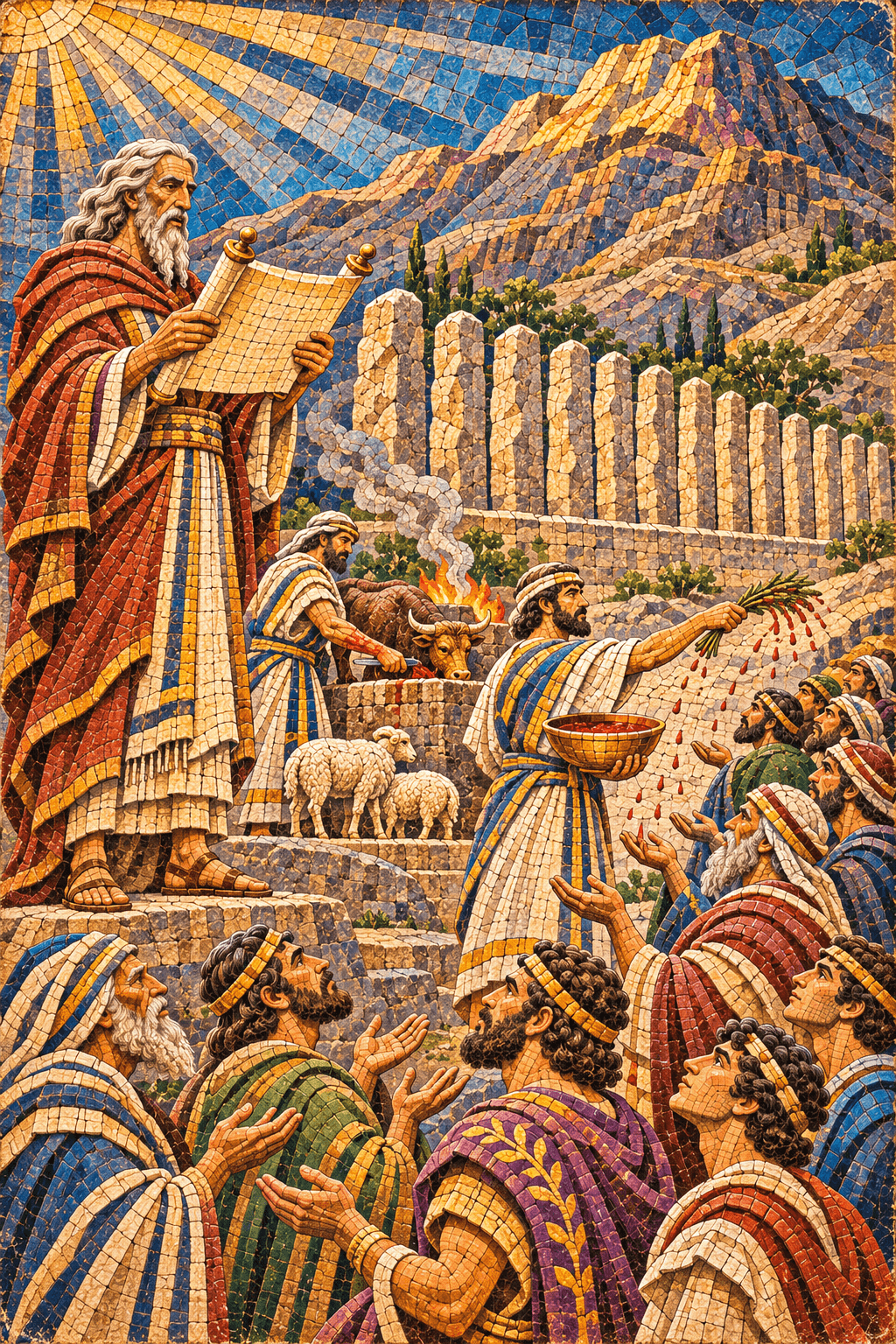
The work of the Church cannot be offered except through the altar and the sacrifice. Therefore Moses rose up early in the morning and built an altar under the mount, and twelve pillars for the twelve tribes of Israel (4); for these tribes have no existence except through the altar… And there is no sanctification for them except by sprinkling half of the blood on the altar and the other half on the people (6, 8). Through the blood of the true Sacrifice, the blood of the Lord Christ, the people enter into the holy places, as our teacher Paul says: “Having therefore, brethren, boldness to enter into the holiest by the blood of Jesus” (Hebrews 10:19).
4. Joining the Heavenly Life with Temporal Reality
KJV · Verses 9–11
9 Then went up Moses, and Aaron, Nadab, and Abihu, and seventy of the elders of Israel: 10 And they saw the God of Israel: and there was under his feet as it were a paved work of a sapphire stone, and as it were the body of heaven in his clearness. 11 And upon the nobles of the children of Israel he laid not his hand: also they saw God, and did eat and drink.
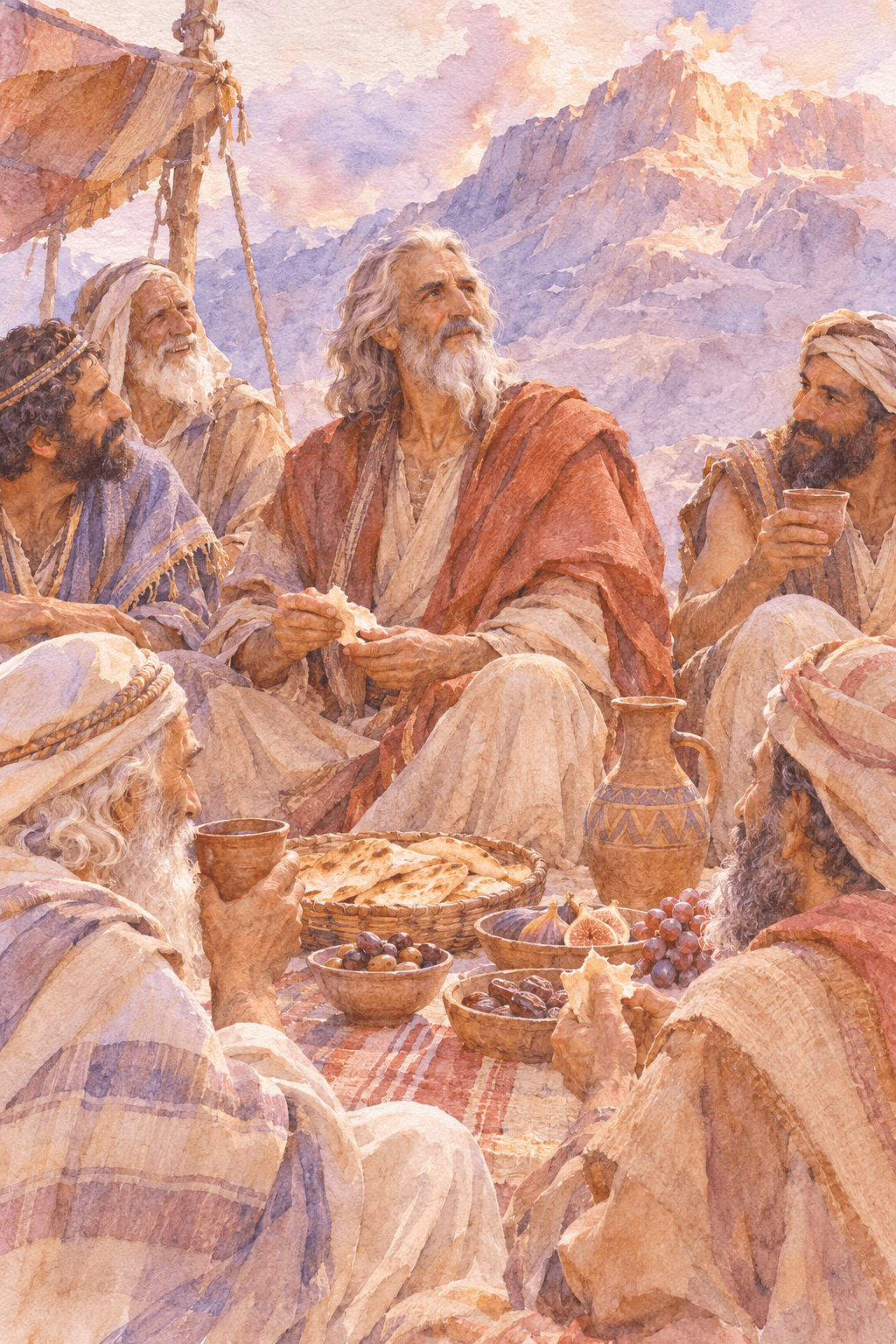
The Lord appeared to them, “and there was under his feet as it were a paved work of a sapphire stone, and as it were the body of heaven in his clearness” (10). It is as if God wanted all who work in the Church to bear the heavenly nature and the heavenly mind, yet without ignoring their temporal reality and the needs of their bodies, for Scripture continues: “Also they saw God, and did eat and drink” (11).
So it is fitting for us, as servants of God, to see Him, become like Him, and carry His thoughts in us, without ignoring the necessary needs of our bodies for food and drink in the presence of the Lord!!!
5. Moses on the Mount Forty Days
KJV · Verses 12–18
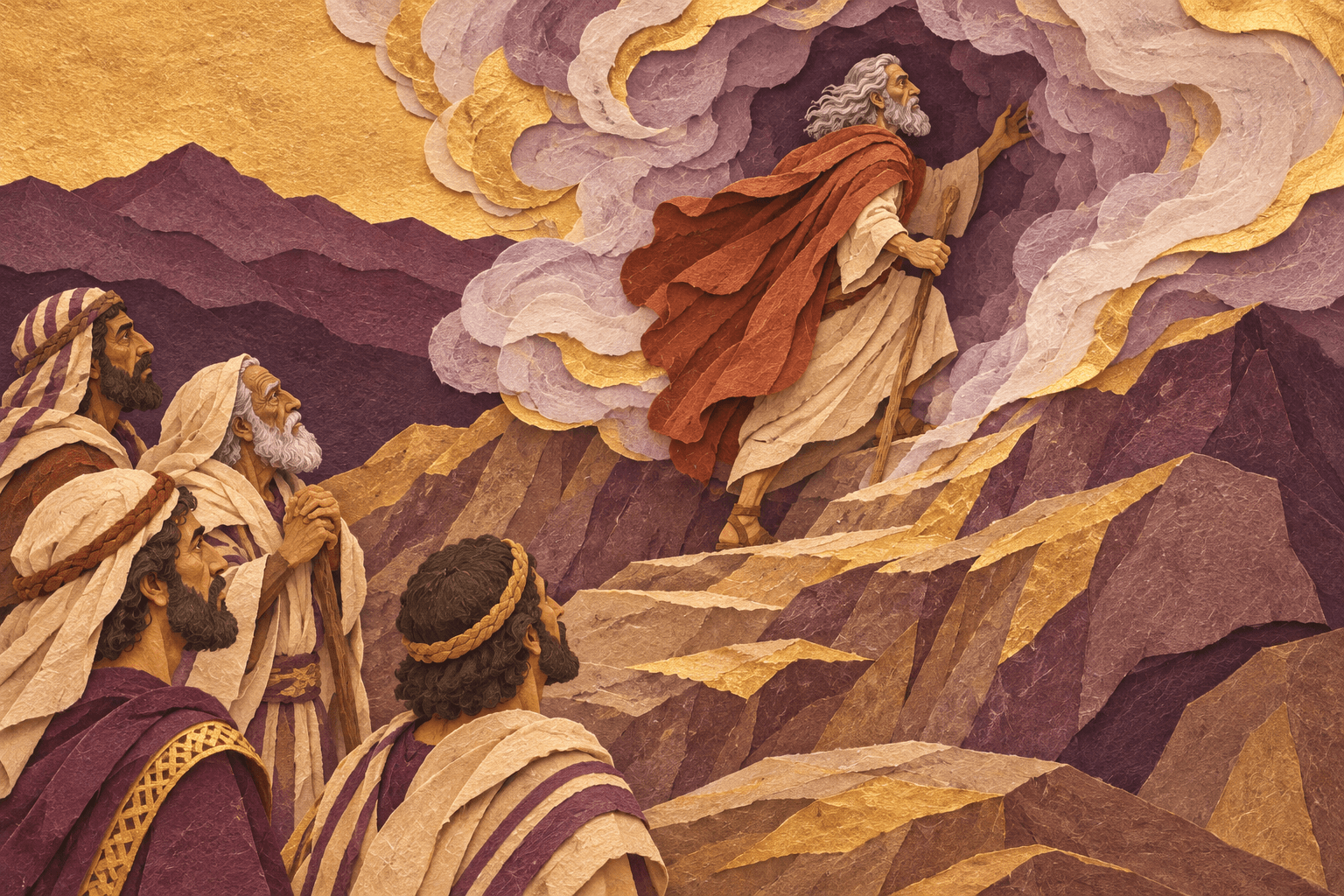
12 And the Lord said unto Moses, Come up to me into the mount, and be there: and I will give thee tables of stone, and a law, and commandments which I have written; that thou mayest teach them. 13 And Moses rose up, and his minister Joshua: and Moses went up into the mount of God. 14 And he said unto the elders, Tarry ye here for us, until we come again unto you: and, behold, Aaron and Hur are with you: if any man have any matters to do, let him come unto them. 15 And Moses went up into the mount, and a cloud covered the mount. 16 And the glory of the Lord abode upon mount Sinai, and the cloud covered it six days: and the seventh day he called unto Moses out of the midst of the cloud. 17 And the sight of the glory of the Lord was like devouring fire on the top of the mount in the eyes of the children of Israel. 18 And Moses went into the midst of the cloud, and gat him up into the mount: and Moses was in the mount forty days and forty nights.
The Spirit of Discipleship
“And Moses rose up, and his minister Joshua: and Moses went up into the mount of God” (13).
Saint Ambrose saw in Joshua’s cleaving to Moses a living picture of discipleship. The successful leader is the one who gives the Church disciples of the Lord; and his success is known after his departure, whether he has left someone to complete the divine mission, or whether his work ended with his departure. Saint Ambrose says of Joshua:
He clung to the blessed Moses everywhere, amid all the wonderful works and the awesome mysteries… How beautiful is the union between the old man and the young! The first gave testimony (the two tables of the Law), and the other gave rest (the land of promise). The one gave leadership, the other happiness… One ruled the sea, and the other the heaven (Joshua 10:12). [328]
Working in the Spirit of Prayer with Wisdom
Aaron was joined with Hur; [329] they worked together when they held up the hands of Moses during Joshua’s war against Amalek (Exodus 17:12), and here they work now in judging the causes of the people during Moses’ absence (14).
Aaron represents the priesthood. Hur is of the tribe of Judah, the grandfather of Bezaleel, of whom Moses said: “The LORD hath called by name Bezaleel the son of Uri, the son of Hur… And he hath filled him with the spirit of God, in wisdom, in understanding, and in knowledge” (Exodus 35:30–31). So it is as if Hur represents divine wisdom. If Moses, stretching out his hands, represented the Cross, this Cross rested on the priestly work of Christ and the wisdom of God for our salvation. Here too, in Moses’ absence, Aaron and Hur are left to judge the causes of the people; it is as if the Church, in her care for the people, must join priestly work full of tenderness and gentleness with wisdom in governing.
Forty Days and Forty Nights
We spoke before of the cloud and the appearing of God’s glory as a devouring fire; but let us look now at Moses on the mount “forty days and forty nights” (18).
Saint Augustine sees that the number 40 points to the fullness of our earthly or temporal life. It is as if the believer should spend all the days of his life on the mount of God, that is, in God’s Law and commandments, contemplating the glory of the Lord and enjoying meeting Him face to face. As Moses fasted forty days, so the true believer lives a life of self-denial all the days of his sojourning, not for the sake of self-denial in itself, but for the lifting up of his heart to the life of fellowship with God and continual gazing upon Him. Or, more precisely, we say with Tertullian:
Moses and Elijah fasted forty days and lived on God alone. [330]
That is, He became their satisfying food!
Notes and References
[326] Fr. Tadros Yacoub Malaty, Pastoral Love (Arabic, 1965), p. 771.
[327] God willing, a booklet will be published on the role of teachers in the Church.
[328] St. Ambrose, Duties of the Clergy 2:20.
[329] Josephus thinks that Hur was the husband of the sister of Moses and Aaron.
[330] Tertullian, On the Resurrection of the Flesh 11.