
This chapter speaks of: between the tabernacle, the Church, and heaven; the offerings for the tabernacle (1–9); the ark (10–22); the table of shewbread (23–30); and the lampstand and its lamps (31–40).
1. The Offerings for the Tabernacle
KJV · Verses 1–9
1 And the Lord spake unto Moses, saying, 2 Speak unto the children of Israel, that they bring me an offering: of every man that giveth it willingly with his heart ye shall take my offering. 3 And this is the offering which ye shall take of them; gold, and silver, and brass, 4 And blue, and purple, and scarlet, and fine linen, and goats' hair, 5 And rams' skins dyed red, and badgers' skins, and shittim wood, 6 Oil for the light, spices for anointing oil, and for sweet incense, 7 Onyx stones, and stones to be set in the ephod, and in the breastplate. 8 And let them make me a sanctuary; that I may dwell among them. 9 According to all that I shew thee, after the pattern of the tabernacle, and the pattern of all the instruments thereof, even so shall ye make it.
Between the Tabernacle, the Church, and Heaven
We have already published a volume devoted to the study of the church building, [331] and its development from Paradise, where our first parents were, until our passing over to the heavenly city and entering into the eternal holy of holies. In it we spoke of the relationship of the church building to the church community, liturgical worship, and the inner life of the believer; and we spoke of the details of the building’s contents and their relationship to what the tabernacle of meeting and the old temple contained, in the light of the Gospel and the writings of the early fathers. So I find myself bound to point to the need to refer to that study to complete what I will mention as we deal with the tabernacle and its contents, to avoid repetition.
Now, returning to chapter 25 of Exodus, we see Moses the prophet, having separated himself from the hindrances to the divine vision, rise up on the mountain of holy knowledge. The divine commandments and the Law were given to him, and now the Lord gives him a new vision: “the heavenly sanctuary,” not made by man, in which God dwells with His beloved creation. He asked him to make a shadow of the image of this sanctuary, a pattern of it for those at the foot of the mountain, so that God might dwell in their midst and prepare them to enter the heavenly sanctuary. In other words, the tabernacle of meeting came as a shadow of the image of heaven itself, so that the people might pass over into the New Covenant and enter the image of heaven, or its foretaste, and finally set out in eternal life to the fullness of the heavenly dwelling.
This is what Father Methodius expressed when he said:
The Jews prophesied our state, but we prophesy heavenly things; for the tabernacle is a symbol of the Church, and the Church is a symbol of heavenly things. [332]
He also says:
The Hebrews were commanded to adorn the tabernacle as a type of the Church, so that through sensible things they might declare beforehand the image of divine things. For the pattern shown to Moses on the mount, to which he held when he set it up, was a kind of true representation of the heavenly dwelling, which we now see more clearly than before through the figures, though it is counted dim when we see the truth as it is. For until now the truth is not given to mankind as it is in the present life, since it cannot behold things immortal and pure, as one cannot gaze at the rays of the sun. To the Jews was revealed the shadow of the image of heavenly things, so they received a third of the truth; we have beheld the image of the heavenly order; but after the resurrection the truth will appear clearly, when we see the heavenly dwelling, the city “whose builder and maker is God” (Hebrews 11:10), face to face, and not darkly or in part (1 Corinthians 13:12). [333]
This is what Paul the Apostle revealed to us in the Epistle to the Hebrews, when he drew near in the spirit to the tabernacle with awe and reverence, seeing it as “the example and shadow of heavenly things” (Hebrews 8:5), declaring the mysteries of God’s work among His people, things of which “we cannot now speak particularly” (Hebrews 9:5).
The Offerings for the Tabernacle
God asked Moses to ask the people that each one offer “whosoever is of a willing heart” (Exodus 35:5), that is, as much as his love allows, to contribute to the offering used in making “the sanctuary” in which the Lord dwells among His people: “Of every man that giveth it willingly with his heart ye shall take my offering. And this is the offering which ye shall take of them; gold, and silver, and brass, And blue, and purple, and scarlet, and fine linen, and goats’ hair, And rams’ skins dyed red, and badgers’ skins, and shittim wood, Oil for the light, spices for anointing oil, and for sweet incense, Onyx stones, and stones to be set in the ephod, and in the breastplate” (2–7).
What are these materials which we contribute to the building that becomes God’s possession, in which God meets with us? Let us take examples of these materials and understand their spiritual meanings:
A) Gold: Origen sees that gold is the faith that makes the heart a heaven; so gold points to heavenly things, and also to the saints, as a heaven in whose hearts God dwells. He says:
If you believe, you offer your heart and your mind as gold…! For this reason Moses, who represents the spiritual Law, declares: “Take ye from among you” (Exodus 35:5). If you can take these things from among you, then they are within you. You can offer the Lord something of your feelings, of your words, and so on. [334]
Father Methodius sees that gold points to the life of virginity, for he says:
He commanded gold (for the vessels within the holy of holies) for two reasons: first, because it does not rust; and second, because its color is somewhat like the color of the sun. So it suits virginity, which bears nothing defiled or wrinkled, but always shines with the light of the Word. Through it we stand near to God, within the holy of holies and before the veil, with undefiled hands like incense, offering prayers to the Lord as a sweet and acceptable savour, in the (golden) censers of the twenty-four elders, which are the prayers of the saints. [335]
B) Silver: If gold is the faith of the heart, silver is the word of preaching, for the words of the LORD are “as silver tried in a furnace of earth, purified seven times” (Psalm 12:6). And if gold points to virginity, the fathers see in silver a sign of the chastity of marriage.
C) Brass: It points to patience or strength. The Lord Christ’s “hands are as gold rings” (Song of Solomon 5:14), for His works are heavenly; but “his feet like unto fine brass, as if they burned in a furnace” (Revelation 1:15). With them we crush all the thorns and tribulations of this life without fear!
D) Wood that does not rot: It points to knowledge, or to chastity that does not grow old [336] or decay.
E) Fine twined linen: Since linen points to the body, its being twined means being under restraint and discipline, [337] as the Apostle says: “I keep under my body, and bring it into subjection” (1 Corinthians 9:27). Every struggle to restrain and control the body in Christ Jesus is an offering for the house of the Lord.
F) Scarlet: If the scarlet cord that saved the life of Rahab and all her house (Joshua 2:18) points to the blood of the Lord Christ the Savior, the scarlet we offer is our witness to Him even to blood, as the Apostle says: “For thy sake we are killed all the day long” (Romans 8:36). Scarlet points to martyrdom, whether the shedding of the blood of the faithful in the ages of martyrdom or the life of daily mortification for the Lord.
G) Purple: Purple is the garment of kings; so when they wanted to mock the Lord Christ as King, they clothed Him in purple. We put on purple, the garment of the King, which is “love.” Origen sees that it points to the brightness of love, [338] and also to fire. [339] The true Christian bears fire in his heart, the fire of the Holy Spirit, who lights the way and burns the thorns that choke the soul. The Lord Christ affirmed the presence of this fire in our hearts when He said: “I am come to send fire on the earth; and what will I, if it be already kindled?” (Luke 12:49). And in the Book of Jeremiah the Lord says: “I will make my words in thy mouth fire” (Jeremiah 5:14), for it is engraved in the heart by the fiery Holy Spirit. The two disciples of Emmaus received a divine fire when they heard the words of the Savior, for they said: “Did not our heart burn within us, while he talked with us by the way, and while he opened to us the scriptures?” (Luke 24:32). And the Church received the tongues of fire on the day of Pentecost (Acts 2).
H) Goats’ hair: It points to death to sin (Exodus 35:6; Leviticus 4:23). Origen says:
Offering it points to the destruction of sin and its death in him, so that it no longer reigns in his members. [340]
I) Rams’ skins: If the goats point to sin, the rams point to anger; whoever offers their skins declares that anger has died in him.
All Share in the Offering
Origen says:
Each one’s share in the offering is a matter the Lord does not neglect. What honor you receive…! On the other hand, what shame if the Lord discovers that you offered nothing for the building of the tabernacle! For if you live in ungodliness and faithlessness, you leave no memorial for yourself in the tabernacle of the Lord.
When the prince of the world comes, he searches our hearts to see if he finds something that belongs to him, so as to claim it; but if the Lord finds in your heart an offering for Him, He defends you and makes you a king.
My Lord Jesus, grant me to be worthy to leave a memorial of myself in Your tabernacle. For I long to have a share in this gold from which the altar is made, or with which the ark is covered, or from which the lampstand or the lamps are made. And if I have nothing in this, grant me at least to have a share in the silver offered for the pillars or their sockets, or to be counted worthy to have a share in offering the brass of the tabernacle, from which the rings and the other things mentioned in Holy Scripture are made. Would that I were a prince, to offer the precious stones for the ephod and the breastplate of the high priest. If that is beyond my strength, let me offer something else for the tabernacle of God, such as goats’ hair, so that I may not be found barren and fruitless! [341]
In chapter 35 he testifies that the men and women came to Moses with their offerings… a matter we will speak of in its place, if the Lord wills and we live.
Where Did the Offerings Come From?
Origen sees that the people used the gold, silver, precious stones, and garments which they took from the house of bondage in making the tabernacle of meeting and its contents, for he says:
The Egyptians did not use these things well, but the Hebrews used them for religious purposes, for the wisdom of God was with them. [342]
Let Them Make Me a Sanctuary
The Lord asked Moses that they make Him a sanctuary in which God would dwell with them, a shadow of heavenly things, for He says: “And let them make me a sanctuary; that I may dwell among them. According to all that I shew thee, after the pattern of the tabernacle, and the pattern of all the instruments thereof, even so shall ye make it” (8–9).
As the authentic church building bears an image of heavenly things, so too a dwelling for the Lord is set up in the heart, bearing the image of heavenly things. On this Origen says:
Each one of us can build a tabernacle for the Lord within his own soul. [343]
He also says:
God desires that a tabernacle be made for Him, promising us the vision of Him in return, for the Apostle says to the Hebrews: “Follow peace with all men, and holiness, without which no man shall see the Lord” (Hebrews 12:14). This is the tabernacle He commands to be built, which the Apostle wants to see in the firstborn, that they may be holy in body and spirit; for he knew well that the building of the tabernacle of the Lord is through purity of heart and body, so as to see God. So let us build a tabernacle for the Lord; let us all build it together, and let each one of us build it within himself. The tabernacle we build is the holy Church, “not having spot, or wrinkle” (Ephesians 5:27). [344]
2. The Ark
KJV · Verses 10–22
10 And they shall make an ark of shittim wood: two cubits and a half shall be the length thereof, and a cubit and a half the breadth thereof, and a cubit and a half the height thereof. 11 And thou shalt overlay it with pure gold, within and without shalt thou overlay it, and shalt make upon it a crown of gold round about. 12 And thou shalt cast four rings of gold for it, and put them in the four corners thereof; and two rings shall be in the one side of it, and two rings in the other side of it. 13 And thou shalt make staves of shittim wood, and overlay them with gold. 14 And thou shalt put the staves into the rings by the sides of the ark, that the ark may be borne with them. 15 The staves shall be in the rings of the ark: they shall not be taken from it. 16 And thou shalt put into the ark the testimony which I shall give thee. 17 And thou shalt make a mercy seat of pure gold: two cubits and a half shall be the length thereof, and a cubit and a half the breadth thereof. 18 And thou shalt make two cherubims of gold, of beaten work shalt thou make them, in the two ends of the mercy seat. 19 And make one cherub on the one end, and the other cherub on the other end: even of the mercy seat shall ye make the cherubims on the two ends thereof. 20 And the cherubims shall stretch forth their wings on high, covering the mercy seat with their wings, and their faces shall look one to another; toward the mercy seat shall the faces of the cherubims be. 21 And thou shalt put the mercy seat above upon the ark; and in the ark thou shalt put the testimony that I shall give thee. 22 And there I will meet with thee, and I will commune with thee from above the mercy seat, from between the two cherubims which are upon the ark of the testimony, of all things which I will give thee in commandment unto the children of Israel.
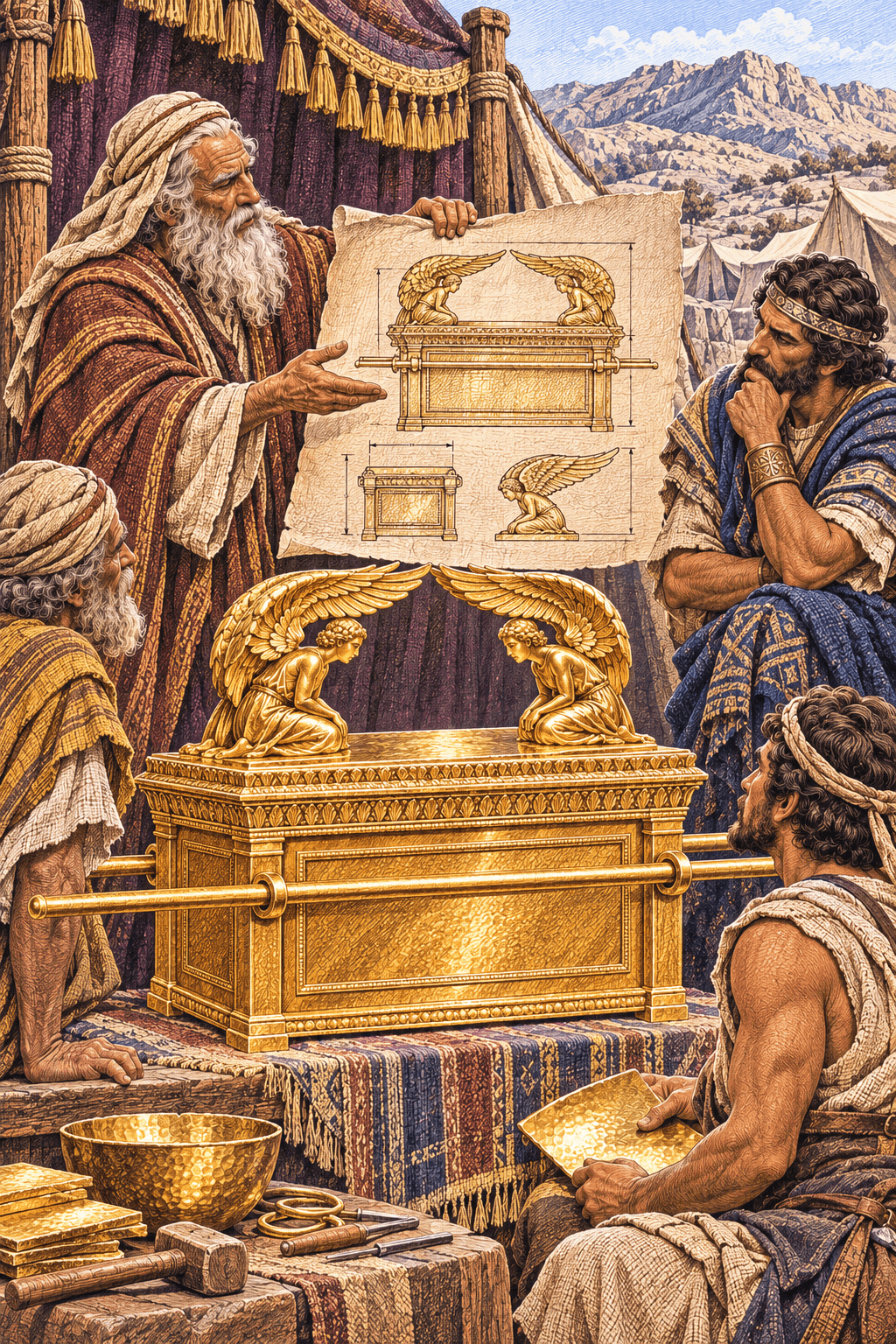
We would have expected the Book of Exodus, after the call to share in the offerings for building the tabernacle, to define the dimensions of the tabernacle, its building materials, and its parts, and finally the furniture in it. But here we find it begins by speaking of some of its furniture before speaking of the tabernacle itself. In this chapter it speaks of the ark of the covenant, the table of shewbread, and the lampstand. Perhaps by this it wanted to begin with the holiest things in the holiest place at that time. These three things represent the mystery of God’s dwelling among His people (the ark), the mystery of their being satisfied by God (the table of shewbread), and the mystery of their enlightenment by Him (the golden lampstand).
The speaking of these three things came before speaking of the tabernacle itself, and after the receiving of the Ten Commandments and the Law. It is as if God wanted by this to give His people the resources that support them in carrying out these divine commandments. For man by his free will alone cannot carry out the divine commandments; he needs the ark, which is God’s own dwelling in the heart; the table of shewbread, which is being satisfied with the bread of angels; and the lampstand, which is enlightenment by the Holy Spirit. In this way the commandments not only become possible to carry out, but become natural in the life of God’s children and joyful to their souls.
Now we speak of the ark of the covenant.
The Form and Material of the Ark
In Hebrew it is called “aron,” and the word means “chest.” It was like a chest two and a half cubits long, a cubit and a half wide, and a cubit and a half high, made of shittim (acacia) wood and overlaid with pure gold plates, within and without (11). A crown of gold surrounded its top. Over it was a cover of pure gold called “kapporeth”; this name is derived from “kaphar,” which means “to cover,” and also “to atone.” It is also called the mercy seat, for it represented God’s throne, full of tenderness toward His children. On it were two cherubim, one at each end, of pure gold, overshadowing the cover, stretching out their wings on high, with their faces one toward the other. On each of the two sides were two rings of gold, so that a staff of shittim wood overlaid with gold could be put through each pair of rings, used to carry the ark. The sons of Kohath, of the Levites, were charged with guarding and carrying it (Numbers 3:29–31).
The History and Work of the Ark
The ark of the covenant represented the divine presence, for the Lord says: “And there I will meet with thee, and I will commune with thee from above the mercy seat, from between the two cherubims which are upon the ark of the testimony, of all things which I will give thee in commandment unto the children of Israel” (22).
So the ark went before the people, preceded by the pillar of cloud by day and the pillar of fire by night. When it set forward, it was said: “Rise up, LORD, and let thine enemies be scattered; and let them that hate thee flee before thee”; and when it rested, it was said: “Return, O LORD, unto the many thousands of Israel” (Numbers 10:33–36).
When the people crossed the Jordan, the ark was carried before them and the river was divided (Joshua 3:14–17). Then it remained for a time in the tabernacle at Gilgal, after which it was moved to Shiloh, where it remained between three and four centuries (Jeremiah 7:12–15). Because of the wickedness of the two sons of Eli the priest, the ark fell into the hands of the Philistines at Aphek (1 Samuel 4). They brought it to Ashdod and set it beside the idol Dagon (1 Samuel 5:2); calamities came upon them, and they were forced to return it. It was placed in Kirjath-jearim (1 Samuel 6:21); then David the prophet moved it to Jerusalem, until the temple was built (2 Samuel 6:1–15; 1 Chronicles 15:25–29).
The Ark and the Christian Altar
The ark of the covenant points not only to the divine presence, but also to God’s work of salvation through the sacrifice of the covenant. [345] So the altar came to complete what the ark aimed at in all its details and contents. We mention for example:
A) The ark was made of shittim wood, a sign of the wooden Cross, the secret of our union with God and the cause of our entering into His divine holy places.
B) It was overlaid with pure gold within and without, though the inside was not visible, so that the work of the sacrifice may act in our inner depths as in our outward conduct, and we may live in a heavenly (golden) spirit.
C) A crown of gold surrounded its top, a sign of our entering into the heavenly glories through the divine altar.
D) Two cherubim overshadowed the cover, a sign of our openness to the heavenly creation and our fellowship with the seraphim and cherubim in their praises and liturgies.
E) The appearing of the cloud between the cherubim, God’s showing Himself there and the hearing of His voice, and the appearing of a blue (heavenly) color at the cherubim… all this speaks of the eschatological character of our liturgy at the new altar and its heavenly stamp.
F) Inside the ark were the two tables of the covenant, which point to the saving word of God that we receive through the sacrificial work; the pot of manna, which points to the holy Body of the Lord; and Aaron’s rod, which points to the pastoral work of the Church and its connection with the sacrifice.
The Ark and the Church
When I speak of the Church, I cannot separate the universal Church from the Church of the heart, for the latter is a member of the whole holy community… The ark came bearing a symbol of this one Church, the Church of the holy community and the Church of the heart.
Saint Jerome says:
The bride of Christ should be like the ark of the covenant, overlaid with gold within and without, and a guardian of the law of God (the two tables of the Law). As the ark contained nothing but the two tables of the Law [346] (1 Kings 8:9), so there should be nothing in your mind outside the Law, for God is pleased to sit in your mind as He sat on the mercy seat and the cherubim (22). [347]
If the ark represents the Church, it also represents Saint Mary the Virgin, as the bearer of the Lord Christ and the most perfect member of the holy Church. We have spoken before in more detail of the likeness between the ark of the covenant and Saint Mary: she is overlaid with virginity (gold), spiritual and bodily, within and without. As the ark brought joy to the people, so that David danced before it (2 Samuel 6), so the visit of Saint Mary, bearing the Lord in her womb, gladdened the unborn John the Baptist in his mother’s womb, and he leaped (eskirtēsen) for joy (Luke 1:41, 44)! [348]
3. The Table of Shewbread
KJV · Verses 23–30
23 Thou shalt also make a table of shittim wood: two cubits shall be the length thereof, and a cubit the breadth thereof, and a cubit and a half the height thereof. 24 And thou shalt overlay it with pure gold, and make thereto a crown of gold round about. 25 And thou shalt make unto it a border of an hand breadth round about, and thou shalt make a golden crown to the border thereof round about. 26 And thou shalt make for it four rings of gold, and put the rings in the four corners that are on the four feet thereof. 27 Over against the border shall the rings be for places of the staves to bear the table. 28 And thou shalt make the staves of shittim wood, and overlay them with gold, that the table may be borne with them. 29 And thou shalt make the dishes thereof, and spoons thereof, and covers thereof, and bowls thereof, to cover withal: of pure gold shalt thou make them. 30 And thou shalt set upon the table shewbread before me alway.
The table of shewbread was made of shittim wood, two cubits long, one cubit wide, and a cubit and a half high. It was overlaid with gold, with a crown of gold on its upper edge, and four rings of gold at its corners for two staves to carry it.
The dishes were used to bring the bread to the table and take it from it; the spoons held the incense (Leviticus 24:7); in the cups the wine of the offering was placed; and the bowls were used for pouring and libation.
The table of shewbread was placed in the holy place by the north wall, that is, at the right of one entering the tabernacle (Exodus 40:22). In Solomon’s temple there were ten tables of shewbread, as there were ten golden lampstands; but it seems that only one table was used at a time, and only one lampstand at a time (2 Chronicles 4:8, 19; 13:11). As for the second temple, its table was taken by Antiochus Epiphanes, and Judas Maccabeus made another table in its place (1 Maccabees 1:22–23; 4:49–51).
The Names of the Shewbread
There are many names for this bread, [349] which carry spiritual meanings touching our relationship with God. It is called the shewbread, or the bread of the Presence (25:30; 35:13). The literal translation of the Hebrew expression is “bread of (the) face,” pointing to this bread’s being before God and in His presence. It is as if God is personally committed to satisfying the needs of His people. So the loaves were twelve, a sign of His pledge to satisfy all His people (all the tribes). The number 12 also points to the months of the year, as if God pledges to satisfy His people throughout the year. Therefore it is called “the continual bread” (Numbers 4:7), and also “the continual shewbread” (2 Chronicles 2:4)… The continuity here also points to its being offered without ceasing, a sign of a lasting covenant between God and the whole community that does not stop. It is also called “hallowed bread” (1 Samuel 21:4–6), for none ate it but the priests sanctified for the work. They ate it in the tabernacle on the Sabbath (the rest), after new hot bread had been set out. It is as if it points not to material, bodily satisfaction, but to the spiritual satisfaction befitting the life of holiness; it is eaten on the Sabbath, the day of rest, as if it belongs to the eternal rest!
The Rite of the Bread
This bread has a precise rite given in Leviticus (Leviticus 24:5–9). It was made every Sabbath, when work is not permitted, for it points to the heavenly bread which is not of this world (that is, the heavenly Christ Himself). It was set out hot on the golden table, affirming its heavenly character and His heart burning with love to satisfy us. The bread was set in two rows, or two sets, and incense was put on each row. As Josephus the historian says, incense was offered in golden cups [350] and burned on the Sabbath. [351] Josephus thinks this bread was unleavened. [352] Each loaf was two tenth deals of fine flour, which was used to serve honored guests and at the king’s table (Genesis 18:6; 1 Kings 4:22), and was also used in some offerings.
4. The Lampstand and Its Lamps
KJV · Verses 31–40
31 And thou shalt make a candlestick of pure gold: of beaten work shall the candlestick be made: his shaft, and his branches, his bowls, his knops, and his flowers, shall be of the same. 32 And six branches shall come out of the sides of it; three branches of the candlestick out of the one side, and three branches of the candlestick out of the other side: 33 Three bowls made like unto almonds, with a knop and a flower in one branch; and three bowls made like almonds in the other branch, with a knop and a flower: so in the six branches that come out of the candlestick. 34 And in the candlesticks shall be four bowls made like unto almonds, with their knops and their flowers. 35 And there shall be a knop under two branches of the same, and a knop under two branches of the same, and a knop under two branches of the same, according to the six branches that proceed out of the candlestick. 36 Their knops and their branches shall be of the same: all it shall be one beaten work of pure gold. 37 And thou shalt make the seven lamps thereof: and they shall light the lamps thereof, that they may give light over against it. 38 And the tongs thereof, and the snuffdishes thereof, shall be of pure gold. 39 Of a talent of pure gold shall he make it, with all these vessels. 40 And look that thou make them after their pattern, which was shewed thee in the mount.
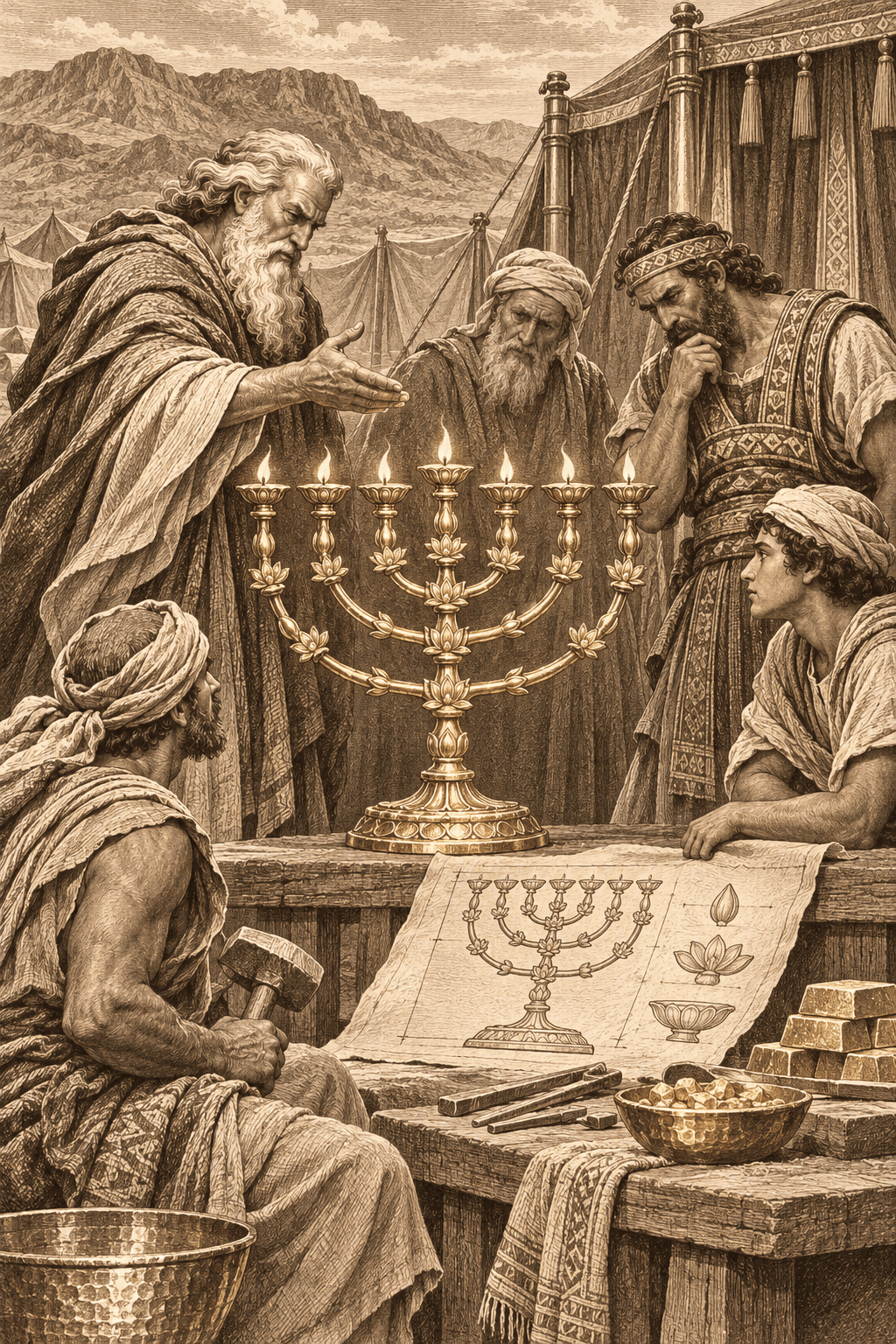
The Lord set its design and fixed its material and measurements. Its height reached six feet; it consisted of a base, a shaft, and six branches, adorned with bowls, knops, and flowers, with tongs and snuffdishes, all of gold. It bore seven lamps, lit with very pure oil all through the evening (31; Exodus 37:17; Leviticus 24:3–4; Numbers 8:2). The golden tongs were used to trim the lamps, and in the snuffdishes the burnt wicks were placed.
The lampstand was not merely for lighting; it was an inseparable part of the rite of worship, with its theological and spiritual meanings. Light reminds us of God, who created it as the first of His works of creation (Genesis 1:3). God dwells in light (Daniel 2:22), and covers Himself with it as with a garment (Psalm 104:2). He is the light of His people (Isaiah 10:17); He shines upon them by His coming for their salvation (Isaiah 9:2), and shines on the nations and peoples (Isaiah 42:6; 49:6), to turn them from children of darkness into children of light. Therefore in the rite of baptism, when the one to be baptized renounces Satan he looks to the west, a sign of the devil’s kingdom of darkness; and when he confesses God’s work of salvation he looks to the east, a sign of God’s kingdom of light.
As the Lord Christ is the light of the world (John 1:9; 8:12), by shining upon His disciples He made them the light of the world (Matthew 5:14, 16). So we see the churches in the Book of Revelation in the form of seven candlesticks (Revelation 1).
The seven lamps point to the fiery work of the Holy Spirit, who shines in the Church and inflames her with the fire of divine love. He works in her sacramental life (through the seven sacraments), and in every spiritual work to which the hand of the Church reaches, so that the faithful live in continual enlightenment.
Light in the Church of the New Covenant
The Church received from Jewish tradition, the Torah, the writings, and the rites of worship, spiritual understandings of light, and the apostolic Church used lights during worship. The Book of Acts could not tell us without meaning of the many lights (Acts 20:8) during the celebration of the Eucharist at Troas; had they been merely for lighting, it would have been a natural thing with no need to mention it. But the Christian Church from her beginning saw in lighting a spiritual rite touching the life of the worshippers, and she walked in this spirit. We find the Spanish poet Prudentius in the fourth century speaking of the shining lamps in the church, whose lights were reflected on its pure glass as though the heavens sparkled with light. In the same century Saint Paulinus, bishop of Nola gave a similar testimony to the use of lights during worship.
We have spoken before of the lamp that shines in the east of the church night and day, like the star of the east that appeared to the Magi to bring them to the Messiah, the Savior; [353] of the two candlesticks around the altar, like the two angels who accompanied the Lord’s body in the tomb, one at the head and the other at the feet; [354] and of the lamps that shine before the icons of the saints, for the saints have become, through Christ Jesus our Lord, a light in the world and shining stars in Paradise.
In the Divine Liturgy according to the Byzantine rite, the bishop blesses the people with a two-branched candle (dikerion) or a three-branched candle (trikerion). [355] In the Coptic rite, the serving priest blesses the people with the cross, accompanied by three candles, during the raising of incense and asking God for mercy. During the reading of the Gospel all the lights of the church are lit, and two deacons carry two candles to the right and left of the Gospel, as the psalmist says: “Thy word is a lamp unto my feet, and a light unto my path” (Psalm 119:105), and as a sign of the Gospel’s work in enlightening the world. [356] Lights, lamps and torches, are also used as part of the rite of funeral prayers, as is told in the acts of the martyrdom of Saint Cyprian, [357] in the description of the funeral of Saint Macrina, the sister of Saint Gregory of Nyssa, [358] and in the funeral of the emperor Constantine, [359] a sign of the passing over of the departed soul to the heavenly light and eternal joy.
Notes and References
[331] Fr. Tadros Yacoub Malaty, The Church, the House of God (Arabic, 1979).
[332] Methodius, Banquet of the Ten Virgins 5:8.
[333] Ibid. 5:7.
[334] Origen, In Exod. hom. 13:2.
[335] Methodius, Banquet of the Ten Virgins 5:8.
[336] Origen, In Exod. hom. 9:3.
[337] Ibid. 13:5.
[338] Ibid. 9:3.
[339] Ibid. 13:4.
[340] Ibid. 13:5.
[341] Ibid. 13:3.
[342] Origen, Letter to Gregory Thaumaturgus.
[343] Origen, In Exod. hom. 9:4.
[344] Ibid. 9:3.
[345] Fr. Tadros Yacoub Malaty, The Church, the House of God, pp. 110, 111.
[346] That is, it held no tablets other than the two tables of the Law… The pot of manna, Aaron’s rod, and the book of the Torah all fall within the scope of the Law and the word of God.
[347] St. Jerome, Epistle 22:24.
[348] For more, see Fr. Tadros Yacoub Malaty, Saint Mary in the Orthodox Understanding (Arabic, 1978), pp. 61, 62.
[349] J. Hastings, Dictionary of the Bible, 1963, pp. 911–913.
[350] Josephus, Antiquities 3:6:6.
[351] Ibid. 3:10:7.
[352] Ibid. 3:6:6.
[353] Fr. Tadros Yacoub Malaty, The Church, the House of God, p. 143.
[354] Ibid., p. 127.
[355] J. G. Davies, Dictionary of Liturgy and Worship, p. 112.
[356] St. Jerome, Against Vigilantius.
[357] Acta Proconsularia S. Cypriani 5.
[358] Gregory of Nyssa, Life of St. Macrina.
[359] Eusebius, Life of Constantine 4:66.