
The pagan peoples of Canaan were devoted to gods, especially those they thought to be the source of fertility, growth, and multiplication; therefore the prophet Moses affirmed that God’s grace is the source of all blessings. In this chapter the prophet Moses reveals to his people the secret behind the wandering in the wilderness: God allows His people to enter into hardship, but His eyes look tenderly on His people in the midst of the hardship, until He brings them out into a broad place, so that they may thank the Lord and realize His surpassing kindness toward them.
God, in His love for man, gives him His life-giving commandment in order to give him Himself; He enters into a relationship of love with him and gives him blessings in abundance. With the same love He leads him into the narrow way. Why?
1. For proving: “to humble thee, and to prove thee, to know what was in thine heart, whether thou wouldest keep his commandments, or no” (2).
2. For our crowning: when our faithfulness is proven through hardship, we are counted worthy to receive greater blessings: “For the Lord thy God bringeth thee into a good land, a land of brooks of water, of fountains and depths…” (7–10).
3. For discipline: “as a man chasteneth his son, so the Lord thy God chasteneth thee” (5).
4. So that we do not fall into pride or self-righteousness: “And thou say in thine heart, My power and the might of mine hand hath gotten me this wealth” (17).
5. As an opportunity to see the Lord, touch Him, and enjoy His works in new experiences: “And he humbled thee, and suffered thee to hunger, and fed thee with manna, which thou knewest not, neither did thy fathers know” (3). In the midst of the furnace the three young men gained a new experience, for the Son of God appeared with them, surrounding and accompanying them, turning the fire into dew. So with the fire of hardship the believer experiences a new vision of God and tastes heavenly food that is new to him.
6. Turning energies from evil into positive energies for building up, as water is brought out of the rock of flint (15). If our senses and energies have turned to stone, the Lord brings out of them springs of water that refresh thirsty souls and turn the wilderness into a divine paradise.
1. Keeping the Commandment, the Aim of the Wilderness
KJV · Verses 1–2
1 All the commandments which I command thee this day shall ye observe to do, that ye may live, and multiply, and go in and possess the land which the Lord sware unto your fathers. 2 And thou shalt remember all the way which the Lord thy God led thee these forty years in the wilderness, to humble thee, and to prove thee, to know what was in thine heart, whether thou wouldest keep his commandments, or no.
We have seen the connection between meeting the Person of the Lord Himself and enjoying His commandment. The commandment He gives aims at shaping man by the Spirit of God, so that he returns to his origin, the image and likeness of God. So the image is drawn to the original, and the original, God, finds His pleasure in His living image revealed in man. If He did not allow His people to cross from Egypt to Canaan in a short time, but to pass through the wilderness for years, it was so that their depths might be tested, and they might keep His commandment, enjoy it, live by it, and inherit the heavenly Canaan.
(See verses 1–2 above.)
Clearly the subject of “obedience,” or enjoying the Lord’s commandment, is the aim of the forty years in the wilderness. If these years point to our temporal life, which is like a continual journey through which we cross from the land of bondage to enter the heavenly Canaan, we ought to focus on the word of God, enjoy His commandment, and strive by His Holy Spirit to practice obedience to it. This happens through our union with the incarnate Word, who, though He was the Son, “learned obedience by the things which he suffered” (Hebrews 5:8). Through our union with Him we enjoy the Word and gain the honor of fellowship with Him in His nature, that is, the honor of perfect obedience to God the Father.
What is our obligation concerning the commandment?
First: Accepting all the commandments, for the commandments are one indivisible whole; either we accept them entirely, or we are counted as rejecting them. For accepting the commandments in their depths is accepting the Person of the divine Word working in us: either we accept Him, so that we dwell in Him and He abides in us, or we are outside Him and do not enjoy Him. The Word of God cannot be divided!
Second: By saying “ye shall observe,” he points to being occupied with the commandments and caring for them, so that they draw our hearts and thoughts and occupy our whole being. So whoever accepts the incarnate Word sings with his whole being, not only his tongue: “I am my beloved’s, and my beloved is mine” (Song of Songs 6:3).
Third: By saying “to do,” the prophet declares that the commandment is not a theoretical idea to occupy us, a philosophy to embrace, or a principle to talk about, but a lived life that we practice.
The aim of the commandment is man’s return, as it were, to the life of Paradise, so that he hears what was said to his parents Adam and Eve, that they should live, multiply, and have dominion over the earth. The prophet says: “that ye may live, and multiply, and go in and possess.” Through the commandment we gain the Word of God, the Giver of life, so we live, bear much fruit and have children in the Lord, and enter the heavenly life and reign, saying with Saint John the Theologian: “And hath made us kings and priests unto God and his Father” (Revelation 1:6).
Among the blessings of the commandment is that we remember God’s dealings with us. He brings us into the wilderness to discover our humiliation and weakness, and to declare to Him whether we keep the commandment or reject it. We realize that everything that happens to us is not, as some think, coincidence, but by divine wisdom and a surpassing plan, so that we may enjoy divine blessings in the midst of the wilderness.
The Epistle of James says, “(God) tempteth no man” (James 1:13), while here it says, “the Lord thy God led thee… to prove thee” (2). Saint Augustine says:
“We must understand that there are two kinds of temptation: a temptation that deceives and one that proves. Of the one that deceives it is said, ‘God tempts no one’; of the one that proves it is said, ‘God proves you.’ [87]”
This chapter reveals the shortest and safest way leading to the heavenly Canaan: discovering God’s plan through past events. Historical events seem to some to be merely human, temporal events, but the pure heart senses God’s revelations through these events. Though the journey of life contains many events, all of them are like threads woven together to reveal the unbroken thread of God’s care.
2. The Lord’s Tender Eyes in the Wilderness
KJV · Verses 3–4
3 And he humbled thee, and suffered thee to hunger, and fed thee with manna, which thou knewest not, neither did thy fathers know; that he might make thee know that man doth not live by bread only, but by every word that proceedeth out of the mouth of the Lord doth man live. 4 Thy raiment waxed not old upon thee, neither did thy foot swell, these forty years.
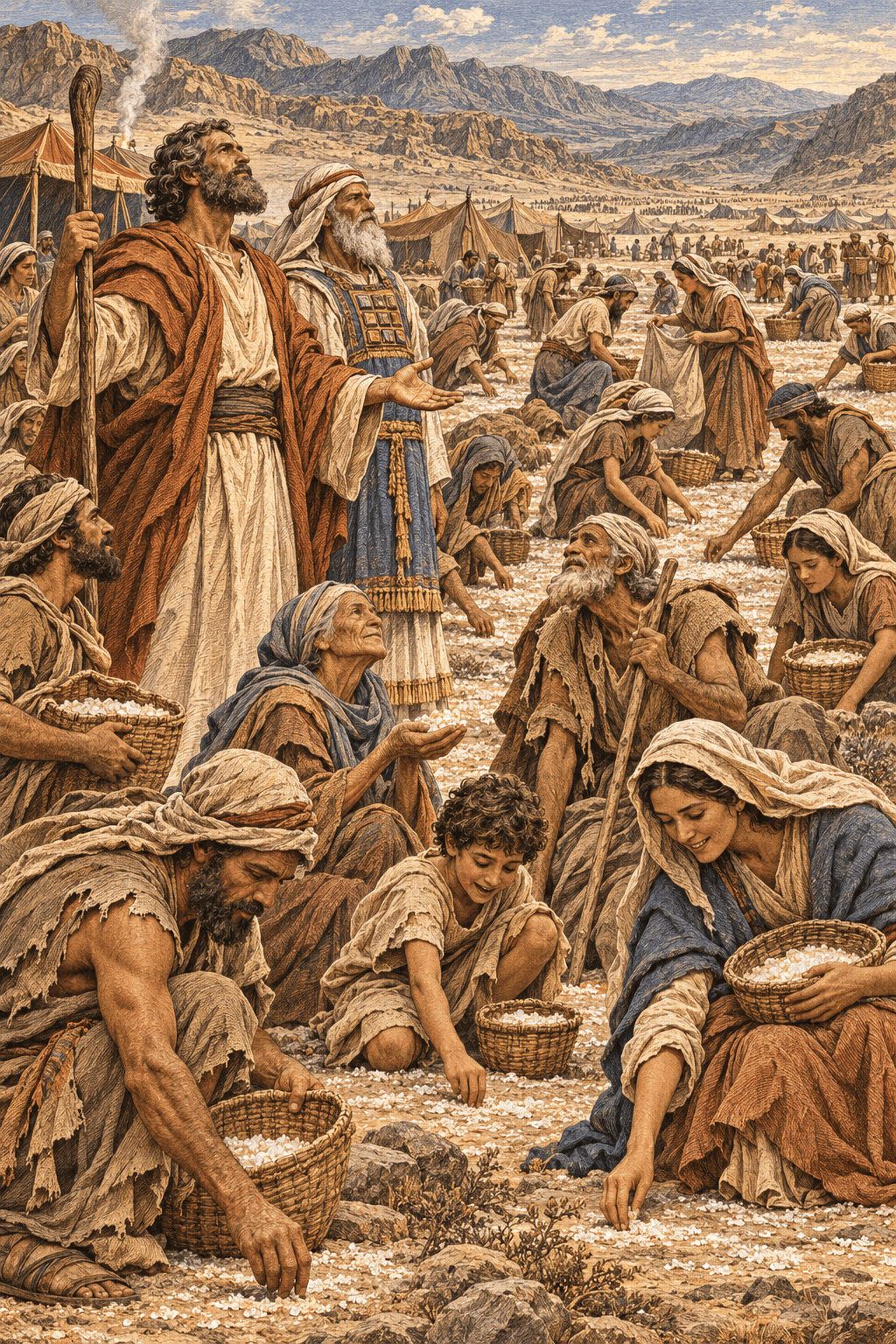
“He humbled thee” (3): the wandering in the wilderness was a punishment that fell on the past generation, to push the present generation toward humility and submission.
As they stood at the gates of Canaan, they should not forget the long wilderness period. The wilderness was a school for them, in which they learned that man is a hungry being needing food he did not know and his fathers did not know: the manna coming down from heaven (Exodus 16:8), or the life-giving word of God.
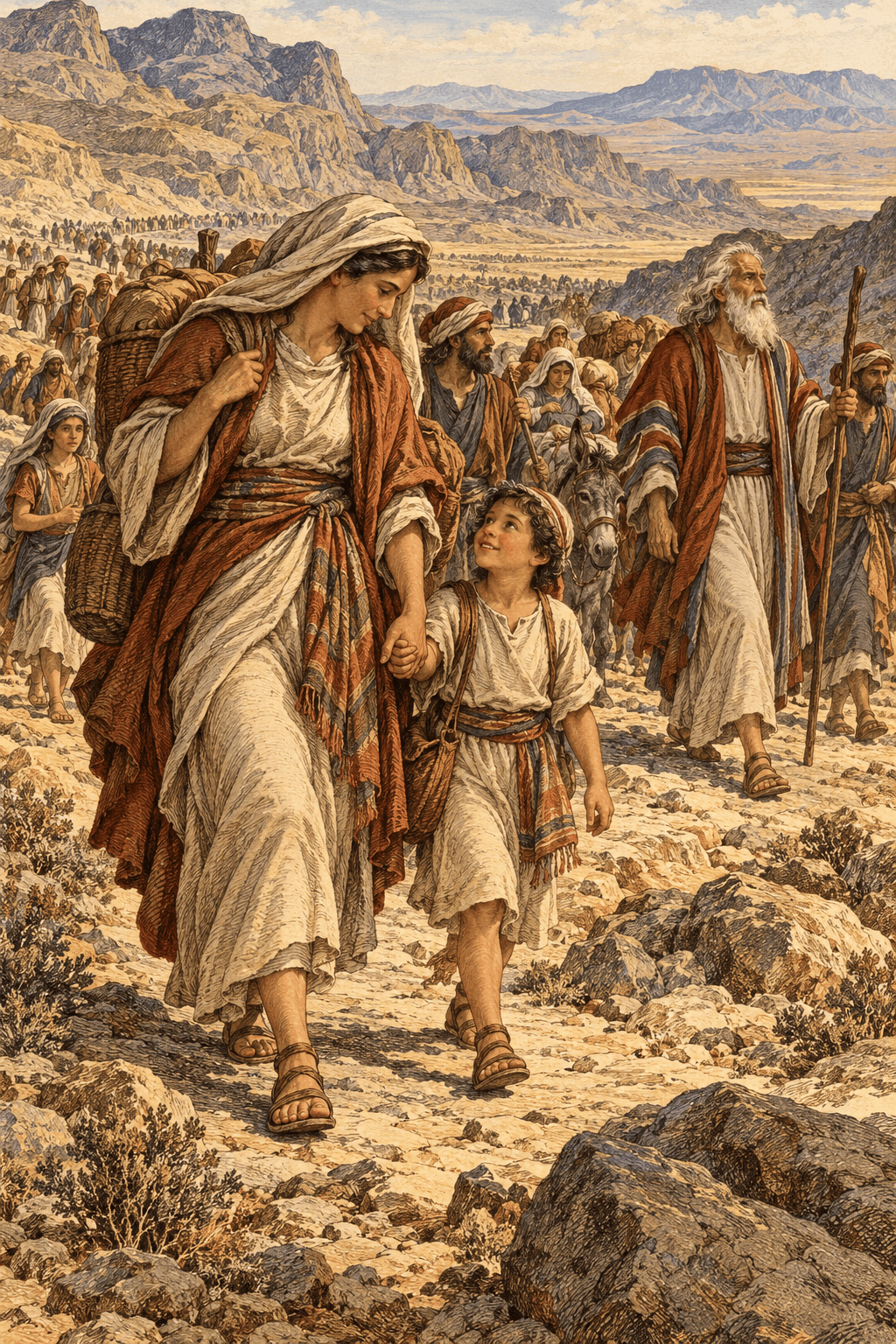
The believer realizes that God cares for all his affairs: He covers him with clothes that do not wear out and keeps his feet from swelling. God cares for our food, drink, clothing, and health. God sustains life and satisfies it in His own way, with heavenly manna. The God who gives man bread to satisfy the body is the One who gives the soul His divine mysteries, the “spiritual manna,” to satisfy its needs. Whoever fixes his eyes on material bread becomes indebted to the dust for what it gives him; but whoever fixes his eyes on the living knowledge of God becomes indebted to Him for his life.
He permits trials so that we feel humbled, but He permits them within the limits that serve our benefit and edification, so that we do not come out of them hungry, naked, or sick, but victorious, growing, and crowned with glory. He permits trials so that we may discover the true God, His care, His mercies, and His love!
Though He allowed them to wander, in the midst of the wilderness they did not need to plow, sow, water the land, or harvest, nor to grind wheat and make bread, nor to cook food. Nor did they need anyone to weave cloth and make garments, or to make sandals or shoes, or doctors, medicines, and hospitals. Their clothes did not wear out, and even grew as the child grew, and so did the shoes.
The Lord Christ quoted verse 3 in answering Satan when he asked Him to turn the stones into bread (Matthew 4:3–4).
In the midst of the wilderness the people did not change their food, but ate as it were one meal morning, noon, and evening, and this lasted all those years. Men, women, and children did not change their clothes, and all walked on a dry desert road, yet He satisfied them with His surpassing care. All this confirms that our true satisfaction and happiness are not in eating, drinking, clothing, adornment, and a life of luxury, but in entering God’s love and enjoying His surpassing fatherhood. As the Lord Christ commands us: “But seek ye first the kingdom of God, and his righteousness; and all these things shall be added unto you” (Matthew 6:33). And as He commanded His disciples: “Take no thought for your life, what ye shall eat, or what ye shall drink; nor yet for your body, what ye shall put on. Is not the life more than meat, and the body than raiment?” (Matthew 6:25). And He said to His apostles: “When I sent you without purse, and scrip, and shoes, lacked ye any thing?” (Luke 22:35).
For the believer, though the road is a desert, it is safe and will not hurt his feet, for it is said, “He will keep the feet of his saints” (1 Samuel 2:9); while of the wicked it is said, “the way of transgressors is hard” (Proverbs 13:15).
A person is often preoccupied with filling his stomach with perishable bread and does not care to satisfy his soul with eternal spiritual manna, the word of God, the Giver of life. Therefore the Church cares for the discipline of fasting for long periods, not to humiliate the body with hunger, but to lift the soul to heaven, so that it finds a heavenly table worthy of it.
Saint Ambrose says:
“Blessed is he who knows how to be satisfied in Christ, not bodily but spiritually, with the satisfaction that knowledge gives. [88]”
Father John of Kronstadt says:
“Be fully assured that the enemy attacks the heart through the fullness of the stomach.”
Saint John Climacus says:
“Be master of your stomach before it masters you. Whoever feeds his gluttony and hopes to overcome the spirit of fornication is like one who tries to put out a fire with oil. [89]”
Saint Jerome says:
“They despised the food of angels and groaned for the flesh of Egypt. Moses fasted forty days and forty nights on Mount Sinai, and showed then that man does not live by bread alone but by every word of God. He said to the Lord, ‘The people are full, and have made images’ (see Exodus 32:6, 8). With an empty stomach Moses received the Law written by the finger of God. The people, who ate and drank and rose up to play, cast a golden calf, and preferred the Egyptian calf to the majesty of God. The labor of many days was lost through the fullness of one hour. Moses broke the two tablets, for he knew that drunkards cannot hear the word of God. [90]”
“Because the first man obeyed his stomach and not God, he was cast out of Paradise into the valley of tears. [91]”
“Having given great attention to your thoughts, you ought to put on the armor of fasting and sing with David: ‘I wept, and chastened my soul with fasting’ (Psalm 69:10); ‘I have eaten ashes like bread’ (Psalm 102:9); ‘But as for me, when they were sick, my clothing was sackcloth’ (Psalm 35:13). Eve was cast out of Paradise because she ate the forbidden fruit; Elijah, on the other hand, was carried in a chariot of fire to heaven after forty days of fasting. For forty days and forty nights Moses lived in intimate meeting with God, proving in his own case the truth of the saying: ‘man doth not live by bread only, but by every word that proceedeth out of the mouth of the Lord’ (3).”
“The Savior of the world, who by His virtues and the pattern of His life left us an example to follow (John 13:15; 1 Peter 2:21), was led up by the Spirit immediately after His baptism to wrestle with the devil (Matthew 4:1); and after crushing and overcoming him, He handed him over to His disciples to tread under their feet. What does the Apostle say? ‘And the God of peace shall bruise Satan under your feet shortly’ (Romans 16:20). Yet after the Savior had fasted forty days, the devil laid his snare for Him with food: ‘If thou be the Son of God, command that these stones be made bread’ (Matthew 4:3). Under the Law, in the seventh month, after the blowing of trumpets, on the tenth day of the month, a fast was proclaimed for the whole Jewish people, and every soul that preferred its luxury to humbling itself was cut off from its people (Leviticus 23:27–29). And in Job it is written of Behemoth: ‘his strength is in his loins, and his force is in the navel of his belly’ (Job 40:16). [92]”
3. Fatherly Discipline
KJV · Verses 5
5 Thou shalt also consider in thine heart, that, as a man chasteneth his son, so the Lord thy God chasteneth thee.
The wilderness was not only a school for man to discover his weaknesses and look to God as his only Lord; it was a school of God’s purposeful love. In the wilderness the believer comes under fatherly discipline, so that he may gain new experiences and grow in understanding and wisdom.
(See verse 5 above.)
As the Psalmist says: “Blessed is the man whom thou chastenest, O Lord, and teachest him out of thy law” (Psalm 94:12).
Saint Cyprian says:
“God rebukes in order to correct, and corrects in order to keep us for Himself. [93]”
Along with the good things God gives His people, He gives fatherly disciplines to keep them in the spirit of sonship (4–5). For the believer, discipline is not a punishment to dread and tremble at, but a school in which he enjoys knowledge and continual growth; it is the door to fervent prayer, which pushes a person into the bosom of his heavenly Father.
Discipline is the beginning of the way to God’s revelation of Himself to the one disciplined. The one disciplined realizes the truth about himself, and by knowing himself he knows God, for whoever knows himself knows God. Therefore the early Fathers, such as Saint Clement of Alexandria and Saint Anthony the Great, focused on man’s perception of the depths of his soul. Through discipline a person realizes that he is nothing in himself, but in God he can do all things.
We can say that discipline through hardship has a double aim:
A) That a person come to know himself, and so come to know God, who works in man’s heart and inner man.
B) That a person withdraw from the way of sin to accept the righteousness of Christ in him, bearing the obedience of sonship that the Lord Christ has toward His Father, one with Him in essence.
This is God’s plan in discipline: we come to know God, enjoy Christ in us, and share His marks.
4. Abundance After the Wilderness
KJV · Verses 6–9
6 Therefore thou shalt keep the commandments of the Lord thy God, to walk in his ways, and to fear him. 7 For the Lord thy God bringeth thee into a good land, a land of brooks of water, of fountains and depths that spring out of valleys and hills; 8 A land of wheat, and barley, and vines, and fig trees, and pomegranates; a land of oil olive, and honey; 9 A land wherein thou shalt eat bread without scarceness, thou shalt not lack any thing in it; a land whose stones are iron, and out of whose hills thou mayest dig brass.
In the Old Testament God offers the good land, a land of brooks, where fountains and depths spring out of valleys and hills, bringing forth all the fruits and crops man needs (7). In the New Testament, however, the Lord Christ offers us the bosom of the Father as the place of our inheritance, where we settle forever in safety, without war or enemy, and the springs of the Holy Spirit overflow upon us, shaping us after the icon of Christ and making us like Him. It was not possible for the Israelites to grasp God’s surpassing mystery or to experience the surpassing heavenly life; all the people could grasp was the good land, the rivers and springs, the wheat and barley, the vines, figs, pomegranates, olives, and honey.
“A good land” (7): Travelers in the wilderness on their way from Egypt say they feel relief on reaching Palestine with its blossoming plains, beautiful valleys, and green hills, especially since its elevation provides it with the crops of temperate and near-tropical regions.
“Whose stones are iron” (9): The description here is of the hard black rocks used for many purposes.
“Brass” (9): Copper is found in the hills of Palestine (2 Samuel 8:8), and traces of copper mining have been found near Hamath.
The mountains of southern Lebanon, the region east of the Sea of Galilee, and the area south of the Dead Sea contain iron. Copper and iron are found in abundance in the Arabah region south of the Dead Sea. Some copper mines date back to the days of Solomon and perhaps earlier. Zarethan was a center of bronze work in the days of Solomon (1 Kings 7:45–46). Some bronze objects at this site date from before Solomon, and today bronze works are found at Timna in the Negev.
When He brings us into the wilderness for discipline, we declare that we keep the Lord’s commandments and enjoy His fear. Then He brings us out of distress into a broad place:
Instead of the barren land, He brings us into a new land.
Instead of drought, we enjoy rivers of living water and springs that do not run dry.
Instead of the dry wilderness, we enjoy fields full of crops and fruits.
Instead of want, we lack nothing.
Instead of stones, we find mines of iron, and instead of mountains, mines of brass.
It is as if, through the distress of the wilderness, man enters as it were into the garden of Eden, to live and work in a good land watered by rivers and springs, where he finds countless fruits and precious resources.
He gave them these gifts for the following reasons:
1. That they might discover God’s surpassing care, for after a long life in the wilderness they receive in abundance what they did not expect.
2. That they might realize the blessings of keeping the Lord’s commandments, for He grants the obedient both temporal and heavenly blessings.
3. That God turns even the labor of others into their rest: they find fields they did not plant, wells they did not dig, and rich resources for which they did not toil.
4. What they receive is a symbol of what they will receive on entering the heavenly Jerusalem and enjoying the heavenly Canaan.
He did not mention all the crops and fruits of Canaan, but chose the following:
First: Wheat and barley. Wheat is used as food for man, and barley for animals and birds, as if God satisfies their needs and those of their animals and birds.
Second: Vines, for the juice of the grape, or wine, points to spiritual joy, which is the food of the soul. As He cares for their bodies, He also cares for their souls, satisfying them with heavenly joy.
Third: The fig, which points to the Church, for a single seed has no taste unless all the seeds are gathered together in one covering that gives them sweetness. So the believer, whatever his position in the Church, is without taste or value unless he is united with his brothers in the covering of unity and love. It is as if God cares for the community as a whole, as for each member in it.
Fourth: The pomegranate, whose juice is used in hot regions in summer as a cool drink. God cares even for our comfort, granting us coolness in the midst of afflictions.
Fifth: The olive, whose oil is used as healthy food, for lighting, and in medicines; that is, He cares for the health and enlightenment of His people.
Sixth: Honey, by which believers experience the sweetness and delight of fellowship with God.
5. Thanksgiving for the Lord’s Blessings and Remembering Them
KJV · Verses 10–16
10 When thou hast eaten and art full, then thou shalt bless the Lord thy God for the good land which he hath given thee. 11 Beware that thou forget not the Lord thy God, in not keeping his commandments, and his judgments, and his statutes, which I command thee this day: 12 Lest when thou hast eaten and art full, and hast built goodly houses, and dwelt therein; 13 And when thy herds and thy flocks multiply, and thy silver and thy gold is multiplied, and all that thou hast is multiplied; 14 Then thine heart be lifted up, and thou forget the Lord thy God, which brought thee forth out of the land of Egypt, from the house of bondage; 15 Who led thee through that great and terrible wilderness, wherein were fiery serpents, and scorpions, and drought, where there was no water; who brought thee forth water out of the rock of flint; 16 Who fed thee in the wilderness with manna, which thy fathers knew not, that he might humble thee, and that he might prove thee, to do thee good at thy latter end;
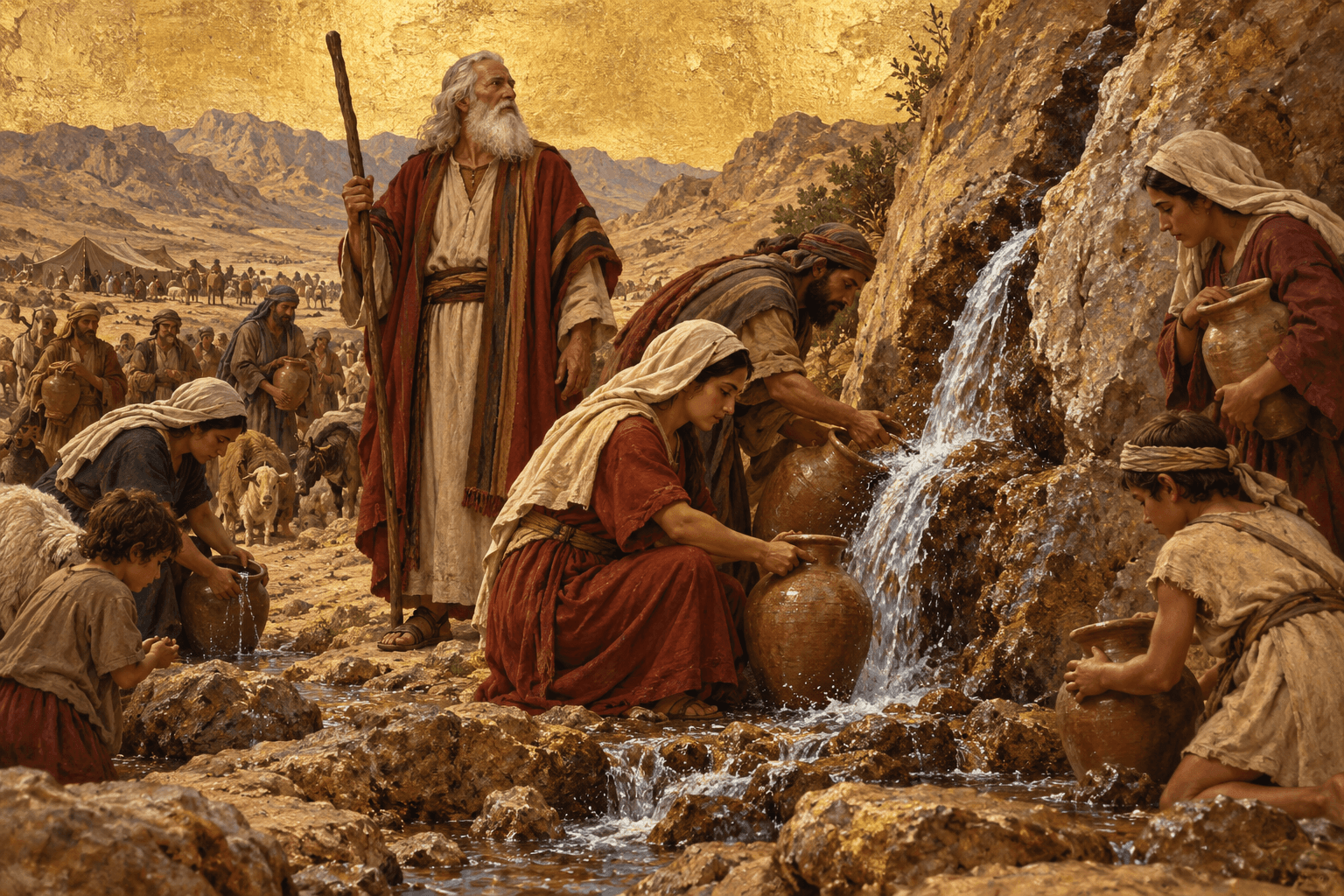
If God gave His people a good land, it was so that the believers might eat, be full, and bless the Lord, and so become themselves a good land bearing the fruits of the Spirit: love, joy, and continual thanksgiving to the Giver of blessings.
A life of thanksgiving reveals holy hearts that touch God’s love and grasp the mysteries of His love, and so respond to Him. But souls that forget God’s care and blessings fall into pride and ignore God’s work with them: He brought them out of the wilderness, the dwelling of fiery serpents and scorpions, the barren land without water, and brought them into a good land overflowing with good things and full of natural resources. Instead of the wilderness, the dwelling of deadly serpents, He gave them a land full of fields where cattle and sheep graze. Instead of the desert, He gave them a land full of silver and gold.
In the midst of the barren wilderness He brought water out of the rock of flint for them, and the spring accompanied them all the way until they crossed over to where there is rain and abundant water. The prophets of the Old Testament often focused on the presence of rain in the Promised Land as a sign of the gifts of heaven in the New Testament, so that the messianic age was called the age of water.
Saint Jerome noticed the link here between the fiery serpents and scorpions and the thirst where there is no water. Writing to Oceanus, one of the Roman nobles zealous for the faith, about the blessings of water and baptism, he says (in summary): [94]
• In the beginning, at creation, the Spirit of God moved upon the face of the waters like a charioteer (Genesis 1:2), and brought forth from them the little world, a symbol of the Christian child who is immersed in the waters of baptism.
• The Hebrew word for heavens, shamayim, means “coming out of the waters.”
• The heavenly living creatures that Ezekiel the prophet saw in his vision had over their heads the likeness of a firmament, as the color of the terrible crystal, stretched forth over their heads (Ezekiel 1:22), that is, waters pressed very close together.
• In the garden of Eden there was a river in its midst, parted into four heads, watering the garden (Genesis 2:10).
• In Ezekiel’s vision of the new house of the Lord, he saw waters issuing from under the threshold of the house toward the east, and the waters heal and give life to dead souls (Ezekiel 47:1–9).
• When the world fell into sin, it could not be cleansed except by the flood; and after the unclean bird went out, the dove of the Holy Spirit returned to Noah. It later came to Christ in the river Jordan, and carried in its beak the branch announcing peace to the whole world.
• Pharaoh and his soldiers, who refused to let God’s people leave Egypt, were drowned in the waters of the Red Sea; thus the sea became a symbol of our baptism. The destruction of Pharaoh is described in the Book of Psalms: “Thou didst divide the sea by thy strength: thou brakest the heads of the dragons in the waters. Thou brakest the heads of leviathan in pieces” (Psalm 74:13–14).
• As the tree made the waters of Marah sweet to water seventy palm trees with their streams, so the cross made the waters of the Law life-giving for the seventy apostles of Christ (Exodus 15:23–27; Luke 10:1).
• Abraham and Isaac dug wells while the Philistines tried to stop them (Genesis 26:15, 18).
• Beersheba, the city of the oath (Genesis 21:31), and Gihon, the place where Solomon was enthroned as king, took their names from springs (1 Kings 1:38; 2 Chronicles 32:30).
• Eliezer found Rebekah beside a well (Genesis 24:15–16).
• As Rachel drew water from the well, she received a kiss there from Jacob (Genesis 29:11).
• When the daughters of the priest of Midian were on their way to the well and were in distress, Moses opened the way for them and delivered them from those driving them away (Exodus 2:16–17).
• The forerunner of the Lord in Salim (that is, peace) prepared the people for Christ by a spring of water (John 3:23).
• The Savior Himself did not preach the kingdom of heaven until He had cleansed the Jordan by His baptism in it by immersion (Matthew 3:13–14).
• He said to Nicodemus in a mystical way: “Except a man be born of water and of the Spirit, he cannot enter into the kingdom of God” (John 3:5).
• As Christ’s ministry began with water, it also ended with it, for His side was pierced with the spear, and blood and water flowed from it, as symbols of baptism and martyrdom (John 19:34).
• After His resurrection, when He sent His apostles to the nations, He commanded them to baptize them in the mystery of the Trinity (Matthew 28:19).
• When the Jews repented of their evils, Peter sent them to be baptized (Acts 2:38).
• Paul, the persecutor of the Church, the ravening wolf out of Benjamin (Genesis 49:27), bowed his head before Ananias, one of Christ’s flock, and received his sight only when he accepted the medicine of baptism (Acts 9:17–18).
• By reading the prophet, the eunuch of Candace, queen of Ethiopia, was prepared for the baptism of Christ (Acts 8:27, 38). Contrary to nature, the Ethiopian changed his skin and the leopard his spots (Jeremiah 13:23).
• “The voice of the Lord is upon the waters… the Lord sitteth upon the flood” (Psalm 29:3, 10). “Thy teeth are like a flock of sheep that are even shorn, which came up from the washing; whereof every one bear twins, and none is barren among them” (Song of Songs 4:2).
• Micah the prophet pointed to the grace of baptism: “He will turn again, he will have compassion upon us; he will subdue our iniquities; and thou wilt cast all their sins into the depths of the sea” (Micah 7:19).
Some may ask: “Did God not know that in the wilderness there were deadly serpents and scorpions and no water? Why then did God allow His people to walk this narrow way?”
First: So that the believer may discover his inner depths, for in the midst of distress it is easy for a person’s gaze to turn to his depths and see them. God led His people through the wilderness, where there were fiery serpents and scorpions, and He was a guard and support for them until they crossed into the new, safe land. So we should realize that God carries us into our depths so that we may see them full of the deadly serpents that crept into us, either by our will or through our negligence. He leads us and transforms our barren nature, inhabited by sins like deadly serpents, and brings us across to the new nature. He turns our spiritual dryness into fellowship in the divine nature, so that we become as those who are in the new Canaan.
Behind this is the love of God, which transforms man, who has been corrupted by sin, into incorruption. Man chose sin in his full freedom, so distress became necessary to draw him away from its path.
Saint John Chrysostom says:
“This wilderness was not barren and without fruit like human nature. For how many scorpions and vipers are found in the wilderness of this parable, human nature? How many serpents and offspring of vipers (Matthew 3:7) are found in it? But let us not be afraid, for the leader of our exodus is not Moses but Jesus. [95]”
Second: When He brings us into distress, we realize the inability of every human hand to support us, so we look to God alone, who is able to make the affliction a way to our salvation, our inner happiness, and our glory.
Holy Scripture everywhere affirms man’s need, after his fall into sin, for distress. It is as if the whole Bible, and this book especially, affirms this truth: distress is the way of entrance into true happiness.
6. Not Relying on Oneself
KJV · Verses 17–18
17 And thou say in thine heart, My power and the might of mine hand hath gotten me this wealth. 18 But thou shalt remember the Lord thy God: for it is he that giveth thee power to get wealth, that he may establish his covenant which he sware unto thy fathers, as it is this day.
The first and chief of sins, which crept even into the heavenly beings and brought down the devil and his hosts, is pride, or self-reliance. The enemy aimed the same arrow at the hearts of our first parents, Adam and Eve, when he said to Eve, “ye shall be as gods” (Genesis 3:5). He still aims the same arrow at mankind, so that we think we are gods, and that by our own strength and ability we have attained material, social, or spiritual gains. The cure for this is to remember God’s dealings with us, His surpassing care, and His continual gifts. Therefore he says (see verses 17–18 above).
7. Not Relying on Strange Gods
KJV · Verses 19–20
19 And it shall be, if thou do at all forget the Lord thy God, and walk after other gods, and serve them, and worship them, I testify against you this day that ye shall surely perish. 20 As the nations which the Lord destroyeth before your face, so shall ye perish; because ye would not be obedient unto the voice of the Lord your God.
Not remembering God’s gifts and forgetting His surpassing care not only pushes us into pride, so that we set up ourselves as gods for ourselves, but also turns us aside to imitate idol worshipers, as we set up for ourselves other gods besides the true God. We lean on human arms or on bare human experience, on our abilities, our learning and knowledge, or our social positions: many gods before which man bows, ignoring the power of God. In other words, instead of turning to God, who gave us all these blessings with His own hands, we make gods out of them, and so these blessings turn into an invitation to idolatry.
(See verses 19–20 above.)
There is no respect of persons with God: whoever leans on Him and obeys Him enjoys the reward, and whoever turns to another, ignoring His care and disobeying His commandments, loses His blessing; He leaves man perfect freedom to choose his way.
8. A Meditation on Deuteronomy 8
Lead Me Across the Wilderness of My Life
May You accompany me, O You who are wonderful in Your care.
Support me with Your surpassing fatherhood, for I am in a wilderness!
You turn the wilderness of my life into a paradise.
You walk with me to train me in the midst of sufferings;
You keep my heart and support it, so that it becomes wholly Yours.
In the midst of the wilderness I feel a great thirst.
Who can quench my thirst but the spring flowing from Your side,
O Rock that accompanies me!
In the midst of the wilderness I feel a deadly hunger;
send me the heavenly manna.
Grant me Your life-giving word as heavenly bread.
Make Yourself known to me; knowing You is the eternal food.
I cry out to You:
How long will I care about filling my stomach,
and not be occupied with the food of my soul?!
By my own will the fiery serpents entered my nature;
the scorpions found a place in me.
I am in a deadly thirst!
By Your cross You kill every serpent,
and crush the scorpions under my feet,
and the springs of Your Holy Spirit overflow within me!
Wonderful are You, who transform the wilderness of my nature
into fellowship in the divine nature.
What can I offer You in the midst of the wilderness?
I have nothing to offer You, O Rich One!
Accept my thanksgiving as a sacrifice of love acceptable to You.
Let me remember Your surpassing care,
let me remember Your wonderful, practical love,
let me remember Your dealings with me every day.
Your paths drop fatness, O surpassing Love.
Notes and References
[87] St. Augustine, On the Gospel of St. John, Tractate 43:5.
[88] St. Ambrose, Duties of the Clergy, 17 (92).
[89] St. John Climacus, The Ladder of Divine Ascent, Step 14.
[90] St. Jerome, Against Jovinianus, Book 2:15.
[91] St. Jerome, Letter 22:10.
[92] St. Jerome, Letter 130:10.
[93] St. Cyprian, Epistle 7:5.
[94] St. Jerome, Letter 69:6.
[95] St. John Chrysostom, Homilies on Ephesians, 23.