
As the people were called to worship God by entering into a covenant with Him, God asked them to destroy the inhabitants of this region. The commands here appear severe concerning the destruction of idolatry and all that relates to it, even the killing of the idolaters, for the warning against attachment to idolatry and idolaters was extremely strict.
1. No Fellowship with the Pagans
KJV · Verses 1–4
1 When the Lord thy God shall bring thee into the land whither thou goest to possess it, and hath cast out many nations before thee, the Hittites, and the Girgashites, and the Amorites, and the Canaanites, and the Perizzites, and the Hivites, and the Jebusites, seven nations greater and mightier than thou; 2 And when the Lord thy God shall deliver them before thee; thou shalt smite them, and utterly destroy them; thou shalt make no covenant with them, nor shew mercy unto them: 3 Neither shalt thou make marriages with them; thy daughter thou shalt not give unto his son, nor his daughter shalt thou take unto thy son. 4 For they will turn away thy son from following me, that they may serve other gods: so will the anger of the Lord be kindled against you, and destroy thee suddenly.
Here he gives a strict warning against every relationship with idol worshipers, for whoever has fellowship with the unfruitful works of darkness cannot enter into fellowship with God. The aim of this warning is to prevent the setting of snares of evil before them.
When the Lord thy God shall bring thee into the land whither thou goest to possess it, and hath cast out many nations before thee, the Hittites, and the Girgashites, and the Amorites, and the Canaanites, and the Perizzites, and the Hivites, and the Jebusites, seven nations greater and mightier than thou; And when the Lord thy God shall deliver them before thee; thou shalt smite them, and utterly destroy them; thou shalt make no covenant with them, nor shew mercy unto them: [1–2]
I have already addressed the subject of the wars in the introduction. The aim of this commandment is to create a pure church, a holy family, and a kingdom justified in the Lord, kept from pagan abominations.
We often fall into evaluating what is in the Old Testament through an unsound lens, ignoring the language of its time. The circumstances surrounding the people then were completely different from what we live today in the age of grace, and their understanding was not ours. Therefore they needed a commandment to support their salvation. In our lives these strict commands are understood as symbols:
A) Making no covenant with them (2) means our refusal to be lenient with sin or to open the door of dialogue with it.
B) Not intermarrying with them (3), for there is no fellowship between believer and unbeliever in married life, nor between light and darkness. The believer’s acceptance of union with an unbeliever at the level of family relationships comes at the expense of the soul’s salvation and the sanctification of the family.
C) Destroying their altars, breaking their images, cutting down their groves, and burning their graven images with fire (5) means purifying the heart (the temple of the Lord) from setting up other gods, such as self-love, love of praise, or satisfying the lusts of the body.
D) “Thine eye shall have no pity upon them” (16): let the word of God be like a two-edged sword (Hebrews 4:12), separating truth from falsehood with power and discernment, without laxity.
E) “Thou shalt not be afraid of them” (18): the spiritual person has authority (Deuteronomy 28:1); he does not dread sin or fear the enemy of good, trusting in God, who gives the victory (1 Corinthians 15:57).
God, for His part, brings them into the Promised Land and drives out before them the many and mighty nations, for the power of God cannot be resisted; He is able to fulfill His promise. It remains for His people, on their part, to refuse to enter a covenant with the pagans or to be bound by marriage or family ties with them, and to destroy them.
In numbers, Israel as one foreign nation could not, by human reckoning, stand before these peoples with their long military experience and their knowledge of the land’s strategy; but God’s promise accomplishes the impossible.
Sin appears strong and man very weak before it, and the enemy of good with all his forces, evil experience, and plans appears to be a dangerous power no one can stand against. But the believer in whom God’s Holy Spirit works, granting him union with the Father in His Son Jesus Christ, carries heavenly capabilities with which he destroys all the energies of the evil one and of evil. In Christ Jesus he can receive the spirit of victory and strip the devil of the authority by which he dominates the whole human being; he spoils him of all his powers and makes a show of him openly by the cross of our Lord Jesus (Colossians 2:15).
In our study of the writings of Saint John Cassian we saw that Origen holds that the principal sins in human life are eight, and Evagrius took up the same idea, which spread in the writings of the Eastern and Western Fathers. God’s people overcame Pharaoh and his army, the Egyptians, and here they overcome the seven nations mentioned; it is as though God gives His Church the spirit of victory over the eight principal sins.
God did not allow them any kind of relationship with the pagan nations: they were not to accept them as tenants, as tribute payers, or even as slaves; they were to make no covenant with them and show them no mercy. He had given these nations opportunities to repent for long generations, but as time passed each generation became more corrupt than the one before, until the cup of their evil was full.
In the age of grace the matter has shifted from sinners to sin, so these commandments remain alive and effective: we must not leave a hoof of the beasts of sin in our land. We ought to crucify and put to death every lust in us, so that we may carry the life of the risen Christ within us.
Forbidding marriage with pagan women
Neither shalt thou make marriages with them; thy daughter thou shalt not give unto his son, nor his daughter shalt thou take unto thy son. For they will turn away thy son from following me, that they may serve other gods: so will the anger of the Lord be kindled against you, and destroy thee suddenly. [3–4]
The aim of this commandment is purity. God does not aim to separate the nations from one another; He longs for all to become one in Him. He wants a royal generation, a peculiar people, a renewed humanity under the leadership of the New Adam as the one Head of all believers in the world. Since humanity was not yet ready for this holy unity, He separated the believers from the pagans and limited their freedom in marriage.
This divine law came because of man’s weakness, his sin, and his ignorance of God’s eternal plan. Man had lost his understanding of marriage as the establishment of a holy church preparing for eternal glory; therefore He gave this commandment.
The law was harsh on paganism, its abominations, and its evil customs, so that the pagans might reconsider and return to the worship of the true God, as verse 5 confirms. This commandment was not for the benefit of one people at the expense of another. A believer’s marriage to an unbelieving woman draws his heart toward paganism, so he falls under judgment; and the unbelieving woman’s judgment is doubled, for besides worshiping idols she drew the children of God into evil. Depriving her of marriage to a believer gives her a chance to reconsider herself and realize her eternal position.
No doubt some would escape the sword and then seek to enter family relationships, especially since some of them had great wealth and honor and some of their women were beautiful. The enemy of good uses marriage as an opportunity to draw the sons of God to the daughters of men, as happened before: “the sons of God saw the daughters of men that they were fair; and they took them wives of all which they chose. And the Lord said, My spirit shall not always strive with man, for that he also is flesh” (Genesis 6:2–3).
Many in our own day have lost their life in the Lord through marriage to people who do not know the Lord. In Ezra’s prayer and confession, when “the holy seed have mingled themselves with the people of those lands” (Ezra 9:2), he said: “Should we again break thy commandments, and join in affinity with the people of these abominations? wouldest not thou be angry with us till thou hadst consumed us, so that there should be no remnant nor escaping?” (Ezra 9:14).
The Apostle Paul counsels us: “Be ye not unequally yoked together with unbelievers: for what fellowship hath righteousness with unrighteousness? and what communion hath light with darkness? And what concord hath Christ with Belial? or what part hath he that believeth with an infidel? And what agreement hath the temple of God with idols?” (2 Corinthians 6:14–16). For the temptation of evil is strong: the pagan pushes the believer toward the broad way through continual temptations, not the reverse, because life with God is entering the narrow way.
“For they will turn away thy son from following me, that they may serve other gods: so will the anger of the Lord be kindled against you, and destroy thee suddenly” (4). If God longs to shape His worshipers so that they bear His image, imitate Him, and become partakers of the divine nature, false gods shape their worshipers to bear their own nature, that is, to become vain. Carrying this corrupt nature, a person will not rest until he drags everyone around him into corruption and vanity, so that all perish with him. This is what He meant by “the anger of the Lord be kindled against you, and destroy thee suddenly”: when God withdraws His grace, care, and mercies from the person who persists in vanity, he becomes vain!
On the other hand, the cup of evil of the Jews was almost full, and they had a final opportunity: either to accept God, “the Truth,” with their whole heart and embrace Him, or to condemn themselves to be cut off with the nations they were asked to cut off. God shows no partiality: the nations had filled the cup of evil and pushed themselves to destruction; if the Jews embraced them, they too would fill up their cup of evil, and their fate would be like that of the pagan nations.
Those who marry pagans marry their idols, and take on their marks, that is, vanity instead of the true God.
2. A Warning Against Paganism
KJV · Verses 5–11
5 But thus shall ye deal with them; ye shall destroy their altars, and break down their images, and cut down their groves, and burn their graven images with fire. 6 For thou art an holy people unto the Lord thy God: the Lord thy God hath chosen thee to be a special people unto himself, above all people that are upon the face of the earth. 7 The Lord did not set his love upon you, nor choose you, because ye were more in number than any people; for ye were the fewest of all people: 8 But because the Lord loved you, and because he would keep the oath which he had sworn unto your fathers, hath the Lord brought you out with a mighty hand, and redeemed you out of the house of bondmen, from the hand of Pharaoh king of Egypt. 9 Know therefore that the Lord thy God, he is God, the faithful God, which keepeth covenant and mercy with them that love him and keep his commandments to a thousand generations; 10 And repayeth them that hate him to their face, to destroy them: he will not be slack to him that hateth him, he will repay him to his face. 11 Thou shalt therefore keep the commandments, and the statutes, and the judgments, which I command thee this day, to do them.
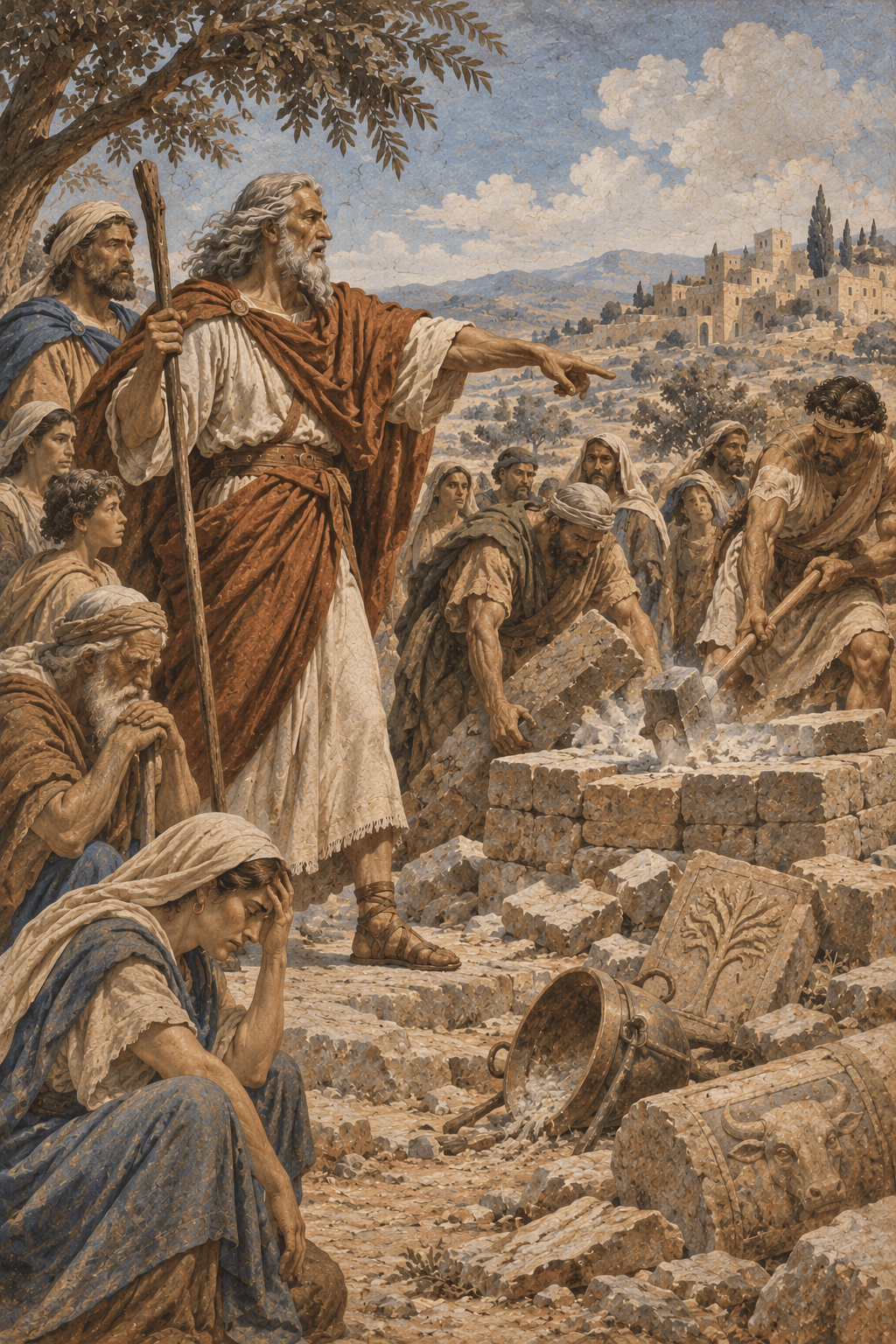
The matter does not stop at not being bound by marriage ties with the pagans; He asked them to destroy every trace of idols.
But thus shall ye deal with them; ye shall destroy their altars, and break down their images, and cut down their groves, and burn their graven images with fire. [5]
Such a command had been given before (Exodus 23:24). And it was said of Josiah, the good king, that he “began to purge Judah and Jerusalem from the high places, and the groves, and the carved images, and the molten images. And they brake down the altars of Baalim in his presence; and the images, that were on high above them, he cut down; and the groves, and the carved images, and the molten images, he brake in pieces, and made dust of them, and strowed it upon the graves of them that had sacrificed unto them” (2 Chronicles 34:3–4). In a similar way this was done in the early Church, where the books of magic were burned (Acts 19:19).
This law was a kind of preparation for the way of the Lord Jesus, the Light that has no fellowship with darkness; the darkness had to be destroyed so that people might receive the light in their lives. It is truly a very long way, but our Christ in every age seeks souls that prepare themselves willingly to receive Him, so that He may enter, reign, and shine His light in them.
This applies to the pagan nations as societies allied in resisting the worship of the true God and spreading idol worship; but no doubt the situation was different with individuals who accepted the faith, rejected idol worship, and were cleansed of all its abominations. These were a small minority, whom the Jews called “proselytes.”
He gave them reasons that bind them to respond to this warning:
First: God’s choice of them.
For thou art an holy people unto the Lord thy God: the Lord thy God hath chosen thee to be a special people unto himself, above all people that are upon the face of the earth. [6]
“An holy people”: repeated in Deuteronomy 14:2, 21; 26:19; 28:9. The word “holy” in the Old Testament has two meanings: first, “set apart for the service of the Lord,” and second, “pure and splendid.” The word “holy” points to the consecration of the heart and the whole being to God, so that one becomes His own, separated from all evil. Some hold that the word means a person’s complete purity from everything earthly, as his being is drawn into the holy heavenly life, to live in fellowship with the Holy One. These two qualities must belong to the people and to every believer who has enjoyed the divine calling.
If the Lord honored them and chose them above others, how can they insult Him by choosing idols in His place? God wanted to raise them to be His own above all peoples; do they want to lower themselves to join the pagan peoples? He wanted them to be His own; do they not want Him to be theirs, accepting no other but Him?
By saying “a special people” He means that they became God’s private possession, with no right to dispose of themselves except according to the will of the One who acquired them. The Apostle Peter quoted this expression from the Septuagint: “But ye are a chosen generation, a royal priesthood, an holy nation, a peculiar people” (1 Peter 2:9).
Second: He chose them by His free grace, for there was nothing in them that qualified them for this choice. “In the multitude of people is the king’s honour” (Proverbs 14:28), but God the King paid no attention to number.
The Lord did not set his love upon you, nor choose you, because ye were more in number than any people; for ye were the fewest of all people: [7]
When He chose them, He chose one person, Abraham; and when they began as a nation in Egypt, they were about seventy souls.
Saint John Chrysostom says:
“After saying, ‘of his fulness have all we received,’ he added, ‘and grace for grace’ (John 1:16). For by grace the Jews were saved. The Lord says, ‘I chose you not because of the greatness of your number, but because of your fathers’ (7, LXX). If they were not chosen by God because of their good works, it is clear that by grace they received this honor. We too are saved by grace, but not in the same way, nor for the same ends, but for what is greater and higher. The grace in us, then, is not like the grace in them. For not only forgiveness of sins was given to us (in this we share with them, for all have sinned), but we have also received righteousness, sanctification, sonship, and the gift of the Spirit, in a more glorious and abundant way. [84]”
Saint Ambrose wrote to the Emperor Theodosius, asking him to submit to God his Creator and imitate Him. The Lord in His love and free grace pardons sinners and gives them of His blessings, not because of their merit but because of the riches of His grace. So it is fitting for the emperor, in imitating the Lord, the Giver of graces, to wash the feet of others, so that he may become the object of God’s pleasure and the joy of the heavenly hosts.
“Therefore, O Emperor, I now direct my words not only about you but to you, as you observe how strictly God wills to judge. The more glorified you have become, the more you ought to submit fully to your Creator, for it is written: ‘When the Lord thy God shall bring thee into a strange land, and thou shalt eat the fruits of others, say not, My power and my righteousness have given me these things; for the Lord thy God hath given them unto thee’ (see Deuteronomy 9:4–5). Christ in His mercy has given you these things; therefore, out of love for His body, the Church, give water for His feet, kiss His feet! Not only pardon those who have fallen into sin, but also, by your love of peace, restore them and give them rest. Pour ointment on His feet, so that the whole house where Christ sits may be filled with the fragrance of your ointment, and all who sit with Him may rejoice in your sweet savor. That is, honor the humbled, so that the angels may rejoice at their pardon, as they rejoice over one sinner who repents (Luke 15:10), and the apostles may be glad, and the prophets filled with joy. [85]”
Third: He chose them because of His faithfulness to His covenant with their fathers, as He says:
But because the Lord loved you, and because he would keep the oath which he had sworn unto your fathers, hath the Lord brought you out with a mighty hand, and redeemed you out of the house of bondmen, from the hand of Pharaoh king of Egypt. Know therefore that the Lord thy God, he is God, the faithful God, which keepeth covenant and mercy with them that love him and keep his commandments to a thousand generations; [8–9]
“But because the Lord loved you”: His divine love is free, as Hosea the prophet says: “I will love them freely” (Hosea 14:4). He loves because He wills to.
“Because he would keep the oath”: He keeps His word that carried surpassing promises, counting Himself indebted to what He promised and swore to fulfill. And He did fulfill it by bringing them out of Egypt despite their unworthiness.
This Exodus took place “with a mighty hand,” highlighting here the role of the Word of God, the Second Person, who is called the divine hand. Saint Athanasius the Apostolic says:
“As the hand is in the bosom, so the Son is in the bosom; the Son is the hand, and the hand is the Son, by whom He made all things, as it is written, ‘For all those things hath mine hand made’ (Isaiah 66:2); He brought out His people by His hand (Deuteronomy 7:8), that is, by His Son. [86]”
The Son who brought the people out of Egypt through Moses, the leader of His people, is the One who became incarnate to bring His believers Himself out of the bondage of the devil.
God is faithful in His promises; therefore His own should be faithful to Him, not with eloquent but false poetry, but by keeping His commandments faithfully. They glorify Him not with words but with shining deeds. “To a thousand generations”: He is the fountain of faithful love through the generations.
Fourth: He permitted discipline that seems harsh for the sake of the faithful few, for God does not desire anyone’s destruction; He is faithful and loving.
And repayeth them that hate him to their face, to destroy them: he will not be slack to him that hateth him, he will repay him to his face. Thou shalt therefore keep the commandments, and the statutes, and the judgments, which I command thee this day, to do them. [10–11]
He is love flowing through the generations; but those who persist in rejecting Him, who hate the truth, hate themselves, for they lose love and, as it were, become subject to the divine wrath. This is not like the emotional anger of people; it is the soul’s deprivation of enjoying the source of its life and peace, so that it casts itself into eternal destruction.
He keeps the covenant, faithful and true in His promises, the Giver of life to whoever cleaves to Him; but whoever turns his back and not his face to Him gives himself destruction and death instead of life.
The pagans and those who hate the Lord cannot harm God; they harm only themselves. As the Psalmist says: “Thou shalt make them as a fiery oven in the time of thine anger: the Lord shall swallow them up in his wrath, and the fire shall devour them. Their fruit shalt thou destroy from the earth, and their seed from among the children of men. For they intended evil against thee: they imagined a mischievous device, which they are not able to perform. Therefore shalt thou make them turn their back, when thou shalt make ready thine arrows upon thy strings against the face of them” (Psalm 21:9–12).
God often allows the wicked to taste the bitterness of their iniquity, for “There is no peace, saith my God, to the wicked.” And the wise man says: “Behold, the righteous shall be recompensed in the earth: much more the wicked and the sinner” (Proverbs 11:31).
We do not deny that He may allow some of the wicked to obtain authority, power, wealth, or temporal success. God gives them these things in this world either for justice, because of their temporal labor, or to urge them to repentance; but they will not enjoy inner peace and true joy, the pledge of heaven, as long as they walk in their evil and disobedience.
Having pointed to God’s care for His people, giving them true divine promises and pledges made to their fathers, this divine choice does not mean reckless freedom. As the Apostle Paul says: “use not liberty for an occasion to the flesh” (Galatians 5:13). This is what the Book of Deuteronomy affirms whenever it mentions God’s choice of His people.
3. The Blessings of Keeping the Covenant
KJV · Verses 12–16
12 Wherefore it shall come to pass, if ye hearken to these judgments, and keep, and do them, that the Lord thy God shall keep unto thee the covenant and the mercy which he sware unto thy fathers: 13 And he will love thee, and bless thee, and multiply thee: he will also bless the fruit of thy womb, and the fruit of thy land, thy corn, and thy wine, and thine oil, the increase of thy kine, and the flocks of thy sheep, in the land which he sware unto thy fathers to give thee. 14 Thou shalt be blessed above all people: there shall not be male or female barren among you, or among your cattle. 15 And the Lord will take away from thee all sickness, and will put none of the evil diseases of Egypt, which thou knowest, upon thee; but will lay them upon all them that hate thee. 16 And thou shalt consume all the people which the Lord thy God shall deliver thee; thine eye shall have no pity upon them: neither shalt thou serve their gods; for that will be a snare unto thee.
He first called them to keep the covenant as a positive response to His keeping His covenant with them despite their unworthiness. He revealed to them the danger of breaking the covenant and turning aside to paganism and its abominations; but He does not stop there. He presents to them the positive blessings of their faithfulness in keeping the covenant.
Wherefore it shall come to pass, if ye hearken to these judgments, and keep, and do them, that the Lord thy God shall keep unto thee the covenant and the mercy which he sware unto thy fathers: And he will love thee, and bless thee, and multiply thee: he will also bless the fruit of thy womb, and the fruit of thy land, thy corn, and thy wine, and thine oil, the increase of thy kine, and the flocks of thy sheep, in the land which he sware unto thy fathers to give thee. [12–13]
Election must not be misunderstood. Along with God’s choice of us, which flows from His surpassing divine love, He leaves us full freedom to accept His righteousness or reject it, to keep His commandment or refuse it; and in keeping it He gives us the ability to carry it out if we ask for that.
God began by declaring the covenant, revealing the promises, and offering His surpassing grace. This is the part of the merciful God; our part remains to respond to Him, so that we may enjoy the continuity and abundance of His grace and gifts.
First: The first blessing of our keeping the covenant is perceiving His love: “And he will love thee” (13), that is, our entering the circle of divine love that satisfies the soul. This is not something He did not do before; rather He reveals it to us and lets us enjoy more of it. “Herein is love, not that we loved God, but that he loved us” (1 John 4:10). He loved us first, but we will not perceive this love, nor will He reveal Himself to us, unless we respond practically to His love: “He that hath my commandments, and keepeth them, he it is that loveth me: and he that loveth me shall be loved of my Father, and I will love him, and will manifest myself to him” (John 14:21).
Second: “And bless thee” (13). As the fruit of the mutual love between God and man, the believer enjoys fellowship in the blessed life; that is, he experiences the heavenly life, which knows nothing but continual joy in the Lord. This is the blessing the believer enjoys in this life as a pledge of the life to come. “Thy corn, and thy wine, and thine oil” (13) are repeated in Deuteronomy 11:14; 12:17; 14:23; 28:51; these are the chief products of Palestine and symbolize abundance, joy, and spiritual success (Genesis 22:17).
Third: “And multiply thee.” Many descendants and abundance of crops and possessions (Genesis 1:28; 9:1) were among the divine promises to the people of the Old Testament, suited to the stature of the believer at that time.
Fourth: “Thou shalt be blessed above all people” (14). When a person separates himself from the world to be God’s own, consecrated to His service, he carries marks that differ from those of others, and God raises him to enjoy what others do not; so he is “above all people”! This is the work of the Holy Spirit in the life of the Church as in the life of each of her members: He makes the Church a community as of angels, with special spiritual capabilities, and the law of their life becomes the law of Christ, which seems to others impossible to practice among human beings! The spiritual person, in his meekness and humility, becomes great, awe-inspiring, and possessed of inner authority.
Fifth: Continual spiritual birth in the inner life and in drawing others to the faith, for it is said: “there shall not be male or female barren among you (that is, bearing the fruit of the Spirit), or among your cattle (bearing spiritual fruit for the body)” (14). Whoever is faithful in his covenant with God knows no barrenness, but becomes like a mother bearing many children, who gives birth to many by the Spirit of the Lord so that they may enjoy sonship to God. Many souls are won for the Lord through the sanctification of the soul and also of the body (the cattle).
Sixth: Health of soul, mind, and body. When a person’s heart and mind are purified from all worship foreign to the Lord, the Lord purifies his whole being, even his body, from the diseases that have come upon it.
And the Lord will take away from thee all sickness, and will put none of the evil diseases of Egypt, which thou knowest, upon thee; but will lay them upon all them that hate thee. [15]
When the people flee from idols, the Lord saves them from the plague that came upon the Egyptians. “None of the evil diseases of Egypt, which thou knowest” (15): notice how Moses draws on his memories in Egypt.
Seventh: You will be a master, not a slave. When a person bows to sin for pleasure, he becomes its slave and does not exercise the right of mastery given him by God. Therefore it is said:
And thou shalt consume all the people which the Lord thy God shall deliver thee; thine eye shall have no pity upon them: neither shalt thou serve their gods; for that will be a snare unto thee. [16]
So God handed everything over to man to rule and use, that is, to “consume,” not to be enslaved and consumed. God made man master over all things, but he served stones, wood, and evil spirits, and this became a snare to him, for he became a slave to what he should have ruled.
4. A Promise of Victory over Evil
KJV · Verses 17–26
17 If thou shalt say in thine heart, These nations are more than I; how can I dispossess them? 18 Thou shalt not be afraid of them: but shalt well remember what the Lord thy God did unto Pharaoh, and unto all Egypt; 19 The great temptations which thine eyes saw, and the signs, and the wonders, and the mighty hand, and the stretched out arm, whereby the Lord thy God brought thee out: so shall the Lord thy God do unto all the people of whom thou art afraid. 20 Moreover the Lord thy God will send the hornet among them, until they that are left, and hide themselves from thee, be destroyed. 21 Thou shalt not be affrighted at them: for the Lord thy God is among you, a mighty God and terrible. 22 And the Lord thy God will put out those nations before thee by little and little: thou mayest not consume them at once, lest the beasts of the field increase upon thee. 23 But the Lord thy God shall deliver them unto thee, and shall destroy them with a mighty destruction, until they be destroyed. 24 And he shall deliver their kings into thine hand, and thou shalt destroy their name from under heaven: there shall no man be able to stand before thee, until thou have destroyed them. 25 The graven images of their gods shall ye burn with fire: thou shalt not desire the silver or gold that is on them, nor take it unto thee, lest thou be snared therin: for it is an abomination to the Lord thy God. 26 Neither shalt thou bring an abomination into thine house, lest thou be a cursed thing like it: but thou shalt utterly detest it, and thou shalt utterly abhor it; for it is a cursed thing.
When God called Joshua to take the leadership in place of the prophet Moses, to bring the people across the Jordan into the Promised Land, His repeated command to him was “Be not afraid” (Joshua 1:9). Fear is a denial of faith in the Almighty God, a denial of God’s care and love, and a disregard of the Pantocrator. Remarkably, when the believer looks to the past, in the life of the Church as in his own life, he finds continual assurances and practical experiences of God’s care, power, fatherhood, and wisdom.
Thou shalt not be afraid of them: but shalt well remember what the Lord thy God did unto Pharaoh, and unto all Egypt; The great temptations which thine eyes saw, and the signs, and the wonders, and the mighty hand, and the stretched out arm, whereby the Lord thy God brought thee out: so shall the Lord thy God do unto all the people of whom thou art afraid. [18–19]
The believer ought not to fear. Let him not say, “My enemy is greater than I; how shall I win?” but let him say with Elisha the prophet: “they that be with us are more than they that be with them” (2 Kings 6:16). And as it is said, “let the weak say, I am strong” (Joel 3:10). So in Christ Jesus our Lord we receive the spirit of power, not the spirit of defeat and failure, and we are not shaken before trials, hardships, or sins. The secret of his victory is this:
First: The believer does not rely on his own energy in spiritual warfare, but on the work of God, who fights for him, as it is said: “Moreover the Lord thy God will send the hornet among them, until they that are left, and hide themselves from thee, be destroyed” (20). The Lord fights for us in our spiritual battle. For our spiritual peace He does not end the battle in a moment, lest we fall into pride and the beasts of the field (arrogance, self-conceit, pride) break in. He says: “And the Lord thy God will put out those nations before thee by little and little: thou mayest not consume them at once, lest the beasts of the field increase upon thee” (22).
Second: The matter does not stop at God’s supporting His believers; He Himself defends them by dwelling in their midst: “Thou shalt not be affrighted at them: for the Lord thy God is among you, a mighty God and terrible” (21). Perhaps the greatest thing the believer enjoys in the spiritual battle is not that he receives victories from the Lord’s hand, but that he perceives God’s presence in his depths.
Third: God’s wisdom and plan for His people. Though He promised complete victory to His people, He gives it to them gradually. Perhaps the secret behind this is the fear that man might fall into pride, or because what a person gains easily and quickly he loses through carelessness. Therefore it is said:
And the Lord thy God will put out those nations before thee by little and little: thou mayest not consume them at once, lest the beasts of the field increase upon thee. But the Lord thy God shall deliver them unto thee, and shall destroy them with a mighty destruction, until they be destroyed. [22–23]
It is not hard for God to remove all the nations at once so that His people may occupy the land; but had this happened, the Promised Land would have become a wilderness where wild beasts roam, and it would have lost all its fields. So in our spiritual life, as in the work of the Church, we should believe in the wisdom of God, who always works in the fullness of time, at the right moment and in the way He sees fitting.
Fourth: Salvation is final and certain:
And he shall deliver their kings into thine hand, and thou shalt destroy their name from under heaven: there shall no man be able to stand before thee, until thou have destroyed them. [24]
If the subject of the whole book is the divine covenant, the book focuses on the Person of God as its center.
Fifth: Victory for the sake of holiness, not greed. The aim of our struggle is to become like the Holy One and live as saints, cleansed from every defilement, enjoying the righteousness of Christ and the sanctification of the Spirit, with no material gain as our goal.
The graven images of their gods shall ye burn with fire: thou shalt not desire the silver or gold that is on them, nor take it unto thee, lest thou be snared therin: for it is an abomination to the Lord thy God. Neither shalt thou bring an abomination into thine house, lest thou be a cursed thing like it: but thou shalt utterly detest it, and thou shalt utterly abhor it; for it is a cursed thing. [25–26]
He warns them against the spirit of greed and every impurity, because the enemy within is more dangerous than the enemy without. If He wants to give them authority so that they reign in place of the nations, He asks them to carry authority in their depths: the authority of freedom from every inner defilement and evil lust.
“The graven images of their gods shall ye burn with fire” (25). This commandment, like the others, remains alive in its spirit in the New Testament, for every source of sin must be destroyed without slackness or compromise. As the Lord Christ says: “And if thy right eye offend thee, pluck it out, and cast it from thee: for it is profitable for thee that one of thy members should perish, and not that thy whole body should be cast into hell. And if thy right hand offend thee, cut it off, and cast it from thee: for it is profitable for thee that one of thy members should perish, and not that thy whole body should be cast into hell” (Matthew 5:29–30).
God does not accept half measures, but asks for complete sanctification; therefore the commandment repeats: “Touch not; taste not; handle not” anything unclean.
5. A Meditation on Deuteronomy 7
How Can I Fear an Enemy!
You gave Your people victory over Pharaoh and his soldiers,
and now You long to give me victory over the devil and his angels!
You fought with them and through them against seven nations,
to give me strength to overcome all sins.
I have made a covenant with You;
how can I make a covenant with any sin?!
You have received me as a member of the heavenly family;
how can my soul unite with any evil?!
You have set up an altar in my depths;
how can I leave an altar for an idol in my heart?
You have made me a soldier in the army of Your salvation;
how can I fear or dread any enemy?!
I will not cease to strive by Your grace,
for You have counted me Your own son,
a member of Your holy people,
with the right to enjoy Your true and faithful promises!
You loved me with all love before I knew You;
let me return love for love, and obedience.
Grant me to keep the covenant,
for You are wonderful, O Keeper of the covenant.
Let me keep it, and enjoy the blessed life,
bearing the fruit of a Spirit that never dries up.
Let me enjoy peace of soul and mind, together with the body,
and enjoy unceasing victories!
Notes and References
[84] Saint John Chrysostom, Homilies on John, 14:2.
[85] Saint Ambrose, Letter 50:26.
[86] Saint Athanasius, Discourses Against the Arians, 4:26.