
In the previous chapter the prophet Moses focused on affirming that the blessings the people enjoy are not the fruit of their own righteousness, but a free gift from God, who longs to enter into a covenant with them. He brings them into the wilderness so that they may realize the barrenness of their inner nature, and He sends them Moses as a leader to declare that He cares for them and carries them to Himself personally. He is faithful in His promises despite their unfaithfulness. In this chapter he makes clear that God established His covenant with His people to pour out the abundance of His blessings, not because of man’s own righteousness (1–6), but because of God’s faithfulness to His promises. In His faithfulness God gave His people the Law, while the people worshiped the golden calf (7–21). The prophet Moses did not stand passively before this great crime, but interceded for God’s people, reminding Him of the divine promises (22–29).
It is noteworthy that the recollection of the events of Horeb in Deuteronomy 9:7–10:11, and the presentation of details of time and place, suggest that they left a deep impression on Moses’ mind. All this stands as decisive and comprehensive evidence that the book is rightly attributed to the prophet Moses.
1. God Is the Leader of the Battle
KJV · Verses 1–3
1 Hear, O Israel: Thou art to pass over Jordan this day, to go in to possess nations greater and mightier than thyself, cities great and fenced up to heaven, 2 A people great and tall, the children of the Anakims, whom thou knowest, and of whom thou hast heard say, Who can stand before the children of Anak! 3 Understand therefore this day, that the Lord thy God is he which goeth over before thee; as a consuming fire he shall destroy them, and he shall bring them down before thy face: so shalt thou drive them out, and destroy them quickly, as the Lord hath said unto thee.
Some think that the words “Hear, O Israel” indicate a new sermon that Moses delivered, perhaps on the Sabbath following the previous sermon. [96]
About thirty-eight years earlier they had been near the Promised Land, but the fullness of time for their entry had not yet come; they were not permitted to enter because of the rebellious nature that had taken hold of their hearts. Now, in the eleventh month of the fortieth year of the journey, the command was issued: “Thou art to pass over Jordan this day.” On the first day of the new year they crossed into the Promised Land, and during this month the prophet Moses died.
The words the prophet Moses spoke in this sermon may resemble the words spoken by the spies (Numbers 13:28, 33), but how far apart is the spirit in which Moses spoke, declaring God’s faithfulness in fulfilling His promises to His people, so that He passes over before His people as a consuming fire burning up all resistance, and the spirit of the spies, which shatters faith and makes souls lose hope of enjoying the divine promises!
He affirms that Israel faces nations and peoples greater in number and mightier in strength and in experience of war, not like the primitive peoples who lived in America or Australia, marked by simplicity and lack of organization, and so on. Yet God Himself takes the role of leadership, and the divine presence is the secret of the people’s victory.
The people ought to strive and fight, relying on the divine promise: “as the Lord hath said unto thee” (3). The victory the people enjoy is a divine gift, not the result of human ability. By human logic this people could not conquer and possess, but this victory is a gift from the God of the impossible, the Worker of wonders. He brings us into baptism (the Jordan) so that we may reign with Him (Revelation 5:10), shattering all the powers of the enemy (the children of Anak).
The secret of strength: “the Lord thy God is he which goeth over before thee; as a consuming fire” (3). If the darts of the enemy are fiery (Ephesians 6:16), the Lord sets Himself as a wall of fire round about us (Zechariah 2:5), shattering these darts away from us.
2. Victory Is Not Because of Their Own Righteousness
KJV · Verses 4
4 Speak not thou in thine heart, after that the Lord thy God hath cast them out from before thee, saying, For my righteousness the Lord hath brought me in to possess this land: but for the wickedness of these nations the Lord doth drive them out from before thee.
The prophet Moses warns them against pride and arrogance, for it is not because of their righteousness that they gain the victory, but because of God’s faithfulness.
(See verse 4 above.)
If we ascribe the victory to God, He glorifies and crowns us; but if we ascribe it to our own righteousness, He withdraws His free grace, we lose the victory, and we fall into humiliation and shame. As to human nature, he is “a stiffnecked people” (6); it is only because of the divine promise and the covenant He establishes with man by an oath (5) that man possesses. Let us hold fast to the divine covenant, for it transforms the hardness of our hearts into the righteousness of Christ.
3. The Defeat of the Nations Because of Their Wickedness
KJV · Verses 4–5
4 Speak not thou in thine heart, after that the Lord thy God hath cast them out from before thee, saying, For my righteousness the Lord hath brought me in to possess this land: but for the wickedness of these nations the Lord doth drive them out from before thee. 5 Not for thy righteousness, or for the uprightness of thine heart, dost thou go to possess their land: but for the wickedness of these nations the Lord thy God doth drive them out from before thee, and that he may perform the word which the Lord sware unto thy fathers, Abraham, Isaac, and Jacob.
If it is because of the riches of God’s mercies that God grants His believers strength and victory, the destruction and perishing of the wicked is the natural fruit of their wickedness and corruption, for God is not unjust.
(See verses 4–5 above.)
God is glorified in His believers by His free gifts, and is glorified in the wicked, who are determined in their wickedness and stubbornness, by their destruction. Those whom the Lord rejects deserve in justice to be rejected; but those whom He accepts, He accepts not because of their own righteousness, but because of His free and surpassing mercies.
God, in His love for man, affirms that what befalls the wicked nations is not a mere exercise of God’s authority, but because of their wickedness. In this He gives a lesson to His people: though He gave them the land freely, because of the riches of His grace and not for any righteousness in them, if they persist in evil their lot will be like that of the nations before them; their wickedness will drive them out too.
Let us not marvel, then, that God, in the fullness of time, cut off the natural branches, that is, the Jews, because of their denial of faith in the Messiah, the Savior, and grafted in the wild branches to bear the fruit of the Spirit. Let us receive this in a spirit of humility, without boasting against the branches that were cut off.
4. God’s Faithfulness to His Promises to Their Fathers
KJV · Verses 5–6
5 Not for thy righteousness, or for the uprightness of thine heart, dost thou go to possess their land: but for the wickedness of these nations the Lord thy God doth drive them out from before thee, and that he may perform the word which the Lord sware unto thy fathers, Abraham, Isaac, and Jacob. 6 Understand therefore, that the Lord thy God giveth thee not this good land to possess it for thy righteousness; for thou art a stiffnecked people.
He swore to their fathers who loved Him, and so He gave their children an inheritance, not by their own merit, but because of God’s faithfulness. Likewise the choice of Eleazar the son of Aaron as priest suggests the forgiveness of Aaron’s sin; so the office of the high priest continued.
5. A People Murmuring from the Beginning
KJV · Verses 7
7 Remember, and forget not, how thou provokedst the Lord thy God to wrath in the wilderness: from the day that thou didst depart out of the land of Egypt, until ye came unto this place, ye have been rebellious against the Lord.
Having affirmed that it is not because of their own righteousness, but because of God’s faithfulness to His promises to their fathers, that He gives them the inheritance, he made clear to them that they had not practiced righteousness, but had been full of murmuring and provocation from the beginning of the way, while they were in Egypt at their departure, and they remained so throughout the whole way during the wandering in the wilderness. Murmuring was their nature; they practiced it from the beginning to the end of their journey.
Here the prophet Moses records his bitter experience with his people, whom he called “stiffnecked” (6), ever provoking, from the day they came out of Egypt until they reached the land of Moab, carrying a spirit of resistance against the Lord.
6. A People Worshiping the Calf While Receiving the Law
KJV · Verses 8–15
8 Also in Horeb ye provoked the Lord to wrath, so that the Lord was angry with you to have destroyed you. 9 When I was gone up into the mount to receive the tables of stone, even the tables of the covenant which the Lord made with you, then I abode in the mount forty days and forty nights, I neither did eat bread nor drink water: 10 And the Lord delivered unto me two tables of stone written with the finger of God; and on them was written according to all the words, which the Lord spake with you in the mount out of the midst of the fire in the day of the assembly. 11 And it came to pass at the end of forty days and forty nights, that the Lord gave me the two tables of stone, even the tables of the covenant. 12 And the Lord said unto me, Arise, get thee down quickly from hence; for thy people which thou hast brought forth out of Egypt have corrupted themselves; they are quickly turned aside out of the way which I commanded them; they have made them a molten image. 13 Furthermore the Lord spake unto me, saying, I have seen this people, and, behold, it is a stiffnecked people: 14 Let me alone, that I may destroy them, and blot out their name from under heaven: and I will make of thee a nation mightier and greater than they. 15 So I turned and came down from the mount, and the mount burned with fire: and the two tables of the covenant were in my two hands.
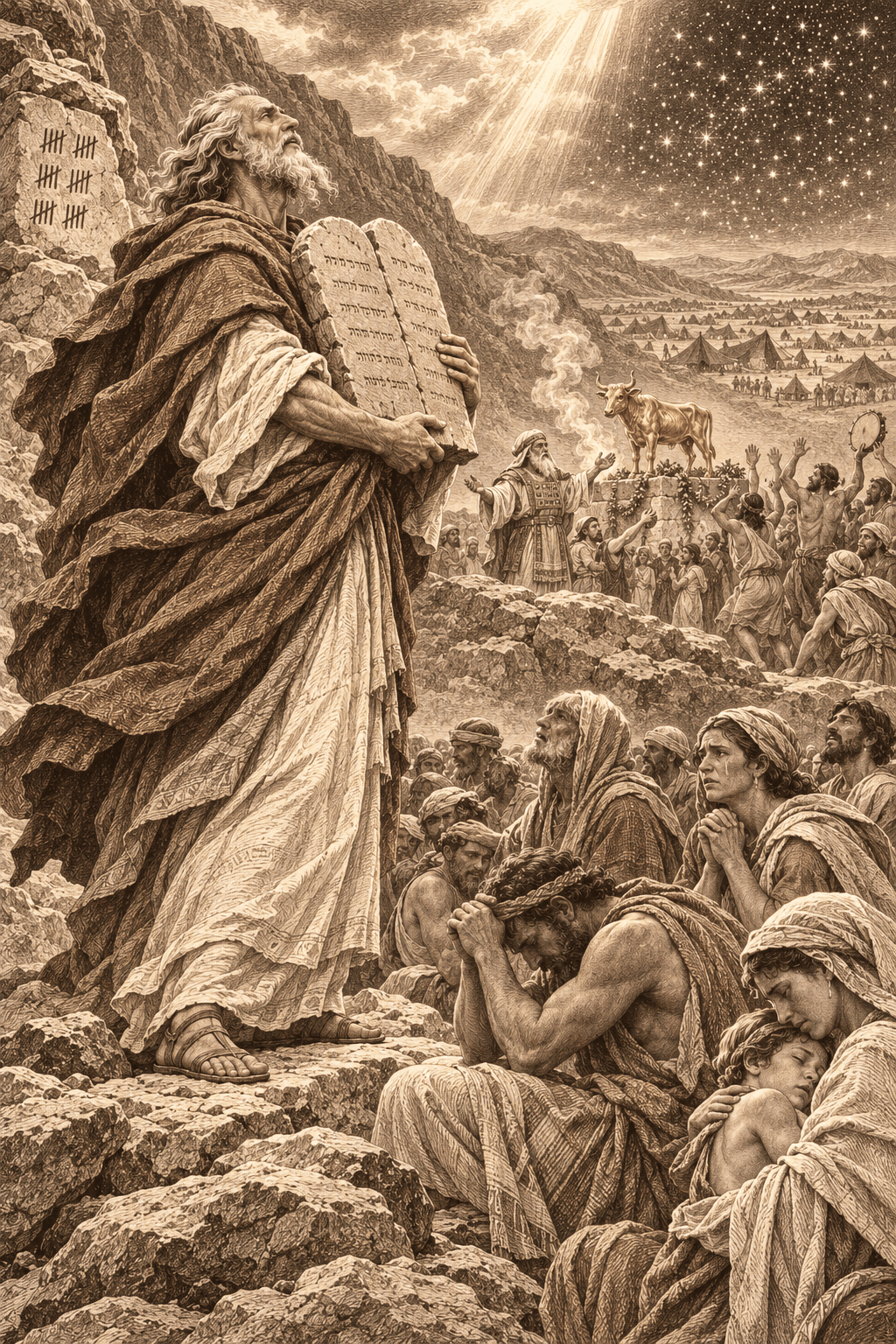
We have already spoken about the making of the golden calf in our study of the Book of Exodus, chapter 32, and quoted what Saint Ephrem the Syrian said:
“Moses was kept away from them for a time, so that the calf that was before them might appear and they might worship it openly, the calf they had been worshiping secretly in their hearts. [97]”
What grieved Moses’ heart was that the people, in the holiest moments, when God was speaking with Moses and giving him His Law, which strictly warns against idolatry, while Moses was fasting forty days and forty nights, neither eating bread nor drinking water, and the mountain was smoking with fire at Horeb, turned aside from the truth and, in stubbornness and stiffness of neck, cast a golden calf to worship.
In the very place where they received the Law, they broke it, at the very moment of receiving it. While their eyes still looked at the mountain burning with fire, their hearts did not soften; instead they cast the golden calf by melting it in a burning fire.
Also in Horeb ye provoked the Lord to wrath, so that the Lord was angry with you to have destroyed you. [8]
So the prophet Moses expresses the horror of their sin: the Lord wanted to destroy them at the very moments in which He wanted to give them all love and mercy.
When I was gone up into the mount to receive the tables of stone, even the tables of the covenant which the Lord made with you, then I abode in the mount forty days and forty nights, I neither did eat bread nor drink water: And the Lord delivered unto me two tables of stone written with the finger of God; and on them was written according to all the words, which the Lord spake with you in the mount out of the midst of the fire in the day of the assembly. And it came to pass at the end of forty days and forty nights, that the Lord gave me the two tables of stone, even the tables of the covenant. And the Lord said unto me, Arise, get thee down quickly from hence; for thy people which thou hast brought forth out of Egypt have corrupted themselves; they are quickly turned aside out of the way which I commanded them; they have made them a molten image. Furthermore the Lord spake unto me, saying, I have seen this people, and, behold, it is a stiffnecked people: Let me alone, that I may destroy them, and blot out their name from under heaven: and I will make of thee a nation mightier and greater than they. So I turned and came down from the mount, and the mount burned with fire: and the two tables of the covenant were in my two hands. [9–15]
Moses was in the most glorious moments of his life on earth, for he was on the top of the mountain, enjoying the vision of the shadow of God’s glory and receiving the Law that God wrote on two tablets and engraved as with divine fire, while the whole mountain quaked and was filled with smoke and cloud. He expected, on coming down, to see the whole people, men and women, children and elders, occupied with nothing but receiving the Law. He thought he would see their eyes fixed on the top of the mountain, forgetting their eating, drinking, and sleeping in the midst of this great glory. But his soul was utterly crushed, for instead of the divine fire they asked the high priest to kindle a fire into which they threw their golden ornaments, so that he might cast them a molten calf to be their god.
The gold that God allowed them to take from the Egyptians in return for the years of their humiliation and bondage, they offered for idolatry to provoke God their Savior.
They misused God’s gift. The golden earrings He allowed them to take should have been worn by the women and girls, not the sons. But the people, in self-indulgence and lack of restraint, made their sons wear them, for Aaron said to them: “Break off the golden earrings, which are in the ears of your wives, of your sons, and of your daughters” (Exodus 32:2). This dissolution pushed them into idolatry, and they took off the earrings to cast them into a calf. The blessings became a curse to them, as He says through the prophet: “I will curse your blessings: yea, I have cursed them already, because ye do not lay it to heart” (Malachi 2:2).
The solid, rocky mountain burned with fire to declare the divine presence, while the hearts of God’s people turned to stone, kindling a human fire to shape for them a god after their evil hearts.
“The assembly” (10): The Septuagint renders it ekklesia, which means church, and Stephen quoted it in his speech: “the church in the wilderness” (Acts 7:38). The word means gathering together in a particular place, and carries the meaning of being set apart and assembled.
7. Moses’ Anger and the Breaking of the Tablets of the Covenant
KJV · Verses 16–19
16 And I looked, and, behold, ye had sinned against the Lord your God, and had made you a molten calf: ye had turned aside quickly out of the way which the Lord had commanded you. 17 And I took the two tables, and cast them out of my two hands, and brake them before your eyes. 18 And I fell down before the Lord, as at the first, forty days and forty nights: I did neither eat bread, nor drink water, because of all your sins which ye sinned, in doing wickedly in the sight of the Lord, to provoke him to anger. 19 For I was afraid of the anger and hot displeasure, wherewith the Lord was wroth against you to destroy you. But the Lord hearkened unto me at that time also.
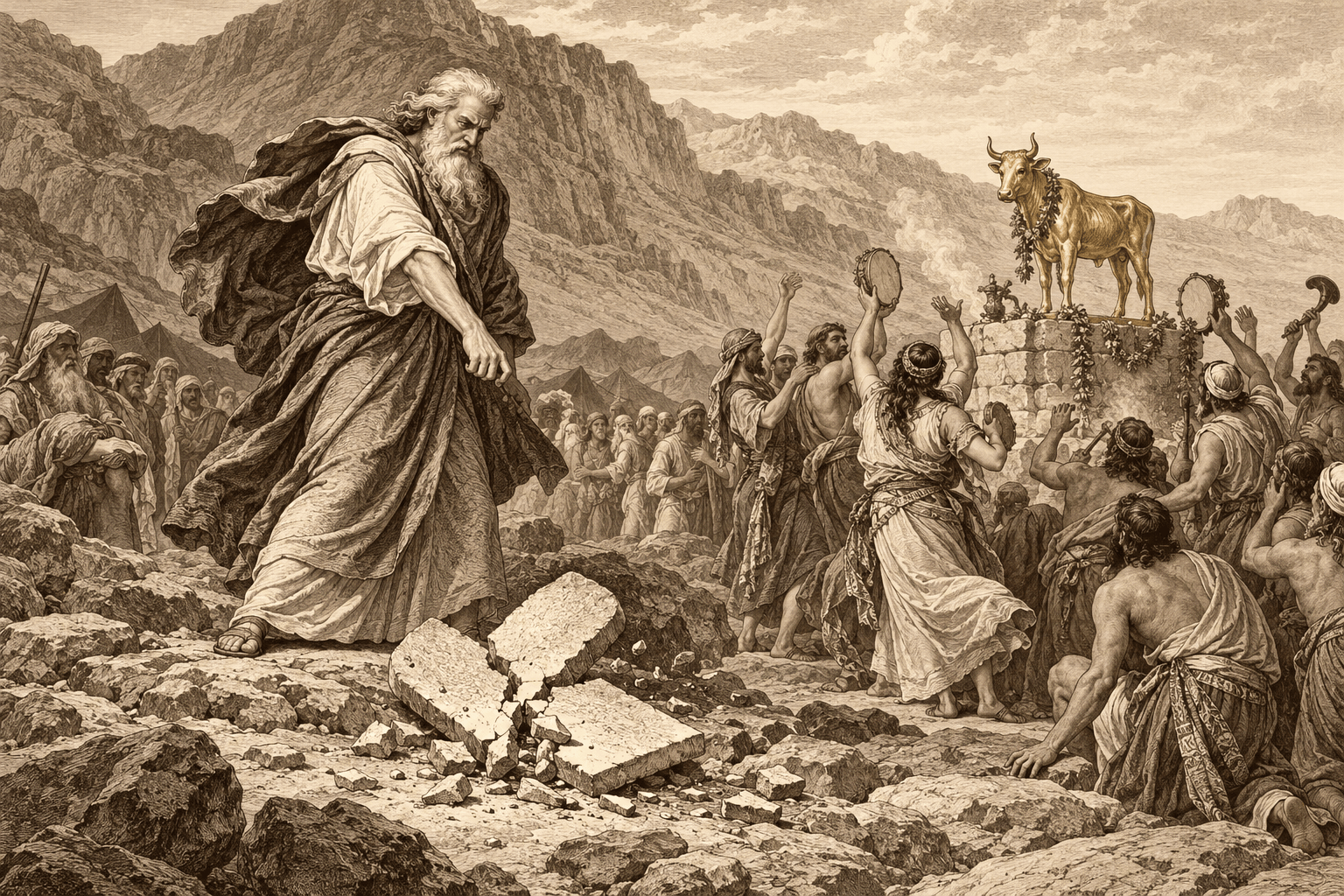
It is as if he were saying to them: What righteousness do you boast of on entering the Promised Land, and what merit do you have, when you made me lose my senses on seeing what I had not expected?
Saint Augustine says:
“We read that the Law was written by the finger of God and given through Moses, His holy servant. Many understand the finger of God to be the Holy Spirit. [98]”
The prophet Moses broke the two stone tablets before the eyes of the people to declare to them that they had broken the Law and come under the curse of disobedience. Now the Lord Christ has come to give, not tablets of stone, but His fiery Holy Spirit, who engraves the law of the New Covenant on the heart, in the inner depths. As the Evangelist says: “For the law was given by Moses, but grace and truth came by Jesus Christ” (John 1:17).
While God was giving Moses the tablets of the Law, and Moses was fasting for the sins of the people (18), and the mountain was burning with fire (15), that is, while God, His prophet, and nature were all working on behalf of the people, the people became corrupt and compelled Aaron to set up the golden calf for them.
Moses was in the happiest moments of his life, in the presence of the Lord, receiving the Lord’s Law on behalf of the whole people, indeed on behalf of mankind, in a most awesome atmosphere. He stood fasting, neither eating nor drinking for forty days, in isolation as it were from the whole world, on the mountain burning with fire, meeting the Creator of heaven and earth, who engraved the Law with His divine finger on two tablets of stone. He wanted to go down to the people to give them the two tablets as tablets of a covenant between God and man, but he came back to find the covenant broken with a speed he had not expected.
He threw the tablets of the covenant to the ground and they broke, so that all might realize that they had broken the covenant by provoking the Lord.
The prophet Moses expressed his great fear, not at meeting the Lord in the midst of the fire, but at realizing the divine wrath that had come upon them to destroy them completely.
He fasted a second time for another forty days and pleaded for his people, and the Lord listened to him that time also. Where, then, is their righteousness of which they boast?!
8. The High Priest’s Share in Their Error
KJV · Verses 20
20 And the Lord was very angry with Aaron to have destroyed him: and I prayed for Aaron also the same time.
The high priest shared their error, for he cast the gold and made the image of the calf for worship. He who bore on his forehead a golden plate inscribed “Holiness to the Lord” should have resisted the people’s error; but instead of sanctifying the people and lifting God’s wrath from them, he himself fell under the divine wrath.
(See verse 20 above.)
When the prophet Moses spoke of the Lord’s anger and wrath against the people, he did not say “the Lord was very angry,” but he said so when he spoke of the high priest’s error. There is no respect of persons with God: whoever knows much and does not act is beaten with many stripes. The sin of the shepherd is more serious than the sin of the people; therefore God disciplines shepherds more strictly than He disciplines the people when they sin.
Saint Jerome says:
“The honor of the priesthood is great, but if priests sin, their ruin is terrible.”
“A priest is not saved because of his rank, but only if he walks in a manner worthy of his rank. [99]”
Saint John Chrysostom says:
“I fear lest, having received the flock in a good and flourishing condition, I should ruin it through my lack of skill, and so provoke against me God, who loves the flock so much that He gave Himself for its salvation and redemption. [100]”
“If a layman stumbles, he is easily corrected; but if a cleric becomes wicked, he becomes incapable of receiving counsel. [101]”
Instead of the high priest interceding for the people, he himself needed someone to intercede for him:
“And I prayed for Aaron also the same time” (20).
Who could speak these words but Moses? For even Aaron did not keep the commandment concerning not worshiping idols once the visible signs of the Lord’s presence had ceased!
9. Accepting the Crushing of the Calf Instead of Their Crushing
KJV · Verses 21
21 And I took your sin, the calf which ye had made, and burnt it with fire, and stamped it, and ground it very small, even until it was as small as dust: and I cast the dust thereof into the brook that descended out of the mount.
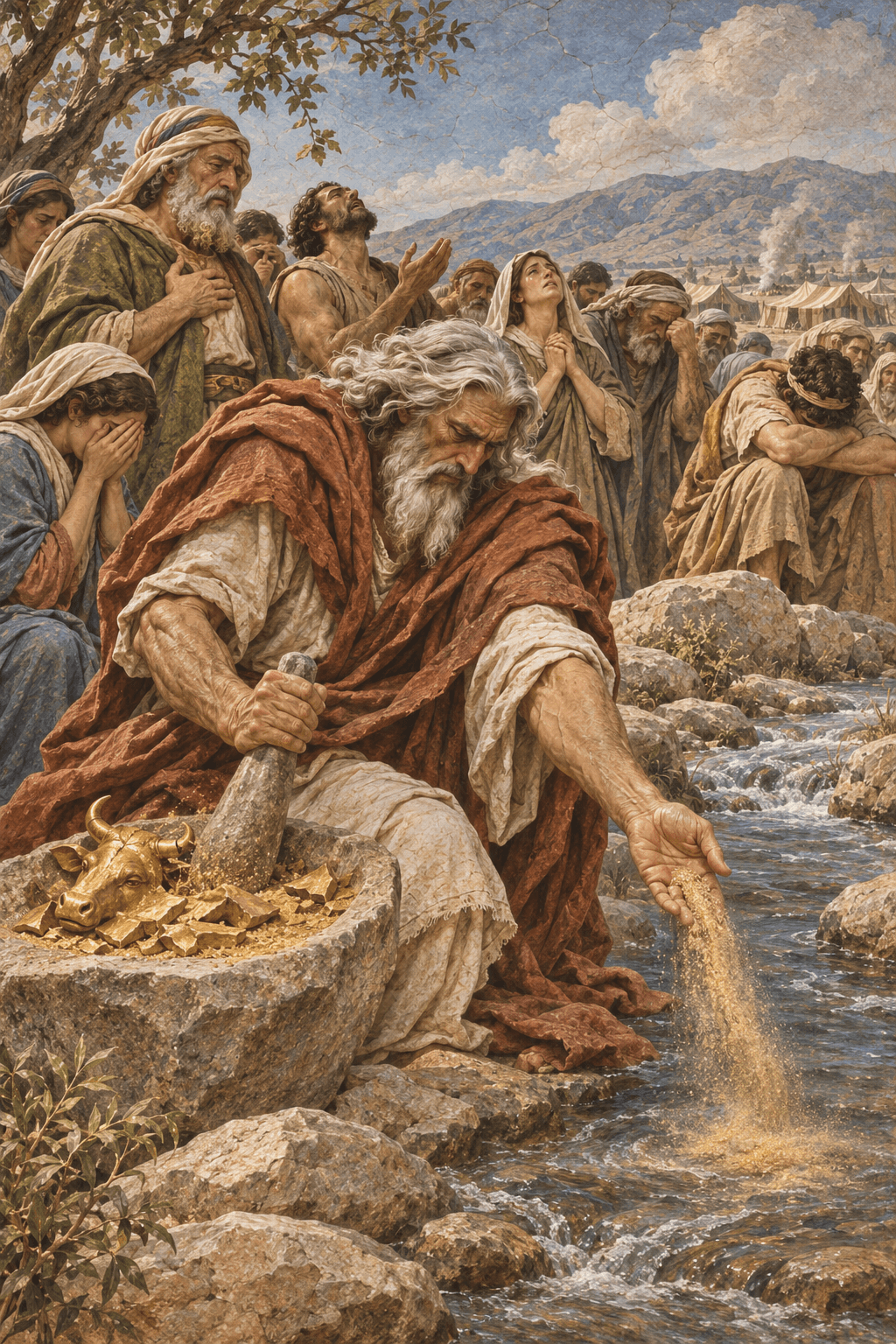
The people deserved to be crushed because of the horror of their sin, even in their choice of place and time. But of God’s mercies He accepted that the calf be burned, stamped, and ground, and then scattered like dust in the brook, instead of this being done to the people.
The people had become like what they worshiped, and the Lord accepted the crushing of the likeness and pardoned them.
(See verse 21 above.)
10. A Chain of Murmuring and Provocation
KJV · Verses 22–24
22 And at Taberah, and at Massah, and at Kibrothhattaavah, ye provoked the Lord to wrath. 23 Likewise when the Lord sent you from Kadeshbarnea, saying, Go up and possess the land which I have given you; then ye rebelled against the commandment of the Lord your God, and ye believed him not, nor hearkened to his voice. 24 Ye have been rebellious against the Lord from the day that I knew you.
The people began with provocation and murmuring before they came out of Egypt, and this provocation accompanied them in the wilderness until it reached its peak at Horeb, while Moses was receiving the Law. Moses fasted and interceded for them, yet their murmuring nature did not change, and their life became an unbroken chain of murmuring and provocation. He mentions, for example (see verses 22–24 above).
Moses also reminds them of their disobedience, for the Lord commanded them at Kadeshbarnea to go up and possess the land, but they did not believe Him or listen to His voice (Deuteronomy 9:22–24; see Numbers 13; 32:8).
11. Moses Intercedes for Them
KJV · Verses 25–29
25 Thus I fell down before the Lord forty days and forty nights, as I fell down at the first; because the Lord had said he would destroy you. 26 I prayed therefore unto the Lord, and said, O Lord God, destroy not thy people and thine inheritance, which thou hast redeemed through thy greatness, which thou hast brought forth out of Egypt with a mighty hand. 27 Remember thy servants, Abraham, Isaac, and Jacob; look not unto the stubbornness of this people, nor to their wickedness, nor to their sin: 28 Lest the land whence thou broughtest us out say, Because the Lord was not able to bring them into the land which he promised them, and because he hated them, he hath brought them out to slay them in the wilderness. 29 Yet they are thy people and thine inheritance, which thou broughtest out by thy mighty power and by thy stretched out arm.
The matter was extremely serious, for Moses fell down before the Lord to pray night and day for the people. Some think these forty days were distinct from the forty days he fasted the second time, when the Lord rewrote the tablets of the covenant, while others think they were the same forty days.
Moses prayed to the Lord and reminded Him of His promise to their fathers Abraham, Isaac, and Jacob, asking Him not to look at the stubbornness of their hearts, their wickedness, and their sin, but to remember that they are His people, for whose deliverance He had worked wonders!
Adam Clarke says:
“God grants many blessings to comparatively unworthy persons, either for the sake of their godly ancestors, or because of religious persons connected with them; therefore union with the Church of God is a great blessing.”
Moses did not justify himself, but in love he fasted, prayed, and asked God to act for the sake of His covenant with their blessed forefathers.
12. A Meditation on Deuteronomy 9
Who Will Intercede for Me, for I Am Ever Murmuring!
Who will intercede for me,
for I am ever murmuring!
By what shall I be justified before You, O surpassing Love?
I am a man ever murmuring.
I have shared with Your people of old in the spirit of murmuring.
They set out from Egypt murmuring,
instead of glorifying You, O Giver of victory.
Their murmuring accompanied them even in the most wonderful moments.
The mountain was still burning with fire for their sake,
and Moses carried the tablets of the covenant written by Your finger.
Heaven and nature, even the stones, bear witness to Your love.
Yet they broke Your covenant before they received the tablets of the covenant.
Aaron the high priest came to need someone to intercede for him before You!
Who will deliver me from my sins but You, O Worker of wonders?
They exchanged You for a golden calf, O You who moved all nature on their behalf.
Instead of holiness they practiced abominations to provoke You.
Who will renew my mind, my heart, and my will but You?!
My soul is bitter within me!
With all my corruption I often ascribe Your blessings to my own righteousness.
You alone are the secret of all true righteousness.
You are the Giver of holiness and the Bestower of blessings.
Notes and References
[96] Matthew Henry, Commentary on the Whole Bible.
[97] St. Ephrem the Syrian, Homily on Our Lord, 2 (1:17).
[98] St. Augustine, Exposition on Psalm 8.
[99] Fr. Tadros Y. Malaty, Pastoral Love (Arabic), 1965, p. 147.
[100] Ibid., p. 160.
[101] Ibid., p. 164.