
The people’s relationship with God rests on accepting the covenant in which God declares His complete and surpassing love for humanity; humanity for its part is bound to obey His voice and to long for His commandment with the whole heart, not only with the lips. He made clear to them the necessity of being occupied with the commandment when they enjoy the new land. In this way the commandment becomes a reason to remember God’s work with them, instead of being preoccupied with good things and forgetting the Lord’s commandment.
1. The Commandment and the Land Flowing with Milk and Honey
KJV · Verses 1–3
1 Now these are the commandments, the statutes, and the judgments, which the Lord your God commanded to teach you, that ye might do them in the land whither ye go to possess it: 2 That thou mightest fear the Lord thy God, to keep all his statutes and his commandments, which I command thee, thou, and thy son, and thy son’s son, all the days of thy life; and that thy days may be prolonged. 3 Hear therefore, O Israel, and observe to do it; that it may be well with thee, and that ye may increase mightily, as the Lord God of thy fathers hath promised thee, in the land that floweth with milk and honey.
As the people were about to enter the land flowing with milk and honey, the prophet Moses feared lest the land distract them from the commandment, and the Lord’s temporal blessings distract them from His Person. Therefore he stressed in every way the following points:
First: The commandments, laws, and judgments he gave them were not his own, but from the Lord Himself.
Now these are the commandments, the statutes, and the judgments, which the Lord your God commanded to teach you, that ye might do them in the land whither ye go to possess it: [1]
They are the commandments of the Lord, not of Moses. So the servants of Christ should present His commandments, through which He is revealed in His hearers and is present among His people. Therefore Matthew the Evangelist ends his Gospel with the words of the Lord Christ: “Teaching them to observe all things whatsoever I have commanded you: and, lo, I am with you alway, even unto the end of the world” (Matthew 28:20).
The Book of Deuteronomy makes clear the role of man and the role of God in the covenant between them. The prophet Moses often repeats “hear,” “see,” “keep,” “do”: this is the believer’s role. God’s role is to give, multiply, and bless.
Second: That we accept the commandment in our daily practical life: “that ye might do them,” that is, carry it across the Jordan into the new land as the constitution of their practical life.
That thou mightest fear the Lord thy God, to keep all his statutes and his commandments, which I command thee, thou, and thy son, and thy son’s son, all the days of thy life; and that thy days may be prolonged. [2]
So when they possess the new land, they must practice a new life with a new mind and a new divine law.
Third: When the believer accepts the commandment as a treasure he keeps and entrusts to his children and grandchildren, the commandment must turn into “fear of the Lord” (2), and he must keep all the commandments and statutes. Whoever teaches with his tongue but not with his heart and conduct is like one writing on water.
I have already spoken of “the fear of the Lord” in our study of the Book of Proverbs: it is the fear of a son lest he wound his father’s feelings. This is the fear we pass on to coming generations through living, practical tradition, so that our days are prolonged, for the holy days of our grandchildren are counted as our own. Just as a corrupt son kills his parents’ heart, so that they count their days as lost and shortened, so a godly son or grandson gladdens the heart of his parents and grandparents in the Lord, and the days of their life in the Lord are prolonged.
Fourth: If the people were to possess the land full of good things as a divine gift, there remain greater good things and a better sweetness that believers find in the commandment, as he says:
Hear therefore, O Israel, and observe to do it; that it may be well with thee, and that ye may increase mightily, as the Lord God of thy fathers hath promised thee, in the land that floweth with milk and honey. [3]
As they enter the land of Canaan, so we ought to enter the land of the commandment through obedience to God, so that our souls are satisfied with good things and need nothing; for through it we enter heaven itself, and through it the Creator of heaven Himself is revealed.
2. The Commandment as the Believer’s Companion Wherever He Is
KJV · Verses 4–9
4 Hear, O Israel: The Lord our God is one Lord: 5 And thou shalt love the Lord thy God with all thine heart, and with all thy soul, and with all thy might. 6 And these words, which I command thee this day, shall be in thine heart: 7 And thou shalt teach them diligently unto thy children, and shalt talk of them when thou sittest in thine house, and when thou walkest by the way, and when thou liest down, and when thou risest up. 8 And thou shalt bind them for a sign upon thine hand, and they shall be as frontlets between thine eyes. 9 And thou shalt write them upon the posts of thy house, and on thy gates.
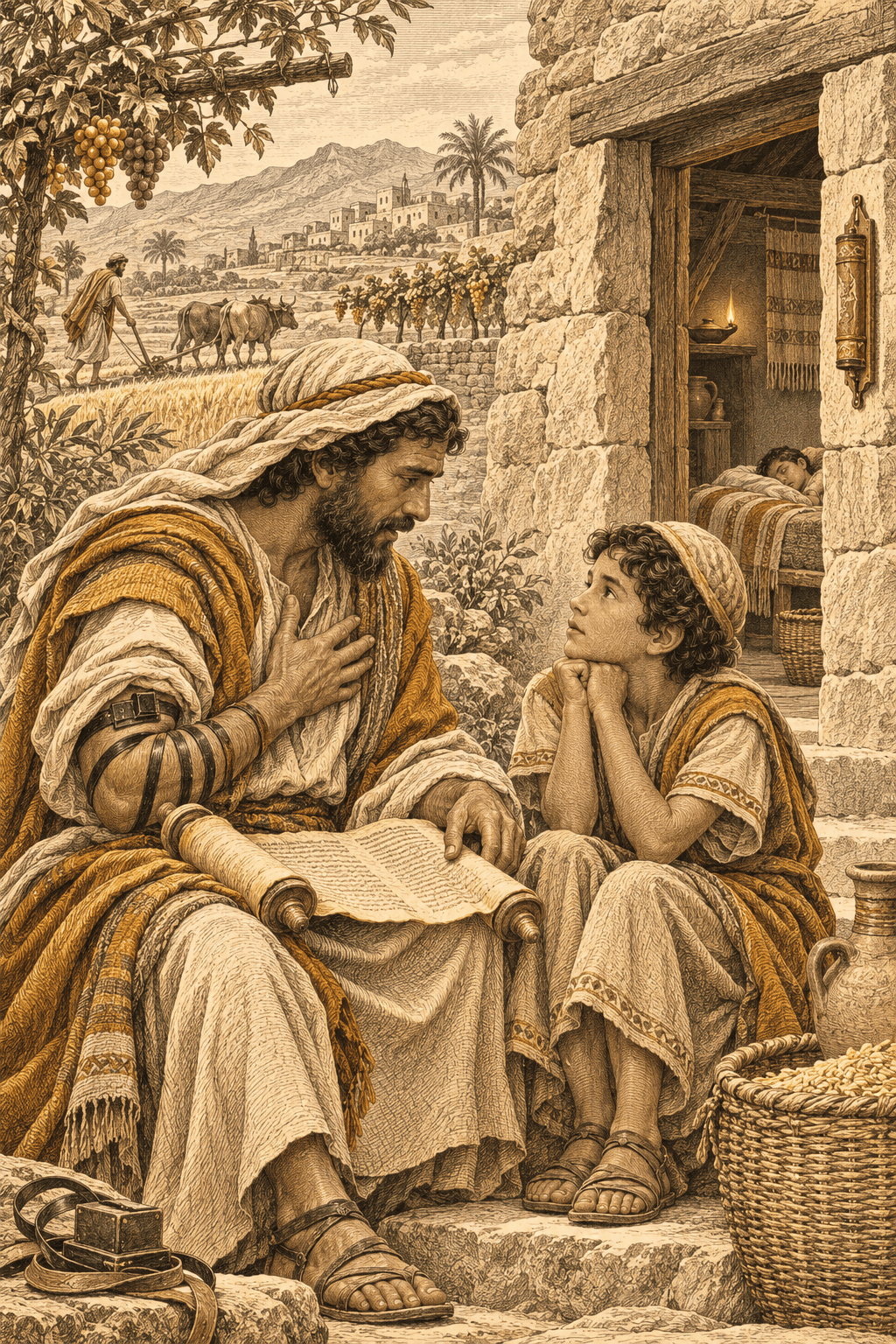
The Jews consider verses 4–5 among the most wonderful passages of Scripture. Pious Jews recite them, together with Numbers 15:37–41 and Deuteronomy 11:13–21, at least twice daily, and the person who utters them every morning and evening and fulfills them in practice is counted blessed. The two verses are known by the word “Shema,” the first Hebrew word in them. Christ quoted these two verses as the first and great commandment, adding “with all thy mind” (Mark 12:30).
The Hebrew word used here and translated “one” is echad, which does not deny the Christian doctrine of the Holy Trinity, a trinity in unity. There is another Hebrew word that could be translated “one,” yachid, which denotes the absolute oneness held by the followers of some other religions, meaning the oneness of a single essence that admits no plurality. That word is not used here. Here we find faith in the oneness of God mixed with love, something no other religion requires.
The Jews used to write the last letter of the first and last words larger, to draw the readers’ attention to this passage as the greatest and most important commandment.
Saint Ambrose says:
“He did not say ‘Speak,’ but ‘Hear’ (4). Eve fell because she spoke to the man what she had not heard from the Lord her God. The first word God says to you is ‘Hear.’ If you hear, you take care on your way; and if you fall, you quickly correct your way. For ‘Wherewithal shall a young man cleanse his way? by taking heed thereto according to thy word’ (Psalm 119:9). Therefore before everything, be silent and hear, so that you do not fall by your tongue. It is a great evil for a man to be condemned by his own mouth. [64]”
What does it mean to say, “Jehovah our God (Eloheinu), Jehovah is one” (4)?
A) The believer treasures the expression “Jehovah,” for it is the special title of God who dwells among His people. He is Elohim, “the Almighty” and the Creator, but we treasure Him all the more for His dwelling among His people and His abiding in their hearts.
B) If He is the Almighty, “Elohim,” He is the Almighty who is ours, “our God.” His power, might, and surpassing capabilities are all on our behalf; we possess Him, and He works with us and in us.
C) The prophet Moses presented the doctrine of God’s oneness with a hint of the Trinity, in a way suited to the Jews, who were like children in spiritual and theological knowledge at that time. He says, “The Lord our God is one Lord” (4): while affirming God’s oneness, he repeats the name of the Lord three times, for He is three Persons.
The prophet presents to us the one God, the Fountain that overflows with what satisfies all heavenly and earthly beings, instead of belief in many gods, dry springs that cannot reach the depths of the soul or satisfy it.
Saint Ambrose says:
“There is God in God, yet they are not two gods, for it is written that there is one God. And there is Lord (Jehovah), yet they are not two lords. [65]”
“The Law proves the unity of the Godhead, speaking of one God. As the Apostle Paul says of Christ: ‘For in him dwelleth all the fulness of the Godhead bodily’ (Colossians 2:9). If, as the Apostle says, all the fullness of the Godhead is bodily in Christ, we must confess that the Father and the Son are one Godhead. [66]”
And thou shalt love the Lord thy God with all thine heart, and with all thy soul, and with all thy might. [5]
The Lord Christ Himself repeated these words as they are, affirming that God accepts nothing less than to be within the heart, occupying it fully, asking all our love in return for all His love given to us. By entering our depths He makes the heart upright, the soul full of sweetness, and the love unmixed with impurity, a pure, free, generous love that knows no division. He turns the inner being into a fountain of living water overflowing on others; for love cannot be imprisoned in the prison of the ego, but always flies in the heavenly places, giving generously without reproach. It rises on its wings as to heaven to take from there its pure and holy marks, and returns to work on earth with a new spirit.
In the previous chapter he spoke of the godly person who fears God with a son’s fear of his father; here we find God, as the Lover of mankind, giving us the commandment to love Him! We have never heard of a king, ruler, or any leader who legislates a law asking us to love him as a response to his love for us.
We love Him as the Lord, the Master of all, and as God who makes a covenant with us. He asks for love flowing from the whole heart, for He looks at our depths as His heavenly kingdom. We love Him also with true understanding and perception, that is, not only through the emotions and feelings of the heart; and with all our might, that is, we use all our energy and gifts to express this love.
Saint Ambrose says:
“It always seems fitting to give God the greatest thing you have, which is your mind, for you have nothing greater than it. [67]”
“We ought to stir up the love of the bride, as it is written: ‘Thou shalt love the Lord thy God.’ [68]”
Saint Basil the Great says:
“The expression ‘with all’ calls for the addition that there is no division into parts. [69]”
Saint Gregory of Nyssa says in his work On the Making of Man:
“Human life consists of a unity with three aspects. The Apostle teaches something similar in what he said to the Ephesians, that he prays for them that complete grace may preserve body, soul, and spirit until the coming of the Lord. We use the word ‘body’ for the process of nourishment by food, the word ‘soul’ for the vital aspect, and ‘spirit’ for the rational dimension. In the same way the Lord teaches the writer of the Gospel to set before every commandment that love for God is practiced with all the heart, soul, and mind (Matthew 22:37; Mark 12:30; Luke 10:27). This expression includes the whole human being. [70]”
Origen, Saint Augustine, and others often spoke of the mystery of the number 3 (with all thy heart, with all thy soul, and with all thy might) as pointing to the resurrection with Christ on the third day: we worship God with the whole risen heart, the whole soul, and the whole mind. Christ’s resurrection is declared in us, and we practice the new life in Him. [71]
Saint Basil the Great holds that man carries an energy of love, a power either for his building up or for his destruction. Therefore, as we love God, we must translate love into a power of action for building up. [72]
And these words, which I command thee this day, shall be in thine heart: [6]
If the commandment is not in the heart, it has no existence; but if it occupies the heart, it goes forth to the mind and directs a person’s thoughts and understanding through it. On the other hand, whoever loves God loves His words and commandments; the commandment’s occupying the heart is a sign of God’s kingship over the heart.
The greatest memory is the heart. When the commandment enters the storehouses of the heart, a person cannot forget it, but remembers it always; indeed his whole being is shaped by what the heart keeps. He asks us to carry the commandment wherever we are, for when a person keeps it in his heart, he carries it wherever he is.
And thou shalt teach them diligently unto thy children, and shalt talk of them when thou sittest in thine house, and when thou walkest by the way, and when thou liest down, and when thou risest up. [7]
When the commandment enters the heart, the believer becomes able to teach his children and grandchildren in the language of love and simplicity, with burning zeal and sincerity. People, especially children, love those who speak to them from the heart; their hearts joyfully receive what comes from their parents’ hearts.
He says, “thou shalt teach them diligently unto thy children, and shalt talk of them” (7). He asks us not merely to repeat the commandment, but to teach our children with all diligence. The father does not take the position of a teacher delivering sermons and giving orders, but speaks in the language of love, “telling and talking.” When the Lord’s word enters the heart, it becomes part of our life, and we speak in the spirit of love and the language of life.
When the heart of the true believer is enlarged by love, it carries a shadow of God’s fatherhood, and he feels that everyone around him is like his own children. So his teaching of the commandment does not stop with his children according to the flesh, but extends to every person, so that he may bring everyone into glory.
“And shalt talk of them when thou sittest in thine house” (7). When the believer sits in his house, he realizes that he is in the Lord’s house; his conversation with his household is in the Lord, and what he utters is what the Lord Himself utters. He carries the Lord’s words with joy to his brethren. When he sits at home with husband or wife, with children, with servants and workers, or with friends, he finds nothing to speak of but the Lord’s words.
Saint John Chrysostom says:
“When you return home, discuss these things with your household, as many do when they come back from gardens: they pick a rose or some other flower and hold it between their fingers. Others, leaving the gardens to go home, take branches of trees laden with fruit. Others, coming from banquets full of delicacies, carry some home to those they support. So it is fitting for you, when you leave this place, to take counsel with you for your wife, your children, and your whole household. This counsel is more profitable than orchard, garden, or banquet. These roses will not wither, these fruits will not fall, these delicacies will not spoil. The former give temporary pleasure; the benefit of the latter remains. [73]”
“And when thou walkest by the way” (7): the believer is not ashamed to speak of the Lord’s commandment even on the road, when he meets people he does not know.
“And when thou liest down, and when thou risest up” (7): a person begins his night speaking of the commandment and is occupied with it when he begins his day. It occupies his whole being, even in his dreams and during his daily work.
And thou shalt bind them for a sign upon thine hand, and they shall be as frontlets between thine eyes. [8]
It was a well-known custom in the ancient world to tie something on the hand or finger to remind oneself of something urgent and important. So by binding the commandment on his hand, the believer remembers the importance of carrying out the commandment and teaching it. If the word is stored in the heart, it must also be written on the hand, that is, turned into action. We bear witness to the word with our hearts, our mouths, and our deeds, so that others sense it, hear it, and see it.
“And they shall be as frontlets between thine eyes” (8): so that the believer’s mind is occupied with it and he meditates on it continually.
And thou shalt write them upon the posts of thy house, and on thy gates. [9]
It reigns over the heart, the tongue, the hands, the eyes, and the house. No door is left for the enemy to enter and occupy a place in the person; rather he is holy in all his senses and all his actions, and becomes Christ’s epistle, read by all people.
Some have considered the word “write” a mistake, claiming that writing was unknown at that time. But modern excavations have proved that writing was familiar in the time of Moses, in cuneiform and the Hebrew alphabet. Most likely Moses learned to write in Egypt (Acts 7:22), and perhaps others, including Joshua, learned to write too; but not everyone wrote, so they employed scribes or copyists.
The early Christians used to write some important verses on the walls of churches, engrave them on doors, and also in their homes, so that they would always be before the eyes of those present and occupy their thoughts.
The Lord asked the children of Israel to put the blood of the Passover lamb on the two side posts and the upper door post (Exodus 12:7); now He asks that the commandment be written on the posts of the house and on the gates (Deuteronomy 6:9). So the blood of the Passover, which gives salvation, is linked with the commandment: by the blood we escape death, so that through the commandment we may receive the joy of union with the Word of God, by the merit of His blood. In other words, faith in the blood cannot be separated from the joy of receiving the Holy Bible and entering its depths, to meet the sacrificed Christ as a personal friend. The union of the blood with the commandment also means the unity of faith with practical obedience to God through His commandment.
Saint Athanasius the Apostolic holds that the righteous and faithful servants of the Lord have become disciples of the kingdom of heaven, who bring out of it things new and old, meditating on the Lord’s words whether they sit in the house, lie down, rise up, or walk by the way. [74] It is as though, through enjoying the commandment wherever they are and under all circumstances, they realize that they are children of the kingdom of heaven.
Having spoken to us about the commandments and their connection with making a covenant with God, he reveals here our obligation to enjoy the commandment in our inner life as a lived experience, and to bear witness to it at home, among colleagues, and then among strangers. This passage agrees with the words of the Lord Christ to His disciples about preaching (Acts 1:8).
The commandment in its reality is union with the Word of God, who alone can take away from man his feeling of isolation, for He dwells in his heart (6), becomes the subject of his concern in his family relationships (7), accompanies him on the road (7), does not leave him in sleep or waking (7), occupies him during his daily work (8), and fills all his thought and inner insight (8).
In the same spirit the Lord Christ asked His disciples to preach first in Jerusalem, then in Judea, then in Samaria, and to the end of the earth:
- “These words, which I command thee this day, shall be in thine heart”: that is, “ye shall be witnesses unto me… in Jerusalem.”
- “Thou shalt teach them diligently unto thy children”: “and in all Judaea.”
- “When thou sittest in thine house”: “and in Samaria.”
- “When thou walkest by the way”: “and unto the uttermost part of the earth.”
The call is to continual witness to the Lord and His commandment, but with a spirit of wisdom, at the fitting time and in the suitable manner.
Saint Gregory of Nyssa says:
“We ought to think of God even more than we draw breath, and, if I may say so, we ought to do nothing else… I do not forbid continual remembrance of God; I only forbid speaking about God, not as though it were wrong, but it must be offered at the right time. I do not forbid teaching, but I ask for moderation. Even eating honey to excess causes vomiting. As Solomon says, there is a time for everything, and what is good loses its goodness if it is not practiced in a good way. [75]”
3. The Commandment and the Enjoyment of Blessings
KJV · Verses 10–19
10 And it shall be, when the Lord thy God shall have brought thee into the land which he sware unto thy fathers, to Abraham, to Isaac, and to Jacob, to give thee great and goodly cities, which thou buildedst not, 11 And houses full of all good things, which thou filledst not, and wells digged, which thou diggedst not, vineyards and olive trees, which thou plantedst not; when thou shalt have eaten and be full; 12 Then beware lest thou forget the Lord, which brought thee forth out of the land of Egypt, from the house of bondage. 13 Thou shalt fear the Lord thy God, and serve him, and shalt swear by his name. 14 Ye shall not go after other gods, of the gods of the people which are round about you; 15 (For the Lord thy God is a jealous God among you) lest the anger of the Lord thy God be kindled against thee, and destroy thee from off the face of the earth. 16 Ye shall not tempt the Lord your God, as ye tempted him in Massah. 17 Ye shall diligently keep the commandments of the Lord your God, and his testimonies, and his statutes, which he hath commanded thee. 18 And thou shalt do that which is right and good in the sight of the Lord: that it may be well with thee, and that thou mayest go in and possess the good land which the Lord sware unto thy fathers. 19 To cast out all thine enemies from before thee, as the Lord hath spoken.
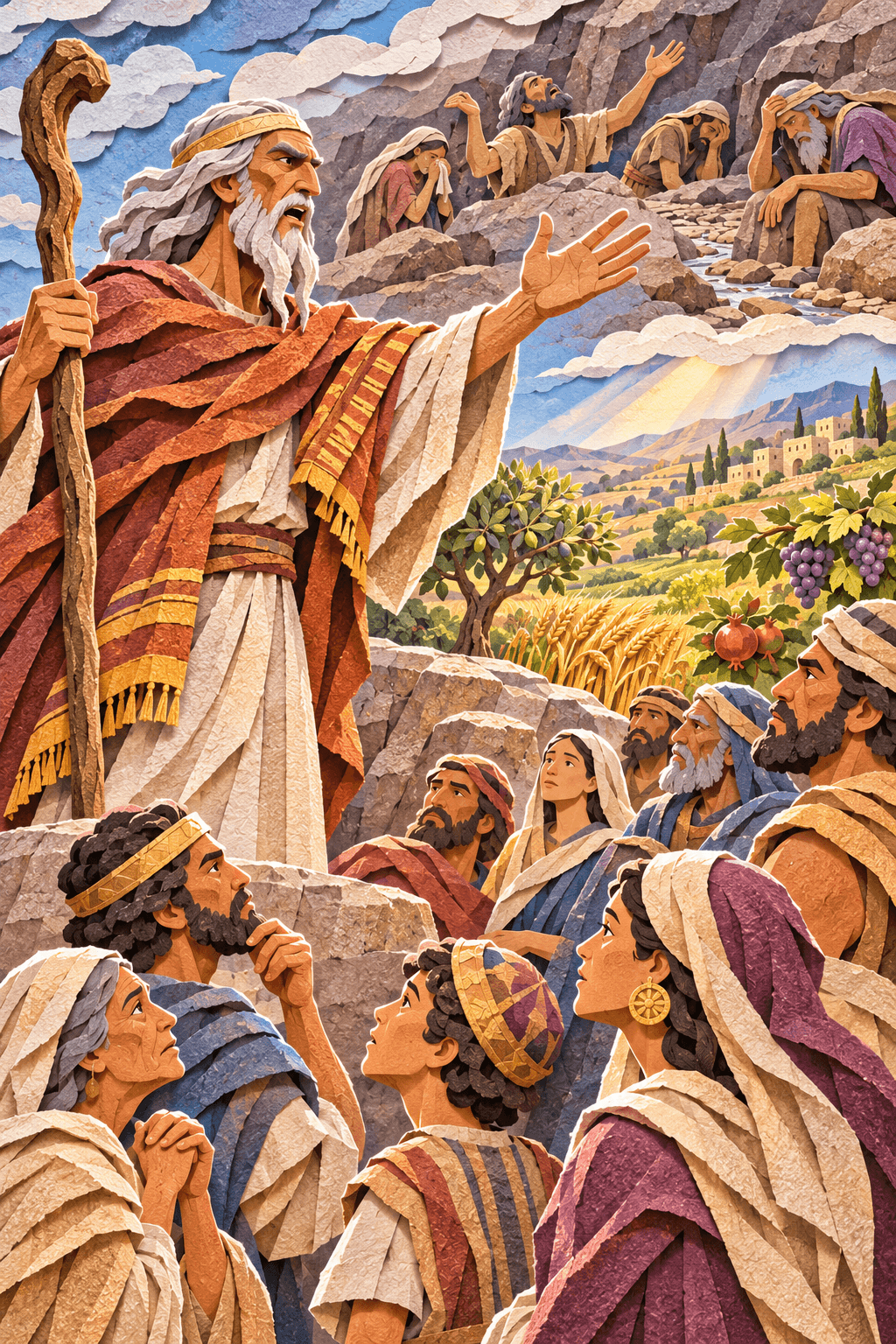
After speaking of the necessity of man’s whole being being bound to the divine commandment, which occupies him wherever he is and under all circumstances, the prophet Moses gave a special warning against ignoring the commandment when a person enjoys many blessings and good things. These are good gifts from God in themselves, but if they take the place of the divine commandment in the heart, they lose their goodness.
And it shall be, when the Lord thy God shall have brought thee into the land which he sware unto thy fathers, to Abraham, to Isaac, and to Jacob, to give thee great and goodly cities, which thou buildedst not, And houses full of all good things, which thou filledst not, and wells digged, which thou diggedst not, vineyards and olive trees, which thou plantedst not; when thou shalt have eaten and be full; Then beware lest thou forget the Lord, which brought thee forth out of the land of Egypt, from the house of bondage. [10–12]
If God brought His people out of the land of bondage, poured abundant blessings on them, and brought them into the Promised Land He had promised their fathers Abraham, Isaac, and Jacob, on the other hand He warns them lest they turn away from cleaving to the Lord when they are full and live in luxury. It was fitting for them not to forget the Lord, but to seek Him, so as to come out of this world and live with Him in the new heaven and the new earth.
If He gave them great and goodly cities they did not build, instead of their walking in the wilderness carrying their tents as unsettled wanderers and strangers, it was fitting that they look forward to settling in the Father’s bosom, in the heavenly Jerusalem with its surpassing walls and buildings not made by man.
If He gave them houses that became storehouses full of good things, they should seek the Giver of good things Himself. They came to the Promised Land to find wells they had not labored to dig; let them seek the Fountain of life that never runs dry. As they enter fields they did not plant, eat, and are full, let them seek the bread of angels, the heavenly food that satisfies the heart.
So as we enjoy the Lord’s free gifts, we should seek the Giver of the gifts Himself, lest the gifts distract us from their Giver. For many, when they are full, are filled with ingratitude. This is what Agur feared: “Lest I be full, and deny thee, and say, Who is the Lord?” (Proverbs 30:9).
Saint John Chrysostom says:
“When Hezekiah was in distress, see what he did to be saved: he put on sackcloth and so on. But when he was in relief, he fell through the lifting up of his heart (2 Kings 19:1). When the Israelites were in distress they grew greatly in number, and when He left them to themselves they went down to their destruction. [76]”
“When you begin to sink into the pleasures of luxury, remember how short pleasure is; look at the loss. Truly it is a loss, when a person pays much money for what harms him, causing him diseases and weaknesses. Despise luxury. How many have been struck by evils because of luxury? Noah became drunk and was shamed, uncovered; see how many evils flowed from this (Genesis 9:21). Esau lost his birthright because of his greed, and thought of becoming his brother’s murderer. The people of Israel sat down to eat and drink, and rose up to play (Exodus 32:6). Therefore the Scripture says, ‘When thou shalt have eaten and be full, then beware lest thou forget the Lord’ (see Deuteronomy 6:11–12), for they were on the edge of falling into luxury. ‘But she that liveth in pleasure is dead while she liveth’ (1 Timothy 5:6). [77]”
When disaster struck Antioch, after the people rose up against the Emperor Theodosius and insulted his statues and those of the empress in the public square, he sent his deputies to take vengeance, and everyone cried out to God for mercy. When the pardon came, Saint John Chrysostom feared that the people would forget their God in their relief, and said to them:
“When the fires of ruin from these disasters were blazing, I said that it was not a time for teaching but for prayer. Now that the fires have been put out, I repeat the same thing: now especially, more than before, is a time for prayer. It is a time for tears and contrition for the watchful, diligent, and very careful soul. Before, temptation pressed upon us against our will and drove us to be wise and more devout; but now that the bridle has been removed and the cloud has passed, I fear lest you fall again into sluggishness and grow slack with this postponement (of judgment). I fear lest someone have reason to say of us, ‘When he slew them, then they sought him: and they returned and enquired early after God’ (Psalm 78:34). Your goodness will be shown if you continue to practice the same piety. [78]”
Thou shalt fear the Lord thy God, and serve him, and shalt swear by his name. Ye shall not go after other gods, of the gods of the people which are round about you; [13–14]
He asks them to fear the Lord as Lawgiver and Judge, to serve Him as Creator, and to swear by His name as their only God. Swearing by God’s name was a sign of trust in Him, honor for Him, and attachment to Him; therefore he continued, “Ye shall not go after other gods.”
The word “swear” in Hebrew, tishshabea, is derived from shaba, which points to one who is full, satisfied, and sufficient. So the oath points to the soul that calls on God as witness to any promise, that He is able to fulfill the promise completely and guarantees what it utters. Whoever swears declares his faith in God, who is able to fulfill what the believer promises his brethren. [79]
(For the Lord thy God is a jealous God among you) lest the anger of the Lord thy God be kindled against thee, and destroy thee from off the face of the earth. [15]
He has betrothed your souls as a heavenly Bridegroom; therefore, as a betrothed one, you ought to be faithful, lest the love with which He accepted man as a heavenly bride turn into a fiery jealousy that the unfaithful soul cannot bear, and it perish.
Ye shall not tempt the Lord your God, as ye tempted him in Massah. [16]
“Massah” is a Hebrew name meaning “testing,” the name of a place in the wilderness also called “Meribah” or “Rephidim.” There the people quarreled with Moses and almost stoned him because of thirst (Exodus 17).
The Lord Christ used this verse in answering the devil in one of the temptations (Matthew 4:7). Saint Athanasius the Apostolic used it to defend himself when he fled from the Arians: the prophet Moses fled from Egypt to Midian, David hid in a cave from Saul, and Elijah and the prophets stayed in their caves and did not appear before King Ahab. [80]
They tempted the Lord, saying, “Is the Lord among us, or not?” (Exodus 17:1–7). They doubted God’s tenderness, love, care, and power, and His presence among them, after He had given them all the surpassing gifts and proved His love by many testimonies.
Saint Augustine says:
“Let us not tempt the Lord, as if to say: If we belong to You, grant us to work a miracle. [81]”
Ye shall diligently keep the commandments of the Lord your God, and his testimonies, and his statutes, which he hath commanded thee. And thou shalt do that which is right and good in the sight of the Lord: that it may be well with thee, and that thou mayest go in and possess the good land which the Lord sware unto thy fathers. To cast out all thine enemies from before thee, as the Lord hath spoken. [17–19]
So he warns us against slackness and neglect, urging us to keep the commandment, or to strive in it, for God’s free grace does not work in the lazy and careless.
4. The Commandment and Remembering Freedom from Bondage
KJV · Verses 20–25
20 And when thy son asketh thee in time to come, saying, What mean the testimonies, and the statutes, and the judgments, which the Lord our God hath commanded you? 21 Then thou shalt say unto thy son, We were Pharaoh’s bondmen in Egypt; and the Lord brought us out of Egypt with a mighty hand: 22 And the Lord shewed signs and wonders, great and sore, upon Egypt, upon Pharaoh, and upon all his household, before our eyes: 23 And he brought us out from thence, that he might bring us in, to give us the land which he sware unto our fathers. 24 And the Lord commanded us to do all these statutes, to fear the Lord our God, for our good always, that he might preserve us alive, as it is at this day. 25 And it shall be our righteousness, if we observe to do all these commandments before the Lord our God, as he hath commanded us.
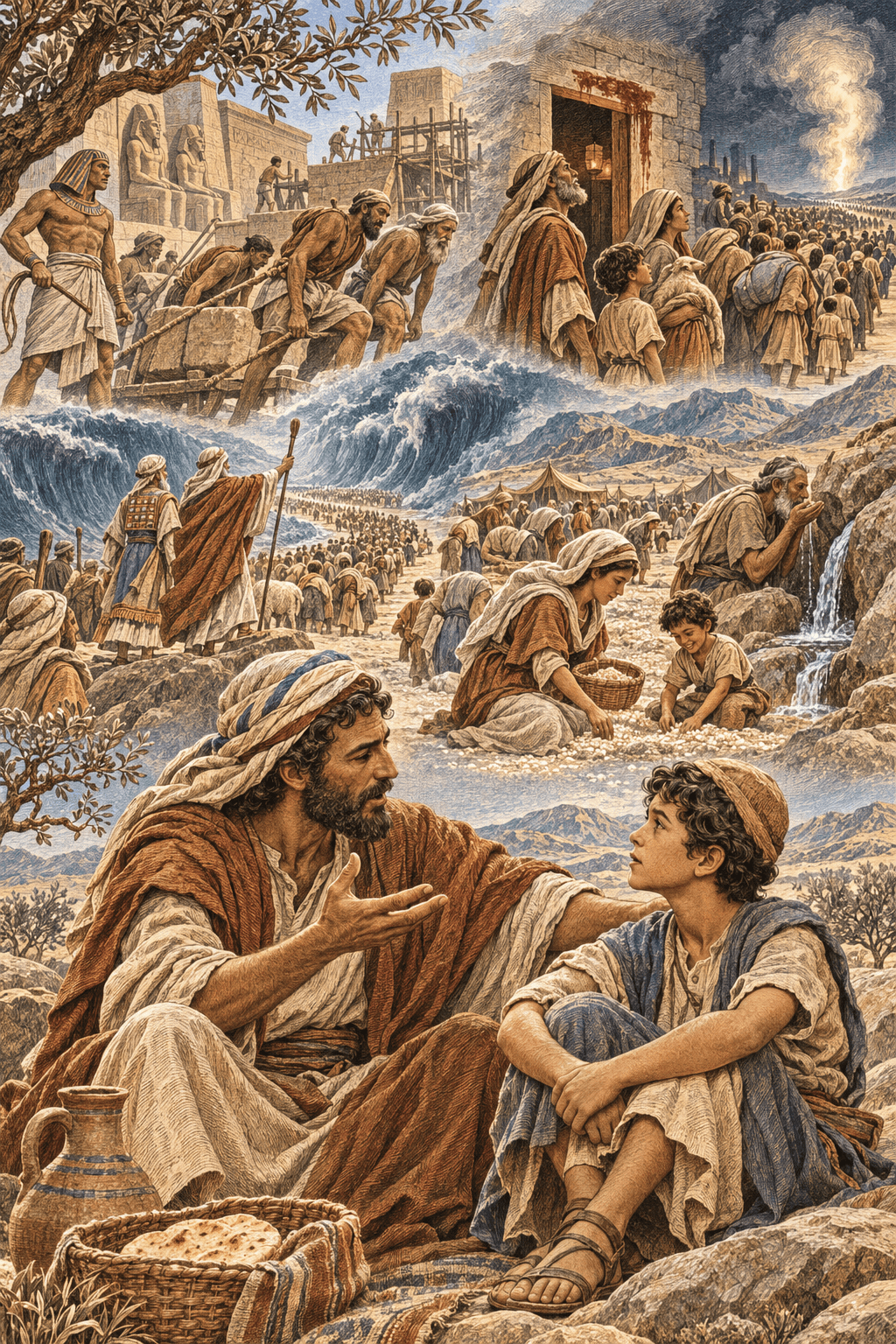
The prophet Moses stresses here two inseparable things:
A) Remembering God’s saving works with us, so that we thank God and obey Him without murmuring. We remember that He gave us great and goodly cities we did not build (10), that is, the sanctification of soul, body, mind, senses, and feelings, as cities we possessed by divine grace; He gave us free satisfaction (“houses full of all good things, which thou filledst not”), an abundance of the springs of the inner work of God’s Spirit (“wells digged, which thou diggedst not”), and the multiplying fruits of the Spirit (“vineyards and olive trees, which thou plantedst not; when thou shalt have eaten and be full”).
B) Bearing witness to God’s works, especially in the family (Deuteronomy 6:20–23). We bear witness that we were Pharaoh’s bondmen and the Lord saved us with His mighty hand. This testimony is tasted by the nursing infant, the small child, the husband, the wife, and everyone who meets us, if they touch the inner burning of our hearts with love, thanksgiving, and obedience, not the outward forms of worship without spirit.
Here the Holy Bible allows the new generation to ask about the testimonies, statutes, and judgments, that is, to ask what lies behind the divine commandment and the religious laws and rites. Though the believer receives everything divine through tradition from previous generations, tradition does not mean obscurity and ignorance. We ought to enter the depths of the divine word and understand every evangelical rule and liturgical rite, so that we may pass it on to the next generation, and they may worship with the spirit and with the understanding, as the Apostle Paul says: “I will pray with the spirit, and I will pray with the understanding also: I will sing with the spirit, and I will sing with the understanding also” (1 Corinthians 14:15). The believer should consecrate all his energies, including his mind and understanding, for the kingdom of God.
Saint Augustine says:
“When you cross the Red Sea, when you are led out of your transgressions with a mighty hand and a stretched-out arm, you perceive mysteries you did not know. So it happened with Joseph when he came to the land of Egypt and heard a language he did not know… You will hear where your heart must be (Matthew 6:21), something that even now, as I speak, many understand and answer with wonder, while the rest stand in dullness, because they have not heard the language they do not know, so as to hasten, cross over, and learn. [82]”
The prophet presents to us the mystery behind every commandment, law, or rite: discovering God’s surpassing love for man and His saving work, to carry us out of bondage into the glorious liberty of the children of God. He says:
Then thou shalt say unto thy son, We were Pharaoh’s bondmen in Egypt; and the Lord brought us out of Egypt with a mighty hand: And the Lord shewed signs and wonders, great and sore, upon Egypt, upon Pharaoh, and upon all his household, before our eyes: And he brought us out from thence, that he might bring us in, to give us the land which he sware unto our fathers. And the Lord commanded us to do all these statutes, to fear the Lord our God, for our good always, that he might preserve us alive, as it is at this day. And it shall be our righteousness, if we observe to do all these commandments before the Lord our God, as he hath commanded us. [21–25]
The son has the right to ask, and the right to find a convincing and satisfying answer that comes from practical, lived reality, as appears from the prophet Moses’ words. Let us speak with our children without shame about how we lived for a time under the yoke of bondage, and how the Lord freed us from its weight. Let us not deify ourselves or justify ourselves as though we were angels with a nature different from that of the new generation. Rather let us assure them that we were weak, captive in the darkness of the devil, but the grace of God rescued and freed us. This reality awakens hope in our children’s souls and gives us true and genuine honor in their eyes. We should be ready to answer anyone who asks us the reason for the hope that is in us. Our faith is not offered to irrational beings. God, the Creator and Giver of the mind, does not belittle our minds or ask us to ignore them, but to sanctify them and help them grow.
In this way our children realize the secret of the strength in us: it is not from us, but from God who works in all generations, who wants all to be saved and to come to the knowledge of the truth.
So we should realize what lies behind our doctrines of faith and our devotional practice:
First: We were slaves of the devil, and the Lord freed us from his bondage, so that we are counted children of God (21).
Second: God, the Lover of mankind, does great signs and wonders on behalf of His believers, offering His capabilities for our salvation (22).
Third: He wants to give us the new land, that is, He longs to carry us to the new, heavenly Jerusalem above (23).
Fourth: To grant us to remain alive forever, so that death has no authority over us (24). The commandment and worship are an encounter with the Lord, the Life and the Giver of life.
Fifth: That we carry His righteousness in us, and are justified before the Father, hidden in His holy and righteous Son (25).
So we realize that behind the Lord’s words lies our good, our life, our glory, and our eternal sanctification. On the other hand, whatever understanding we offer our children or others should come from a practical taste of God’s work with us.
The Book of Deuteronomy often refers to “the oath” (23): the Lord swore to their fathers to give them the land He had promised (23). This divine oath is made by God “swearing by His own divine Self,” to confirm the truth of His promises; as it was said to Abraham at the sacrifice of his son Isaac: “By myself have I sworn, saith the Lord” (Genesis 22:16).
When Abraham made his servant, the eldest of his house, swear, he asked him to put his hand under his thigh (Genesis 24:2), pointing to the source of life. The Hindus swear by the waters of the Ganges; the Hebrew swears on the five books of Moses; the churchly Christian makes the sign of the cross as testimony to the truth of his promise; and some Protestants take the Holy Bible as a kind of oath. [83]
5. A Meditation on Deuteronomy 6
Your Commandment Is My Rich Companion!
In Your love You have brought me into the storehouses of Your good things.
You shepherd me, and I lack nothing!
Let me gain You and hold fast to Your commandment, for it is better than all good things.
It is my rich companion, satisfying my whole being!
Yes, let Your commandment enter my heart!
Let me keep it in my depths, and it will accompany me wherever I am!
Let me go forth with it to my children and loved ones,
for out of the abundance of the heart the tongue speaks.
I have no inheritance to give my loved ones but Your commandment!
Let me speak it on the road,
in season and out of season, but with the fitting spirit of wisdom.
Nothing occupies me but it.
Your commandment brings me into the heavenly Canaan.
I enjoy a city not made by man.
I drink from living springs, the springs of Your Holy Spirit,
and gather the fruits of the Spirit, and bear Your likeness in me.
Your commandment sets me free from the bondage of the devil,
and carries me to Your heavenly sanctuaries.
Great and rich is Your commandment.
Let it be my constant companion when I wake, as when I sleep!
Notes and References
[64] Saint Ambrose, Duties of the Clergy, Book 1, ch. 2 (7).
[65] Saint Ambrose, On the Christian Faith, Book 1, 3 (23).
[66] Saint Ambrose, On the Christian Faith, Book 3, 12 (102).
[67] Saint Ambrose, Duties of the Clergy, Book 2, 50 (262).
[68] Saint Ambrose, Concerning Virgins, Book 2, 6 (40).
[69] Saint Basil the Great, Exegetic Homilies, Homily 17.
[70] Saint Gregory of Nyssa, On the Making of Man, 8:5.
[71] Saint Augustine, On Psalm 6.
[72] Saint Basil the Great, Exegetic Homilies, Homily 17.
[73] Saint John Chrysostom, Concerning the Statues, Homily 6:18.
[74] Saint Athanasius, Paschal Epistles, 11:6.
[75] Saint Gregory of Nyssa, A Preliminary Discourse Against the Eunomians, 5.
[76] Saint John Chrysostom, Homilies on Acts, 16.
[77] Saint John Chrysostom, Homilies on Acts, 27.
[78] Saint John Chrysostom, Concerning the Statues, Homily 17:2.
[79] See Adam Clarke Commentary.
[80] Saint Athanasius, Apologia de Fuga, 25.
[81] Saint Augustine, On Psalm 91 (90).
[82] Saint Augustine, On Psalm 81.
[83] Adam Clarke Commentary.