
The Second Sermon (Deuteronomy 5–28): The Commandments and the Constitution of the Law
This sermon is considered the body of the book, its essential part. It presents to us the divine commandments (Deuteronomy 5–11) that we must obey in order to live and enter the heavenly Canaan, to inherit and reign. The prophet Moses begins his second sermon by affirming the same aim: entering into a covenant with God, and our commitment to obedience and love.
1. God Himself, the Lawgiver of the Old Testament, is its fulfiller in the New Testament, since both Testaments are the unchanging word of God.
2. Through the cross, the Christian can understand the commandments not in a deadly literalism, but in deep spiritual meanings.
3. The commandments of the New Testament reveal the depths of the commandments of the Old Testament, just as the latter reveal powerfully the meaning of salvation and the cross.
The second sermon can be divided into three parts:
- Part one (Deuteronomy 5–11): the general foundations of the divine covenant.
- Part two (Deuteronomy 12–26): the particular commandments or laws.
- Part three (Deuteronomy 27–28): the rite of the blessings and the curses.
Part One: The General Foundations of the Divine Covenant (Deuteronomy 5–11)
After the introduction to the sermon (Deuteronomy 4:44–49), the prophet Moses reviews the general foundations on which the divine covenant rests:
- Commitment to the Ten Commandments (Deuteronomy 5), the backbone of the Law and the foundation of the spiritual life.
- The commandment as the believer’s companion wherever he is (Deuteronomy 6).
- No fellowship with idolatry (Deuteronomy 7).
- Keeping the commandment, the aim of the wilderness and of hardship (Deuteronomy 8).
- Victory through God, not through self-righteousness (Deuteronomy 9).
- The commandment and the commitment to worship (Deuteronomy 10).
- Enjoying the days of heaven (Deuteronomy 11).
The Ten Commandments: The Heart of the Divine Covenant
The prophet Moses called not only the elders and leaders but all the people, and asked them to remember that the covenant God made with Israel was not a covenant belonging to the past, but a covenant always present and standing. He reminded them of the Ten Commandments, and how they had asked him to draw near to God on their behalf to receive the Law from Him.
After speaking of purifying the Promised Land from idol worship and from the shedding of any innocent blood, the prophet Moses presents to us the backbone of the divine covenant, the Ten Commandments. They agree with what is found in Exodus 20:2–17, except that they give a new reason for keeping the Sabbath: it is a memorial of God’s saving work in bringing the people out of Pharaoh’s bondage (15), instead of a memorial of creation (Exodus 20:11). He concludes by stressing obedience to the voice of the Lord as the condition for enjoying the good things of the new life in the Promised Land (22–33).
1. A Present Divine Covenant
KJV · Verses 1–5
1 And Moses called all Israel, and said unto them, Hear, O Israel, the statutes and judgments which I speak in your ears this day, that ye may learn them, and keep, and do them. 2 The Lord our God made a covenant with us in Horeb. 3 The Lord made not this covenant with our fathers, but with us, even us, who are all of us here alive this day. 4 The Lord talked with you face to face in the mount out of the midst of the fire, 5 (I stood between the Lord and you at that time, to shew you the word of the Lord: for ye were afraid by reason of the fire, and went not up into the mount;) saying,
Moses called the people to hear the commandment, learn it, do it, and keep it, as he had already stressed in the first sermon. God asks us first to hear, then to learn, and third to keep, that is, to take the commandment into the depths of the heart and guard it as in a secure storehouse (1). As the Scripture says: “Thy word have I hid in mine heart, that I might not sin against thee” (Psalm 119:11). Fourth, to practice it, for it is not enough to store it in the ear by hearing, in the mind by learning, or in the heart by keeping and longing for it; it must be translated into practice. He does not ask us to fill our minds with theoretical ideas or our lips with empty words; the commandment must be translated into action, so that a person consecrates all the members of his body to carrying it out, as he should keep it in his heart, consecrating all his feelings to it. So the commandment fills a person’s mind, sanctifies the members of his body, and kindles his heart with love. The whole body shares in carrying it out, and the whole person is sanctified by receiving the commandment and responding to it.
No one can claim to fulfill all the commandments perfectly except the Lord Christ. The commandments are like a mirror that reveals what is in the heart, but cannot renew it or change its nature; or like the headlights fixed on a vehicle, which show the road and reveal obstacles but cannot repair the road. Therefore the Apostle Paul says: “Knowing that a man is not justified by the works of the law, but by the faith of Jesus Christ… for by the works of the law shall no flesh be justified” (Galatians 2:16). One cannot be justified by the works of the Law, first because the Law cannot correct what has happened because of our sins, and second because no one can fulfill the commandments of the Law.
“Wherefore then serveth the law? It was added because of transgressions… and it was ordained by angels in the hand of a mediator” (Galatians 3:19). You have a right to ask: Why the Law? The answer: so that you may discover the increase of transgressions and the need for the One born according to the divine promise. “Wherefore the law was our schoolmaster to bring us unto Christ, that we might be justified by faith. But after that faith is come, we are no longer under a schoolmaster” (Galatians 3:24–25).
So the Law has become a servant to us; it takes us by the hand and brings us to the cross, saying: “Come in, my little friends, to the Savior, for He alone can justify and glorify you!” The Law, then, is good; it declares the mind of God, reveals our inability, and urges us to enjoy the fellowship of eternal glory: “For all have sinned, and come short of the glory of God” (Romans 3:23).
The prophet Moses turns the commandments, judgments, and laws into a covenant, saying: “The Lord our God made a covenant with us in Horeb” (2). The commandments, as the prophet Moses presents them here, are not merely orders God issued for man to obey; in their depths they are a “covenant” between God and man.
The Lord our God made a covenant with us in Horeb. The Lord made not this covenant with our fathers, but with us, even us, who are all of us here alive this day. [2–3]
First: Looking at the commandments, judgments, and laws as a covenant gives a special understanding of the relationship between God and man. God does not command and forbid as a master whom slaves must obey, nor as a Creator with whom the creature may not converse; rather He lifts man up to be as a partner, so that they converse together. The believer sees in the commandments the fruit of a covenant founded on the full freedom of his will. He deals with God as a rational being who may accept or refuse, who may converse and reason.
Second: This covenant is made between God and His present Church, a new covenant that does not grow old. It is not a covenant concluded between God and the previous generation, but a present, contemporary covenant: “The Lord made not this covenant with our fathers, but with us, even us, who are all of us here alive this day. The Lord talked with you face to face in the mount out of the midst of the fire” (3–4). It is a personal covenant: though it was made with Abraham, Isaac, and Jacob, the present generation enjoys it as a covenant standing with them personally. God makes His personal covenant with the contemporary Church, and with every believer personally as a living member in her. The Hebrew expression “not with our fathers… but with us” carries the meaning “not with our fathers only, but with us too.” Here the prophet Moses lays personal responsibility on them, since they would be the first to dwell in the land as pioneers. Through this covenant the Lord speaks with His people “face to face” (4).
Third: It is an open covenant, made face to face, not in darkness but in the midst of fire. It is not as Eliphaz the Temanite said: “Now a thing was secretly brought to me… In thoughts from the visions of the night, when deep sleep falleth on men, Fear came upon me, and trembling, which made all my bones to shake” (Job 4:12–14).
Fourth: The mediator of the covenant here is the prophet Moses, who stands between God dwelling in heaven and the people at the foot of the mountain. The aim of his mediation is to give the Law to the people and let them hear the voice of the Lord without dying. In this he is a symbol of the Lord Christ, the Mediator between the Father and man, in whom man enjoys the divine Word and becomes the object of the Father’s pleasure.
The Lord talked with you face to face in the mount out of the midst of the fire, (I stood between the Lord and you at that time, to shew you the word of the Lord: for ye were afraid by reason of the fire, and went not up into the mount;) saying, [4–5]
“The Lord our God made a covenant with us in Horeb” (2). Moses refers to the very place, to make them feel their responsibility and their privilege.
2. The Ten Commandments
KJV · Verses 6–22
6 I am the Lord thy God, which brought thee out of the land of Egypt, from the house of bondage. 7 Thou shalt have none other gods before me. 8 Thou shalt not make thee any graven image, or any likeness of any thing that is in heaven above, or that is in the earth beneath, or that is in the waters beneath the earth: 9 Thou shalt not bow down thyself unto them, nor serve them: for I the Lord thy God am a jealous God, visiting the iniquity of the fathers upon the children unto the third and fourth generation of them that hate me, 10 And shewing mercy unto thousands of them that love me and keep my commandments. 11 Thou shalt not take the name of the Lord thy God in vain: for the Lord will not hold him guiltless that taketh his name in vain. 12 Keep the sabbath day to sanctify it, as the Lord thy God hath commanded thee. 13 Six days thou shalt labour, and do all thy work: 14 But the seventh day is the sabbath of the Lord thy God: in it thou shalt not do any work, thou, nor thy son, nor thy daughter, nor thy manservant, nor thy maidservant, nor thine ox, nor thine ass, nor any of thy cattle, nor thy stranger that is within thy gates; that thy manservant and thy maidservant may rest as well as thou. 15 And remember that thou wast a servant in the land of Egypt, and that the Lord thy God brought thee out thence through a mighty hand and by a stretched out arm: therefore the Lord thy God commanded thee to keep the sabbath day. 16 Honour thy father and thy mother, as the Lord thy God hath commanded thee; that thy days may be prolonged, and that it may go well with thee, in the land which the Lord thy God giveth thee. 17 Thou shalt not kill. 18 Neither shalt thou commit adultery. 19 Neither shalt thou steal. 20 Neither shalt thou bear false witness against thy neighbour. 21 Neither shalt thou desire thy neighbour’s wife, neither shalt thou covet thy neighbour’s house, his field, or his manservant, or his maidservant, his ox, or his ass, or any thing that is thy neighbour’s. 22 These words the Lord spake unto all your assembly in the mount out of the midst of the fire, of the cloud, and of the thick darkness, with a great voice: and he added no more. And he wrote them in two tables of stone, and delivered them unto me.
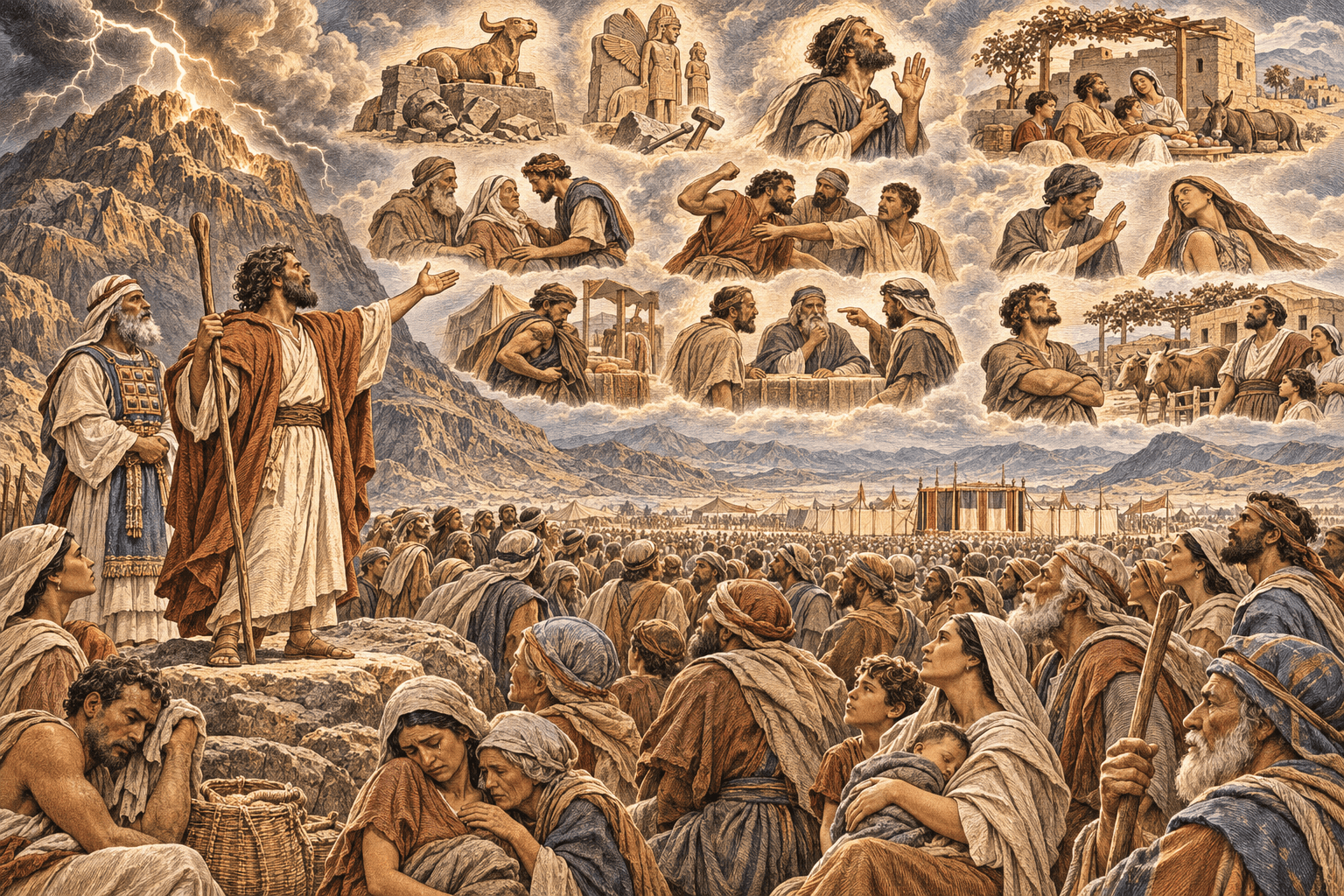
The prophet Moses repeats the Ten Commandments with their explanation. Those who had heard the Ten Commandments had died and their bones had decayed; the new generation needed to hear these commandments with an explanation in the light of the experience of forty years in the wilderness.
Some may object that what is found here repeats what is in Exodus 20. Let it be so, for Scripture stresses the importance of these commandments and the duty of hearing them more than once, since they are fundamental in the believer’s life. He had already spoken of the Ten Commandments, but he returns to remind them of them in some detail. So we should not tire of hearing the commandment until we fulfill it, and God’s will becomes active in us. Speaking of the commandment again and again brings joy; as the Apostle Paul writes: “To write the same things to you, to me indeed is not grievous, but for you it is safe” (Philippians 3:1).
Indeed He is an awesome God, a consuming fire, yet He gives life to His people, as it says: “For who is there of all flesh, that hath heard the voice of the living God speaking out of the midst of the fire, as we have, and lived?” (26). He has shown us His glory and His greatness, and we have heard His voice out of the midst of the fire; “we have seen this day that God doth talk with man, and he liveth” (24). So we understand the commandment not as orders issued, but as an ascent, as on the mountain, to meet God in His glory, where He speaks with us face to face and we do not die.
The Ten Commandments are the core of the Law and the foundation of God’s covenant, and chapters 12–26 can be considered a detailed application of their principles to the life of the people in the land of Canaan. The people of the Old Testament cared to carry out their outward form, but our Lord Jesus revealed their depths. Christ made them a rule “to enter into life” when He asked the rich young man to keep them in order to live (Matthew 19:18), and He made them the rule of life for all His followers. The people of old thought they were justified merely by receiving the commandments; but in the New Testament, discovering humanity’s inability to fulfill all the commandments in their depth, we realize our need for the Lord Christ, who justifies us by His blood and supports us by His Holy Spirit to carry out the commandment.
I am the Lord thy God, which brought thee out of the land of Egypt, from the house of bondage. Thou shalt have none other gods before me. Thou shalt not make thee any graven image, or any likeness of any thing that is in heaven above, or that is in the earth beneath, or that is in the waters beneath the earth: Thou shalt not bow down thyself unto them, nor serve them: for I the Lord thy God am a jealous God, visiting the iniquity of the fathers upon the children unto the third and fourth generation of them that hate me, And shewing mercy unto thousands of them that love me and keep my commandments. [6–10]
God gives the name “Jehovah,” the God of the covenant, and enters into fellowship and union with His chosen people as their portion. In the fullness of time He gave His Son (John 3:16), and this personal relationship between God and man in Christ is the foundation of the Christian faith.
“Visiting the iniquity of the fathers upon the children” (9): not in guilt, but in consequences; this is true and we sense it in practical experience. We also experience the promise of mercy “unto thousands of them that love me and keep my commandments” (10).
Thou shalt not take the name of the Lord thy God in vain: for the Lord will not hold him guiltless that taketh his name in vain. Keep the sabbath day to sanctify it, as the Lord thy God hath commanded thee. Six days thou shalt labour, and do all thy work: But the seventh day is the sabbath of the Lord thy God: in it thou shalt not do any work, thou, nor thy son, nor thy daughter, nor thy manservant, nor thy maidservant, nor thine ox, nor thine ass, nor any of thy cattle, nor thy stranger that is within thy gates; that thy manservant and thy maidservant may rest as well as thou. And remember that thou wast a servant in the land of Egypt, and that the Lord thy God brought thee out thence through a mighty hand and by a stretched out arm: therefore the Lord thy God commanded thee to keep the sabbath day. [11–15]
Man needs to set apart this day for worship, for waiting on the Lord and listening to His voice, so that he does not run in a feverish struggle to create wealth or wisdom, but his life gains meaning according to God’s purpose and guidance. This commandment is a prophecy of the coming eternal rest (Hebrews 4:9). So the Jewish Sabbath passed to the Christian Sunday, where true freedom is in Christ Jesus.
Honour thy father and thy mother, as the Lord thy God hath commanded thee; that thy days may be prolonged, and that it may go well with thee, in the land which the Lord thy God giveth thee. [16]
This fifth commandment concerns the holiest human bond, fatherhood, for the name “father” points first to God, and God honored human beings by using the same title. A person chooses his friends, but parents are the gift of God; God chose them as the means of a person’s coming into the world, an unequaled, surpassing service.
Honoring parents comes second after honoring God, who has the highest authority.
The Lord Christ rebuked the Jews for setting up a human tradition opposed to this divine commandment (Matthew 15:3–6; Mark 7:8–11), by which a son broke the commandment to honor his parents in practice and neglected their material needs, claiming that he would offer to the temple as a gift what he should have supported them with. As Origen says: “When the parents hear that what should have been given to them has become an offering dedicated to God, they hesitate to take it from their children, even if they are in great need of life’s necessities.” He also says that the Pharisees were lovers of money (Luke 16:14), so they pretended to collect it for giving to the poor, depriving the parents of their children’s gifts. [47]
Saint Jerome says:
“The Lord Himself discussed this commandment of the Law, which says, ‘Honour thy father and thy mother.’ He showed clearly that it is not to be interpreted in bare words, as when a person shows his parents an empty appearance of honor while leaving them poor and unable to obtain necessities, instead of honoring them by providing the actual necessities of life. The Lord commanded that poor parents must be supported by their children, so that they repay them in their old age the blessings they received from them in childhood.”
“On the contrary, the scribes and Pharisees taught sons to honor their parents by saying, ‘It is Corban,’ that is, a gift I have promised to offer at the altar; ‘I will bring it to the temple, and it will refresh you just as if we had given it to you directly to buy food.’ So it often happens that while the father and mother are in great need, their sons offer sacrifices for the priests and scribes to eat. [48]”
Thou shalt not kill. Neither shalt thou commit adultery. Neither shalt thou steal. [17–19]
“Thou shalt not kill”: this sixth commandment declares the sanctity of human life. All life comes from God; we must look on it with reverence and respect as His gift.
Neither shalt thou bear false witness against thy neighbour. [20]
“Neither shalt thou bear false witness” (Exodus 20:16). This ninth commandment may seem negative in form, but it is positive in meaning: it sets truth against falsehood, forbidding falsehood in order to establish truth. All our words and testimony must be true, and our judgment just.
Neither shalt thou desire thy neighbour’s wife, neither shalt thou covet thy neighbour’s house, his field, or his manservant, or his maidservant, his ox, or his ass, or any thing that is thy neighbour’s. [21]
“Neither shalt thou desire” (21; Exodus 20:17). This tenth commandment differs from those before it in that it speaks of a person’s heart, not of what appears in his outward behavior; God alone sees whether it is broken or kept. In its negative form it forbids coveting what belongs to others, and in its positive form it teaches contentment and faith (Hebrews 13:5–6).
There is a slight difference between the wording of this commandment here and in Exodus 20:17: here the people were about to enter Canaan, a time of testing in which they would be tempted to covet a neighbor’s field, so Moses speaks to them of the neighbor’s field, which they must not covet.
In the so-called Second Letter of Saint Clement of Rome, the writer links true knowledge of God with love of neighbor:
“Let us, brethren, confess Him in our works, by loving one another (John 13:35; 15:12; 1 John 3:11)… We ought to be compassionate toward one another and not covetous. Let us confess Him by these works, not by their opposites. [49]”
The Ten Commandments and the ten plagues
Among the sermons of Father Caesarius, Bishop of Arles there are two sermons on the Ten Commandments and their connection with the ten plagues, [50] which say the following:
The number of the commandments equals the number of the plagues with which the Egyptians were struck because of their pride, for the Lord gave His commandments as a remedy for our grave wounds:
“You can verify that those ten commandments oppose the ten plagues in the same order. The first plague is struck down by the first commandment, the second plague by the second commandment, the third by the third, and so on to the tenth. [51]”
The first commandment, concerning the one God and not mixing Him with pagan gods (Exodus 20:3), came to heal the first plague of the Egyptians, when the waters were turned to blood. If blood points to bodily lusts, these lusts came as the fruit of unbelief in the one God. So through the first commandment the senses that had been darkened are sanctified and become wise and holy.
The Egyptians wanted to kill the Hebrew infants and shed their blood; therefore God turned the river’s waters to blood for them to drink. [52] We can say that the first commandment grants us to cleave to the living God and fear Him; then our bloody nature (violent and lustful) is changed into a gentle nature, watered by the waters of the Holy Spirit.
The second commandment is not to take the name of God in vain, for whoever does so will not be clean (Exodus 20:7); but whoever possesses the name of Jesus, the Truth, carries the fellowship of divine righteousness. We can say that this commandment is the medicine against the second plague, the filling of the land with frogs, which point to heretics and atheist philosophers. They offer deceptive philosophies like the ceaseless croaking of frogs in the mud; they have continual voices but no divine spiritual wisdom. They offer sounds to the ears, but cannot offer food to the soul or the mind. [53]
The third commandment concerns keeping the Sabbath (Exodus 20:8). It is a commandment of freedom, with rest of heart and quietness of mind through a good conscience. In reality this commandment points to the work of the Holy Spirit, the Giver of freedom and true rest. The Holy Spirit rests upon a person so that he keeps the spiritual Sabbath, drawing him into heavenly worship in the spirit instead of being troubled with temporal things. [54]
The fourth commandment concerns honoring parents (Exodus 20:12), and it opposes the fourth plague, of flies, for whoever does not honor his parents suffers from the evil of the devil and his torments. [55]
The fifth commandment, against adultery (Exodus 20:14), heals the plague of pestilence that fell on the cattle. A man who is not content with his wife but covets his brother’s wife or daughter loses his manhood; such a person is turned, as it were, into a beast in human form, for he does not want to hear the word of the Lord: “Be ye not as the horse, or as the mule, which have no understanding” (Psalm 32:9). If you do not fear being like beasts, fear dying like them.
The sixth commandment, “Thou shalt not kill,” corresponds to the sixth plague, the boils on men and beasts coming from the ashes of the furnace. Murderers are people whose souls are burned by the fires of anger and have become like the ashes of the furnace. The murderer kills himself before he kills the bodies of others. The commandment asks that our hearts not burn with anger but with love for others; the first causes deadly boils, while the second brings healing to the soul.
The seventh commandment, “Thou shalt not steal,” corresponds to the very grievous hail that fell like rain and destroyed animals and crops in the fields. Whoever steals, that is, unjustly plunders what is not his, suffers loss from heaven as from a heavy hail. By stealing a person thinks he has gained much in visible things, not realizing that he has really suffered invisible losses. Whoever through his evil lusts steals visible things is struck within by the hail of God’s heavenly judgments, and loses the hidden things.
If thieves could look at the fields of their hearts, they would realize the greatness of the loss that has befallen them: their souls die of hunger, for their resources have been destroyed by hail, while outwardly they think they have gained much by wronging others. Therefore the Apostle Peter directs us to inner riches: “the hidden man of the heart, in that which is not corruptible, even the ornament of a meek and quiet spirit, which is in the sight of God of great price” (1 Peter 3:4), so that a person is rich, not before people, but before God.
The eighth commandment, “Thou shalt not bear false witness,” corresponds to the plague of locusts, insects that destroy the fields with their mouths. So whoever bears false witness destroys himself and his brethren with the lying words of his mouth. Therefore the Apostle Paul warns us: “But if ye bite and devour one another, take heed that ye be not consumed one of another” (Galatians 5:15).
The ninth commandment is “Thou shalt not covet thy neighbour’s wife,” and the ninth plague is thick darkness. Truly, whoever covets his brother’s wife is overtaken by thick darkness, for nothing blinds the soul more or arouses greater anger. Whoever defiles another’s wife practices unbridled madness.
The tenth commandment is “Thou shalt not covet… any thing that is thy neighbour’s: his ox, his ass,” and so on. This corresponds to the plague of the death of the firstborn. Everything a person acquires is to be given to his heirs, and among heirs none is dearer than the firstborn. While a person is deprived of the possessions he wants to give his heirs, the one who plunders his brother’s possessions is deprived of his very firstborn, not only of what he would leave as inheritance. Who is this slain firstborn but faith, the firstborn of the heart and its source? For no one can do a good work unless faith is first born in his heart as its firstborn.
Father Caesarius concludes his Sermon 100 by saying that through the Ten Commandments a person is freed from the unjust persecution of the Egyptians, that is, from the spiritual oppression in his depths, so that his heart may be free and set out for the Promised Land with divine help.
The Ten Commandments in three complementary parts
First: Commandments concerning our relationship with God
1. Being bound to God alone, with no other besides Him (commandment 1). This God we have come to know in His mysteries through the Incarnation of the Word (Matthew 11:27).
Saint Augustine says [56] that when the Lord Christ spoke with the Jews about their freedom from bondage, they told Him they had never been in bondage to any man (John 8:31–36), though Joseph was sold as a slave (Genesis 37:28), holy prophets were found in captivity (2 Kings 24; Ezekiel 1), the people fell under the bondage of Pharaoh (Exodus 1:14), and even in the days of the Lord Christ they were subject to tribute to the Roman state (Matthew 22:15–21). What the Lord Christ wanted was to free them from the bondage of the ego and empty pride, but they understood freedom in a carnal sense.
2. Refraining from the worship of images (commandment 2), so that we do not turn aside to idol worship, that is, setting up images in the heart such as self-love and love of acquisition.
Though the prophet Moses testifies that God visits the iniquity of the fathers upon the children, in the same book he affirms that the father does not die for his son’s sin, nor the reverse (Deuteronomy 24:16). How? Saint John Chrysostom answers that the first text concerns the children who fill up the measure of their fathers and become worse than they. [57]
3. Not taking the name of God in vain (commandment 3). In ancient times, swearing by the name of God was a sign of honoring and fearing God, and so it was permitted; but in the New Testament, man having risen to the level of spiritual maturity, it is fitting that he swear not at all (Matthew 5). The commandment is concerned with the sanctification of the mouth. When the Apostle Paul spoke of the corruption of humanity, that all had gone astray and become corrupt together, he was concerned with the mouth: “Their throat is an open sepulchre; with their tongues they have used deceit; the poison of asps is under their lips: Whose mouth is full of cursing and bitterness” (Romans 3:13–14).
4. Keeping the Sabbath (commandment 4; see Exodus 20). We have spoken earlier in some detail about the Sabbath, its keeping and its rites, [58] and we noted that in its essence it is not a heavy commandment binding on the believer, but a joyful feast that reflects the spirit of gladness on the whole community, on every believer with his household and the strangers staying with him, on hired servants and slaves, and even gives rest to the animals.
The books of the Old Testament gave special emphasis to the commandment of keeping the Sabbath in order to focus minds on expecting the coming of the Savior, our Liberator from the bondage of the devil and the Giver of true rest. As Saint Clement of Alexandria says: “We keep the spiritual Sabbath until the coming of the Savior, having rested from sin.” [59] And Saint Augustine says: “(In it) we shall rest and see, see and love, love and praise; this is what shall be in the end without end.” [60]
The difference appears clearly in the fourth commandment concerning the sanctification of the Sabbath day. In Exodus 31:13 God asked us to sanctify the Sabbath day because He created the world in six days, so we should sanctify it, that is, consecrate the seventh day to offering worship and thanks to the Creator. Here, however, He gives a new reason: sanctifying the Sabbath day for the sake of His saving works and the renewal of our life, for He is the One who freed us from the bondage of the devil (Pharaoh) and brought us into the heavenly Canaan. Now the Lord has become our Sabbath; in Him the Father finds His rest toward us, and we find our rest.
The Lord reminds them of the bitterness of the slavery they lived in Egypt, counting their Exodus as the Sabbath or rest through which they enjoyed freedom. The true Sabbath is that we give others the spirit of freedom, so that their souls are not embittered in humiliation. The Sabbath is the soul’s going forth in love toward all the brethren, and even toward animals and birds, longing for all to enjoy true rest.
If the Sabbath is man’s “exodus” from the bondage of the devil, our Sabbath has become Sunday, as our exodus under the leadership of the Lord Christ, hidden in Him, out of the bondage of the devil into the glorious liberty of the children of God.
Second: Commandments concerning our relationship with our relatives in the Lord
5. Honoring parents (commandment 5). After giving the commandments concerning the believer’s relationship with God, he gives the commandments concerning his relationship with people, beginning with his relationship with his parents. Whoever does not know how to honor the parents he sees and touches physically, how can he honor God, his heavenly Father? In this commandment he added what the Apostle Paul quoted in his Epistle to the Ephesians (Ephesians 6:3): “that thy days may be prolonged, and that it may go well with thee, in the land which the Lord thy God giveth thee” (16).
Length of life does not mean the literal sense, but a person’s enjoyment of good. The moments that the unborn John the Baptist lived in the womb of his mother Elizabeth were fuller of fruit than those of the leaders, the elders of Israel, who denied the faith and resisted the truth. Therefore it is said that one day with the Lord is as a thousand years, and a thousand years as one day. God’s reckoning is not our human reckoning. Solomon the Wise says: “Though a sinner do evil an hundred times, and his days be prolonged, yet surely I know that it shall be well with them that fear God, which fear before him: But it shall not be well with the wicked, neither shall he prolong his days, which are as a shadow; because he feareth not before God” (Ecclesiastes 8:12–13).
Third: Commandments concerning our relationship with society in the Lord
The last five commandments come together as though they were one commandment: “Thou shalt not kill. Neither shalt thou commit adultery. Neither shalt thou steal. Neither shalt thou bear false witness against thy neighbour. Neither shalt thou desire thy neighbour’s wife, neither shalt thou covet thy neighbour’s house, his field, or his manservant, or his maidservant, his ox, or his ass, or any thing that is thy neighbour’s” (17–21). In this way the prophet Moses showed the unity of the commandments. As James the Apostle says: “For whosoever shall keep the whole law, and yet offend in one point, he is guilty of all” (James 2:10).
- 6. Thou shalt not kill (commandment 6). The Lord Christ made clear that a person may kill with his tongue (Matthew 5).
- 7. Thou shalt not commit adultery (commandment 7). The Lord of glory asks of us inner purity of heart (Matthew 5).
- 8. Thou shalt not steal (commandment 8).
- 9. Thou shalt not bear false witness against thy neighbour (commandment 9).
- 10. Thou shalt not covet thy neighbour’s wife, his house, or his field (commandment 10). This happens when the heart is occupied with God Himself, and so is satisfied and overflows with love instead of seeking what belongs to others.
Saint Basil the Great says:
“Truly the laws of God groan aloud when they see great corruption on the earth. [61]”
These words the Lord spake unto all your assembly in the mount out of the midst of the fire, of the cloud, and of the thick darkness, with a great voice: and he added no more. And he wrote them in two tables of stone, and delivered them unto me. [22]
The prophet Moses also made clear that these commandments were given in an atmosphere of wonderful awe. If fire is awesome, its awe is greater in the midst of darkness. The prophet stressed, “and he added no more,” meaning that God’s commandments are complete and need no addition.
“The fire, of the cloud, and of the thick darkness” (22): the people heard thunder, but Moses heard the words (John 12:29; Acts 9:7). Moses was a mediator between God and the people (Galatians 3:19), as a symbol of the Lord Christ (see Deuteronomy 34:10).
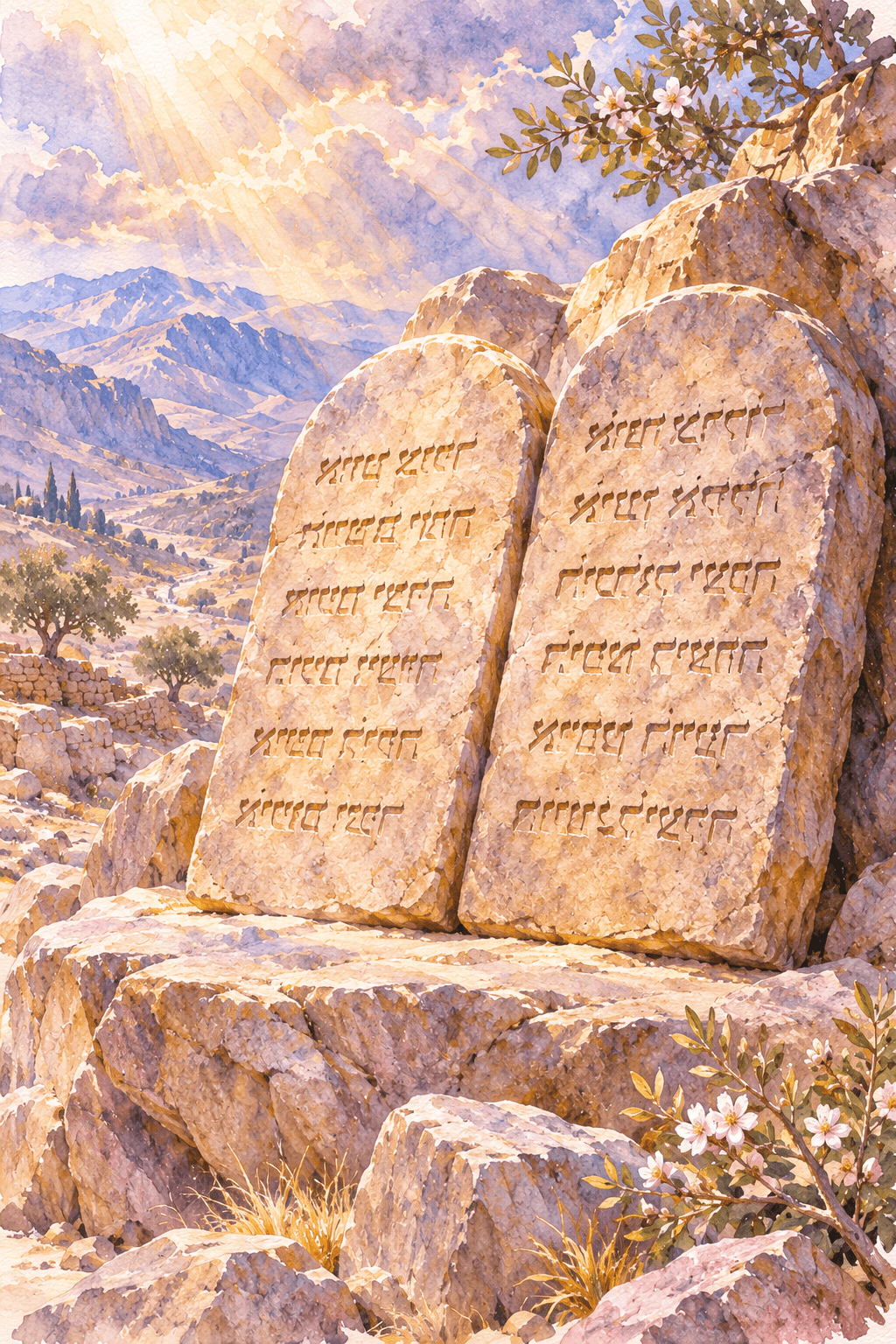
The commandments were written on two tablets of stone: “And he wrote them in two tables of stone, and delivered them unto me” (22). He engraved them on two stones so that no one could change anything in them.
The two stones point to the heart, for the human heart had become stony and needed the divine commandment to be engraved on it by the finger of God. The prophet Moses placed the two tablets in the ark of the covenant, which points to the divine presence. Saint John the Beloved says: “And the temple of God was opened in heaven, and there was seen in his temple the ark of his testament: and there were lightnings, and voices, and thunderings, and an earthquake, and great hail” (Revelation 11:19).
3. Moses Receives the Law
KJV · Verses 23–33
23 And it came to pass, when ye heard the voice out of the midst of the darkness, (for the mountain did burn with fire,) that ye came near unto me, even all the heads of your tribes, and your elders; 24 And ye said, Behold, the Lord our God hath shewed us his glory and his greatness, and we have heard his voice out of the midst of the fire: we have seen this day that God doth talk with man, and he liveth. 25 Now therefore why should we die? for this great fire will consume us: if we hear the voice of the Lord our God any more, then we shall die. 26 For who is there of all flesh, that hath heard the voice of the living God speaking out of the midst of the fire, as we have, and lived? 27 Go thou near, and hear all that the Lord our God shall say: and speak thou unto us all that the Lord our God shall speak unto thee; and we will hear it, and do it. 28 And the Lord heard the voice of your words, when ye spake unto me; and the Lord said unto me, I have heard the voice of the words of this people, which they have spoken unto thee: they have well said all that they have spoken. 29 O that there were such an heart in them, that they would fear me, and keep all my commandments always, that it might be well with them, and with their children for ever! 30 Go say to them, Get you into your tents again. 31 But as for thee, stand thou here by me, and I will speak unto thee all the commandments, and the statutes, and the judgments, which thou shalt teach them, that they may do them in the land which I give them to possess it. 32 Ye shall observe to do therefore as the Lord your God hath commanded you: ye shall not turn aside to the right hand or to the left. 33 Ye shall walk in all the ways which the Lord your God hath commanded you, that ye may live, and that it may be well with you, and that ye may prolong your days in the land which ye shall possess.
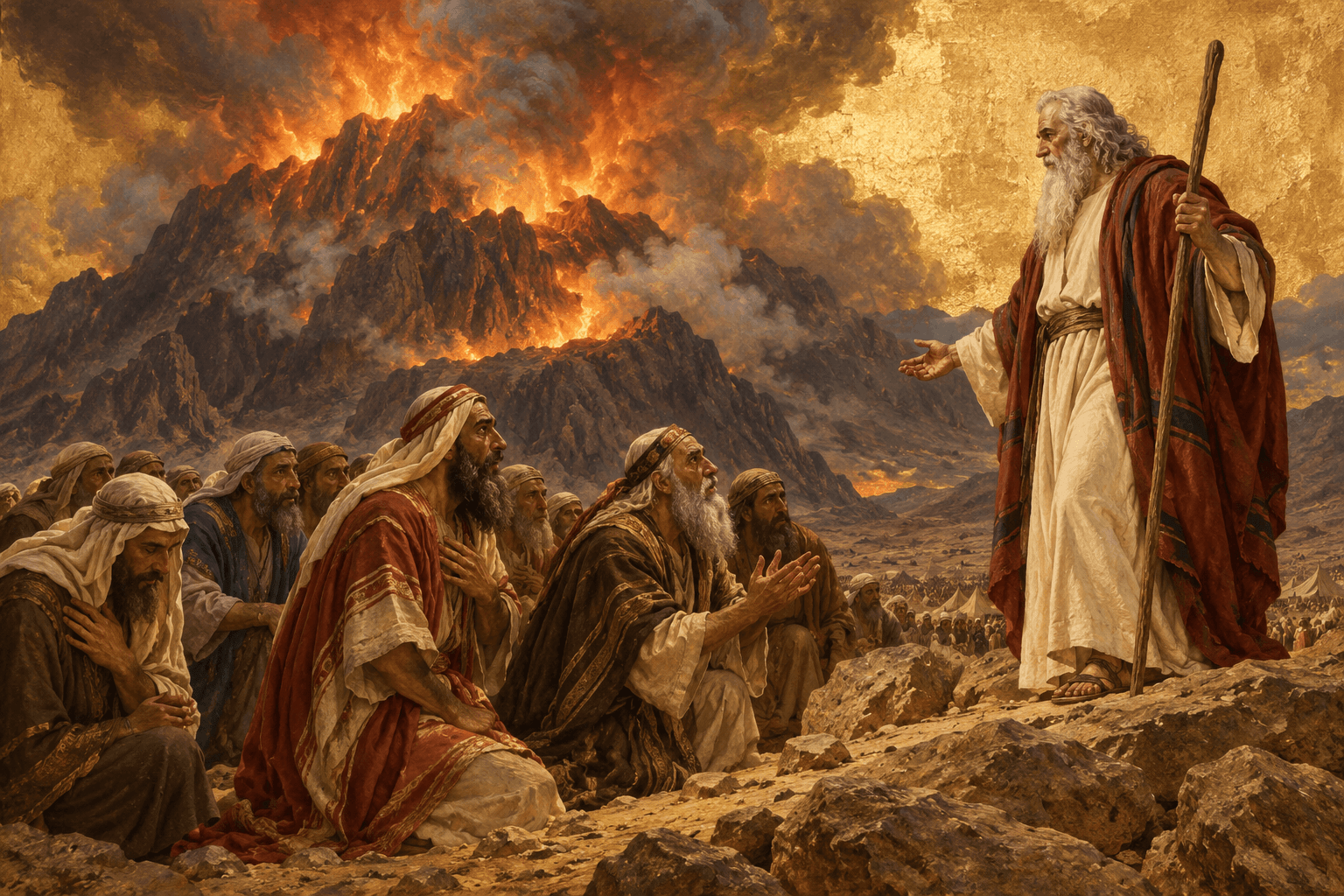
The people could no longer bear more than they had seen of the fire burning on the mountain, with the awesome divine voice coming out of the midst of the darkness. Therefore they asked Moses to go forward and receive the Law on behalf of the whole people. The people realized that they could not see or hear more without dying, yet they had a true longing to hear more and more; so they asked the prophet Moses to complete the journey. Remarkably, this request came a short time after they had wanted to kill and stone him (Exodus 17:4).
He also showed them how much God cared for them: when they spoke with Moses, God paid attention to their words, as One occupied with them and with what they said. “And the Lord heard the voice of your words, when ye spake unto me; and the Lord said unto me, I have heard the voice of the words of this people, which they have spoken unto thee: they have well said all that they have spoken” (28).
God, who cares for them, asks that their hearts be full of a godliness that matches what their tongues utter: “O that there were such an heart in them, that they would fear me, and keep all my commandments always, that it might be well with them, and with their children for ever!” (29). With their lips they showed that they wanted more divine words, or the laws He gave through Moses as their representative; but God asks for their hearts and not merely their lips.
Here the heart expresses true longing, sincere desire, and deep love; it also represents free human will. Let them ask in full freedom: if their hearts have grown cold, He will turn them into a blazing divine fire; and if they have become completely hardened, He will engrave His commandments on them with His finger, making the heart two tablets of testimony, holy to the Lord and witnessing to the divine word.
Saint John Chrysostom says:
“Wishing to show God’s great longing for our salvation, hear what He promised the people after their many transgressions, that they might walk in the straight way, saying: ‘O that there were such an heart in them, that they would fear me, and keep all my commandments always, that it might be well with them, and with their children for ever!’ (29). And as Moses reasoned with them, he said: ‘And now, Israel, what doth the Lord thy God require of thee, but to fear the Lord thy God, to walk in all his ways, and to love him?’ (Deuteronomy 10:12).”
“He who cares that we love Him, and does everything with this aim, did not spare His only Son out of His love for us, counting it something dear to Him if we are reconciled to Him at any time. How then will He not welcome and love us if we repent? [62]”
God appointed the prophet Moses as His messenger to receive the Law from His divine mouth: “But as for thee, stand thou here by me, and I will speak unto thee all the commandments, and the statutes, and the judgments, which thou shalt teach them, that they may do them in the land which I give them to possess it” (31).
Saint Ambrose says:
“This is what was said to Moses: ‘for the place whereon thou standest is holy ground’ (Exodus 3:5). No one stands unless he stands by faith, unless he stands firm and resolute in heart. Elsewhere we read: ‘But as for thee, stand thou here by me’ (Deuteronomy 5:31). Each of these sayings the Lord spoke to Moses, meaning: stand with Me, if you stand firm in the Church. For the place itself is holy, the very ground fruitful in holiness and rich in the harvest of virtues.”
“Stand, then, in the Church; stand where I appear to you, and where I will be with you. Where the Church is, there is the firmest place for the rest of your mind; there you find help for your soul, and I appear to you in the bush. You are the bush, and I am the fire. The fire burns in the bush; I am in the flesh. Therefore I am the fire, to give you light and to consume your thorns, that is, your sins, and to show you My grace. As you stand firm in your heart, I drive away the wolves that seek to find prey… [63]”
Ye shall observe to do therefore as the Lord your God hath commanded you: ye shall not turn aside to the right hand or to the left. [32]
By saying this He wants us to take care to act according to the Lord’s command, that is, to accept with joy that His divine will takes the place of our will, or to accept that He shapes our will to conform to His. Though we lose our weak self-will, we enjoy something greater: with our free will we carry God’s will at work in us.
The aim of this will is walking in the way of truth and righteousness, as a straight way that carries us to the Father’s bosom and moves us toward inner glories, with fellowship in heavenly glory. What is this way but the One who said, “I am the way, the truth, and the life”?
4. A Meditation on Deuteronomy 5
I Will Not Turn Aside from You to the Right Hand or to the Left
You have given me Your commandments as a way of truth.
Your Spirit carries me and leads me on the royal road.
I do not turn to the left through lusts and abominations,
but walk on the royal road and reach the bosom of Your Father.
You are the Way, the Truth, and the Life.
You gave me the Ten Commandments out of the midst of the fire.
Let my heart become a blazing fire, so that You speak within me.
Engrave Your divine commandments on my stony heart,
and make my depths an ark of covenant for You.
Let me keep Your commandments by Your fiery Spirit,
so that I see no god but You.
My heart grows wide for You, and carries within it the humanity You love.
I become a living icon of You,
and am made like You, O You who have no likeness!
Notes and References
[47] The author: The Gospel according to Saint Matthew, 1983, p. 343.
[48] Saint Jerome, Letter 123, to Ageruchia.
[49] The so-called Second Letter of Clement, 3:4.
[50] Father Caesarius of Arles, Sermons 100, 100a.
[51] Father Caesarius of Arles, Sermon 100:1.
[52] Father Caesarius of Arles, Sermon 100:2.
[53] Father Caesarius of Arles, Sermon 100:3.
[54] Father Caesarius of Arles, Sermon 100:4.
[55] Father Caesarius of Arles, Sermon 100:5.
[56] Saint Augustine, On the Gospel of Saint John, Tractate 41:2.
[57] See Saint John Chrysostom, Homilies on John, 56.
[58] See the author’s commentary on Leviticus, chapter 23.
[59] The author: Christ in the Sacrament of the Eucharist, 1973, p. 125.
[60] Saint Augustine, The City of God, 22:30.
[61] Saint Basil the Great, Letters, 46:1.
[62] Saint John Chrysostom, Letters to the Fallen Theodore, 1:15.
[63] Saint Ambrose, Letter 63:41–42.