
For the sanctification of the people, He asked for the destruction of Amalek, which was determined to resist holiness, spread the spirit of corruption, and propagate abominable practices. But the negative side is not enough; the people in the Promised Land are obliged to positive work, that is, to offer the firstfruits in a wonderful religious rite. The firstfruits are a thank offering to God, the Giver of the holy land and the Giver of good things, and an affirmation of the continuing bond of the believer with his God and the renewal of the covenant with Him in the land of sojourning.
Thanksgiving in the Bible and Thanksgiving in the West
The rite of thanksgiving in the Old Testament carries three important elements: praise, giving, and renewal of the covenant with God or affirmation of obedience to Him. In the New Testament, the “day of thanksgiving” became Sunday, when the Church offers the unique, unrepeatable sacrifice of Christ to the Father; she offers Him the Firstborn Son. This is her offering, bound up with praise, giving, and the affirmation of the covenant with God on a transcendent level.
Unfortunately, “Thanksgiving Day” in North America has become a day of eating, and sometimes of drunkenness, songs, and dissolute parties… and many ignore giving, praise, and the enjoyment of the covenant with God.
This chapter calls us to review our concepts of thanksgiving and of offering the firstfruits to God according to what pleases Him, and not according to human whims.
Notice that this wonderful rite affirms the necessity of praise and thanksgiving on every level:
- The personal level: each member comes to the house of the Lord in a personal relationship with God, thanking God for the good things he has enjoyed.
- The family level: what is offered is in the name of the whole family.
- The ecclesial level: the believer praises God who has worked in our Church since the age of the fathers, still works, and will work through the generations to build up His Church.
- The national level: the believer thanks God for His dealings with Israel as a special nation.
1. The Offering of the Firstfruits
KJV · Verses 1–11
1 And it shall be, when thou art come in unto the land which the Lord thy God giveth thee for an inheritance, and possessest it, and dwellest therein; 2 That thou shalt take of the first of all the fruit of the earth, which thou shalt bring of thy land that the Lord thy God giveth thee, and shalt put it in a basket, and shalt go unto the place which the Lord thy God shall choose to place his name there. 3 And thou shalt go unto the priest that shall be in those days, and say unto him, I profess this day unto the Lord thy God, that I am come unto the country which the Lord sware unto our fathers for to give us. 4 And the priest shall take the basket out of thine hand, and set it down before the altar of the Lord thy God. 5 And thou shalt speak and say before the Lord thy God, A Syrian ready to perish was my father, and he went down into Egypt, and sojourned there with a few, and became there a nation, great, mighty, and populous: 6 And the Egyptians evil entreated us, and afflicted us, and laid upon us hard bondage: 7 And when we cried unto the Lord God of our fathers, the Lord heard our voice, and looked on our affliction, and our labour, and our oppression: 8 And the Lord brought us forth out of Egypt with a mighty hand, and with an outstretched arm, and with great terribleness, and with signs, and with wonders: 9 And he hath brought us into this place, and hath given us this land, even a land that floweth with milk and honey. 10 And now, behold, I have brought the firstfruits of the land, which thou, O Lord, hast given me. And thou shalt set it before the Lord thy God, and worship before the Lord thy God: 11 And thou shalt rejoice in every good thing which the Lord thy God hath given unto thee, and unto thine house, thou, and the Levite, and the stranger that is among you.
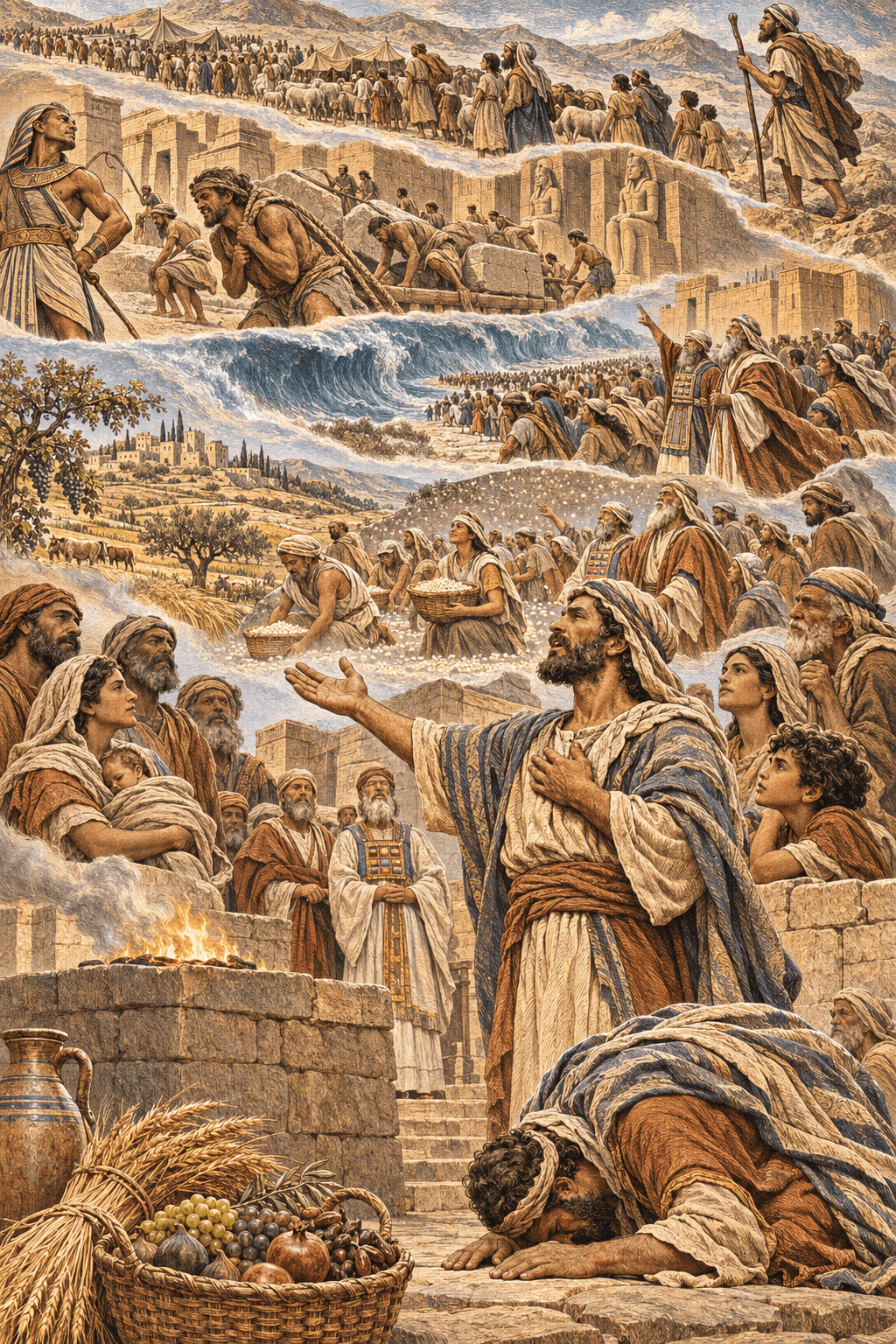
The believer was asked to bring a basket in which he gathered the firstfruits of the fruits for the Lord every year (see verses 1–2 above). This was besides the firstfruits sheaf offered for the whole land on the day after the Passover (Leviticus 23:10). Each man brought his own basket of firstfruits at the Feast of Pentecost (Weeks), at the end of the harvest, which is called “the feast of firstfruits” (Exodus 34:22). It is said that it was kept together with the freewill offering, as a person’s hand allowed (Deuteronomy 16:10).
The Jews hold that when a person found that the fruits had ripened, he took their firstfruits for the Lord and put them in the basket, which contained wheat, barley, grapes, figs, pomegranates, olives, and dates, putting leaves of trees between each kind and the next; then he offered this basket.
Offering the firstfruits is a thank offering to God, who gave them the Promised Land after the bitterness of bondage in Egypt. It is a symbol of the Lord Christ, our Firstfruits, through whom we have enjoyed eternal life and have been counted God’s own possession.
Notice the following in this offering:
First: By this offering the believer confesses that all he has is a gift from God, and that he offers from what God has given him.
Second: That a person deny himself, offering the firstfruits of the ripe fruits to God, offering what is God’s before what he takes for himself; in other words, God comes first in everything. So we ought to offer the firstfruits of our life, our time, our works, and our gifts to God, offering the best we have for His sake.
Third: When the believer offers the firstfruits of the best of the harvest, he declares that the people consecrated to God from among the peoples of the world must be ripe firstfruits, so that we do not hear what was said by Micah the prophet: “Woe is me! for I am as when they have gathered the summer fruits, as the grapegleanings of the vintage: there is no cluster to eat: my soul desired the firstripe fruit. The good man is perished out of the earth: and there is none upright among men” (Micah 7:1–2).
Fourth: When the believer comes with the basket bearing the firstfruits of the crops, he affirms that the land which God promised to his fathers and which he received is still in his hands and in his possession. For a time came when the people lost their land and were led into captivity, in Assyria (Israel) and then in Babylon (Judah).
Fifth: The material giving is accompanied by a thank offering to God, by which the believer confesses God’s dealings with all his fathers throughout the generations as dealings with him personally (see verse 3 above). After that the priest sets the basket before the altar of the Lord, and the believer makes his declaration (see verses 4–9 above).
So every believer offers a hymn of thanksgiving to God for His gifts to him personally and to the whole people through the generations. In this hymn the believer confesses the following:
1. All the generations look to the blessings they receive and see that what has been fulfilled with them is a divine promise to Abraham, who was not an Israelite but an Aramean (Syrian), a wanderer with no place to settle. At the feast of thanksgiving they must come in a spirit of humility, realizing that their fathers Abraham, Isaac, and Jacob were not Israelites. So their hearts ought to open in love toward the other nations. Abraham, the father of the fathers, lived in Mesopotamia (between the rivers), as is written in Genesis (Genesis 29–31), and to this region his origin goes back (Genesis 11:31).
2. Though they are proud to be the children of Abraham, he and his men were few in number (5). So the great number they reached is a divine gift.
3. His people were born poor, strangers, and persecuted in Egypt, and now they have become rich and very great; so there is no room for pride, nor any place for ignoring the riches of God’s grace toward them. No offering is accepted unless it is accompanied by a hymn full of the spirit of humility and thanksgiving to God. So through this yearly offering with its spiritual rites, the memory of God’s dealings with them, His gifts, and His blessings remains their constant meditation.
It is as though every year, when the believer celebrates the feast of firstfruits or the day of thanksgiving, he praises God for the following blessings:
- His origin goes back to Aramean (Syrian) fathers who were not yet God’s chosen people, yet were greatly beloved by Him, received the divine promises, and entered into a covenant with God or renewed the covenant with Him.
- His fathers were strangers in Egypt and fell under the bitterness of bondage, and now he has received freedom.
- When the people entered Egypt they were very few, and now their number cannot be counted.
- He has received a portion of the Promised Land, which still yields him free and continual good things.
- He now enjoys the divine presence, standing before the Lord to offer love and giving from what God has given him, and renewing the covenant with Him!
Sixth: An affirmation that what the believer offers is from what God has given him (see verse 10 above). The believer ought to translate the hymn of thanksgiving into action, or giving, as Jacob did: “of all that thou shalt give me I will surely give the tenth unto thee” (Genesis 28:22). This is what was expressed on the day of the dedication of the house of the Lord, and what the men of God always affirm: “for all things come of thee, and of thine own have we given thee” (1 Chronicles 29:14).
Seventh: The offering is accompanied by feelings of joy that fill the whole house: “And thou shalt rejoice in every good thing which the Lord thy God hath given unto thee, and unto thine house, thou, and the Levite, and the stranger that is among you” (11). God wants His people to rejoice and exult, eating their bread with gladness and singleness of heart, praising God (Acts 2:46–47).
Eighth: If joy is a personal divine gift that the believer enjoys through God’s blessings and worship, the believer cannot practice this joy except through the community, for the ministers of the word and the strangers rejoice with him: “thou shalt rejoice… thou, and the Levite, and the stranger that is among you” (11).
2. The Tithes
KJV · Verses 12–15
12 When thou hast made an end of tithing all the tithes of thine increase the third year, which is the year of tithing, and hast given it unto the Levite, the stranger, the fatherless, and the widow, that they may eat within thy gates, and be filled; 13 Then thou shalt say before the Lord thy God, I have brought away the hallowed things out of mine house, and also have given them unto the Levite, and unto the stranger, to the fatherless, and to the widow, according to all thy commandments which thou hast commanded me: I have not transgressed thy commandments, neither have I forgotten them. 14 I have not eaten thereof in my mourning, neither have I taken away ought thereof for any unclean use, nor given ought thereof for the dead: but I have hearkened to the voice of the Lord my God, and have done according to all that thou hast commanded me. 15 Look down from thy holy habitation, from heaven, and bless thy people Israel, and the land which thou hast given us, as thou swarest unto our fathers, a land that floweth with milk and honey.
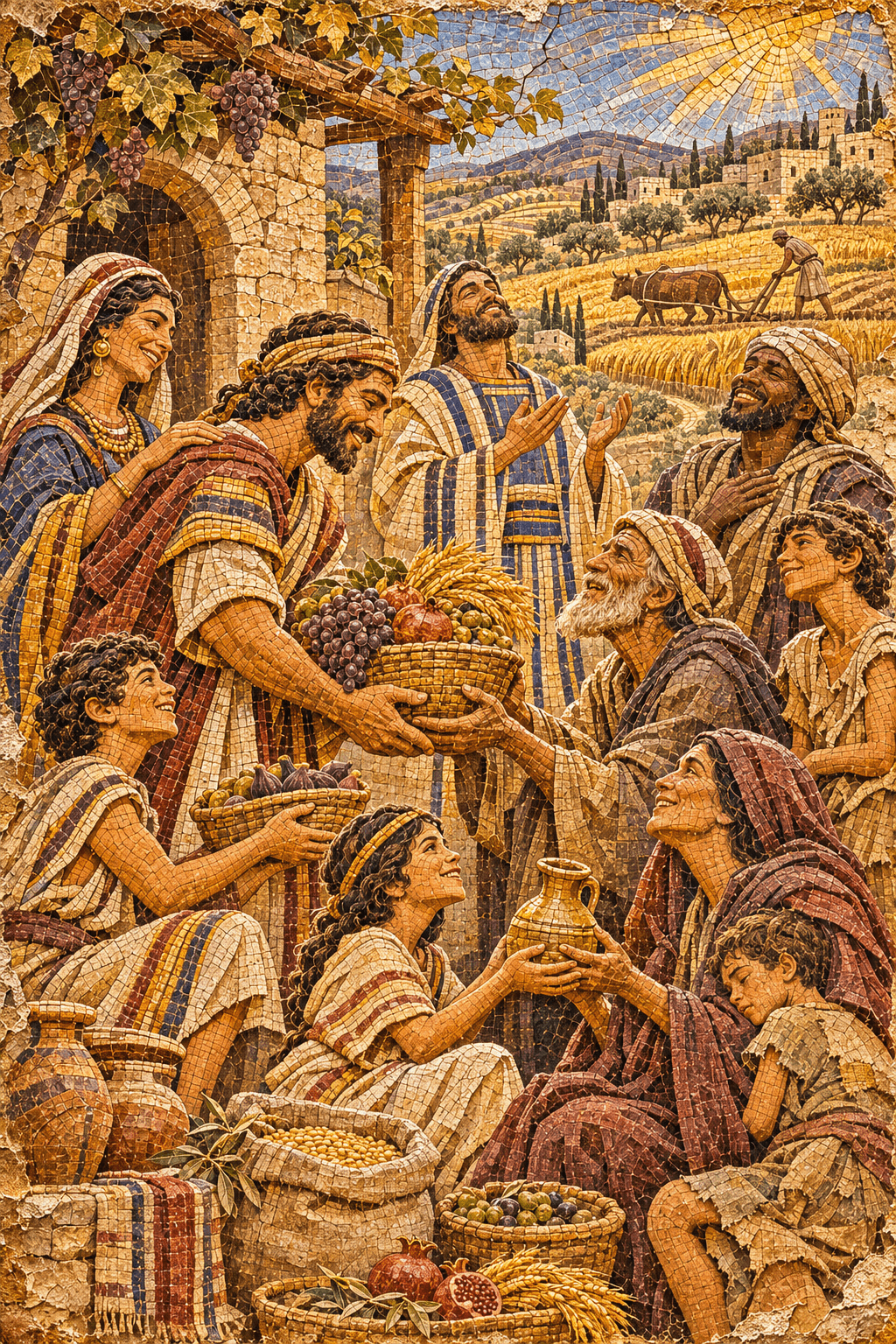
We have already spoken about offering the tithes of the third year in the commentary on Deuteronomy 14:28–29. Some suppose that the third and sixth years of the sabbatical cycle were the two years of tithes devoted to the poor, besides the tithes offered to the temple.
Notice the following in the law of tithes:
A) Care for all the needy together with the ministers of the Lord: “When thou hast made an end of tithing all the tithes of thine increase the third year, which is the year of tithing, and hast given it unto the Levite, the stranger, the fatherless, and the widow, that they may eat within thy gates, and be filled” (12).
For two years the believer carried his tithes to the house of the Lord to offer them to the Lord, but in the third year he did this work in his own house. They are offered in the third year as a symbol of the resurrection with Christ on the third day; by His resurrection we have received a heart enlarged toward all, especially toward the ministers of the Lord’s house, the strangers, and the needy.
While the firstfruits and tithes are offered in the house of the Lord before His altar, tithes are also offered to needy believers. The firstfruits point to the heavenly Lord Christ, who carries us to His heavens, and the tithes point to our sanctification in Him, so that our land, or our life, becomes holy in Him. On the one hand God affirms His presence in the midst of His people through His house dedicated to Him, and on the other hand He declares His presence in the midst of their homes, the holy family churches.
In love we carry our gifts to the house of the Lord to declare our longing to set out toward heaven, and we offer our gifts in our home to see the Lord coming to us through His ministers (the Levites), the poor, and the needy.
B) The gift of tithes is accompanied by a true longing to obey the divine commandment (see verse 13 above).
His saying, “before the Lord thy God,” does not necessarily mean being in the temple, for the believer senses the divine presence wherever he is. Isaac said to his son Esau: “and bless thee before the Lord before my death” (Genesis 27:7).
If the divine commandment requires offering the tithes, which are holy to the Lord, I will not covet any part of them, but offer to God what He commanded me; for when I practice this commandment, which touches material things, I declare my obedience to all the commandments. So material giving, especially tithes in the Old Testament, if not accompanied by the giving of free will, a longing to obey, and remembrance of the commandment, is not acceptable to God.
C) Giving and all the rites that accompany it are accompanied by a spirit of joy together with holiness. So, since in the tithes of the other two years some parts of the sacrifices were allowed to be eaten by the one who offered them, he had to eat them not in a spirit of greed and lust, but with heavenly joy together with holiness (see verse 14 above).
Perhaps he means: I have not offered anything of what is Yours to an idol; that is, I have not mixed the sacrifices that are God’s with those that are the idols’, nor joined the worship of God with pagan worship. It is said that some would shed the blood of the sacrifices before the idols and then offer the meat in the name of the living God.
The believer testifies that he has not eaten of the tithes of his crops in his mourning (14), that is, he has not used them as an offering to idols, as in Hosea 9:4: “their sacrifices shall be unto them as the bread of mourners; all that eat thereof shall be polluted,” and in Ezekiel 24:17: “and eat not the bread of men.” This offering was connected with the god of fertility who died, was buried, and rose, so that the pagans shared in mourning for him. He affirms the same meaning by saying, “nor given ought thereof for the dead” (14), that is, he did not use it in the rite of the Canaanite fertility god. Perhaps by saying, “nor given ought thereof for the dead,” he means that he did not offer his sacrifices and gifts in honor of dead idols, or for the sake of friends or relatives who had died.
Some Jews hold that the believer says this confession (13–14) in a low voice, because it is a confession concerning himself; but the confession to God of His works is made in a loud voice.
D) He concludes his confession with a petition to the Lord of heaven to bless His people (see verse 15 above). It is as though what the believer offers of gifts, praises, and thanksgiving, with prayers and supplications, is in the name of the whole community.
E) The believer links his sincere godly life with his prayers, for God does not hear the prayers of the wicked who are determined on their wickedness, nor listen to the cries of heretics. Job asks: “Will God hear his cry when trouble cometh upon him?” (Job 27:9). And the Psalmist says: “If I regard iniquity in my heart, the Lord will not hear me” (Psalm 66:18). Whoever listens to the voice of sin, God does not listen to his petition, nor accept his offerings and sacrifices. “The sacrifice of the wicked is an abomination to the Lord: but the prayer of the upright is his delight” (Proverbs 15:8). “The Lord is far from the wicked: but he heareth the prayer of the righteous” (Proverbs 15:29). “Whoso stoppeth his ears at the cry of the poor, he also shall cry himself, but shall not be heard” (Proverbs 21:13). In other words, a person’s prayer is surely answered if he draws near to God with repentance, walking in the righteousness of Christ, and with a heart enlarged toward his brothers.
When the believer offers his longing for God and for the enjoyment of His blessings, he hungers and thirsts all the more for the divine blessings, and does not cease to ask for blessing in a spirit of love, not selfishness. He does not ask for himself alone, but for all the people: “bless thy people!” The believer’s thirst for the divine blessings is counted an inseparable part of the sacrifice of thanksgiving to God.
3. Remembering the Covenant
KJV · Verses 16–19
16 This day the Lord thy God hath commanded thee to do these statutes and judgments: thou shalt therefore keep and do them with all thine heart, and with all thy soul. 17 Thou hast avouched the Lord this day to be thy God, and to walk in his ways, and to keep his statutes, and his commandments, and his judgments, and to hearken unto his voice: 18 And the Lord hath avouched thee this day to be his peculiar people, as he hath promised thee, and that thou shouldest keep all his commandments; 19 And to make thee high above all nations which he hath made, in praise, and in name, and in honour; and that thou mayest be an holy people unto the Lord thy God, as he hath spoken.
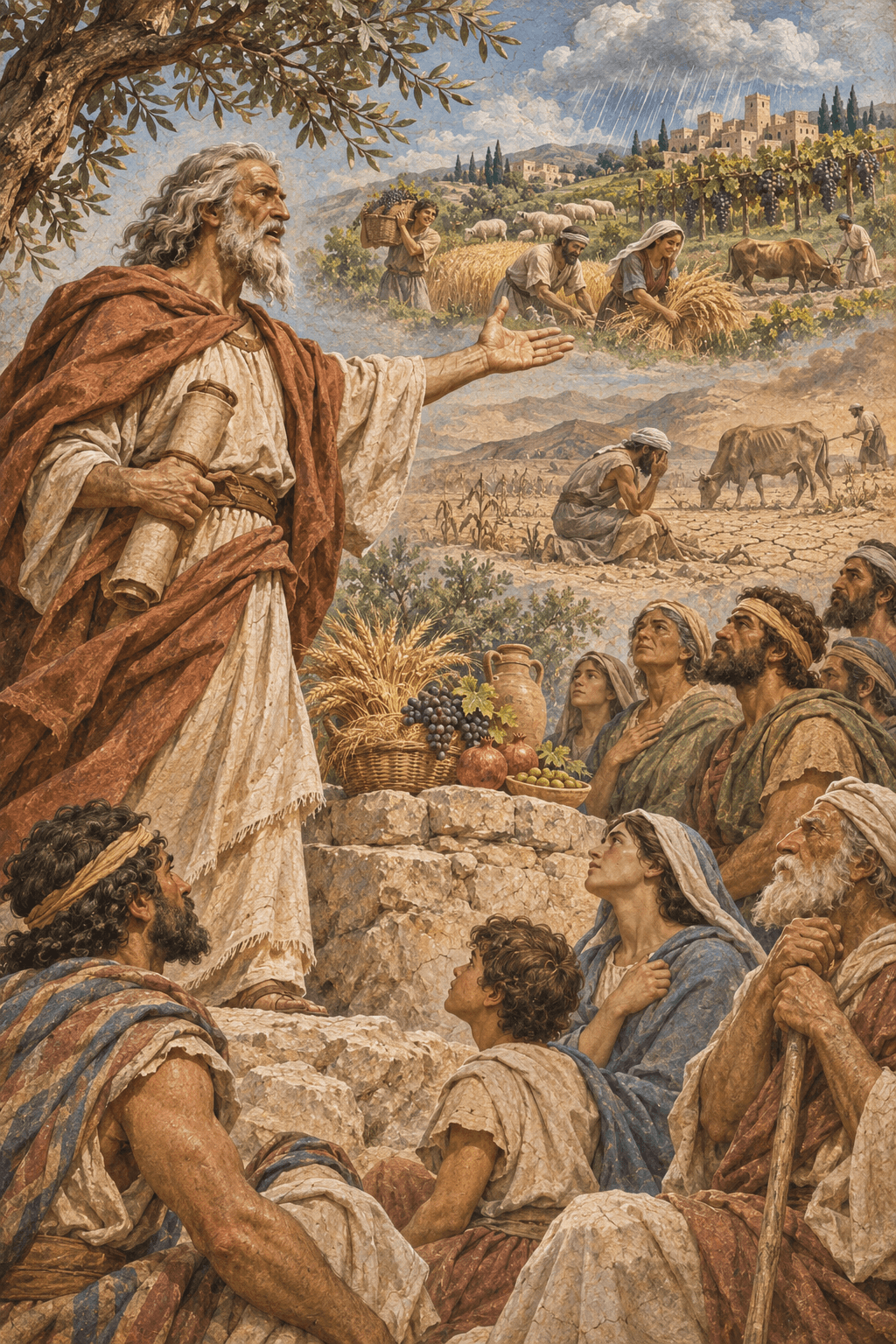
Some see in these verses (16–19) a “golden chain” that begins with God and ends with God. This chain contains the following stages:
- God first: He is the One who gives His commandments.
- When the people respond to the commandments with all the heart and soul, God declares that He belongs to them as their God.
- When God becomes their God, they listen all the more to His commandments, and become His holy, special people.
- When God’s people rise above all peoples, they bear what is God’s: praise, His holy name, and His surpassing splendor.
- This brings them into greater steadfastness as the Lord’s people, and a deeper belonging to God as their own God.
So the people enter an unbroken chain of glorious good things through their union with God their God.
Moses the prophet always focuses on two things: first, being occupied with the commandments of the Lord and keeping them in the inner depths; and second, remembering God’s covenant, or pact, with His own people and holding fast to it. The Law came to affirm the following:
- Union with God: “and will be their God, and they shall be my people” (Jeremiah 31:33).
- A holy life in the Holy God: “that thou mayest be an holy people unto the Lord thy God” (19).
- God’s care for the honor of His people as a whole among the peoples, and the honor of every believer, to make them like a heavenly angel bearing a heavenly citizenship. He says: “Since thou wast precious in my sight, thou hast been honourable, and I have loved thee…” (Isaiah 43:4).
What Moses the prophet presents are not his own commandments, but the commandments, statutes, and judgments that “the Lord thy God hath commanded thee to do” (16). These commandments do not grow old or age; they are commandments that God gives “this day” (16).
As for the fruit of keeping the commandment with all the heart and soul and faithfulness in holding fast to the divine covenant, it is:
First: That they become His special people (18).
Second: That God exalts His people and sanctifies them: “And to make thee high above all nations which he hath made, in praise, and in name, and in honour; and that thou mayest be an holy people unto the Lord thy God, as he hath spoken” (19). As it is said, righteousness exalts a nation, but sin is a reproach to any people (Proverbs 14:34). He exalts them, giving them the ability to praise, that they may share with the heavenly hosts in their praises. He gives them exaltation in name, binding them to His great name, so that heaven and earth stand amazed at the honor they have in the Lord; and exaltation in honor, for He reflects the splendor of His glory on them. Finally He sanctifies them, so that they become holy as He is holy.
In conclusion, it may be said that this chapter is a hymn of thanksgiving expressed by every means:
- Praise through the Church liturgy (the communal prayers arranged in a set order).
- Praise to God by practicing a spirit of joy and spreading this spirit in the lives of others.
- Praise in a spirit of giving and self-sacrifice, so that we express thanksgiving by deeds.
- Praise with a good free will, through obedience to the divine commandment and renewal of the covenant with God.
- Praise in a spirit of continual thirst for God Himself, who blesses His people without ceasing!
4. A Meditation on Deuteronomy 26
Accept Me as Firstfruits to You!
You long to see me as firstfruits, O unique Firstborn.
You want me as ripe fruit offered to You before Your divine throne,
that You may find in me Your delight, O secret of the joy of all creation.
You have no need of me, nor of my worship, nor of my gifts;
but You desire my heart, O You who are wonderful in Your love.
Accept the basket of my firstfruits, for I gather in it for You the firstfruits of Your gifts to me.
I offer You in it my surpassing thanks, O You who brought me out of nothing.
I thank You, for You freed me, not from the bondage of Pharaoh, but from the captivity of the devil.
You brought me across the Red Sea,
when You brought me into the waters of baptism, granting me a life of victory.
You gave me Your Holy Spirit as the guide of my life.
You carried me to the new Canaan,
Your land that flows with honey and milk.
I offer You my continual joy in You, O delight of my heart.
From the basket of firstfruits grant me to offer the tithes.
I feel great shame when I offer You from what You have given me.
Your rich hand reaches out to accept from my weakness what is Yours.
I will not come to Your temple with an empty hand, for You have filled it with good things.
I offer to You in Your house as in heaven!
I open the doors of my house with giving to Your ministers,
as to the stranger, the orphan, and the widow.
Let them come and eat with me of what You have given me.
I see You coming in them to bless my heart, my house, and my storehouses.
Let me carry of Your blessings to me into Your house,
and come into my house to accept the little of Your gifts to me!
I enter Your house, and You enter my house!
I find rest in Your heart, and You rest in my heart.