
Continuing the previous chapter, God declares His care and concern for the suffering, even when a person is under punishment. He sets a limit to the punishment of scourging, and cares for the ox that treads out the corn, so that the farmer does not muzzle it. He also cares for protecting the widow and raising up seed for the dead man who has no offspring, to establish his name. At the same time this chapter presents a group of various laws whose aim is to affirm care for the sanctification of the congregation that belongs to the Lord.
1. Forty Stripes
KJV · Verses 1–3
1 If there be a controversy between men, and they come unto judgment, that the judges may judge them; then they shall justify the righteous, and condemn the wicked. 2 And it shall be, if the wicked man be worthy to be beaten, that the judge shall cause him to lie down, and to be beaten before his face, according to his fault, by a certain number. 3 Forty stripes he may give him, and not exceed: lest, if he should exceed, and beat him above these with many stripes, then thy brother should seem vile unto thee.
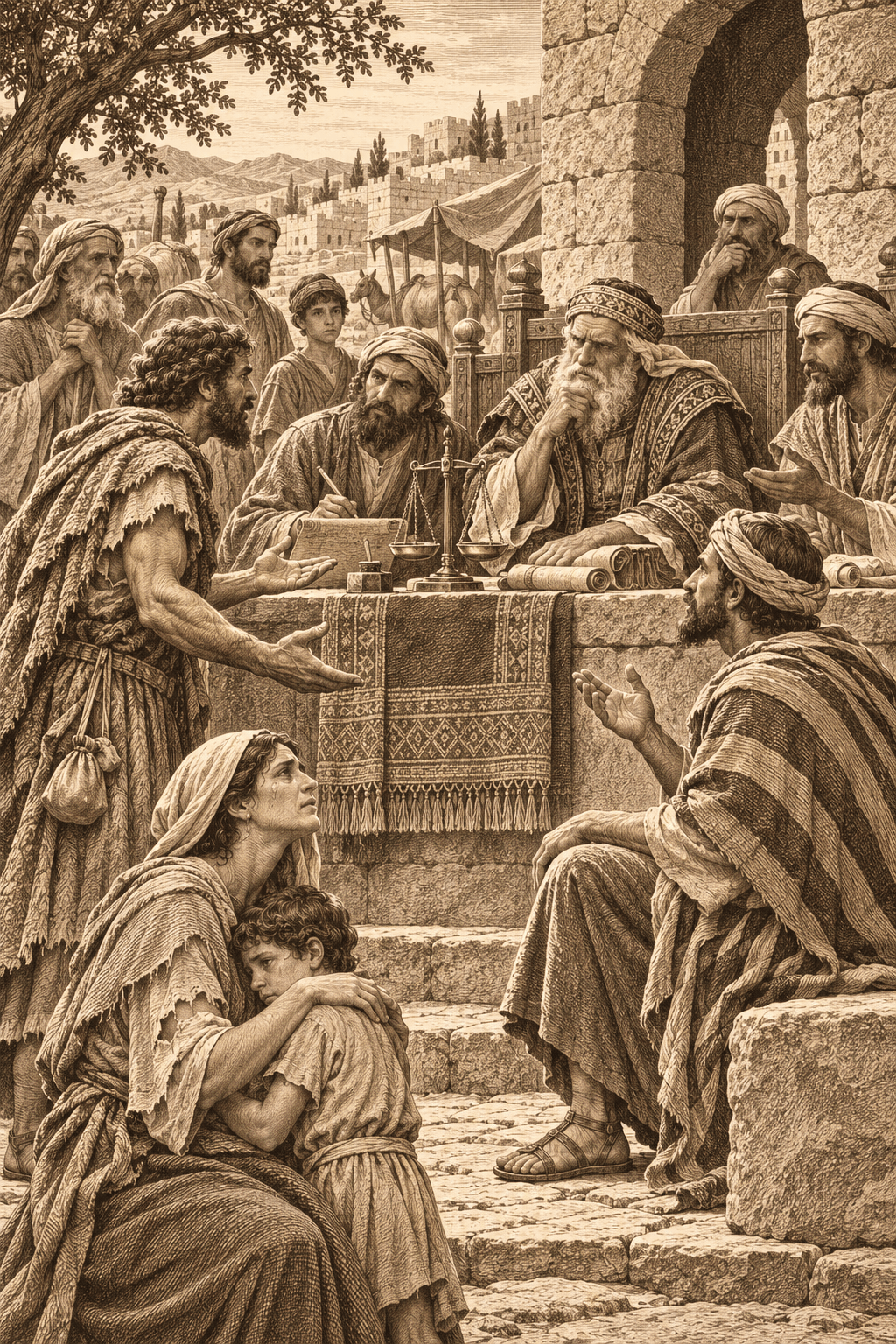
The Law seems extremely harsh with wrongdoers, for the punishment reaches the degree of stoning; but it does not look to punishment as an end in itself, nor does it carry a spirit of revenge. It looks even upon the criminal as a brother (2 Thessalonians 3:15). He must be treated as gently as possible, without indulgence at the expense of the salvation of his soul and the salvation of his brothers. The Law dealt with the Jewish people as little children who sometimes needed great firmness, lest their communal or personal mission be destroyed (see verses 1–3 above).
The punishment of beating was usually with a rod (Exodus 21:20; 2 Samuel 7:14; Proverbs 10:13), and it is still used in the Middle East, where a person is thrown to the ground and beaten on his feet with a rod. Sometimes he was beaten with thorns (Judges 8:16–17), and at other times with an ordinary whip or one with hard knots (1 Kings 12:11, 14).
In these verses the following principles are presented:
First: The accused must be confronted by his accuser in the presence of the judges, so that the matter may be verified and the truth discovered. Everything is then in the light, and no crookedness creeps into the judgment.
Second: The righteous must be justified.
Third: Whoever justifies the wicked or condemns the innocent is counted unclean (Proverbs 17:15). Paul the Apostle says: “But if thou do that which is evil, be afraid; for he beareth not the sword in vain: for he is the minister of God, a revenger to execute wrath upon him that doeth evil” (Romans 13:4). And St. Peter the Apostle says: “Whether it be to the king, as supreme; or unto governors, as unto them that are sent by him for the punishment of evildoers, and for the praise of them that do well” (1 Peter 2:13–14).
Fourth: The punishment is issued according to a person’s crime and its seriousness. If he does not deserve death or stoning, he is usually sentenced to be scourged, and the number of stripes is according to the kind of crime. No one is exempted from scourging because of his rank, social position, or wealth.
Fifth: The punishment was usually carried out with purposeful religious reverence, and the number of stripes did not exceed forty. The Jews preferred to pronounce the sentence of forty stripes save one (2 Corinthians 11:24), lest a mistake occur and a person be scourged more than forty times. The whip usually had three thongs, and the person was struck 13 times, making a total of 39 stripes. Setting limits to the number of stripes affirms that the wrongdoer is not to be treated as a slave or an animal, lest the one being disciplined fall into despair and think that he is despised by all and that there is no hope of his reform. So God cares for the soul of everyone. God does not want to kill the wrongdoer or crush him; He separates the sin from the sinner. He asks that the sin be killed and crushed, while the sinner is rescued and his affairs set right.
During the scourging, the head of the court would read aloud (Deuteronomy 28:58–59; 29:9), and conclude with a psalm (Psalm 78:38), to affirm that the aim of the punishment is not revenge, but the benefit of the wrongdoer and the edification of others. Trapp says that when the Turks severely scourged a person, he was obliged to go back to the judge who had issued the order, kiss his hand, thank him, and pay money to the officer who had whipped him. [259]
Sixth: The sentence is carried out in the presence of the one who issued it, so that those carrying it out are neither lax nor excessive, and justice is achieved.
Seventh: By saying, “lest… thy brother should seem vile unto thee” (3), He reveals God’s care for human dignity, not only in his brother’s eyes, but in heaven’s view of him. The trial carried out on earth by human judges must be an echo of a heavenly work whose aim is to isolate the evil, not the evildoer, to destroy the sin, not the sinner, and to crush corruption while glorifying the penitent on a heavenly, eternal level. He may be sentenced to beating or scourging so that the congregation may present him as a precious stone to God!
2. Thou Shalt Not Muzzle the Ox
KJV · Verses 4
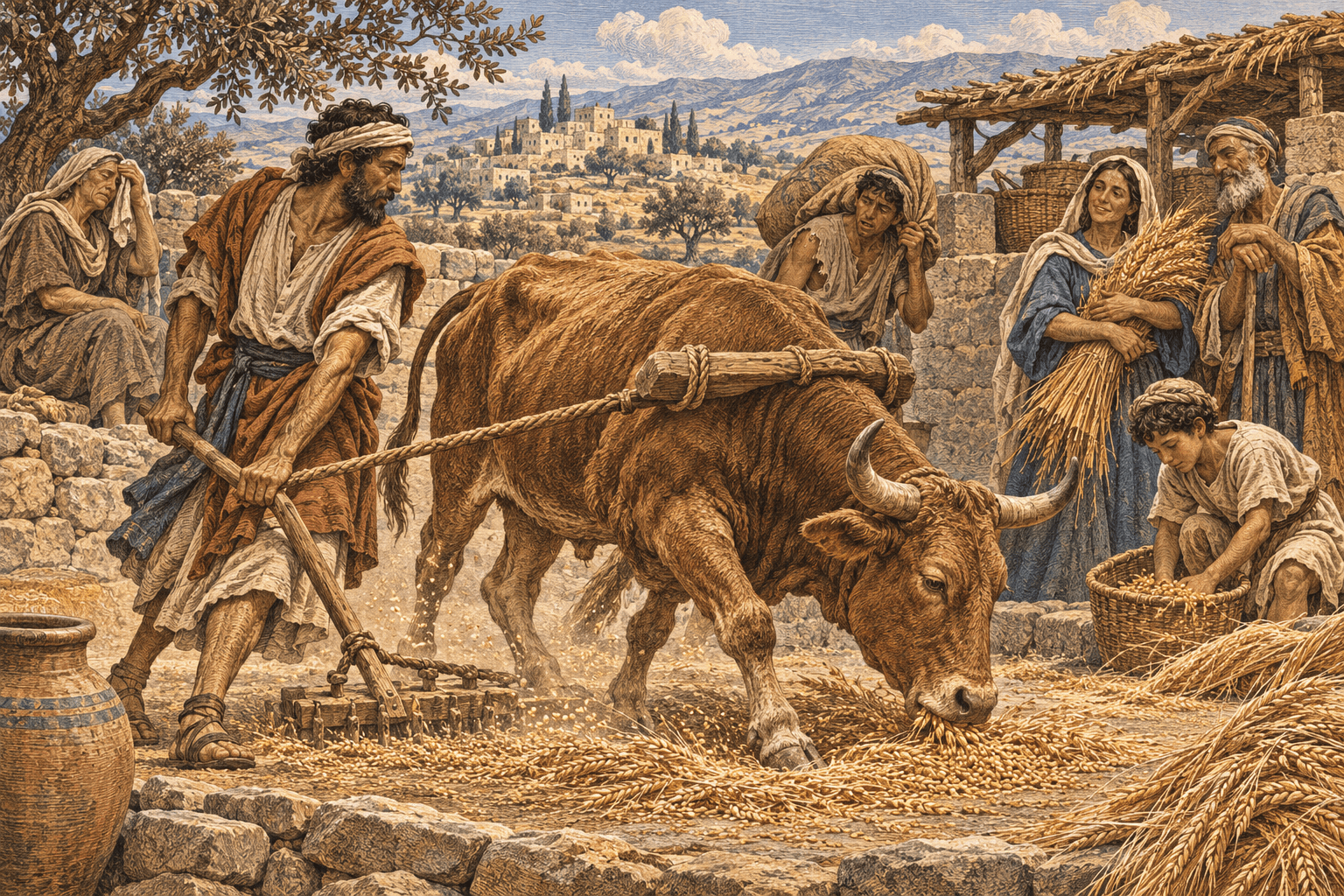
4 Thou shalt not muzzle the ox when he treadeth out the corn.
“Thou shalt not muzzle the ox when he treadeth out the corn” (4). The farmer may not muzzle an ox treading out the grain, but must leave it the opportunity to eat while it works. St. Paul sees that this text points to the minister of the altar, who eats of the altar. The needs of those who work, even in preaching the Gospel, must be provided, so that they may serve without being distracted by material matters. The Apostle says:
Doth God take care for oxen? Or saith he it altogether for our sakes? For our sakes, no doubt, this is written: that he that ploweth should plow in hope; and that he that thresheth in hope should be partaker of his hope. If we have sown unto you spiritual things, is it a great thing if we shall reap your carnal things?… Do ye not know that they which minister about holy things live of the things of the temple? and they which wait at the altar are partakers with the altar? Even so hath the Lord ordained that they which preach the gospel should live of the gospel. (1 Corinthians 9:9–14)
3. Raising Up Seed for the Dead
KJV · Verses 5–10
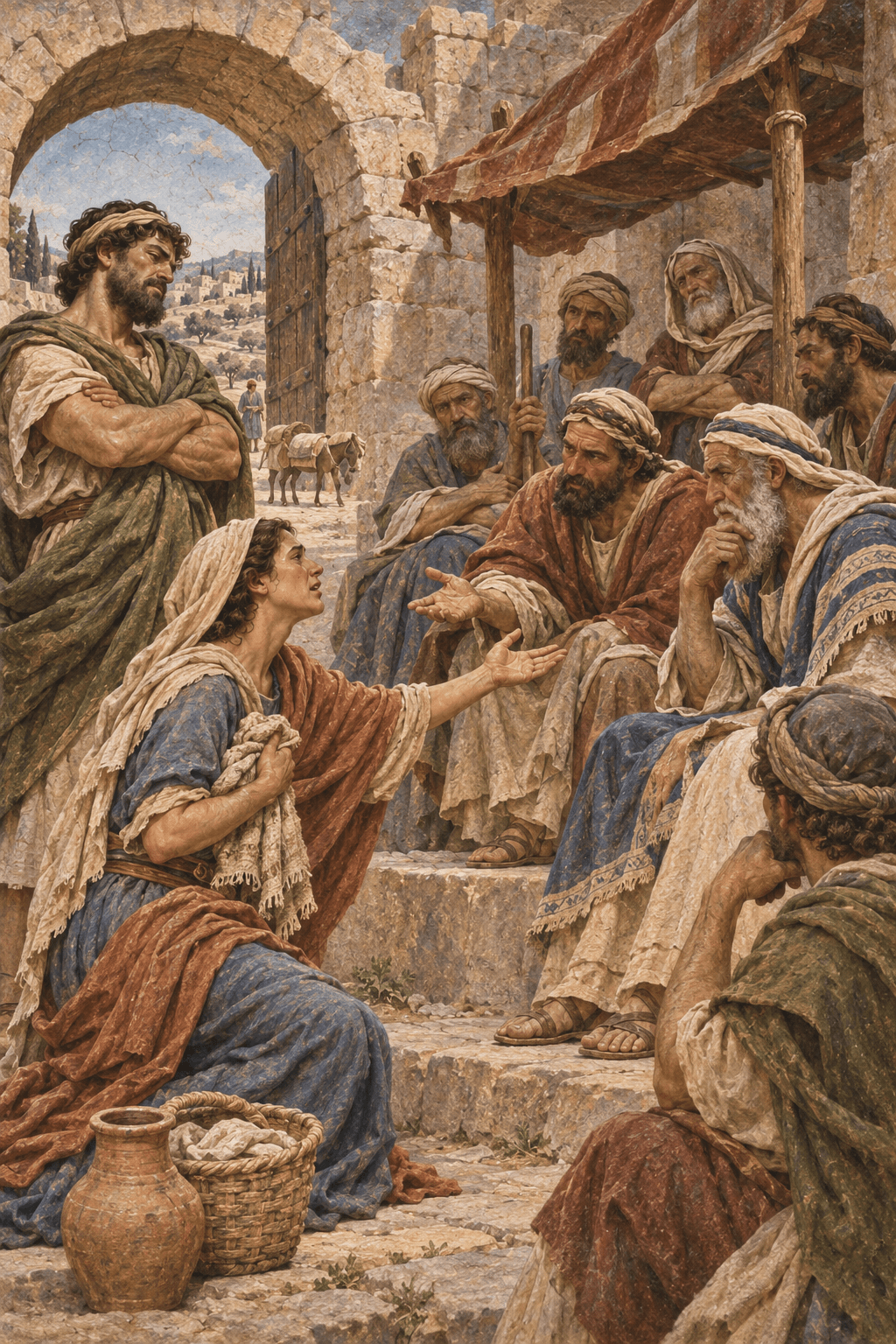
5 If brethren dwell together, and one of them die, and have no child, the wife of the dead shall not marry without unto a stranger: her husband’s brother shall go in unto her, and take her to him to wife, and perform the duty of an husband’s brother unto her. 6 And it shall be, that the firstborn which she beareth shall succeed in the name of his brother which is dead, that his name be not put out of Israel. 7 And if the man like not to take his brother’s wife, then let his brother’s wife go up to the gate unto the elders, and say, My husband’s brother refuseth to raise up unto his brother a name in Israel, he will not perform the duty of my husband’s brother. 8 Then the elders of his city shall call him, and speak unto him: and if he stand to it, and say, I like not to take her; 9 Then shall his brother’s wife come unto him in the presence of the elders, and loose his shoe from off his foot, and spit in his face, and shall answer and say, So shall it be done unto that man that will not build up his brother’s house. 10 And his name shall be called in Israel, The house of him that hath his shoe loosed.
This law raises up seed for the dead man (see verses 5–6 above).
What Is the Aim of This Law?
First: A person saw in his offspring an extension of his life, so if he died without begetting a son, it meant that his name was removed from the world forever. Therefore the brother or the kinsman was obliged to marry the widow of the dead man for no other reason than to raise up seed for the dead, so that his name would not be blotted out of the world. This custom was ancient, before the receiving of the Law, as in Genesis 38:8. The widow could not marry anyone other than the kinsman, unless the kinsman refused to marry her.
Second: The most important thing a person owned in the Old Testament was his portion in the Promised Land, which was given as a free divine gift from God to the whole people, and divided by lot at the hand of Joshua the son of Nun. Each tribe’s care for its land pointed to the Church’s care for her enjoyment of the new land, the heavenly Jerusalem. A widow who had no children could not manage the affairs of the land, its crops, the sale of its produce, the care of the flocks, and so on. So marriage was often a necessity for her. This law was set so that she would not marry a man of another clan, who with his offspring after him would inherit land not belonging to his clan. Thus the land is kept not only for the same tribe, but even for the same clan, and for the nearest kinsman of the childless dead man; indeed, the land is handed to the firstborn son who bears the dead man’s name, so that it remains kept for the same family.
Third: In this law there is also honor for the widow, and an atmosphere of family love offered to her, since she was left without a husband or children to care for.
The Sadducees misunderstood this law, thinking it a proof against the resurrection of the dead, for in the resurrection whose wife would she be (Matthew 22:24–28)?
Some translate the word “son” as “child,” as in the Septuagint and the Vulgate (5). [260] So if the dead man had a daughter, seed could be raised up for him through her (Numbers 27:4).
What If the Brother or Kinsman Refuses to Marry the Widow?
The Law answers this case in verses 7–10 above.
First: No law compels him to do this against his will. If he does not love her, he has the right to refuse her, for the marriage relationship is not established by compulsion, but through the intimacy of love and understanding.
Second: The kinsman who refuses to marry his brother’s wife (or the dead man’s kinswoman) has his shoe loosed before the elders of the city, and she spits in his face and says, “So shall it be done unto that man that will not build up his brother’s house,” and his name is called “The house of him that hath his shoe loosed.” This rite reveals how careful the Law was that the name of the dead should remain… for every believer hoped that the Messiah would come from his seed.
The kinsman’s refusal to marry the widow is counted a contempt for God’s plan to preserve each tribe’s portion of the land, and if possible each clan’s portion, and even each small family’s. Therefore some see in this refusal an offense to the widow herself, to the dead man and his family, to the tribe, and to the whole people; indeed, to God Himself. He deserves to be shamed.
Some Jews interpret this as spitting on the ground before his face, not in his face. [261] Since he does not care to build his brother’s house, he deserves to be shamed. In some countries of the Middle East, such as parts of Upper Egypt, when a person wants to insult another, he still spits on the ground before him.
In the story of Ruth, when the kinsman refused to marry her, the one after him, Boaz, accepted it, to raise up seed for the dead, and so he was made worthy that the Lord Christ should come from his seed (Ruth 4).
The widow’s loosing of his shoes and taking them is a symbolic act showing that he is not worthy to walk in his shoes on the dead man’s land, and that the widow now has the right to dispose of it by marrying another. This symbolic act is clear from the Psalmist’s words, “over Edom will I cast out my shoe” (Psalm 60:8; 108:9), that is, I will walk on his land and possess it.
Moses was asked to take off his shoes before the bush, and so the priests take off their shoes when they enter the temple as holy ground, declaring that they are not the bridegroom who owns the place, but servants of the bride; the only Bridegroom is the Lord Christ, the Savior of the world.
Saint Ambrose says:
According to the Law, Boaz, who loved Ruth, could not take her as his wife unless the shoe was first loosed according to the Law, for he was not yet her husband. So Moses was not the bridegroom, and therefore he had to take off his shoe on the holy ground (Exodus 3:5), and so did Joshua the son of Nun (Joshua 5:15). But our Lord Christ, the true Bridegroom, does not have His shoe loosed; even St. John the Baptist counted himself unworthy to loose it (John 1:27). [262]
Walking barefoot points to extreme misery, and captives were sometimes forced to do so. In Isaiah the prophet it is written: “Go and loose the sackcloth from off thy loins, and put off thy shoe from thy foot. And he did so, walking naked and barefoot. And the Lord said, Like as my servant Isaiah hath walked naked and barefoot three years for a sign and wonder upon Egypt and upon Ethiopia; So shall the king of Assyria lead away the Egyptians prisoners, and the Ethiopians captives, young and old, naked and barefoot, even with their buttocks uncovered, to the shame of Egypt” (Isaiah 20:2–4).
When David fled from his son Absalom, he went up Mount Olivet weeping, with his head covered, and he went barefoot (2 Samuel 15:30).
4. The Shameless Woman
KJV · Verses 11–12
11 When men strive together one with another, and the wife of the one draweth near for to deliver her husband out of the hand of him that smiteth him, and putteth forth her hand, and taketh him by the secrets: 12 Then thou shalt cut off her hand, thine eye shall not pity her.
A woman has the right to defend her husband in a time of distress, but she must behave with a spirit of modesty. So if her hand reached out to seize the private parts of the one fighting her husband, her hand was to be cut off (see verses 11–12 above).
Whatever the circumstances, a woman who does this, even with the intention of rescuing her husband, reveals a complete loss of modesty, and the loss of her virtuous life and her dignity.
Her hand is cut off without pity, so that shamelessness may not seep into others. It is better for her to remain with her hand cut off than to make girls and women stumble. Perhaps the Lord Christ, in His teaching on offense, was pointing to this law: “And if thy right eye offend thee, pluck it out, and cast it from thee: for it is profitable for thee that one of thy members should perish, and not that thy whole body should be cast into hell. And if thy right hand offend thee, cut it off, and cast it from thee: for it is profitable for thee that one of thy members should perish, and not that thy whole body should be cast into hell” (Matthew 5:29–30). That is, the believer ought always to be wary of any offense or danger that befalls him or those around him, and to crucify the bodily lusts whatever it costs him.
5. Deceit in Weights
KJV · Verses 13–16
13 Thou shalt not have in thy bag divers weights, a great and a small. 14 Thou shalt not have in thine house divers measures, a great and a small. 15 But thou shalt have a perfect and just weight, a perfect and just measure shalt thou have: that thy days may be lengthened in the land which the Lord thy God giveth thee. 16 For all that do such things, and all that do unrighteously, are an abomination unto the Lord thy God.
Deceit in weights and measures is not fitting; nor should we show partiality, weighing for one person with one measure and for another with a different measure, as when we favor the rich at the expense of the poor (see verses 13–16 above).
God created man to deal with his brother in a spirit of justice. Trade and dealings are not opportunities for a person to exploit in order to acquire something unjustly, but opportunities to practice the righteousness of Christ and to experience faithfulness, so that we may hear the words: “thou hast been faithful over a few things, I will make thee ruler over many things” (Matthew 25:21). Negligence in faithfulness is an abomination in the eyes of God, the Holy and Faithful One. Here we see that the principles of justice must govern commercial dealings (Luke 6:38).
First: Not only must a person not use deceitful weights and measures, he must not allow himself even to keep them in his house, even if he does not use them, for He says, “Thou shalt not have,” and not “Thou shalt not use.” A person must not leave in his house or place of work what might draw him toward sin.
Second: Every injustice we practice is a practice of false weights, for we misjudge matters. As it is written: “Hear this, O ye that swallow up the needy, even to make the poor of the land to fail, Saying, When will the new moon be gone, that we may sell corn? and the sabbath, that we may set forth wheat, making the ephah small, and the shekel great, and falsifying the balances by deceit? That we may buy the poor for silver, and the needy for a pair of shoes; yea, and sell the refuse of the wheat?” (Amos 8:4–6).
Third: The word for weights in Hebrew is “eben,” meaning “stone,” for stones were used as weights. The deceit was done by a person keeping two sets of stones, one heavy and the other light; he used the first when buying something and the other when selling it (see Exodus 16:16; Leviticus 19:23).
Fourth: Deceit is a crime directed not only against the one we deal with but against the whole society. The person who gains his profit by deceit and fraud does not feel the value of what he has, and so wastes it in wrong ways. On the other hand, the one wronged by the deceit is an inseparable part of society, so the harm that befalls him befalls the whole society. Moreover, deceit strips the blessing of the Lord from a person and from those around him.
Every person ought to see in his shop, office, or factory the throne of God revealed and the Lord Christ present, and so behave as befits a place where the Lord Himself dwells. Success in work is not in much profit, but in the living witness to the work of God, who blesses and gives success to those who are faithful in their conduct.
Fifth: Faithfulness in weights and measures reveals a heart that loves justice, so the believer enjoys the blessing of the Lord, and his days are prolonged on the earth; but deceit, injustice, or partiality bring him under the curse. For God hates every kind of deceit. Solomon the wise says: “A false balance is abomination to the Lord: but a just weight is his delight” (Proverbs 11:1). “Divers weights, and divers measures, both of them are alike abomination to the Lord” (Proverbs 20:10).
Using true balances and measures points to the spirit of inner discernment, so that a person does not weigh for himself with one balance and for others with another. As Abba Theonas says in the Conferences of St. John Cassian:
Since a just and unerring judge dwells in our conscience, even if all others err, our inner purity will never be deceived. So we must keep a constant calm in our watchful heart with all diligence and care, lest the judgment of our discernment go astray and we be occupied either with a foolish (that is, excessive) fast or with the enjoyment of too much relaxation, and so weigh our strength in an unsound balance. Rather, we must put the purity of our souls in one pan and our bodily strength in the other, and weigh them by the just judgment of our conscience, so that we do not lean wrongly to one pan at the expense of the other, that is, to unfitting severity or to careless relaxation.
So it is not without reason that the Lord rebukes the one who deceives himself with false considerations, saying: “Surely men of low degree are vanity, and men of high degree are a lie: to be laid in the balance, they are altogether lighter than vanity” (Psalm 62:9). Therefore the blessed Apostle commands us to hold the reins of discernment and not turn aside to excess in either direction (Romans 12:3). And the Lawgiver forbids the same thing, saying: “Ye shall do no unrighteousness in judgment, in meteyard, in weight, or in measure” (Leviticus 19:35).
So we ought not to have unjust balances in our hearts, nor double weights in the storehouse of our conscience; that is, we must not crush those to whom we must preach the word of the Lord with strict and exaggerated laws heavier than we ourselves bear, while we give ourselves freedom and lighten them… For if we weigh for our brothers in one way and for ourselves in another, the Lord blames us that our balances are unjust and our measures double, as Solomon says that a double weight is an abomination to the Lord and a deceitful balance is not good in His eyes (see Proverbs 20:10). [263]
We ought not to have two measures, one for the clergy and another for the people, for all are members of the one body of Christ, subject to one Lord, and enjoying one life in Christ Jesus. If a priest sins, whatever his rank, his priesthood does not exempt him from discipline; rather his punishment is doubled because of his greater knowledge.
Truly there is no distinction between the people and the priests. [264]
— Saint Gregory of Nazianzus
6. The Destruction of Amalek
KJV · Verses 17–19
17 Remember what Amalek did unto thee by the way, when ye were come forth out of Egypt; 18 How he met thee by the way, and smote the hindmost of thee, even all that were feeble behind thee, when thou wast faint and weary; and he feared not God. 19 Therefore it shall be, when the Lord thy God hath given thee rest from all thine enemies round about, in the land which the Lord thy God giveth thee for an inheritance to possess it, that thou shalt blot out the remembrance of Amalek from under heaven; thou shalt not forget it.
Having spoken of true standards and of not deceiving in weights and measures, he gives Amalek as an example of this (see verses 17–19 above).
The first battle the people entered was at Rephidim against Amalek (Exodus 17). Some see that Pharaoh represents the devil, who enslaved man for a time, and from whom the people were saved in the waters of baptism; and Amalek represents the lust of the flesh, or the works of the old man that fight the believer, but he overcomes them by the cross until victory is accomplished. The Lord said: “the Lord will have war with Amalek from generation to generation” (Exodus 17:16). For our war with the works of the old man continues as long as we are in the body in this world. As the Apostle says: “For the flesh lusteth against the Spirit, and the Spirit against the flesh: and these are contrary the one to the other: so that ye cannot do the things that ye would” (Galatians 5:17).
They measured out evil to God’s people to destroy their faith, so the people had to blot out their remembrance, lest their corruption and abominations seep into the people and they perish. The destruction of Amalek points to blotting out every trace of the violent sin that resists us on the way of our salvation.
We ought to be merciful and kind, but with a spirit of wisdom and discernment, so that we are not lax with sin and do not open a door to our own stumbling or that of others. If possible, we live peaceably with all men and pray for all; but if friendship pushes us toward evil, we are firm with ourselves in a spirit of wisdom and love.
Some see that Amalek’s wrong was not directed against a particular person, but against the Church as the people of God; so God Himself stands as her defender. As it is said: “No weapon that is formed against thee shall prosper” (Isaiah 54:17).
7. A Meditation on Deuteronomy 25
Grant Me the Spirit of Gentle Justice
Your Law is exceedingly firm, just, and exact.
It demands the punishment of criminals, not to torment them but to discipline them.
It cares for the criminal, that even in his discipline he may repent,
and if he loses his temporal life, it seeks his eternity.
You care even for the ox treading out the corn, and do not allow its mouth to be muzzled,
so that it may eat as long as it works!
The ox works for my sake;
it goes round and round to thresh the grain for me.
How can I enjoy it and deprive the animal that works for me?!
Grant me to work for the sake of Your kingdom,
to seek every lost sheep,
that You may rejoice and delight in it!
You are satisfied with the salvation of my brothers;
as for me, never leave me hungry!
You will never muzzle my mouth from bodily bread,
nor my heart from the table of the angels!
You gave us the law of raising up seed for the dead,
for all were awaiting the coming of the Messiah from their seed.
You did not want to grieve the heart of a widow who lost her husband and had no offspring.
You gave the woman the right to defend her husband,
but with a spirit of modesty and decency.
Your Law obliges us not to deceive in weights,
nor to measure for one person with one measure and for another with another.
Let us bear Your likeness, O You who show no partiality.
Notes and References
[259] Pulpit Commentary, Deuteronomy, p. 394.
[260] LXX; Vulgate; Josephus, Antiquities 4:8.23; Matthew 22:25; Maimonides, Yibbum 2:6–9.
[261] Talmud, Yebamoth 106; Maimonides, Yibbum 4:6–8.
[262] Saint Ambrose, On the Christian Faith, Book 3, 10 (71).
[263] St. John Cassian, Conferences 21:22.
[264] Saint Gregory of Nazianzus, In Defense of His Flight to Pontus (Oration 2).