
Part Three: The Rite of the Curses and the Blessings (Deuteronomy 27–28)
Moses and the elders obliged the people, on entering the Promised Land, to do the following:
A) Inscribe the commandments on great stones on Mount Ebal (Shechem) for all to see. They point to the Lord Christ, the divine Word who came down to us.
B) Set up an altar to the Lord of whole stones, pointing to the Lord Christ, the cornerstone, who offered Himself as a sacrifice to the Father in our name, the secret of our satisfaction and our joy, for He says: “and shalt eat there, and rejoice before the Lord thy God” (Deuteronomy 27:7). The Lord Christ is the secret of our entering the heavenly Promised Land; He is the Word and the Sacrifice.
C) Six tribes stand on Mount Gerizim pronouncing the blessings, and six tribes on Mount Ebal pronouncing the curses (Deuteronomy 27:12–13).
The Commandment with the Sacrifice: A Preparation for the Crossing
As God was preparing the people with all His leading for the crossing into the Promised Land, He repeatedly focused on keeping the commandment, as a sign of faithfulness in accepting the divine covenant, and on the sacrifice, as a sign of the need for blood to atone for sin.
Speaking of the commandment and its bond with worship, he emphasizes “this day” (1), though he reminds them of past events and lifts their eyes in a spirit of hope toward the future. So in our faith we look to the past and the future as though they were present. The past does not carry memories that have passed away, but brings us an experience that we must live in our present reality; and the future for us is not theoretical ideas, for we enjoy the pledge of the future, especially of eternity, in our present day. So the believer lives in a living, effective past, present, and future.
The proclamation of the blessings and curses of the covenant was bound up with setting up a stone altar on which offerings suited to the renewal of the covenant were offered (1–8). Half of the people stood on Mount Ebal and the other half on Mount Gerizim to confirm the blessings and curses of the covenant. Whoever disobeys or breaks the covenant falls under the curse (9–14). He gave a list of the curses that fall on those who break the covenant with God (15–26).
1. Writing the Law on Plastered Stones
KJV · Verses 1–4
1 And Moses with the elders of Israel commanded the people, saying, Keep all the commandments which I command you this day. 2 And it shall be on the day when ye shall pass over Jordan unto the land which the Lord thy God giveth thee, that thou shalt set thee up great stones, and plaister them with plaister: 3 And thou shalt write upon them all the words of this law, when thou art passed over, that thou mayest go in unto the land which the Lord thy God giveth thee, a land that floweth with milk and honey; as the Lord God of thy fathers hath promised thee. 4 Therefore it shall be when ye be gone over Jordan, that ye shall set up these stones, which I command you this day, in mount Ebal, and thou shalt plaister them with plaister.
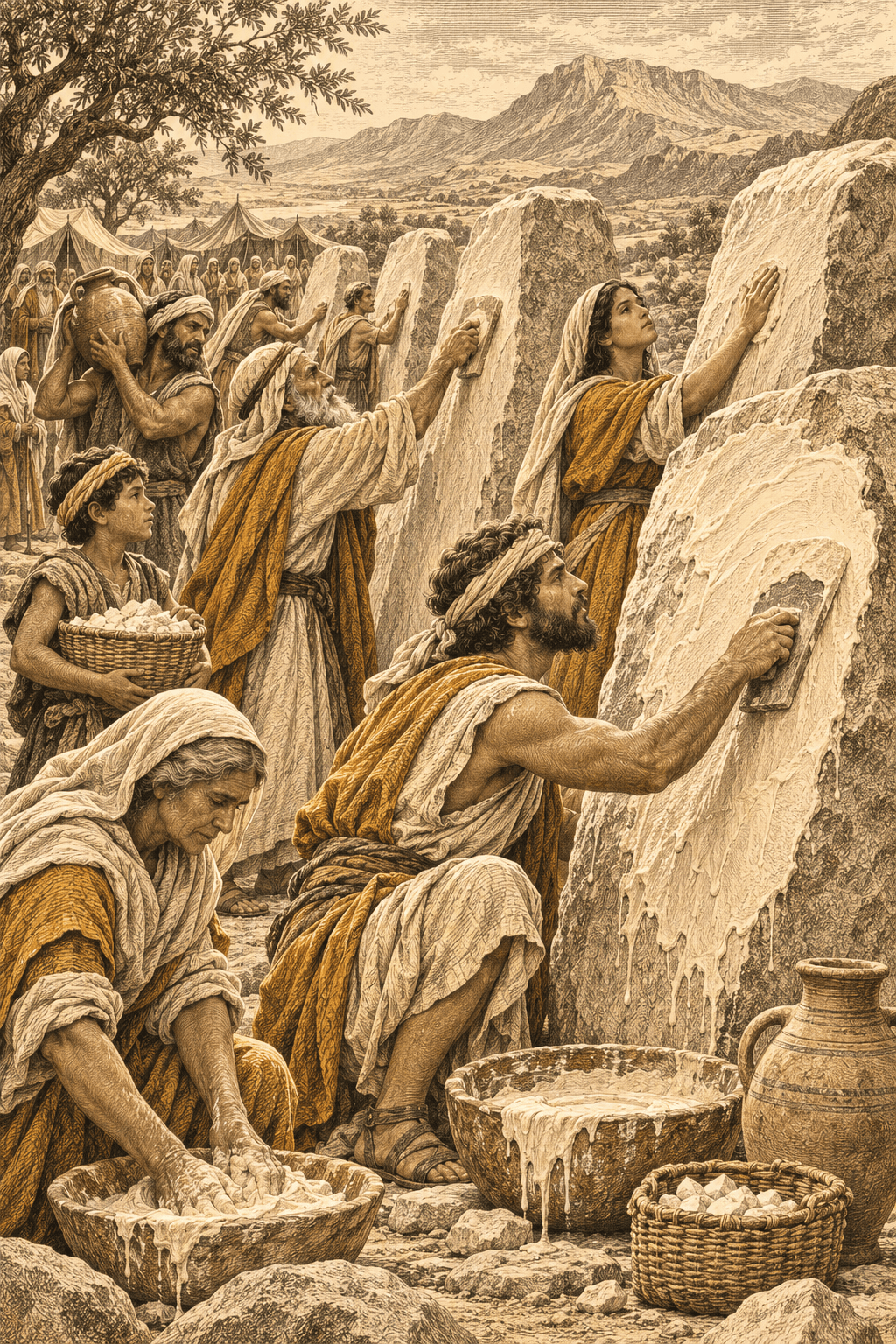
Moses the prophet did not give the commandments here alone, but together with the elders of the people, so that the people would not think that Moses alone, the old man who was near death, was concerned with them. As a successful leader, he shares the service with others and does not attribute everything to himself alone. So Paul the Apostle often includes in his epistles the names of some who worked with him, such as Silvanus and Timothy, and in his journeys, such as Barnabas, Mark, and Silas.
He asked them to write the Law on great plastered stones, writing it on the day of their crossing, for they could not enjoy the Promised Land and the divine promises without holding fast to the divine commandment.
Writing or inscribing on stones, or on stone or metal pillars, was the means of publishing decrees or laws. Lysias quoted a law from a pillar that stood on the Areopagus in Athens. [265] At Eleusis pillars were found inscribed with laws. [266] Plato spoke of pillars set up in the public markets bearing laws regulating traffic. [267] And Polybius used the word “pillar” to mean a law or one of the terms of an alliance. [268]
The number of stones is not known, but it was probably large, so that the words of the Law could be inscribed on them. The stones were covered with plaster (lime) to become smooth, so that writing on them would be easy and clear. Some scholars think that the words of the Law were inscribed on the stones and then the writing was covered to preserve it, a method the Egyptians used, as they tended to write on the stones of temples. But the more likely opinion is that the stones were covered with a layer of lime and the writing was inscribed on the lime, for writing on it is much easier than carving stone. Thomson mentions that he saw stones covered with plaster with writing on the plaster dating back about 2,000 years. [269]
Writing it on great plastered stones in clear script aimed to remove every excuse anyone might plead. God did not leave man to depend on the natural law, and when He gave him the Law He did not make it a prisoner in the libraries of the priests and teachers, but set it openly before everyone who seeks the truth, while at the same time it would be a witness against everyone who disobeys the divine commandment.
What is meant by “the words of this law”? Some think they are the curses pronounced on Mount Ebal recorded in this chapter. Others think they are the statutes and judgments in chapters 12–26 of Deuteronomy. A third group thinks they are the Ten Commandments that Moses the prophet received from God on Mount Sinai. Others hold that the commandments Moses gave and recorded on the stones numbered 613. [270]
The valley at the foot of Mount Ebal and Mount Gerizim forms a wonderful natural amphitheater suited to this occasion. Ebal could be seen from the place where Moses gave his address.
2. Building an Altar of Whole Stones
KJV · Verses 5–10
5 And there shalt thou build an altar unto the Lord thy God, an altar of stones: thou shalt not lift up any iron tool upon them. 6 Thou shalt build the altar of the Lord thy God of whole stones: and thou shalt offer burnt offerings thereon unto the Lord thy God: 7 And thou shalt offer peace offerings, and shalt eat there, and rejoice before the Lord thy God. 8 And thou shalt write upon the stones all the words of this law very plainly. 9 And Moses and the priests the Levites spake unto all Israel, saying, Take heed, and hearken, O Israel; this day thou art become the people of the Lord thy God. 10 Thou shalt therefore obey the voice of the Lord thy God, and do his commandments and his statutes, which I command thee this day.
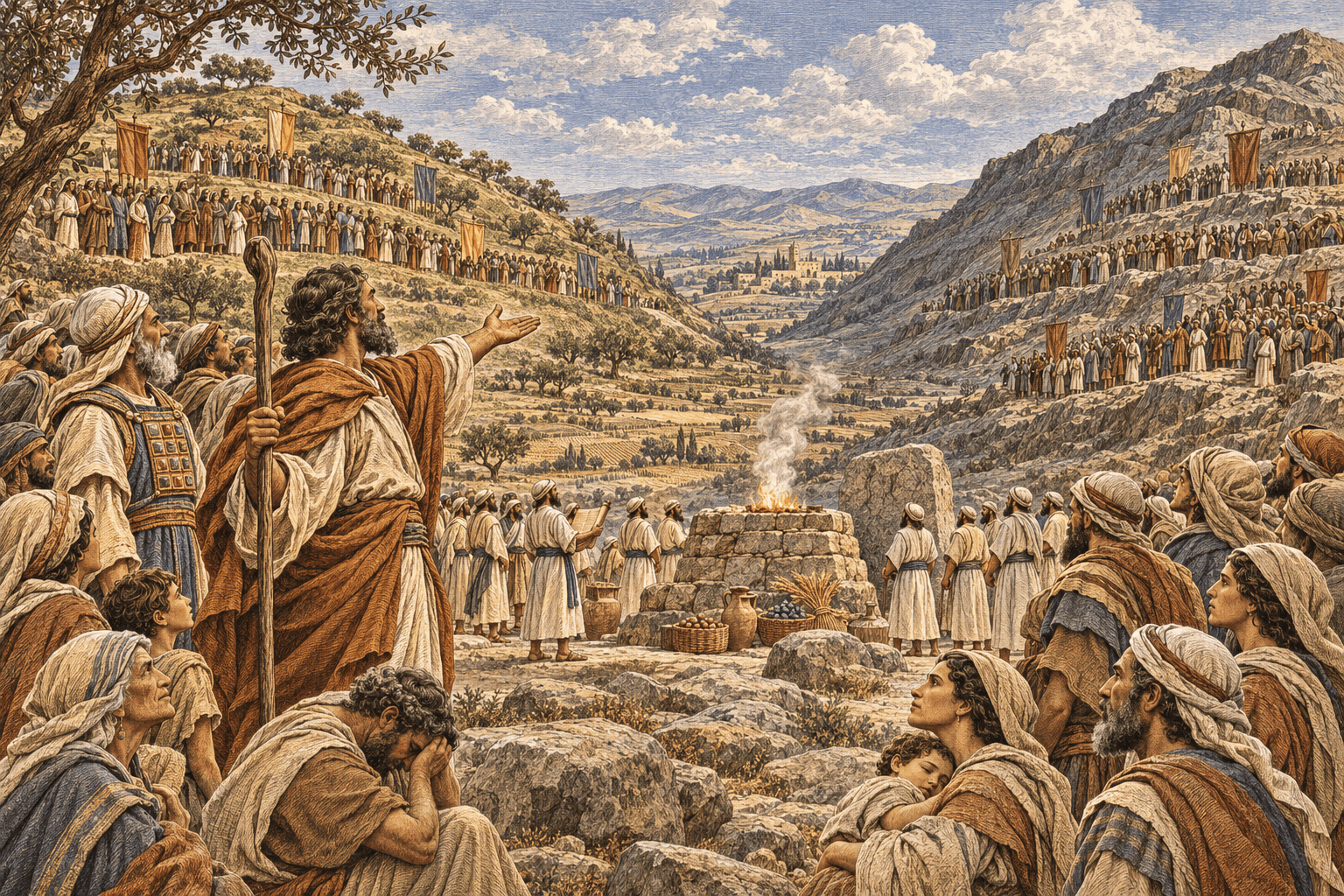
Beside the stones on which the commandments were recorded, an altar to the Lord was set up of whole stones on which no sharp tool was lifted (Exodus 20:25), and burnt offerings and peace offerings were offered on it (see verses 5–8 above).
The altar is set up of stones on which no iron is lifted, whole stones taken from the fields without being touched by the hand of a mason with his chisel. The stone here points to the Lord Christ, of whom Daniel the prophet prophesied that He was cut out without hands and became a great mountain (Daniel 2:34–35). So the builders rejected Him, for He had no form nor comeliness, as Isaiah the prophet says (Isaiah 53); but He is accepted by God and has become the head of the corner.
No iron is lifted on the stones of the altar; that is, no human hand reaches out to use any tool to prepare them. So our salvation is not accomplished by a human hand, but through the true divine work, which is the work of the cross.
Saint Gregory of Nazianzus, in the funeral oration he gave for his father, St. Gregory the Elder, in the year 374, spoke of the role of his mother, St. Nonna, who drew his father to the surpassing life of faith until he became a successful bishop; they lived together like brothers. He says of his mother:
Just as it is counted a great thing that no iron is lifted on the altar (5), since everything consecrated to God must be natural, with nothing artificial in it, so surely it is counted a great thing that she honored the temple with her silence, never turned her back on the venerable table, nor disputed in the divine aisle… and that she never shared in an unclean, unholy table, could not bear to pass by or even look at a house of corruption, and did not allow her ears, which received divine things, nor her tongue, which spoke divine things, to be defiled by Greek tales or songs of the theater. [271]
- Burnt offerings are offered on the altar to the Lord, for the Lord Christ offers Himself as a burnt offering of perfect love before the Father on behalf of humanity.
- Peace offerings are offered on it (7), for through Christ crucified reconciliation is accomplished between the Father and humanity, and in Him the believer receives his inner peace.
- There the believer eats (7), for the sacrifices were bound up with food as a sign of fellowship together.
- The believer rejoices before the Lord his God (7), for he enjoys the shadow of heaven, bears its icon, and declares his delight in the divine covenant and the joy of his soul in cleaving to Him. We are called to a joyful banquet, for God Himself is pleased and delights in the obedience of His children, their love, and their heartfelt worship, and He calls them to rejoice with Him and share His delight in them.
- “And thou shalt write upon the stones all the words of this law very plainly” (8): so the sacrifice, or worship, is bound to keeping the divine commandment. He repeated the commandment to write the words of the Law on the stones in the same chapter, insisting that it be “very plainly,” in the Septuagint “very clearly.” For the aim of the writing is to publish it to the whole people, so that it is easy for them to read. As the Lord said to Habakkuk: “Write the vision, and make it plain upon tables, that he may run that readeth it” (Habakkuk 2:2).
- The word of God must be well inscribed, or very clear, so that all, clergy and people, can read and understand it, and no voice is raised above the voice of the divine word. Our Gospel is the core of our faith and the backbone of Church tradition and Church life; every canon that does not carry the spirit of the Scriptures is void! Our Gospel is the divine book that leads our life and carries us to the bosom of God Himself.
- Inscribing the word on stones clearly, and placing it in a public place, reveals the Church’s responsibility to present the word as it is to the whole people, so that all may enjoy it.
- The altar and the stones inscribed with the Law are set up on Mount Ebal, so that the disobedient, who have fallen under the curse of disobedience, may find a way to return to God through the holy sacrifice and the bond with the divine word.
The stones were placed on Mount Ebal, where the curses were, so that all might realize that the Law is unable to remove the curse or to give life; it gives the knowledge of sin and reveals man’s need for One who justifies him (Romans 3:19–20; 7:9–14). So the fitting place for the Law is the mountain of curses, not of blessings. In the same way the altar was set up on the mountain of curses, so that the believers might realize their need for the unique sacrifice that is able to lift the curses from them, the sacrifice of Christ. As for the animal sacrifices the Law required of them, they are only a shadow and a symbol, and so are unable to sanctify the conscience, purify the depths, and give righteousness (see verses 9–10 above).
By saying, “Take heed, and hearken,” he declares the need of the people, as of every believer, for silence and attentiveness, for the voice of the world around us and within us often drowns out the divine voice. From time to time we need a period of quiet in which the ears of the inner man incline to the voice of the Lord and listen to it with all attention.
“Thou art become the people of the Lord thy God” (9): The Lord’s people always belong to Him because of His choice and calling, but they truly become so when they receive His word and obey His Law (John 1:12). God always reminds us of the calling to which we have been called, to be God’s people, so that as He is holy, we may be holy in Him. It is a call to cleave to Him and belong to Him, to become His people, that is, to enjoy the heavenly royal character. Then all the storehouses of heaven, its blessings, and its resources are in our hands.
3. Two Groups for the Blessing and the Curse
KJV · Verses 11–14
11 And Moses charged the people the same day, saying, 12 These shall stand upon mount Gerizim to bless the people, when ye are come over Jordan; Simeon, and Levi, and Judah, and Issachar, and Joseph, and Benjamin: 13 And these shall stand upon mount Ebal to curse; Reuben, Gad, and Asher, and Zebulun, Dan, and Naphtali. 14 And the Levites shall speak, and say unto all the men of Israel with a loud voice,
Mount Ebal is on the west bank of the Jordan River, very near Shechem, the place where the sanctuary of the Lord was for a time (Joshua 24:1).
The tribes chosen for the blessing were of the sons of Leah and Rachel. The tribes chosen to proclaim the curse on Mount Ebal were Gad and Asher, of Zilpah, Leah’s handmaid; Dan and Naphtali, of Bilhah, Rachel’s handmaid; and Zebulun and Reuben, of Leah. As for the Levites (that is, the priests charged with this work, not the whole tribe of Levi), they were probably in a middle area between the two mountains (Joshua 8:33), proclaiming the blessing and the curse in a loud voice so that all could hear them.
The blessings are not mentioned here, but the curses. The Jews hold that the curse was pronounced together with the blessing corresponding to it. [272]
Some think it impossible for the voice to reach the people when each group proclaimed the blessing or the curse, but modern experiment has shown that the voice can easily be heard clearly, especially since those speaking were a large group, not one individual.
4. The Curses Pronounced on Mount Ebal
KJV · Verses 15–26
15 Cursed be the man that maketh any graven or molten image, an abomination unto the Lord, the work of the hands of the craftsman, and putteth it in a secret place. And all the people shall answer and say, Amen. 16 Cursed be he that setteth light by his father or his mother. And all the people shall say, Amen. 17 Cursed be he that removeth his neighbour’s landmark. And all the people shall say, Amen. 18 Cursed be he that maketh the blind to wander out of the way. And all the people shall say, Amen. 19 Cursed be he that perverteth the judgment of the stranger, fatherless, and widow. And all the people shall say, Amen. 20 Cursed be he that lieth with his father’s wife; because he uncovereth his father’s skirt. And all the people shall say, Amen. 21 Cursed be he that lieth with any manner of beast. And all the people shall say, Amen. 22 Cursed be he that lieth with his sister, the daughter of his father, or the daughter of his mother. And all the people shall say, Amen. 23 Cursed be he that lieth with his mother in law. And all the people shall say, Amen. 24 Cursed be he that smiteth his neighbour secretly. And all the people shall say, Amen. 25 Cursed be he that taketh reward to slay an innocent person. And all the people shall say, Amen. 26 Cursed be he that confirmeth not all the words of this law to do them. And all the people shall say, Amen.
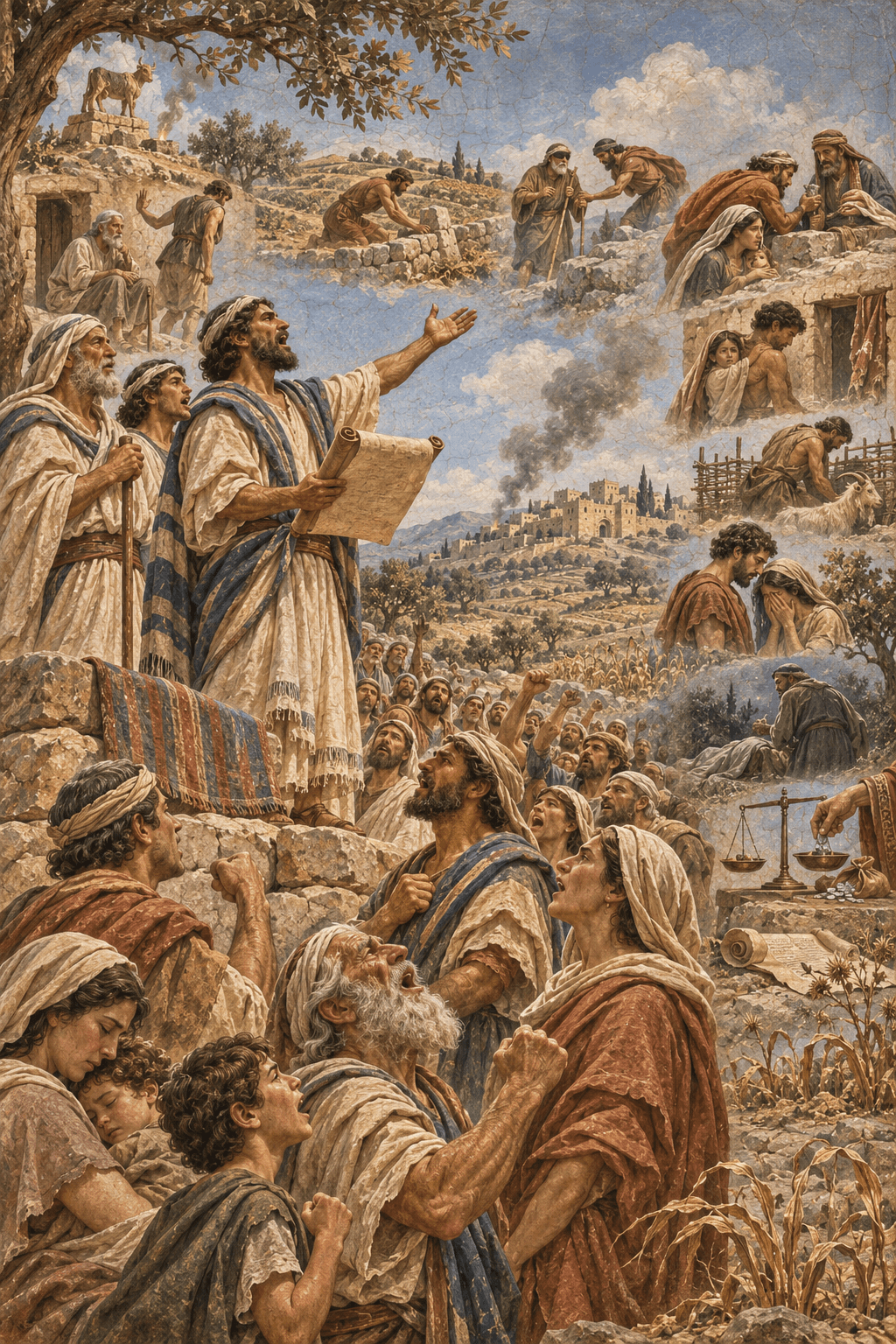
As the time drew near for the people to cross the Jordan River into the west bank, they had to know an important truth: the land they would possess and inherit is the Lord’s. God is the Owner, and the rent is “obedience.” By this obedience they would not only remain established in the Lord’s land, but would have a portion in the new land, in the heavenly Jerusalem.
The curses for disobedience, or for breaking one of the Ten Commandments, and the blessings for obedience to the divine commandment came as a key for the people to enjoy the land and be filled with hope in heaven itself!
The curses begin with sins directed against God Himself directly, such as idolatry (15), then against parents (16), against social justice (17), and then against the broken and needy (18–19). That is, he began with God, then parents, then society in general, then the needy. These are followed by the curses against purity and chastity (20–23), then murder (24–25), and finally he gave a general commandment concerning keeping the commandments.
Notice that the book records the words of the curses in detail without the words of the blessings. The words of the curses were read first and then the blessings, each item by itself, the curse then the blessing. This was to affirm that no one can escape the curse except the one who takes refuge in the Savior. As it is said: “If thou, Lord, shouldest mark iniquities, O Lord, who shall stand?” (Psalm 130:3). “For as many as are of the works of the law are under the curse: for it is written, Cursed is every one that continueth not in all things which are written in the book of the law to do them” (Galatians 3:10). “They are all gone out of the way, they are together become unprofitable; there is none that doeth good, no, not one” (Romans 3:12).
Proclaiming the curses and then the blessings affirms humanity’s need to be threatened first with punishment, and when they mature they come to delight in the blessings. As we have seen before, the curse is nothing but the natural fruit of man’s separating himself from God, the Source of blessings; and the blessings are an entering into the blessed life and an enjoyment of fellowship with God. Sin carries its discipline within it, because it separates man from the source of his life; and obedience carries its blessings, for it carries us to God, the Source of life and satisfaction.
The number of curses is twelve, as the number of the tribes. Notice in these curses:
First: The repetition of the word “all,” so that it may be realized that no one is above the commandment, clergy or layman, rich or poor, man or woman. All the members of the community, leaders and people, are bound to keep the commandment.
Second: At the end of each statement all declare “Amen,” a sign that all accept the obligation and respond to the commandment. The people’s continual answer with the word “Amen” carries the following meanings:
1. An affirmation that every member of the people knows that the fruit of sin is the curse.
2. That a person reaps this fruit by breaking any commandment of the Law, not by breaking all the commandments together or certain commandments. As St. James the Apostle says: “For whosoever shall keep the whole law, and yet offend in one point, he is guilty of all. For he that said, Do not commit adultery, said also, Do not kill. Now if thou commit no adultery, yet if thou kill, thou art become a transgressor of the law” (James 2:10–11).
3. This carries every person’s sense of guilt; he has no right to justify himself.
4. An implicit confession that the Law is good, and the fault lies in man.
5. The religious person needs to repeat the word “Amen” more than others, for because of his religiosity he sometimes puts on the garment of hypocrisy. So he must be frank with himself, declaring that falling into disobedience drives him to the curses.
Saint John Chrysostom says:
I say that the people were subject to this curse, because there is no man who has continued doing the whole Law or keeping it. But Christ changed this curse by another curse: “Cursed is every one that hangeth on a tree.” So whoever was hanged on a tree and whoever disobeyed the Law became cursed; and it was necessary that He who would free from the curse should Himself be free of it. Therefore Christ took upon Himself the other curse, to free us from the curse.
It is like an innocent man who undertakes to accept the sentence of death for another, and so saves him from the punishment. For Christ took upon Himself not the curse of disobedience but the other curse, to remove the curse from others, since He “had done no violence, neither was any deceit in his mouth” (Isaiah 53:9; 1 Peter 2:22). By His death He saved the dying from death, and by bearing the curse He saved them from it. [273]
“Secretly” (24): All the sins mentioned here can be committed in secret, so the warning is directed to the conscience of the individual. And God called the whole people to denounce these sins publicly.
“The words of this law” (26): The people bind themselves to the covenant by way of a curse, a way well known in the East (Acts 23:12). This was repeated with Nehemiah (Nehemiah 10:29), and Paul mentions it (Galatians 3:10). Christ bore the curse on Himself (Galatians 3:13) to free His people from it.
Third: With every proclamation of a curse, the whole people said Amen. But now that He who is able to bear the curse for us has come, we sing with Paul the Apostle, saying: “Christ hath redeemed us from the curse of the law, being made a curse for us: for it is written, Cursed is every one that hangeth on a tree” (Galatians 3:13).
With every cry of “Amen,” every true believer senses the inability of the Law not only to give a blessing, but even to give life, for all had fallen under death. The believer awaits the coming of the Savior, the Messiah, who alone is able to bear the curse for us and give us His blessed life. “But before faith came, we were kept under the law, shut up unto the faith which should afterwards be revealed. Wherefore the law was our schoolmaster to bring us unto Christ, that we might be justified by faith” (Galatians 3:23–24).
5. A Meditation on Deuteronomy 27
Set Up in My Heart Two Tables of the Law, and Make It an Altar for You
My heart is in Your hands; by Your fiery Spirit inscribe Your commandment on it.
Make of it two tables of the Law,
bearing the work of Your divine finger.
Whoever takes Your commandment from me tears out my heart
and deprives me of my life.
Let Your commandment remain within me until I cross into the new land;
it is my treasure and my heavenly wealth.
Make my heart a holy altar for You.
On it burnt offerings of love are offered, as my whole being burns with love for You.
On it I offer the peace offering, for You are the secret of my reconciliation with Your holy Father.
You are the Giver of true peace!
Let a banquet of love be set up in my heart, offered on Your altar,
where You come in and sup with me, and I with You!
Turn my heart into a banquet of joy, and restore to me the joy of Your salvation.
My heart exults in Your commandment and is satisfied by Your altar.
It meditates on the blessings You proclaim without ceasing, and the curses find no place in it.
Stand in my heart and stretch out Your hand in blessing.
You are the secret of true blessedness.
Notes and References
[265] Lysias, Against Eratosthenes 31 (cf. 12).
[266] Pollux, Onomasticon 10:97.
[267] Plato, Laws 11, p. 916E.
[268] Polybius, Histories 24:4, 12; 26:1, 4.
[269] Thomson, The Land and the Book, vol. 2, p. 204.
[270] Pulpit Commentary, Deuteronomy, p. 419.
[271] Saint Gregory of Nazianzus, On the Death of His Father (Oration 18), 10.
[272] Babylonian Talmud, Sotah, ch. 7; Targum Jerusalem, in loc.; Surenhusius, Mishnah, 3:262.
[273] Saint John Chrysostom, Commentary on Galatians 3:13.