
Chapters 17–18 deal with the qualities required of the people’s chief leaders at that time: the king, the priest, and the prophet. Pagan worship was marked by revelry and abominations, while the worship of the true God is marked by seriousness together with repentance. The first gives birth to a temporary joy that will not satisfy the soul; the second grants inner joy. God, in His love for His people, gave them the feasts so that their life might be turned into continual joy in the Lord; this is not achieved through laxity or slackness in practicing the Lord’s commandment. Therefore he speaks with firmness about three matters: the punishment of idol worship; the submission of the judges in a spirit of obedience to the holy communal order; and the king’s commitment to the divine commandment.
1. The Punishment of Idol Worshipers
KJV · Verses 1–7
1 Thou shalt not sacrifice unto the Lord thy God any bullock, or sheep, wherein is blemish, or any evilfavouredness: for that is an abomination unto the Lord thy God. 2 If there be found among you, within any of thy gates which the Lord thy God giveth thee, man or woman, that hath wrought wickedness in the sight of the Lord thy God, in transgressing his covenant, 3 And hath gone and served other gods, and worshipped them, either the sun, or moon, or any of the host of heaven, which I have not commanded; 4 And it be told thee, and thou hast heard of it, and enquired diligently, and, behold, it be true, and the thing certain, that such abomination is wrought in Israel: 5 Then shalt thou bring forth that man or that woman, which have committed that wicked thing, unto thy gates, even that man or that woman, and shalt stone them with stones, till they die. 6 At the mouth of two witnesses, or three witnesses, shall he that is worthy of death be put to death; but at the mouth of one witness he shall not be put to death. 7 The hands of the witnesses shall be first upon him to put him to death, and afterward the hands of all the people. So thou shalt put the evil away from among you.
Having declared that true and lasting joy lies in cleaving to the Holy God and entering into a perpetual covenant with Him, the believers ought not only to be holy as He is holy (Leviticus 11:44), but also not to offer a sacrifice with a blemish. God is holy, and the sacrifice of reconciliation must be holy and without blemish, as a shadow of the Lord Christ who is without blemish, so that He grants His people the holy life.
An ox or sheep with a blemish offered to the Lord is not only unacceptable to Him; He counts it an abomination and a sin, for it is an insult to the true Sacrifice, who is without blemish.
Through the last prophet of the Old Testament God warns His people against offering a sacrifice with a blemish, saying: “And if ye offer the blind for sacrifice, is it not evil? and if ye offer the lame and sick, is it not evil?” (Malachi 1:8).
If there be found among you, within any of thy gates which the Lord thy God giveth thee, man or woman, that hath wrought wickedness in the sight of the Lord thy God, in transgressing his covenant, And hath gone and served other gods, and worshipped them, either the sun, or moon, or any of the host of heaven, which I have not commanded; And it be told thee, and thou hast heard of it, and enquired diligently, and, behold, it be true, and the thing certain, that such abomination is wrought in Israel: Then shalt thou bring forth that man or that woman, which have committed that wicked thing, unto thy gates, even that man or that woman, and shalt stone them with stones, till they die. [2–5]
Idol worship is regarded as a capital crime, as treason against God, against the holy community, and against man himself; therefore its punishment is death by stoning.
From ancient times idolatry was focused mostly on the worship of the sun, moon, and stars, and then turned to statues depicting in one way or another humans, animals, birds, or reptiles. The danger of this sin is that whoever practices it does not rest until he entices others to practice the same worship. It is like an epidemic that strikes the soul and spreads to the souls of others. Some think that the mention of sun worship indicates that the book was written in the Assyrian age; but this worship is ancient, going back before the time of Moses the prophet, to Sumerian times. [197]
Some think that sun worship began in the days of the tower of Babel, when people feared lest God send another flood on them, so they turned to the sun, thinking it would not send a flood. They did not realize that the sun plays a role in rainfall and floods, through evaporating the water, which rises as clouds into the sky and then falls as rain. [198] They worshiped the sun, moon, and stars, counting them friends of man; they worshiped them and denied their Creator.
Why Is Idol Worship Regarded as a Capital Crime?
First: It is a direct disobedience to God, who did not command idol worship but forbade it. Idol worship is a movement of rebellion against God. If rebellion against an earthly king is counted a capital crime, how much more rebellion against the King of kings?!
Second: It is evil in the Lord’s eyes: “that hath wrought wickedness in the sight of the Lord thy God, in transgressing his covenant” (2). He hates it and cannot bear it, for it means putting lifeless creation in His place.
Third: It is a betrayal of the covenant made with God, a kind of betrayal of the marriage covenant, breaking the spiritual marriage bond between God and His believers.
Fourth: It is an abomination in Israel (4). God chose His people to be His own, holy and consecrated to Him, fulfilling His divine will, and He gave them knowledge of His divine mysteries; so if they turn aside to idol worship, their sin is greater than that of the other peoples. It is an abomination!
What Is the Law Concerning Falling into Idol Worship?
First: Careful investigation. Despite the gravity of this sin, no one may be punished merely on suspicion of his conduct; the matter must be investigated carefully.
And it be told thee, and thou hast heard of it, and enquired diligently, and, behold, it be true, and the thing certain, that such abomination is wrought in Israel: [4]
Though the Law cares for the holiness of the people of the Holy God, no one’s reputation must be harmed or anyone punished unjustly. Therefore every person is considered innocent until his guilt is proven after strict examination. At the same time, whoever is proven guilty after careful examination must not be treated leniently.
In the previous chapter we saw the Law insisting on appointing judges marked by justice and impartiality; in this chapter it asks that they be able to examine cases carefully so that no one falls under injustice. If “the judgments of the Lord are true and righteous altogether” (Psalm 19:9), the judge, as God’s steward, must clothe himself with justice without respect of persons.
The poor man may find no one anywhere to do him justice, so he should be able to turn to the house of God and find justice at “the seats of judgment.” In the house of the Lord he sees the Lamb of God, who gives the spirit of righteousness and justice together with mercy and tenderness. Many stumble in their faith because of the partiality they may find in a man of religion.
Second: The trial must take place with two or three witnesses (6) as true evidence against the accused; for under the pretense of defending God’s glory an innocent person must not be wronged.
At the mouth of two witnesses, or three witnesses, shall he that is worthy of death be put to death; but at the mouth of one witness he shall not be put to death. The hands of the witnesses shall be first upon him to put him to death, and afterward the hands of all the people. So thou shalt put the evil away from among you. [6–7]
Third: The punishment for idol worship is stoning, whether the worshiper is a man or a woman; a woman’s weakness is not offered as an excuse for worshiping idols.
Fourth: The stoning takes place at the city gate. In other places we find that the punishment was carried out outside the city walls (Nehemiah 8:1; Job 29:7; Acts 7:58; Hebrews 13:12), and during the wandering in the wilderness outside the camp (Leviticus 24:14; Numbers 15:36). The two witnesses or more cast the first stones, for the following reasons:
A) As long as the sin is public, or may become public, the punishment must be public.
B) So that the whole city takes warning, and it becomes a lesson for all.
C) When the witnesses cast the first stones, they cannot justify themselves before their consciences if they are false witnesses, for they would feel they had unjustly killed a man with their own hands.
Saint Jerome says:
“Under the old law, whoever disobeyed the priests was put out of the camp and stoned by the people, or his head was cut off, and he atoned for his contempt with his blood. But now the disobedient is cut off with the sword of the Spirit, or is excluded from the Church and torn to pieces by raging demons. [199]”
D) The literal translation of the Hebrew text is: “the dead man shall die,” or “a man of death” (1 Kings 2:26), or “a son of death” (1 Samuel 20:31). The death sentence passed on him was not foreign to him, for by his evil deed he had in fact become a son of death and in its grip. His stoning only revealed the death that had already come upon his soul.
2. The Submission of Judges to the Order
KJV · Verses 8–13
8 If there arise a matter too hard for thee in judgment, between blood and blood, between plea and plea, and between stroke and stroke, being matters of controversy within thy gates: then shalt thou arise, and get thee up into the place which the Lord thy God shall choose; 9 And thou shalt come unto the priests the Levites, and unto the judge that shall be in those days, and enquire; and they shall shew thee the sentence of judgment: 10 And thou shalt do according to the sentence, which they of that place which the Lord shall choose shall shew thee; and thou shalt observe to do according to all that they inform thee: 11 According to the sentence of the law which they shall teach thee, and according to the judgment which they shall tell thee, thou shalt do: thou shalt not decline from the sentence which they shall shew thee, to the right hand, nor to the left. 12 And the man that will do presumptuously, and will not hearken unto the priest that standeth to minister there before the Lord thy God, or unto the judge, even that man shall die: and thou shalt put away the evil from Israel. 13 And all the people shall hear, and fear, and do no more presumptuously.
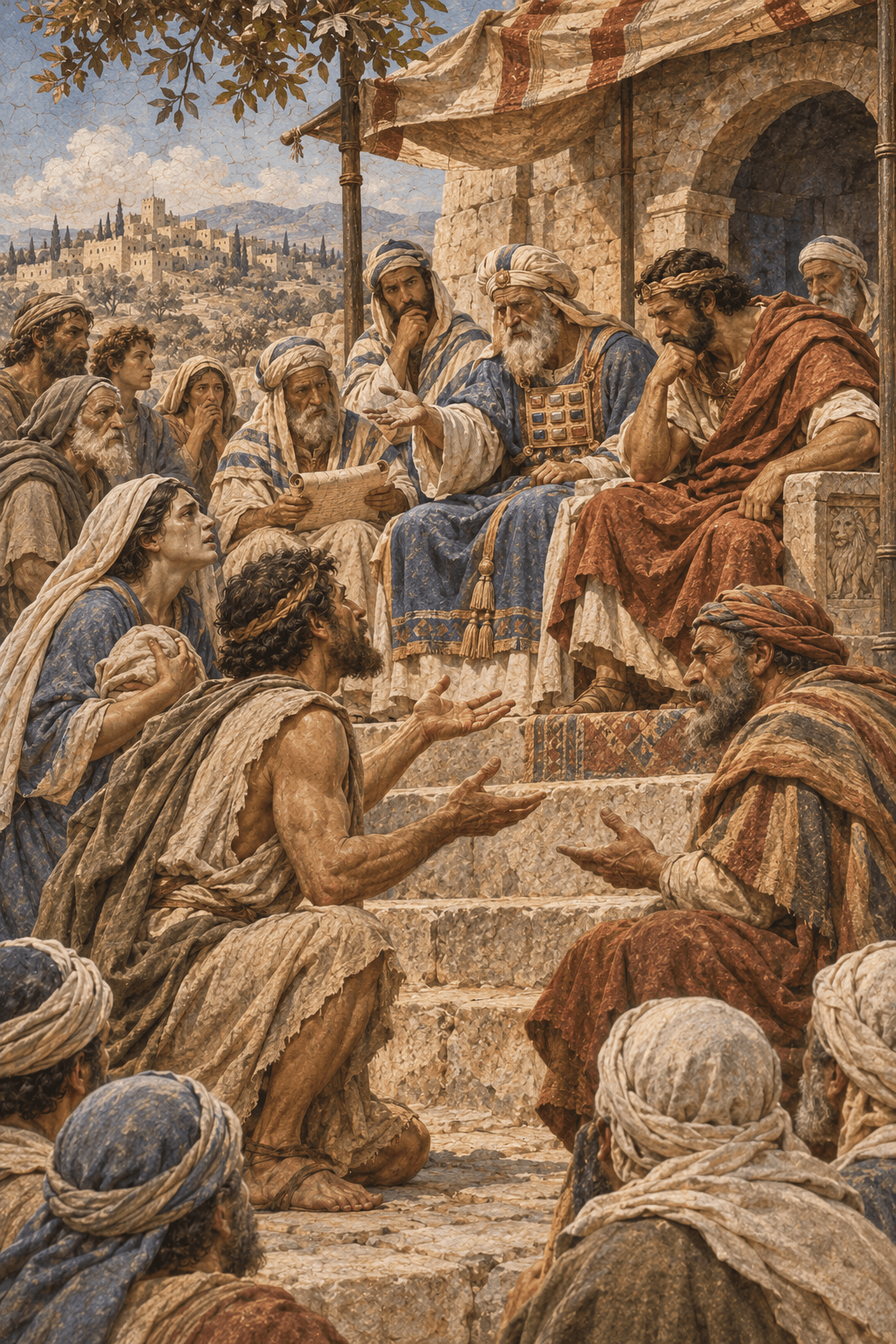
Judicial work is not an honor the judge acquires for himself, but an obligation and a responsibility; therefore the following rules were laid down:
First: The judge does not rule in a matter he doubts or finds it hard to decide. He is obliged before his conscience to refer it to a higher court, to those with more experience than he.
If there arise a matter too hard for thee in judgment, between blood and blood, between plea and plea, and between stroke and stroke, being matters of controversy within thy gates: then shalt thou arise, and get thee up into the place which the Lord thy God shall choose; And thou shalt come unto the priests the Levites, and unto the judge that shall be in those days, and enquire; and they shall shew thee the sentence of judgment: And thou shalt do according to the sentence, which they of that place which the Lord shall choose shall shew thee; and thou shalt observe to do according to all that they inform thee: [8–10]
Jethro, the father-in-law of Moses, advised his son-in-law to devote himself to the great and difficult cases (Exodus 18:13, etc.). After the death of Moses there were some persons generally esteemed as men of God who played the same role, such as Othniel, Deborah, and Gideon. Sometimes the high priest played this role, when he was of high standing and able to manage these matters, such as Eli the priest; and sometimes a council of priests and Levites serving the sanctuary did so.
Second: The judge is obliged to submit to those with more experience and of higher rank, for he ought to be humble and love to learn.
According to the sentence of the law which they shall teach thee, and according to the judgment which they shall tell thee, thou shalt do: thou shalt not decline from the sentence which they shall shew thee, to the right hand, nor to the left. And the man that will do presumptuously, and will not hearken unto the priest that standeth to minister there before the Lord thy God, or unto the judge, even that man shall die: and thou shalt put away the evil from Israel. And all the people shall hear, and fear, and do no more presumptuously. [11–13]
The Law required the appointment of just judges as a sign of the people’s bond with the covenant of the just God. But there remain difficult cases that local judges find hard to decide; these are raised to the Levitical priests and the judge at the sanctuary, as to the supreme court at the highest level. Whoever does not accept their judgment is put to death (Deuteronomy 17:8–13).
The Second Book of Chronicles tells us what Jehoshaphat did: after appointing judges in the land in all the cities of Judah, he set up a supreme judicial body in Jerusalem: “Moreover in Jerusalem did Jehoshaphat set of the Levites, and of the priests, and of the chief of the fathers of Israel, for the judgment of the Lord, and for controversies” (2 Chronicles 19:8). When Jehoshaphat king of Judah appointed judges in all the cities, he said to them: “Take heed what ye do: for ye judge not for man, but for the Lord, who is with you in the judgment. Wherefore now let the fear of the Lord be upon you” (2 Chronicles 19:6–7).
Saint Augustine says:
“People ought to keep the way carefully as they walk between fire and water, so that they are neither burned nor drowned. So we ought to order our steps between the height of pride and the whirlpools of sloth, as it is written: ‘thou shalt not decline… to the right hand, nor to the left.’ [200]”
The judge ought to obey the judge above him; otherwise he is stoned as an example to the whole people. The fault may seem slight and not deserving of stoning. But though the fault seems slight, the one who commits it is in a position of leadership, so his faults are counted grave because of his position. As others ought to obey him, he is obliged to obey his superiors. God cannot bear a leader who is arrogant and stubborn!
3. The Obligations of the King
KJV · Verses 14–20
14 When thou art come unto the land which the Lord thy God giveth thee, and shalt possess it, and shalt dwell therein, and shalt say, I will set a king over me, like as all the nations that are about me; 15 Thou shalt in any wise set him king over thee, whom the Lord thy God shall choose: one from among thy brethren shalt thou set king over thee: thou mayest not set a stranger over thee, which is not thy brother. 16 But he shall not multiply horses to himself, nor cause the people to return to Egypt, to the end that he should multiply horses: forasmuch as the Lord hath said unto you, Ye shall henceforth return no more that way. 17 Neither shall he multiply wives to himself, that his heart turn not away: neither shall he greatly multiply to himself silver and gold. 18 And it shall be, when he sitteth upon the throne of his kingdom, that he shall write him a copy of this law in a book out of that which is before the priests the Levites: 19 And it shall be with him, and he shall read therein all the days of his life: that he may learn to fear the Lord his God, to keep all the words of this law and these statutes, to do them: 20 That his heart be not lifted up above his brethren, and that he turn not aside from the commandment, to the right hand, or to the left: to the end that he may prolong his days in his kingdom, he, and his children, in the midst of Israel.
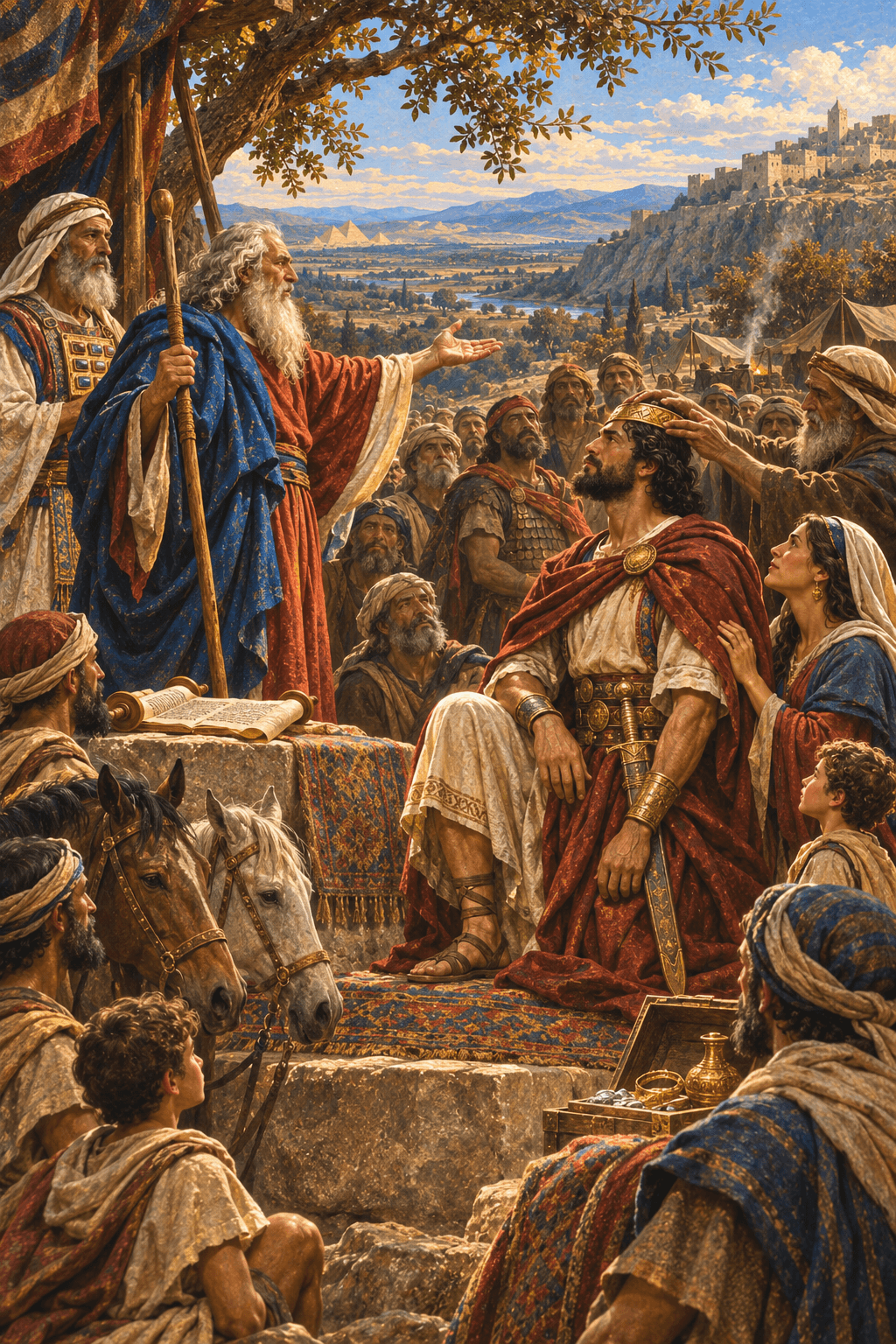
First: The king must be a believer.
When thou art come unto the land which the Lord thy God giveth thee, and shalt possess it, and shalt dwell therein, and shalt say, I will set a king over me, like as all the nations that are about me; Thou shalt in any wise set him king over thee, whom the Lord thy God shall choose: one from among thy brethren shalt thou set king over thee: thou mayest not set a stranger over thee, which is not thy brother. [14–15]
As for the people, when they meet many peoples with great and mighty kings, they long to have a king like all the nations around them.
The prophet Moses realized, through his experience with his people and also by the spirit of prophecy, that once they settled in the Promised Land, instead of taking pride in God’s leadership as their King, they would ask for an earthly king; instead of glorying in God as their King, they would desire what belongs to the nations. These are the feelings of the natural man, not the spiritual; he seeks outward glory and does not experience the beauty of inner glory. Even after their bitter experience with wicked kings, when the Lord Christ came they rejected Him, wanting an earthly king to liberate them and give them temporal authority.
Moses spoke of the king who would lead the people, something the people desired about 400 years after the departure of the prophet Moses. They desired to set up kings according to the lust of their hearts, not according to God’s mind. As is said in Hosea the prophet: “They have set up kings, but not by me: they have made princes, and I knew it not” (Hosea 8:4). Therefore he affirms here: “Thou shalt in any wise set him king over thee, whom the Lord thy God shall choose” (15).
It is clear from the style of the writing that the monarchy had not yet appeared in Israel; indeed its appearance seems a remote and unacceptable possibility.
The prophet Moses was no less fearful of setting up kings over the people than Samuel the prophet, when the people asked him: “now make us a king to judge us like all the nations” (1 Samuel 8:5), and the thing displeased Samuel. Samuel the prophet warned them: “And ye shall cry out in that day because of your king which ye shall have chosen you; and the Lord will not hear you in that day” (1 Samuel 8:18). “Nevertheless the people refused to obey the voice of Samuel; and they said, Nay; but we will have a king over us” (1 Samuel 8:19).
By the spirit of prophecy the prophet Moses knew that the people would insist on setting up a king like all the peoples, and the discourse here lays down the broad lines of what the king is bound to.
God did not promise them a king, nor command them to choose a king; rather the Law came to regulate and reveal the qualities of whoever would be king. God wanted this people to be His own, distinguishing them from all peoples and attributing them to Himself as their King. If they desired to have a king, He allowed it on condition that he fulfill God’s will and be a shadow and symbol of the Messiah King.
The Law legislated the rules for royal rule: if they asked for a king, the king must be chosen by God Himself, and from God’s people, not a foreigner chosen for his strength, his surpassing resources, or his strong personality. He feared lest such a one lead the people astray to idol worship and strange gods, and push the people into unclean and unfitting practices. Therefore the king ought to be a believer, bearing a symbol of the true King, the Messiah Savior, who is bone of our bones (Hebrews 2:14). When the king is a believer he longs to fulfill not his own will but the will of the heavenly King, the King of kings.
Since He asked them not to choose a foreigner as king, it is clear that the Law gave the people the right to choose the king. The commandment here makes clear God’s affirmation of the people’s obligation to act positively in choosing the king (and therefore all leaders). It is the right of every person, indeed his duty, to contribute to choosing a believing leader who walks in the Spirit of the Lord. Therefore the Apostle Paul in his epistles (1 and 2 Timothy, Titus) stressed great care in choosing the deacon, the priest, or the bishop.
In his book On the Priesthood, Saint John Chrysostom says:
“Those who belong to Christ destroy His kingdom more than His enemies and opponents, by choosing the unworthy for the ministry. [201]”
“It is not enough for them to excuse themselves concerning the one they chose by saying they did not know him. For this excuse increases their responsibility; what they counted a justification increases their guilt. If they want to buy a slave, do they not first present him to a physician to examine him, ask guarantees from the seller, and inquire about him from his neighbors; and after all this they do not dare to buy him, but ask for a period of trial? Yet whoever presents someone for so great an office gives his testimony and recommendation carelessly, without care or scrutiny, merely to satisfy the wishes of some?! Who then will intercede for us on that day, if those who defend us themselves need someone to defend them?! Whoever is chosen must be examined carefully; for if one inquired about him and knew his unworthiness and yet chose him, then for any charge against the one chosen, the one who chose him bears the punishment together with him, and indeed the punishment of the first is more severe. [202]”
And Saint Jerome says: “In these days many build churches; their walls and pillars are of precious marble, their ceilings glitter with gold, their altars are adorned with jewels; but to the choice of God’s ministers they give no attention.” [203]
Second: The king must avoid everything that keeps him far from God. He ought to bear a spirit of humility, unlike the kings of the nations around him (16–17). He must not be occupied with what deprives him of the godly, holy life, such as love of vainglory, bodily pleasures, and love of riches.
Concerning love of vainglory, he says:
But he shall not multiply horses to himself, nor cause the people to return to Egypt, to the end that he should multiply horses: forasmuch as the Lord hath said unto you, Ye shall henceforth return no more that way. [16]
The king ought to realize that the nation does not exist for him, but he for it; so he must not work for his own luxury and glory, but for the good of the community.
The king must not bring the people back to the bondage from which they came out, that is, Egypt. This road must be closed completely, so that the people live in a spirit of freedom and not of bondage. Returning the people to Egypt does not mean merely sending some to buy horses for him, but that the king’s own life becomes like a colonizing country that harnesses the people’s energies for its own wealth and personal glory.
Man often inclines toward the old land of bondage, as the Hebrew people in the wilderness longed to return to Egypt to eat the leeks and onions and smell the flesh pots. So man’s heart often turns back to the works of the old, corrupt man instead of enjoying the works of the new man, who is in the image of his Creator. The believer’s heart must not turn back with the heart of Lot’s wife, lest he become a pillar of salt; rather the hope of the life to come opens before him. He says with the Apostle Paul: “but this one thing I do, forgetting those things which are behind, and reaching forth unto those things which are before, I press toward the mark for the prize of the high calling of God in Christ Jesus” (Philippians 3:13–14).
With this joyful view of the future our heart does not turn back to the past, longing for the clock to turn back to what has passed and ended; rather we rejoice in the days that have passed and in the end of every year, glad in the present and setting out toward the future in a spirit of glorious joy.
Saint Augustine says:
“We can take the horse as a symbol of any possessions in this world, or of any kind of honor on which we rely in pride, thinking mistakenly that the higher you rise the greater your safety and height. Do you not realize how violently you will be thrown down?! The higher you rise, the heavier your fall… How then is safety achieved? It is not achieved by strength, nor authority, nor honor, nor glory, nor the horse. [204]”
Origen the Scholar sees that the horses point to the demons who fell from heaven because of their pride, those who followed the one who said: “I will ascend above the heights of the clouds; I will be like the most High” (Isaiah 14:14).
Saint Jerome says:
“Pharaoh rode his horses, and fell into sleep and perished. The Egyptians also had their horses and perished. For this reason the Law gave a remedy, that a Hebrew should not own horses. Remember that Solomon had no horse from Jerusalem or Judea; he bought some horses from Egypt (1 Kings 10:28). Horses were sold in Egypt. ‘Some trust in chariots, and some in horses’ (Psalm 20:7). Truly those who ride horses sleep and perish. Our Lord also has horses, but besides these He has bright mountains, while the mountains of Satan are full of darkness. [205]”
“It is written in the Book of Psalms: ‘An horse is a vain thing for safety’ (Psalm 33:17); and it is said in another place in Holy Scripture: ‘The horse and his rider hath he thrown into the sea’ (Exodus 15:1). There is also the commandment issued to the king of Israel not to ride horses (Deuteronomy 17:16)… I think the horses are sinful men and their riders are the demons who ride the wicked. Whoever has become a persecutor is a horse, and Satan is his rider who hurls a spear at us. The horse runs and Satan hurls spears. The horse is driven in a frenzy by the one who stirs it up and maddens it against its will. [206]”
The king is forbidden to ride horses, though the King of kings in His humility entered Jerusalem riding on an ass and a colt the foal of an ass. He was forbidden to use horses excessively as a kind of vainglory, or because with many horses he gives unworthy people the opportunity to exploit their position in the royal palace; it is said: “I have seen servants upon horses, and princes walking as servants upon the earth” (Ecclesiastes 10:7).
God fears lest the king take pride in his own strength and military resources, for it is said: “Some trust in chariots, and some in horses: but we will remember the name of the Lord our God” (Psalm 20:7). And: “There is no king saved by the multitude of an host: a mighty man is not delivered by much strength. An horse is a vain thing for safety: neither shall he deliver any by his great strength” (Psalm 33:16–17). “Asshur shall not save us; we will not ride upon horses” (Hosea 14:3).
Egypt was the source of horses exported to Canaan (1 Kings 10:28–29), so He did not want them to acquire many horses, lest they enter into excessive commercial dealings with Egypt, which would push them to long for the gods of the Egyptians such as the calf Apis, as they did in the wilderness when they cast a golden calf and worshiped it.
The king is bound to trust in the Lord and walk according to the commandments of the covenant (18–20). He ought to realize that he in turn is subject to the heavenly King. The king must not think that he is above the law or the divine Law, or greater in God’s eyes than those subject to him.
As for bodily lusts, it is said of the king: “Neither shall he multiply wives to himself, that his heart turn not away” (17). This is what Solomon the Wise fell into: “But king Solomon loved many strange women, together with the daughter of Pharaoh, women of the Moabites, Ammonites, Edomites, Zidonians, and Hittites… Solomon clave unto these in love… and his wives turned away his heart. For it came to pass, when Solomon was old, that his wives turned away his heart after other gods: and his heart was not perfect with the Lord his God, as was the heart of David his father” (1 Kings 11:1–6).
He warned the king against love of riches: “neither shall he greatly multiply to himself silver and gold” (17). For the love of money pushes the king to press the people for his own profit. It seems that Solomon the Wise fell into this weakness (1 Kings 12:4). Love of money makes the king trust in his own resources and abilities, not in the arm of the Lord; it is said: “Trust not in oppression, and become not vain in robbery: if riches increase, set not your heart upon them” (Psalm 62:10). David the prophet gathered gold and silver (1 Chronicles 29:4), but he did not gather them for himself, but for the service of God and of God’s people, not for the service of his own family.
Third: He is bound to the divine commandment.
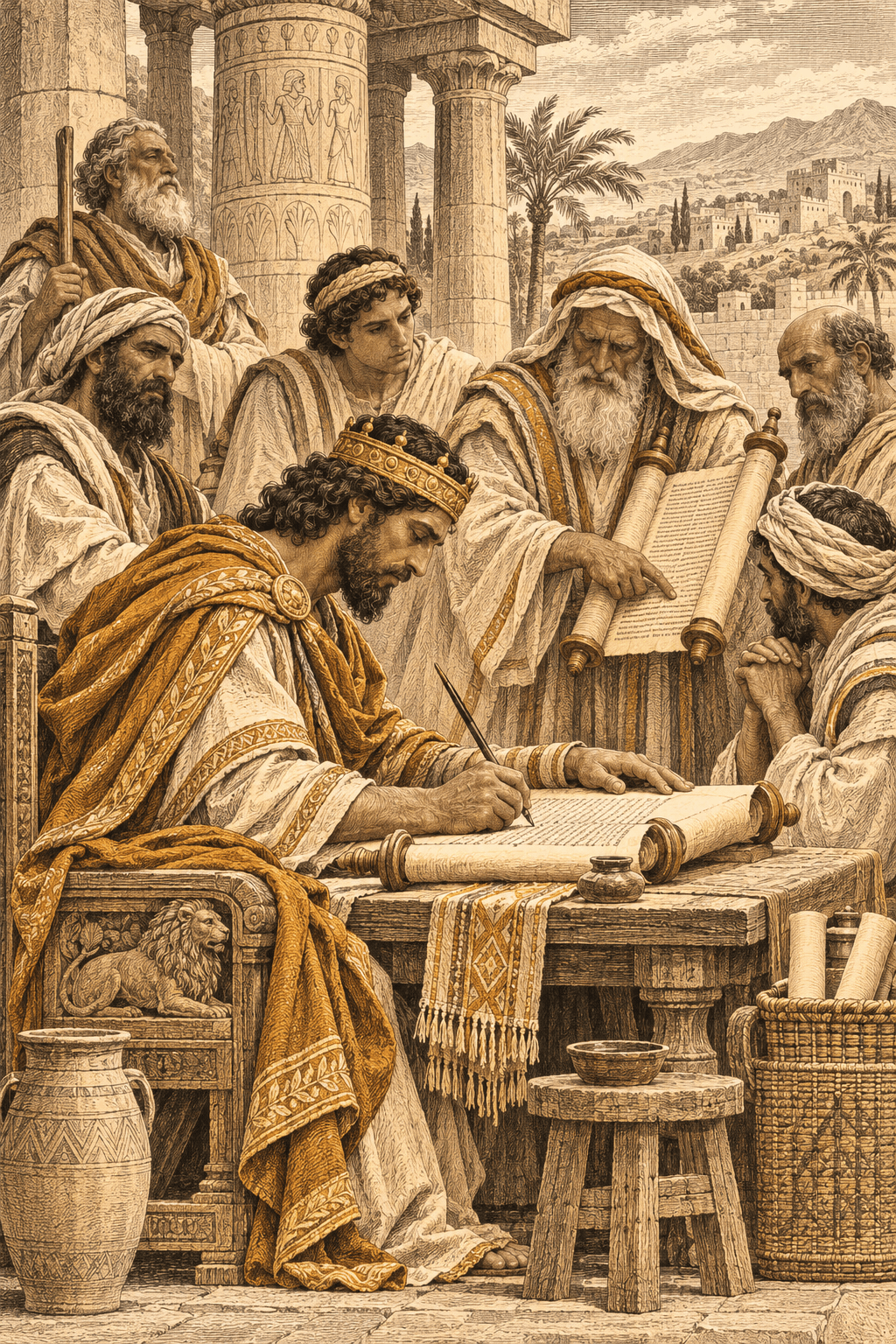
And it shall be, when he sitteth upon the throne of his kingdom, that he shall write him a copy of this law in a book out of that which is before the priests the Levites: And it shall be with him, and he shall read therein all the days of his life: that he may learn to fear the Lord his God, to keep all the words of this law and these statutes, to do them: That his heart be not lifted up above his brethren, and that he turn not aside from the commandment, to the right hand, or to the left: to the end that he may prolong his days in his kingdom, he, and his children, in the midst of Israel. [18–20]
The king ought to be first and foremost a man of Holy Scripture, a man of the word of God, who loves the divine word. He ought to be a diligent student of the word of God, walking in the spirit of obedience to the divine commandment, his heart bowing in a spirit of love toward God who made him king and toward his people; thereby He grants him success in everything.
A) Some see the copy of the Law that the king writes himself as “the Book of Deuteronomy,” for it gives commandments and laws touching the life of the king and leaders, unlike Leviticus and Numbers, where most of the laws concern rites, ministry, and priesthood. Others see that the Law here means the five books of Moses, which were kept together as one unit, the foundation of all that concerns religion.
B) No doubt the king had more than one copy of the Law, but he was bound to write a copy in his own hand after taking the throne, if he had not written one before he began to rule. He had to write a new copy, as a renewal of the covenant between him and God. The copy was written from the one in the hands of the priests, kept in the ark of the covenant before the Lord, so as to match the original.
C) The king usually had scribes whose handwriting was more beautiful than his, but he was bound to write in his own hand, because writing fixes the thoughts and helps a person meditate on what he writes more than mere reading. By this He wanted the Law to be imprinted on the king’s mind.
D) The king learns that nothing in the affairs of his state is more important than sitting and being occupied with God’s commandment, under all the circumstances of the kingdom and the weight of responsibility. He has no excuse that he bears many responsibilities, or that someone else can do this work.
E) It is not enough to write it and keep it in his treasury; he is bound to read it, not once or twice, but to keep reviewing it all the days of his life.
F) The aim of reading is that it be turned into a life of godliness, so that he fears the Lord his God. He realizes that though he has received authority and majesty, he is bound to bow in fear before the authority and might of God. God is above all, and the King of all.
G) He is bound to faithfulness in carrying out all the commandments and statutes, keeping the Law always.
H) By the Law he learns humility, so that his heart is not lifted up above his brethren.
i. His days become long, that is, fruitful and blessed.
4. A Meditation on Deuteronomy 17
Grant Me the Spirit of Holiness, Justice, and Authority
Grant me the spirit of holiness, justice, and authority.
O Holy Father, You long to make me a saint for You.
You sent me Your Holy Son to carry me to You,
and gave me Your Holy Spirit to sanctify me completely!
Grant me not to offer You what is unworthy of You,
but smell in all my offerings the fragrance of Your Holy Son.
Let there be no blemish or defilement in my depths,
so that my prayer and all my worship come forth holy in You!
Of old, idol worship was a great crime punished by stoning.
Let Your fiery Spirit work in my heart and remove every strange god from me.
Let abomination have no place in my depths;
rather let Your Spirit dwell within me, granting me the spirit of holiness.
With holiness grant me the spirit of justice.
You have made me a judge, that I may judge myself in a spirit of justice.
You are the Judge of judges, who judges all mankind.
Grant me the spirit of truth with humility!
Let Your commandment be the judgment within me.
With holiness and justice grant me the spirit of authority.
You are the King of kings.
You make Your people kings, but not like the kings of the nations.
You chose me a king bearing spiritual authority.
I say to this thought, Go, and it goes; and to that one, Come, and it comes!
Grant me authority, so that I do not fear sin,
nor dread Satan or events!
Through You I become a king;
through You my soul is enriched with every blessing,
and I perceive the mysteries of Your commandment.
Your Law is the constitution of my inner kingdom.
I do not turn from it to the right or to the left.
It prepares my royal way for me!
Notes and References
[197] J. A. Thompson, Deuteronomy, 1973, pp. 201–202.
[198] J. Vernon McGee, Deuteronomy, chapter 17.
[199] St. Jerome, Letter 14:8.
[200] St. Augustine, Letter 48:2.
[201] From the author’s Pastoral Love (Arabic), 1965, p. 230.
[202] Ibid., pp. 230–231.
[203] Ibid., p. 233.
[204] St. Augustine, On the Psalms, 33 (32).
[205] St. Jerome, Homilies on the Psalms, 9.
[206] St. Jerome, Homilies on the Psalms, 56.