
The aim of the divine commandment is that the believer’s life be turned into a perpetual feast, as he affirms in this chapter: “thou shalt surely rejoice” (15). The prophet Moses speaks to us of the three great annual feasts (Exodus 23:14–17; 34:18–23; Leviticus 23), which may be called “feasts of pilgrimage” or “of sojourning.” In them the people remember their sojourning with joy and gladness, offering gifts to the house of the Lord as each is able. They are:
1. The Feast of the Passover (1–8): it symbolizes redemption, in which mankind rejoiced in its victory over the devil.
2. The Feast of Weeks, or Pentecost (9–12): it symbolizes our joy at the descent of the Holy Spirit upon us.
3. The Feast of Tabernacles (13–17): dwelling here as in booths, we await the perfection of glory in Christ.
He does not mention here the other great feasts, such as the Feast of Trumpets and the Day of Atonement, for he is content with the feasts in which the people gather together in the house of the Lord. We have already spoken of the feasts in our study of Exodus, Numbers, and Leviticus, of their spiritual meanings, rites, and order; for the study of the feasts see Numbers 28–29.
Here he focuses on communal joy and communal worship in the place the Lord chooses, and that the believer should not appear empty in the house of the Lord. He closes this by affirming justice in judgment in the house of the Lord, and not mixing the worship of God with idol worship. The sign of faithfulness to the covenant is giving the heart to God in the practice of joy and gladness. So the Law mingles heartfelt giving and continual joy in the Lord with the practice of justice as a sign of faithfulness to the just God who rejects injustice. It does not separate the laws governing relations among believers from the laws of worship; this is what we notice throughout the book. There is no justice and love without pure worship, and no acceptable worship without justice and mercy toward the brethren. So worship mingles with conduct, working together as one holy, indivisible life.
1. The Feast of the Passover
KJV · Verses 1–8
1 Observe the month of Abib, and keep the passover unto the Lord thy God: for in the month of Abib the Lord thy God brought thee forth out of Egypt by night. 2 Thou shalt therefore sacrifice the passover unto the Lord thy God, of the flock and the herd, in the place which the Lord shall choose to place his name there. 3 Thou shalt eat no leavened bread with it; seven days shalt thou eat unleavened bread therewith, even the bread of affliction; for thou camest forth out of the land of Egypt in haste: that thou mayest remember the day when thou camest forth out of the land of Egypt all the days of thy life. 4 And there shall be no leavened bread seen with thee in all thy coast seven days; neither shall there any thing of the flesh, which thou sacrificedst the first day at even, remain all night until the morning. 5 Thou mayest not sacrifice the passover within any of thy gates, which the Lord thy God giveth thee: 6 But at the place which the Lord thy God shall choose to place his name in, there thou shalt sacrifice the passover at even, at the going down of the sun, at the season that thou camest forth out of Egypt. 7 And thou shalt roast and eat it in the place which the Lord thy God shall choose: and thou shalt turn in the morning, and go unto thy tents. 8 Six days thou shalt eat unleavened bread: and on the seventh day shall be a solemn assembly to the Lord thy God: thou shalt do no work therein.
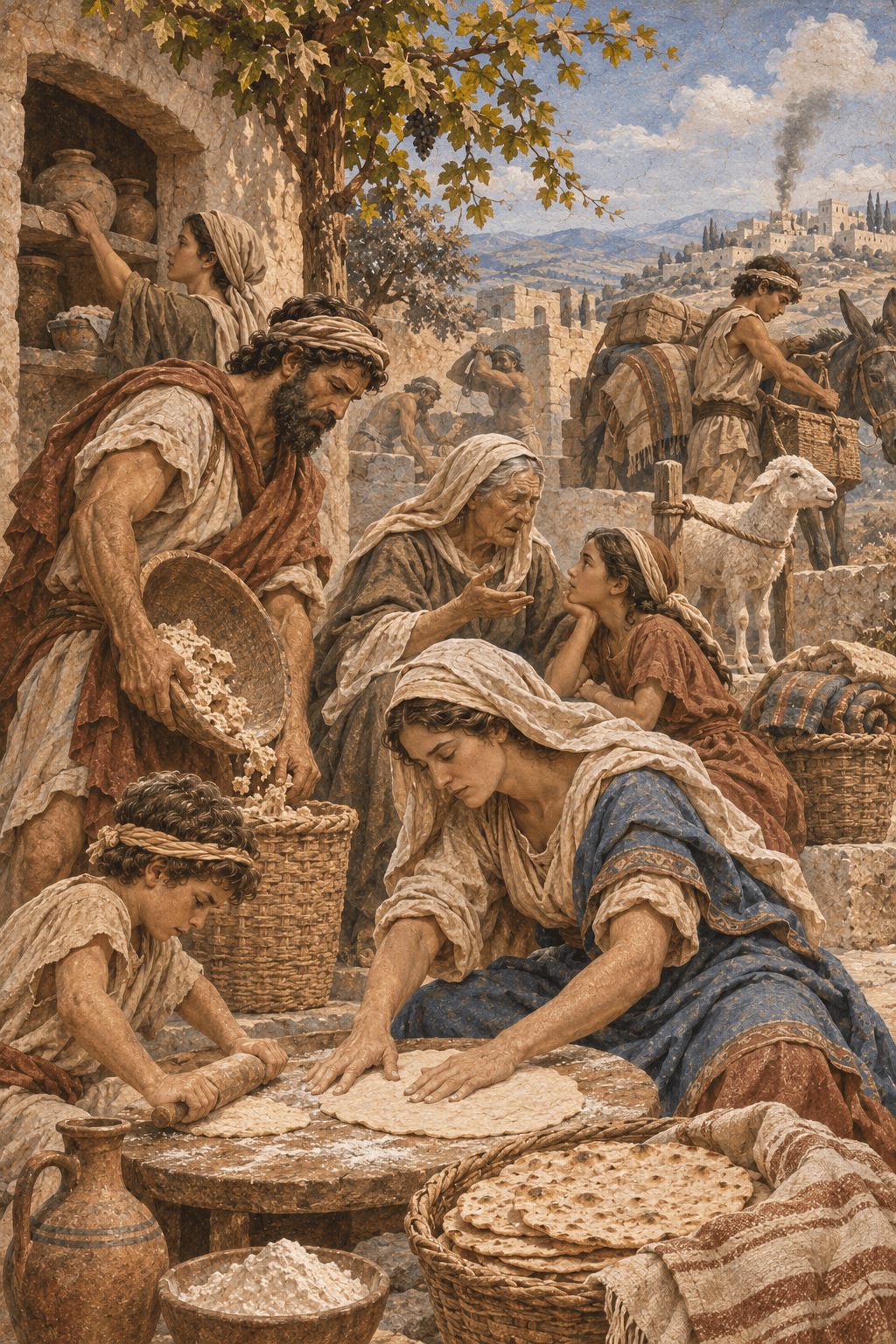
The Feast of the Passover had a special meaning for the Hebrew people, for in it their fathers came out of Egypt to cross into the wilderness, setting out toward the Promised Land. It is the feast in which the foundation was laid for establishing the people as a nation born in Egypt, in a foreign land, which then set out into the wilderness like a young stranger betrothed to her bridegroom. As the Lord says in the Book of Jeremiah: “I remember thee, the kindness of thy youth, the love of thine espousals, when thou wentest after me in the wilderness, in a land that was not sown” (Jeremiah 2:2). It is as though the Feast of the Passover is the remembrance of the young girl born in exile setting out toward maturity, to become a spiritual bride of the Heavenly One.
This is what made the event of the “Exodus,” or “the Feast of the Passover,” the backbone of Holy Scripture, as a shadow of the exodus accomplished for us by Jesus Christ our Passover, who brings us across from the land of bondage into the wilderness, heading toward heaven, as a heavenly bride adorned for her husband (Revelation 21:2). The Book of Exodus had already set out the details of this feast in chapter 12.
The law of the Passover has its own holiness: the people are bound to keep the whole month, though the feast is celebrated for one week in the middle of the month.
Observe the month of Abib, and keep the passover unto the Lord thy God: for in the month of Abib the Lord thy God brought thee forth out of Egypt by night. [1]
The Septuagint reads: “Keep the month of new things, and keep the Passover to the Lord thy God.”
Pope Athanasius the Apostolic says:
“The time of shadows has ended, and the old things have passed away; now the month of new things is in our hands, which every person ought to keep as a feast in obedience to Him. [192]”
“If God Himself loves the feast and calls us to it, then, brethren, it is not fitting that you delay in celebrating it, or keep it carelessly; rather, let us come to it with energy and zeal, and draw near to this heavenly feast with zeal. [193]”
The month Abib, or the month of new fruits (between March and April), is the month in which the people enjoyed the Exodus from Egypt and their release from bondage. This month became the beginning of the Jewish year (Exodus 12:2).
It was called the Feast of Passing Over, for the destroying angel passed over the doors sprinkled with blood and destroyed no one (Exodus 12:23). The Passover was offered by night, and at midnight the Lord struck the firstborn of the Egyptians (Exodus 12:29); then the Egyptians urged the people to go out.
In this feast we go out spiritually from “Rameses” in Egypt, which in the mind of Origen the Scholar means “confusion.” We set out from confusion and corruption to inner peace and holiness. The Feast of the Passover is a call to examine the soul in its bond with the true Passover, the unique sacrifice of Christ, which alone can bring us into the bosom of the Father bearing the righteousness of our Savior, so that we find in Him our continual joy, our eternal peace, and our living heavenly fellowship with the Holy One Himself.
Let us go out spiritually, as at midnight in the thick darkness, to enjoy the pledge of heaven, which needs no sun or moon or lamp, for the Sun of Righteousness Himself shines in it. He sets up His heavenly kingdom within us and reflects the splendor of His glory upon us, so that the powers of darkness cannot come near us.
With every Sunday, indeed with every breath of our life, we celebrate the Feast of the Passover, for we experience the resurrection of Christ our Passover and live the risen life that defies the last enemy, death! God turns all our days into an unceasing feast, and shines at midnight in the darkness, so that we enjoy the splendor of His glory in the midst of our sojourning.
Thou shalt therefore sacrifice the passover unto the Lord thy God, of the flock and the herd, in the place which the Lord shall choose to place his name there. Thou shalt eat no leavened bread with it; seven days shalt thou eat unleavened bread therewith, even the bread of affliction; for thou camest forth out of the land of Egypt in haste: that thou mayest remember the day when thou camest forth out of the land of Egypt all the days of thy life. And there shall be no leavened bread seen with thee in all thy coast seven days; neither shall there any thing of the flesh, which thou sacrificedst the first day at even, remain all night until the morning. Thou mayest not sacrifice the passover within any of thy gates, which the Lord thy God giveth thee: But at the place which the Lord thy God shall choose to place his name in, there thou shalt sacrifice the passover at even, at the going down of the sun, at the season that thou camest forth out of Egypt. And thou shalt roast and eat it in the place which the Lord thy God shall choose: and thou shalt turn in the morning, and go unto thy tents. Six days thou shalt eat unleavened bread: and on the seventh day shall be a solemn assembly to the Lord thy God: thou shalt do no work therein. [2–8]
We have already spoken of the rite of this feast in the commentary on Exodus 12 and Numbers 28. Here we focus on the following points:
First: The sacrifices of the feast are to be offered in the place the Lord chooses to place His name there (2, 6–7). Jerusalem is not mentioned here, for the temple had not yet been built. This confirms that the book was written before the age of David, when Jerusalem was chosen as the city of God, in which Solomon the son of David built the temple of God.
The sacrifices are offered “in the place which the Lord shall choose to place his name there” (2), affirming that the house of the Lord is God’s gift to His people; He chooses the place to declare His dwelling in the midst of His people. So when a person looks into his depths, he sees within him a temple the Lord has chosen, in which to offer sacrifices of love and thanksgiving to God through the cross, “the Passover sacrifice.” Within us is the spiritual Jerusalem that God Himself chose as His holy city, where He set up His temple and receives our offerings.
The commandment still stands: “Thou shalt therefore sacrifice the passover unto the Lord thy God, of the flock and the herd, in the place which the Lord shall choose to place his name there” (2). What is this place but Golgotha, where the unique Passover sacrifice was offered? Every offering or sacrifice offered outside Golgotha God the Father will not smell as a savor of pleasure and good will. This is the work of God’s Holy Spirit, who makes the Church a Golgotha where the Crucified meets His beloved ones who come to carry His cross with Him. There the sacrifices of true love are offered.
It is also the work of the Holy Spirit to make the soul a Golgotha and to build an altar not made of stones, but a surpassing altar, on which our Christ declares His cross, and the soul finds its delight in meeting Him, saying: “I sat down under his shadow with great delight, and his fruit was sweet to my taste. He brought me to the banqueting house, and his banner over me was love” (Song of Songs 2:3–4).
May we not sacrifice the Passover in the place we choose, but in the place the Spirit of the Lord chooses, making of it a true Golgotha!
Second: In verse 2 he refers to offering the sacrifice on the first day of the feast, of the flock or the herd, to be eaten at the Passover supper, with nothing left until the next day. On the remaining days of the feast any other animals could be slaughtered. He links the feast with the sacrifices, for the Passover itself is a sacrifice; and Christ our Passover was sacrificed for us (1 Corinthians 5:7). Other sacrifices too were offered during the seven days of the feast (Numbers 28:19). Therefore he says: “Thou shalt therefore sacrifice the passover unto the Lord thy God, of the flock and the herd” (2).
In every Divine Liturgy, when we celebrate the feast of our Passover, that is, the cross and resurrection of the Messiah, we enjoy fellowship with the sacrificed Christ, and offer our lives given up as an acceptable sacrifice of love through the cross. Whoever does not accept being crucified with the crucified Messiah does not experience the joy of the resurrection with Him, nor taste “the Feast of the Passover.” Therefore Saint Augustine, looking at the altar bearing the Body and Blood of the Lord given up for us and asking us to accept the fellowship of His sufferings in practice, says: “You are on the altar; you are in the cup.”
Third: They eat unleavened bread for seven days (3–4, 8); not only do they not use leaven during all the days of the feast, but they do not allow it to be in the house (1 Corinthians 5:7).
Fourth: He calls this unleavened bread “the bread of affliction,” for it is not easy to digest and its taste is not pleasant. Perhaps it points to the harshness they suffered in the land of bondage. As they eat it they remember how their fathers came out of Egypt in haste, before their bread was leavened. According to the Jewish rite, the head of the family would break the unleavened bread and give it to each member of the family, saying: “This is the bread of affliction which your fathers ate in the land of Egypt.”
The Apostle Paul saw in the unleavened bread a sign of celebrating the feast in a spirit of sincerity without hypocrisy, without “the leaven of malice” (1 Corinthians 5:8). This feast extends for seven days, that is, the whole week, or the whole life of man.
The Christian sees all the days of his life as a Feast of the Passover, for he receives the sacrificed Christ in his depths as the cause of an unceasing heavenly feast.
By saying, “and go unto thy tents” (7), it is clear that the book was written while the people were still living in tents. Yet this expression was later used to refer to dwellings, whether tents or buildings (1 Samuel 13:2; 2 Samuel 20:1; 1 Kings 8:66, etc.).
Christ Our Passover
The Feast of the Passover poured a special joy on the Jews once a year; in it hundreds of thousands of lambs were slaughtered, unable to purify the inner depths. But the true men of God looked forward to the true Lamb, who alone is able to purify completely and to pour joy on the believers all the days of their sojourning, and indeed in heaven itself. Saint John the Beloved saw in the midst of the wedding “a Lamb as it had been slain” (Revelation 5:6). When Saint John the Baptist saw Jesus coming to him he said: “Behold the Lamb of God, which taketh away the sin of the world” (John 1:29). And the Apostle Peter said of Him: “Forasmuch as ye know that ye were not redeemed with corruptible things, as silver and gold, from your vain conversation received by tradition from your fathers; But with the precious blood of Christ, as of a lamb without blemish and without spot: Who verily was foreordained before the foundation of the world” (1 Peter 1:18–20). So, even before our fall into sin, the Word of God accepted by His will to offer Himself as a Passover lamb, to bring man, who would fall, across and into glory. The Apostle Paul plainly calls the cross of Christ the Feast of the Passover, for he says: “For even Christ our passover is sacrificed for us: Therefore let us keep the feast” (1 Corinthians 5:7–8).
So our Savior Jesus Christ by His cross turned our life into a perpetual Feast of the Passover. We do not eat the flesh of a lamb unable to rise, but partake of His Body and Blood given up for us, and enjoy the risen Paschal life. We eat it not with bitter herbs but in a spirit of true repentance, and enter into the joy of His heavenly kingdom. We do not sprinkle the blood on the doorposts of our houses; the Spirit of God sprinkles it in our depths, and the gates of heaven open before us, and we gain the right to enter the bosom of the Father in the merits of the blood and righteousness of Christ.
2. The Feast of Weeks
KJV · Verses 9–12
9 Seven weeks shalt thou number unto thee: begin to number the seven weeks from such time as thou beginnest to put the sickle to the corn. 10 And thou shalt keep the feast of weeks unto the Lord thy God with a tribute of a freewill offering of thine hand, which thou shalt give unto the Lord thy God, according as the Lord thy God hath blessed thee: 11 And thou shalt rejoice before the Lord thy God, thou, and thy son, and thy daughter, and thy manservant, and thy maidservant, and the Levite that is within thy gates, and the stranger, and the fatherless, and the widow, that are among you, in the place which the Lord thy God hath chosen to place his name there. 12 And thou shalt remember that thou wast a bondman in Egypt: and thou shalt observe and do these statutes.
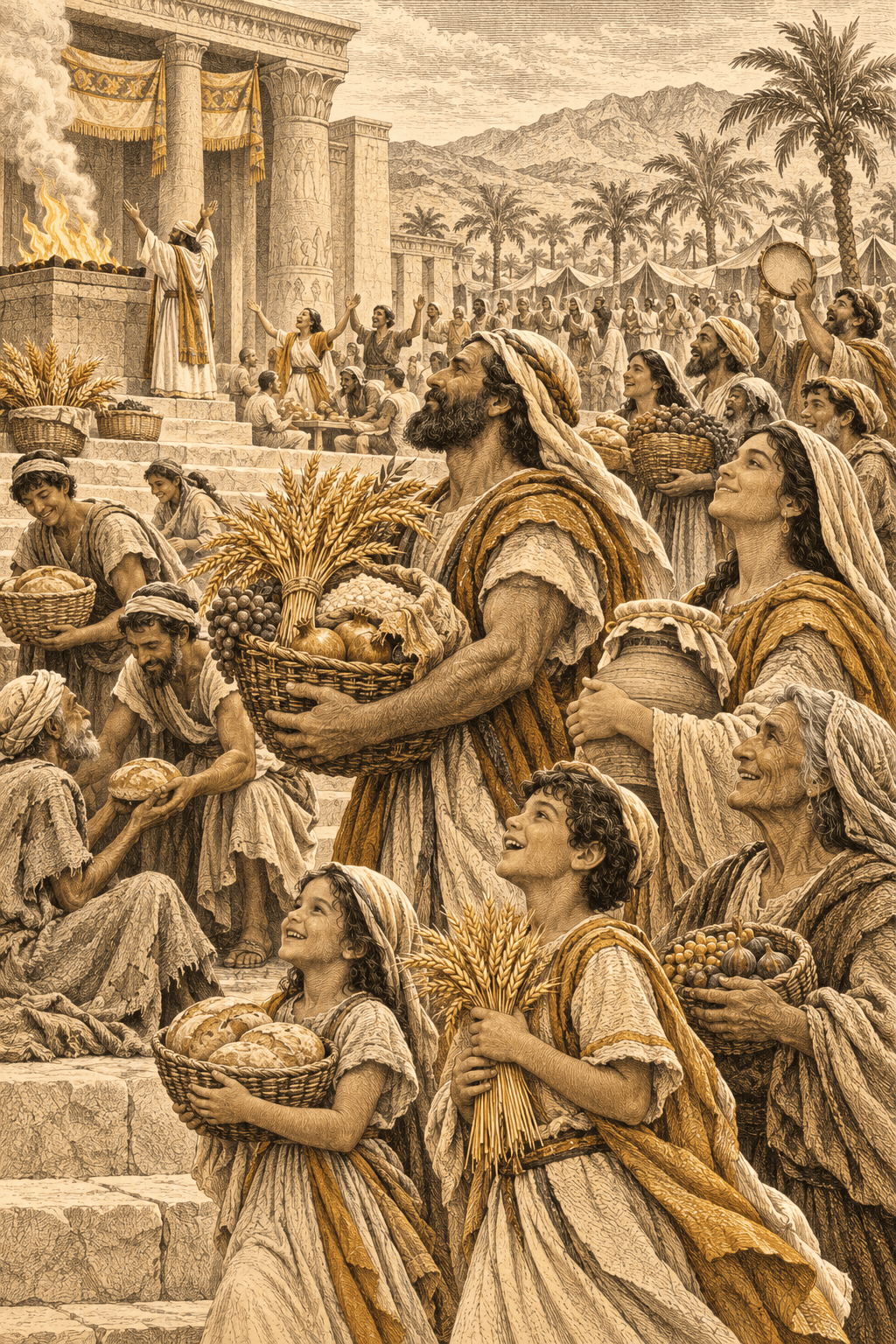
The Feast of the Passover is linked with a historical event, the people’s release from bondage, as a symbol of the freedom that has become ours in Christ Jesus. The Feast of Weeks is an offering of thanksgiving for God’s work in pouring upon us the inheritance of the land He gave us. The first feast is the feast of reconciliation between God and man through the blood; the second is the feast of equality among human beings, in which all share together in joy before the Lord, also through the sacrifice of Christ.
The Feast of Weeks is Pentecost, or the Fiftieth, celebrated seven weeks after the Feast of Unleavened Bread (the fiftieth day). In it messengers were sent to harvest a sheaf of barley to be offered to the Lord as firstfruits (Exodus 34:22). Some think the feast celebrated the divine care for the land, for the harvest came at its proper time through God’s care for the weather.
How Is the Feast Celebrated?
Seven weeks shalt thou number unto thee: begin to number the seven weeks from such time as thou beginnest to put the sickle to the corn. And thou shalt keep the feast of weeks unto the Lord thy God with a tribute of a freewill offering of thine hand, which thou shalt give unto the Lord thy God, according as the Lord thy God hath blessed thee: [9–10]
First: Bringing an offering to the Lord. Bringing an offering to the Lord, each as he is able (10). It is a voluntary offering, like a tribute presented to the King, “God Himself,” the owner of the land, who gave it to the people to work. This is a “freewill” offering, for the believer was left to give according to his generosity, without set limits, so that he gives joyfully and in complete freedom. As the Lord gives to him generously, blessing his harvest (10), so he ought to give to Him generously of what He has given him.
Since it is a feast of thanksgiving to God, who is generous in giving, this feast ought to be expressed not only by worship, but by the believer imitating his God, being generous in giving to his needy brother.
Second: Mingling giving with joy.
And thou shalt rejoice before the Lord thy God, thou, and thy son, and thy daughter, and thy manservant, and thy maidservant, and the Levite that is within thy gates, and the stranger, and the fatherless, and the widow, that are among you, in the place which the Lord thy God hath chosen to place his name there. [11]
The believer translates his thanksgiving to God into practice by generous giving to his brother, and by his joy in giving in a spirit of praise. So he rejoices and gladdens the hearts of his brothers with him.
The aim of the feasts is that the believer enjoy spiritual joy, to live as in heaven, and reflect this joy on the life of his family, his relatives, and those who work with him and under him. He practices this joy in his home, his worship, his work, and his meeting with others, especially the poor and needy. Joy before the Lord does not stop at offering praises with the mouth to God, but man expresses his joy and thanksgiving to God with his whole being.
A Jewish commentator, Rashi, [194] sees that God asks the believer to gladden the hearts of eight: four on the believer’s side, “thy son, and thy daughter, and thy manservant, and thy maidservant,” and four on God’s side, “the Levite… the stranger, and the fatherless, and the widow.” So the believer celebrates the feast seated in the midst of his family, his servants, the men of God, the strangers, and the needy. He cares for his family, that they may share his joy in the feast, and does not forget his servants working in his house; at the same time those who serve the Lord and those the Lord cares for, orphans and widows, share with him.
Whoever loses his family love, or is arrogant toward the despised servants and maids, or does not care for the servants of the Lord, does not open his home to strangers, and does not care for the needy, is unable to celebrate the feast.
So the celebration of the feast becomes an icon of heaven, where all gather around God and enjoy His embrace, and the believer finds himself as in the midst of his family, with no distinction between master and slave, male and female, Jew or Gentile, rich or poor, priest or layman.
This joy is bound up with worship, especially with offering peace offerings and sacrifices of praise and thanksgiving to God, so that the heart comes to bear the nature of joyful thanksgiving.
He distinguishes the kind of joy, saying “thou shalt rejoice before the Lord,” for the world’s joy, based on amusement and irresponsibility and the like, does not take place before the Lord, does not fill the soul within, and usually turns into sorrow.
Third: Meditating on God’s saving work. One of the most important factors that bring inner joy to the soul and move us to keep the divine commandment is remembering God’s dealings with us in our lives, and His wonderful salvation for us.
And thou shalt remember that thou wast a bondman in Egypt: and thou shalt observe and do these statutes. [12]
So he links joy and God’s saving work with the life of thanksgiving and obedience to the commandment, all of them intertwined aspects of one reality: “fellowship with God the Savior.”
A Pentecostal Church
In the Feast of the Passover we saw a symbol of the Lord Christ, the true Passover, who turned our life on earth, as it were into heaven, into an unceasing feast. We see Him, and our souls rejoice, and our whole being utters the new praise of the Lamb.
As for the Feast of Weeks, or “Pentecost,” we see the Church keeping this feast all the days of her sojourning on earth, offering to the Father Christ the Firstborn, the wonderful offering of thanksgiving on behalf of all believers. As the Apostle says: “But now is Christ risen from the dead, and become the firstfruits of them that slept” (1 Corinthians 15:20). This is the first and greatest harvest, acceptable to the Father and the object of His pleasure. Those who are united with Him become firstborn with Him; so it is said of them: “it is the firstfruits of Achaia” (1 Corinthians 16:15). And as the Apostle James says: “Of his own will begat he us with the word of truth, that we should be a kind of firstfruits of his creatures” (James 1:18). It is also said of them: “These are they which follow the Lamb whithersoever he goeth. These were redeemed from among men, being the firstfruits unto God and to the Lamb” (Revelation 14:4). So the firstborn Church remains in a continual feast, offering her Christ the Firstborn, the first ear of grain, waving Him in the presence of the Father as an acceptable offering of thanksgiving.
3. The Feast of Tabernacles
KJV · Verses 13–15
13 Thou shalt observe the feast of tabernacles seven days, after that thou hast gathered in thy corn and thy wine: 14 And thou shalt rejoice in thy feast, thou, and thy son, and thy daughter, and thy manservant, and thy maidservant, and the Levite, the stranger, and the fatherless, and the widow, that are within thy gates. 15 Seven days shalt thou keep a solemn feast unto the Lord thy God in the place which the Lord shall choose: because the Lord thy God shall bless thee in all thine increase, and in all the works of thine hands, therefore thou shalt surely rejoice.
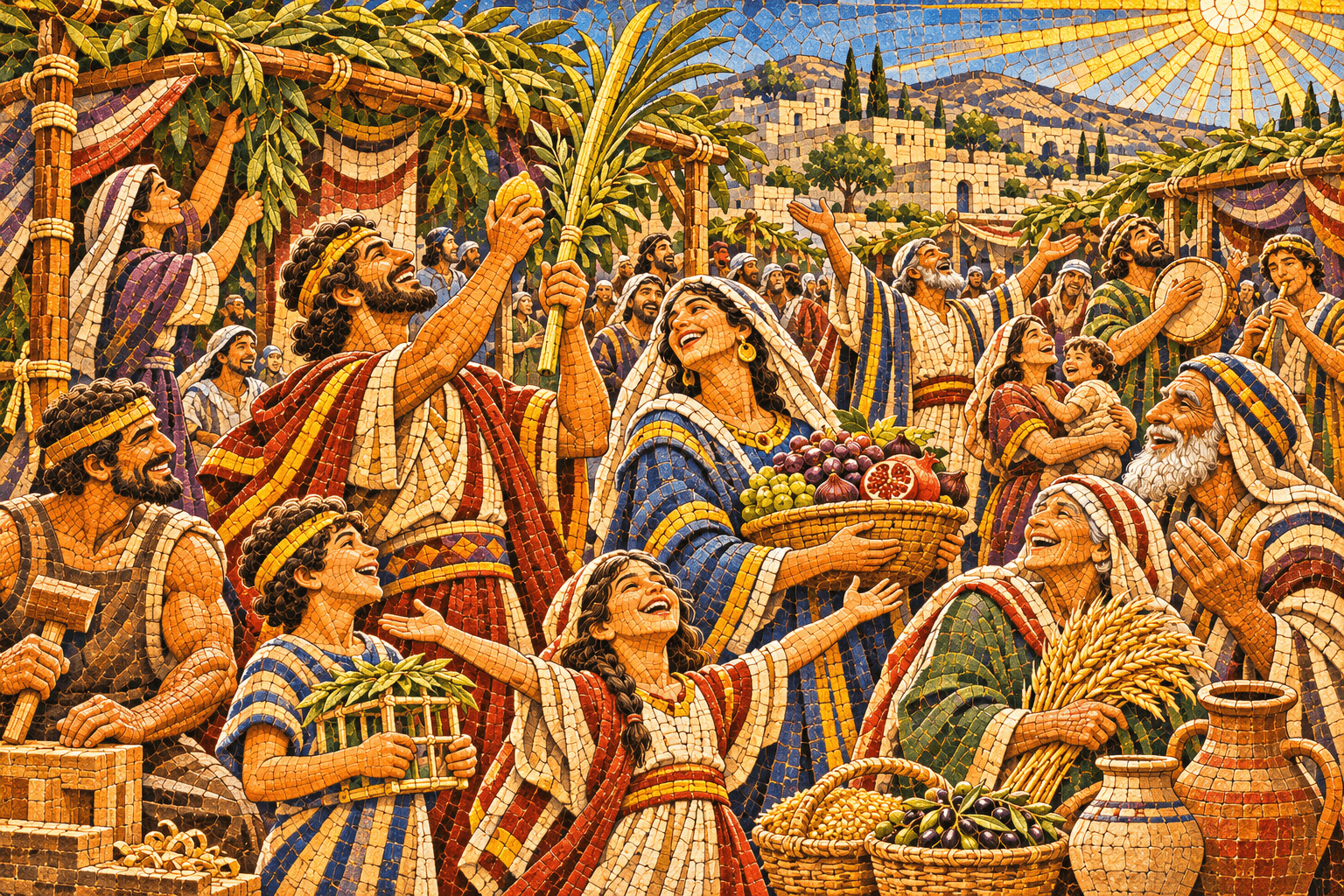
These three feasts complete one another, declaring our need for God to sanctify our work in this world in all its stages. The Jews celebrated the Feast of the Passover with the first stroke of the sickle in the harvest, as a sign of the beginning of work; the Feast of Pentecost when the harvest was completed, as a sign of the continuing blessing of the Lord in the midst of our work; and the Feast of Tabernacles at the end of the agricultural year, so that the Lord’s blessing seals our work at the end of the road. It is as though the Lord’s blessing accompanies us at the beginning, during the work, and to the end.
In the Feast of the Passover the believer enjoys reconciliation with God; in the Feast of Weeks the believer offers thanksgiving to God by generosity toward his brothers and his sense of equality among believers; and in the Feast of Tabernacles the believer rejoices in his sojourning, longing to depart to heaven. These three feasts cannot be separated from one another; they bring about a kind of union between God, man, and heaven, and this union gives birth to communal and personal joy, which is realized only through the sacrifice of the Lord Christ on the cross.
He reminds them here of some rites of the Feast of Tabernacles, of which he had spoken before (Numbers 29:12), and makes clear the following truths:
First: The link between making the booths and gathering in from the threshingfloor and the winepress: “Thou shalt observe the feast of tabernacles seven days, after that thou hast gathered in thy corn and thy wine” (13). When the Lord gives us blessing in our crops and pours the abundance of His temporal gifts upon us with His surpassing blessing, He fears lest our souls be bound to the world and not to its Creator. Therefore, whenever we enjoy good things, we ought to set up “booths” for ourselves, remembering that we are strangers and sojourners on the earth, on which we will not settle forever.
Second: The link between the sense of sojourning and heavenly joy in the Lord.
And thou shalt rejoice in thy feast, thou, and thy son, and thy daughter, and thy manservant, and thy maidservant, and the Levite, the stranger, and the fatherless, and the widow, that are within thy gates. Seven days shalt thou keep a solemn feast unto the Lord thy God in the place which the Lord shall choose: because the Lord thy God shall bless thee in all thine increase, and in all the works of thine hands, therefore thou shalt surely rejoice. [14–15]
This feast is a call to realize man’s true position in the world: he is a stranger. As the Psalmist says: “for I am a stranger with thee, and a sojourner, as all my fathers were” (Psalm 39:12). This view is not pessimistic, for it is accompanied by looking toward the open heaven and God’s arms stretched out to the believers, so that they may depart to Him and rest in Him. As the Apostle Paul says: “For we know that if our earthly house of this tabernacle were dissolved, we have a building of God, an house not made with hands, eternal in the heavens” (2 Corinthians 5:1). The sense of sojourning accompanied by hope in heaven gives birth to inner joy.
This is God’s will for us: that we rejoice before Him and that the hearts of others rejoice with us. If those under the shadow of the Law ought to rejoice and bring joy into the lives of others, how much more we who have entered the covenant of grace and enjoy the continual dwelling of the Holy Spirit in us, who grants us His fruits, which are love, joy, and so on.
The believer rejoices because of the gifts and blessings God has given him, and rejoices also that he gives to others, so that his joy in giving is greater than in receiving, counting the joy of his brothers his own joy!
We rejoice in the feast because of the Lord Himself, our Feast; because of His gifts that declare His love for us; because He grants us the blessing of giving to others so that their hearts rejoice; and because of His true and faithful promises, which we receive when He carries us into the bosom of the Father instead of the booths in which we live here, and we enjoy the fellowship of glory with Him. Here we know nothing but inner spiritual joy: “thou shalt surely rejoice” (15).
4. The Feasts and Giving
KJV · Verses 16–17
16 Three times in a year shall all thy males appear before the Lord thy God in the place which he shall choose; in the feast of unleavened bread, and in the feast of weeks, and in the feast of tabernacles: and they shall not appear before the Lord empty: 17 Every man shall give as he is able, according to the blessing of the Lord thy God which he hath given thee.
He gives us general touches concerning these three annual feasts, as in Exodus 23:16–17; 34:23.
First: Practicing the communal life in the Lord.
Three times in a year shall all thy males appear before the Lord thy God in the place which he shall choose; in the feast of unleavened bread, and in the feast of weeks, and in the feast of tabernacles: and they shall not appear before the Lord empty: [16]
The males appearing together three times a year at the central place of worship points to affirming unity in the Lord and fellowship together in a spirit of communal joy.
Second: Giving.
Every man shall give as he is able, according to the blessing of the Lord thy God which he hath given thee. [17]
This giving is a sacrifice of thanksgiving offered to the Lord from what He gives us, each according to the breadth of his heart, as much as his heart overflows with the spirit of thanksgiving to God and with love for his brothers, so as to satisfy their needs and gladden their hearts, just as God satisfies his needs and pours His joy on him. The Apostle Paul commands us: “Now concerning the collection for the saints… Upon the first day of the week let every one of you lay by him in store, as God hath prospered him” (1 Corinthians 16:1–2). And he says of the Macedonians: “For to their power, I bear record, yea, and beyond their power they were willing of themselves; Praying us with much intreaty that we would receive the gift, and take upon us the fellowship of the ministering to the saints. And this they did, not as we hoped, but first gave their own selves to the Lord, and unto us by the will of God” (2 Corinthians 8:3–5).
A wonderful picture of giving: it is giving oneself to God and to those who love Him before giving material things, giving love and joy before visible giving, springing from a true longing and sincere desire to give. They gave according to their ability, indeed beyond their means, counting it an honor and glory to enjoy the grace of giving and to share in the ministry to the saints. They imitated the poor widow who gave all she had (Luke 21:4).
5. The Feasts and Justice
KJV · Verses 18–20
18 Judges and officers shalt thou make thee in all thy gates, which the Lord thy God giveth thee, throughout thy tribes: and they shall judge the people with just judgment. 19 Thou shalt not wrest judgment; thou shalt not respect persons, neither take a gift: for a gift doth blind the eyes of the wise, and pervert the words of the righteous. 20 That which is altogether just shalt thou follow, that thou mayest live, and inherit the land which the Lord thy God giveth thee.
God wants His people to practice joy in the Lord, so that they come to His house rejoicing, and all are glad: the rich man in giving generously and lovingly, and the poor man in receiving the gift with thanksgiving and gratitude. This joy is realized all the more where He sets up for them judges and officers in all the gates, that is, at the gate of every city and village, to look into the troubles of the people and do justice to the oppressed.
No special buildings were set up for judgment, nor was judgment held in the public squares of the towns, but at the gates of the city walls. Why?
First: Because most cities had walls; through the gates the workers in agriculture and the fields went out every day to their places of work, and through them they came in after work; and all strangers and those coming from other lands entered through them. So the gates of the walls were public places where those coming in and going out met.
Second: If the city must be fortified with strong walls to protect its inhabitants from the enemy, this protection ought to be bound up with justice. Without justice the walls cannot keep the city from the enemy; rather, injustice destroys it.
Third: God Himself, all-just, is the wall that protects His people; therefore He says: “For I, saith the Lord, will be unto her a wall of fire round about, and will be the glory in the midst of her” (Zechariah 2:5).
Judges and officers shalt thou make thee in all thy gates, which the Lord thy God giveth thee, throughout thy tribes: and they shall judge the people with just judgment. [18]
The judge ought to realize that it is out of God’s love and condescension that man has been permitted to exercise judgment, “for the judgment is God’s” (Deuteronomy 1:17). The judge is God’s steward and ambassador, so he ought to present an image fitting this grave position. Judges have been called gods: “God standeth in the congregation of the mighty; he judgeth among the gods. How long will ye judge unjustly, and accept the persons of the wicked?” (Psalm 82:1–2). And the Apostle Paul commands us: “Let every soul be subject unto the higher powers. For there is no power but of God: the powers that be are ordained of God” (Romans 13:1).
He had set up judges for them according to their numbers, with captains of thousands and captains of hundreds, in the wilderness. Now that they were coming into cities, he sets up judges and officers (the executive body of justice) at every city and village. So as the men go up joyfully to the house of the Lord to worship, they find at their homes those who do them justice against wrong and defend the oppressed among them.
Besides the seventy elders whom Moses chose, who became the nucleus and beginning of the Sanhedrin that sat in judgment in Jerusalem, councils of justice were set up in the large cities, and in the small cities containing more than 120 families, according to the population of the city. This was renewed in the days of Jehoshaphat (2 Chronicles 19:5, 8).
Some think that the officers here are the secretaries and scribes who accompanied the judges to help them, and perhaps they were like counselors who gave them advice to support them.
The number of judges and officers is not mentioned here, for they differed from city to city or village to village according to population.
God asked the people to set up the judges, choosing those in whom they saw the spirit of justice and impartiality.
The Hebrew text has “just just judgment”; this repetition points to emphasis. Perhaps it is repeated twice because the number 2 points to love, which makes the two “one,” as the widow cast two mites into the treasury out of her love, and the Good Samaritan gave two pence to the inn for the care of the wounded man as a sign of his love. So the judge, when he pronounces a just sentence, ought not to bear within him hatred or enmity even toward those sentenced to discipline or stoning; he must carry within him a love that is never separated from justice.
Thou shalt not wrest judgment; thou shalt not respect persons, neither take a gift: for a gift doth blind the eyes of the wise, and pervert the words of the righteous. [19]
Since God knows the corruption and crookedness of the human heart, He warned the judges against three things: “wresting judgment, respecting persons, and taking a gift.”
Father Caesarius of Arles says:
“While they seek money (a bribe), they lose their souls. No one acquires unjust gain without just loss. Where there is gain, there is loss: the gain is in the money of the chest, but the loss is in the conscience. [195]”
He warns the judges against practicing any injustice and rejecting any bribe (Exodus 23:8); they are rather to hold fast to justice.
That which is altogether just shalt thou follow, that thou mayest live, and inherit the land which the Lord thy God giveth thee. [20]
The officers probably means those working to carry out judgment, such as soldiers, and also those who carried out inspection, such as checking weights and measures.
6. Not Mixing the Worship of God with Idols
KJV · Verses 21–22
21 Thou shalt not plant thee a grove of any trees near unto the altar of the Lord thy God, which thou shalt make thee. 22 Neither shalt thou set thee up any image; which the Lord thy God hateth.
The mention of pillars and groves is evidence that these discourses were delivered at an early time, when the features of Canaanite worship were evident, and not at a late time when the people had been influenced by the pagan customs around them.
Clearly the discourse was given to the people before the building of Solomon’s temple, when altars could be set up in several places.
The grove (Asherah) was a sacred tree or wooden pole symbolizing the goddess Ashtoreth (Astarte), or in the likeness of one of the goddesses; they supposed it had magical power.
The pillar (massebah) was a stone pillar of sacred value, sometimes a memorial, pointing to the male god Baal.
The altar set up in the name of the Lord is for the people, not for God: “which thou shalt make thee.” God does not need sacrifices and offerings; it is we who need reconciliation with God.
God hates the mixing of truth and falsehood, of worship of God with idol worship. Man ought not to halt between two opinions, but walk uprightly in the royal way. He does not only ask us to walk in the truth, but to be careful in our conduct so as not to cause anyone to stumble. Therefore He rejects not only idol worship but even planting a wooden pole or setting up a pillar beside the temple, even if the believer does not use it in idol worship, lest anyone suspect that the one who made the altar practices idol worship.
The Septuagint reads: “Thou shalt not set thee up a pillar, things which the Lord thy God hateth.” In his commentary on the title of Psalm 16, “Michtam of David” (an inscription), Saint Jerome distinguishes between the memorial pillar in which God is pleased, and the pillar or memorial column that God hates. Psalm 16 and other psalms represent a memorial inscription engraved on our souls with God’s words, so that we always remember the death of the Lord, as Jacob set up a pillar on the grave of Rachel. So Saint Jerome sees the hearts of believers as like a holy tomb on which the memorial of Christ’s death is engraved, sharing their Christ’s sufferings and death. There are also memorial pillars that the Lord hates, as Absalom set up a pillar for himself, and as Lot’s wife herself became a pillar by looking back and not forward. [196]
7. A Meditation on Deuteronomy 16
Thou Shalt Surely Rejoice!
Thou shalt surely rejoice!
You made Your Sabbath a Sabbath for me, and Your rest a rest for me.
For You rest in me, and give me rest in You.
You want to make all my days holy feasts;
indeed, You want to bring me into an unceasing feast.
You have made my life days ever new.
Every day You bring me out of the bondage of sin,
and bring me across into the heavenly Canaan.
So I keep for You the Feast of the Passing Over, O true Passover!
All my days are days of harvest.
The fruit of Your Holy Spirit never ceases nor fails!
Let me come before You with the fruit of Your Spirit, and let my soul eat and rejoice.
Let me be satisfied with Your work, and let hungry souls be satisfied with me!
Eat, O Holy One, of Your garden that You planted in me;
call Your heavenly friends, that they may eat and drink and rejoice!
I spend my whole life as a Feast of Tabernacles.
My soul will not settle as long as I am on the earth,
but lives in the tent of this body,
until I meet You and settle in the bosom of Your Father!
You command me, indeed You promise me:
“Thou shalt surely rejoice!”
Yes, let me rejoice!
I rejoice in Your Sabbaths and Your unceasing feasts.
I rejoice when I offer You of what You have given me,
so that I do not appear before You empty.
Let me rejoice in Your righteousness, and walk in the spirit of justice full of love,
so that no injustice creeps into my heart,
and I cause no one to stumble by my conduct.
Rejoice in Your work with me, O my good Savior.
Let my soul rejoice together with my body and my whole being.
Let every poor and needy man rejoice in the generosity of my heart.
Let everyone in pain rejoice when he finds in my life the spirit of justice and love!
Notes and References
[192] St. Athanasius, Paschal (Festal) Letters, 19:1.
[193] St. Athanasius, Paschal (Festal) Letters, 6:1.
[194] Joseph Parker, The People’s Bible, vol. 4, on Deuteronomy 16:11.
[195] Fr. Caesarius of Arles, Sermon 13.
[196] St. Jerome, Homilies on the Psalms, 61.