
After his stern words about enticement to idol worship, he dealt with some pagan customs related to funerals (1–2), asking them to remember that they are “the children of the Lord” and “an holy people… a peculiar people.” Then he set forth the subject of clean and unclean foods. So that offerings and sacrifices might be practiced with pure and clean hearts, he gave the law of clean and unclean animals, to distinguish them from the Canaanites (3–21). He also asked them to offer tithes (22–23), to be used to meet the needs of His chosen ministers and also of the poor (26–29).
1. Funeral Customs
KJV · Verses 1–2
1 Ye are the children of the Lord your God: ye shall not cut yourselves, nor make any baldness between your eyes for the dead. 2 For thou art an holy people unto the Lord thy God, and the Lord hath chosen thee to be a peculiar people unto himself, above all the nations that are upon the earth.
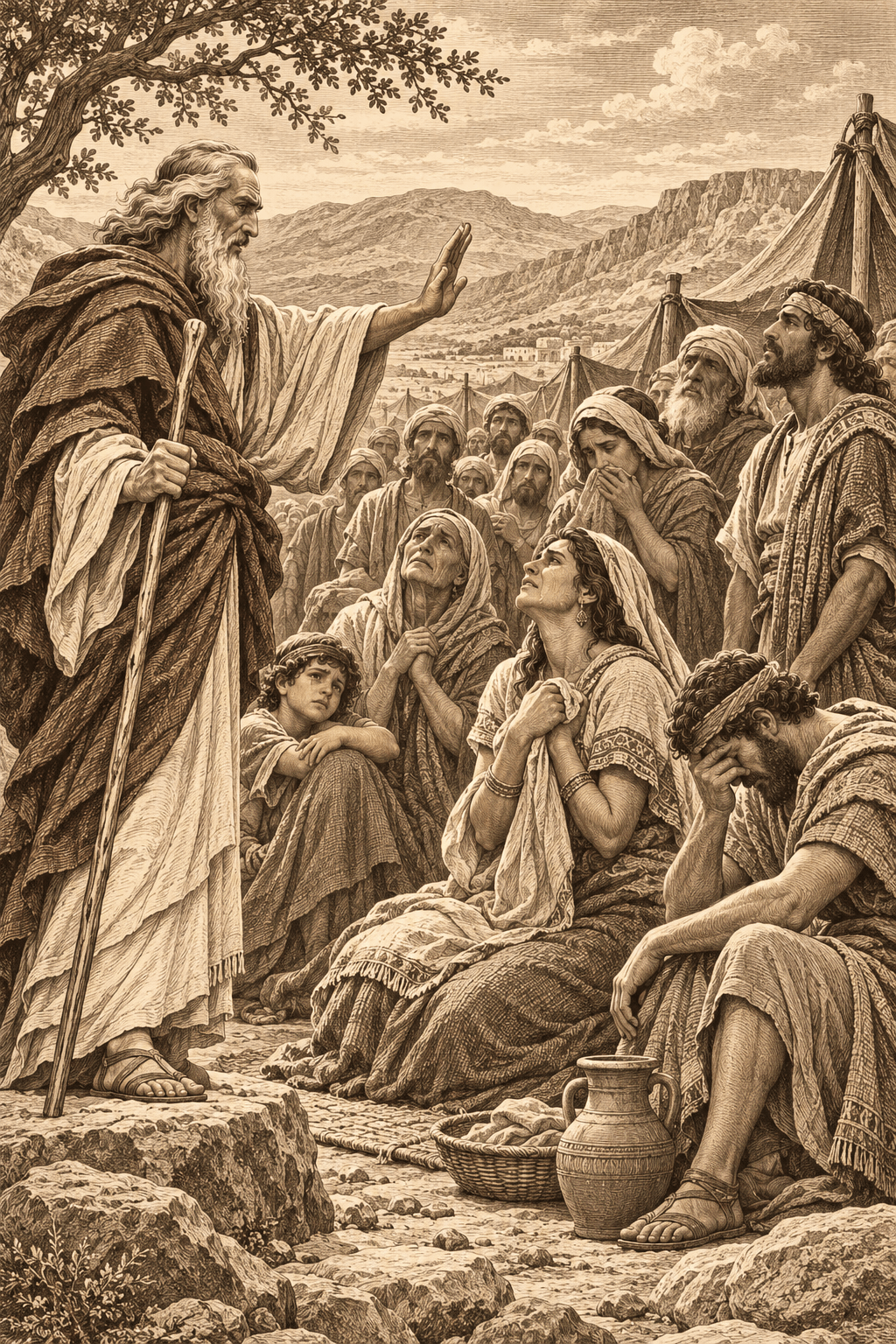
The believer practices the holy life through his customs, even in harsh moments such as death; in his daily life, such as eating and drinking; in his worship, such as giving; and in his relationship with others, such as caring for strangers and the needy.
(See verses 1–2 above.)
In giving them laws for their sanctification that touch their daily conduct and particular occasions, God does not issue orders to be obeyed without discussion, but, as a Father, affirms their sonship to Him; what comes from the Father is surpassing love for their edification. What God seeks from these laws is not merely carrying them out mechanically, but the children’s response to their Father’s love, so that they become holy as He is holy.
Now that the Only-Begotten Son has come and by His Holy Spirit has granted us the spirit of sonship to the Father, the commandment of the New Testament has become sweet and joyful. We do not see in the commandments orders and prohibitions, but a royal way fitting for the children of God. As children of God we accept the commandment, and even bear fellowship in the sufferings of the crucified Christ, so that we may inherit and be glorified with Him: “And if children, then heirs; heirs of God, and joint-heirs with Christ; if so be that we suffer with him, that we may be also glorified together” (Romans 8:17). “And because ye are sons, God hath sent forth the Spirit of his Son into your hearts, crying, Abba, Father. Wherefore thou art no more a servant, but a son; and if a son, then an heir of God through Christ” (Galatians 4:6–7).
As children of God they are bound to a special life befitting them, different from others both inwardly and in outward conduct. He constantly reminds them of their position: “Ye are the children of the Lord your God.” They had entered into a covenant with God, not by any merit of their own, but through the riches of the mercies of God, who chose them to be a holy, chosen, and peculiar people to Himself. God’s people ought to bear a special holiness and not imitate the peoples around them. He lifts them above all peoples in holy living, so it is not fitting for them to go down to pagan customs, such as cutting the body and making their heads bald to express grief at funerals.
God commanded them to abstain from pagan customs so that the way might be opened before them for new teachings and a living, practical faith. Among the pagans it was the custom to cut or shave the hair, to wound the face and beat the breast, and to put dark dyes on the face, things by which they expressed the intensity of their grief for the dead. God’s people had to refrain from sharing these customs of the pagans, as a sign of their enjoyment of a new life different from that of the pagans.
Abstaining from these customs is a testimony to the new understanding that believers, the children of God, have about death, for they see the dead who are sanctified in the Lord as departing to a better life. Their life did not end with their death; they are still alive with Abraham, Isaac, and Jacob, awaiting eternal glory.
God’s people bore in their bodies “circumcision,” the sign of the Lord, so it was not fitting for them to bear the marks of strange gods, namely cutting their bodies. The pagans used to cut their bodies not only at funerals, but also during the worship of their gods, as the priests of Baal did (1 Kings 18:28).
God, the Creator of the body, is not pleased with one who disfigures his body, but with one who cares for it, nourishes it, and honors it as befits a holy gift from the Lord. Every creature of God is good (1 Timothy 4:4). The body is a beautiful divine gift; man has no right to disfigure it by cutting, whatever the reason. Cutting the body at funerals makes them like children who disfigure their bodies when they play with a knife; so God in His fatherhood wants to take the knife out of their hands lest they harm themselves.
Cutting and baldness point to the despair and excessive grief that come upon the relatives of the departed, while the Apostle Paul commands us: “But I would not have you to be ignorant, brethren, concerning them which are asleep, that ye sorrow not, even as others which have no hope” (1 Thessalonians 4:13). Their abstaining from this excessive grief bears witness to their faith in the resurrection of the dead, their victory over death, and their not fearing to pass through the valley of the shadow of death.
Their being distinguished from the pagan peoples at funerals declares their faith in the divine presence at all times, even before the dead, for God is the God of the living and the dead; He gathers all together to live with Him forever.
We do not deny that the believer grieves over the pain of separation, but within limits and for a time. Many pagans accepted faith in the Lord Christ when they saw how Christians faced death with courage and cheerfulness. The martyr Saint Justin Martyr recorded how he was affected by this before he accepted the faith. [135]
Even in times of peace, one of the factors that drew pagans to the faith was the Christian funeral rites and the feelings of peace and hope in eternity they carried. [136]
The person who fixes his eyes on his inner depths and sees his Christ within him also looks at the death of the body and sees it as a divine gift, a bridge of crossing to immortality, and a true liberation from temporal life with all its spiritual and bodily diseases.
Saint Basil the Great says:
“The death of the righteous has become sleep; indeed, it has become life.”
Saint Gregory of Nazianzus looked to his elder sister, Saint Gorgonia, as a model of the Christian, and was deeply affected by her, for he loved her piety and devotion. He showed how she prepared for death without fear:
“Gorgonia’s homeland was the Jerusalem above (Hebrews 12:22–23)… which Christ inhabits, together with the assembly and church of the firstborn which are written in heaven.”
“All that she could snatch from the prince of this world she deposited in safe places. She left nothing behind her but her body. She parted with everything for the sake of the hope on high. The only wealth she left her children was the imitation of her example, and that they might enjoy what she had merited.”
“Here I speak of her death and what distinguished her at that time, to give her her due… She longed greatly for the time of her departure, for she knew who had called her, and preferred to be with Christ more than anything else on earth (Philippians 1:23).”
This saint longed to be freed from the bonds of the body and to escape from the mire of this world in which we live. And what is more wonderful, she tasted the beauty of her Beloved Christ, for she was ever contemplating Him.
By saying “the Lord hath chosen thee” (2), he does not mean passivity on man’s part; rather, man is bound to walk as befits this choice, so as to be counted a true member of the holy people.
Saint John Chrysostom says:
“Why did He choose us? ‘That we should be holy and without blame before him’ (Ephesians 1:4). So that when you hear ‘He chose us,’ you do not think that faith alone is enough; he adds life and conduct. He says that He chose us for this purpose, ‘that we should be holy and without blame’… If men in their choosing choose what is best, much more does God. Truly, election is the gift of the loving and merciful God, and it is also good conduct. He has made us holy, and we ought to continue in holiness. The holy man is the one who shares in the faith; the man without blame is the one who has a blameless life. [137]”
2. Clean Animals
KJV · Verses 3–8
3 Thou shalt not eat any abominable thing. 4 These are the beasts which ye shall eat: the ox, the sheep, and the goat, 5 The hart, and the roebuck, and the fallow deer, and the wild goat, and the pygarg, and the wild ox, and the chamois. 6 And every beast that parteth the hoof, and cleaveth the cleft into two claws, and cheweth the cud among the beasts, that ye shall eat. 7 Nevertheless these ye shall not eat of them that chew the cud, or of them that divide the cloven hoof; as the camel, and the hare, and the coney: for they chew the cud, but divide not the hoof; therefore they are unclean unto you. 8 And the swine, because it divideth the hoof, yet cheweth not the cud, it is unclean unto you: ye shall not eat of their flesh, nor touch their dead carcase.
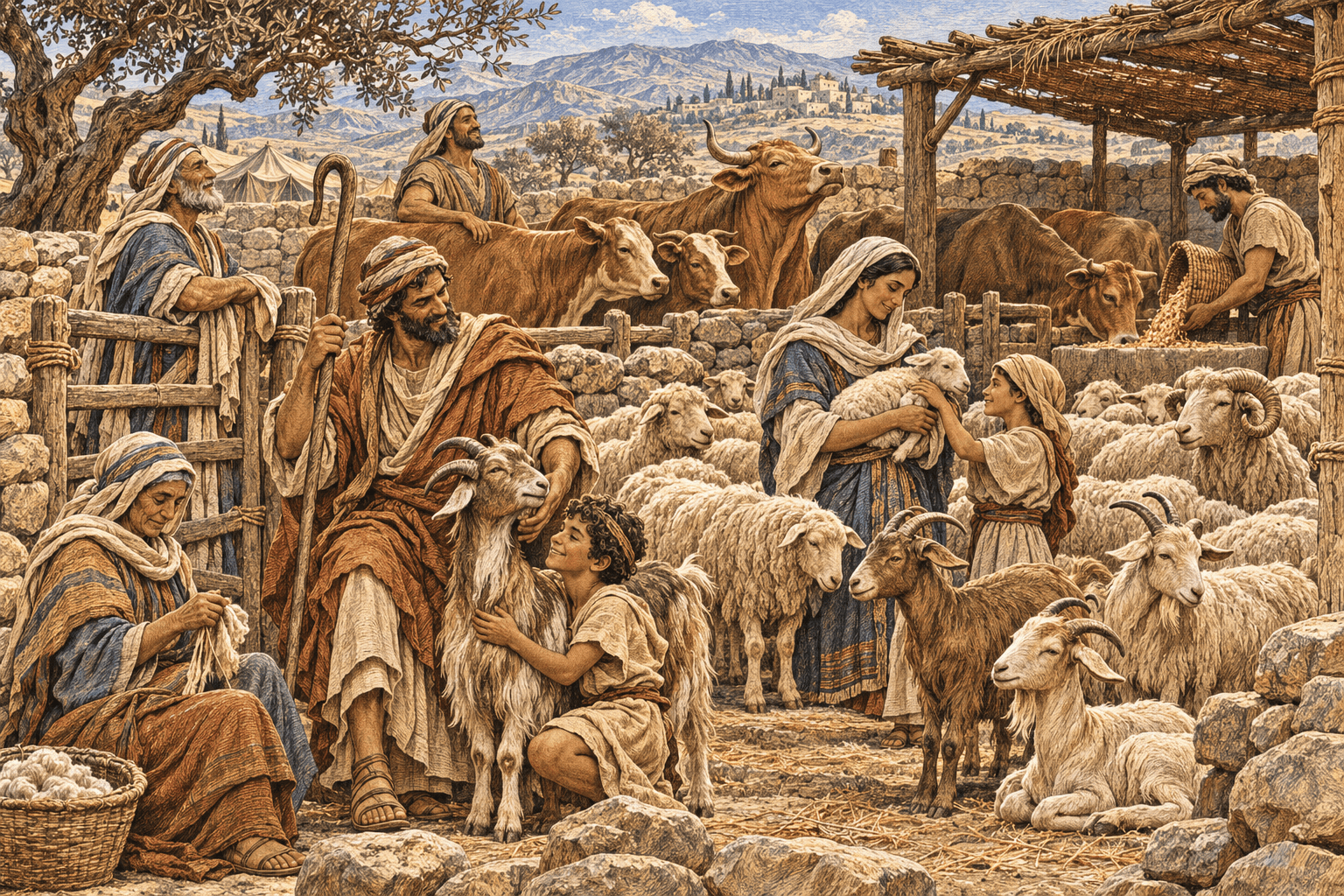
We said that the true believer senses the divine presence even when he stands before a dead person very dear to him, and so he behaves as befits this presence and as suits his faith. Now the believer declares his awareness of the divine presence even at the dinner table, for God has revealed to him the permitted foods and the defiled ones. The question many ask is: does it matter to God what kinds of food His believers eat?
First: So that the believer in the Old Testament would feel bound by a law that governs all his conduct, not to limit his freedom but to support him, so that he walks as befits a son of God. The Christian feels obligated in all his conduct, even in his eating and drinking, not only for the sake of his own conscience but for the sake of his brothers who are weak in faith, so as not to put a stumbling block before them (Romans 14:13). The Apostle Paul laid down a living principle of faith to guide our conduct: “Whether therefore ye eat, or drink, or whatsoever ye do, do all to the glory of God. Give none offence, neither to the Jews, nor to the Gentiles, nor to the church of God: Even as I please all men in all things, not seeking mine own profit, but the profit of many, that they may be saved” (1 Corinthians 10:31–33).
Second: So that he would feel consecrated to the Lord, belonging to a chosen people and a distinct spiritual kingdom. Since God wanted to separate His people for a time so that they would not share the abominations of the nations, He commanded that they be kept from sharing one table with them. Whoever does not share the same table with others does not share in other things either. In many countries today, whoever refuses to share a table with someone is counted as refusing to enter any relationship with him. In many countries of the Middle East, whoever refuses to share a table with someone is counted as having insulted and slighted the one who invited him to the banquet. So God wanted to cut His people off from every serious relationship or fellowship with the pagan nations.
Third: So that he would always think of purity and holiness, even in his eating and drinking, and become holy as God is holy. The distinction between permitted and defiled foods is a daily call to the people to be occupied with the holy life.
Fourth: Because God wanted to keep His people from sharing the tables of the pagans, which they considered an inseparable part of pagan worship. Worship did not stop at offering sacrifices and incense, but extended to sharing in the tables of demons. But now that the Lord Christ has come into the world and dwelt among mankind as one of them, it is fitting that believers do not withdraw from the world, for then they would need to go out of it (1 Corinthians 5:10); yet they are not conformed to the people of the world, but walk in newness of life. As the Apostle Paul says: “And be not conformed to this world: but be ye transformed by the renewing of your mind” (Romans 12:2). “Know ye not that your bodies are the members of Christ?… For ye are bought with a price: therefore glorify God in your body, and in your spirit, which are God’s” (1 Corinthians 6:15, 20). Man with his whole being has become the Lord Christ’s, who alone leads him by His Holy Spirit and reigns over soul, spirit, and body with all their gifts and abilities, to work for the glory of God.
Fifth: These foods carry spiritual symbols, as we saw in our study of the Book of Genesis. The distinction between clean and unclean animals, and among birds and sea creatures, calls the believer to perceive the distinction between true believers who walk in the spirit of righteousness and holiness, and others.
Sixth: God is the Creator of the body together with the soul, so He cares for everything concerning man, bodily and spiritually.
Seventh: God wants to affirm the unity of man: what enters the stomach affects even the soul, and the spiritual and psychological feelings the soul carries affect the body.
We spoke in some detail about permitted and forbidden foods and the symbolic spiritual meanings they carry in our study of the Book of Leviticus. [138] They were also given for health reasons.
In the New Testament there are no clean and unclean foods, but every creature of God is good (1 Timothy 4:4). Now in Christ Jesus there are no permitted and forbidden foods, but whoever cares for his spiritual life must also be careful concerning his body. Consider, for example, the difference between a mother who prepares food mingling it with her prayers and praises, and a mother who mingles it with worldly songs; the difference between one who mingles his food with prayer, feeling that he is in the Lord’s presence even while eating, and one who occupies his mind with corrupting things meanwhile.
(See verses 3–8 above.)
The permitted animals are those that chew the cud and have a cloven hoof. If we take the cow as an example of chewing the cud, it has a complex stomach with more than one chamber. In the morning it eats grass, which enters a certain part of the stomach. At midday it rests under the shade of a tree or stands behind a wall in the shade and begins to chew again what it had eaten, moving it from one part of the stomach to another after grinding it with its teeth. This is a picture of the believer who finds his food in the word of God; he eats it, and from time to time sits to meditate on it. As the Psalmist says: “Blessed is the man… [whose] delight is in the law of the Lord; and in his law doth he meditate day and night” (Psalm 1:1–2).
Saint Jerome says:
“Meditating on the Law does not mean merely reading it, but practicing it. As the Apostle Paul says in another place: ‘Whether therefore ye eat, or drink, or whatsoever ye do, do all to the glory of God’ (1 Corinthians 10:31). [139]”
Saint John Chrysostom says:
“Let us count everything secondary beside hearing the word of God, for there is no time unsuitable for it… rather, all times suit it. [140]”
As for the cloven hoof, it is divided on one side, a sign of separation, and united on the other, a sign of unity. Chewing the cud points to continual meditation on the word of God, [141] or, as Origen sees it, to moving from the literal meaning of God’s word to the symbolic meaning. [142]
The cloven hoof points to the believer’s acceptance of Holy Scripture in both its Old and New Testaments, [143] or to the believer who knows how to be sanctified in this temporal life and to be holy in the eternal life, [144] or to the believer who has a firm faith in the Father and the Son. [145]
Whoever walks with a hoof divided on one side and united on the other is one who knows how to walk in a spirit of discernment. He knows what belongs to his temporal life and its limits, and what belongs to his eternal life and how it occupies him. As for unity, in all his daily conduct and worship he is never separated from his Christ, but walks in Christ Jesus our Lord. The Apostle Paul says: “As ye have therefore received Christ Jesus the Lord, so walk ye in him” (Colossians 2:6).
If the hoof points to what is dead in our body, dividing the hoof points to dividing what is dead in us, that is, mortification of the lusts that kill the soul.
Perhaps the reason for rejecting unclean foods was often that they were used as sacrifices to idols, such as the swine and the camel. In Palestine these two animals ate poisonous plants and were often infected with harmful parasites.
God cannot bear uncleanness, and it is strange that the people in their stubbornness sought what was unclean. Therefore He says in Isaiah the prophet: “A people that provoketh me to anger continually to my face; that sacrificeth in gardens, and burneth incense upon altars of brick; which remain among the graves, and lodge in the monuments, which eat swine’s flesh, and broth of abominable things is in their vessels” (Isaiah 65:3–4). He gave them different kinds of animals whose meat could be eaten, so that when He pointed to abstaining from unclean animals such as the swine they would not be distressed.
3. Clean Fish
KJV · Verses 9–10
9 These ye shall eat of all that are in the waters: all that have fins and scales shall ye eat: 10 And whatsoever hath not fins and scales ye may not eat; it is unclean unto you.
We find an implicit prohibition against eating shellfish, because they feed on refuse.
For water creatures to be clean, two conditions are required:
The first: That they have fins that help them swim and resist every current of water. This points to the soul that can pass through the waters of this world with strength.
The second: That they have scales that protect them from what surrounds them. These scales point to the grace of God, to which the believer holds fast so as to resist every corruption that destroys the soul.
4. Clean Birds
KJV · Verses 11–20
11 Of all clean birds ye shall eat. 12 But these are they of which ye shall not eat: the eagle, and the ossifrage, and the ospray, 13 And the glede, and the kite, and the vulture after his kind, 14 And every raven after his kind, 15 And the owl, and the night hawk, and the cuckow, and the hawk after his kind, 16 The little owl, and the great owl, and the swan, 17 And the pelican, and the gier eagle, and the cormorant, 18 And the stork, and the heron after her kind, and the lapwing, and the bat. 19 And every creeping thing that flieth is unclean unto you: they shall not be eaten. 20 But of all clean fowls ye may eat.
The birds mentioned in verses 12–18 feed on carrion, and therefore they are forbidden.
Birds of prey are counted unclean, because they bear not love but violence and the devouring of others. So whoever does not bear the spirit of love, but hatred and enmity, is not counted holy in the Lord’s eyes.
Insects in general are counted unclean.
5. The Carcass
KJV · Verses 21
21 Ye shall not eat of anything that dieth of itself: thou shalt give it unto the stranger that is in thy gates, that he may eat it; or thou mayest sell it unto an alien: for thou art an holy people unto the Lord thy God. Thou shalt not seethe a kid in his mother’s milk.
He warns us against eating a carcass for health reasons, and also for a symbolic meaning: the believer ought not to feed on dead things and die with them, but to be nourished by the living, life-giving word of God. God wanted the believers of the Old Testament to keep away from all that is dead, so that they would realize that they must let the dead bury their dead and seek the things above, where death cannot reach them.
The law today forbids butchers from selling carcasses, to prevent disease and for fear of poisoning or infection.
One of the reasons for abstaining from eating blood is not eating animals and birds that died of themselves, since their blood remains in them and was not drained by slaughter.
The commandment not to seethe a kid in its mother’s milk came to prevent sorcery. The Canaanites used to cook a kid in its mother’s milk as a charm and spell to increase fertility. It also respects the natural bond between parents and young even among animals and birds, like the prohibition against killing a cow or ewe and its young on the same day (Leviticus 22:28), or a sitting bird together with its young (Deuteronomy 22:6). It had already been said: “Thou shalt not seethe a kid in his mother’s milk” (Exodus 23:19; 34:26). God created the animals for man and permitted him to slaughter and eat them, but he is to do this with regard for the feelings of the mother (among animals and birds). It is as if God moves His believers toward gentleness with all creation, even irrational creatures, respecting their feelings as far as they can.
As for the kid not being seethed in its mother’s milk, some think it points here to the lamb offered at the Passover.
6. The Tithes
KJV · Verses 22–29
22 Thou shalt truly tithe all the increase of thy seed, that the field bringeth forth year by year. 23 And thou shalt eat before the Lord thy God, in the place which he shall choose to place his name there, the tithe of thy corn, of thy wine, and of thine oil, and the firstlings of thy herds and of thy flocks; that thou mayest learn to fear the Lord thy God always. 24 And if the way be too long for thee, so that thou art not able to carry it; or if the place be too far from thee, which the Lord thy God shall choose to set his name there, when the Lord thy God hath blessed thee: 25 Then shalt thou turn it into money, and bind up the money in thine hand, and shalt go unto the place which the Lord thy God shall choose: 26 And thou shalt bestow that money for whatsoever thy soul lusteth after, for oxen, or for sheep, or for wine, or for strong drink, or for whatsoever thy soul desireth: and thou shalt eat there before the Lord thy God, and thou shalt rejoice, thou, and thine household, 27 And the Levite that is within thy gates; thou shalt not forsake him; for he hath no part nor inheritance with thee. 28 At the end of three years thou shalt bring forth all the tithe of thine increase the same year, and shalt lay it up within thy gates: 29 And the Levite, (because he hath no part nor inheritance with thee,) and the stranger, and the fatherless, and the widow, which are within thy gates, shall come, and shall eat and be satisfied; that the Lord thy God may bless thee in all the work of thine hand which thou doest.
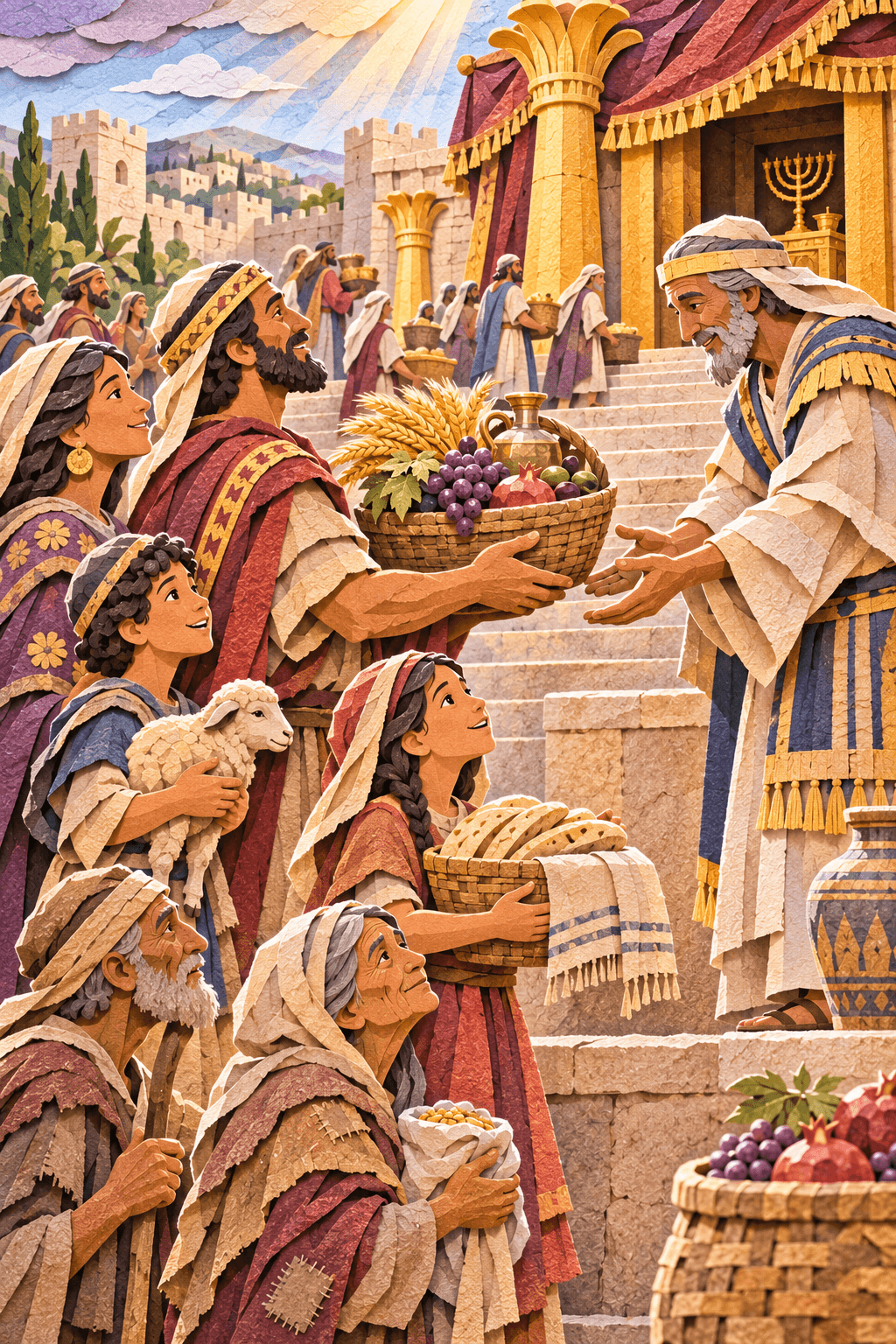
He presents to us three uses of our resources: for the service of God, for the happiness of our families, and for caring for the needs of others. He spoke of tithes and offering them to God, making the following points clear:
1. Keeping the Sabbath rests on the basis of offering tithes, for all of man’s time and wealth are gifts from God and a trust from Him with us (Deuteronomy 8:18; Matthew 25:14). We must set apart a portion for the sanctuary as a sign of the sanctification of the whole (Deuteronomy 23:25).
Thou shalt truly tithe all the increase of thy seed, that the field bringeth forth year by year. [22]
2. Offering tithes and firstfruits was an occasion for holding feasts and for generosity toward all within the gates (27), as though Moses were looking forward to the coming days of peace and prosperity. Offering tithes is a sign of sanctifying all that we own for the Lord. It seems to have been a traditional law handed down through the generations [Jacob at Bethel (Genesis 28:22)]. When the believer feels that what he owns (the land) is a holy gift from the Lord, he is obliged to offer the tithes as a sign of his heart’s response of love to the divine love. In his love he gives to the Levites (the ministers of the word), the strangers, the orphans, and the widows (29). Its fruit is joy (26) and blessing (29).
And thou shalt eat before the Lord thy God, in the place which he shall choose to place his name there, the tithe of thy corn, of thy wine, and of thine oil, and the firstlings of thy herds and of thy flocks; that thou mayest learn to fear the Lord thy God always. And if the way be too long for thee, so that thou art not able to carry it; or if the place be too far from thee, which the Lord thy God shall choose to set his name there, when the Lord thy God hath blessed thee: Then shalt thou turn it into money, and bind up the money in thine hand, and shalt go unto the place which the Lord thy God shall choose: [23–25]
3. He links giving with joy: “And thou shalt bestow that money for whatsoever thy soul lusteth after, for oxen, or for sheep, or for wine, or for strong drink, or for whatsoever thy soul desireth: and thou shalt eat there before the Lord thy God, and thou shalt rejoice, thou, and thine household, And the Levite that is within thy gates; thou shalt not forsake him; for he hath no part nor inheritance with thee” (26–27).
At the end of three years thou shalt bring forth all the tithe of thine increase the same year, and shalt lay it up within thy gates: And the Levite, (because he hath no part nor inheritance with thee,) and the stranger, and the fatherless, and the widow, which are within thy gates, shall come, and shall eat and be satisfied; that the Lord thy God may bless thee in all the work of thine hand which thou doest. [28–29]
Hegemonius says:
“In this offering [the widow’s two mites (Mark 12:41–44)] there truly appeared something surpassing what Moses said about the offering of money. For Moses accepted gifts from those who had money, but Jesus receives gifts even from those who have none. [146]”
Saint Paulinus of Nola says:
“We have been entrusted with temporal wealth to manage and use for the common good, not as those who own something as their own eternal possession. If you accept the truth that ownership on earth is for a time, you can enjoy eternal ownership in heaven. Remember the widow who forgot herself in her care for the poor and thought only of the life to come, and so gave all she had, as the Judge Himself testified. He says that the others gave of their surplus; but she, having only two mites and being more in need than many of the poor, though she surpassed all the rich in spiritual wealth, thought only of the life to come. Longing for the heavenly treasure, she gave at once all that is drawn from the earth, and insisted on returning it… Let us return to the Lord the gifts He has given us. Let us offer them to Him who receives them in the person of every poor man or woman. Let us give with gladness; I say that we will have great joy when we receive the reward He has promised. [147]”
4. There were two kinds of tithes. The first was given to the Levites, and from it the priests’ portion was paid (Numbers 18:24–28; Nehemiah 10:37–38). From what remained the second tithe was paid, which they ate before the Lord in the first and second years; the tithe of the third year was given to the Levites and the poor (Deuteronomy 14:28–29). In the fourth and fifth years its owners ate of it, in the sixth year it was given to the poor, and the seventh year was given as a Sabbath to the land, when everything was held in common (Exodus 23:10–11). [148]
5. The Levites feel obliged to give blessing to the people through teaching and prayer, and the people rejoice to share with them the gifts of the Lord to them (29).
7. A Meditation on Deuteronomy 14
Let Me Walk as Your Son!
Let me walk as Your son,
and as a member of Your holy people!
You chose me as Your son;
You made a covenant with me, and gave the two tablets of the covenant as a pledge.
Grant me to walk as befits
a son holy to You.
Let my conduct be fitting
for one who belongs to a peculiar people, belonging to the Holy One.
Let me not walk in the folly of the ignorant,
that I may not cut my body at a funeral,
nor make myself bald through excessive grief.
Let even my eating and drinking be sanctified,
so that nothing unfitting enters my mouth,
and no defilement enters my heart.
Let me offer You the tithes, the firstfruits, and the vows,
and count this a symbol of offering all that is mine,
for I own nothing.
All that is in my hand is from the riches of Your love and care.
Notes and References
[135] St. Justin Martyr, Second Apology, 12. See also the author’s The Gift of Death (Arabic), 1998.
[136] Boniface Ramsey, Beginning to Read the Fathers, p. 218.
[137] St. John Chrysostom, Homilies on Ephesians, 1.
[138] See the author’s commentary on Leviticus, chapter 11.
[139] St. Jerome, Homilies on the Psalms, 1.
[140] St. John Chrysostom, Homilies on John, 18:4.
[141] Epistle of Barnabas 10:11–12; St. Clement of Alexandria, Paedagogus 3:11; St. Irenaeus, Against Heresies.
[142] Origen, Homilies on Leviticus, 7:6.
[143] St. Jerome, Homilies on the Psalms, 23.
[144] St. Clement of Alexandria, Stromata 5:8; Paedagogus 3:11.
[145] St. Irenaeus, Against Heresies, 5:8:4.
[146] Hegemonius, Disputation with Manes, 42.
[147] St. Paulinus of Nola, Letter 34:2–4.
[148] Adam Clarke, Commentary.