
Since the Lord Christ would come from the seed of Judah, Holy Scripture had to present to us the line of Judah’s descendants, so that we might trace the Lord’s genealogy.
It is true that Judah — in his love of money — advised his brothers to sell their brother Joseph; but God turned his error into the fulfillment of His divine purposes, and Judah came to stand for the Jewish nation, which betrayed the true Joseph. Now Judah sets out to marry a Canaanite woman, but God’s surpassing grace turned even this act into a declaration of God’s saving dispensation…
1. The Sons of Judah
KJV · Verses 1–5
1 And it came to pass at that time, that Judah went down from his brethren, and turned in to a certain Adullamite, whose name was Hirah. 2 And Judah saw there a daughter of a certain Canaanite, whose name was Shuah; and he took her, and went in unto her. 3 And she conceived, and bare a son; and he called his name Er. 4 And she conceived again, and bare a son; and she called his name Onan. 5 And she yet again conceived, and bare a son; and called his name Shelah: and he was at Chezib, when she bare him.
“And it came to pass at that time, that Judah went down from his brethren, and turned in to a certain Adullamite, whose name was Hirah. And Judah saw there a daughter of a certain Canaanite, whose name was Shuah; and he took her, and went in unto her. And she conceived, and bare a son; and he called his name Er” (1–3).
Judah separated from his brothers and turned in to Hirah the Adullamite, perhaps a friend of his, and there he joined himself to the daughter of a Canaanite man called “Shuah,” that is, “riches.” It is as though he represents the Jewish nation, which denied the true Joseph and set out, through its love of the world’s riches, to join itself to the pagan girl, that is, unbelief.
Shuah’s daughter conceived and bore Onan, and a third time she bore Shelah; and he was at Chezib when she bore him. This joining to the Canaanite woman and bearing children by her points to the Jewish nation’s insistence on refusing faith in the Savior; and the third time the birth took place in Chezib, which means “lying,” for the nation bears false fruits through its cleaving to unbelief.
Adullam, to which Hirah belonged, is one of the major cities of Canaan; its meaning is “hiding place” or “refuge.” It is near the famous cave of David in the valley of Elah, which stretches from Hebron to Philistia, some two or three miles south of Socoh and about 15 miles northwest of Hebron. As for Chezib, it was called “Achzib” in the prophecy of Micah (Micah 1:14–15); it lies at Ain Kezbeh, north of Adullam and near it.
2. Er and Tamar
KJV · Verses 6–11
6 And Judah took a wife for Er his firstborn, whose name was Tamar. 7 And Er, Judah's firstborn, was wicked in the sight of the Lord; and the Lord slew him. 8 And Judah said unto Onan, Go in unto thy brother's wife, and marry her, and raise up seed to thy brother. 9 And Onan knew that the seed should not be his; and it came to pass, when he went in unto his brother's wife, that he spilled it on the ground, lest that he should give seed to his brother. 10 And the thing which he did displeased the Lord: wherefore he slew him also. 11 Then said Judah to Tamar his daughter in law, Remain a widow at thy father's house, till Shelah my son be grown: for he said, Lest peradventure he die also, as his brethren did. And Tamar went and dwelt in her father's house.
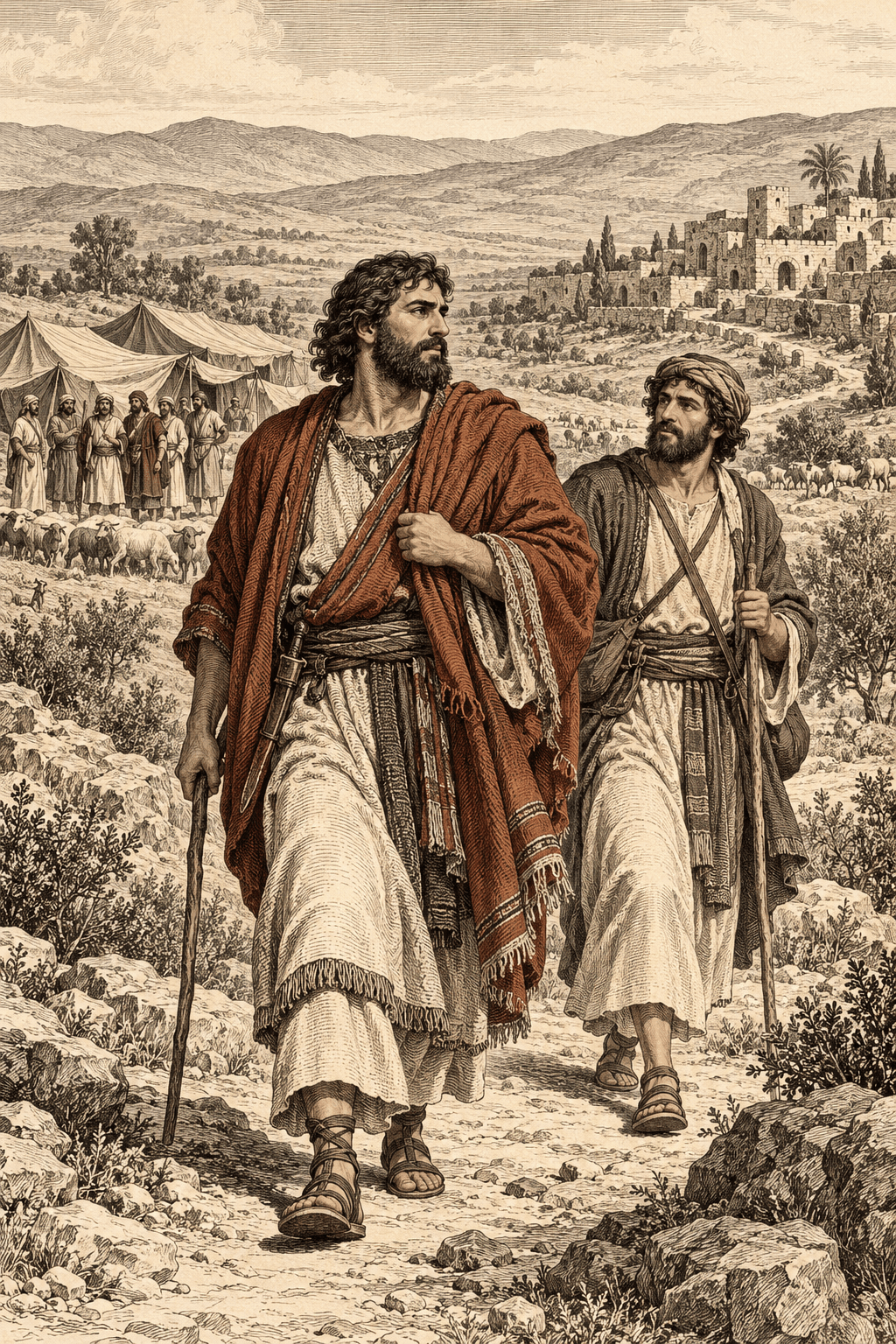
Judah took for Er his firstborn Tamar as a wife, whose name means “palm tree.”
If Judah erred by joining himself to a Canaanite woman, the fruit of this error was manifested in his children. The book tells us of his firstborn son Er that he died before begetting children, to be a lesson to his family and that Judah and his other sons might take warning all the more. But the lesson had no effect on the life of his brothers. When Judah obliged his son Onan to marry Tamar to beget a child in the name of the dead Er, he acted in an inhuman way in his married life so that Tamar would not bear children. Perhaps he aimed by this that his father’s inheritance would be divided between him and his younger brother Shelah, and the dead (Er) would have no share. Thus, out of greed for the larger share, he refused to beget a child in the name of his dead brother… therefore the Lord slew him also (10).
Judah ought to have reviewed his accounts and perceived that he had failed in raising his children. Here he had lost Er and Onan, and only Shelah remained… Instead of reaching an understanding with Shelah, that he might walk in the spirit of his fathers Jacob, Isaac, and Abraham, he asked Tamar to return to her father’s house under cover of the youth of his third son; but in his heart he said, “Lest peradventure he die also, as his brethren did” (11). How much we need, in treating our affairs, to go to the depth, to see the real cause of corruption and remove it, instead of acting in a formal, outward way! Had Judah rooted out sin from his family, there would have been no need for the fears that filled his mind and heart, nor any necessity to return Tamar to her father’s house.
3. Judah and Tamar
KJV · Verses 12–26
12 And in process of time the daughter of Shuah Judah's wife died; and Judah was comforted, and went up unto his sheepshearers to Timnath, he and his friend Hirah the Adullamite. 13 And it was told Tamar, saying, Behold thy father in law goeth up to Timnath to shear his sheep. 14 And she put her widow's garments off from her, and covered her with a vail, and wrapped herself, and sat in an open place, which is by the way to Timnath; for she saw that Shelah was grown, and she was not given unto him to wife. 15 When Judah saw her, he thought her to be an harlot; because she had covered her face. 16 And he turned unto her by the way, and said, Go to, I pray thee, let me come in unto thee; (for he knew not that she was his daughter in law.) And she said, What wilt thou give me, that thou mayest come in unto me? 17 And he said, I will send thee a kid from the flock. And she said, Wilt thou give me a pledge, till thou send it? 18 And he said, What pledge shall I give thee? And she said, Thy signet, and thy bracelets, and thy staff that is in thine hand. And he gave it her, and came in unto her, and she conceived by him. 19 And she arose, and went away, and laid by her vail from her, and put on the garments of her widowhood. 20 And Judah sent the kid by the hand of his friend the Adullamite, to receive his pledge from the woman's hand: but he found her not. 21 Then he asked the men of that place, saying, Where is the harlot, that was openly by the way side? And they said, There was no harlot in this place. 22 And he returned to Judah, and said, I cannot find her; and also the men of the place said, that there was no harlot in this place. 23 And Judah said, Let her take it to her, lest we be shamed: behold, I sent this kid, and thou hast not found her. 24 And it came to pass about three months after, that it was told Judah, saying, Tamar thy daughter in law hath played the harlot; and also, behold, she is with child by whoredom. And Judah said, Bring her forth, and let her be burnt. 25 When she was brought forth, she sent to her father in law, saying, By the man, whose these are, am I with child: and she said, Discern, I pray thee, whose are these, the signet, and bracelets, and staff. 26 And Judah acknowledged them, and said, She hath been more righteous than I; because that I gave her not to Shelah my son. And he knew her again no more.
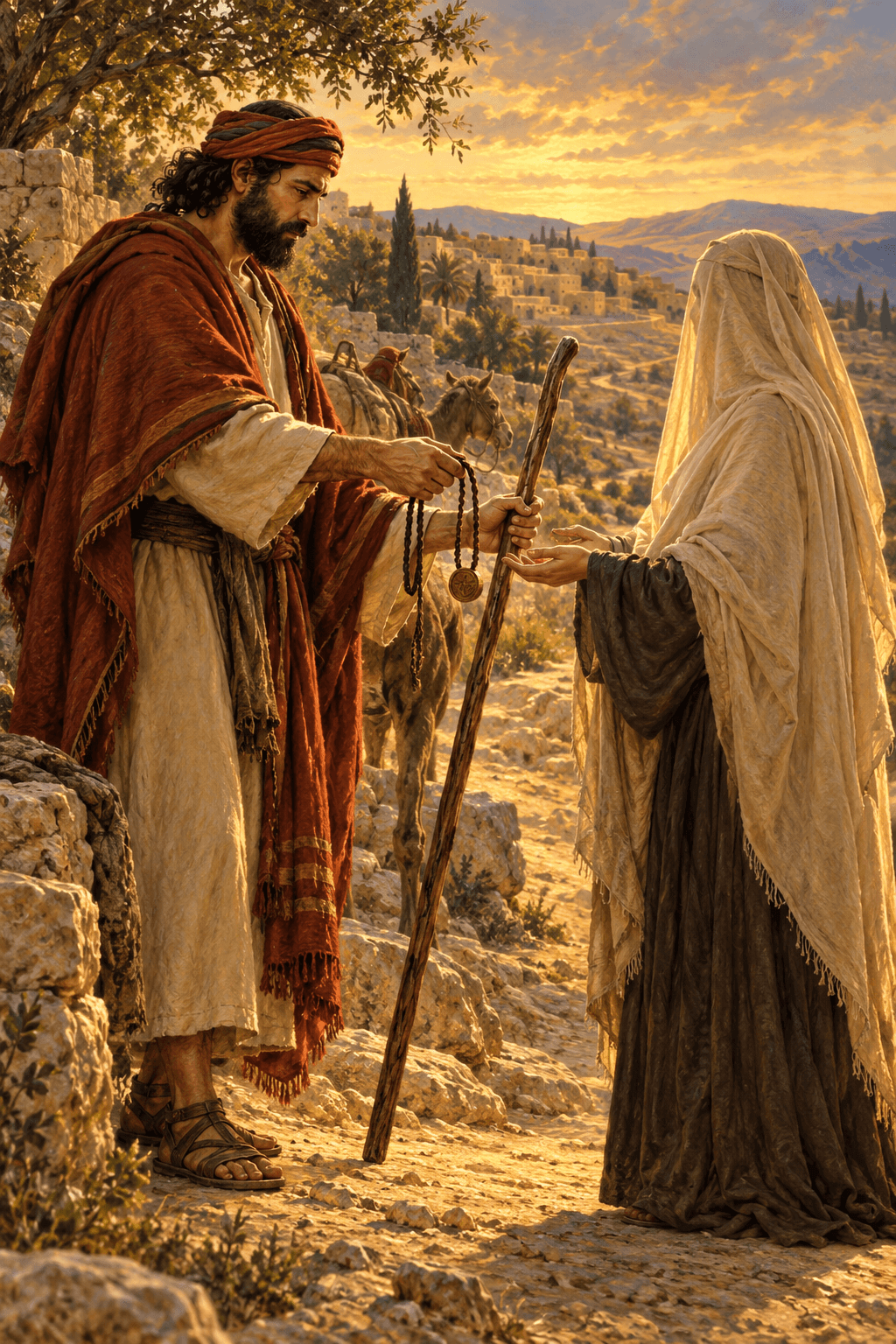
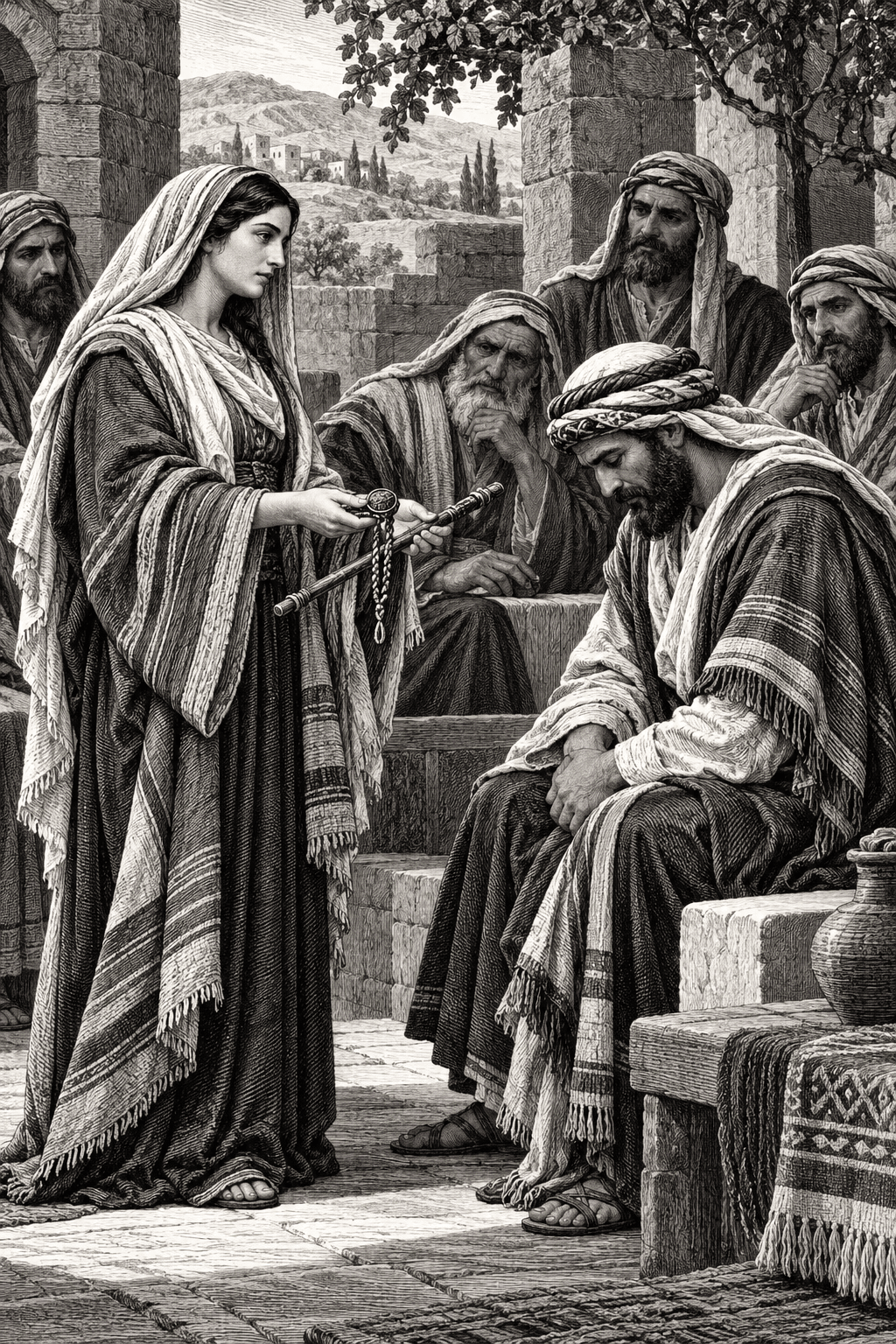
Shelah grew up, and Judah did not keep his promise, for he did not give him as a husband to Tamar… When Judah was going up to Timnath to shear his sheep, Tamar put off her widow’s garments, covered herself with a veil, and sat in an open place (the entrance of Enaim), which is by the way to Timnath. Judah, thinking her a harlot, went in unto her after giving her his signet and his staff as a pledge until he should send her a kid of the goats from the flock. When Judah sent the kid of the goats, the messenger did not find her and brought it back to Judah. About three months later Judah was told that Tamar was with child, and Judah said: “Bring her forth, and let her be burnt” (24). But she brought out the signet and the staff, and when Judah acknowledged them, he perceived his error and said: “She hath been more righteous than I; because that I gave her not to Shelah my son” (26).
We notice in this story the following:
First: “Timnath” in Hebrew means “the appointed portion.” [407] More than one place bears this name; the one mentioned here is about 7 miles from Adullam, where Judah and Hirah were, near Bethlehem, and is now called Tibneh.
Judah set out to Timnath, that is, his own portion, after he was comforted, for Shuah’s daughter had died… Judah was not thinking of another’s portion; he cared for what was his own and did not care for what was Tamar’s, his widowed daughter-in-law… Therefore he spoke truly when he said, “She hath been more righteous than I.”
Second: Tamar, who longed like every Hebrew woman that the Messiah, the Savior, would come from her seed, accepted to expose her life to danger. She put off her widow’s garments, put a veil on her face, and was not ashamed to appear as a harlot — not for bodily lust but for the sake of bearing children. She joined herself to her father-in-law, an aged man… Her purity appears in that when she revealed the matter she did not afterward seek marriage with her husband’s brother but lived with her father-in-law; and it was said, “And he knew her again no more” (26).
Because of her faith she longed to bear children, while Judah in his old age committed fornication… so he says, “She hath been more righteous than I” (26)… Tamar became a living example that prevents us from condemning, however clear and tangible the signs of sin appear. Saint Ambrose commented much on this phrase, “She hath been more righteous than I,” in his discourse on repentance, asking every person — even the bishop — not to condemn anyone but to be gentle and compassionate toward sinners. Among his words:
O Lord, grant that the falls of every man may be before me, that I may bear them with him and not rebuke him in pride, but grieve and weep; for in weeping for others I weep for myself, saying, “She hath been more righteous than I.”
Suppose a girl has fallen, deceived and swept away by circumstances that provoke sins — well, we who are older may fall too. In us also the law of the flesh wars against the law of our mind and brings us into captivity to sin, so that we do what we would not (Romans 7:23). Her youth may be an excuse for her, but what is my excuse? She must learn, but I must teach that “she hath been more righteous than I.”
We may revile the covetousness of others, but let us consider whether we have never coveted. For covetousness, or the love of money, is the root of all evil, working in our bodies like a fearful serpent in its den. Therefore let each of us say: “She hath been more righteous than I.”
When we are greatly angered against someone, this layman is less rash than what the bishop has committed. So we ought to consider the matter carefully, saying that the one we rebuked is more righteous than we. For in saying so we guard ourselves against what the Lord Jesus said to us: “And why beholdest thou the mote that is in thy brother’s eye, but considerest not the beam that is in thine own eye?… Thou hypocrite, first cast out the beam out of thine own eye; and then shalt thou see clearly to cast out the mote out of thy brother’s eye” (Matthew 7:3, 5).
Let us not then be ashamed to confess that our fault is more hideous than the fault of the one we see deserving of rebuke; for this is what Judah did, who rebuked Tamar, for remembering his own sin he said: “She hath been more righteous than I”… He accused himself before others accused him. [408]
Third: By this act of faith Tamar was made worthy to be an ancestress of the Lord Christ, her blood running in His veins, so that Matthew the Evangelist recorded her name in the genealogy of the Lord Christ (Matthew 1:3), while the names of Sarah, Rebekah, and other blessed mothers were not recorded.
Tamar was a symbol of the community of the Gentiles, which became a holy Church for the Lord — she who was before without fruit like Tamar, like an abandoned widow with no one to support or help her. Her first kinsman, Shelah, did not marry her, but she joined herself to the second kinsman, Judah… So the community of the Gentiles did not join itself to the first kinsman, that is, the Mosaic Law, nor was it bound to circumcision and Judaizing; but it joined itself to the second kinsman, that is, the true Judah, our Lord Jesus Christ, who came forth from the tribe of Judah.
What is wonderful is that Tamar’s actions bore many symbols corresponding to what the Church of the Gentiles enjoyed; we mention among them:
A) Tamar put off her widow’s garments to join herself to Judah; so the Gentiles put off the garments of the old man to put on the new man befitting their union with the eternal Bridegroom — indeed the Lord Christ Himself became their fine garment.
B) Tamar covered her face with a veil; and the Gentiles, having accepted the faith, live here as in a riddle until they meet the Bridegroom face to face, see Him in the fullness of His glory and the greatness of His splendor, and come to know the sublimity of His surpassing mysteries.
C) Tamar sat at the entrance of Enaim, that is, the entrance of two springs; like the Church of the Gentiles, which enjoyed not the spring of the Old Testament alone but also the spring of the New Testament with it.
D) Tamar enjoyed Judah’s signet, his bracelets (band), and his staff, that is, the seal of sonship to God and the heavenly crown, together with the life-giving wood of the cross.
E) The signs of pregnancy appeared after three months; like the Church of the Gentiles, which bore spiritual fruits through her faith in the Holy Trinity (three months) and her enjoyment of the risen life in Christ Jesus, who rose on the third day.
Fourth: Some scholars think that an ordinary harlot did not cover herself with a veil; rather this was done by the woman who devoted herself to fornication in the service of the gods, especially Ashtoreth, the moon goddess, doing so to collect from each man a kid of the goats to offer to the temple of the gods. Therefore the word “harlot” in the Hebrew text is “qedeshah,” that is, a holy one or one devoted to the gods.
By this act Tamar took the position of the Gentile girl devoted to idols, to represent the community of the Gentiles who were immersed in uncleanness and have joined themselves to faith in the new Judah, to enjoy the holy, pure life and have a portion in the Lord.
4. The Birth of Pharez and Zarah
KJV · Verses 27–30
27 And it came to pass in the time of her travail, that, behold, twins were in her womb. 28 And it came to pass, when she travailed, that the one put out his hand: and the midwife took and bound upon his hand a scarlet thread, saying, This came out first. 29 And it came to pass, as he drew back his hand, that, behold, his brother came out: and she said, How hast thou broken forth? this breach be upon thee: therefore his name was called Pharez. 30 And afterward came out his brother, that had the scarlet thread upon his hand: and his name was called Zarah.
Zarah put out his hand, and the midwife bound a scarlet thread upon his hand; but he drew back his hand, and Pharez came out first, and after him Zarah.
Some fathers see in Zarah an example of the Jewish people, who ought to have been the firstborn: they stretched out their hand and received the Law, which centered on the sacrifice (the scarlet blood); but through unbelief Pharez came forth, representing the Gentiles, who obtained the firstfruits of the Spirit in place of Zarah (the Jews). [409]
Notes and References
[407] New Westminster Dictionary of the Bible, p. 948.
[408] St. Ambrose, Be Gentle with Sinners! (Arabic trans., 1968), pp. 60–61.
[409] See the author’s commentary on the Gospel according to Matthew (1983), p. 43.