
If Judah, the free son, enslaved himself to the lust of the body and married the Canaanite daughter of Shuah, Joseph the slave declared his true freedom, for his master’s wife could not capture his heart or defile his body, despite all the bitter circumstances in which this young man lived.
Truly, if “Joseph” means “growth” or “increase,” he bore in his life a growth without ceasing: he succeeded in his love for his brothers despite their hatred of him, and here he succeeds in enjoying purity in the house of bondage.
1. Joseph in Potiphar’s House
KJV · Verses 1–6
1 And Joseph was brought down to Egypt; and Potiphar, an officer of Pharaoh, captain of the guard, an Egyptian, bought him of the hands of the Ishmeelites, which had brought him down thither. 2 And the Lord was with Joseph, and he was a prosperous man; and he was in the house of his master the Egyptian. 3 And his master saw that the Lord was with him, and that the Lord made all that he did to prosper in his hand. 4 And Joseph found grace in his sight, and he served him: and he made him overseer over his house, and all that he had he put into his hand. 5 And it came to pass from the time that he had made him overseer in his house, and over all that he had, that the Lord blessed the Egyptian's house for Joseph's sake; and the blessing of the Lord was upon all that he had in the house, and in the field. 6 And he left all that he had in Joseph's hand; and he knew not ought he had, save the bread which he did eat. And Joseph was a goodly person, and well favoured.

We did not hear of Joseph, while he was in his father Jacob’s house, that the house was blessed because of him, nor was it said, “the LORD was with Joseph, and he was a prosperous man” (2). This was not because Joseph was not a “blessing” in his father’s house, nor because he was not prosperous… but being pampered in his father’s embrace, enjoying the coat of many colors above his brothers, he had no need of a word of encouragement… But now that he had been sold as a slave in a strange land and deprived of all family affection, inspiration declared that the Lord Himself was with him, giving him success and favor in his master’s eyes, so that it was said: “the LORD blessed the Egyptian’s house for Joseph’s sake; and the blessing of the LORD was upon all that he had in the house, and in the field. And he (Potiphar) left all that he had in Joseph’s hand; and he knew not ought he had, save the bread which he did eat. And Joseph was a goodly person, and well favoured” (5–6).
Joseph was like an alabaster box of very precious ointment, kept sealed in Jacob’s house; no one smelled its fragrance as it truly was. But when it was broken by the sufferings of slavery and deprivation of family love, its fragrance spread through Potiphar’s house and filled his fields too. So he loved Joseph greatly, saw in him the Lord’s work, and handed everything over to him. All saw him as goodly and well favored, for the distress revealed the beauty of his inner face and the peace of his heart and mind.
What happened with Jacob his father was repeated with him. Jacob could not enjoy the heavenly ladder nor grasp the mysteries of the cross and its glories while in his father’s tent and in the embrace of his mother Rebekah; he received this only when he became a fugitive on the road without human help, resting his head on Christ (the cornerstone). So the Lord’s blessing on Joseph, the success of his works, and the beauty of his inner features were revealed only in the house of bondage in the land of sojourning.
If we may say so, we could not have come to know the true Joseph as “fairer than the children of men” (Psalm 45:2) except by His being lifted up on the cross and treading the winepress alone for our sake. Therefore the Church addresses Him, saying: “thy name is as ointment poured forth, therefore do the virgins love thee” (Song of Solomon 1:3).
2. Joseph and His Master’s Wife
KJV · Verses 7–10
7 And it came to pass after these things, that his master's wife cast her eyes upon Joseph; and she said, Lie with me. 8 But he refused, and said unto his master's wife, Behold, my master wotteth not what is with me in the house, and he hath committed all that he hath to my hand; 9 There is none greater in this house than I; neither hath he kept back any thing from me but thee, because thou art his wife: how then can I do this great wickedness, and sin against God? 10 And it came to pass, as she spake to Joseph day by day, that he hearkened not unto her, to lie by her, or to be with her.
The Church in all her generations stands with all reverence and honor before the pure Joseph, who exposed his life to death so as not to defile his body. The heart filled with true love, even for brothers who hated him, has no empty room for bodily lust nor any need of a strange woman’s affection! Joseph succeeded in the trial the enemy set for him through his master’s wife — not out of human chivalry, nor because of the upbringing in which he was raised, but above all because of the love that filled his heart. This is what Saint John Chrysostom affirmed when he compared Joseph and Potiphar’s wife, declaring that Joseph truly loved her in practice. In his conversation with her he did not wound her feelings with a harsh word… he did not utter a word that she was committing adultery, but in humility said: “Behold, my master wotteth not what is with me in the house, and he hath committed all that he hath to my hand; there is none greater in this house than I; neither hath he kept back any thing from me but thee, because thou art his wife” (8–9). He reminds her that she is his mistress and the wife of his master… and declares her honoring of him — how then could he return her honor with this treachery? He declares that he is the servant who serves and does not betray, and that he is the object of his master’s trust, so he cannot deny him! He made clear that his relationship with them both was in the Lord: “how then can I do this great wickedness, and sin against God?” (9).
He loved her in the Lord and submitted to her in the Lord… And the sign of his sincere love is that he did not expose her in the prison nor take revenge on her when Pharaoh handed everything over to him! On the contrary, Potiphar’s wife loved him carnally — or in other words, she loved the lusts of her own body — and the sign of this is that she handed him over to prison and exposed him to death after defaming him. Did she bear love for him?!
Father Caesarius of Arles says:
I think she loved neither him nor herself. Had she loved him, why did she want to destroy him?! And had she loved herself, why did she want to ruin herself…?! She did not love, but was burning with the poison of lust, not shining with the flame of truth. [410]
In speaking with her who loved him violently, he did not disdain to call her husband “my master.” He did not exploit her evil feelings to dominate her or speak to her as her equal, but adorned himself with the spirit of humility. As Saint Ambrose says:
Though Joseph was of the family of the great patriarchs, he was not ashamed of lowly servitude, but rather adorned it by his readiness to serve and made it glorious by his virtues. He knew how, with humility, to be in the hands of the buyer and the seller and to call them “my master.” [411]
3. Joseph and the Garment
KJV · Verses 11–18
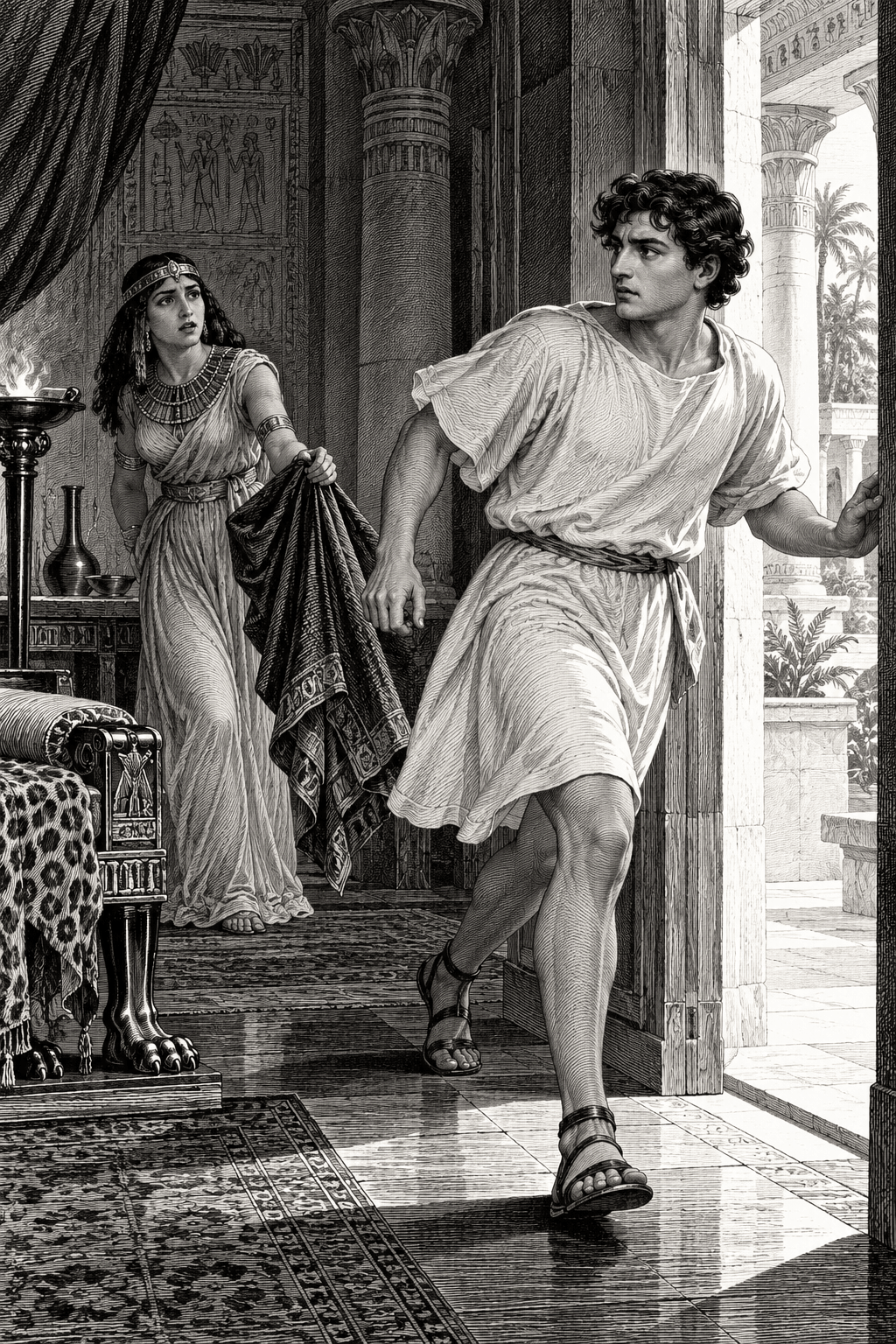
11 And it came to pass about this time, that Joseph went into the house to do his business; and there was none of the men of the house there within. 12 And she caught him by his garment, saying, Lie with me: and he left his garment in her hand, and fled, and got him out. 13 And it came to pass, when she saw that he had left his garment in her hand, and was fled forth, 14 That she called unto the men of her house, and spake unto them, saying, See, he hath brought in an Hebrew unto us to mock us; he came in unto me to lie with me, and I cried with a loud voice: 15 And it came to pass, when he heard that I lifted up my voice and cried, that he left his garment with me, and fled, and got him out. 16 And she laid up his garment by her, until his lord came home. 17 And she spake unto him according to these words, saying, The Hebrew servant, which thou hast brought unto us, came in unto me to mock me: 18 And it came to pass, as I lifted up my voice and cried, that he left his garment with me, and fled out.
When they were alone in the house she caught hold of him, and at once “he left his garment in her hand, and fled, and got him out” (12–13). He knew the price of his flight: nakedness, scandal, false accusation, prison, and perhaps death; but he accepted all this as the price of his relationship with God and his purity. Thus the young Joseph became a living example of purity. As Father Caesarius of Arles says:
There are in the Church three models of chastity that we must imitate: Joseph, Susanna, and Mary. Let men imitate Joseph, women Susanna, and virgins Mary. [412]
If it was said of Joseph that he was “a goodly person, and well favoured” (6), by leaving his garment in his mistress’s hands he revealed his purity, the beauty of his soul, and the sweetness of his heart. As Father Caesarius of Arles says:
Joseph was more beautiful within than without, more radiant by the light of his heart than by the beauty of his body, which the eyes of this woman could not burn toward and enjoy. [413]
Saint John Chrysostom [414] says that Joseph, being stripped, became more radiant than others, as though he had returned to the state of Adam, naked in paradise and not ashamed, because of his purity.
Joseph became a living and courageous example of fleeing from evil. Among the words of the fathers on this matter:
Saint John Chrysostom says:
If you have been pure until now, be purer still by avoiding such sights. Do not delight in vain discussions nor plead useless excuses; let there be for you one excuse only… leave the Egyptian harlot, as one who flees naked from her hands. [415]
Saint Ambrose says:
Joseph fled and left his garment, so as not to hear anything against his chastity. He who takes pleasure in listening urges the other to speak. [416]
Saint Jerome says:
If you can imitate Joseph and leave your garment in the hand of your Egyptian mistress, then in your nakedness you follow your Lord and Savior, who says in the Gospel: “whosoever doth not bear his cross, and come after me, cannot be my disciple… whosoever he be of you that forsaketh not all that he hath, he cannot be my disciple” (Luke 14:27, 33). [417]
He also says:
When you stand on the housetop, do not think of the garment inside (Matthew 24:17–18); to flee from your Egyptian mistress, leave the garment that belongs to this world… For even Elijah, in his swift translation to heaven, could not take his mantle with him, but left the garments of the world in the world (2 Kings 2:11, 13). [418]
Saint Asterius of Amasea sees that what Joseph did bore what was powerfully fulfilled in Christ Jesus our Lord, saying:
An Egyptian woman laid hold of Joseph, and he left her his garments and departed; and Christ departed from death, which had laid hold of Him, leaving the garments in the tomb. The Egyptian woman held Joseph’s garments but could not hold him; and the grave clothes were in the tomb, which did not hinder the Lord, for it was not possible that He should be held by it. [419]
4. Joseph in Prison
KJV · Verses 19–23
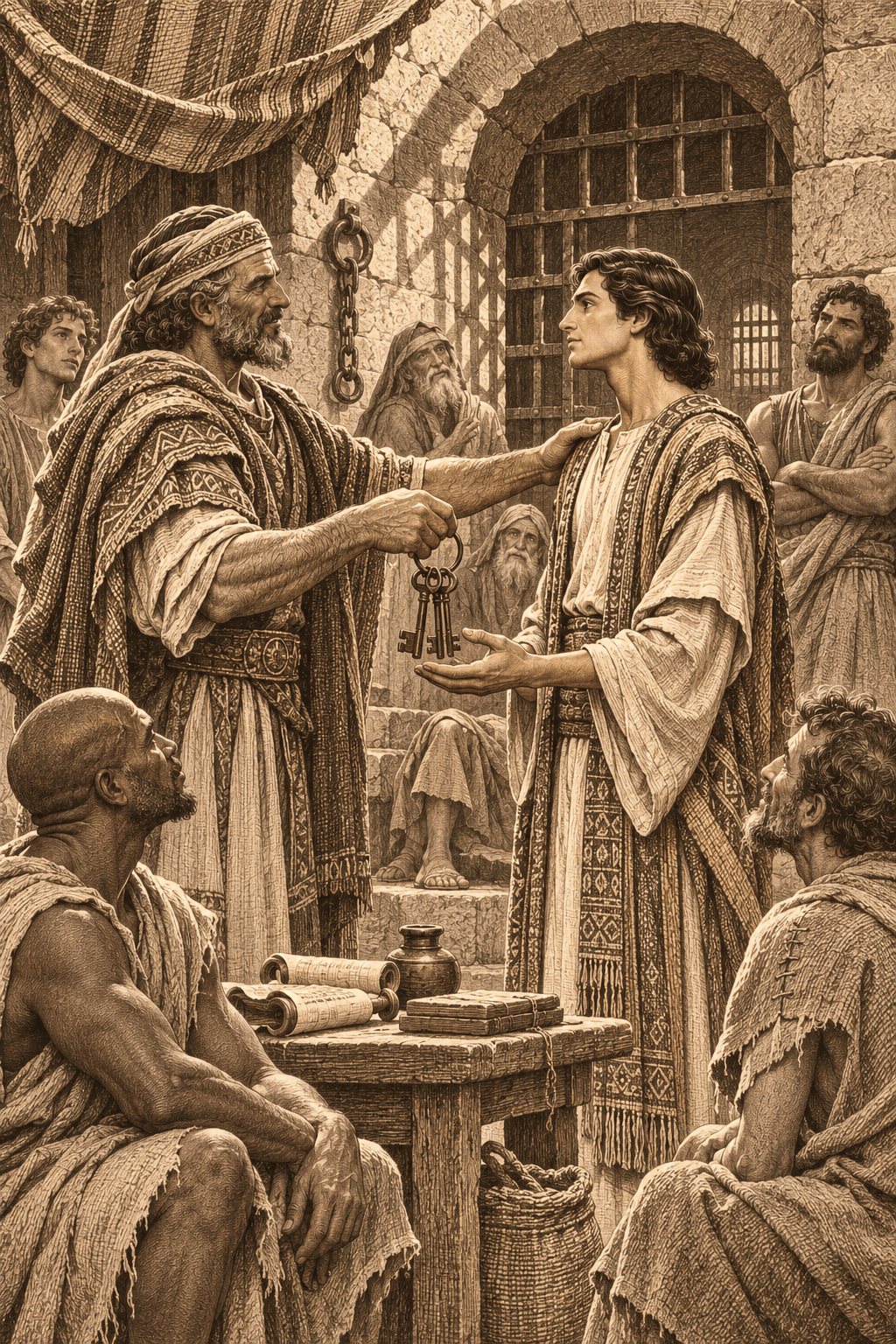
19 And it came to pass, when his master heard the words of his wife, which she spake unto him, saying, After this manner did thy servant to me; that his wrath was kindled. 20 And Joseph's master took him, and put him into the prison, a place where the king's prisoners were bound: and he was there in the prison. 21 But the Lord was with Joseph, and shewed him mercy, and gave him favour in the sight of the keeper of the prison. 22 And the keeper of the prison committed to Joseph's hand all the prisoners that were in the prison; and whatsoever they did there, he was the doer of it. 23 The keeper of the prison looked not to any thing that was under his hand; because the Lord was with him, and that which he did, the Lord made it to prosper.
When Potiphar’s wife could not seize Joseph’s heart and caught hold of his garments, she cried out to accuse him of evil, and her husband’s wrath was kindled: “And Joseph’s master took him, and put him into the prison, a place where the king’s prisoners were bound: and he was there in the prison. But the LORD was with Joseph, and shewed him mercy, and gave him favour in the sight of the keeper of the prison” (20–21).
Joseph succeeded in his father’s house as a son who loved those who hated him; so the Lord brought him into slavery to declare his success as a foreign slave. And when he succeeded in his slavery and adorned it with virtues, He brought him into prison, that God might be glorified in him amid criminals. The Lord gave him favor in the eyes of the keeper of the prison, so that he committed everything to him; and behold, the Lord was with him, “and that which he did, the LORD made it to prosper” (23).
How beautiful are the words of Saint John Chrysostom:
Joseph was more glorious than any crowned victor while he remained in chains, and she (Potiphar’s wife) was more wretched than any prisoner, even though she dwelt in royal dwellings. [420]
Divine inspiration affirms, “the LORD was with Joseph”… Thus the prison was turned into heaven, for where the Lord is, the place becomes heaven! Jonah met the Lord, buried in the tomb, while he was in the belly of the whale amid the currents of the waters and the raging depths of the sea; and the Word of God appeared to surround the three young men while they were in the furnace of fire… while the Pharisee was deprived of meeting God inside the Temple when he stood arrogantly enumerating his virtues! I do not belittle the holiness of the Temple by this, but I wish that we meet our Lord wherever we are! The purpose of the house of the Lord is that we become a sanctuary for the Lord and a temple of His Holy Spirit; wherever we go we carry Him within us. So the prison in Joseph’s life was turned into a new meeting with the Lord, on a level perhaps deeper than when he was in his father’s house or in his master’s house.
In any case, the wicked woman cast Joseph into prison to destroy him; and behold, he obtained success and favor in the prison, and the prison was turned into a way to glory. As Saint John Chrysostom says:
Such are God’s ways of dispensation: the very things that harm us are the things that profit us. This is what happened with Joseph. His mistress wanted to destroy him, and she seemed indeed to wrestle with him to destroy him; but in doing so her work was bringing him into safety. The house in which this beast (the woman) was kept was to Joseph a pit, while the prison was to him a kindness. When he was in the house, surrounded with honor and flattery (her wooing of him), he was in terror, fearing lest his mistress catch him; he was in a state of fear harsher than when he was in prison. But after the accusation he was in peace and safety, for he was rid of this beast, her lewdness, and her destructive schemes. So it was better for him to be kept in a miserable place (the prison) among human creatures than to be in the company of a mad mistress… In truth he was not cast into a prison but set free from a prison. She made his master his enemy, but she made God his friend; she brought him into a closer relationship with God, who is the true Friend. [421]
Notes and References
[410] Caesarius of Arles, Serm. 98:1.
[411] Ambrose, Duties of the Clergy 2:17.
[412] Caesarius of Arles, Serm. 93:3.
[413] Ibid. 90:2.
[414] Chrysostom, In Matt. hom. 18:2.
[415] Ibid. 37:8.
[416] Ambrose, Duties of the Clergy 1:18.
[417] Jerome, Ep. 145.
[418] Jerome, Ep. 118:4.
[419] Asterius of Amasea, On Ps. 5, hom. 19.
[420] Chrysostom, In Matt. hom. 84:4.
[421] Chrysostom, In Acts hom. 49.