
God’s Dealings with Joseph (Genesis 37–50)
In our meeting with our fathers Abraham, Isaac, and Jacob, we sense aged fathers in whose lives God’s dealings were richly drawn, so that from their loins the Church of the Old Covenant came forth as a leaven that should have leavened the whole lump. Now, as we meet Joseph, the person of our Lord Jesus is drawn in our minds, for he came as a type of Him in many respects:
1. Joseph, the son and the servant (chapter 37).
2. Joseph and Potiphar’s wife (chapter 39).
3. Joseph the prisoner (chapter 40).
4. Joseph glorified (chapter 41).
5. Joseph’s meeting with his brothers (chapter 42).
6. The second meeting with Joseph (chapter 43).
7. The summoning of Joseph’s brothers (chapter 44).
8. Joseph reveals himself (chapter 45).
9. Jacob blesses Joseph and his two sons (chapter 48).
Joseph, the Son and the Servant
Holy Scripture brought out the life of Abraham the patriarch as having received the promise, “And in thy seed shall all the nations of the earth be blessed” (Genesis 22:18), since the Lord Christ, the Savior of the world and the Desire of the nations, came from his seed; and so too with Isaac and Jacob. Some might have expected it to present the life of Judah, from whose seed the Lord would come; but we find it speaking of Joseph at some length, for his life bore a living symbolic picture of the person of the Messiah, His qualities, His saving work, and His glories — so that he was worthy to enjoy a double portion, becoming, alone among his brothers, two tribes: Ephraim and Manasseh. Joseph’s life is also considered the link between the age of the patriarchs and the emergence of the Jews as a people or nation, for Joseph opened the way for his father and brothers to live in Egypt.
In the chapter before us we see Joseph as a type of the Lord Christ: the loving son and the servant who loves his brothers, offering his life as a ransom for them.
1. Joseph in His Father’s House
KJV · Verses 1–3
1 And Jacob dwelt in the land wherein his father was a stranger, in the land of Canaan. 2 These are the generations of Jacob. Joseph, being seventeen years old, was feeding the flock with his brethren; and the lad was with the sons of Bilhah, and with the sons of Zilpah, his father's wives: and Joseph brought unto his father their evil report. 3 Now Israel loved Joseph more than all his children, because he was the son of his old age: and he made him a coat of many colours.
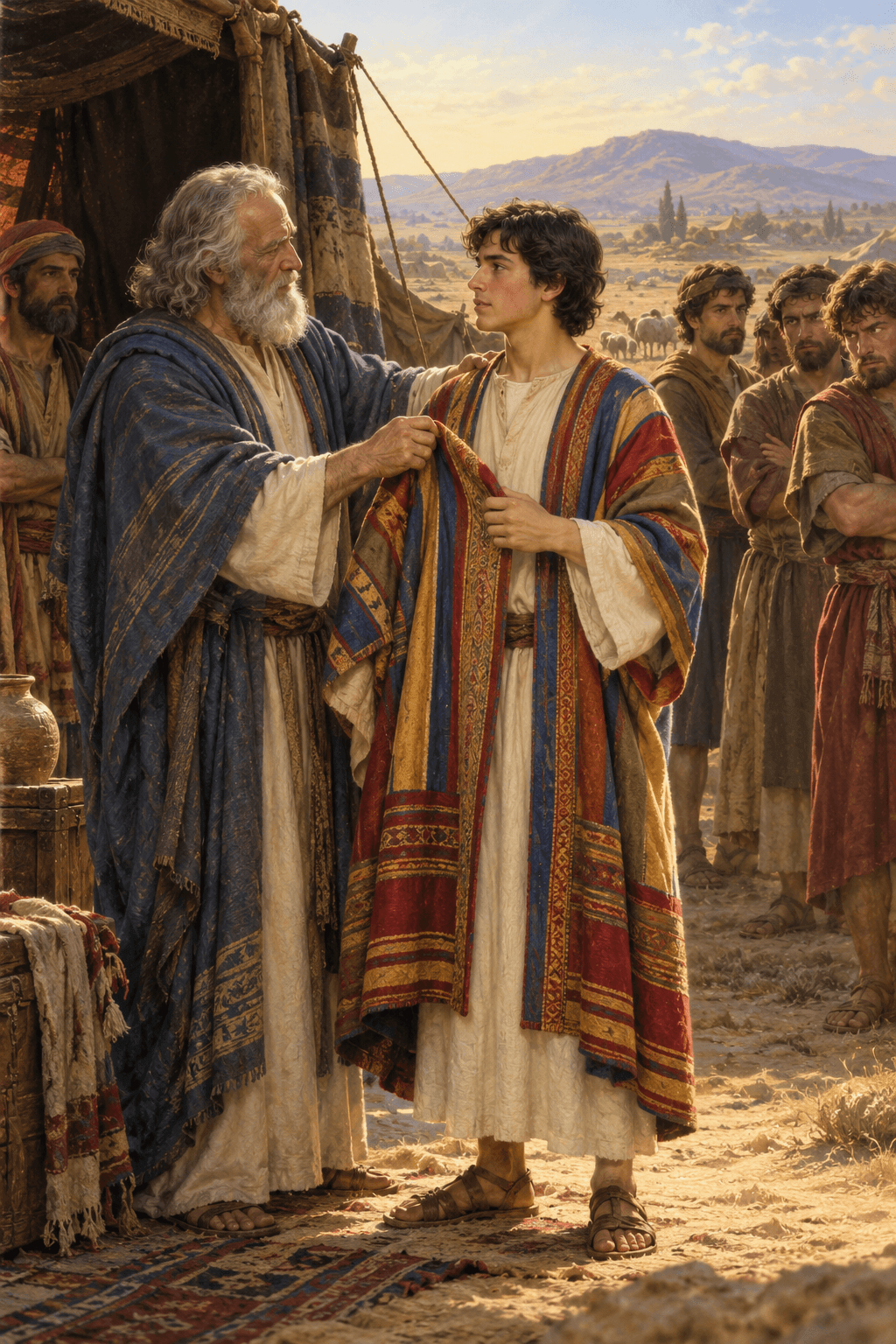
“And Jacob dwelt in the land wherein his father was a stranger, in the land of Canaan. These are the generations of Jacob. Joseph, being seventeen years old, was feeding the flock with his brethren; and the lad was with the sons of Bilhah, and with the sons of Zilpah, his father’s wives: and Joseph brought unto his father their evil report. Now Israel loved Joseph more than all his children, because he was the son of his old age” (1–3).
Jacob dwelt in Canaan as a land of sojourning, like his father Isaac, until his descendants would later receive it as a land of promise, living in it not as strangers in tents but as citizens building cities and houses… It is as though Jacob represents the soul wrestling spiritually for the kingdom, living by faith in the heavenly Canaan until it later inherits it and dwells there forever.
Divine inspiration found nothing greater to record about the generations of Jacob, that is, his descendants, than to speak of the young Joseph, who was seventeen years old, as a lad helping the sons of the two maids Bilhah and Zilpah. He is great in God’s eyes and beloved of his father, even though he worked as a lad for the sons of the maids! For true greatness does not spring from the kind of work a person does nor from his position, but from his inner life and spiritual conduct. Joseph was able to win his father’s heart more than all his brothers, and his father counted him the son of his old age, though there were brothers younger than he.
We said that Joseph was a type of the Lord Christ, for he is the son beloved of his father. As Father Caesarius of Arles says:
Jacob loved his son because the Father loves His only-begotten Son, for He says: “This is my beloved Son” (Matthew 3:17). [397]
If Joseph became a slave in Egypt because of his brothers, and a prisoner, so as to enter the palace and satisfy his brothers’ needs, Scripture declared that he was the son beloved of his father… I say it is a living picture of the life of our Lord Jesus Christ, who came down to our Egypt as a servant and entered judgment for our sake to lift us up with Him to His heavenly palace — He who is the only-begotten Son. And what I say of the Lord Christ I say of every true believer: he must first enter into sonship to God and be the object of His love through abiding in Christ Jesus; by this sonship we accept with love to become servants and enter under judgment for our brethren, that we may lift them up with us in Christ Jesus to taste the fellowship of His glory and be satisfied with the heavenly bread.
This is what the Apostle expressed when he said: “For though I be free from all men, yet have I made myself servant unto all, that I might gain the more” (1 Corinthians 9:19). In the waters of baptism he enjoyed freedom in Christ Jesus, and this freedom, full of love, moved him to become a servant of all, to gain the more for the glory of our Lord Jesus Christ.
Since Israel loved his son more than his brothers, “he made him a coat of many colours” (3). What is this coat of many colors but the Church of many gifts, which the Lord Christ received from His Father’s hands as the price of His love for mankind and His entering into servitude for its sake?! This is what Saint Augustine and Origen the scholar affirmed: the coat of many colors is the Church, which cleaves to the Lord Christ as His garment. In His Transfiguration “his raiment was white as the light” (Matthew 17:2), a sign of the Church which the Lord acquired for Himself and in which He dwelt as the Sun of Righteousness illuminating her. The hem of this garment is the Apostle Paul, who says of himself: “And last of all he was seen of me also, as of one born out of due time. For I am the least of the apostles” (1 Corinthians 15:8–9). This hem the woman with the issue of blood touched (that is, the community of the Gentiles, defiled by pagan worship), and she was healed of her flow of blood. As for its being of many colors, the Apostle says: “Now there are diversities of gifts, but the same Spirit. And there are differences of administrations, but the same Lord” (1 Corinthians 12:4–5).
It is one coat with many colors; if one color is removed from it, it loses its beauty and even its strength. So the Church declares her need for every member in her, whatever his color, that is, his position, work, or gifts.
Comparing Joseph with the Lord Christ, Saint Asterius of Amasea says:
His father made Joseph a coat of many colors; and it was said of Christ: “my soul shall be joyful in my God; for he hath clothed me with the garments of salvation, he hath covered me with the robe of righteousness, as a bridegroom decketh himself with ornaments (a crown)” (Isaiah 61:10). [398]
2. The Dreamer
KJV · Verses 4–11
4 And when his brethren saw that their father loved him more than all his brethren, they hated him, and could not speak peaceably unto him. 5 And Joseph dreamed a dream, and he told it his brethren: and they hated him yet the more. 6 And he said unto them, Hear, I pray you, this dream which I have dreamed: 7 For, behold, we were binding sheaves in the field, and, lo, my sheaf arose, and also stood upright; and, behold, your sheaves stood round about, and made obeisance to my sheaf. 8 And his brethren said to him, Shalt thou indeed reign over us? or shalt thou indeed have dominion over us? And they hated him yet the more for his dreams, and for his words. 9 And he dreamed yet another dream, and told it his brethren, and said, Behold, I have dreamed a dream more; and, behold, the sun and the moon and the eleven stars made obeisance to me. 10 And he told it to his father, and to his brethren: and his father rebuked him, and said unto him, What is this dream that thou hast dreamed? Shall I and thy mother and thy brethren indeed come to bow down ourselves to thee to the earth? 11 And his brethren envied him; but his father observed the saying.
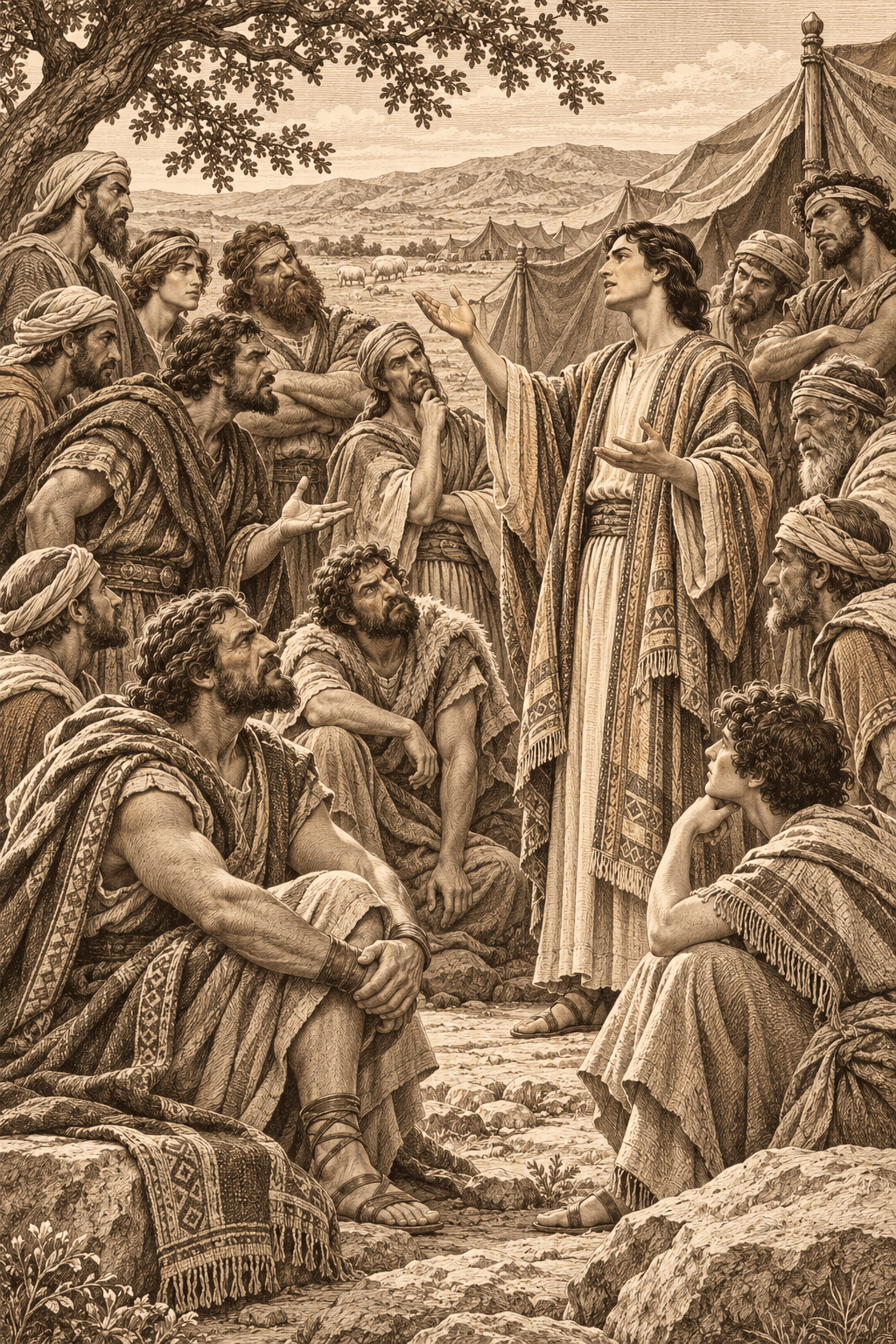
Joseph’s brothers could not bear their father’s love for their brother Joseph, so they bore a grudge against him, until they “could not speak peaceably unto him” (4). These bitter feelings that surrounded Joseph from his brothers in his father’s house could not close his heart toward them, nor hurt his feelings, nor make him lose his peace. Therefore heaven opened before him to assure him, by two successive dreams bearing one meaning, of “his entering into glory and the submission of all to him.” It is as though he represents the Lord Christ, who opens His heart with love to mankind, which bore enmity without cause, offering His life as a ransom even for those who crucified Him!
Joseph dreamed that sheaves surrounded his sheaf and bowed down to it, and he dreamed that the sun, the moon, and eleven stars bowed down to him; and his brothers perceived that he would reign over them and they would submit to him… Instead of listening to heaven’s voice and opening their hearts to him, “they hated him yet the more for his dreams, and for his words” (8), and they were filled with envy (11), like the wicked husbandmen who, “when they saw the son, said among themselves, This is the heir; come, let us kill him, and let us seize on his inheritance” (Matthew 21:38). The heavens declared his glory, and the wicked grew more wicked toward him; but the good God brings good out of evil and turns their conduct into a path for the fulfillment of His divine plan.
“And his brethren envied him; but his father observed the saying” (11). Jacob perceived that he would submit to his son in his glory… Perhaps the matter represented a mystery he could not grasp at that time, so he kept the matter in his heart, waiting in silence and contemplating God’s works and the fulfillment of His promises. So the people of God live, keeping God’s revelations in their hearts and minds and contemplating His dealings, as was said of Saint Mary: “but his mother kept all these sayings in her heart” (Luke 2:51).
3. His Mission of Love
KJV · Verses 12–17
12 And his brethren went to feed their father's flock in Shechem. 13 And Israel said unto Joseph, Do not thy brethren feed the flock in Shechem? come, and I will send thee unto them. And he said to him, Here am I. 14 And he said to him, Go, I pray thee, see whether it be well with thy brethren, and well with the flocks; and bring me word again. So he sent him out of the vale of Hebron, and he came to Shechem. 15 And a certain man found him, and, behold, he was wandering in the field: and the man asked him, saying, What seekest thou? 16 And he said, I seek my brethren: tell me, I pray thee, where they feed their flocks. 17 And the man said, They are departed hence; for I heard them say, Let us go to Dothan. And Joseph went after his brethren, and found them in Dothan.
Joseph’s brothers went to Shechem to feed their father’s flock. Most likely this flock included the sheep they had seized after killing its owners in revenge for their sister Dinah (chapter 34). Therefore Jacob sent Joseph to see the welfare of his brothers and the welfare of the flock, fearing that some Canaanite tribes might have attacked them in revenge for the people of Shechem.
Joseph set out in obedience to his father, who loved his sons despite the evil report that marked them (2) and the hatred and envy they bore toward their beloved and loving brother Joseph. But it was not the obedience of fear, like slaves, nor the obedience of the hireling waiting for wages, but the obedience of a son who loves his father and his envious brothers. In love he set out from the vale of Hebron to Shechem, and when he did not find them, he did not return but searched for them and went after them to Dothan.
Joseph’s mission represents the mission of the only-begotten Son. As Father Caesarius of Arles says:
Jacob sent his son to show his concern for them, and the Father sent His only Son to visit the human race, which was weak through sin, a lost flock. When Joseph was looking for his brothers he wandered in the wilderness, and the Lord Christ, seeking the human race, wandered in the world… Joseph sought his brothers in “Shechem,” which means “shoulder,” for sinners turned their backs to the face of the Righteous One and put their shoulders behind. [399]
4. The One Falsely Accused
KJV · Verses 18–30
18 And when they saw him afar off, even before he came near unto them, they conspired against him to slay him. 19 And they said one to another, Behold, this dreamer cometh. 20 Come now therefore, and let us slay him, and cast him into some pit, and we will say, Some evil beast hath devoured him: and we shall see what will become of his dreams. 21 And Reuben heard it, and he delivered him out of their hands; and said, Let us not kill him. 22 And Reuben said unto them, Shed no blood, but cast him into this pit that is in the wilderness, and lay no hand upon him; that he might rid him out of their hands, to deliver him to his father again. 23 And it came to pass, when Joseph was come unto his brethren, that they stript Joseph out of his coat, his coat of many colours that was on him; 24 And they took him, and cast him into a pit: and the pit was empty, there was no water in it. 25 And they sat down to eat bread: and they lifted up their eyes and looked, and, behold, a company of Ishmeelites came from Gilead with their camels bearing spicery and balm and myrrh, going to carry it down to Egypt. 26 And Judah said unto his brethren, What profit is it if we slay our brother, and conceal his blood? 27 Come, and let us sell him to the Ishmeelites, and let not our hand be upon him; for he is our brother and our flesh. And his brethren were content. 28 Then there passed by Midianites merchantmen; and they drew and lifted up Joseph out of the pit, and sold Joseph to the Ishmeelites for twenty pieces of silver: and they brought Joseph into Egypt. 29 And Reuben returned unto the pit; and, behold, Joseph was not in the pit; and he rent his clothes. 30 And he returned unto his brethren, and said, The child is not; and I, whither shall I go?
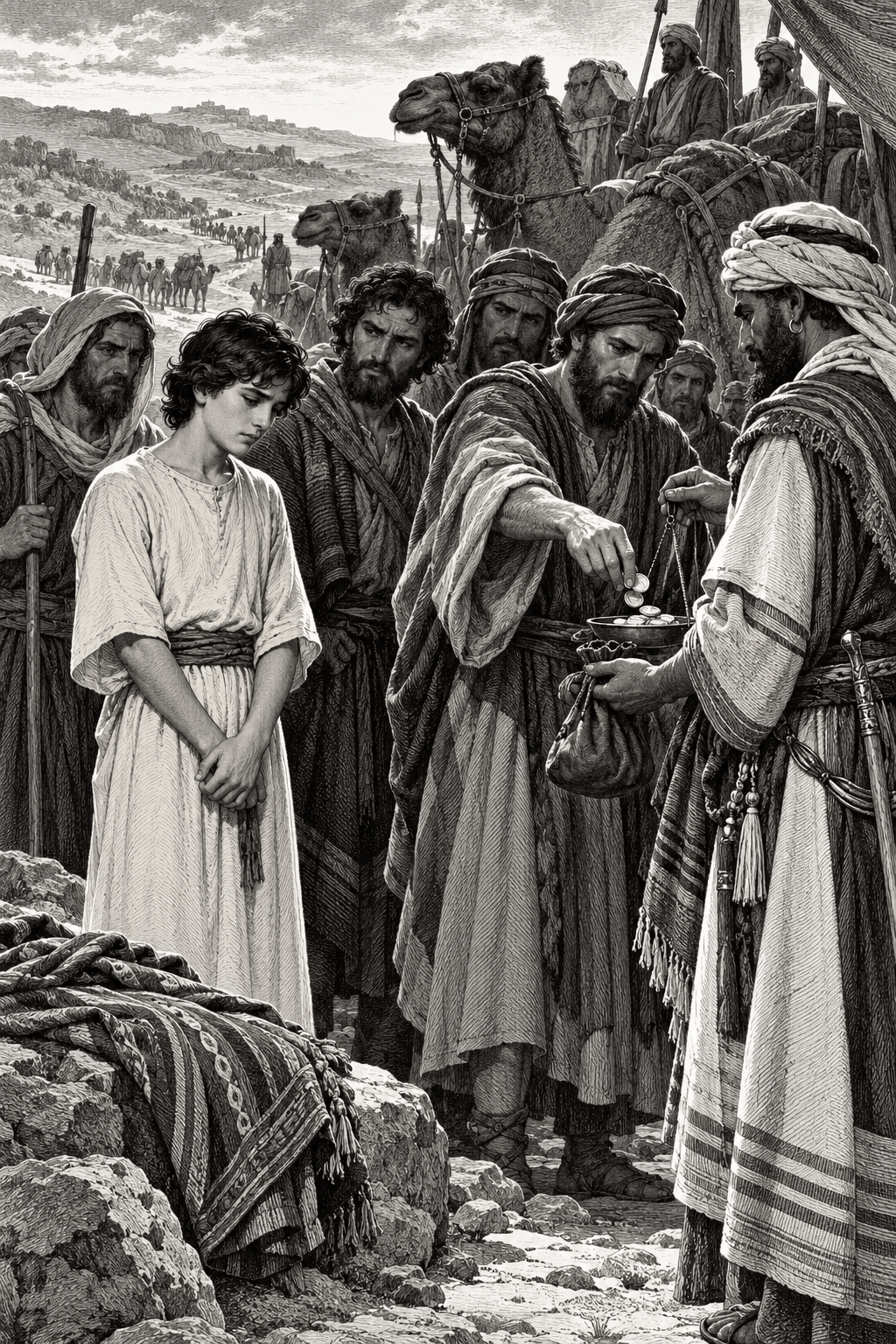
When Joseph went down from his father’s house in love, seeking his straying brothers, Scripture says: “And when they saw him afar off, even before he came near unto them, they conspired against him to slay him. And they said one to another, Behold, this dreamer cometh. Come now therefore, and let us slay him, and cast him into some pit, and we will say, Some evil beast hath devoured him: and we shall see what will become of his dreams” (18–20).
Reuben interceded for him, so they did not kill him, but they stripped him of the coat of many colors and cast him into an empty pit without water. As they sat eating, they saw a company of Ishmaelites coming from Gilead, bearing spicery, balm, and myrrh, going to carry it down to Egypt. Judah advised them to sell him as a slave to them, and they sold him for twenty pieces of silver. When Reuben returned to his brothers and did not find Joseph in the pit, he rent his clothes and did not know what to do.
They could not bear to see him even from afar, for he came to them on a mission of love, while they grew in envy because of God’s work with him and His revelations to him (“the dreamer”). As Abba Piamun says:
Joseph their brother could not lessen the intensity of the envy of his eleven brothers, who desired his death though he had done them no harm. It is clear that envy is one of the worst sins and the hardest to heal, for it is inflamed by the very remedies by which the other sins are destroyed… What can you do for a man whose disobedience increases the more you increase in humility and kindness, who is not angry out of greed for a bribe to receive… or services to obtain, but is angry because of the success and happiness of others?! [400]
What Joseph’s brothers did here carried a symbol of what the Jews did with the Lord Christ in several respects, among them:
A) Saint Asterius of Amasea says:
Joseph’s brothers heaped bitter reproaches on their brother, and the Jews offered reproach to the Lord, saying: “We be not born of fornication” (John 8:41)… Joseph was sent to his brothers as a physician to visit them, and to them he was as an enemy plotting schemes; and Christ was sent as a merciful shepherd, and they regarded Him as a crucified thief… [401]
Father Caesarius of Arles says:
As Joseph’s brothers bore envy toward their brother and turned their backs, not their faces, to brotherly love, so, alas, the Jews preferred envy to love toward the Bringer of salvation who came to them. Of such it was said in the Psalms: “Let their eyes be darkened, that they see not; and make their loins continually to shake” (Psalm 69:23). [402]
B) The matter did not stop at inner envy, but was translated into a revolt, a plot, and betrayal. Father Caesarius of Arles says:
Joseph found his brothers in Dothan, which means “revolt,” for those seeking to kill their brother were truly in a great revolt. On seeing Joseph they discussed his death, just as the Jews did with the true Joseph, Christ the Lord, when all resolved on one plan, that He be crucified. Joseph’s brothers seized his outer coat of many colors, and the Jews stripped Christ of His garments at His death on the cross. When the coat was taken from Joseph, Joseph was cast into a pit, that is, a hole; and when they had broken the body of Christ, He descended into Hades. Joseph was lifted from the pit and sold to the Ishmaelites, that is, to the Gentiles; and Christ, when He returned from Hades, was bought by the Gentiles at the price of faith. [403]
Thus Joseph was a type of the Lord Christ in the counsel against him, in his being cast into the pit, in the stripping of his garments, and in his being sold to the Gentiles.
C) As Judah advised the selling of Joseph, so Judas sold the Lord Christ. The first was sold for twenty pieces of silver — in the Septuagint “twenty pieces of gold” — while his Lord was sold for thirty pieces of silver. Father Caesarius of Arles comments on this, saying:
The servant was sold for more than his Lord; but surely human reckoning deceived man in the case of our Lord, who is beyond price! [404]
D) When the brothers had cast Joseph into the pit empty of water, “they sat down to eat bread” (25). So when the Jews had plotted the killing of the Lord Christ, they sat eating the old Passover, as a food satisfying their bodies, not their souls.
E) The camels of the Ishmaelites who bought Joseph were laden with spicery (tragacanth), a kind of gum used in medicine and as an adhesive, from the goat’s-thorn trees (Astragalus); with balm, a fragrant oil that flows from the balsam tree when its trunk is wounded, used in medicine and embalming; and with myrrh (ladanum), a kind of gum whose tree is called Cistus creticus, used in medicine. These goods borne by the Ishmaelites’ camels when Joseph was bought point to the gifts and capacities of the Gentiles, which they brought when they believed in the true Joseph, and which were sanctified and used for His kingdom.
5. His Coat Dipped in Blood
KJV · Verses 31–35
31 And they took Joseph's coat, and killed a kid of the goats, and dipped the coat in the blood; 32 And they sent the coat of many colours, and they brought it to their father; and said, This have we found: know now whether it be thy son's coat or no. 33 And he knew it, and said, It is my son's coat; an evil beast hath devoured him; Joseph is without doubt rent in pieces. 34 And Jacob rent his clothes, and put sackcloth upon his loins, and mourned for his son many days. 35 And all his sons and all his daughters rose up to comfort him; but he refused to be comforted; and he said, For I will go down into the grave unto my son mourning. Thus his father wept for him.
Joseph’s brothers tried to deceive their father by dipping Joseph’s coat of many colors in the blood of a kid of the goats and presenting it to him to verify whether it was his coat, declaring that an evil beast had devoured him. Jacob rent his clothes, put sackcloth upon his loins, and mourned for his son many days.
Jacob had deceived his father Isaac in taking the blessing… and because of the purity of his heart and his striving he received the blessing rather than Esau, for the Lord Christ came from his seed; but he received discipline for deceiving his father. What he measured to his father was measured to him by his sons: he lived many days in mourning without comfort until he met his son in Egypt.
Jacob could not bear to see his son’s coat of many colors stained with blood — though the coat, which points to the Church, cannot have its existence and beauty except by being dipped in the blood of the slain One, our Lord Jesus, who delivered His body to death by His own will, to pour His pure blood upon His believers, granting them the power of His resurrection.
Thinking that his son had died, Jacob said in bitterness: “For I will go down into the grave unto my son mourning” (35). As Saint Jerome says:
He went down to Hades, because paradise had not yet been opened by the thief. [405]
All feared death, because it was a passage to Hades, awaiting the coming of the Lord Christ to carry His spoils into His paradise, foremost among them the thief who believed in the crucified Lord.
6. Joseph the Servant
KJV · Verses 36
36 And the Midianites sold him into Egypt unto Potiphar, an officer of Pharaoh's, and captain of the guard.
The pampered son was sold as a slave in Egypt, bearing a free heart and a noble soul which outward slavery could not enter into its inner depths; rather by his inner freedom he raised the standing of slaves and honored free humanity whatever its social position. Saint Jerome says:
We read of Joseph, who gave proof of his integrity when in want as when rich, and who affirmed the freedom of the soul when a slave as when a master. [406]
Joseph the son became a slave, as though bearing the image of our Lord Jesus Christ, the only Son, who for our sake became a servant (Philippians 2:7). Father Caesarius of Arles says:
Joseph went down to Egypt, and Christ came down to the world! Joseph saved Egypt from want of wheat, and Christ freed the world from the famine of the word of God. Had Joseph not been sold by his brothers, Egypt would not have been saved; truly, had the Jews not crucified Christ, the world would have perished.
He was sold to Potiphar, whose name means “belonging to Ra (the sun god).” The word “eunuch” (officer) does not mean that he was castrated but denotes the position of one of the chiefs of Pharaoh’s guard, who sometimes judged offenders and supervised the prisons (Genesis 37:36; 39:1, 20).
Notes and References
[397] Caesarius of Arles, Serm. 89:1.
[398] Asterius of Amasea, On Ps. hom. 19.
[399] Caesarius of Arles, Serm. 89:1.
[400] Cassian, Conferences 18:16.
[401] Asterius of Amasea, On Ps. hom. 19.
[402] Caesarius of Arles, Serm. 89:1.
[403] Ibid.
[404] Ibid. 93:4.
[405] Jerome, On Ps. hom. 34.
[406] Jerome, Ep. 79:2.