
Having taken possession of the central region (Jericho and Ai), they began to advance toward the south (Joshua 9–10). But the people of Gibeon, who lived southwest of Jericho, hastened to devise a ruse to make a covenant with Joshua and his men, so as not to perish; and Joshua and his men fell into the net of the ruse:
1. The nations stirred up against them (1–2).
2. The ruse of the Gibeonites (3–13).
3. Joshua’s men deceived (14–20).
4. The humbling of the Gibeonites (21–27).
1. The Nations Stirred Up Against Them
KJV · Verses 1–2
1 And it came to pass, when all the kings which were on this side Jordan, in the hills, and in the valleys, and in all the coasts of the great sea over against Lebanon, the Hittite, and the Amorite, the Canaanite, the Perizzite, the Hivite, and the Jebusite, heard thereof; 2 That they gathered themselves together, to fight with Joshua and with Israel, with one accord.
The crossing of the river Jordan was not the conclusion of the struggle but its beginning. When the nations living in Canaan heard, they were stirred up together and gathered “to fight with Joshua and with Israel, with one accord.” This uproar increased every time Joshua and the people entered into a new victory. So, beloved, our entering baptism is the enjoyment of the means God has given us, not to boast of them and argue about them, but to make use of them in our spiritual struggle.
With every spiritual victory we should expect fiercer warfare and more afflictions. When Jesus the Lord of glory is found reigning through the members of His body, the enemy of good and all his evil angels are stirred up!
The kings heard of their crossing the Jordan and their taking of Jericho and Ai, and all gathered together to fight Joshua and Israel … that is, Jesus and His kingdom. Inspiration specified the locations of the kings: in the hills, in the valleys, and in all the coasts of the great sea over against Lebanon. All this reveals how greatly the demons, as kings and powers of darkness, are stirred up against the Lord of glory Jesus and His believers.
Some dwell in the high and lofty mountains, where they breathe into man the spirit of vain greatness and empty pride; others dwell in the plains, among souls loosened by despair and crushed by faint-heartedness; a third company dwells on the coast of the great sea, where they push souls into the sea of this world to confuse them with its waves and turmoil; and those dwelling in Lebanon point to the spirit of luxury and pampering, through which the soul loses its earnestness about salvation.
In any case, all of these gather together against the struggling soul, to advance in war according to each person’s circumstances and abilities. The war may begin with pride, if the person is religious and has a long history of worship or service; or it may begin with despair, if they see him terrified of sin, and so on … all to fight our inner Joshua and destroy all our gifts and abilities by corruption.
But what we must notice in the Book of Joshua is that not only do the attacks intensify after the crossing of baptism and the gaining of successive victories, but Joshua and his men were the ones poised against evil and resisting it. The Christian, realizing that his heart is the land of promise over which the true Joshua must reign, does not cease to resist every evil, so that it may have no place in him. On this Bishop Caesarius says:
“Before Adam sinned, our body and soul were both a land of promise; but after sin they became the land of the Canaanites. What was a dwelling of virtues became a den of thieves; for when the virtues were driven out, the vices reigned in us. However, with the coming of our Lord Jesus Christ we must hasten to seek His help in driving out the hostile nations. If anger is not removed, we give no room to patience; likewise, unless we put away pride, greed, envy and dissipation from us, that is, from the land of promise, we cannot prepare a place in ourselves for the holy virtues. If, with God’s help, you do not remove the vices from within you, that is, from your land, which was sanctified by the grace of baptism, you cannot receive the fullness of the promised inheritance. Truly there are within us thrones of vices that attack the soul continually without ceasing; the spiritual Canaanites within us wage daily war against us. Knowing this, the Apostle says: ‘The flesh lusteth against the Spirit, and the Spirit against the flesh’ (Galatians 5:17). Therefore, beloved, we must consider how we may work, watch and persevere in good works, so as to uproot all the vicious nations from us, from our land, and be set free from the war. [151]”
2. The Ruse of the Gibeonites
KJV · Verses 3–13
3 And when the inhabitants of Gibeon heard what Joshua had done unto Jericho and to Ai, 4 They did work wilily, and went and made as if they had been ambassadors, and took old sacks upon their asses, and wine bottles, old, and rent, and bound up; 5 And old shoes and clouted upon their feet, and old garments upon them; and all the bread of their provision was dry and mouldy. 6 And they went to Joshua unto the camp at Gilgal, and said unto him, and to the men of Israel, We be come from a far country: now therefore make ye a league with us. 7 And the men of Israel said unto the Hivites, Peradventure ye dwell among us; and how shall we make a league with you? 8 And they said unto Joshua, We are thy servants. And Joshua said unto them, Who are ye? and from whence come ye? 9 And they said unto him, From a very far country thy servants are come because of the name of the Lord thy God: for we have heard the fame of him, and all that he did in Egypt, 10 And all that he did to the two kings of the Amorites, that were beyond Jordan, to Sihon king of Heshbon, and to Og king of Bashan, which was at Ashtaroth. 11 Wherefore our elders and all the inhabitants of our country spake to us, saying, Take victuals with you for the journey, and go to meet them, and say unto them, We are your servants: therefore now make ye a league with us. 12 This our bread we took hot for our provision out of our houses on the day we came forth to go unto you; but now, behold, it is dry, and it is mouldy: 13 And these bottles of wine, which we filled, were new; and, behold, they be rent: and these our garments and our shoes are become old by reason of the very long journey.
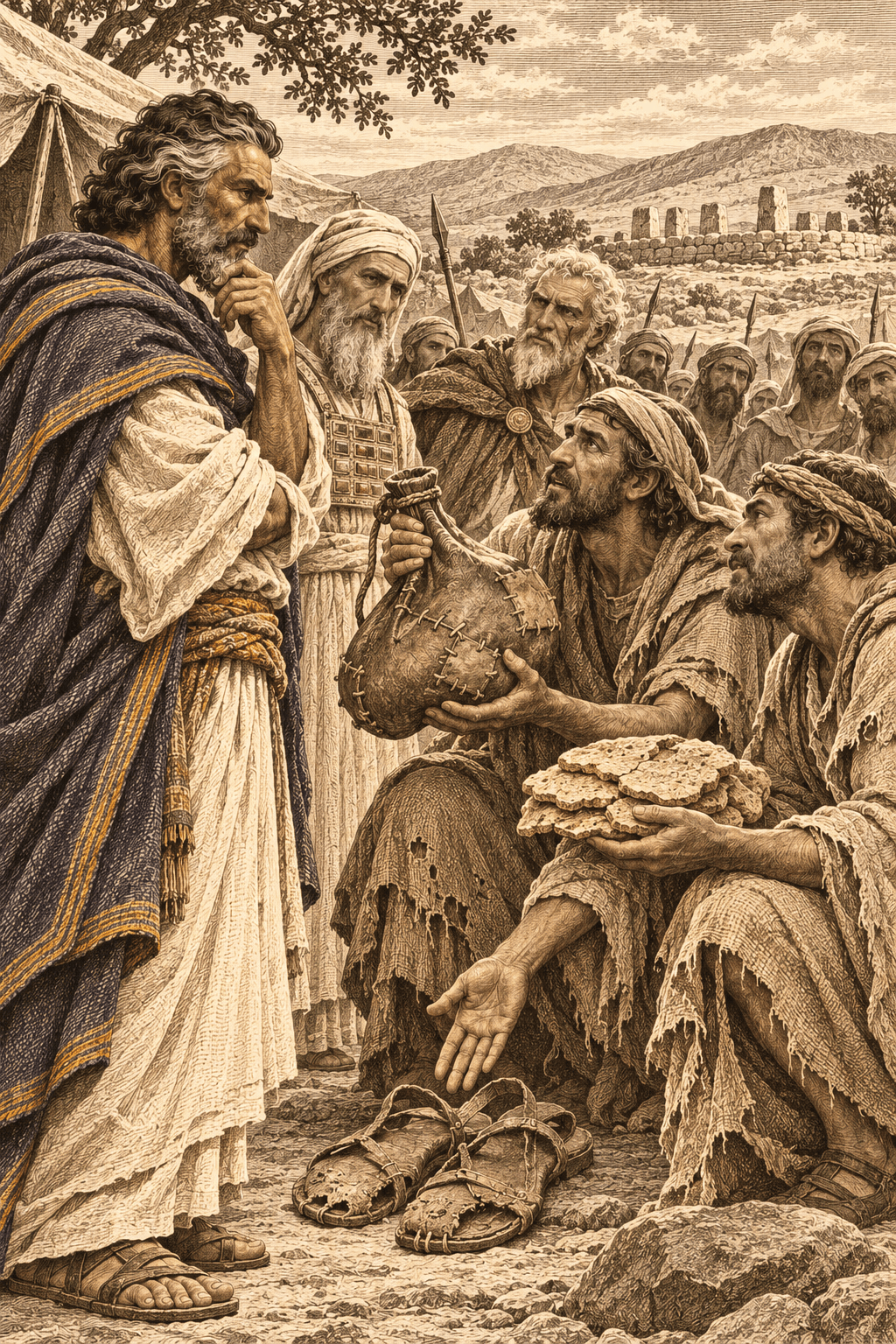
The Gibeonites felt danger closing in on them, for Joshua and God’s people had drawn near to them, and they had heard all that God had done with them. So they devised a ruse (see verses 4–13 above).
The Gibeonites perceived what Rahab the harlot had perceived; all wanted salvation, for they saw the mighty hand of God working for His people. But the Gibeonites did not attain what Rahab attained, though they rose above the other nations around them. By faith Rahab was able not only to be saved, with her household, from death, but to enter into membership of the community, representing the Church of the New Testament coming from the Gentiles as a holy bride and virgin of the Lord.
She had the great honor of having her name recorded in the genealogy of the Lord — something many great women of faith did not enjoy — and the Apostle counted her among the men and women of faith (Hebrews 11:31). But the Gibeonites were saved from death through fear together with cunning; they entered the midst of the people as slaves, hewers of wood and drawers of water for all the congregation and for the house of God (Joshua 9:21, 23).
Truly they were not destroyed like the other nations, but they could not rise to the glory of Rahab. They walked in the spirit of fear and cunning, she in the spirit of faith and love. They clung to everything old and worn out — dry bread, old wine bottles rent and bound up, old and clouted shoes, and old garments — while she clung to the spies, and her heart rose with them above the roof among the stalks of flax (purity), and she charged them to walk on the mountains and not in the low valleys.
It is as if the Gibeonites, even in clinging to God’s people, were bound to the worn-out things of the world, while Rahab’s heart rose to heavenly things, to the lofty, pure life. In other words, the Gibeonites became an example of the person who worships God out of fear of losing temporal blessings and living in loss; while Rahab represents the person who casts the old lusts of his body under his feet, putting off his old man with all his works, seeking eternal glory and longing to become like God Himself.
The Gibeonites used cunning against the children of God in order to enjoy temporal life, which lost them many blessings. As for Rahab, though she behaved with a lie and with cunning toward the messengers of the king of Jericho — something not commendable — she was frank and clear in her dealings with the children of God.
Origen sees the Gibeonites as representing the lower degrees of faith and those who enjoy less glory. He comments on this chapter:
“‘In my Father’s house are many mansions’ (John 14:2). In the resurrection of the dead the glorified bodies will differ among themselves, for ‘there is one glory of the sun, and another glory of the moon’ (1 Corinthians 15:39–41). How many other comparisons have been offered to show that there is a difference among those who obtain salvation! In my belief these Gibeonites represent those who receive a little of the glory of salvation, which does not remove blame and reproach from them. See how they were condemned to become hewers of wood and drawers of water for the congregation and for the house of the Lord, because they practiced deceit: they came with old and clouted shoes on their feet and old garments, and the bread of their provision was dry and mouldy; they came to see Joshua … and asked of him nothing but bodily salvation. [152]”
Origen continues his comment, explaining that the Gibeonites point to those who believe in God and in His saving works but do not translate this faith into a practical life which they live. He says:
“There are in the Church true believing Christians, who believe in God and do not dispute His commandments, who fulfill their religious duties and are eager to serve; but in their conduct and private life they are not pure but defiled; they have not put off the old man with his deeds (Colossians 3:9). They are like the Gibeonites, who wear their old garments and worn-out shoes. They believe in God and show respect toward the servants of the Lord and the Church, but there is no sign in them of reform or inner renewal in their conduct. These want the Lord Jesus to grant them salvation, but this salvation does not spare them the marks of the shame that falls on them. In the book called The Shepherd [153] we find a similar picture of this class of people: it speaks of the tree that produces no fruit but supports the vine that bears many grapes. The tree is fruitless, yet its role seems important and useful, for it serves the vine! So in the story of the Gibeonites: we find that they do not put off the old man with all his deeds, yet they serve the saints (hewing wood and drawing water), which gives them some importance. In this way they receive salvation from Joshua according to the covenant he made with them. As for us, we do not want to receive salvation in this way, after the example of the Gibeonites. We do not want to be hewers of wood or drawers of water, but to be true Israelites, enjoying the inheritance and having a share in the land of promise. [154]”
3. Joshua’s Men Deceived
KJV · Verses 14–20
14 And the men took of their victuals, and asked not counsel at the mouth of the Lord. 15 And Joshua made peace with them, and made a league with them, to let them live: and the princes of the congregation sware unto them. 16 And it came to pass at the end of three days after they had made a league with them, that they heard that they were their neighbours, and that they dwelt among them. 17 And the children of Israel journeyed, and came unto their cities on the third day. Now their cities were Gibeon, and Chephirah, and Beeroth, and Kirjathjearim. 18 And the children of Israel smote them not, because the princes of the congregation had sworn unto them by the Lord God of Israel. And all the congregation murmured against the princes. 19 But all the princes said unto all the congregation, We have sworn unto them by the Lord God of Israel: now therefore we may not touch them. 20 This we will do to them; we will even let them live, lest wrath be upon us, because of the oath which we sware unto them.
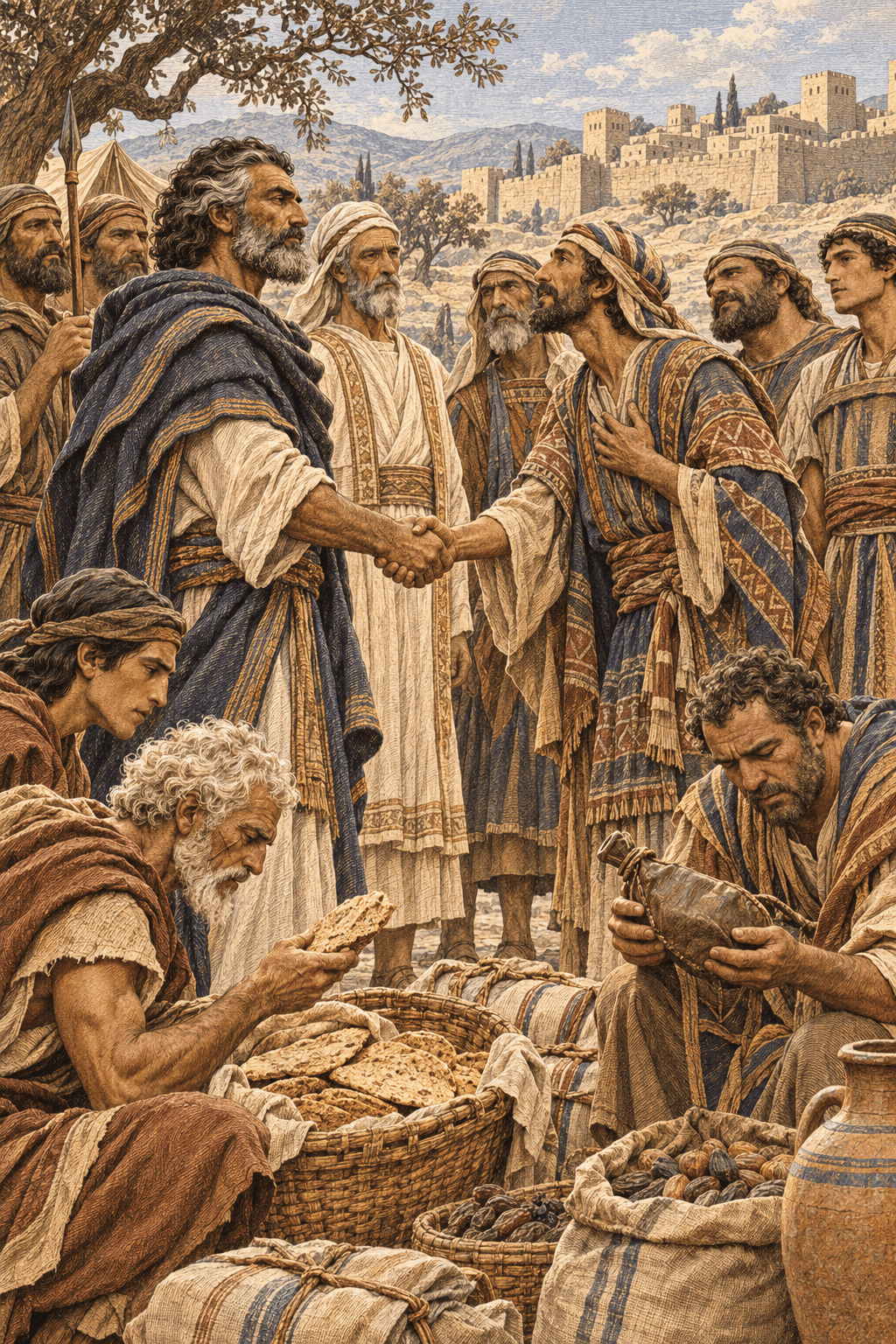
For the second time Joshua and his men fell into the same error: acting without seeking God’s counsel. True, the Israelites suspected the Gibeonites, and they could have consulted God; but they were content to use human wisdom, entering into dialogue with them: “Peradventure ye dwell among us; and how shall we make a league with you?” [7] … The answer came to them from the mouths of men, but they “asked not counsel at the mouth of the Lord” [14]. They relied on human thinking without taking refuge in God, and so they were deceived!
In the first battle, when they met Jericho, they were able by faith and obedience to God to crush its huge fortifications. In the second battle, when they met Ai, they made light of it as a small, unfortified town with few people; relying on their human arm they fell and collapsed, until they were sanctified and obeyed God, and then they overcame it. But here, in the “battle of deception,” where the enemy pretends to be a friend seeking to enter into a covenant, the mighty men who had conquered Jericho and Ai fell before this ruse.
That is why the Apostle Paul says: “But I fear, lest by any means, as the serpent beguiled Eve through his subtilty, so your minds should be corrupted from the simplicity that is in Christ” (2 Corinthians 11:3). And Saint John says: “Believe not every spirit, but try the spirits whether they are of God: because many false prophets are gone out into the world” (1 John 4:1).
The Fathers of the Church often spoke of the deceits and cunning of the enemy, to warn us against him. At times he appears violent, strong and powerful, surrounded by huge walls like Jericho, to terrify us until we despair; at times he makes himself very small in our eyes so that we make light of him like Ai and do not prepare ourselves spiritually to meet him; and at other times he appears as a friend, or even as an angel of light, to deceive us so that we enter into covenants with him, as the Gibeonites did.
Saint Augustine says: “Do not think that the devil has lost his ferocity; therefore, when he flatters you, your fear of him should increase.” [155] He also says:
“Behold, the tempter comes to me in the form of an angel of light, but in vain he tries to deceive me, for You rebuke him, granting me the power to perceive the brightness of the divine light. [156]”
And again he says:
“He is a cunning and deceitful enemy; without Your light we cannot perceive his crooked ways, nor know the many shapes of his face. Now we see him here and now there; now he appears as a lamb and now as a wolf; now as light and now as darkness. He knows how to change himself and change his plans as man’s circumstances, times and places change. To deceive the weary he grieves with them; to draw hearts he pollutes the air of their joy; to kill the fervent in spirit he appears to them in the form of a lamb; and to devour the modest he turns into a wolf … Who can discern the various ways of his cunning? Who can always uncover him in his secret disguise? Who has counted the number of his terrible fangs? He hides his arrows in his quiver, and keeps his tricks until the moment fit for a fall. My God, You who are my hope, without Your light, in which we see all things, we cannot uncover the maneuvers and tricks of Satan! [157]”
Joshua erred in believing them and swearing to them. That is why Saint John Chrysostom speaks to us about the use of oaths, saying: “Truly this oath was a snare of the devil! … May we escape every trap and every satanic snare.” [158]
Though Saint Ambrose criticized Joshua for believing the men quickly without consulting God, he saw in his action a sign of the goodness of his heart, judging him according to his simple heart. He says:
“Who can find fault with the saints in this matter? They think that others have the same feelings as they have, and suppose that none of them lies, because the Truthful One is always in their company. They do not know what deceit is, and they gladly believe others, because they themselves are truthful. Suspicion of others for what they are not does not creep into them … Let us not blame his readiness to believe, but rather praise his goodness. [159]”
Joshua and his men discovered the ruse of the Gibeonites after three days, and realized that they were their neighbours and dwelt among them. We return to the mystery of the three days, of which we have often spoken in this book as in the previous books: through our faith in the Holy Trinity the tricks and deceits of the devil are exposed. When we receive God as our Father, we enter His fatherly embrace by abiding in His only Son as members of His holy body, through the work of His Holy Spirit in us by baptism, as also in repentance, and so on … The enemy cannot deceive us nor draw our heart away from our heavenly Father.
Our practical, living faith, and our enjoyment of the mystery of the Trinity — not as a philosophical idea or an intellectual doctrine, but as the mystery of our fellowship with Him — protects us from every satanic attack. The three days also point to the mystery of our resurrection with Christ, in which we are buried with Him three days so as to rise with Him. The person who has the risen life in the Lord and enjoys its joy lives always above all the enemy’s tricks and deceits!
Let us then flee from the deceits of the Gibeonites by receiving the Holy Trinity as the mystery of our life, and by enjoying the risen life in Christ Jesus our Lord, risen from the dead.
4. The Humbling of the Gibeonites
KJV · Verses 21–27
21 And the princes said unto them, Let them live; but let them be hewers of wood and drawers of water unto all the congregation; as the princes had promised them. 22 And Joshua called for them, and he spake unto them, saying, Wherefore have ye beguiled us, saying, We are very far from you; when ye dwell among us? 23 Now therefore ye are cursed, and there shall none of you be freed from being bondmen, and hewers of wood and drawers of water for the house of my God. 24 And they answered Joshua, and said, Because it was certainly told thy servants, how that the Lord thy God commanded his servant Moses to give you all the land, and to destroy all the inhabitants of the land from before you, therefore we were sore afraid of our lives because of you, and have done this thing. 25 And now, behold, we are in thine hand: as it seemeth good and right unto thee to do unto us, do. 26 And so did he unto them, and delivered them out of the hand of the children of Israel, that they slew them not. 27 And Joshua made them that day hewers of wood and drawers of water for the congregation, and for the altar of the Lord, even unto this day, in the place which he should choose.
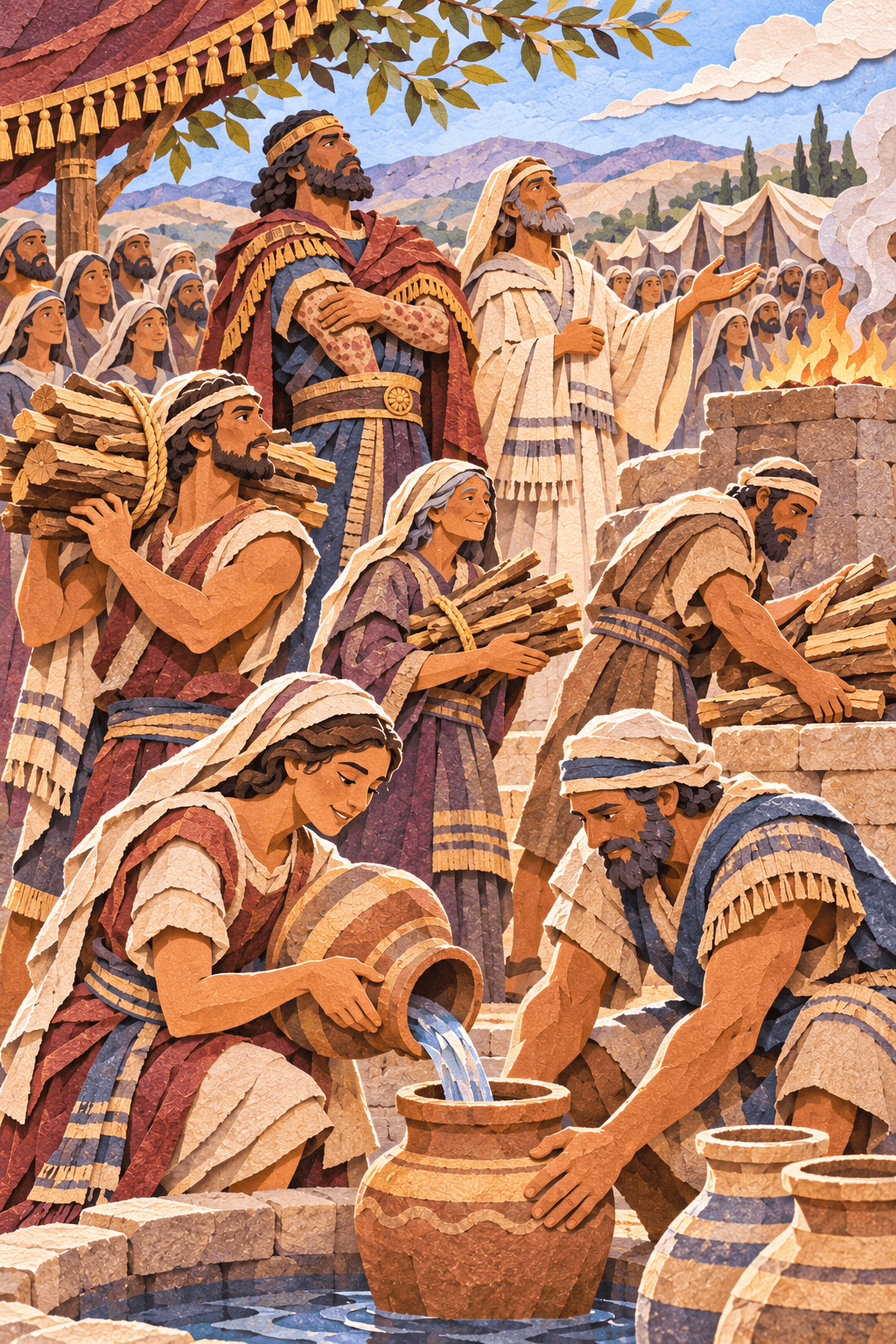
When Israel had made a covenant with the Gibeonites, the princes said to all the congregation: “We have sworn unto them by the Lord God of Israel: now therefore we may not touch them … Let them live; but let them be hewers of wood and drawers of water unto all the congregation.” Joshua called the men of Gibeon and said: “Wherefore have ye beguiled us …? Now therefore ye are cursed, and there shall none of you be freed from being bondmen, and hewers of wood and drawers of water for the house of my God” [19–23].
Joshua was obliged to spare them, as he had earlier spared Rahab and her household; but each received according to the measure of his faith. These remained as slaves — “Ye are cursed, and there shall none of you be freed from being bondmen” — because they came to them out of fear; but she remained as a member of the new Israel, for she received its message with love. Yet truly some of Gibeon came to draw water for the house of God, and so received honor instead of death, and the saying applied to them:
“Instead of the thorn shall come up the fir tree, and instead of the brier shall come up the myrtle tree: and it shall be to the Lord for a name, for an everlasting sign that shall not be cut off” (Isaiah 55:13).
Finally, Origen warns us against entering into faith on the level of the Gibeonites, so that we live as slaves hewing wood and drawing water, instead of being on the level of children of God, doing His will, walking by His Spirit and becoming like Him. He says:
“If someone’s faith were limited to attending church, bowing before the priest, honoring the servants of the Lord and sharing in adorning the altar and the church, without doing anything to reform his conduct and correct his habits — burying evil, practicing the pure life, controlling his anger, his greed and his coveting of what belongs to others, and keeping away from slander, insult and destructive judging — such a one the Lord assigns to the Gibeonites … I beseech you as ambassadors for Christ (2 Corinthians 5:20): while there is still time and possibility of amendment, strive and hasten to cast off the worn-out garments and the impurities that do not befit the freedom of the (new) Israelites. Do you want to know the greatness of this freedom? According to the law, a Hebrew servant who has become a slave cannot remain in slavery more than six years; in the seventh year the law orders him to be set free (Exodus 21:2), for the law cares for freedom. If we take this text in its spiritual sense, we find that the Hebrew servant is you, since you have fallen into the slavery of which Scripture says: ‘Whosoever committeth sin is the servant of sin’ (John 8:34). The perfect, virgin soul does not fall under this slavery; the slack, childish soul falls into it. If you are the Hebrew servant who received baptism in the Church and then fell back as a slave of sin, since the number 7 points to the (Gospel) commandments, you should regain your freedom quickly in seven years, that is, through the commandments, and be a slave no longer. If the number 7 points to the commandments, the number 6 points to the creation of the world (Genesis 1:31). As long as you desire the things on the earth (Colossians 3:2) and mind the things of the flesh, ‘the world’ (Romans 8:5), you will surely live as a slave of sin. But when you reach the number 7, you seek your freedom and return to the honor of your Father … I ask you: if you were the son of a family of high rank, would you want to be a slave of this world? Without doubt you say: No … If in this life no one wants to remain a slave, but all long for freedom, wealth and honor, not only for themselves but for others … then we must, as Saint John said, work the works of our Father who sent us while it is day (John 9:4), so that we may be worthy of the Spirit of adoption (Romans 8:15) and have a place among the children of God, ‘that God in all things may be glorified through Jesus Christ, to whom be praise and dominion for ever and ever. Amen’ (1 Peter 4:11). [160]”
Notes and References
[151] Caesarius of Arles, Sermon 116A:1.
[152] Origen, Homilies on Joshua 10:1 [the PDF reads “1:10”].
[153] By Hermas, a writer of the second century.
[154] Origen, Homilies on Joshua 10:1.
[155] Augustine, quoted in Thoughts of a Philosopher on the Spiritual Life (Arabic), p. 234.
[156] Augustine, Soliloquies 16.
[157] Augustine, Soliloquies 17. (The site adds a cross-reference here to Romans 12:11, “fervent in spirit.”)
[158] John Chrysostom, Homilies on Acts 13.
[159] Ambrose, On the Duties of the Clergy 3:10.
[160] Origen, Homilies on Joshua 10:3.