
When Adoni-zedek king of Jerusalem heard that Joshua had taken Jericho and Ai, and that the Gibeonites, the people of the great city, had made peace with him, he sent to the kings around him; and the five kings of the Amorites — of Jerusalem, Hebron, Jarmuth, Lachish and Eglon — agreed to smite Gibeon. The people of Gibeon cried for help to Joshua, who saved them from these kings and took their cities and the whole region of the south.
1. Gibeon and the five kings (1–5).
2. The appeal to Joshua (6–10).
3. The falling of hailstones (11).
4. The lengthening of the day (12–14).
5. The kings in the cave (15–23).
6. The slaying of the kings (24–27).
7. The capture of the cities of the south (28–43).
1. Gibeon and the Five Kings
KJV · Verses 1–5
1 Now it came to pass, when Adonizedec king of Jerusalem had heard how Joshua had taken Ai, and had utterly destroyed it; as he had done to Jericho and her king, so he had done to Ai and her king; and how the inhabitants of Gibeon had made peace with Israel, and were among them; 2 That they feared greatly, because Gibeon was a great city, as one of the royal cities, and because it was greater than Ai, and all the men thereof were mighty. 3 Wherefore Adonizedec king of Jerusalem, sent unto Hoham king of Hebron, and unto Piram king of Jarmuth, and unto Japhia king of Lachish, and unto Debir king of Eglon, saying, 4 Come up unto me, and help me, that we may smite Gibeon: for it hath made peace with Joshua and with the children of Israel. 5 Therefore the five kings of the Amorites, the king of Jerusalem, the king of Hebron, the king of Jarmuth, the king of Lachish, the king of Eglon, gathered themselves together, and went up, they and all their hosts, and encamped before Gibeon, and made war against it.
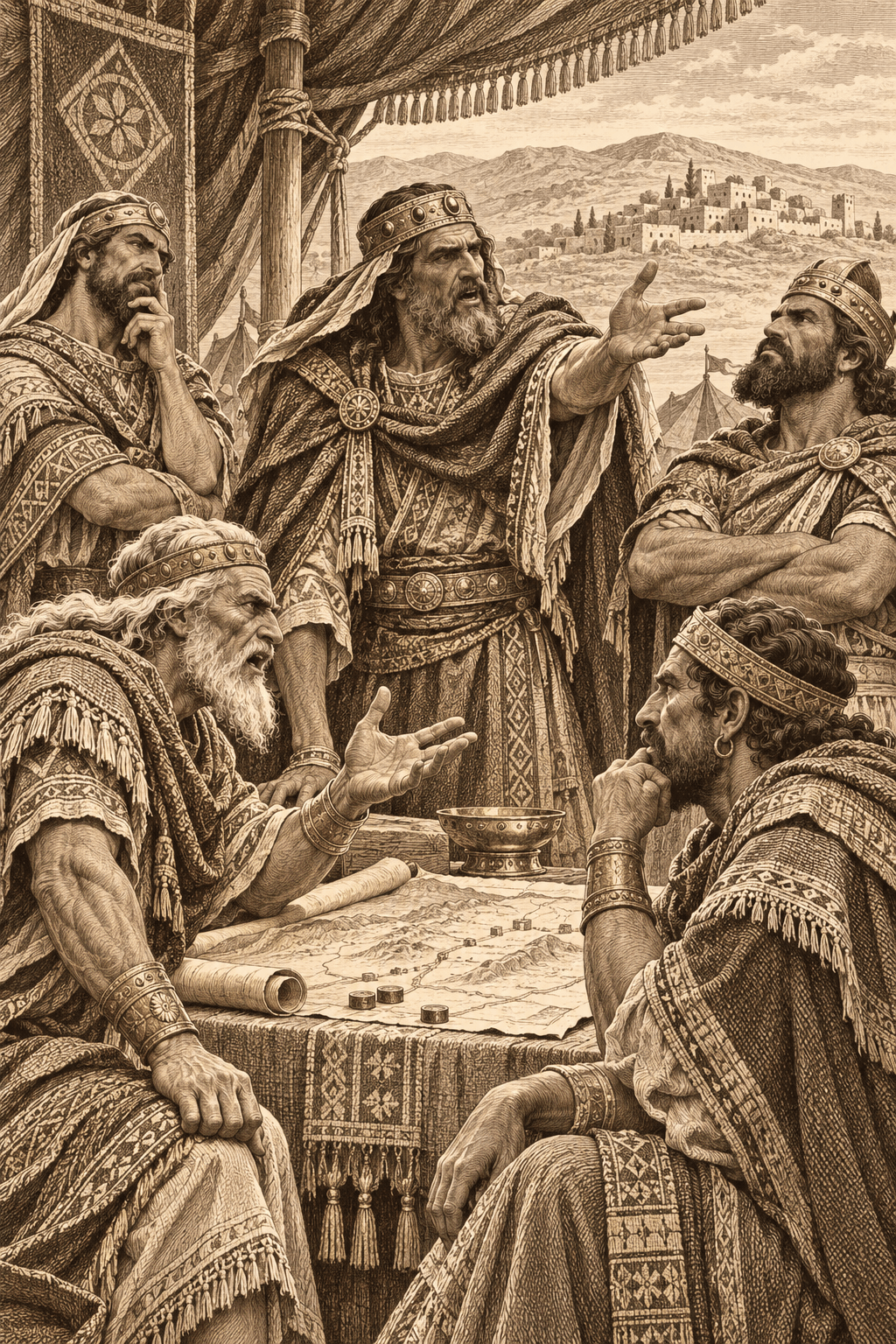
If the Gibeonites represent the faint-hearted among believers, who share in Christian worship but have not yet put off “the works of darkness” of old, these are exposed to a particular kind of spiritual warfare: the war of the five senses and their uprising against them. It is as if the five kings who rose up against Gibeon point to this war to which the weak are exposed — kings who had been friends of Gibeon and became its enemies merely because it made a treaty of peace with Joshua. Origen says:
“When a human soul enters into a covenant with the Word of God (Joshua), it should not doubt that enemies will at once rise up against it, and that its friends of the past will turn into enemies. Do not expect this only from people, but it will certainly happen from the powers of evil and the evil spirits that come down to fight it. So when a man seeks friendship with Jesus, let him know that he must bear the estrangement of many. The Apostle Paul confirms this: ‘All that will live godly in Christ Jesus shall suffer persecution’ (2 Timothy 3:12). And the wise man also says: ‘My son, if thou come to serve the Lord, prepare thy soul for temptation’ (Sirach 2:1). So the inhabitants of Gibeon are still besieged today because they entered into a covenant with Joshua, however weak they are, even if they are hewers of wood and drawers of water. This means that anyone in the Church, even the least, is exposed to the aggression of the five kings, so long as he is in a relationship with Jesus. And though the inhabitants of Gibeon are so weak (and slaves), they are neither neglected nor despised by Joshua or the princes … who support their weakness. Is it not still so with us? For the Apostle commands: ‘Comfort the feebleminded, support the weak, be patient toward all men’ (1 Thessalonians 5:14). This is Joshua’s way with the captains of his soldiers: they support those whom the powers of evil fight for His name’s sake — not only with strength in the struggle, but He lengthens their day and adds to the time of light, delaying the coming of darkness [12–14]. [161]”
After speaking of the uproar of the five kings against the souls that had entered into peace with the true Joshua, and affirming the support of Joshua and his men for them — even if it required the day to be lengthened and the night delayed — Origen spoke of the symbolic meaning of these kings:
“Let us see what the five kings mean … We have often said that there are two kinds of struggle for Christ. One belongs to the saints, like Paul and the Ephesians, for he himself says: ‘For we wrestle not against flesh and blood, but against principalities, against powers, against the rulers of the darkness of this world, against spiritual wickedness in high places’ (Ephesians 6:12). But for those who are less strong and who still have their faults, their struggle is against flesh and blood, for they are still besieged by vices and the falls of the body. I think this is what is meant in this text. We have said that the five kings declared war on the inhabitants of Gibeon, who in our belief symbolize imperfect Christians. These are besieged by five kings, who symbolize the five senses of the human body: sight, hearing, taste, touch and smell. For man falls into sin only through these senses. So the five senses are compared to the five kings who besiege the inhabitants of Gibeon, that is, those who serve the body. [162]”
2. The Appeal to Joshua
KJV · Verses 6–10
6 And the men of Gibeon sent unto Joshua to the camp to Gilgal, saying, Slack not thy hand from thy servants; come up to us quickly, and save us, and help us: for all the kings of the Amorites that dwell in the mountains are gathered together against us. 7 So Joshua ascended from Gilgal, he, and all the people of war with him, and all the mighty men of valour. 8 And the Lord said unto Joshua, Fear them not: for I have delivered them into thine hand; there shall not a man of them stand before thee. 9 Joshua therefore came unto them suddenly, and went up from Gilgal all night. 10 And the Lord discomfited them before Israel, and slew them with a great slaughter at Gibeon, and chased them along the way that goeth up to Bethhoron, and smote them to Azekah, and unto Makkedah.
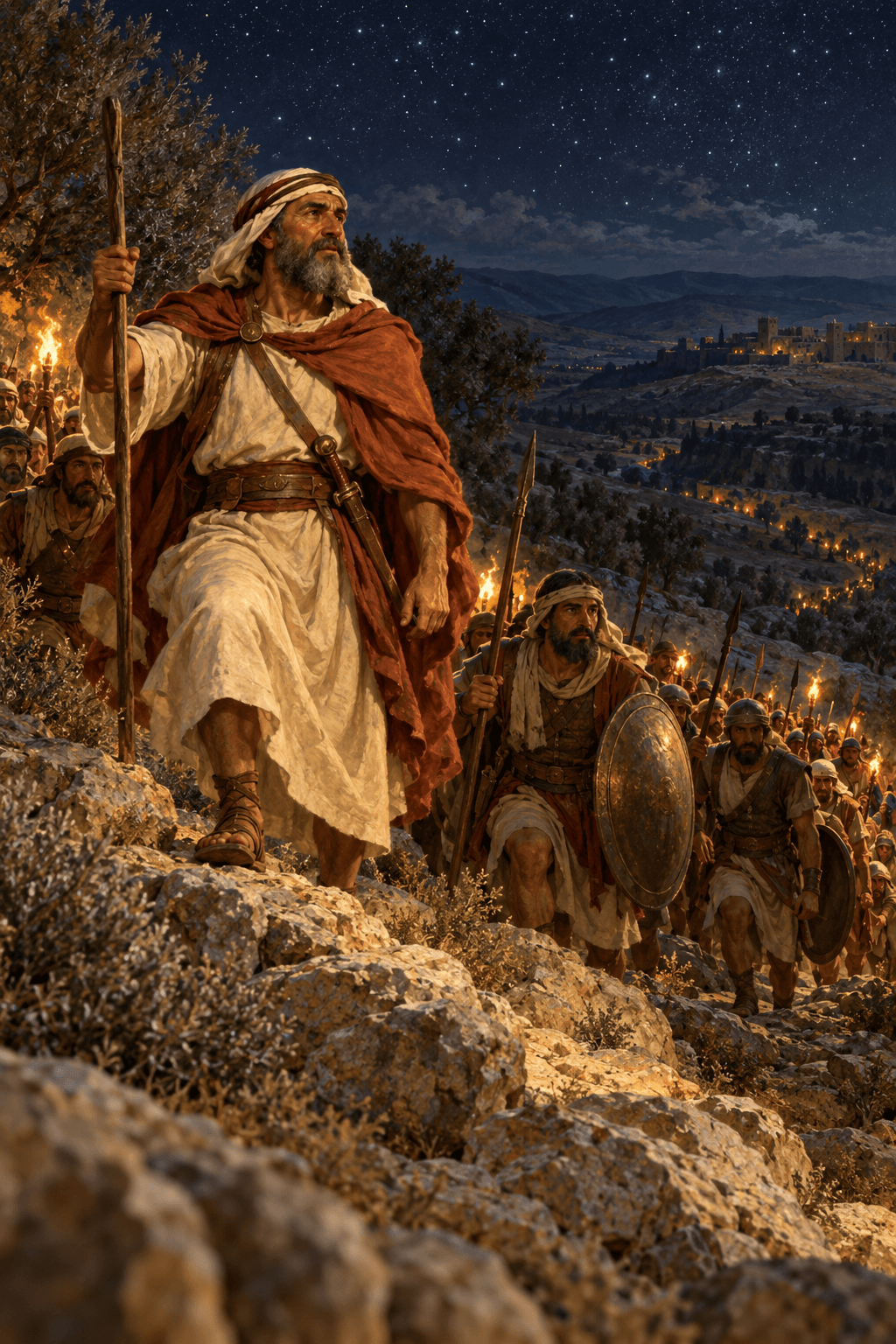
“And the men of Gibeon sent unto Joshua to the camp to Gilgal, saying, Slack not thy hand from thy servants; come up to us quickly, and save us, and help us: for all the kings of the Amorites that dwell in the mountains are gathered together against us. So Joshua ascended from Gilgal, he, and all the people of war with him, and all the mighty men of valour” [6–7].
Saint Augustine speaks of man’s ability: he is able to tame wild beasts so that they submit to him and obey him and become tame, but he is utterly unable to tame himself, especially his tongue. [163] If the five kings point to the rebellious senses in the inner man, no one can tame these wild beasts except the true Joshua, the Creator and Sanctifier of the senses! There is no way of salvation except that the Gibeonites cry for help to Joshua, who is in Gilgal, to roll away [164] their reproach and remove all weakness from them.
So let our souls, groaning from the fires of the war of the lusts of the flesh — whether through sight or touch or any sense — take refuge in our true Joshua, crying to Him to come up to us quickly, save us and help us. He who created our senses is alone able to sanctify them, turn them back from their deviation from their purpose, and quench the flame of lusts in them. That is why Saint Jerome offers us prayer as a remedy against these lusts: “Prayer quenches the fire of the soul, and so also does trust in the Lord.” [165] And Saint John Climacus affirms: “When we are unable to pray against the evil creation (the demons), they launch an attack against us.” [166]
Saint John Climacus counsels us to take refuge in our Lord Jesus Christ when we feel the weight of the war, especially the war of fornication, without resorting to discussions and arguments with the enemy:
“Do not think that you can overcome the demon of fornication by discussions and arguments. Whoever is determined to resist (the lusts of) his body and overcome them in this way fights in vain; for unless God destroys the house of (the lusts of) the body and builds the house of the soul, man’s watching and fasting are in vain … Offer to the Lord the weakness of your nature, fully recognizing your inability and powerlessness, and you will receive from Him the incomprehensible gift of chastity … [167]”
3. The Falling of Hailstones
KJV · Verses 11
11 And it came to pass, as they fled from before Israel, and were in the going down to Bethhoron, that the Lord cast down great stones from heaven upon them unto Azekah, and they died: they were more which died with hailstones than they whom the children of Israel slew with the sword.

Joshua went up to war against these kings, and the Lord Himself strengthened him, saying: “Fear them not: for I have delivered them into thine hand” [8]. Joshua came upon them suddenly, going up all night, and the Lord discomfited the enemy and slew them with a great slaughter at Gibeon, and chased them along the way that goes up to Beth-horon, and smote them to Azekah and to Makkedah … As the enemy fled before Israel and were going down to Beth-horon, the Lord cast down great stones of hail from heaven upon them, and they were more which died with hailstones than they whom the children of Israel slew with the sword.
It is as if the victory over these kings was accomplished by two things: the sword and the hailstones falling from heaven. If these kings point to the five senses that have been defiled and are at war against the inner man, then to overcome we must cut off with the sword of the Spirit every evil, so that it no longer exists in our senses; and we also need the heavenly hailstones, with which the Spirit comes down upon the senses, quenching the flame of evil in them and granting them coolness toward what is earthly, so that they may be kindled anew toward what is heavenly.
The hailstones are deadly to the love of earthly things, but they come down from heaven to lift the senses up to what is heavenly.
4. The Lengthening of the Day
KJV · Verses 12–14
12 Then spake Joshua to the Lord in the day when the Lord delivered up the Amorites before the children of Israel, and he said in the sight of Israel, Sun, stand thou still upon Gibeon; and thou, Moon, in the valley of Ajalon. 13 And the sun stood still, and the moon stayed, until the people had avenged themselves upon their enemies. Is not this written in the book of Jasher? So the sun stood still in the midst of heaven, and hasted not to go down about a whole day. 14 And there was no day like that before it or after it, that the Lord hearkened unto the voice of a man: for the Lord fought for Israel.
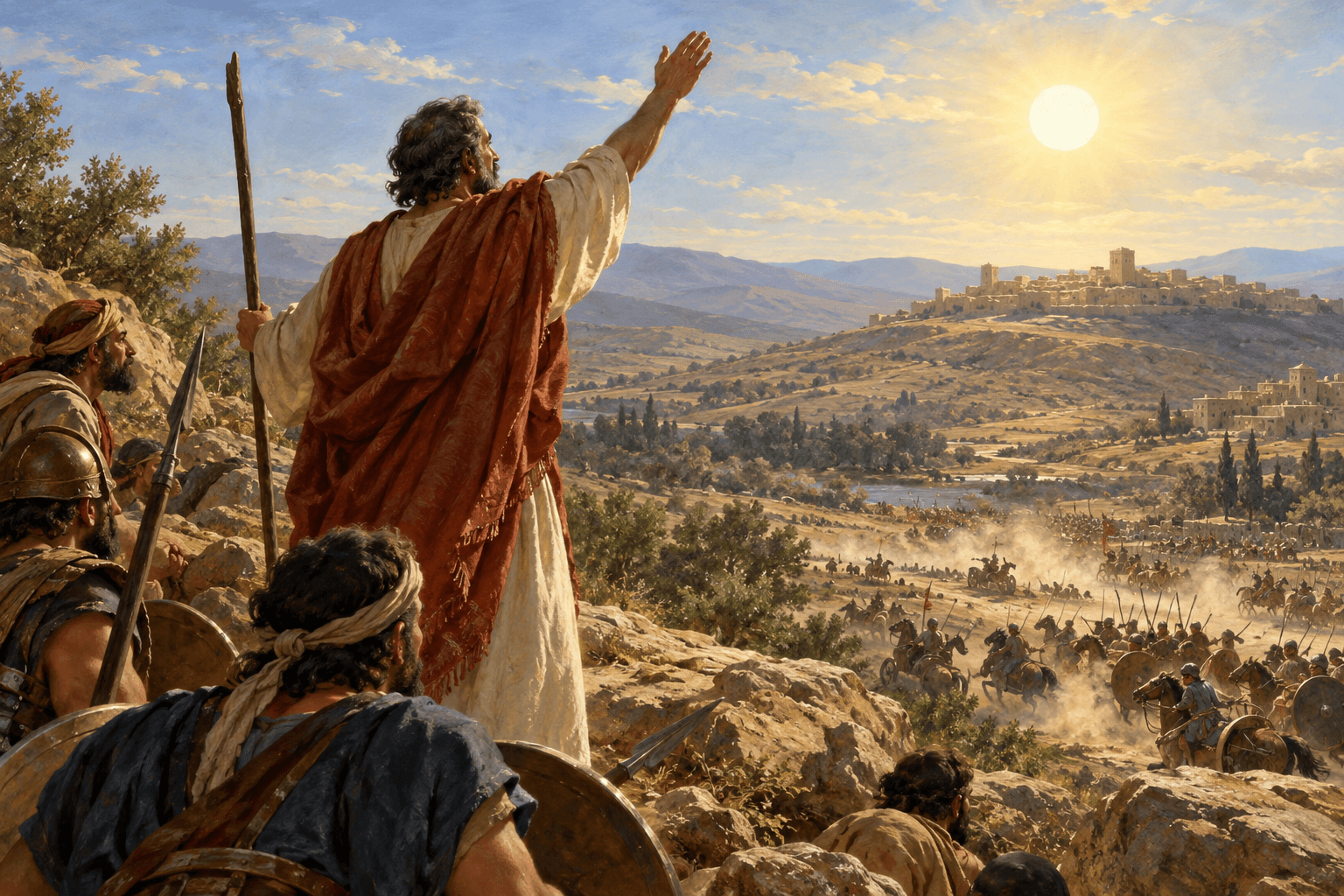
When Joshua had overcome the Amorites, he asked God to delay the coming of night until the victory was complete, saying: “Sun, stand thou still upon Gibeon; and thou, Moon, in the valley of Ajalon.” And the sun stood still and the moon stayed until the people had avenged themselves upon their enemies (see verses 12–14 above).
Some interpreters believed that the battle was so fierce that it seemed to the children of Israel that the day was longer than usual. [168] But it is clear from the words of inspiration that the sun’s setting was delayed, citing in proof the book of Jasher. This book is clearly not one of the books of Holy Scripture; it was most likely written by a layman who loved poetry and literature, in which he recorded some important religious and temporal events.
Having witnessed the delay of the sunset, or heard of it, he recorded it in a poem which he included in his book. It is as if the writer of the Book of Joshua cites this wonderful event from the writings of a layman. It is worth noting that history also bears witness to similar events. Herodotus says that the Egyptian priests showed him documents speaking of a day longer than usual. Chinese writings state that there was a similar day in the reign of their emperor Yao, a contemporary of Joshua; and in Mexico there are documents establishing that a long day occurred in a certain year, the very year in which Joshua was carrying on his wars. [169]
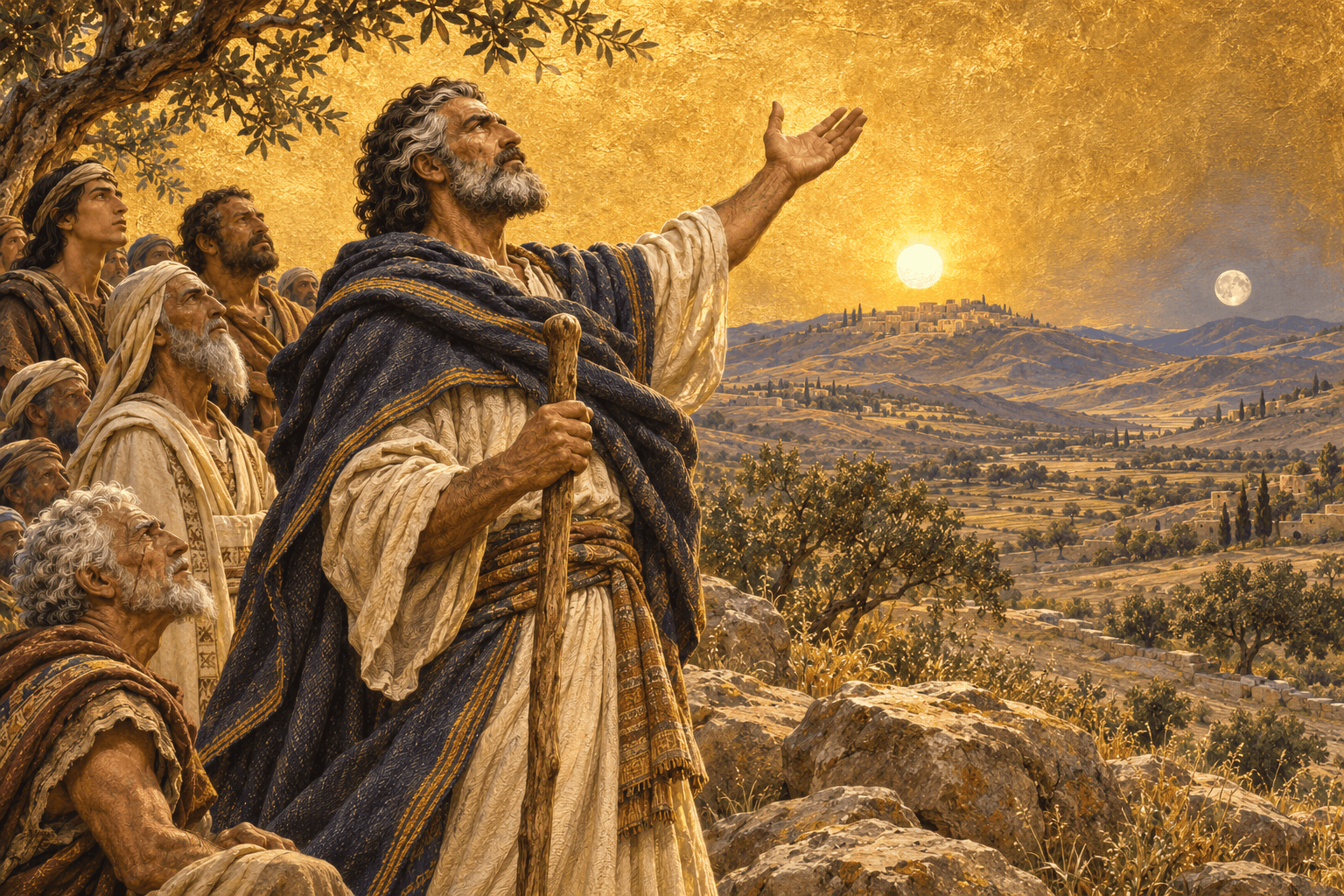
Origen sees in this event a symbolic picture of the work of the true Joshua in our lives, as He lengthens our day for work toward our salvation and delays the night of darkness, so that the enemy may not destroy us. He says:
“We would like, if possible, to show how the Lord Jesus spread the light and lengthened the day for the salvation of souls and the destruction of the powers of evil. From the coming of the Savior, the end of the world was at hand, for He Himself said: ‘Repent: for the kingdom of heaven is at hand’ (Matthew 4:17). But He postponed the day of the end and prevented its appearing. For when God the Father saw that the salvation of the Gentiles would not be accomplished except through Joshua, He said: ‘Ask of me, and I shall give thee the heathen for thine inheritance, and the uttermost parts of the earth for thy possession’ (Psalm 2:8). So until this promise of the Father is fulfilled and the churches grow, gathering the Gentiles and all the good into themselves, and until all Israel is saved, the day is lengthened and its end delayed. The sun never sets, but shines always — the Sun of Righteousness, who sends the light of truth into the hearts of believers. But when the number of believers is complete, the evil time comes, the last generation, in which the love of many waxes cold because of the rise of selfishness and the absence of righteousness; then only a few believers remain, and then the days are shortened (Matthew 24:22). Yes, God Himself knows how to lengthen the days in the time of salvation and shorten the time in the time of hardships and loss. As for us, may we walk faithfully in the clearness of the day and do the works of light, while we have the day and the time of light is lengthened for us. [170]”
Again Origen says:
“While we fight against our enemies, ‘against principalities, against powers, against the rulers of the darkness of this world, against spiritual wickedness in high places’ (Ephesians 6:12), the Sun of Righteousness does not cease to accompany us, for He never leaves us. He does not hasten to set, for He Himself says: ‘Lo, I am with you alway’ (Matthew 28:20) — not with us for the space of a double day only, but all the days until the end of the world, until we triumph over our enemies (the demons). [171]”
In any case, what happened declares God’s wonderful work through His servants. As Saint Athanasius the Apostolic says:
“Though the sun stood still in Gibeon, and the moon in the valley of Ajalon, this was not the work of the son of Nun, but the work of the Lord who heard the prayer, He who rebuked the sea, and on the cross made the sun grow dark (Matthew 27:45). [172]”
5. The Kings in the Cave
KJV · Verses 15–23
15 And Joshua returned, and all Israel with him, unto the camp to Gilgal. 16 But these five kings fled, and hid themselves in a cave at Makkedah. 17 And it was told Joshua, saying, The five kings are found hid in a cave at Makkedah. 18 And Joshua said, Roll great stones upon the mouth of the cave, and set men by it for to keep them: 19 And stay ye not, but pursue after your enemies, and smite the hindmost of them; suffer them not to enter into their cities: for the Lord your God hath delivered them into your hand. 20 And it came to pass, when Joshua and the children of Israel had made an end of slaying them with a very great slaughter, till they were consumed, that the rest which remained of them entered into fenced cities. 21 And all the people returned to the camp to Joshua at Makkedah in peace: none moved his tongue against any of the children of Israel. 22 Then said Joshua, Open the mouth of the cave, and bring out those five kings unto me out of the cave. 23 And they did so, and brought forth those five kings unto him out of the cave, the king of Jerusalem, the king of Hebron, the king of Jarmuth, the king of Lachish, and the king of Eglon.
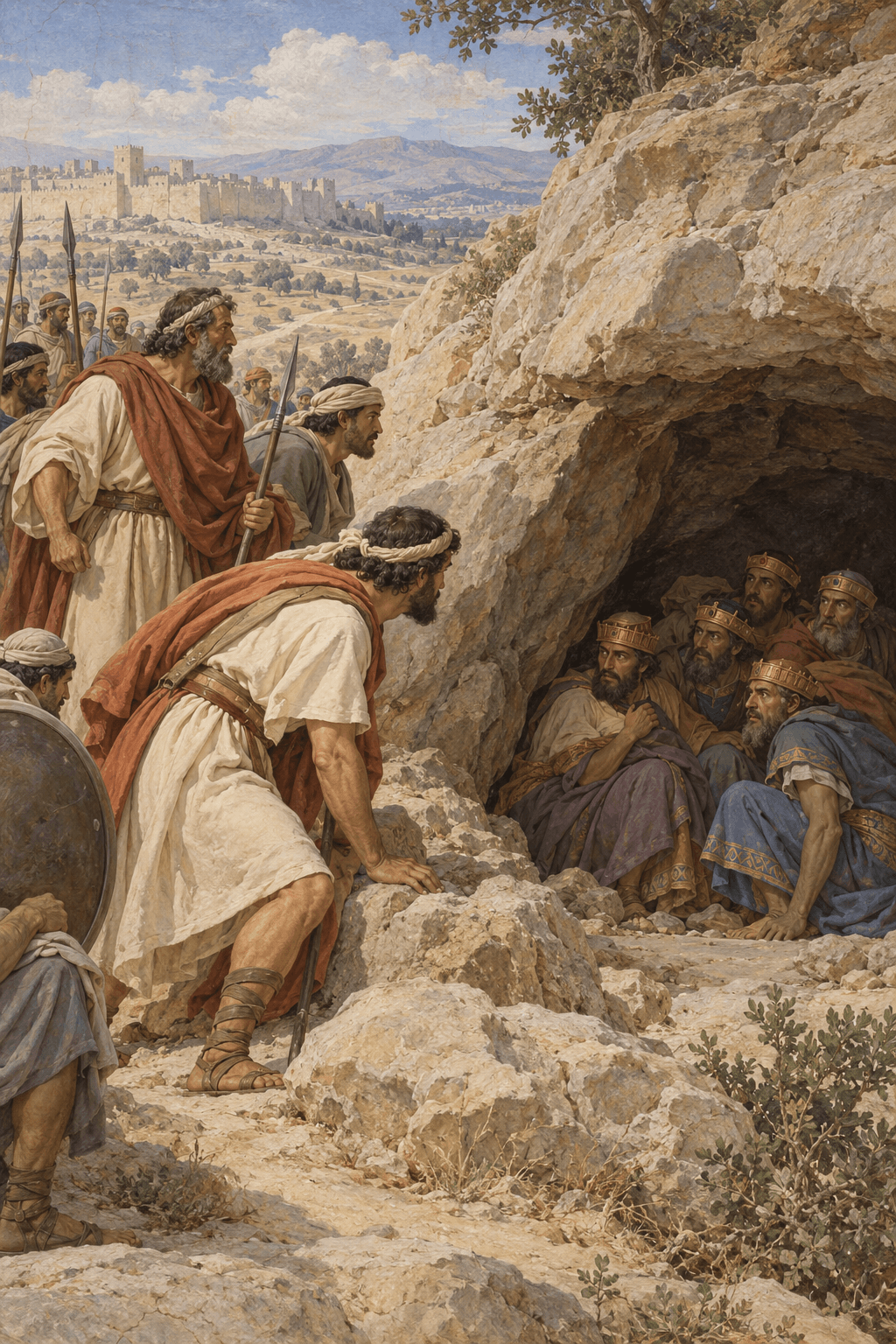
“But these five kings fled, and hid themselves in a cave at Makkedah … And Joshua said, Roll great stones upon the mouth of the cave, and set men by it for to keep them: and stay ye not, but pursue after your enemies, and smite the hindmost of them; suffer them not to enter into their cities: for the Lord your God hath delivered them into your hand” [16–19].
Why did they hide in a cave at Makkedah? If these five kings point to the defilement of the senses, or the onslaught of the war of the senses against the believers, the goal of this war is to bring man into the cave, that is, to bring him down into the depths of earthly things and imprison him there, so that he cannot set out toward heavenly things. On this Origen says: “The cave is a place hewn in the depth of the earth. If we speak of the senses of man occupied with earthly things, caring only for what the body desires without serving God, we can say that his senses are hidden in the depth of the earth.” [173] So we must be freed from the authority of these kings, so that Jesus Christ may take their place, and we do not enter the cave but rise to the heavenly life.
The war of these kings is as old as man. The serpent came creeping on the ground to draw Eve’s heart into the cave instead of rising toward eternal things … The devil could not have captured the hearts of Adam and Eve had they not come down to earthly things and desired temporal things.
Saint Ambrose says: “The serpent represents the bodily lusts that make men creep on the earth, whose god is their belly and whose glory is in their shame (Philippians 3:19), who eat what is of the dust.” [174] And Bishop Ignatius Brianchaninov says: “See, brethren, what Satan does, and what he will do! He leads man’s mind from the spiritual heaven to material things; he binds his heart to the earth and to earthly concerns. Consider, and beware.” [175]
That is why Saint Barsanuphius says: “If you want to be saved, hold fast to dying to everything earthly. Count yourself as nothing, and strive for what is before you, lest under the appearance of good work Satan occupy you with untimely troubles.”
And Saint John Chrysostom affirms our obligation to rise to heaven while we are on earth, so that we are not deceived by the devil’s tricks but are bound to our heavenly King:
“Do not think that you have anything binding you to the earth. Your body has not yet been carried to heaven, but your Head dwells above! Yes, the Lord came here first, and in bringing His angels He meant to take you with Him and depart with you there, so that you may realize that even before you go to that place you can dwell on earth as though it were heaven. [176]”
If the defilement of the senses wants to imprison us in earthly things and smother our souls as in a cave, it befits us, under Joshua’s leadership, to imprison the defilement in a cave, roll great stones upon it, set men over it as guards, and give ourselves to the rest of the wars until Joshua reigns, and then return and kill the defilement completely. What does this mean, if not giving the defilement no opportunity to enter into discussions with us, but shutting it in with great stones, setting a spiritual guard over our senses, and doing the Lord’s positive work, so that evil no longer has strength to resist us?
It befits the Christian to care about the positive side more than the negative. When we take care that Joshua reigns over the eye, for example, so that it is sanctified by the Holy Spirit to look always to heavenly things, the war of “the defiled look” no longer remains a burden on the soul! Let us care more that Joshua reign in us, and not mass all our strength on fighting the negative things in our lives. Origen says:
“We must know that the kingdoms whose kings Joshua defeated and drove into the cave are the very kingdoms that afterward enter into the inheritance of the saints and are counted ‘the Lord’s portion,’ such as Jerusalem, Lachish and Hebron. In my opinion this means that the five bodily senses, after Jesus has defeated them and stripped them of their treachery to the faith, after sin has died in them, when they cease their slavery to sin, become in the service of the spirit for the work of righteousness. So Jerusalem, which was ruled by a king neither honorable nor noble, came afterward to be ruled by David the mighty and Solomon the wise. [177]”
The Lord of glory Jesus, who asked that the stone be taken away to raise dead Lazarus from the tomb, longing to loose the bonds of every man and set him free from the tomb of temporal concerns and bodily lusts, is seen here through the symbol commanding great stones to be rolled upon the cave and guards set, so that He may take over the kingdom. He wants to free us and release us; but He stifles evil and tightens the guard against it, without coming to terms with it or arguing, as I said earlier.
As Saint John Climacus says: “Do not think you can overthrow the demon of lust by arguing with him.” [178] And he says: “Shut the door of your cell to your body, the door of your tongue to talk, and the inner gate to evil spirits.” [179]
6. The Slaying of the Kings
KJV · Verses 24–27
24 And it came to pass, when they brought out those kings unto Joshua, that Joshua called for all the men of Israel, and said unto the captains of the men of war which went with him, Come near, put your feet upon the necks of these kings. And they came near, and put their feet upon the necks of them. 25 And Joshua said unto them, Fear not, nor be dismayed, be strong and of good courage: for thus shall the Lord do to all your enemies against whom ye fight. 26 And afterward Joshua smote them, and slew them, and hanged them on five trees: and they were hanging upon the trees until the evening. 27 And it came to pass at the time of the going down of the sun, that Joshua commanded, and they took them down off the trees, and cast them into the cave wherein they had been hid, and laid great stones in the cave's mouth, which remain until this very day.
Joshua asked the captains to put their feet upon the necks of these kings, then to slay them and hang them on trees until evening. At sunset he commanded that they be taken down and their bodies cast into the cave where they had hidden, and great stones laid on the mouth of the cave.
First: Joshua asked the captains to put their feet upon the necks of these kings, saying to them: “Fear not, nor be dismayed, be strong and of good courage: for thus shall the Lord do to all your enemies against whom ye fight” [25]. It is as if he were Jesus Christ our Lord, who has given us power to tread on serpents and scorpions and over all the power of the enemy (Luke 10:19), granting us the possibility of triumph and victory over the authorities of evil, so that we fight spiritually against sin without fear, strong and courageous in our victorious Jesus.
If the enemies have reigned in our hearts, through Joshua we tread them under our feet, so that He may reign in us. Origen says: “Let us pray, then, that our feet may be strong and good, able to tread on the neck of our enemies and crush the head of the serpent completely, so that it cannot bite our heel.” [180] He also says: “May the Lord Jesus, the Son of God, grant me the grace to crush the spirit of evil, the inclination to anger and violence, and the demon of avarice and pride.” [181]
Second: their hanging on trees reminds us of the hanging of the king of Ai, in which we saw a symbol of the invisible crucifixion of Satan and his being stripped of all authority (Colossians 2:14) by the crucifixion of our Lord Jesus Christ. [182] The crucifixion of these kings points to the crucifixion of the passions of the body and the defilement of its senses, so that evil may die and the senses rise sanctified in the Lord. As the Apostle says: “Likewise reckon ye also yourselves to be dead indeed unto sin, but alive unto God through Jesus Christ our Lord” (Romans 6:11).
Third: they took the bodies down into the cave where they had hidden … They went down into the depth of the earth by their own will, and behold, they fall as corpses into the same place against their will. This is what many Fathers of the Church affirm: sin carries its fruit within it. Whoever chooses the earthly cave goes down into the depths against his will, as if his eternal perdition were a natural extension of what he practiced on earth.
Whoever lives in vanity while still in the world becomes vanity in the other world. But whoever loves heavenly things, whose heart rises above the cave, shutting its door with great stones — the cave of hell cannot swallow him, nor can the gates of earthly things await him; rather, God gives him the desire of his heart, which is to rise above earthly things!
Fourth: the slaying of the five kings points to our victory over our lusts through our Lord Jesus. Saint Ambrose says:
“Joshua the son of Nun, who humbled the five kings and subdued the Gibeonites, was a type of Him who bears the same name and is coming to us; for by His authority all bodily lusts are defeated and the Gentiles are converted, so that they follow the faith of Jesus Christ instead of their former lusts and demands. [183]”
7. The Capture of the Cities of the South
KJV · Verses 28–43
28 And that day Joshua took Makkedah, and smote it with the edge of the sword, and the king thereof he utterly destroyed, them, and all the souls that were therein; he let none remain: and he did to the king of Makkedah as he did unto the king of Jericho. 29 Then Joshua passed from Makkedah, and all Israel with him, unto Libnah, and fought against Libnah: 30 And the Lord delivered it also, and the king thereof, into the hand of Israel; and he smote it with the edge of the sword, and all the souls that were therein; he let none remain in it; but did unto the king thereof as he did unto the king of Jericho. 31 And Joshua passed from Libnah, and all Israel with him, unto Lachish, and encamped against it, and fought against it: 32 And the Lord delivered Lachish into the hand of Israel, which took it on the second day, and smote it with the edge of the sword, and all the souls that were therein, according to all that he had done to Libnah. 33 Then Horam king of Gezer came up to help Lachish; and Joshua smote him and his people, until he had left him none remaining. 34 And from Lachish Joshua passed unto Eglon, and all Israel with him; and they encamped against it, and fought against it: 35 And they took it on that day, and smote it with the edge of the sword, and all the souls that were therein he utterly destroyed that day, according to all that he had done to Lachish. 36 And Joshua went up from Eglon, and all Israel with him, unto Hebron; and they fought against it: 37 And they took it, and smote it with the edge of the sword, and the king thereof, and all the cities thereof, and all the souls that were therein; he left none remaining, according to all that he had done to Eglon; but destroyed it utterly, and all the souls that were therein. 38 And Joshua returned, and all Israel with him, to Debir; and fought against it: 39 And he took it, and the king thereof, and all the cities thereof; and they smote them with the edge of the sword, and utterly destroyed all the souls that were therein; he left none remaining: as he had done to Hebron, so he did to Debir, and to the king thereof; as he had done also to Libnah, and to her king. 40 So Joshua smote all the country of the hills, and of the south, and of the vale, and of the springs, and all their kings: he left none remaining, but utterly destroyed all that breathed, as the Lord God of Israel commanded. 41 And Joshua smote them from Kadeshbarnea even unto Gaza, and all the country of Goshen, even unto Gibeon. 42 And all these kings and their land did Joshua take at one time, because the Lord God of Israel fought for Israel. 43 And Joshua returned, and all Israel with him, unto the camp to Gilgal.
The matter did not stop with the slaying of the five kings; Joshua and his men waged war against the kings of the south and took the cities, the plains and so on …
Origen speaks, with something of an overview, of these wars and the symbols they carry of spiritual warfare and the enjoyment of the eternal inheritance:
“If the ancient symbols — the tabernacle of the congregation, the holy things and the whole of worship — are called the beginning of heavenly things, being the beginning and shadow of heavenly things, so it must be said that the wars Joshua led, in which he killed kings and enemies, are also a beginning and shadow of the heavens, that is, a shadow of the wars which Jesus our God wages against the devil and his angels. He leads them with His army and soldiers, that is, with the company of believers under His leadership. Indeed, the Jesus of Paul and of the Ephesians fought against the powers, against the rulers of the darkness of this world, against spiritual wickedness in high places (Ephesians 6:12). Do you see how the new things agree with the old? The former received the promise of a kingdom in the holy land, the land flowing with milk and honey, inhabited by sinners and hateful kings. Joshua came to this land with the army of the Lord and the princes of Israel, fought them all, killed them, conquered, and received the kingdom of those he overcame as the price of victory. But the Gospel does not promise you a kingdom on earth, but a kingdom in heaven. This kingdom is not vacant or uninhabited … Hear what is said: ‘against spiritual wickedness in high places’ (Ephesians 6:12). Do you understand that these inhabitants must be driven out of the heavenly places by (spiritual) warfare and violence, so that you may inherit these places in the heavenly kingdom? Is it not clear that this is the meaning of the Lord’s words in the Gospel: ‘From the days of John the Baptist until now the kingdom of heaven suffereth violence, and the violent take it by force’ (Matthew 11:12)? … If we are worthy, the Lord Jesus opens to us the palace of His wisdom and brings us into the treasures of His knowledge … Then you see which enemy is symbolized by the king of Makkedah, the king of Lachish and the king of Libnah, and you perceive which inner vice or error of the spirit is represented by those whom God’s people under Joshua’s leadership killed. [184]”
He also says:
“The Jew who reads these events — I speak here of the outward Jew, circumcised in his flesh, who does not know the true Jew circumcised in heart — finds here only a description of wars and the killing of enemies, and the victory of the Israelites who plundered the possessions of strangers and pagans under Joshua’s leadership. But the Jew at heart, that is, the Christian who follows Jesus the Son of God and not Joshua the son of Nun, understands these events as representing the mysteries of the kingdom of heaven. He says: ‘Today too my Lord Jesus Christ fights the powers of evil and drives them out of the cities they occupied, that is, out of our souls. He kills the kings who ruled them, so that sin no longer reigns in us; so that, after our souls are freed from its rule, they become a temple of the Lord and of the kingdom of God, and we hear the words: The kingdom of God is within you’ … Let us understand well, then, that if Joshua killed the king of Jericho, the king of Ai, the king of Libnah, the king of Lachish and the king of Hebron, it was all so that these cities, which practiced the law of sin under evil kings, might live subject to the Lord. [185]”
The cities which Joshua took each bear a double spiritual meaning: one suited to the evil king who controlled it, and another, new meaning suited to it after Joshua reigns over it. These cities are in fact our lives, over which our Joshua reigns, as we say to Him: “Here I offer You my spirit, my heart and my body, wholly and without reservation; for all that lives in me lives for You, O Giver of life! Take all my faculties; possess them wholly.” [186] The most important cities are:
A) Makkedah: a Canaanite name meaning “place of shepherds.” It may have been Khirbet el-Kheishum, northeast of Tell Zakariya. It is the city in one of whose caves the five kings who attacked Joshua hid [16]; so it was a place for such evil shepherds, corrupters of the senses. But Joshua crucified these kings and buried them in the same cave, to make it a holy place for himself, over which no one reigns but him and in which none but his believers dwell, for “the king thereof he utterly destroyed, them, and all the souls that were therein; he let none remain” [28].
It truly became a place of shepherds — not evil shepherds, but shepherds who follow Joshua and work for his spiritual kingdom. When the devil reigns over the heart he sets cruel taskmasters as shepherds in it; but when our Lord Jesus reigns, He sends shepherds after His own heart, who work in His name and with His divine power.
B) Libnah: a Semitic name meaning “whiteness.” It lies in the lowland between Makkedah and Lachish, and is probably the place called Tell Bornat, two miles northwest of Beit Jibrin; some think it is Tell es-Safi. Origen comments on the city’s name: “Libnah means whiteness, and whiteness can be understood in two ways: there is the whiteness of leprosy, and also the whiteness of light; for the word can have two opposite meanings. Under the rule of evil kings, Libnah means the whiteness of leprosy; but after it was overthrown and passed under the rule of the Israelites, its name came to mean the whiteness of light; for in Scripture whiteness is sometimes a matter of praise and sometimes expresses blame.” [187] So Libnah represents an inner city in every person’s life.
If he is an unbeliever, his Libnah is the white leprosy of sin, which defiles the soul, corrupts its life and isolates it from all holy things; as the law says:
“He is unclean … without the camp shall his habitation be” (Leviticus 13:44–46). But if the person is a believer, walking in Christ Jesus in spirit and in truth, his Libnah is the whiteness of light shining in him through the Sun of Righteousness dwelling within him. He becomes like the garment of Christ at His Transfiguration, white as the light (Matthew 17:2).
C) Lachish: a fortified city, formerly identified with el-Hesy, 16 miles northeast of Gaza and 11 miles southwest of Beit Jibrin. Origen sees that the word Lachish means “way,” and comments: “In Scripture the way is a matter of praise or blame. This can easily be proved by the psalm that says: ‘But the way of the ungodly shall perish’ (Psalm 1:6), and in the opposite sense: ‘And he led them forth by the right way’ (Psalm 107:7). We can understand that Lachish was formerly the way of the wicked, but after it was smitten, plundered and re-established as a right way under the rule of Israel …” [188]
D) Hebron: originally called Kirjath-arba (Tetrapolis); it was built seven years before Zoan in Egypt and existed in the days of Abraham (Genesis 13:18; 35:27). Isaac and Jacob sojourned there for a time (Genesis 35:27; 37:14). The spies visited it and found there the children of Anak (Numbers 13:22) … Caleb the son of Jephunneh claimed the district in which Hebron lay, and Hebron became one of the cities of refuge.
The word “Hebron,” as Origen sees it, means “marriage”: “For the soul was first joined to the devil as an evil, unworthy husband. After the death of this unjust husband, and the freeing of the soul from the rule of the first husband, it is joined to the Man of righteousness, the lawful Husband, of whom Paul the Apostle speaks: ‘For I have espoused you to one husband, that I may present you as a chaste virgin to Christ’ (2 Corinthians 11:2).”
It should be noted that in Joshua’s work with these cities he represents the work of our Lord Jesus, which is tearing down and building: tearing down the old man and raising up the new man in us; tearing down evil to its foundations to lay a new foundation for the new building. Origen says:
“The first work of the word of the Lord is to uproot the evil that is established, that is, the thorns and thistles of the vices; for as long as the earth is in the grip of the roots of evil, the holy seeds of good cannot be sown in it. So the first indispensable operation of the Lord is to uproot the roots of sin, to tear out every plant which the heavenly Father has not planted, and destroy it in the fire. The second operation is planting. What does the Father plant? Moses says that God planted the garden (Genesis 2:8); but He still plants every day in the souls of believers. He removes anger and plants calm; He uproots pride and plants humility; He removes the roots of impurity and plants purity; He uproots ignorance and puts knowledge … So the first of the works of the word of God is to tear down what Satan has erected in the human soul; for he has built in each of us the high places of pride and the walls of haughtiness. But the word of God tears down these buildings and makes them collapse, so that we may become, as the Apostle says, ‘God’s husbandry … God’s building’ and His temple (1 Corinthians 3:9; 6:19), built upon the apostles and prophets, Jesus Christ Himself being the chief corner stone, on which the lofty, well-ordered building rises to become in the Spirit a temple for the Lord (Ephesians 2:21). [189]”
Notes and References
[161] Origen, Homilies on Joshua 11:2.
[162] Origen, ibid. 11:4.
[163] Augustine, Sermons on New Testament Lessons.
[164] For Gilgal means “rolling.”
[165] Jerome, Homilies on the Psalms 33.
[166] John Climacus, The Ladder, 15:80.
[167] John Climacus, ibid. 15:24–26.
[168] Dictionary of the Bible (Arabic), p. 1069.
[169] Ibid., p. 1069.
[170] Origen, Homilies on Joshua 10:3.
[171] Origen, ibid. 1:5.
[172] Athanasius, Paschal (Festal) Letter 29.
[173] Origen, Homilies on Joshua 11:2.
[174] Ambrose, On Paradise 15 (74).
[175] Ignatius Brianchaninov, The Arena, p. 194.
[176] John Chrysostom, Homilies on Matthew 12.
[177] Origen, Homilies on Joshua 11:5.
[178] John Climacus, The Ladder 15:24.
[179] John Climacus, ibid. 27:18.
[180] Origen, Homilies on Joshua 12:2.
[181] Origen, ibid. 12:3.
[182] See the commentary on Joshua 8:29.
[183] Ambrose, On the Christian Faith 5, prologue.
[184] Origen, Homilies on Joshua 12:1, 2.
[185] Origen, ibid. 13:1.
[186] Augustine, Soliloquies 18.
[187] Origen, Homilies on Joshua 13:2.
[188] Origen, ibid.
[189] Origen, ibid. 13:3, 4.