
After Moses the prophet sang the song to close his life with exultation, despite his realizing what would befall the people when they would deny the faith and fall under divine discipline, he gave the blessing to the people as a whole, as he gave it to each tribe. We hear nothing of Moses’ wife nor of his sons or daughters according to the flesh, nor did he charge any of them with anything or care to arrange their material affairs; but he counted the whole people his children, and refused to depart from this world without blessing them.
He began the blessing with the people as a whole, and ended it with them too as one holy community. For with his care for each tribe separately, no tribe would enjoy the blessing unless it was united with its brothers in oneness of spirit and mind, so that all became one people to the One God.
After Moses the prophet had spoken as a father and leader, frankly and clearly before all the people, through the prophetic song that revealed what would befall them because of their apostasy from the faith, he did not want this song to be the conclusion of his speeches. Though he was filled with sorrow over what would befall his people, for whose edification he had consecrated all his heart and resources in the Lord, he gave his blessing to each of the tribes. He did not want to appear departing from the world full of anger, but went out at rest, longing for his people to be blessed in the Lord.
Before leaving his people, Moses gave them his commandment and blessed them in poetic style, as Jacob blessed his sons (Genesis 49:2–27). The blessing Jacob uttered reviewed the deeds of his sons, some of which were shameful; but the blessing here reviews the dealings of divine grace in their being bound in a covenant with God. He thanked the God of salvation and of the covenant (2–5), named the tribes by their names, giving a prophetic blessing to each tribe (6–25), then concluded his speech with praise of the Lord of Israel (26–28), and promised that the Lord’s chosen would gain victory over their enemies (29).
It is clear from the first verse that the blessing was written after the death of Moses. Perhaps Moses himself wrote the part before the blessing, or someone who heard Moses speak wrote it. This blessing is a prophetic speech mingled with prayer and thanksgiving (Luke 2:28).
The name of Simeon is omitted, perhaps to keep the number of the tribes at twelve; the tribe of Judah later absorbed the tribe of Simeon. The blessings addressed to the tribes (except Simeon) carry words of comfort, declaring the thoughts of God and the grace He lavishes on His people.
1. Blessing the People
KJV · Verses 1
1 And this is the blessing, wherewith Moses the man of God blessed the children of Israel before his death.
This verse is considered a title for the whole chapter (1). It reveals Moses’ fatherly love and his longing for their growth and salvation, though he dies without sharing in what they receive.
“Moses the man of God” (1): This shows that Moses is not the writer himself. Caleb gave Moses this title (Joshua 14:6), and then it occurs only in the title of Psalm 90.
2. The Glory of God in the Midst of His People
KJV · Verses 2–5
2 And he said, The Lord came from Sinai, and rose up from Seir unto them; he shined forth from mount Paran, and he came with ten thousands of saints: from his right hand went a fiery law for them. 3 Yea, he loved the people; all his saints are in thy hand: and they sat down at thy feet; every one shall receive of thy words. 4 Moses commanded us a law, even the inheritance of the congregation of Jacob. 5 And he was king in Jeshurun, when the heads of the people and the tribes of Israel were gathered together.
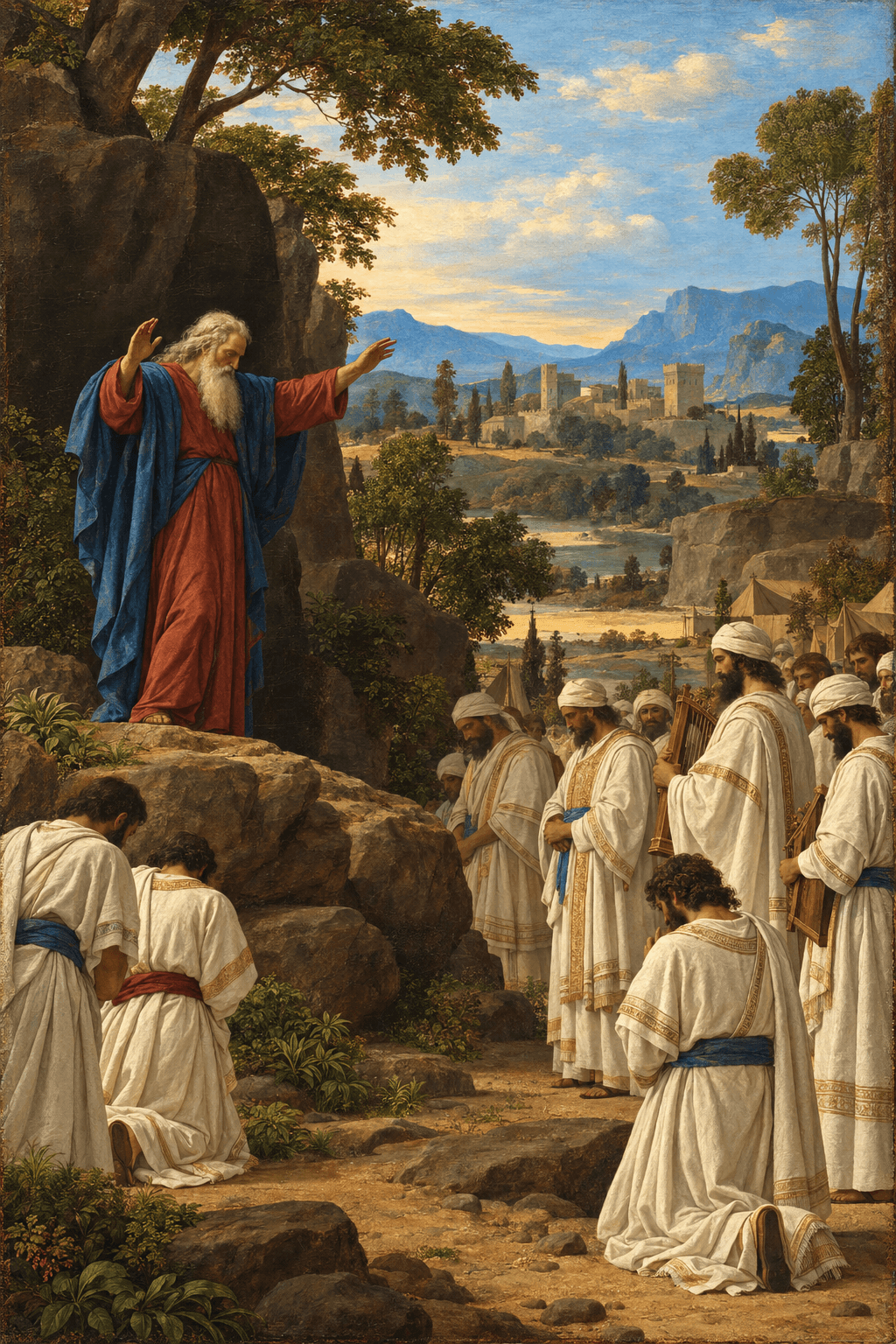
Moses the prophet showed the foundation on which his brothers are blessed, namely the revelation of God’s glory for their sake in various places: at Sinai, at Seir, at Mount Paran, and among ten thousands of saints (see verse 2 above).
He begins the blessing with his vision of the Lord coming from Sinai like the sun at its rising in glory. He sees God, who delivers to His people His Law or commandment, so that they may walk by the heavenly law, enjoy an angelic nature, and have fellowship in the blessed heavenly life. He gave them the fiery law to make them like fiery beings resembling God, the consuming fire.
The Jerusalem Targum says that God came down to give the Law; He offered it on Mount Seir to the Edomites, but they refused it because it contained the commandment, “Thou shalt not kill.” Then He offered it on Mount Paran to the Ishmaelites, and they refused it because it contained the commandment, “Thou shalt not steal.” And when He came to Mount Sinai to Israel, they said: “All that the Lord hath spoken we will do.”
God condescended to give His Law and to speak with His people in glory and splendor, for it is said: “rose up” and “shined forth.” Some also see that when God condescended and gave His fiery Law to Moses on Mount Sinai, He revealed the splendor of His glory, so that it shone on Mount Seir and gleamed on Mount Paran, two mountains far from each other; as though the coming of God’s glory on Mount Sinai flashed over the whole region, so that the distant mountains became radiant and shining.
Others see that God’s glory came down on Mount Sinai, where Moses the prophet received the Law, and this has priority as the most important event in the history of the Old Testament. He also revealed His glory on Mount Seir, as in the Book of Judges: “Lord, when thou wentest out of Seir, when thou marchedst out of the field of Edom, the earth trembled, and the heavens dropped, the clouds also dropped water. The mountains melted from before the Lord, even that Sinai from before the Lord God of Israel” (Judges 5:4–5). And the glory of the Lord appeared at Paran, where it is said: “And the glory of the Lord appeared in the tabernacle of the congregation before all the children of Israel” (Numbers 14:10).
“He came with ten thousands of saints” (2): The Septuagint translates the word “saints” as “angels,” and this is probably the true meaning (Acts 7:53). Some differed in interpreting “ten thousands of saints”: is it a fourth place in which the Lord revealed His glory, or does it point to the coming of the Lord each time, surrounded by thousands of thousands of angels (Daniel 7:10)? And it is said in the Psalms: “The chariots of God are twenty thousand, even thousands of angels” (Psalm 68:17).
God appeared to His people to give them “the fiery law” (2), for it was given “out of the midst of the fire” (Deuteronomy 4:12), and it works like fire, consuming evil, seeking to purify the soul from corruption. And the Holy Spirit came upon the Church of the New Testament in the form of tongues of fire (Acts 2), that they might give the fiery Gospel and turn souls into flames of burning love toward God and people.
As for His saying, “from his right hand went a fiery law for them,” the right hand points to power as well as to blessing; through the Law we enjoy God’s power and receive the right hand of blessing.
“Yea, he loved the people; all his saints are in thy hand: and they sat down at thy feet; every one shall receive of thy words” (3). The hand points to divine care; in the Book of Revelation the seven churches appear in the hand of the Lord Jesus (Revelation 1:16). His right hand is wide, embracing the universal Church from Adam to the end of the ages, and as He says of His sheep: “neither shall any man pluck them out of my hand” (John 10:28). As for His people sitting at His feet receiving His words, it points to the people remaining at the foot of the mountain, waiting for Moses the prophet, who went up to the summit to meet God, receive the Law, and deliver it to the people. Their remaining at the foot of the mountain, where God’s wonderful glory was and the mountain smoked, was like the disciples sitting at the feet of their Teacher, listening to Him in a spirit of humility and desire to learn.
The glorious appearance of God (2–5) is as the true King of all the tribes. At His right hand is His constitution, a fiery law; His law is “His love for His people”; He carries His holy people in His hand, so that no one is deprived of His care. They long to sit at His feet, but He carries them in His bosom with love. Sitting at the feet is a sign of the desire to learn and be a disciple. He loved His people and wanted to give them His Law, so it befitted them to sit humbly at His feet to enjoy it as their inheritance (see verses 4–5 above).
The Law of the Lord is our inheritance, our treasure, and our riches. As the Psalmist says: “Thy testimonies have I taken as an heritage for ever: for they are the rejoicing of my heart” (Psalm 119:111).
When the heads of the people were gathered, Moses was in their midst as a king or general leader of all Israel, giving them the Law of the King of kings; but unfortunately they later rejected Him. The Lord says: “ye said unto me, Nay; but a king shall reign over us: when the Lord your God was your king” (1 Samuel 12:12).
“And he was king in Jeshurun” (5) may refer to Yahweh (compare 1 Samuel 12:12), or to the Messiah King mentioned in verse 3, or to Moses.
3. The Blessing of Reuben
KJV · Verses 6
6 Let Reuben live, and not die; and let not his men be few.
“Let Reuben live, and not die; and let not his men be few” (6). Perhaps the number of this tribe diminished because of the sin of Dathan and Abiram (Numbers 16:1, 30). Dathan and Abiram, of the sons of Reuben, joined Korah in resisting Moses (Numbers 16:1–3); but Moses’ large heart did not carry bitter memories, but asked for the blessing of the tribe. Reuben was the firstborn among the sons of Jacob; though he had lost the honor of the birthright, Moses the prophet began with him so that his spirit would not be crushed.
His inheritance was fixed east of the Jordan, but his men had to cross the Jordan with the rest of the tribes and fight in the front ranks (Numbers 32:27), so that the rest of the tribes might inherit. So Moses asked for them that they might live and not die, and that their number might increase, though they did not enjoy the honor of the birthright. Since his inheritance was on the border, he assured him that God would protect him and support his men, so that the neighboring nations would not swallow them up.
This is the beginning of every blessing: that we enjoy with Reuben living “the eternal life” and not dying “the second death,” so that our resources and glories are not few, but we enjoy eternal glory and are counted in the eyes of heaven “an exceeding great army” (Ezekiel 37:10).
4. The Blessing of Judah
KJV · Verses 7
7 And this is the blessing of Judah: and he said, Hear, Lord, the voice of Judah, and bring him unto his people: let his hands be sufficient for him; and be thou an help to him from his enemies.
“And this is the blessing of Judah: and he said, Hear, Lord, the voice of Judah, and bring him unto his people: let his hands be sufficient for him; and be thou an help to him from his enemies” (7).
The blessing of Judah came before the blessing of Levi, because in the Old Testament the honor of kingship (the royal tribe of Judah) was greater than the honor of the priesthood, though the two are united in the person of the Lord Christ as King and Priest. Judah precedes Levi because the priesthood of the New Testament, bound to the priesthood of Christ, is greater than the Levitical priesthood.
Judah, the royal tribe, realized his weakness, and so takes refuge in God as his support.
The blessing of Judah is directed to David, the symbol of the Lord Christ. David stands out as a man of prayer, whose voice God hears, and as a man of action, struggling with his hands to overcome the enemy. Our Christ intercedes with His blood and loves practically by the cross. What is the voice of Judah to which the Lord listens for the sake of his people but the voice of the Lord Christ, the Mediator between God and men, for the forgiveness of His people’s sins? He went down into the battle to fight Himself on behalf of humanity, and in humility He took refuge in the Father, though He is one with Him, so that in Him we may enjoy divine help. With Reuben we ask to enjoy eternal life, so that death has no authority over us; and with Judah we enjoy our acceptance by the Father, so that we are counted children of prayer, accepted by Him, bearing His strength in our spiritual struggle against the enemy.
5. The Blessing of Levi
KJV · Verses 8–11
8 And of Levi he said, Let thy Thummim and thy Urim be with thy holy one, whom thou didst prove at Massah, and with whom thou didst strive at the waters of Meribah; 9 Who said unto his father and to his mother, I have not seen him; neither did he acknowledge his brethren, nor knew his own children: for they have observed thy word, and kept thy covenant. 10 They shall teach Jacob thy judgments, and Israel thy law: they shall put incense before thee, and whole burnt sacrifice upon thine altar. 11 Bless, Lord, his substance, and accept the work of his hands; smite through the loins of them that rise against him, and of them that hate him, that they rise not again.
Moses the prophet speaks of the tribe to which he belongs, but he does not point to this, nor to his own role; rather, he points to the role of Aaron his brother, the high priest, and whoever takes his place. He bears the Urim and Thummim on his breast (Exodus 28:30) to know the will of God and present it to the people. The Urim points to enlightenment, vision, or wisdom, and the Thummim to perfection or completeness. Our Christ is the High Priest in whom we enjoy the complete life and eternal enlightenment (see verses 8–11 above).
“Thy Thummim and thy Urim” (8): The Septuagint translates them “thy light and thy truth” (Psalm 43:3).
He called him the holy one, the anointed high priest of God, a symbol of the Lord Christ, who alone is holy. Despite the holy life he enjoyed, he fell in weakness at the waters of Meribah with Moses the prophet, and both were deprived of entering the Promised Land. So there arose the need for the High Priest of good things to come, who alone is without weakness, our Lord Jesus Christ.
Aaron consecrated himself to the Lord, so that he became as one who does not see his father and mother, nor favors his brothers according to the flesh, nor his children, for he became a father to the whole people without distinction. The service of the Levites obliged them to care for the people more than for their own families; but our Christ emptied Himself for our sake. They offered incense, burnt offerings, and sacrifices; but the Lord Christ is the sweet savor before the Father, interceding for us, and He is the burnt offering and the sacrifice able to take away sin.
The aim of this tribe is consecration to God, keeping the commandment, guarding the covenant, teaching, and offering pure worship. So it is said: “My covenant was with him of life and peace; and I gave them to him for the fear wherewith he feared me, and was afraid before my name” (Malachi 2:5).
The blessing was very important for Levi, for he had no portion in the land; the Lord was his portion, satisfying all his needs. So Moses asked God to bless his substance (his resources).
6. The Blessing of Benjamin
KJV · Verses 12
12 And of Benjamin he said, The beloved of the Lord shall dwell in safety by him; and the Lord shall cover him all the day long, and he shall dwell between his shoulders.
“And of Benjamin he said, The beloved of the Lord shall dwell in safety by him; and the Lord shall cover him all the day long, and he shall dwell between his shoulders” (12).
This may mean that God carried Benjamin on His shoulders as a shepherd does, or, as a prophecy, that the temple would be on the border of this tribe’s land. Benjamin came directly after Levi because the temple in which the priests worked was on the border of Benjamin’s portion. And Benjamin came before Joseph (Ephraim and Manasseh), because Benjamin adjoins the house of David and the temple and is more honored than Samaria, which was in Ephraim’s portion. Jerusalem was in the portion of this tribe (Joshua 18:28). Though Zion, the city of David, belonged to the tribe of Judah, Mount Moriah, on which the temple was built, was in Benjamin’s portion. So the temple on the mountain is like the head between two shoulders; that is, the Lord dwells with His temple between the shoulders of Benjamin. The building of the temple on Mount Moriah, belonging to Benjamin, shows that Benjamin lives in the shadow of the temple, under the protection of the temple of the Lord Himself. As the Psalmist says: “They that trust in the Lord shall be as mount Zion, which cannot be removed, but abideth for ever. As the mountains are round about Jerusalem, so the Lord is round about his people from henceforth even for ever” (Psalm 125:1–2).
“Benjamin” means “son of the right hand.” It is as though, when a person asks to live forever and not be subject to the second death (the tribe of Reuben), and to practice the royal life through constant prayer together with struggle in the spiritual battle (the tribe of Judah), consecrating his life to obedience to the commandment and the worship of God (the tribe of Levi), he has the right to be a son of the right hand, counted to the Lord, abiding in Him, hidden under His shadow, and settled between His shoulders (the tribe of Benjamin). Benjamin was called “the beloved of the Lord”; Benjamin was the beloved son of Jacob, the son of his right hand (Genesis 49:27). King Saul came from this tribe, and also Paul the Apostle. Whoever cleaves to the Lord becomes His beloved, enjoys safety in Him, and finds rest between His shoulders, that is, in His bosom.
7. The Blessing of Joseph (Ephraim and Manasseh)
KJV · Verses 13–17
13 And of Joseph he said, Blessed of the Lord be his land, for the precious things of heaven, for the dew, and for the deep that coucheth beneath, 14 And for the precious fruits brought forth by the sun, and for the precious things put forth by the moon, 15 And for the chief things of the ancient mountains, and for the precious things of the lasting hills, 16 And for the precious things of the earth and fulness thereof, and for the good will of him that dwelt in the bush: let the blessing come upon the head of Joseph, and upon the top of the head of him that was separated from his brethren. 17 His glory is like the firstling of his bullock, and his horns are like the horns of unicorns: with them he shall push the people together to the ends of the earth: and they are the ten thousands of Ephraim, and they are the thousands of Manasseh.
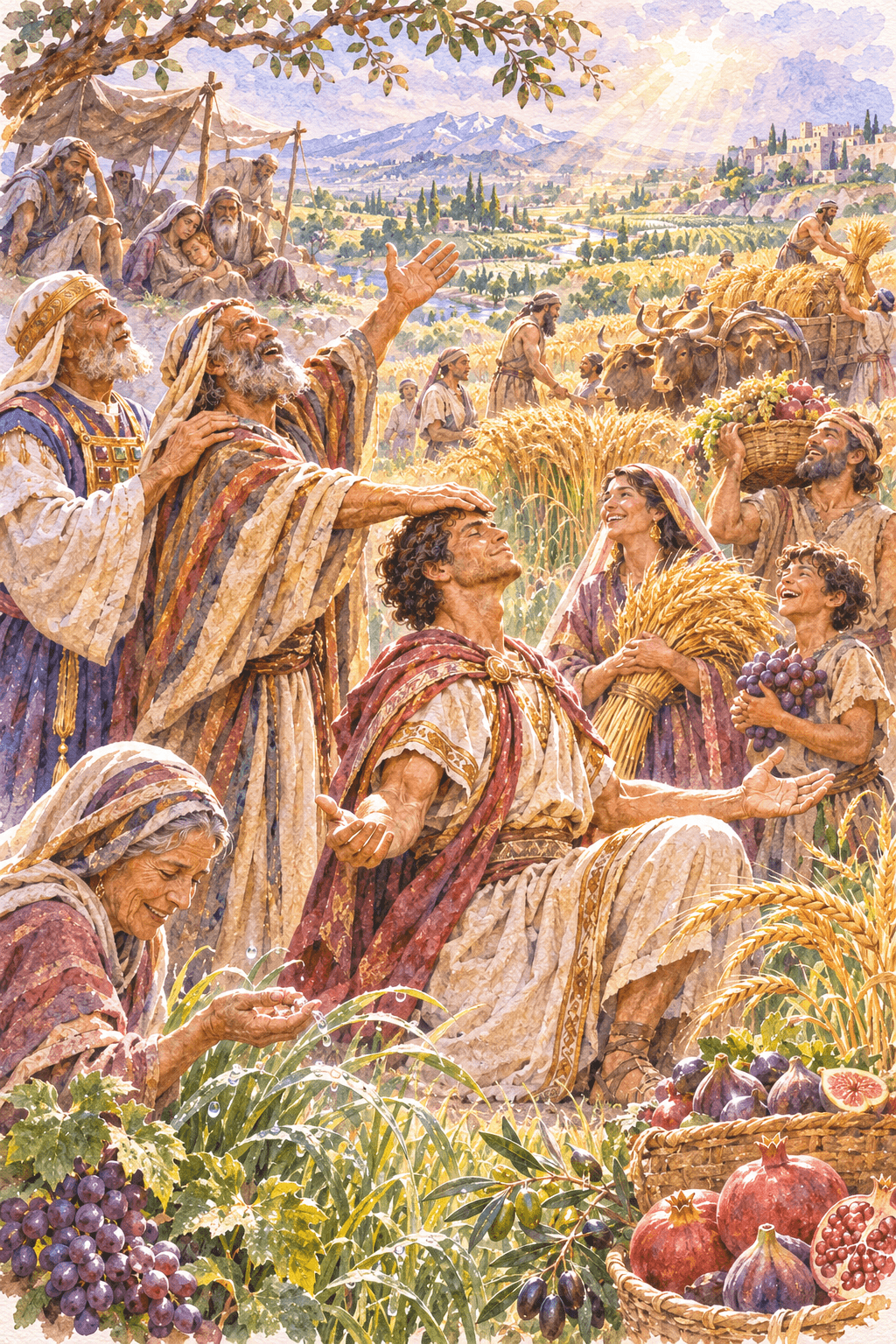
In the blessing of Jacob, the greater portion was given to Joseph (Genesis 49), and so did Moses the prophet (see verses 13–17 above).
Joseph’s strength lies in his being separated from his brothers and in his ability to crush the enemies and overcome them. Moses the prophet called him “him that was separated from his brethren” (16). As the Nazarite, or consecrated one, is a person who separates himself from others to consecrate his life and resources for the kingdom of God, so Joseph was separated from his brothers, sold as a slave, and lived his youth in Egypt far from them for their sake, for he said to them: “Fear not: for am I in the place of God? But as for you, ye thought evil against me; but God meant it unto good, to bring to pass, as it is this day, to save much people alive. Now therefore fear ye not: I will nourish you, and your little ones” (Genesis 50:19–21). God had allowed his separation for a time in order to preserve the lives of his brothers, so he was counted the Nazarite of his brothers.
The blessing of the two tribes that came from Joseph was great in quantity and great in strength; the fertile cities came in their inheritance. Here he declares that the secret of fertility, or blessing, is God’s grace, “the precious things of heaven” (13). Great is His blessing even in his land, which is watered by the Lord’s blessings from heaven and by the springs that burst forth from beneath. So the Lord blesses a person in his body (his land), raining on it the waters of the Spirit, while the springs of the Spirit overflow in the depths, so that the body bears the fruits of the Holy Spirit and becomes God’s fruitful and beloved garden. The Psalmist says: “Thou visitest the earth, and waterest it: thou greatly enrichest it with the river of God, which is full of water” (Psalm 65:9).
Besides blessing the land, the rains, and also the springs, He blesses the work of the sun, the moon, and the stars for him. By the sun’s heat the land gives the best kinds of produce, and the moon’s moisture supports it to bring forth every precious thing. Some understand verse 14 to mean that God harnesses the seasons of the year, which are bound to the sun, moon, and stars, so that man may enjoy abundant fruits, each in its season. So the Lord blesses the inner garden of the soul: the Sun of righteousness shines His light on it and supplies it with His spiritual warmth, so that it enjoys unique and abundant fruit. The Church (the moon) spreads her light on it, and the saints surround it like the stars of heaven, so that it is always fruitful, giving the fitting fruit at the proper time.
While some countries groan from drought because of barren mountains and hills, this tribe enjoys the best kinds of fruit trees growing on the mountains and hills. So the soul rises as it were on the mountains and hills of the word of God, and does not live at the foot with the crowds, but goes up as with the disciples Peter, James, and John in the company of Christ, where it enjoys the Transfiguration and grasps the mysteries of the Old Testament, of the Law (Moses) and the Prophets (Elijah), living on Mount Tabor in the surpassing glory of the Lord. So the believer lives like the steadfast mountain of God that will not be shaken.
As the tribe enjoys the fruits of the mountains and hills, the lowlands and valleys also bring it much produce, so that it rejoices in God’s precious gifts of grain crops, vegetables, and small plants like the bush. So wherever the soul is, it knows only continual fruitfulness; it enjoys the heavenly blessings coming down from above and thanks God for His temporal, earthly blessings that satisfy the needs of the body and the needs of his brothers.
So the blessing comes upon his head, and he is counted the Nazarite of his brothers, for he sees all the blessings in his hands not for himself alone but for the edification and continual growth of his brothers.
Perhaps by the precious things of the earth he means the precious metals and gems it gives him, as Job says: “As for the earth, out of it cometh bread: and under it is turned up as it were fire. The stones of it are the place of sapphires: and it hath dust of gold” (Job 28:5–6). As the earth gives bread to satisfy the body, it also gives precious metals and gems for work and adornment. So the believer finds surpassing blessings: his soul is satisfied with the heavenly bread and adorned with the splendor of God’s glory.
Moses the prophet crowns these blessings that come upon this tribe, whether through the waters of the rain and the springs of the earth, the fruits of the mountains and hills, or the precious things of the earth of gems and precious metals, with what is greater: the meeting of his will with the divine will, so that he bears within him a holy will acceptable to God. This is the surpassing blessing, when God draws the heart, the mind, and the senses to Himself and brings the believer into His surpassing mysteries, especially His saving works of incarnation, crucifixion, and resurrection, so that he sets out bearing a living evangelical witness, longing to draw every soul out of Pharaoh’s bondage and set out with it through the wilderness toward the heavenly Canaan.
When Moses the prophet reaches the enjoyment of the holy will as the greatest blessing, he says: “and for the good will of him that dwelt in the bush: let the blessing come upon the head of Joseph, and upon the top of the head of him that was separated from his brethren” (16).
This concerns the blessings of increasing spiritual fruits. As for the blessing of strength, the prophet sees him as the firstling bullock, which was a symbol of royal greatness. He is strong and able to gain victory over the peoples to the ends of the earth. Joshua the son of Nun, the leader of the people into the Promised Land, at whose hands successive victories were achieved, as he drove out all the Canaanites and received the Promised Land, was of the tribe of Ephraim the son of Joseph. In Ephraim was the royal city of the kingdom of Israel, the northern kingdom. And from Manasseh came the judges Gideon, Jephthah, and Jair, who were the glory of their country, full of blessing and strength.
Some see that he likened him to the firstling bullock because Joseph received the birthright that Reuben lost (1 Chronicles 5:1), and because Bashan, which was Manasseh’s portion, was famous for bulls and cattle (Psalm 22:12). The ox among the Jews was one of the most important animals, because it was acceptable to God among the animals offered as sacrifice, and because of its usefulness in farm work, especially ploughing the land.
His horns are like the horns of the wild ox, to push and overcome, for the tribe of Ephraim was marked by strength. On the other hand, his horns carry a special beauty and point to strength and authority (Psalm 75:5, 10; 89:17, 24; 112:9; Daniel 8:3; Luke 1:69; Revelation 17:3).
He gave Ephraim the ten thousands and Manasseh the thousands, as Jacob prophesied that the younger, Ephraim, would be greater than the elder (Genesis 48:19), and this was fulfilled, as appears in the census of the people (Numbers 1:33–35).
8. The Blessing of Zebulun and Issachar
KJV · Verses 18–19
18 And of Zebulun he said, Rejoice, Zebulun, in thy going out; and, Issachar, in thy tents. 19 They shall call the people unto the mountain; there they shall offer sacrifices of righteousness: for they shall suck of the abundance of the seas, and of treasures hid in the sand.
The two tribes are mentioned together because Zebulun and Issachar were sons of Jacob by Leah, and in the division of the land they were neighbors. The tribe of Zebulun was famous for having seaports in its portion (Genesis 49:13), so many nations passed through its land, and some of them came to faith in God, leaving the worship of idols. The two call the peoples to the mountain to offer sacrifices of righteousness instead of sacrifices to idols. So the blessing here points to openness of heart toward others, and to preaching and evangelical witness before others. They became very rich through sea trade, a symbol of riches in spiritual work (see verses 18–19 above).
What does he mean by the treasures hid in the sand? Jonathan ben Uzziel holds that the sands of Zebulun were of the finest kinds suitable for making glass, so that they were like treasures in their hands. Others hold that from the shells of fish on the sands of the shores there they extracted the precious purple dye. A third group sees that these words are a figurative expression for the great wealth they gained from sea trade.
As Issachar rejoices in his trade through the tents, Zebulun rejoices in his sea trade. So God gave every person or nation what satisfies its needs, some by work on land and others at sea. God gladdens us wherever we are, on land or at sea. We have no right to be puffed up over others because of our gifts, nor to be faint-hearted because of the gifts of others; but let each work according to what he has been given. Let Zebulun thank God for the seaports, and Issachar for the success of his trade through the tents. “Every man also to whom God hath given riches and wealth, and hath given him power to eat thereof, and to take his portion, and to rejoice in his labour; this is the gift of God” (Ecclesiastes 5:19).
Through sea trade as through work in the tents they call the nations to the mountain, where the temple of the Lord stands. So they use their work as an opportunity to bear witness to the Lord and call others to serve the Lord.
The ministry of the Lord Christ began in the land of Zebulun (Matthew 4:14–15); afterward the people were called to the mountain, that is, to the kingdom of Christ, which is called the mountain of the Lord’s house (Isaiah 2:2).
Some see that Issachar, by dwelling in tents, was more aware of the feast days than others, and so called others to celebrate them. Others see that the tents here mean school tents, for some of them loved study and knowledge, and so they had their leading role, though they were neither the royal nor the priestly tribe. So they symbolize the people’s positive work and sense of responsibility.
God gave them riches, so that when they called others to go up to the mountain of the Lord’s house, they would see them coming bearing many gifts abundantly, and so be a living example to them. Isaiah the prophet speaks of the glory of the Church of the New Testament and her spiritual riches, saying: “the abundance of the sea shall be converted unto thee, the forces of the Gentiles shall come unto thee” (Isaiah 60:5). Her trade is turned to God’s glory: “And her merchandise and her hire shall be holiness to the Lord” (Isaiah 23:18).
9. The Blessing of Gad
KJV · Verses 20–21
20 And of Gad he said, Blessed be he that enlargeth Gad: he dwelleth as a lion, and teareth the arm with the crown of the head. 21 And he provided the first part for himself, because there, in a portion of the lawgiver, was he seated; and he came with the heads of the people, he executed the justice of the Lord, and his judgments with Israel.
Gad was one of the tribes that received its portion of the Promised Land, for its portion was east of the Jordan. Moses the prophet prophesied of Gad’s blessing (see verses 20–21 above), which is:
First: Enlarging Gad. Truly Gad had received his portion, but his land was enlarged further. It was said of them that they were skilled in war, that they fought the Hagarites and prevailed over them, took much spoil, and dwelt in their place (1 Chronicles 5:18–22).
In a spirit of overcoming and victory they dwelt as a lion, tearing the arm with the crown of the head; that is, they crush the enemy’s strength (the arm) and strip away their honor and glory (the crown of the head). In the days of David some of the Gadites had faces like the faces of lions: “And of the Gadites there separated themselves unto David into the hold to the wilderness men of might, and men of war fit for the battle, that could handle shield and buckler, whose faces were like the faces of lions, and were as swift as the roes upon the mountains” (1 Chronicles 12:8).
Second: “And he provided the first part for himself”; that is, Gad wisely took care to receive his portion first of all, east of the Jordan, before crossing with Joshua to the west bank. As the Psalmist says: “men will praise thee, when thou doest well to thyself” (Psalm 49:18). So whoever cares for the salvation of his soul and gives priority to the inheritance of the soul over the demands of the body is worthy of praise. He did not take what was his in selfishness, for he set out to fight for the sake of the rest of the tribes: “and he came with the heads of the people, he executed the justice of the Lord” (21). He worked in obedience to Joshua the son of Nun and carried this out (Joshua 4:12–13). They finished their work, “And when Joshua sent them away also unto their tents, then he blessed them” (Joshua 22:7–9).
They were quick in movement, and they are mentioned in the distribution before Reuben (Numbers 32:2). While Joshua distributed the lands to the tribes, Gad and his companions received their portion from Moses, the giver of the Law. “In a portion of the lawgiver,” they settled in it according to the Law, or by God’s providence (21).
10. The Blessing of Dan
KJV · Verses 22
22 And of Dan he said, Dan is a lion’s whelp: he shall leap from Bashan.
“And of Dan he said, Dan is a lion’s whelp: he shall leap from Bashan” (22).
Jewish traditions connect the tribe of Dan with apostasy. Jacob likened them to a serpent (Genesis 49:17), and Moses to a lion’s whelp, for they had the head of a serpent and the heart of a lion.
Jewish commentators hold that Bashan was a place where lions roamed looking for prey. The tribe of Dan was known for strength: “And the coast of the children of Dan went out too little for them: therefore the children of Dan went up to fight against Leshem, and took it, and smote it with the edge of the sword, and possessed it, and dwelt therein, and called Leshem, Dan, after the name of Dan their father” (Joshua 19:47).
He grew up in the tribe of Dan as a whelp, matured, and began looking for his prey among the Philistines.
11. The Blessing of Naphtali
KJV · Verses 23
23 And of Naphtali he said, O Naphtali, satisfied with favour, and full with the blessing of the Lord: possess thou the west and the south.
“And of Naphtali he said, O Naphtali, satisfied with favour, and full with the blessing of the Lord: possess thou the west and the south” (23).
This tribe was given the beautiful, fertile land lying south and west of the Sea of Galilee. He looked at this tribe with amazement, praising them. Perhaps the blessing here points to the people’s will fortified before God. As for the secret of the favor, the fulness of blessing, and his possessing the west and the south, it is because the Lord Christ, the King of kings, shone with His splendor there. As St. Matthew the Evangelist says: “And leaving Nazareth, he came and dwelt in Capernaum, which is upon the sea coast, in the borders of Zabulon and Nephthalim: That it might be fulfilled which was spoken by Esaias the prophet, saying, The land of Zabulon, and the land of Nephthalim, by the way of the sea, beyond Jordan, Galilee of the Gentiles; The people which sat in darkness saw great light” (Matthew 4:13–16). The Lord Christ considered Capernaum His own city (Matthew 9:1; Mark 2:1).
The fulness of blessing here perhaps points to the fertility of its lands. The Jews hold that because of its fertility this tribe was the first to offer the firstfruits to the temple, and the inhabitants of Capernaum and Bethsaida were famous for wealth.
12. The Blessing of Asher
KJV · Verses 24–25
24 And of Asher he said, Let Asher be blessed with children; let him be acceptable to his brethren, and let him dip his foot in oil. 25 Thy shoes shall be iron and brass; and as thy days, so shall thy strength be.
His land was famous for olives. Moses the prophet gives four prophecies about Asher that carry in themselves signs of blessing, for Leah called her son Asher, saying that she was happy (Genesis 30:13) (see verses 24–25 above).
First: Increase in number: “Let Asher be blessed with children,” that he may enjoy many children who enter into a covenant with the Lord and enjoy Him as a source of blessing, not of curse.
Second: Care for the brethren: “let him be acceptable to his brethren”; that is, let him be with them in union and agreement. Let them be full of love and good will toward those who live among them.
Third: They enjoy many good things: “and let him dip his foot in oil.” It is as though, because of the abundance of good things, he not only anoints his body with oil, but dips his foot in it; that is, they wash their feet with oil or perfumes.
Saint Ambrose says:
The Lord says that the priest and the Levite passed by the wounded man and had neither oil nor wine to bind up the wounds of the one whom the robbers had wounded (Luke 10:31–32), for they had nothing to pour on his wounds. As Isaiah declares: “they have not been closed, neither bound up, neither mollified with ointment” (Isaiah 1:6). But the Church has oil with which she soothes the wounds of her children, lest the hardness of the wound spread and deepen. She has the oil she received in mystery. With this oil Asher washed his feet (24). [317]
Fourth: An abundance of metals extracted from their lands, so that they make their shoes of iron and brass. Symbolically, the metal shoes point to strength and splendor, and the ability to walk on rough roads: “Thy shoes shall be iron and brass.”
“And as thy days, so shall thy strength be” means the continuity of strength in their life, so that they never faint on the way.
13. A General Blessing for All Israel
KJV · Verses 26–29
26 There is none like unto the God of Jeshurun, who rideth upon the heaven in thy help, and in his excellency on the sky. 27 The eternal God is thy refuge, and underneath are the everlasting arms: and he shall thrust out the enemy from before thee; and shall say, Destroy them. 28 Israel then shall dwell in safety alone: the fountain of Jacob shall be upon a land of corn and wine; also his heavens shall drop down dew. 29 Happy art thou, O Israel: who is like unto thee, O people saved by the Lord, the shield of thy help, and who is the sword of thy excellency! and thine enemies shall be found liars unto thee; and thou shalt tread upon their high places.
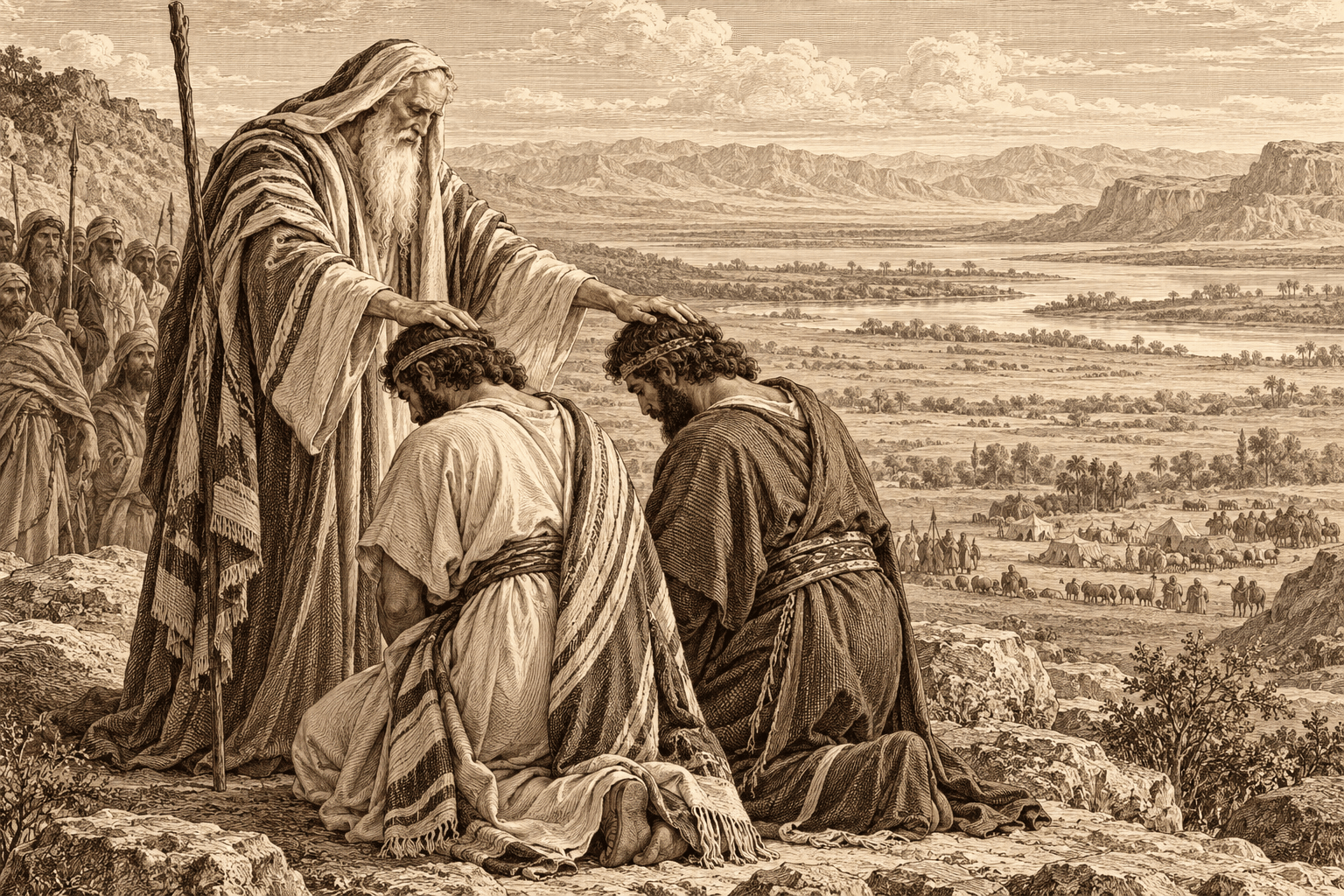
“There is none like unto the God of Jeshurun, who rideth upon the heaven in thy help, and in his excellency on the sky” (26).
God deserves all praise, for He is above His people, beneath them, behind them, before them, and around them. His person stands behind nature and behind the mysteries as Lord and Savior of His people. Every nation boasts of its god, but there is none like the God of Jeshurun.
The whole people is called “Jeshurun,” that is, “the upright people,” or as in the Septuagint, “the beloved.” God hastens to their help, riding the heaven as a divine chariot: “who rideth upon the heaven in thy help, and in his excellency on the sky.” The clouds point to mystery and the inability to grasp the greatness of God in His care for His people. He rides the clouds to help and support His people, declaring the greatness of His love and care in the clouds. He has authority over all nature, which He harnesses for the sake of His people (see verses 27–29 above).
In resources and speed, He uses the clouds to help His people; and in experience, He is the eternal, ancient, unchanging God, who spreads His arms beneath His people so that they do not fall. His arms will not be defeated, and no enemy can break them to snatch His people from among them; but His people remain carried on the everlasting arms. Since the everlasting arms remain beneath the Church, she will never sink, for she is carried on the Rock of ages, and the gates of hell shall not prevail against her (Matthew 16:18). “He shall dwell on high: his place of defence shall be the munitions of rocks: bread shall be given him; his waters shall be sure” (Isaiah 33:16).
He is eternal, before the ages, and will not be subject to time. As it is written in Habakkuk: “Art thou not from everlasting, O Lord my God, mine Holy One? we shall not die” (Habakkuk 1:12).
The people need no weapon to protect them; the Lord Himself becomes their weapon, their shield and their sword. God made Himself a refuge for His people (27), in which the people dwell in safety. When the soul abides in God, she realizes that she is at home in true safety. The Psalmist says: “Return unto thy rest, O my soul; for the Lord hath dealt bountifully with thee” (Psalm 116:7). “Thou art my hiding place; thou shalt preserve me from trouble” (Psalm 32:7). God gives His people victory over the enemy to crush him, so that they become feared.
14. A Meditation on Deuteronomy 33
Open My Mouth to Bless
You gave me a mouth and a tongue to bless and not to curse.
Be in my mouth, that I may bless everyone who meets me.
Let me also enjoy Your blessing on the tongue of Your prophet Moses.
I sit at Your feet with those at the foot of the mountain.
I contemplate the mountain of God burning with fire, and my soul is filled with the splendor of Your glory,
and Your word shines within me.
With Reuben I see You as the Giver of life.
I do not fear death as long as You dwell in me.
With Judah I realize that Your ears incline toward me,
listening to the hidden prayers of my heart
and answering the petitions of my soul.
You crush my enemy and fight my sins,
and through You I gain successive victories.
With Levi I consecrate my whole life to You.
You alone are my portion.
I am not occupied with father, mother, wife, or children; You are everything to me.
I love them in You and serve You in them.
Sanctify me, that I may become a witness to You, O Holy One.
Accept my priesthood, and smell my prayer as a sweet fragrance of incense.
Receive the sacrifices of thanksgiving and praise.
Teach me to keep Your covenant to the end.
With Benjamin grant me a place at Your right hand.
You call me Your beloved, and my soul is at peace in You.
I hide under the shadow of Your wings
and dwell safely between Your shoulders.
With Joseph’s two sons, Ephraim and Manasseh, grant me of the good things of Your love.
You bless my land, so that it gives increasing fruits.
You turn my depths into firm mountains bearing great fruits,
and fill my land with precious metals.
With spiritual riches You give me strength, beauty, and majesty.
You are my riches, my strength, and my glory!
With Zebulun I serve You on the seas,
and with Issachar I bear witness to You in the tents!
Accept my service on the seas as on the land!
With Gad You grant me to care first for the salvation of my soul.
You enlarge the land of my heart to receive every stranger and needy one!
With Dan You make me like a lion’s whelp,
full of youth, vitality, and strength in the spirit!
With Naphtali You give me the blessing of a fertile land, so that I am never found barren,
but always bear the increasing fruit of the Spirit.
With Asher I dip my foot in oil.
You pour blessings upon me, and I wash my feet with spiritual perfumes.
I put on shoes of iron and walk the rough roads without fear.
So my feet are perfumed with love and walk in a spirit of firmness and strength.
Notes and References
[317] Saint Ambrose, Letter 41:19–20.