
Under the leading of the Holy Spirit of God, Moses the prophet gives us his last song. This song has been called the key to all prophecy, for it speaks of the birth of the nation and its childhood, then its ingratitude and apostasy, and finally its punishment and its return.
Moses the prophet gives us a song that carries living theological thought, for as a prophet he does not separate music from theology. Music without theology becomes a kind of frivolity and a waste of time, and theology without music deprives a person of his tenderness. If theology cares for man to make him a living icon of God, bearing an image of the exultant life, theology cannot do without music, for it makes man a heavenly being, exultant and thankful without ceasing.
The true life of faith is a piece of music declaring the harmony in a person’s life between his temporal conduct and his tasting of the pledge of eternity.
If the life of Moses the prophet was an unbroken chain of continual struggle, and he tasted bitterness from the hardness of the people’s hearts, his life in truth was an exultant symphony of love, a chain of praises. At the beginning of his setting out into the wilderness, when God gave him victory over Pharaoh, Moses sang with the people; and in the midst of the wilderness he sang a song when they came to the well that the nobles of the people dug (Numbers 21:17). And here Moses ends his life with a wonderful hymn, for he was called to depart from the world and saw with the eyes of faith the heavenly Canaan, so that his soul exulted on the banks of the Jordan River. He sees in God the Father who accompanies His son all the way, leading him and caring for all his spiritual and material needs. The soul sees Him as the eagle that flutters over its young, spreading its wings to protect them, being gentle with them and carrying them on its shoulders, giving them all its care and not leaving them in need of another. He satisfies it in the midst of the desert, bringing out honey for it from the rock and oil from the flinty rock; that is, He does the impossible for its sake. [291]
In this song Moses the prophet recorded what his depths bore concerning God his Savior, as well as bitterness and groaning over the people’s apostasy from the worship of God and attachment to pagan abominations, which made them fall under divine discipline.
Moses urged his people to obey God; and finally the Lord commanded Moses to go up Mount Nebo to see the land of Canaan and die.
1. The Introduction of the Song
KJV · Verses 1–2
1 Give ear, O ye heavens, and I will speak; and hear, O earth, the words of my mouth. 2 My doctrine shall drop as the rain, my speech shall distil as the dew, as the small rain upon the tender herb, and as the showers upon the grass:
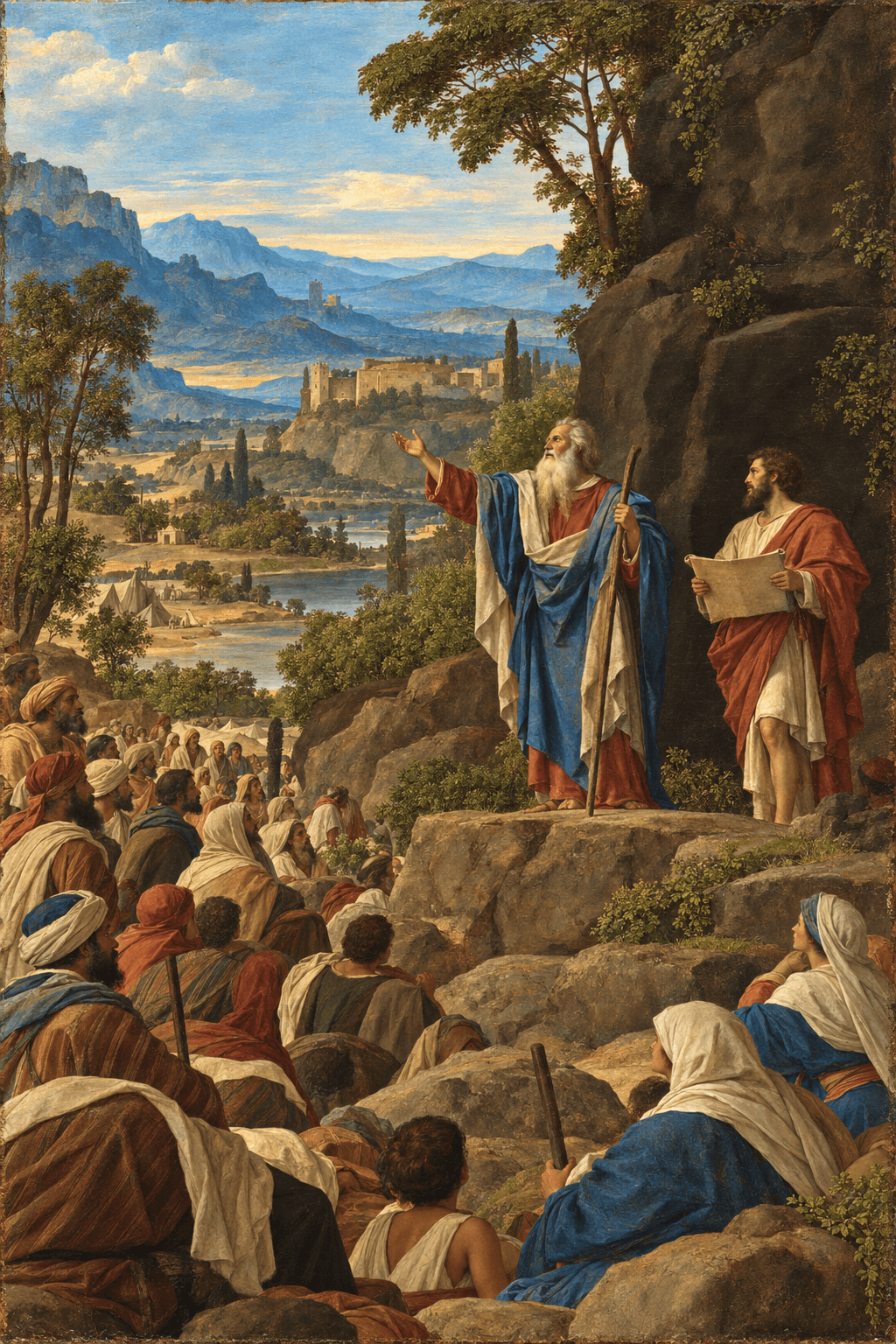
Moses realized his passing from the world and the handing of leadership to his disciple Joshua. As the new generation renewed the covenant with God, he offered to God a wonderful hymn in which he glorifies the great and righteous God (1–4), despite the evil of the people (5–6). He enumerated the works of God: He is the Creator, the Savior, and the Advocate, and He remains faithful to His covenant with His people. Moses the prophet opens his song in verses 1–2 above.
Saint John Chrysostom sees that since there is no man to hear and bear witness to divine things, heaven is called to bear witness. [292]
Moses the prophet calls the angels and all the heavenly orders, as he calls all the nations, to bear witness to what he declares concerning God’s dealings with His people, and the people’s reaction to God’s work in betrayal and ingratitude. And St. Clement of Alexandria sees that God calls to witness the believers who have heavenly knowledge (heaven), as He calls those whose hearts are occupied with earthly things (earth). [293]
We see in Isaiah the prophet (Isaiah 1:2) as in Micah the prophet (Micah 6:2) a call to nature to bear witness in the trial of man, or in the controversy between God and His people.
Moses asks heaven and earth to listen to him… he calls soul and body to praise together with a song of God’s love and care in contrast to man’s hardness and disobedience. God’s words turn the desert into a garden, and like the dew they give coolness and peace to the soul.
Moses the prophet used the hymn for thanksgiving and glorifying God (Exodus 15), and here he uses it for teaching. In the same spirit came many of the psalms and praises of David the prophet under the title “for teaching.” And Paul the Apostle says: “Let the word of Christ dwell in you richly in all wisdom; teaching and admonishing one another in psalms and hymns and spiritual songs, singing with grace in your hearts to the Lord” (Colossians 3:16).
Moses’ teaching is not his own, but like the rain coming down from heaven from the Lord. As it is written in Isaiah: “For as the rain cometh down, and the snow from heaven, and returneth not thither, but watereth the earth, and maketh it bring forth and bud, that it may give seed to the sower, and bread to the eater: So shall my word be that goeth forth out of my mouth: it shall not return unto me void, but it shall accomplish that which I please, and it shall prosper in the thing whereto I sent it” (Isaiah 55:10–11).
It does not depend on human wisdom, but is “as a dew from the Lord, as the showers upon the grass, that tarrieth not for man, nor waiteth for the sons of men” (Micah 5:7). The rain is God’s gift: “For the earth which drinketh in the rain that cometh oft upon it, and bringeth forth herbs meet for them by whom it is dressed, receiveth blessing from God” (Hebrews 6:7).
He utters his teachings like rain that begins with a few successive drops but quickly turns into huge amounts that no one can deny. Or what Moses the prophet declares is the word of God, which is either like dew refreshing many, or like heavy rain or floods that destroy, as happened in the days of Noah.
Teaching is effective and strong when it becomes like the dew and the light rain that causes no disturbance and makes no sound, so that the word enters the heart in a quiet spirit. “He shall come down like rain upon the mown grass: as showers that water the earth” (Psalm 72:6).
Saint Jerome says:
Do you want to know in what way the faithful are called clouds in Holy Scripture? Isaiah says: “I will also command the clouds that they rain no rain upon it” (Isaiah 5:6). Moses was a cloud; therefore he says: “My doctrine shall drop as the rain” (2). The epistles of the apostles are spiritual rain for us. In fact, what does Paul say in his Epistle to the Hebrews? “For the earth which drinketh in the rain that cometh oft upon it” (Hebrews 6:7). And again he says: “I have planted, Apollos watered” (1 Corinthians 3:6). [294]
Father Caesarius of Arles says:
If all of us men desire to water our gardens, and if there is no water in them, we draw water from the sea with great effort, how much more must we strive to supply with water the vegetables of our bodies, which are in the garden of the Lord, that is, in the Church of God, watering the dry places and softening the barren places with the rivers of Holy Scripture and the spiritual streams, or the springs of the ancient fathers, so that after this we may uproot what is harmful and plant what is useful? As it is written of Paul the Apostle, we his successors say, though we are less able than he: “I have planted, Apollos watered; but God gave the increase” (1 Corinthians 3:6). So with God’s help we ought to fulfill what is on our part, continuing to plant and water; for if we fulfill our obligation, God gives His goodness. [295]
2. The Greatness and Righteousness of God
KJV · Verses 3–4
3 Because I will publish the name of the Lord: ascribe ye greatness unto our God. 4 He is the Rock, his work is perfect: for all his ways are judgment: a God of truth and without iniquity, just and right is he.
What is the teaching Moses gives like rain coming down on the earth to turn it into a fruitful garden (see verses 3–4 above)?
First: The greatness of God, which appears in His care for His creation, for He is “the Rock, his work is perfect.” The word “Rock” is repeated in the chapter six times, as though He is the Rock for all His creation, which He brought into being in the six days. He is the unshakable Rock, on which the Church is built and in which she hides, so that she does not fall.
Second: God is “perfect in His work”; all that He created is good. Therefore He is good and perfect in His providence for His creation; all that He allows is for the good of His people. As the wise man says: “I know that, whatsoever God doeth, it shall be for ever: nothing can be put to it, nor any thing taken from it” (Ecclesiastes 3:14–15). Man’s work, however virtuous, is imperfect, but God’s work is very perfect. So the Lord says: “So likewise ye, when ye shall have done all those things which are commanded you, say, We are unprofitable servants” (Luke 17:10).
Third: God is just and faithful; there is no iniquity in Him. As the prophet says: “Who is wise, and he shall understand these things? prudent, and he shall know them? for the ways of the Lord are right, and the just shall walk in them: but the transgressors shall fall therein” (Hosea 14:9). He is the Truth in whom there is no falsehood or lie; He never errs when He disciplines. He knows what is for man’s edification and what is for the good of the community, without wronging anyone. As the Psalmist says: “To shew that the Lord is upright: he is my rock, and there is no unrighteousness in him” (Psalm 92:15).
God is called “faithful” (1 Corinthians 10:13), and man is called faithful. Saint Athanasius the Apostolic says that the word “faithful” carries two meanings in Holy Scripture: the first is “believing” and “trusting,” which suits men; and the second is “trustworthy,” which suits God. Abraham was faithful because he believed the word of God, and God is faithful, as David says in the Psalm: “The Lord is faithful in all his words” (Psalm 145:13 LXX). [296]
3. The People’s Perversity and Breaking of the Covenant
KJV · Verses 5–6
5 They have corrupted themselves, their spot is not the spot of his children: they are a perverse and crooked generation. 6 Do ye thus requite the Lord, O foolish people and unwise? is not he thy father that hath bought thee? hath he not made thee, and established thee?
Despite God’s faithfulness, which nothing mars, the people turned aside and in foolishness broke their promise with God. The prophet presents a contrast between the attributes of God and those of His people. God is great in His love, justice, and wisdom; like the rock, He does not change; the believers lean on Him in security and take refuge in Him. The serpent cannot crawl on the rock, so whoever hides in Him is not bitten by the enemy. Also from the rock the waters flowed for the people in the wilderness. But the people corrupted themselves (Hosea 13:9), for in foolishness they ignored God’s fatherhood. Every person has weaknesses, even God’s children; but these are a perverse and crooked generation, needing to remember God’s work with their fathers in order to turn back from their perversity (see verses 5–6 above).
By their crooked conduct in their dealings with the faithful God they harmed God in nothing; they corrupted themselves. They are the source of their sin, and the cause of their corruption and destruction. As it is said: “O Israel, thou hast destroyed thyself; but in me is thine help” (Hosea 13:9). “If thou be wise, thou shalt be wise for thyself: but if thou scornest, thou alone shalt bear it” (Proverbs 9:12).
It is as though He reproaches them, saying: Here you are destroying yourselves by your evil will, claiming that you are God’s children and belong to Him. Is this the reward you give to God your Father, who acquired you for Himself, who created you and made you a nation and a special people? He is a wonderful Father, who created them, sustained them even in the wilderness, shepherded them, and bore their burdens; do they not feel His bowels burning with love for them?! What they do is ingratitude and ignoring God’s love and the riches of His blessings to them. As the prophet says: “for the Lord hath a controversy with his people, and he will plead with Israel. O my people, what have I done unto thee? and wherein have I wearied thee? testify against me. For I brought thee up out of the land of Egypt, and redeemed thee out of the house of servants; and I sent before thee Moses, Aaron, and Miriam. O my people, remember now what Balak king of Moab consulted, and what Balaam the son of Beor answered him…” (Micah 6:2–5). It is a mad error, for He says: “O foolish people and unwise?!”
He distinguishes here between sins that come from weakness with a true longing for holiness and a struggle for righteousness in God, and sins that come deliberately and persistently without a true desire for repentance and return to God. The first come from God’s children who love and struggle, and the second from those who resist the truth. They deceive themselves, thinking they are God’s children while they resist Him.
“Hath he not made thee, and established thee?” (6): All human beings are God’s creation, but only the redeemed are His true children (John 1:12).
4. Reminding the People of God’s Works
KJV · Verses 7–14
7 Remember the days of old, consider the years of many generations: ask thy father, and he will shew thee; thy elders, and they will tell thee. 8 When the Most High divided to the nations their inheritance, when he separated the sons of Adam, he set the bounds of the people according to the number of the children of Israel. 9 For the Lord’s portion is his people; Jacob is the lot of his inheritance. 10 He found him in a desert land, and in the waste howling wilderness; he led him about, he instructed him, he kept him as the apple of his eye. 11 As an eagle stirreth up her nest, fluttereth over her young, spreadeth abroad her wings, taketh them, beareth them on her wings: 12 So the Lord alone did lead him, and there was no strange god with him. 13 He made him ride on the high places of the earth, that he might eat the increase of the fields; and he made him to suck honey out of the rock, and oil out of the flinty rock; 14 Butter of kine, and milk of sheep, with fat of lambs, and rams of the breed of Bashan, and goats, with the fat of kidneys of wheat; and thou didst drink the pure blood of the grape.
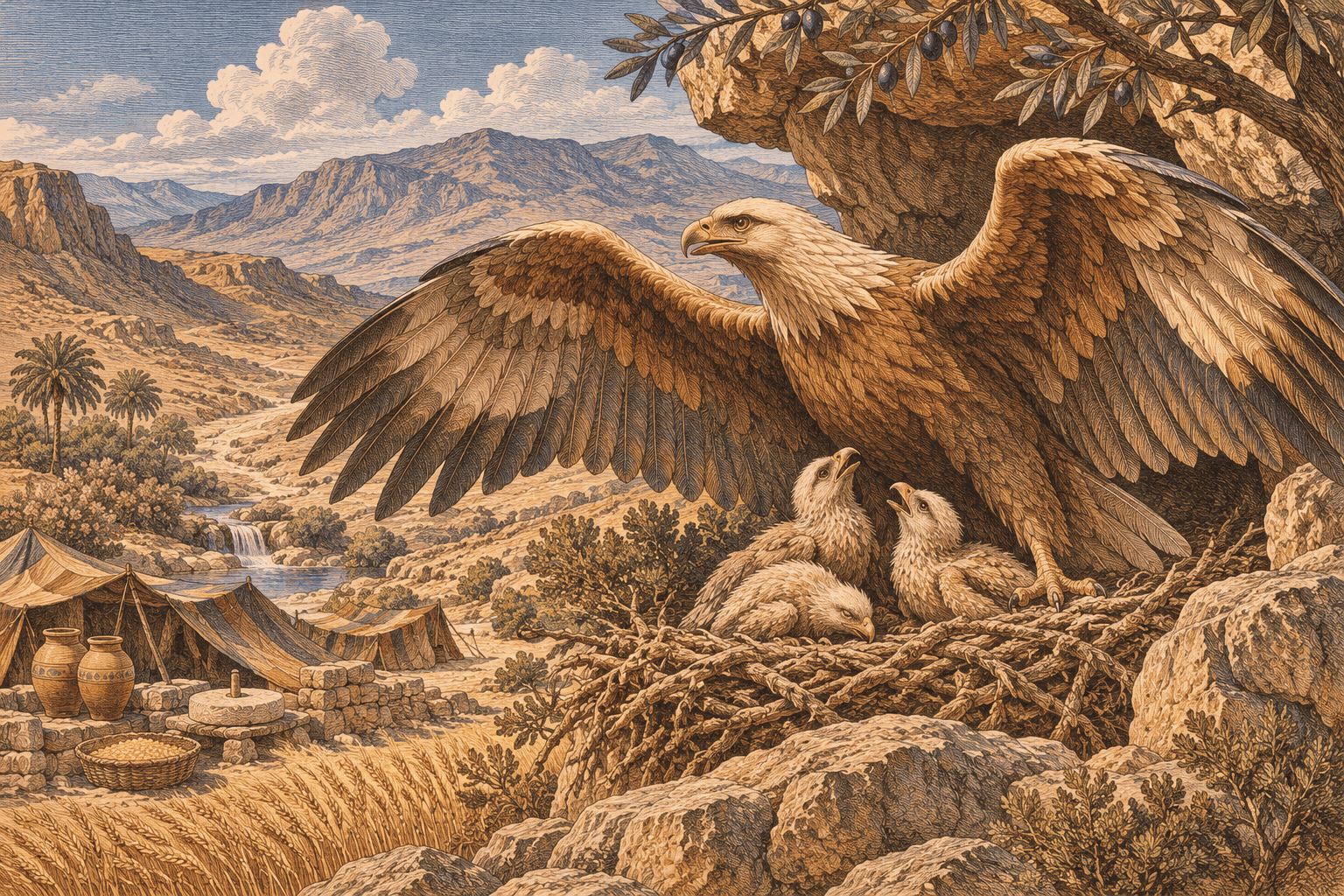
Having charged the people with breaking the covenant with God, he called them to set the situation right by remembering God’s dealings with them in the past, through the generations and from of old, making clear how God cared for them, giving them every possibility.
First: God chose His people as His portion (see verses 7–9 above).
The believer ought to learn from his fathers not only the word of God and His commandments (Exodus 12:26–27; Deuteronomy 6:7), but His work with them through the ages. As the Psalmist says: “We will not hide them from their children, shewing to the generation to come the praises of the Lord, and his strength, and his wonderful works that he hath done. For he established a testimony in Jacob, and appointed a law in Israel, which he commanded our fathers, that they should make them known to their children: That the generation to come might know them, even the children which should be born; who should arise and declare them to their children: That they might set their hope in God, and not forget the works of God, but keep his commandments” (Psalm 78:4–7).
As the fathers ought to teach their children the Lord’s commandments and tell them of His practical care for them, the children also ought to long to know these things, so that they may be the best leader and guide for them on their way.
Returning to the history to which the fathers and elders bear witness, we realize that when God separated the sons of Adam into nations and peoples, He set boundaries which they should keep, so that no nation would trespass on another; but as for Israel, He gave it a special dearness, counting it His own people.
Africa was called the land of Ham (Psalm 78:51; 105:23, 27; 106:22), and it mostly became his and his descendants’ after him; Europe was the portion of Japheth, and Asia the portion of Shem; but the land of Palestine was counted the Lord’s portion, which He gives to His own people. This division of the world into three parts among the three sons of Noah was called the general dispersion, and it took place about two centuries after the age of Noah. This was five centuries before the tower of Babel, when the lands were divided into many peoples with different languages.
The Septuagint reads: “When the Most High divided to the nations, when he separated the sons of Adam, he set the bounds of the peoples according to the number of the angels of God,” as though God entrusted each nation to the hand of an angel; but as for His people, He took their leadership Himself, as His own portion.
In Jewish tradition, as in early Christianity, it came that God appointed a special angel for each nation or people, but the angel does not compel the nation to a particular conduct. As for the Church of the Old Testament, as of the New, He appointed the archangel, the captain of the Lord’s host, as her defender, though He entrusted her to His Holy Spirit to guide her.
Saint John Chrysostom says:
Here there is testimony that the saints have angels, and indeed all men. [297]
Some see in His saying “according to the number of the children of Israel” that Canaan and his eleven sons (Genesis 10:15–18), twelve in number, correspond to the twelve tribes of Israel, so that the tribes inherit the land of Canaan.
By saying that He divided the earth and set boundaries, He made clear that humanity ought not to struggle to seize from one another. As Paul the Apostle said: “And hath made of one blood all nations of men for to dwell on all the face of the earth, and hath determined the times before appointed, and the bounds of their habitation” (Acts 17:26). And the Psalmist says: “The heaven, even the heavens, are the Lord’s: but the earth hath he given to the children of men” (Psalm 115:16). So He gave the earth to the sons of men to live together in peace, each supporting his brother, not struggling with him.
It is wonderful that God, the Creator of heaven and earth, the Owner of all, counts His people His portion in which He delights, for He sees in it the enclosed garden (Song of Songs 4:12) in which He walks and rests. Truly it may be said that God is the believer’s portion, since the latter needs the former and finds in Him his treasure, riches, satisfaction, joy, and gladness of heart. But that God, who needs nothing, should count man His portion is for the sake of God’s honoring of man. It is a surpassing fatherly condescension that He counts His son, who owns nothing of his own, as His portion.
Saint Jerome says:
If our desire is to be the Lord’s inheritance and portion, let us be courageous and strong… let nothing in us be weak, nothing shaken, nothing in us unfit to be an inheritance. For Christ is glorified in His saints, saying: My inheritance is perfect (beautiful). [298]
It is as though God brought His people out of bondage and cared for them in the wilderness, not to give them a land flowing with honey and milk, but to give them Himself, so that He becomes their portion and they His portion (see verse 10 above).
What does he mean by saying “He found him in a desert land” but the land of Egypt, which with all its good things was counted a desert land, because the people were under forced labor, fallen into bondage under the harsh hand of Pharaoh? Perhaps he means the wilderness into which they went out from Egypt on their way to the land of Canaan. They were in a waste, howling wilderness, but God surrounded them like a canopy under which they took shelter. He became a cloud shading them by day and a pillar of light leading them by night. As Stephen the archdeacon says of Moses the prophet: “This is he, that was in the church in the wilderness with the angel which spake to him in the mount Sina, and with our fathers” (Acts 7:38).
He allowed them to remain in the wilderness all this time to isolate them from the world, so that they might forget all the pagan abominations they had learned in Egypt, and so that the Lord might become a light for them and a canopy protecting them, giving them food from heaven and drink from the rock, so that they needed no clothes, shoes, or medicines, and God alone was everything to them.
The Psalmist says: “And he led them forth by the right way, that they might go to a city of habitation” (Psalm 107:7). The Lord always leads us in the right way, even if it seems a wandering in the wilderness, as though we were walking in a closed circle. He taught us how to care for the quiet, long shepherding of the coming generations, as He shepherded His people forty years in the wilderness.
“He kept him as the apple of his eye” (10). We can say that God is the apple of our eye, by whom we see invisible things and enjoy the help of His divine mysteries. But that we should become as the apple of His eye is a wonderful and surpassing thing in God’s esteem for man. There is no greater love than this, that the Creator counts man as the apple of His eye, caring for him, keeping him, and guarding him as one who wants to preserve his sight. What a surpassing divine condescension!
Saint Gregory of Nyssa sees a connection between Moses’ knowing God face to face and the bride’s longing for her Bridegroom’s kisses without ceasing, as she sings: “Let him kiss me with the kisses of his mouth” (Song of Songs 1:2). For when the soul meets God and receives His kisses, her longing for Him increases the more, so that she seeks the kisses of His mouth after seeing Him. She seeks God as though she had never seen Him before, and this desire never stops within her; with every enjoyment of God they burn with ever-increasing desires. [299]
The eagle stirs up its nest, then spreads its wings and flutters on them, to oblige its young to prepare to leave the nest and practice flying. So God stirred up everything around His people with the ten plagues, to move them to depart from the land of Egypt and fly into the wilderness, to enter the Promised Land, or rather so that He might carry them to Himself (11–12). For He says: “and how I bare you on eagles’ wings, and brought you unto myself” (Exodus 19:4).
The eagles’ love for their young is not only to protect them, but to teach them and train them to fly. It is not an idle love that kills them, but an active love that supports the young and gives them new abilities. So God stirs our life, that it may set out into the wilderness of this world amid sufferings, as one flying to the bosom of God, and that we may find in Him stability and rest. He does not move us toward a life of luxury and pampering, but protects us and surrounds us, while at the same time we fly as it were to heaven, heedless of the troubles and trials of the world.
We have spoken before of God’s wings in our study of the Book of Psalms (Psalm 17:8), and saw that God’s two wings are love and mercy, as Saint Augustine says. [300] They also point to the two wings of the cherubim overshadowing the ark of the covenant, where the glory of God appeared. And Saint Gregory of Nyssa sees that the believer ought not only to take refuge under God’s wings, but to recover his own wings, which he lost through sin:
God’s wings represent God’s power, His blessings, His incorruptibility, and so on. All these divine properties were found in man when he resembled God in everything. But our turning aside to evil robbed us of our wings, and so the grace of God was revealed to us and enlightened us. By our rejecting corruption and worldly lusts, the wings of holiness and righteousness grow in us anew. [301]
Saint Jerome says:
This statement (Deuteronomy 32:11; Psalm 91:1) can be interpreted concerning the Savior, for He gave us the shadow (refuge) of His wings on the cross… The Lord’s hand was raised to heaven, not seeking help, but to overshadow us, His wretched creation. [302]
He alone moved His people to salvation; the foreign pagan gods were unable to give salvation.
He gave His people the impossible: He brought out fruits for them from the desert, honey from the rock, and oil from the flinty rock (13); and the most wonderful thing He gave is His precious blood: “and thou didst drink the pure blood of the grape” (14).
By saying, “He made him ride on the high places of the earth,” he means that He brought him out to successive victories, knowing no fall or defeat, but living always as on the high peaks. Instead of the bread of humiliation they ate in Egypt under bondage, they sat on the mountaintops eating the fruits of the field in freedom and dignity.
Perhaps by the high places of the earth he means that the people set out to the mountains of Canaan, where there was greenery and abundant fruit, enjoying the honey the bees produce among the rocks and the oil of the olive trees that fill the region.
It is a living picture of the Christian, who sets out as it were to the pledge of heaven and lives on the heights, with sin having no dominion over him. He eats of the fruit of the Spirit in the midst of the wilderness of this world, and enjoys the sweetness of Christ like honey, and the oil of the Holy Spirit, which supports the soul and fills it with health and peace.
God gives us butter and fat as spiritual food for the mature, and milk as drink for little children. With the spiritual food He gives spiritual drink, wine, which points to joy. He satisfies the needs of old and young, and gives all an inner joy (14).
We know that animals, not plants, have kidneys, but here he says, “with the fat of kidneys of wheat,” as though the wheat gives pure, rich food, free of all impurities, as the kidney does.
Saint Gregory of Nyssa says:
What is the cluster of grapes hanging from the wood but that Cluster which hung from the wood in the last days, whose blood became a saving drink for whoever believes in Him?! “Drink the blood of the grape.” By this he means the saving Passion. [303]
5. An Ungrateful People
KJV · Verses 15–18
15 But Jeshurun waxed fat, and kicked: thou art waxen fat, thou art grown thick, thou art covered with fatness; then he forsook God which made him, and lightly esteemed the Rock of his salvation. 16 They provoked him to jealousy with strange gods, with abominations provoked they him to anger. 17 They sacrificed unto devils, not to God; to gods whom they knew not, to new gods that came newly up, whom your fathers feared not. 18 Of the Rock that begat thee thou art unmindful, and hast forgotten God that formed thee.
Having shown in his song God’s wonderful care from every side, Moses the prophet spoke of Israel’s apostasy from God (see verse 15 above).
“Jeshurun” (15) is a poetic, affectionate name for Israel, translated in the Septuagint “the beloved.”
He likens Israel to a horse that ate, was satisfied, grew fat and thick and full of fat, and began to kick its owner who brought it into being, and in foolishness despised God, the Rock of its salvation. God gave them of His good things, and instead of offering Him a sacrifice of thanksgiving, they raised their feet to kick God Himself. When God rebukes them through His prophets, they rage like an unruly heifer and a bullock unaccustomed to the yoke. In their pride they cannot bear a word of rebuke, even if it comes from God Himself.
Saint John Chrysostom says:
Neither the body nor food is of the devil; luxury alone is so. [304]
These (sorrows) draw mercy and bring us tenderness; on the other hand, that (wealth) lifts us up to foolish pride, leads us to laziness, and drives a person to many displays that make him haughty. So the Psalmist says: “It is good for me that I have been afflicted; that I might learn thy statutes” (Psalm 119:71)… as “The Lord is known by the judgment which he executeth” (Psalm 9:16). [305]
Saint Jerome says:
The praise of heretics is the oil with which they anoint the heads of men and promise them the kingdom of heaven. This makes the head fat with pride. In Holy Scripture everything fat expresses what is unacceptable, for it is said: “Jacob ate and was filled, he waxed fat and kicked; he waxed fat, he grew thick, and became gluttonous” (15). [306]
But the most dangerous sign of revolt against God is idolatry (see verses 16–18 above). Idolatry is the most dangerous example of apostasy from God, through which they fall into the following:
First: Instead of submitting to God in a spirit of obedience and love, they provoke God with disobedience and hatred, offering their hearts, which are God’s throne, as a seat for idols.
Second: Instead of holiness, they practice abominations.
Third: They reject God, who is near them, their Father who begot them, and attach themselves to foreigners who are strangers to them and bear no spirit of fatherhood and tenderness toward them. They exchanged the Father for strangers.
Fourth: Children may have some excuse if they fall into the same pagan worship their fathers fell into; but that they worship new gods their fathers had never worshipped leaves them without excuse.
Fifth: Verse 17, “They sacrificed unto devils,” comes so in the Septuagint, Persian, and Coptic translations.
6. The Discipline of the Ungrateful People
KJV · Verses 19–43
19 And when the Lord saw it, he abhorred them, because of the provoking of his sons, and of his daughters. 20 And he said, I will hide my face from them, I will see what their end shall be: for they are a very froward generation, children in whom is no faith. 21 They have moved me to jealousy with that which is not God; they have provoked me to anger with their vanities: and I will move them to jealousy with those which are not a people; I will provoke them to anger with a foolish nation. 22 For a fire is kindled in mine anger, and shall burn unto the lowest hell, and shall consume the earth with her increase, and set on fire the foundations of the mountains. 23 I will heap mischiefs upon them; I will spend mine arrows upon them. 24 They shall be burnt with hunger, and devoured with burning heat, and with bitter destruction: I will also send the teeth of beasts upon them, with the poison of serpents of the dust. 25 The sword without, and terror within, shall destroy both the young man and the virgin, the suckling also with the man of gray hairs. 26 I said, I would scatter them into corners, I would make the remembrance of them to cease from among men: 27 Were it not that I feared the wrath of the enemy, lest their adversaries should behave themselves strangely, and lest they should say, Our hand is high, and the Lord hath not done all this. 28 For they are a nation void of counsel, neither is there any understanding in them. 29 O that they were wise, that they understood this, that they would consider their latter end! 30 How should one chase a thousand, and two put ten thousand to flight, except their Rock had sold them, and the Lord had shut them up? 31 For their rock is not as our Rock, even our enemies themselves being judges. 32 For their vine is of the vine of Sodom, and of the fields of Gomorrah: their grapes are grapes of gall, their clusters are bitter: 33 Their wine is the poison of dragons, and the cruel venom of asps. 34 Is not this laid up in store with me, and sealed up among my treasures? 35 To me belongeth vengeance and recompence; their foot shall slide in due time: for the day of their calamity is at hand, and the things that shall come upon them make haste. 36 For the Lord shall judge his people, and repent himself for his servants, when he seeth that their power is gone, and there is none shut up, or left. 37 And he shall say, Where are their gods, their rock in whom they trusted, 38 Which did eat the fat of their sacrifices, and drank the wine of their drink offerings? let them rise up and help you, and be your protection. 39 See now that I, even I, am he, and there is no god with me: I kill, and I make alive; I wound, and I heal: neither is there any that can deliver out of my hand. 40 For I lift up my hand to heaven, and say, I live for ever. 41 If I whet my glittering sword, and mine hand take hold on judgment; I will render vengeance to mine enemies, and will reward them that hate me. 42 I will make mine arrows drunk with blood, and my sword shall devour flesh; and that with the blood of the slain and of the captives, from the beginning of revenges upon the enemy. 43 Rejoice, O ye nations, with his people: for he will avenge the blood of his servants, and will render vengeance to his adversaries, and will be merciful unto his land, and to his people.
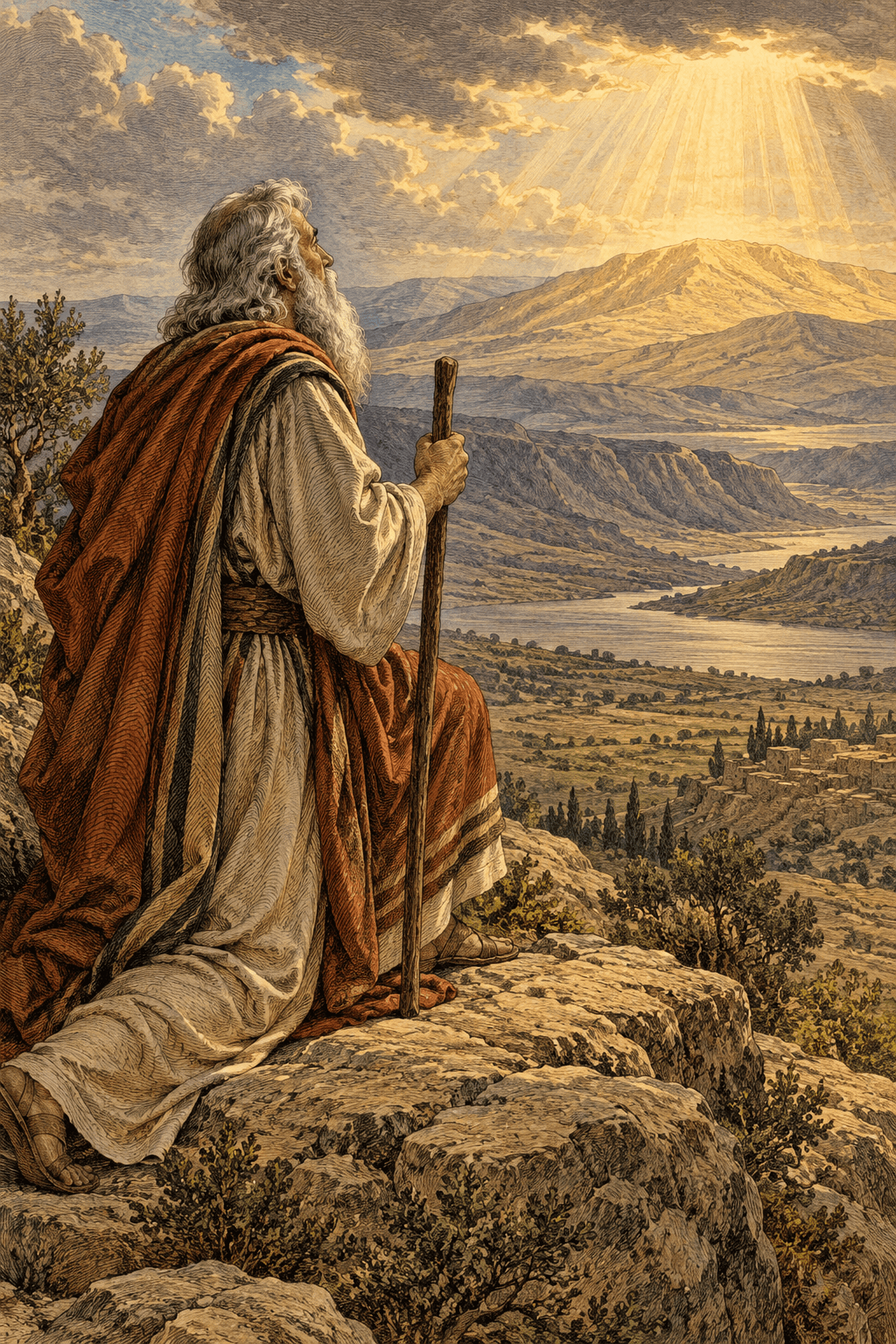
Out of His love for them and His care for their salvation, God disciplines His ungrateful people in many ways.
“And when the Lord saw it, he abhorred them, because of the provoking of his sons, and of his daughters” (19). Does God abhor His sons and daughters? When the sons and daughters wrapped themselves in sin, the Holy Lord looked at them and found them unwilling to be united with Him, for there can be no fellowship between holiness and sin. By this they put themselves in the position of the rejected. As the Psalmist says: “Thus were they defiled with their own works, and went a whoring with their own inventions. Therefore was the wrath of the Lord kindled against his people, insomuch that he abhorred his own inheritance” (Psalm 106:39–40).
“And he said, I will hide my face from them, I will see what their end shall be: for they are a very froward generation, children in whom is no faith” (20). By saying He hides His face from them, He declares His displeasure at their conduct; when they give the Lord the back and not the face, He turns His face from them, and they do not enjoy His pleasure. The Lord reproaches them: “Saying to a stock, Thou art my father; and to a stone, Thou hast brought me forth: for they have turned their back unto me, and not their face: but in the time of their trouble they will say, Arise, and save us” (Jeremiah 2:27). Though they are children, they lost their sonship to God through their unfaithfulness, or their lack of seriousness and steadfastness in God their Father. They became trivial people without aim, not to be relied on or trusted.
“They have moved me to jealousy with that which is not God; they have provoked me to anger with their vanities: and I will move them to jealousy with those which are not a people; I will provoke them to anger with a foolish nation” (21). God often says, “They have moved me to jealousy.” The Apostle quoted this in Romans 10:19, and the thought is repeated in Hosea 1:9. The aim of this jealousy and indignation is to draw hearts to return to Him.
When they ignored His tender fatherhood and attached themselves to abominations, He allowed them to be disciplined, using the very people from whom they learned the abominations. What a person thinks the secret of his joy and pleasure turns into his humiliation. His saying, “I will move them to jealousy,” carries divine love, for He stirs them to repentance. St. Paul (Romans 10:19) sees in this a prophecy of the Gentiles accepting the faith, so that the Jews may return at the end of times and accept the Messiah, the Savior. As the people of Israel rejected God and worshipped what is not God, so God rejected Israel and called the Gentiles as a holy people for Himself, to make them jealous, that perhaps they would return to Him, leave their ingratitude toward the Savior, and believe in Him in the last days.
Saint John Chrysostom says:
It befitted them, on His part, to be able to recognize the preachers, not only from their unbelief, nor from their not preaching peace (Isaiah 52:7), nor from their not proclaiming the good tidings, nor from the word that had been planted in every region of the world, but from the very fact that they had become lower than the Gentiles, who came into greater honor. [307]
“For a fire is kindled in mine anger, and shall burn unto the lowest hell, and shall consume the earth with her increase, and set on fire the foundations of the mountains” (22). If they rely on their great numbers, they are burned as with fire and go down to the pit, that is, to the extreme of misery and wretchedness. If they trust in their strength, the foundations of their mountains will be burned, for there is no barrier to hinder the divine discipline that comes upon the wicked who resist the truth. Some see in this statement a prophetic thought about the burning of the temple in the days of Titus the Roman, when not one stone of its foundations was left upon another (Matthew 24).
“I will heap mischiefs upon them; I will spend mine arrows upon them” (23). God’s judgments of discipline are likened to arrows that fly with surpassing speed and cannot be resisted (Job 6:4; Psalm 21:8, 12; 38:2–3; 64:7; 91:5). If our Christ is the divine arrow He aims at the soul, so that she cries, “I am sick of love” (Song of Songs 2:5), the Lord’s disciplines are also like arrows aimed at the soul, so that she is crushed in repentance and returns, that the Savior may heal her of every disease.
The disciplines he mentions here are:
First: Hunger: “They shall be burnt with hunger” (24). A person is allowed famine of material bread so that he may realize his inner famine and seek the bread that came down from heaven. As Amos says: “Behold, the days come, saith the Lord God, that I will send a famine in the land, not a famine of bread, nor a thirst for water, but of hearing the words of the Lord” (Amos 8:11).
Second: Pestilence and diseases: “and devoured with burning heat” (24), or “with a scorching fever,” where all the waters of the world cannot give the soul coolness and calm; only the tears of repentance remove this heat stirred up by corruption, or the fire that sin has kindled.
Third: Pestilence: “and with bitter destruction,” or “a devastating ruin.” Whoever does not care about the pestilence that strikes his soul, God allows pestilence to strike his body, so that he may realize what has happened in his depths.
Fourth: The raging of creation against him: “I will also send the teeth of beasts upon them, with the poison of serpents of the dust” (24). Predatory animals thirst to devour man, and serpents spread their venom, so that danger surrounds a person on every side.
Fifth: Wars and the destruction they cause in everything (see verses 25–27 above). When the Lord uses the wicked to discipline His children, He then sees these wicked filled with pride, thinking that what they did was not by divine permission but by their own high hand (27); so He disciplines them too because of their insulting of the Lord.
The harshest discipline a person can fall into is to fall under the hand of his fellow man, through wars, captivity, or slavery. The most bitter of the arrows God resorts to for disciplining man is man himself, for he sometimes becomes crueler than predatory animals, indeed more violent than death, so that a person longs for death to escape the hand of his brother and does not find it.
So the wicked man puts himself in the bitterest bitterness, for the merciful God becomes a disciplinarian. His body suffers hunger and thirst; he becomes as in a furnace of fire that cannot be put out; ruin comes upon his being; nature rages against him; and his fellow man becomes a deadly, destructive arrow to him. All this is so that a person may realize the seriousness of what has happened in his depths and take refuge in God his Savior, who lifts him up and supports him. Let a person bear the fear of the Lord, and he will not fear all these things; rather, they will turn to his edification and become the subject of his victory and his crown.
But God, who does not desire the destruction of the sinner but that he return and live, does not discipline without limits, nor is He angry forever; His anger is love and His disciplines are for salvation. So He returns to have mercy on His people who return to Him.
First: He turns back from His anger, lest the enemy who gained the victory over the people think he did so by his own strength and ability, and not by divine permission to discipline His people (27).
Second: The people who fall under discipline ought to come to their senses and enjoy spiritual insight, to see the end and aim of the discipline (see verses 28–29 above). They ought to perceive what is happening to them and see the ruin that has befallen them, not because of the enemy’s strength and military skill, but because the people rejected God, their Rock in whom they take refuge.
He calls His people “a nation void of counsel, neither is there any understanding in them,” for when it left God it lost wisdom and was struck with blindness, and did not grasp the truth of the matter.
By human logic: “How should one chase a thousand, and two put ten thousand to flight?” (30). This cannot happen “except their Rock had sold them, and the Lord had shut them up” (30). There is no other justification for their destruction in this unnatural way except their leaving God, their Protector and Defender, so that He delivered them for a time to the enemies.
Saint Gregory of Nyssa says:
Faithful is He who is able to make one chase a thousand and two put ten thousand to flight, for victory in battle is achieved not by numbers but by righteousness. [308]
He compares God, the true Rock able to protect the people, with the pagan gods in which the nations (perhaps he means the Romans here) take refuge as their rocks, saying: “For their rock is not as our Rock, even our enemies themselves being judges” (31). For if the pagans themselves set themselves up as judges, they would judge that the God of Israel is not to be compared with the rock of the pagan gods.
If God allowed the pagans victory to discipline His people, it is because they had become wicked: “For their vine is of the vine of Sodom, and of the fields of Gomorrah: their grapes are grapes of gall, their clusters are bitter: Their wine is the poison of dragons, and the cruel venom of asps” (32–33). Their life became the life of Sodom, and their works like the works of Gomorrah; they turned into a people bearing deadly poison within.
Some see that the vines here point to their teachings, which they took over from the pagans, so that they became poison to them.
Third: The loving God does not hasten to discipline, but is very long-suffering. If His people persist in evil, He gives them of what they laid up in the storehouses and sealed with their stubbornness, so that they fall under bitter disciplines (see verses 34–35 above).
Some see that He speaks of the people of Israel in their idolatry, so that He is long-suffering until the time of discipline comes. Others see that this concerns them because of what they did to the prophets, killing and persecuting them through the ages. A third group sees that this text also applies to the Canaanites and the pagan nations, for God did not hasten to discipline them, but was very long-suffering with them, and finally scattered them before His people.
Fourth: The defeat that befalls the people is not because of the enemy’s strength, but as the judgment of God their God, who judges them to bring them back to Himself in repentance. He holds the physician’s scalpel to wound and so heal their diseases (see verses 36–43 above).
He judges His people and has compassion on His servants; that is, He sentences them to discipline, but through His divine mercies. Or perhaps, when they return to Him, He judges in their favor, standing as Judge on their behalf against the nations that humiliated them and boasted of their gods as a rock in which they hide.
God allows the soul to be wounded by disciplines for her healing from her diseases and corruption, as He also wounds her with the wounds of divine love, so that she sings: “I am sick of love” (Song of Songs 2:5). The One who wounds her is the Lord Christ, the true Love, the Word of God, the two-edged sword. He wounds her with the arrows of heavenly spiritual knowledge, so that she groans night and day, longing for greater knowledge when she sees the Lord face to face!
Saint Gregory of Nyssa says:
Holy Scripture teaches us that God is love (1 John 4:8). He aimed His only Son, “the polished shaft” (Isaiah 49:2), at the elect, planting its threefold point in the spirit of life. The head of the arrow is faith, which binds the archer to those struck by it. It is as though the soul rises by divine ascents and sees within herself the sweet arrow of love wounding her, adorned with the wounds… It is a good wound and a sweet pain, by which “Life” penetrates the soul; for through the tears of the “arrow” the soul opens the door that is her entrance. [309]
Origen says:
If anyone at any time has burned with true love for the Word of God, if anyone has received the sweet wounds of this chosen arrow, as the prophet calls it, if anyone has been wounded by the spear of His knowledge, worthy of all love, so that he yearns and longs for Him night and day, so that he can speak of nothing but Him, listen to nothing but Him, think of nothing but Him, and incline to no desire or hope but Him, when it is so, the soul rightly says: “I am wounded with love.” She receives her wound from Him of whom it is said: “and made me a polished shaft; in his quiver hath he hid me” (Isaiah 49:2).
It befits God to strike our souls with such wounds, to wound them with such arrows and spears, and to strike them with such healing wounds… Since God is “love,” they say of themselves: “I am wounded with love.” Truly it is the drama of love, for the soul says: “I have received the wounds of love.” The soul that burns with longing for the wisdom of God, that is, that is able to behold the beauty of His wisdom, says in the same way: “I am wounded by wisdom.” The soul that contemplates the greatness of His power and is amazed at the might of His word can say: “I am wounded by power.” The soul that burns with love of God’s justice and contemplates the justice of the dispensations of His providence rightly says: “I am wounded by justice.” And the soul that looks to the greatness of His goodness and the tenderness of His love speaks in the same way. But the wound that includes all these things is the wound of love, by which the bride declares: “I am wounded with love.” [310]
Saint Augustine says:
Saul the persecutor could not have died unless he had been wounded from heaven (Acts 9:4), and the preacher could not have risen except by the life given him through the blood (of Christ). [311]
Saul was torn down, and Paul the preacher was built up… It was said to Jeremiah: “See, I have this day set thee… to root out, and to pull down, and to destroy, and to throw down, to build, and to plant” (Jeremiah 1:10). So this is the voice of the Lord: “I wound, and I heal” (39). He strikes the corruption of the work and heals the pain of the wound. This is what physicians do when they cut, wound, and heal. They hold the weapon (the scalpel) to strike; they carry iron and come to heal. [312]
Would that the unhealthy were wounded, for when they are wounded as they should be, they become healthy. [313]
The same Lord, our divine Physician, uses His instruments and His servants through you… according to His saying: “I wound, and I heal” (39). [314]
God affirms His love for man, and that if He resists, He resists the enemy of good, exposing the pagan gods that eat the fat of the sacrifices and drink the wine of the drink offerings, but are utterly unable to save those who worship them. He says to them: “Go and cry unto the gods which ye have chosen; let them deliver you in the time of your tribulation” (Judges 10:14). “But where are thy gods that thou hast made thee? let them arise, if they can save thee in the time of thy trouble” (Jeremiah 2:28). God wants His bride to return to Him and be united with Him, and no longer remain in her harlotry, so that she says: “I will go and return to my first husband; for then was it better with me than now” (Hosea 2:7).
The enemy taunts God’s people, saying: “Let not thy God in whom thou trustest deceive thee” (Isaiah 37:10); “who is that God that shall deliver you out of my hands?” (Daniel 3:15). And God declares His presence among His people as the secret of their overcoming and victory, affirming: “I, even I, am he, and there is no god with me… I live for ever.” He is the only God with absolute authority, whom no other rivals and who needs no other; whoever possesses Him possesses victory. He kills, but not forever; He makes alive. He crushes and heals. As Jeremiah the prophet says: “It is of the Lord’s mercies that we are not consumed, because his compassions fail not… But though he cause grief, yet will he have compassion according to the multitude of his mercies” (Lamentations 3:22–32). And Hosea the prophet says: “Come, and let us return unto the Lord: for he hath torn, and he will heal us; he hath smitten, and he will bind us up” (Hosea 6:1).
Saint Athanasius the Apostolic, in his dialogue with the Arians, compared verse 39 with Hebrews 13:8, “Jesus Christ the same yesterday, and to day, and for ever,” affirming the divinity of the Lord Christ. [315]
God swears by Himself, lifting His hands to heaven and saying, “I live for ever” (40), to declare that He will return the evil of the resisters upon them.
Moses the prophet ends his song with a call to joy and exultation in the Lord (43), giving three reasons:
- The call of the Church coming from the Gentiles to practice her joy in the Lord, as the Gentiles become His people.
- God gives His Church overcoming and victory over the enemy.
- The Lord declares His mercies; perhaps he means the return of the Jews to the faith by accepting the Lord Christ, so that they exult with the Church of the Gentiles, as all become one exultant Church.
7. A Call to Obedience
KJV · Verses 44–47
44 And Moses came and spake all the words of this song in the ears of the people, he, and Hoshea the son of Nun. 45 And Moses made an end of speaking all these words to all Israel: 46 And he said unto them, Set your hearts unto all the words which I testify among you this day, which ye shall command your children to observe to do, all the words of this law. 47 For it is not a vain thing for you; because it is your life: and through this thing ye shall prolong your days in the land, whither ye go over Jordan to possess it.
After Moses sang his closing song, which, with all the bitterness it carried because of the people’s disobedience and apostasy, ended with joy and the calling of many to the Lord, he now gives them a call to obedience to all the words of this Law (see verses 44–47 above).
Moses came (44), probably from the tabernacle of meeting, where God granted him to utter this prophetic song, which he then recited and sang before all the people. Now he asks them to receive the divine words as their life, and to hand them on to their children, so that they may experience the true life, especially in the Promised Land.
Joshua (44): his name was at first Hoshea, meaning “salvation,” and Moses changed his name to Joshua, which means “God is salvation” (Numbers 13:8, 16). The first name appears in the Hebrew original here, and this may be because Joshua wished it so.
Moses calls to the people from his heart in farewell, for Moses’ day has ended, but the length of their day depends on their obedience. Jesus alone can say, “I am with you alway” (Matthew 28:20).
8. Moses Called to Go Up Mount Nebo
KJV · Verses 48–52
48 And the Lord spake unto Moses that selfsame day, saying, 49 Get thee up into this mountain Abarim, unto mount Nebo, which is in the land of Moab, that is over against Jericho; and behold the land of Canaan, which I give unto the children of Israel for a possession: 50 And die in the mount whither thou goest up, and be gathered unto thy people; as Aaron thy brother died in mount Hor, and was gathered unto his people: 51 Because ye trespassed against me among the children of Israel at the waters of MeribahKadesh, in the wilderness of Zin; because ye sanctified me not in the midst of the children of Israel. 52 Yet thou shalt see the land before thee; but thou shalt not go thither unto the land which I give the children of Israel.
The Lord called him to go up Mount Nebo to see the Promised Land from there, without entering it, he and his brother Aaron, because of their conduct at the waters of Meribah in Kadesh (Deuteronomy 32:51; Numbers 27:14), for they did not sanctify God in the midst of the people; perhaps because Moses and Aaron did not glorify the name of God before the striking of the rock with Moses’ rod (Numbers 20:10). God had forgiven him what he did, but even to the last moments He reminds him of his weakness, so that he may remain steadfast in his humility, remembering his weaknesses (see verses 48–52 above).
Moses accepted the discipline before his death, but he entered the Promised Land at the Transfiguration of the Lord Christ on Mount Tabor. He also saw the land before his death, and his soul exulted, for he counted what his people received as though he had received it himself.
Moses the prophet completed his mission, so the Lord called him to go up the mountain and die there and be gathered to his people, as his brother Aaron had died before.
Saint Athanasius the Apostolic says:
The great Moses, who had once hidden from Pharaoh and withdrawn to Midian for fear of him, when the command came to him, “Return into Egypt” (see Exodus 3:10), did not fear it. Again, when he was commanded to go up Mount Abarim and die, he did not delay in cowardice, but went there with joy. [316]
9. A Meditation on Deuteronomy 32
Let Me Bear Witness to You by My Continual Praise
Moses expressed his joy in You by the unceasing praises of his heart.
He bore witness to You among Your people even in his praises to You.
Great are You in Your love.
You are the Rock of ages, in whom my soul takes refuge.
You are perfect in Your work and know only goodness!
Your care for me surpasses every mind!
All the corruption in me is the work of my own hands!
I drink from the very cup I mix!
You are good, and no harm reaches You;
all my resistance and ingratitude return upon me.
Save me from my corruption and my murmuring, O All-Good.
Your works with me through history surpass every mind.
You gave me everything.
You gave me a portion of the land, so that I need not strive with my brothers,
and You gave me Yourself as a portion, that I may give You my life as Your portion!
I need You, O Source of riches;
but You, out of Your surpassing love, count me Your joyful portion!
You keep me as the apple of Your eye, O You who are wonderful in Your love.
You stir up my nest with troubles and flutter like the eagle around me,
that I may leave the nest of the world and fly with You in heaven.
I move, and You carry me to Yourself, O my Glory!
You stir up my nest so that I do not remain in idle childhood,
and in my setting out You sustain me, so that I lack nothing.
You gave to me abundantly, and I ate, was satisfied, and grew fat.
Instead of offering You a sacrifice of thanksgiving, I kicked in foolishness.
My heart was occupied with the good things and denied their Giver.
Who will take away my ingratitude and the foolishness of my heart?!
Let Your hand reach out to discipline,
for I will trust no hand but Yours.
It wounds and heals, kills and makes alive!
Let the arrows of Your discipline be aimed at me,
for they wound my heart not to kill it but to set it aflame with love!
They wound the body with blows that seem harsh,
that by Your grace I may realize the deadly wounds of my soul.
My sin deprives me even of bodily blessings;
nature rises against me and turns into a deadly arrow for me.
Who can save me from my sin but Your divine mercies?
Let my soul exult with Moses, the great among the prophets,
and await my ascent as on Mount Nebo, that I may enjoy the departure of my soul to You.
Notes and References
[291] Fr. Tadros Yacoub Malaty, The Song of Songs, 1980, p. 10.
[292] Saint John Chrysostom, Homilies on Hebrews 23:8.
[293] St. Clement of Alexandria, Stromata 4:26.
[294] Saint Jerome, Homilies on the Psalms, 73.
[295] Father Caesarius of Arles, Sermon 1:6.
[296] Saint Athanasius the Apostolic, Discourses against the Arians 2:6.
[297] Saint John Chrysostom, Homilies on Matthew 54.
[298] Saint Jerome, Homilies on the Psalms, 61.
[299] Saint Gregory of Nyssa, Commentary on the Song of Songs, homily 1.
[300] Saint Augustine, On the Psalms, Psalm 17 (16):8.
[301] Saint Gregory of Nyssa, Commentary on the Song of Songs, 15.
[302] Saint Jerome, Homilies on the Psalms, 68.
[303] Saint Gregory of Nyssa, The Life of Moses, 268.
[304] Saint John Chrysostom, Homilies on 1 Corinthians 39.
[305] Saint John Chrysostom, Homilies on Hebrews 33:8.
[306] Saint Jerome, Homilies on the Psalms, 51.
[307] Saint John Chrysostom, Homilies on Romans 18.
[308] Saint Gregory of Nyssa, Answer to Eunomius’ Second Book.
[309] Saint Gregory of Nyssa, Sermons on the Song of Songs 4.
[310] Origen, Commentary on the Song of Songs 3:8.
[311] Saint Augustine, On the Psalms, Psalm 102.
[312] Saint Augustine, On the Psalms, Psalm 51.
[313] Saint Augustine, On the Psalms, Psalm 114:7.
[314] Saint Augustine, Letter 219:2.
[315] Saint Athanasius the Apostolic, Discourses against the Arians 1:36; 2:10.
[316] Saint Athanasius the Apostolic, Defense of His Flight 18.