
This is the closing chapter. After Moses the prophet gave the three farewell speeches, then the closing song and the blessing of all the tribes, he went up Mount Nebo, “Pisgah,” to look out over the Promised Land that God had promised to his fathers. Then he gave up his spirit according to the word of the Lord, and the Lord Himself buried him in an unknown grave (5–6). The people grieved for him greatly, for he had departed who spoke with God as a man speaks with his friend, “face to face” (10).
1. Moses on Mount Nebo
KJV · Verses 1–6
1 And Moses went up from the plains of Moab unto the mountain of Nebo, to the top of Pisgah, that is over against Jericho. And the Lord shewed him all the land of Gilead, unto Dan, 2 And all Naphtali, and the land of Ephraim, and Manasseh, and all the land of Judah, unto the utmost sea, 3 And the south, and the plain of the valley of Jericho, the city of palm trees, unto Zoar. 4 And the Lord said unto him, This is the land which I sware unto Abraham, unto Isaac, and unto Jacob, saying, I will give it unto thy seed: I have caused thee to see it with thine eyes, but thou shalt not go over thither. 5 So Moses the servant of the Lord died there in the land of Moab, according to the word of the Lord. 6 And he buried him in a valley in the land of Moab, over against Bethpeor: but no man knoweth of his sepulchre unto this day.
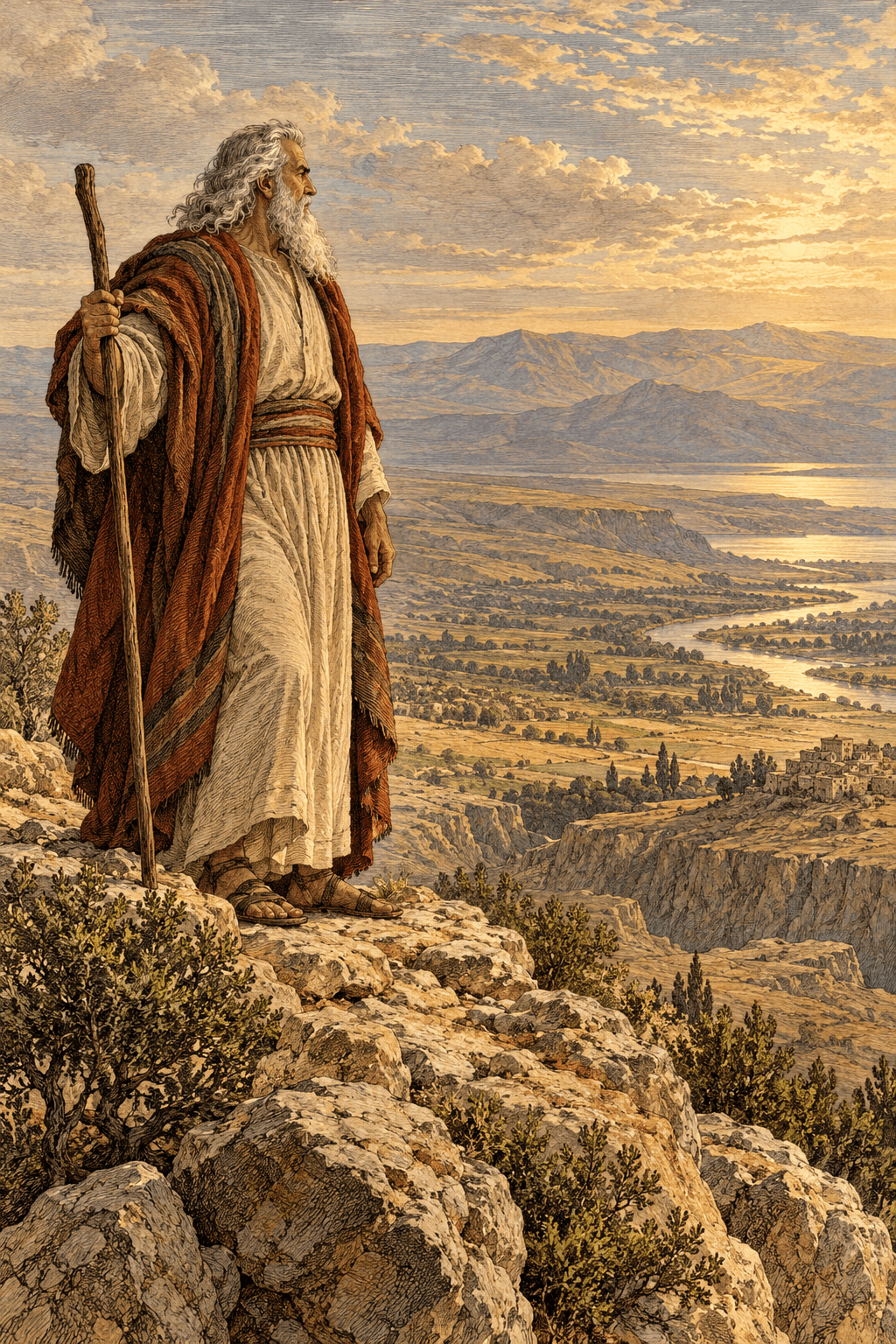
God appointed for Moses the place where he would die (Deuteronomy 32:49–50). He left the people in the plains of Moab and went up, as the Lord commanded, to Mount Nebo, to the top of the mountain in a region called the top of Pisgah. It seems that “Pisgah” was a name given to the summits of some mountains. Since Moses was accustomed to meeting God on the mountain to receive the Law, even his death took place on Mount Nebo, that is, on a height, where he saw by faith what God had promised to his fathers and what would be fulfilled with his people, so that he rejoiced and his soul exulted as though he had received the promise himself (see verses 1–5 above).
Pisgah means “the broken,” that is, a break appearing in the summit of a mountain; it may be the name of a summit of Mount Osha.
Moses was in many ways a model servant of the Lord, and his motto was “according to the word of the Lord.” He set out to God with complete freedom of his soul, and he was exultant because he was going to Him.
He was an old man of one hundred and twenty years, and no one at all was in his company. No one saw him die, either because God did not want to reveal the place of his body, lest the Jews exaggerate in honoring him, or perhaps because He wanted to affirm that God’s children need no human help in the moments of their departure from the world, for God Himself is their help.
Moses the prophet looked down from the mountain to see Canaan, the Promised Land, and his soul exulted at the fulfillment of the divine promises; and he lifted up his eyes to see the heavenly Canaan.
Truly the eyes of Moses were not dim at the age of one hundred and twenty, but his seeing the whole land of Canaan from the mountain could not have been by natural ability; God gave him this ability so that his soul might rejoice in what his people would soon enjoy.
Moses, the great among the prophets and the first leader of the people, is called here the servant of the Lord (5). This title points to the holder of a special position, as one who works in the court of the King of kings and has a special standing with God. Abraham, the father of the fathers, also enjoyed this title (Genesis 26:24), as did Joshua the son of Nun (Joshua 24:29), David, the first righteous king of his people (2 Samuel 7:5); and the prophets, witnesses of the truth, bore the same title (2 Kings 9:7).
The matter did not stop with certain persons, for the Lord longs for every member of His Church to have his living personal role; so Israel was called by this title (Isaiah 41:8). He wants to move even strangers to fulfill His holy will and His mission, so a foreign king was called by this title (Jeremiah 25:9).
Now that the incarnate Word of God Himself has become “the Servant of the Lord,” with four hymns called “the Servant Songs” (Isaiah 42:1–4), He wants every soul to be bound to Him to receive His saving honor. I have spoken before at some length of “the Servant of Yahweh,” or “the Servant of the Lord,” in the commentary on the Book of Isaiah. [318] The Lord’s servants were greater than Moses; but now that the Son Himself has come, there is no longer any comparison between the Son, the Master of the house, and the servant who serves the house (Hebrews 3:1–6).
“And he buried him in a valley in the land of Moab, over against Bethpeor: but no man knoweth of his sepulchre unto this day” (6).
The Lord Himself buried him, perhaps by His angels, who held the ceremony of his repose and burial. God cared for the body of Moses, for the death of the righteous is precious to Him. He did not bury him with his fathers, but in the land of Moab in a place no one knows. So, though God cares even for our bodies, we ought not to be occupied with the place where we will be buried.
Riparius, a priest of Aquitaine, wrote to Saint Jerome concerning the opposition of Vigilantius, who fought against the veneration of the relics of the saints and the vigils on their feasts, looking upon these relics as unclean things. Saint Jerome answered him, giving many examples from both Testaments of honoring the bodies of those who have fallen asleep in the Lord. In his letter he says:
I ask Vigilantius: Are the relics of Peter and Paul unclean? Was the body of Moses unclean, of whom it is said, according to the correct Hebrew text, that the Lord Himself buried him? [319]
Saint Jerome compared the death of Moses with the death of Joshua, showing that at the death of Moses the prophet there was mourning, but at the death of Joshua there was not (Joshua 24:30). For if Moses symbolizes the Jews under the Law, Joshua symbolizes the Christians under the leadership of Jesus. Through the Law weeping comes as by night, and through Jesus joy comes as by day (Psalm 30:5). [320]
It is said: “Moab shall howl over Nebo” (Isaiah 15:2). The mountain on which Moses the prophet went up to see the Promised Land from afar, so that his soul exulted, was a defensive center for the Moabites. The place where Moses exulted, the Moabites howled. What gladdens the believer’s heart crushes the soul of the ungrateful unbeliever.
Saint Gregory of Nyssa says:
What does the history say about this? That Moses, the servant of Yahweh, died when Yahweh gave His command, and no one ever found his grave; his eyes were not dim, and his face was not wrinkled. From this we learn that when a man accomplishes such great works, he is counted worthy of so lofty a name as to be called “the servant of Yahweh,” which is as much as to say that he is better than all others. For no one can serve God unless he has become higher than everyone in the world. This for him is the end of the virtuous life, the goal accomplished by the word of God.
The history speaks of a “death,” a life-giving death, not followed by a grave, nor filling a tomb, nor causing dimness of the eyes or old age of the person.
What, then, do we learn from what has been said? That we should have one aim in life: to be called servants of God by the life we live. When you have defeated all the enemies (the Egyptians, Amalek, the Edomites, and the Midianites), crossed the waters, been enlightened by the cloud, enjoyed the sweetness by the wood, drunk from the rock, tasted the food from above, and gone up the mountain through purity and holiness; when you have attained that, and received teachings concerning the divine mystery by the sound of the trumpets, and drawn near to God by your faith in the impenetrable darkness, and there learned the mysteries of the tabernacle and the dignity of the priesthood; and when you have become the sculptor who carves in your heart the divine teachings you received from God; when you have destroyed the golden idol (that is, when you remove from your life the lust of covetousness); when you have been lifted up to the heights so that you show yourself repelling the sorcery of Balaam (you understand the deceitful, cunning sorcery of life, by which people are drawn by some philosophies and turn as it were into irrational animals and abandon their fitting nature); when you have attained all these things, and the rod of the priesthood blossoms in you, drawing no moisture from the earth, but having its own unique power to bear fruit (that is, the almond, which at first is bitter and rough to the taste, but contains within what is sweet and good to eat); when you have destroyed all that opposes what befits you, as the earth swallowed Dathan and Korah was burned by fire; then you draw near to the goal. I mean the goal for whose sake all things are done. [321]
2. The Vigor of Moses
KJV · Verses 7
7 And Moses was an hundred and twenty years old when he died: his eye was not dim, nor his natural force abated.
“And Moses was an hundred and twenty years old when he died: his eye was not dim, nor his natural force abated” (7).
In Psalm 90 Moses the prophet says: “The days of our years are threescore years and ten; and if by reason of strength they be fourscore years, yet is their strength labour and sorrow” (Psalm 90:10). How does he say this when he himself lived 120 years, unless he counted that his days ended at eighty with strength, and the forty years were a gift from God to him, as he was under sentence of death and God gave him life to serve for the sake of His kingdom?!
Moses lived 120 years, and his eye was not dim nor his natural force abated, a sign of the believer’s enjoyment of continual enlightenment and youthfulness, without his inner self being struck with blindness or the infirmity of old age (Psalm 103:5). The inner man of the true Christian knows no old age, but the Holy Spirit renews him like the eagle.
His eye was not dim, like Isaac’s (Genesis 27:1) and Jacob’s (Genesis 48:10), nor did signs of old age appear on him, but his body was fresh like a young man full of strength and vitality. The face that became shining with the reflection of God’s splendor on it (Exodus 34:30) would not be struck by the old age of weakness.
Saint Gregory of Nyssa says:
The eye is not dimmed, nor does the man grow old. For how can the eye that is always in the light be dimmed by the darkness from which it is always separated? The man who by every means attains incorruption in his whole life will not be touched by corruption in himself. For truly whoever becomes the image of God, and does not turn aside in any way from the divine character, bears in himself its distinguishing marks and shows in everything that he is like the archetype, bearing himself with what is incorruptible and unchangeable, and sharing in no evil at all. [322]
3. The Days of Weeping and Mourning for Moses
KJV · Verses 8
8 And the children of Israel wept for Moses in the plains of Moab thirty days: so the days of weeping and mourning for Moses were ended.
“And the children of Israel wept for Moses in the plains of Moab thirty days: so the days of weeping and mourning for Moses were ended” (8).
The Targum of Jonathan says that the Lord entrusted Michael the archangel with guarding the grave of Moses.
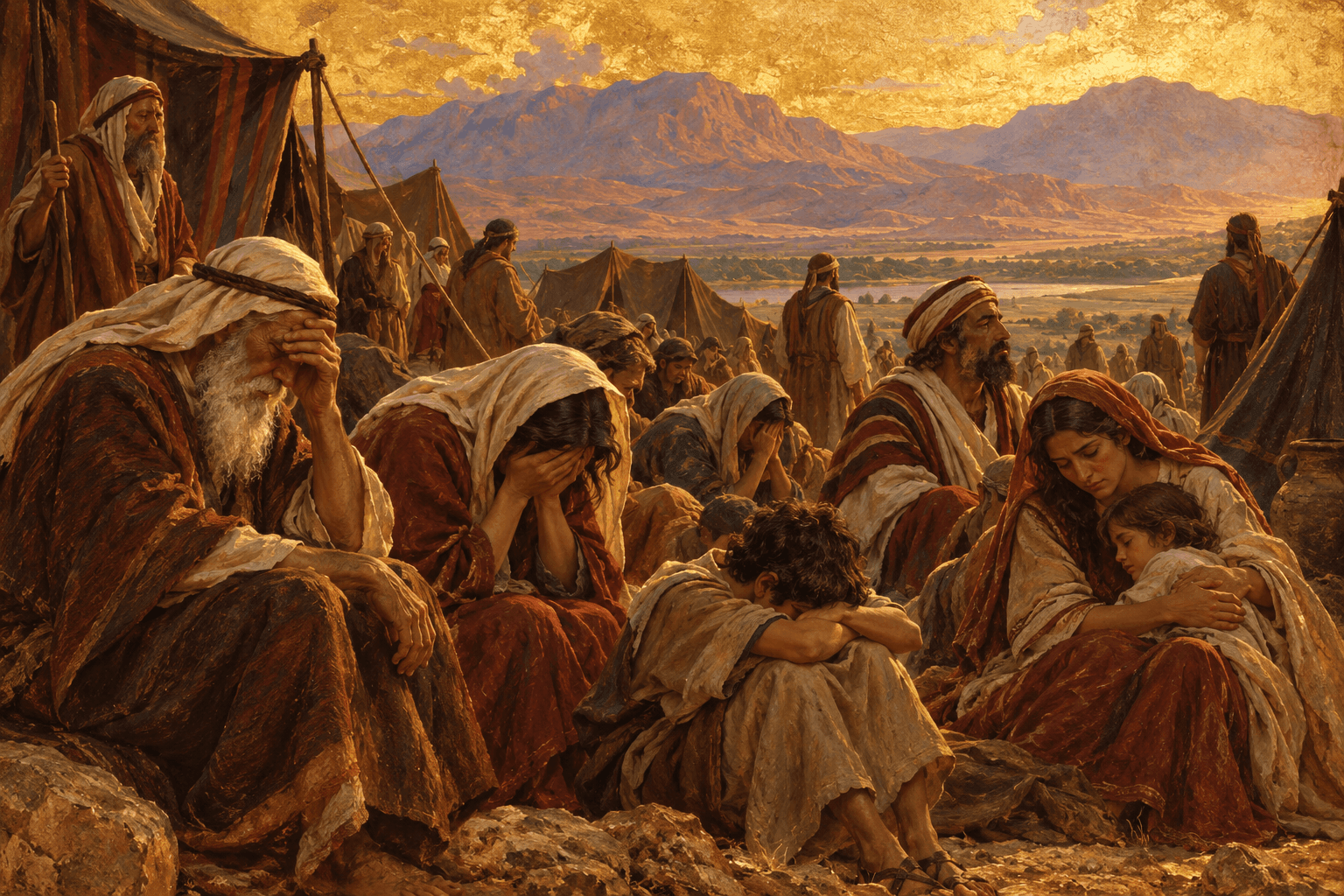
Though God buried Moses, and a unique angelic funeral was held for him, God did not prevent the people from expressing their feelings, so they wept thirty days for this wonderful leader.
4. Joshua Succeeds Moses
KJV · Verses 9
9 And Joshua the son of Nun was full of the spirit of wisdom; for Moses had laid his hands upon him: and the children of Israel hearkened unto him, and did as the Lord commanded Moses.
“And Joshua the son of Nun was full of the spirit of wisdom; for Moses had laid his hands upon him: and the children of Israel hearkened unto him, and did as the Lord commanded Moses” (9).
As Moses was filled with the spirit of wisdom, his disciple Joshua was filled with the same spirit through Moses’ laying his hands on him, that is, by his ordination. Why did he not lay one hand only? Because he did as Jacob did when he blessed his grandsons Ephraim and Manasseh, laying his hands in the form of a cross: the right hand on Ephraim, who was on the left side, and the left hand on Manasseh, who was on the right. So we receive the spirit of leadership through the cross of the Lord of glory.
5. The Conclusion
KJV · Verses 10–12
10 And there arose not a prophet since in Israel like unto Moses, whom the Lord knew face to face, 11 In all the signs and the wonders, which the Lord sent him to do in the land of Egypt to Pharaoh, and to all his servants, and to all his land, 12 And in all that mighty hand, and in all the great terror which Moses shewed in the sight of all Israel.
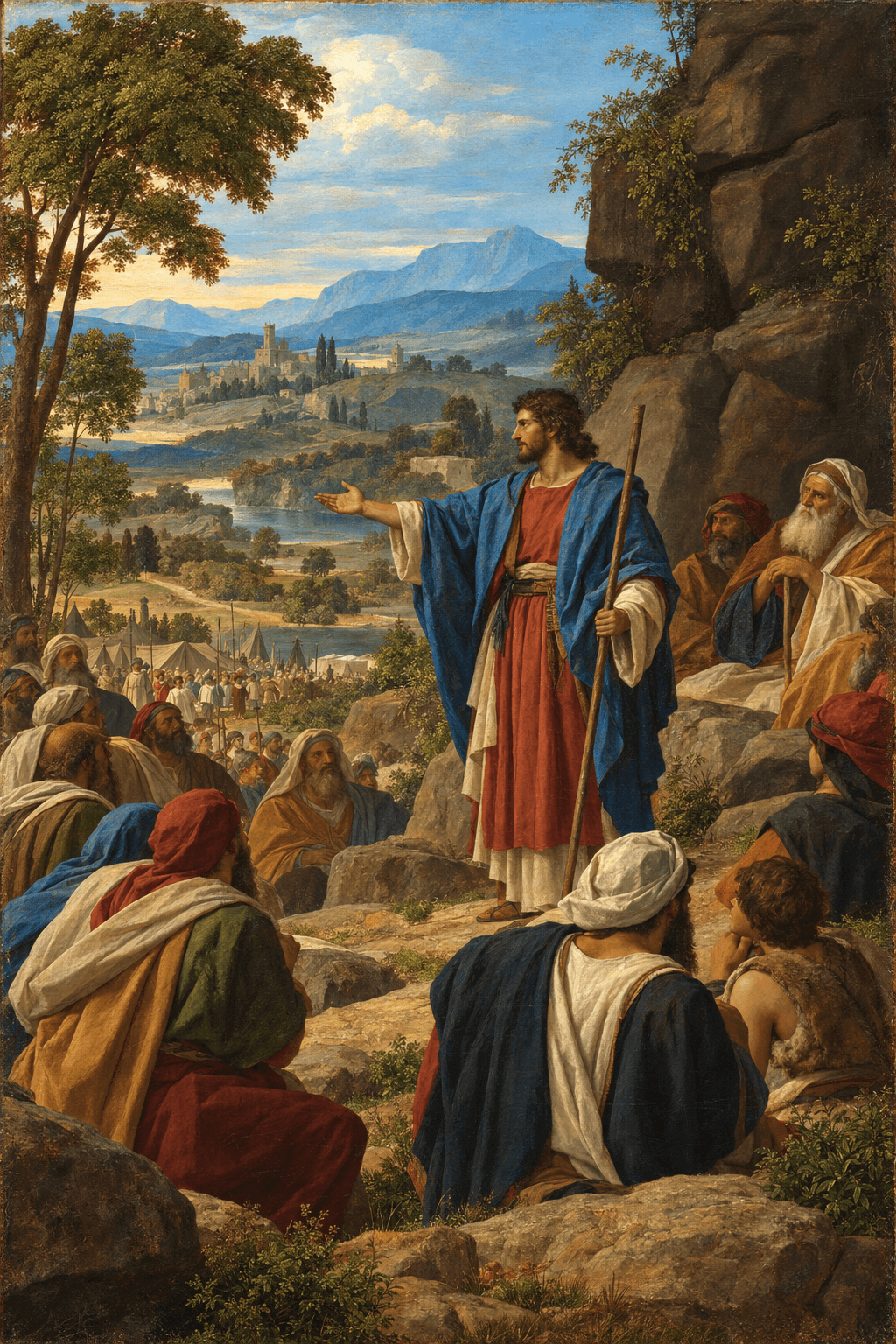
The book ends by revealing the greatness of Moses, in that he was close to the Lord, seeing Him face to face. As it is said, God spoke to him “as a man speaketh unto his friend” (Exodus 33:11). He did not speak with him through visions and dreams, but in direct, frank, and open speech. It is as though the secret of his strength was meeting God and conversing with Him. Through his hands God accomplished salvation from Pharaoh’s bondage, and through him revealed the divine glory, especially when He delivered the Law to him on Mount Sinai (see verses 10–12 above).
These closing verses suggest that their writer was someone later than the time of Joshua. Perhaps Eleazar or one of the elders added them after the death of Joshua (Joshua 24:31).
As a prophet Moses led the people (Hosea 12:13), delivered to them the revelation given to him (Deuteronomy 29:29), and pointed to Christ (Deuteronomy 18:15). “Face to face” (10). “In all that mighty hand” (12): God’s work through Moses was not by words only, but by deeds that could not be forgotten; the signs and wonders he did in Egypt were the divine preparation for the greater redemptive work accomplished at Golgotha.
The Mountains in Holy Scripture
Mountains have a special place in Holy Scripture. They are the places beloved by God, where He meets His people or gives special gifts and revelations. On them the men of God gained victories over evil, and from them the faithful carried the timber they used to build the temple of the Lord. Perhaps His choice of mountains as places for receiving heavenly divine blessings is to call the believer to lift his heart, his mind, and all his senses above everything earthly, to meet the heavenly God.
The Psalmist lifted up his eyes to the holy mountains, awaiting divine help.
If Moses the prophet received the divine Law on the mountain, saw Canaan from the summit of the mountain, and there delivered his spirit into the hands of God, who cared for his spirit as for his body, it is to affirm our need to go up to “the mountain of the Lord’s house.” It is said: “And it shall come to pass in the last days, that the mountain of the Lord’s house shall be established in the top of the mountains, and shall be exalted above the hills; and all nations shall flow unto it” (Isaiah 2:2).
What is this mountain but the person of the Lord Christ, the true Rock that pours forth the waters of the Spirit on His people (1 Corinthians 10:4), the mountain that Daniel the prophet saw filling the earth (Daniel 2:34–35, 45)? Saint Augustine says: “The mountain, as the prophetic testimony teaches us, is the Lord Himself.” [323] And Origen calls us to go up the high mountains, saying: “It is enough that you do not remain on the earth, nor dwell in the valleys, nor linger in the buried places.” [324]
Perhaps the most important mountains mentioned in Holy Scripture are:
1. Mount Ararat: in present-day Turkey, on which Noah’s ark rested (Genesis 8:4); where the Church, saved from the flood of the world, rests on the heights, in heaven itself, for she has no place in the low places.
2. Mount Sinai: or Horeb, northeast of Egypt, where Moses the prophet received the Law (Exodus 19:2–25). For we are drawn with Moses onto the mountain to enjoy receiving His commandment in the depths of the soul, which He writes not on tables of stone but on the heart itself by His fiery Holy Spirit.
3. Mount Ebal: opposite Mount Gerizim. Moses the prophet commanded that an altar to the Lord be built on this mountain when they entered the Promised Land. For the believer cannot offer his life as a sacrifice of love to God while he is confused.
4. Mount Gerizim: concerning which the Lord Christ spoke with the Samaritan woman at the well (John 4:20), who left her waterpot and went into the city calling all its inhabitants to come, see, and hear, so that they might experience what she had experienced: the sweetness of the work of the Savior, the Lover of mankind.
5. Mount Nebo: or Pisgah, from which Moses looked over the Promised Land, which he saw with his eyes without entering it. Since Moses was a symbol of the Law, it is unable to bring the believer into heaven, the eternal Canaan; it only reveals it to him from afar, so that he may be bound to Jesus (Joshua the son of Nun), who alone is able to carry him there. It is said that God buried Moses on this mountain with His own hands; the body, or the letter, of the Law had to die so that we might enjoy the risen life in Christ Jesus through the Spirit.
6. Mount Carmel: on which Elijah the prophet triumphed over the prophets of Baal (1 Kings 18:9–42). Whoever does not go up the mountain of the Lord will not be able to crush the devil, his soldiers, his servants, all his tricks, and all his authority.
7. Mount Gilboa: on which King Saul and his sons were killed in battle against the Philistines (1 Chronicles 10:1, 8). On the holy mountains the prince of this world falls and goes down dead.
8. Mount Hermon: it represents the boundary when the people entered Canaan (Joshua 11:3, 17).
9. The Mount of Olives: on which the Lord Christ gave His discourse about His last coming (Matthew 24:3). For when a person renounces earthly things, he goes up as it were on the Mount of Olives to sit at the feet of the Savior, delighting in His promises.
10. Mount Lebanon: the source of the cedar timber that Solomon the wise used in building the temple in Jerusalem (1 Kings 5:14, 18). So the soul goes up to the mountains of the Lord, the wood of the cross, with her crucified Bridegroom; for if she is not crucified with Him, she will not be able to build His holy temple in the inner Jerusalem, in the depths of the heart.
6. A Meditation on Deuteronomy 34
Grant Me the Gift of Death!
When my mission is accomplished successfully,
let me go up with Moses the prophet and receive the gift of death.
May I not die at the foot of the mountain,
but go up to the top of the holy mountain.
I rise above every earthly thought and temporal lust;
there my heart burns with longing for the vision of You.
I do not seek a place to bury my body,
nor do I seek a person to care for shrouding and burying me.
Whether I live or die, I am Yours.
You shepherd me until my meeting with You.
Let Your hands reach out and work through me,
and let me touch the leaders of the new generation with exultation.
You are the true Leader through all generations.
Notes and References
[318] Fr. Tadros Yacoub Malaty, Isaiah, 1988, pp. 19–21.
[319] Saint Jerome, Letter 109:1.
[320] Saint Jerome, Letter 60:6.
[321] Saint Gregory of Nyssa, The Life of Moses 2:314–317.
[322] Saint Gregory of Nyssa, The Life of Moses 2:318.
[323] Saint Augustine, Sermons on New Testament Lessons 39:2.
[324] Origen, Homilies on Numbers 3.