
In the previous chapter he spoke of “the congregation of the Lord,” its holiness, and preserving it. Now he speaks of laws that touch the family and its very being. He begins by restricting divorce, and by caring for the happiness of the family even in times of war, and for the obligation to support poor and needy families in various ways. He cares for those who are forced to give pledges, speaking of them three times in this chapter.
It may be said that this chapter preserves human rights in general. It defends the rights of the woman in the matter of divorce, and her rights during the time of her wedding (the first year of her marriage). It also defends the rights of poor debtors, the rights of hired workers, the right of a person not to be punished for a wrong committed by those closest to him, and finally the right of a person to exercise freedom.
1. The Family and Divorce
KJV · Verses 1–4
1 When a man hath taken a wife, and married her, and it come to pass that she find no favour in his eyes, because he hath found some uncleanness in her: then let him write her a bill of divorcement, and give it in her hand, and send her out of his house. 2 And when she is departed out of his house, she may go and be another man’s wife. 3 And if the latter husband hate her, and write her a bill of divorcement, and giveth it in her hand, and sendeth her out of his house; or if the latter husband die, which took her to be his wife; 4 Her former husband, which sent her away, may not take her again to be his wife, after that she is defiled; for that is abomination before the Lord: and thou shalt not cause the land to sin, which the Lord thy God giveth thee for an inheritance.
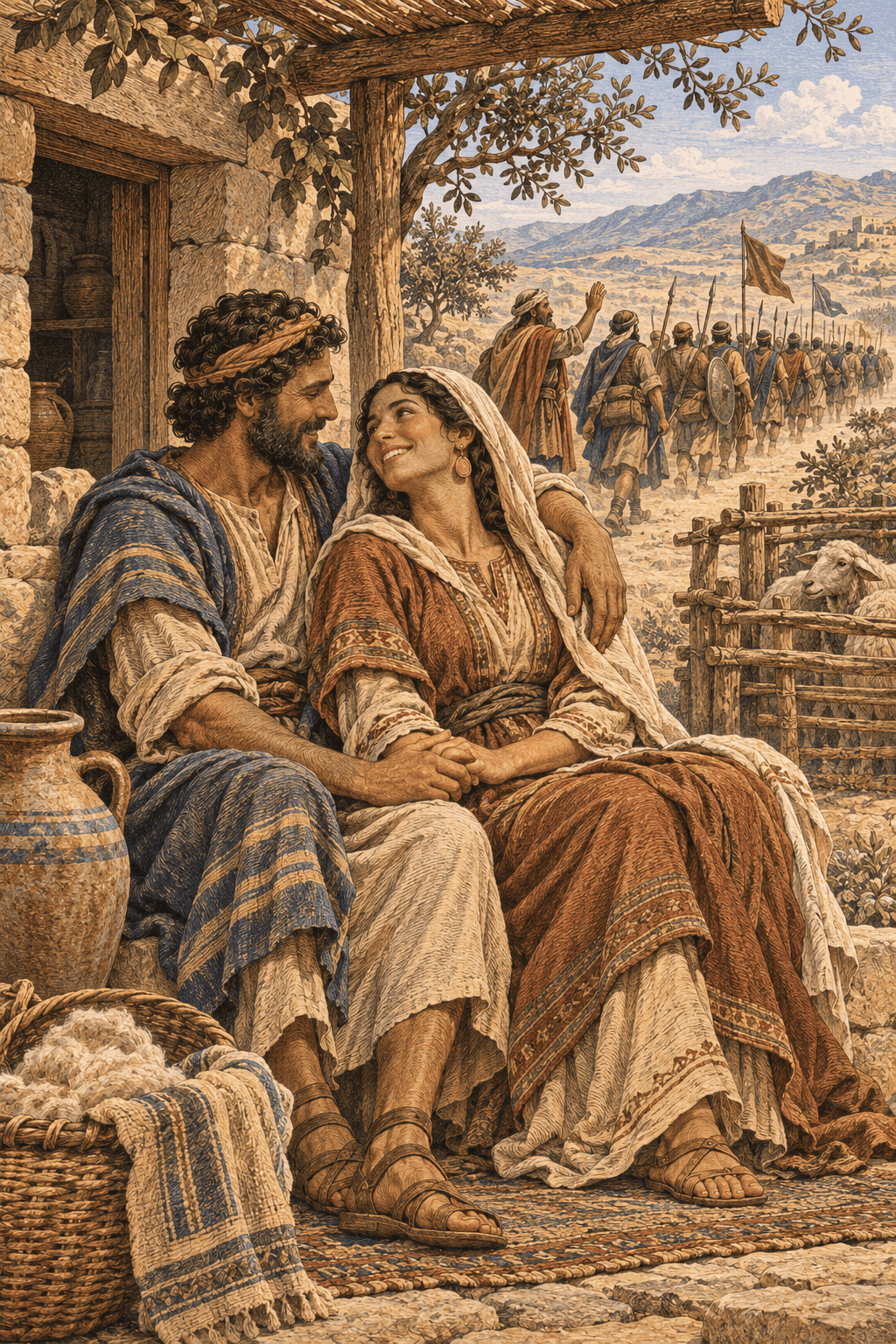
The holiness of the congregation of the Lord cannot be preserved without caring for the holiness of the family and the marriage bond. The believer ought to look upon marriage with holiness and reverence, bearing the very mind of God in this matter, who sees that the family unit must be the most important and strongest unit the earth knows. Because of the hardness of their hearts, Moses allowed them divorce, so that no one would commit murder to be rid of his wife, or justify himself in committing adultery and so fall under the divine wrath, he and the woman with whom he sinned being exposed to stoning (if she was married). But in the New Testament, where man has entered into maturity, divorce is not allowed except for the cause of fornication (Matthew 19:8–9).
The Law set limits to divorce, among them the law in verses 1–4 above. What lies behind this law is:
First: That a person not hasten to seek divorce for any reason. The Law required that it was not enough to utter the word of divorce; he had to declare it in writing, two or more witnesses had to sign the certificate of divorce, and he had to deliver the bill of divorce into his wife’s hand and send her away, that is, provide her material needs, so that no one would act hastily but would reconsider. Besides this, if he divorced her, he should know that if another married her, he could never marry her again if the other divorced her or even died, whatever the reasons.
The following is a form of the bill of divorce that a man wrote for his divorced wife: [254]
On the … day of the week, or the … day of the month …, in the year … from the creation of the world, or from the reign of (Alexander), according to our custom here in the place …, I, so-and-so son of so-and-so, of the district of …, of my free will and my own desire, without any compulsion, have left you, released you, and put you away, you, so-and-so daughter of so-and-so, of the city of …, who were my wife. And now I dismiss you from me, leave you, and put you away, so that you are free and have authority over your own life, to marry any man you wish, and no one may refuse you on account of my name, from this day and forever. So you are permitted to be any man’s. And this is from me a bill of divorce, a writ of release, and a letter of dismissal, according to the law of Moses and Israel.
Second: It affirms the right of the divorced wife to marry, the first man being counted to her as though he had died. Therefore she may not cleave to him after being united with another man, for she would be like one who cleaves to a dead body, and this is counted defilement.
Third: Some think this law was issued to prevent certain unclean customs, such as some Egyptians practiced, where men exchanged wives among themselves. It was feared that two men would divorce their wives so that each might take the other’s wife for a time, then divorce them and each remarry his first wife; marriage and divorce would then become a means of achieving this unclean conduct under cover of the law of divorce. So the Law utterly refused remarriage to the first wife once she had cleaved to another. By this the man realizes that the woman is not a plaything in his hand, to be driven out whenever he wishes and taken back whenever he pleases; she has her human being and her personality, which the husband must respect.
Fourth: Saint John Chrysostom says:
The Law did not forbid the man who hates his wife to put her away and marry another, but he was obliged to give her a bill of divorce, and he might not take her back again even if her second husband died or divorced her. The reason for this is that the Law feared that if the man were obliged to keep the wife he hated, he would kill her, for such was the state of the Jews at that time. They killed the prophets and shed blood like water (Psalm 79:3). So putting away the hated wife is a lesser evil than killing her. As for the reason she was not to return, it was so that all would realize that marriage ought to remain and not be dissolved; so before a man puts away his wife and divorces her, he must reconsider many times, for she will not return to him. [255]
Fifth: The Jewish commentators differed in their interpretation of the phrase “because he hath found some uncleanness in her” (1). In the opinion of the school of Hillel, a man could divorce his wife for any cause he considered unseemly. [256] So in the days of the Lord Christ the Pharisees came to Him asking, “Is it lawful for a man to put away his wife for every cause?” (Matthew 19:3). The school of Shammai, on the contrary, held that a man had no right to divorce his wife except for a serious fault in her, such as committing the sin of adultery. [257] Yet the “uncleanness” here cannot be interpreted as committing adultery, for the punishment of this sin was stoning, not divorce.
2. The Family and Military Service
KJV · Verses 5
5 When a man hath taken a new wife, he shall not go out to war, neither shall he be charged with any business: but he shall be free at home one year, and shall cheer up his wife which he hath taken.
In every way God made clear His hatred of divorce, longing that it not happen among His people. At the same time He gave great care to the soundness and happiness of the family. So He exempted the newly married man from military service, so that he might spend the first year with his wife in a happy life. The foundation of the happiness of the whole society is the family, and a joyful family spreads a spirit of joy to those around it (see verse 5 above).
The newly married man was not allowed to take part in a war during the first year of his marriage for several reasons, among them:
First: As we saw before, those occupied with matters that possess their thoughts and hearts were excluded, for this might cause them fear or cowardice during the battle.
Second: To preserve the soundness and unity of the family. In the first year a person often finds problems in his married life, for the two have not yet learned to accept each other’s will and understand each other’s ideas as they should. The man’s going out to war for a long time might cause a coldness in marital love, or one of them might find it an opportunity not to return to married life.
Third: Since all God’s people ought to be pure, having no experience of bodily relations before marriage, at their marriage they gain a new experience that is hard to be free from. If the man were called to the army, he would find it hard to live without a bodily relationship and might fall in love with any woman he met during the war, especially if his army won and took some women captive. The bride whom her bridegroom left might also find it hard to walk in purity in this critical period.
Fourth: The purpose of the man’s not going out to war is not escaping the battle or fear of death, but that he must do all he can to make his wife happy.
Fifth: God considers the first year of marriage a “continuous wedding feast” that will not be repeated. So God Himself takes care to preserve and fortify it, so that the bride and bridegroom remain in a period of joy and gladness that supports them all the days of their life. It is the beginning of a new life, which God takes care to water with the waters of joy and gladness, so that God Himself finds rest in it. It is as though the joy of the bride and bridegroom is the delight of God Himself.
Sixth: This feast that continues for a whole year has its limits. It is not a feast that stirs up a spirit of laziness and lack of commitment, but a temporary feast that founds a holy house in which the Lord works and in which the bride and bridegroom carry out their role with all seriousness. With the importance of a life of joy, joy must be bound to wisdom, and happiness to work and commitment to responsibility.
Seventh: As the believer ought to work for the sake of the community, giving even his life for it, the state ought also to care for each of its members, caring for the newly married bride, her well-being, her happiness, and the stability of her home.
3. The Family and Pledges
KJV · Verses 6
6 No man shall take the nether or the upper millstone to pledge: for he taketh a man’s life to pledge.
Not taking the necessities of life in pledge, so that we do not destroy the lives of our brothers (see verse 6 above).
God created man and placed him in the garden to work the ground (Genesis 2:5). So whoever deprives a person of work deprives him of the human life God gave him. And whoever deprives himself of work shall not eat (2 Thessalonians 3:10). So the creditor ought not to take from the debtor his tools of work, but on the contrary encourage him to work, not only to pay the debt, but to eat and to give to the needy. As Paul the Apostle commands us even concerning thieves: “Let him that stole steal no more: but rather let him labour, working with his hands the thing which is good, that he may have to give to him that needeth” (Ephesians 4:28).
Taking the millstone in pledge, or its upper part in which a wooden handle was fixed to turn it, without which the lower stone becomes worthless, was common because of abject poverty. The mill here is a small hand mill used by one person, usually the housewife, to grind enough grain to make bread for the family for one day. So whoever takes the mill in pledge deprives the family of its necessary daily food, namely bread, and so deprives the whole family of the right to life.
Perhaps he means here by the mill one belonging to a person whose work is grinding grain for the people for a wage. He forbids a person to demand a security by which the borrower loses the ability to work, such as asking for the carpenter’s axe, the ploughman’s oxen, or the student’s book. The creditor’s work is not to destroy the debtor’s ability, but to support him so that he and his family may live and be fed.
In every age and in every nation, wealth is a power that can be used for building up or for tearing down. The rich man who cares for his poor brother uses his means for good. But one whom wealth turns to tyranny and the abuse of power is like one who destroys himself and devours his poor brothers.
4. The Family and Slavery
KJV · Verses 7
7 If a man be found stealing any of his brethren of the children of Israel, and maketh merchandise of him, or selleth him; then that thief shall die; and thou shalt put evil away from among you.
According to the Law, whoever steals a thing deserves punishment, but not the death penalty; but whoever steals a person or a child and sells him as a slave commits a great crime whose punishment is death (see verse 7 above).
Kidnapping among the Semites was usually a cause of bloodshed, and the Code of Hammurabi punished it with death. Whoever deprives a person of his human freedom is like one who has killed him, and so deserves death.
5. The Family and Murmuring
KJV · Verses 8–9
8 Take heed in the plague of leprosy, that thou observe diligently, and do according to all that the priests the Levites shall teach you: as I commanded them, so ye shall observe to do. 9 Remember what the Lord thy God did unto Miriam by the way, after that ye were come forth out of Egypt.
The Law took care for the stability of the family and for every member’s enjoyment of security and freedom, and it also cared for a spirit of obedience without murmuring. So, in referring to the law of leprosy, he reminds us of what befell Miriam the sister of Aaron when she murmured against her brother Moses (Numbers 12:14) (see verses 8–9 above).
He mentions here the plague of leprosy because, according to the Law, the priest had to enter the house and examine what was in it, lest the infection spread to the rest of the family, or lest the house struck with leprosy (its foundations defective) fall and the whole family die (Leviticus 14:33–53).
The priest’s entering the house is not counted an intrusion on a person’s privacy, first because as God’s representative he bears fatherhood and love, and second because he does not enter the house as a judge or to expose the family, but to keep everything holy and to protect the family from harm.
6. The Family and Loans
KJV · Verses 10–13
10 When thou dost lend thy brother any thing, thou shalt not go into his house to fetch his pledge. 11 Thou shalt stand abroad, and the man to whom thou dost lend shall bring out the pledge abroad unto thee. 12 And if the man be poor, thou shalt not sleep with his pledge: 13 In any case thou shalt deliver him the pledge again when the sun goeth down, that he may sleep in his own raiment, and bless thee: and it shall be righteousness unto thee before the Lord thy God.
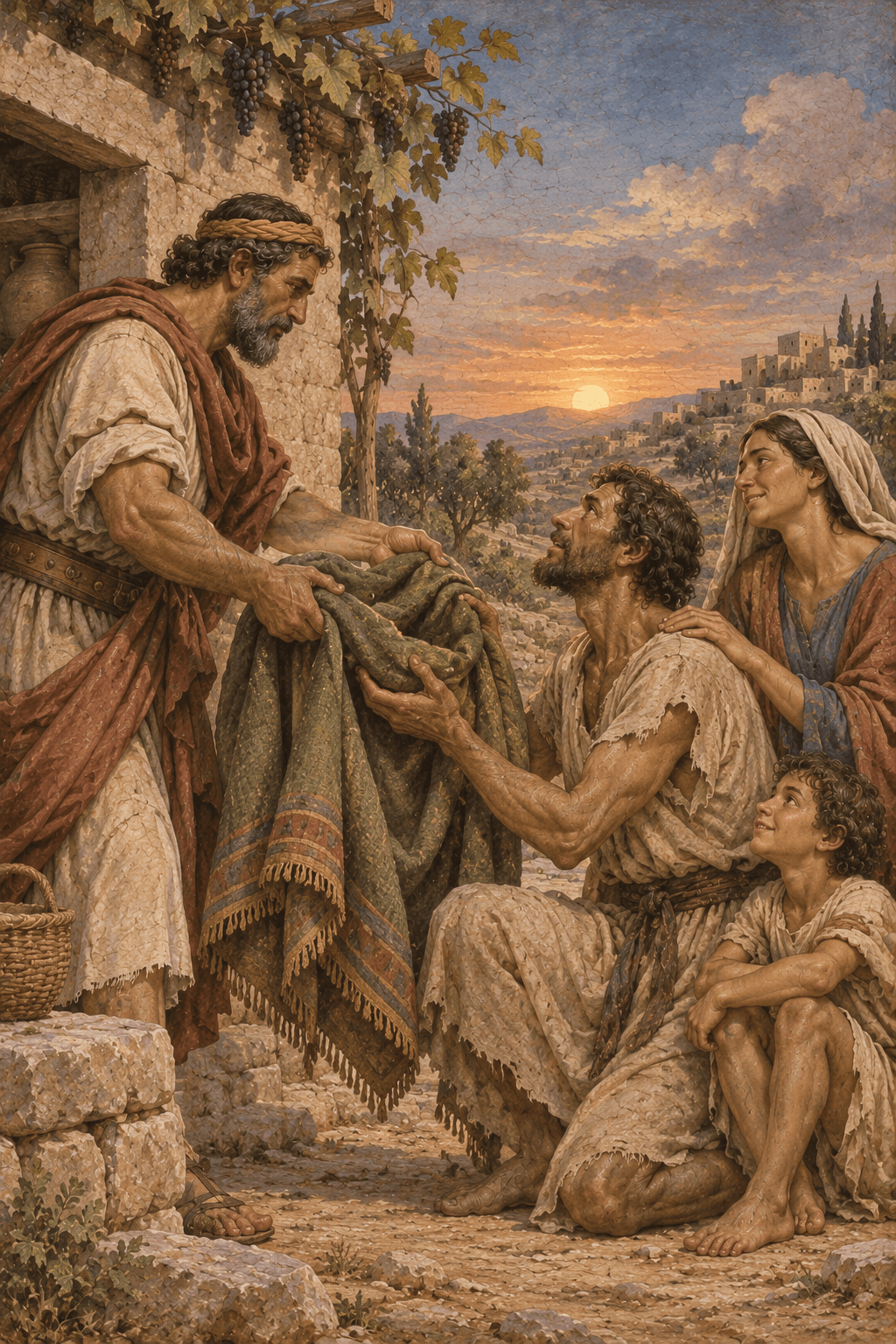
He returns again to speak of pledges for loans. In verse 6 he warned against taking in pledge what is necessary for daily food or daily life, such as the mill. Here he warns against wounding the feelings of the person who borrows from him: he should not enter the house to take a pledge, so as not to wound the debtor’s modesty, but should remain outside. And if he is poor, having only one garment to sleep in, it must be returned at sunset so that the debtor does not suffer from cold (see verses 10–13 above).
The home is a person’s fortress, especially the poor man’s; he feels that God covers him through it. So the creditor’s entering the debtor’s house to take something in pledge makes him feel as though he has lost his security. If the debtor, because of the severity of his needs, pledges some of his household goods, the creditor ought not to insult the dignity of the needy, for entering the debtor’s house and taking the pledge is counted in some countries of the Middle East a degradation of his human dignity.
By this legislation God gives a lesson to the rich creditor himself, not only in respecting the dignity of his needy brother, but in his view of his own family. Some rich people care for money and ignore the unity, peace, and happiness of the family. If the rich man is obliged to respect the family of the poor, how much more must he care for his own family, its unity and its holiness.
The divine law teaches us to guard the privacy of the poor, so that we do not break into his house, whatever the circumstances.
In the Middle East, the poor man can do without his outer garment while working during the day, especially in farming or in manual work such as carpentry and building. But he cannot do without it at night, when he warms himself with it, even in summer, for in desert regions the day is often hot and the night cold.
When God rebuked Israel for its evils, He said: “And they lay themselves down upon clothes laid to pledge by every altar” (Amos 2:8).
7. The Hired Worker and His Wages
KJV · Verses 14–15
14 Thou shalt not oppress an hired servant that is poor and needy, whether he be of thy brethren, or of thy strangers that are in thy land within thy gates: 15 At his day thou shalt give him his hire, neither shall the sun go down upon it; for he is poor, and setteth his heart upon it: lest he cry against thee unto the Lord, and it be sin unto thee.
As a person cares for his family, he must also care for the families of the hired laborers who work for him in his fields or his business. He should be just and generous with them, and careful of their feelings; he should not wait for the worker to ask for his wage at the end of the day, but should hasten to give it himself (see verses 14–15 above).
The employer ought not to oppress the hired workers by pressing them with tasks beyond their abilities, or by using improper words and insulting them, and so be unjust to them. As St. James the Apostle says: “Behold, the hire of the labourers who have reaped down your fields, which is of you kept back by fraud, crieth: and the cries of them which have reaped are entered into the ears of the Lord of sabaoth” (James 5:4). It is a great sin for a person to ignore his brother’s right and not consider his feelings. So when his heart cries out in bitterness, the Lord Himself hears him.
The Law makes no distinction between an Israelite and a foreign hired worker, for the believer ought never to oppress anyone, especially the poor and needy, regardless of nationality or religion. Mercy and love are marks of true believers.
8. Personal Responsibility
KJV · Verses 16
16 The fathers shall not be put to death for the children, neither shall the children be put to death for the fathers: every man shall be put to death for his own sin.
It was the custom among the pagan nations for the punishment of the criminal to fall on the whole family. [258] Truly God threatened His people that He would visit the iniquity of the fathers upon the children unto the third and fourth generation of them that hate Him (Exodus 20:5), to warn them of the bitter fruits of sin and its effect on children and grandchildren, and to deter them; for a person sometimes does not care about the punishment that falls on himself, but greatly fears that it may fall on his children and grandchildren. The judges must not exploit this divine threat and think that it is in their power to punish one member of the family for another.
In dealing with family life, the Law affirms to the judges that no member of the family is to be punished because of another member; each one must bear his own responsibility (see verse 16 above).
Amaziah the son of Joash, king of Judah, applied this principle: he “slew his servants which had slain the king his father. But the children of the murderers he slew not: according unto that which is written in the book of the law of Moses, wherein the Lord commanded, saying, The fathers shall not be put to death for the children, nor the children be put to death for the fathers” (2 Kings 14:5–6).
Ezekiel the prophet spoke of personal responsibility in some detail in chapter 18 (Ezekiel 18).
9. The Family and Pledges (Again)
KJV · Verses 17–18
17 Thou shalt not pervert the judgment of the stranger, nor of the fatherless; nor take a widow’s raiment to pledge: 18 But thou shalt remember that thou wast a bondman in Egypt, and the Lord thy God redeemed thee thence: therefore I command thee to do this thing.
For the third time he speaks here of caution in taking pledges (see verses 17–18 above).
The judges ought not to pervert judgment, but be a support in the truth for strangers and orphans, defending them where they find no friends to support them in their weakness. God reminds them of their state as slaves in Egypt: having tasted humiliation, they must defend those who are humiliated. For some, especially those who have suffered deprivation, when they take a position of leadership, become harsh instead of sharing with the deprived and supporting them. There is a common proverb: “Set a beggar on horseback and he will ride to the devil.”
10. Caring for the Needy at Harvest
KJV · Verses 19–22
19 When thou cuttest down thine harvest in thy field, and hast forgot a sheaf in the field, thou shalt not go again to fetch it: it shall be for the stranger, for the fatherless, and for the widow: that the Lord thy God may bless thee in all the work of thine hands. 20 When thou beatest thine olive tree, thou shalt not go over the boughs again: it shall be for the stranger, for the fatherless, and for the widow. 21 When thou gatherest the grapes of thy vineyard, thou shalt not glean it afterward: it shall be for the stranger, for the fatherless, and for the widow. 22 And thou shalt remember that thou wast a bondman in the land of Egypt: therefore I command thee to do this thing.
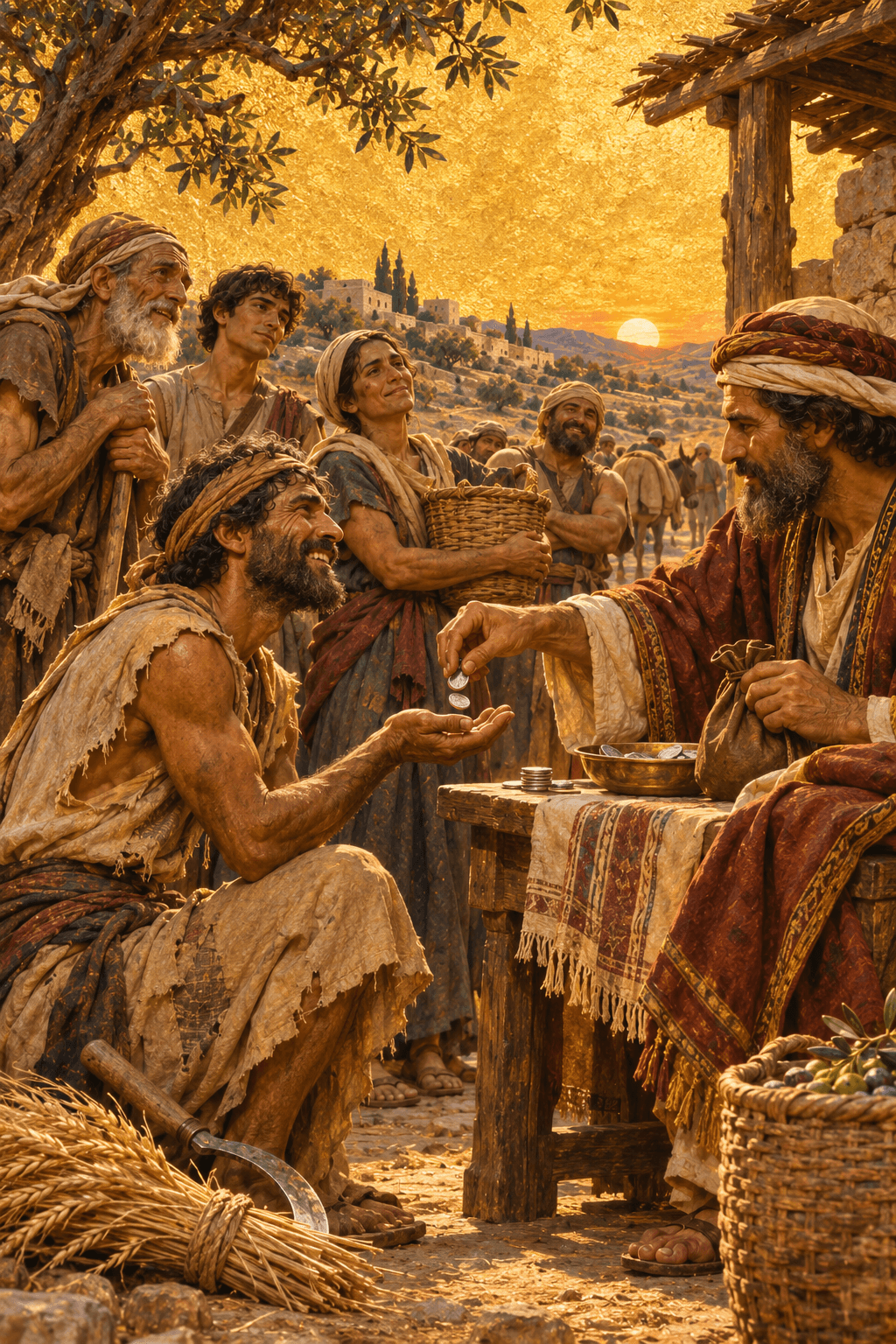
The laws here consider the feelings of every person, and the Law comes to spread, by every means and on every occasion, a spirit of love and tenderness toward humanity, especially toward the needy and strangers. Wherever the believer is and in all circumstances, he must remember the poor and work to support them. The giver offers his gift without wounding the feelings of the needy or the strangers. The law here comes as a completion of what is in the Book of Leviticus (Leviticus 19:9; 23:22). There the Lord forbade the reapers to reap the corners of their fields wholly, or to gather what fell from their harvest, or to glean their vineyards, but to leave these for the poor and the stranger. Here we find care for the stranger, the orphan, and the widow without wounding their feelings: if a person forgets a sheaf in the field he does not go back to take it, and he must also leave some of the fruit on the trees (see verses 19–22 above).
So we notice that in all the laws in this chapter, God cares to spread a spirit of love and kindness, together with justice, righteousness, and good will among humanity, especially in the family, so that it may be a holy leaven that leavens the whole lump, while caring for the poor, the needy, and the strangers. This is the golden thread that binds all the commandments together, not in Deuteronomy alone, but throughout the whole of Holy Scripture.
Through this law a person learns not to be continually occupied with who will receive the gift, but to let divine providence guide his life and his gifts, even in what seems trivial, such as forgetting a sheaf in a field or the remains of olives on the tree.
11. A Meditation on Deuteronomy 24
Grant Me a Holy Family
Your tender fatherhood embraces me always.
From the Church of heaven You give me a mother,
and from the angels beloved brothers!
What a wonderful heavenly family!
You have made the family here an icon of the family of heaven.
The powers of darkness cannot creep into it.
Of old You allowed a man, because of the hardness of his heart, to divorce his wife;
but You remained a fortress for the family,
and a defender of the divorced woman!
Man in his foolishness wants his wife to be a plaything in his hand,
but You, the Creator, honor every man and woman!
Grant me a holy family united in You,
into which the powers of darkness cannot creep.
Every bride dreams of the first month of her marriage,
but You made the first year a continual wedding feast.
You want us to be in an unbroken family joy,
not a joy of negligence and slackness,
but a joy of preparing for work and commitment to responsibility.
You did not allow the newly married man to take part in any war.
Let me experience the spiritual marriage union, so that my soul is bound to You,
and I become a soldier striving in the truth.
Many long to enslave their brothers,
buying and selling them for temporal gain!
But You became a slave for the sake of slaves;
You delivered Yourself to the traitor like a slave that is sold,
and gave slaves eternal freedom!
You alone are the liberator of souls.
Let me taste the sweetness of family life,
and long for all to experience what I live.
Let me not steal a person from a family and sell him to evil,
and so become in God’s eyes like a murderer.
Grant that every family may have a special place in my heart.
If I lend, let me not take in pledge any of the necessities of its life,
nor wound its feelings.
You are the Father of the fatherless and the Judge of widows.
You are the fortress of the suffering and the distressed.
You are the helper of poor hired workers.
You are gentle with debtors who cannot pay.
You are occupied with every needy and poor person.
Grant me Your love, that I may bear Your spirit of kindness!
Grant me Your mind, that I may live for others!
Grant me Your righteousness, that I may oppress no one.
You are all love, You are righteousness itself;
let me possess You, O Source of all goodness!
Notes and References
[254] Bartolocci, Bibliotheca Magna Rabbinica, vol. 4, p. 4450 (cited in Adam Clarke’s Commentary).
[255] Cf. Saint John Chrysostom, Homilies on Matthew, 17.
[256] Mishnah, Gittin 9:10.
[257] Lightfoot, Horae Hebraicae et Talmudicae, on Matthew 5:31 (Pulpit Commentary, Deuteronomy, p. 381).
[258] Esther 9:13–14; Herodotus 3:118–119; Ammianus Marcellinus 23:6; Curtius 6:11.20, etc. (Pulpit Commentary, Deuteronomy, p. 382).