
In the first chapter the prophet Moses set out some of the people’s errors and what they reaped as the fruit of disobedience. Now they stood at the gates of entry into the land of Canaan, for in them the divine promise given to their father Abraham and confirmed through the generations was to be fulfilled, provided that the people would hold fast to the spirit of discernment in their conduct and in their dealings with the nations.
Although God, in His love for His people, dwelt in their midst and gave them the Promised Land, fighting for them against many nations, He wanted them to walk according to His plan, with prudence and wisdom. He asked them not to attack the children of Esau (Deuteronomy 2:1–8), since they were their brethren (Esau and Jacob were brothers) and had already received a promise to take Mount Seir as an inheritance (Genesis 36:8). He also asked them not to stir up war against Moab and Ammon (Deuteronomy 2:9, 18), since they were the children of Lot. But He commanded them to fight Sihon king of the Amorites, who hardened his heart and would not let them pass through his land; the Lord would give them victory over the army of the king of the Amorites, and all the cities of Sihon would become theirs (Deuteronomy 2:26–36).
God, who gives them victory in their wars, does not want to make them a people that loves war and acquisition. If they fight, let it be in the Lord; and if they possess, let it be as a divine gift. Therefore He set limits and a goal for their wars.
1. Their Journey in the Wilderness
KJV · Verses 1–3
1 Then we turned, and took our journey into the wilderness by the way of the Red sea, as the Lord spake unto me: and we compassed mount Seir many days. 2 And the Lord spake unto me, saying, 3 Ye have compassed this mountain long enough: turn you northward.
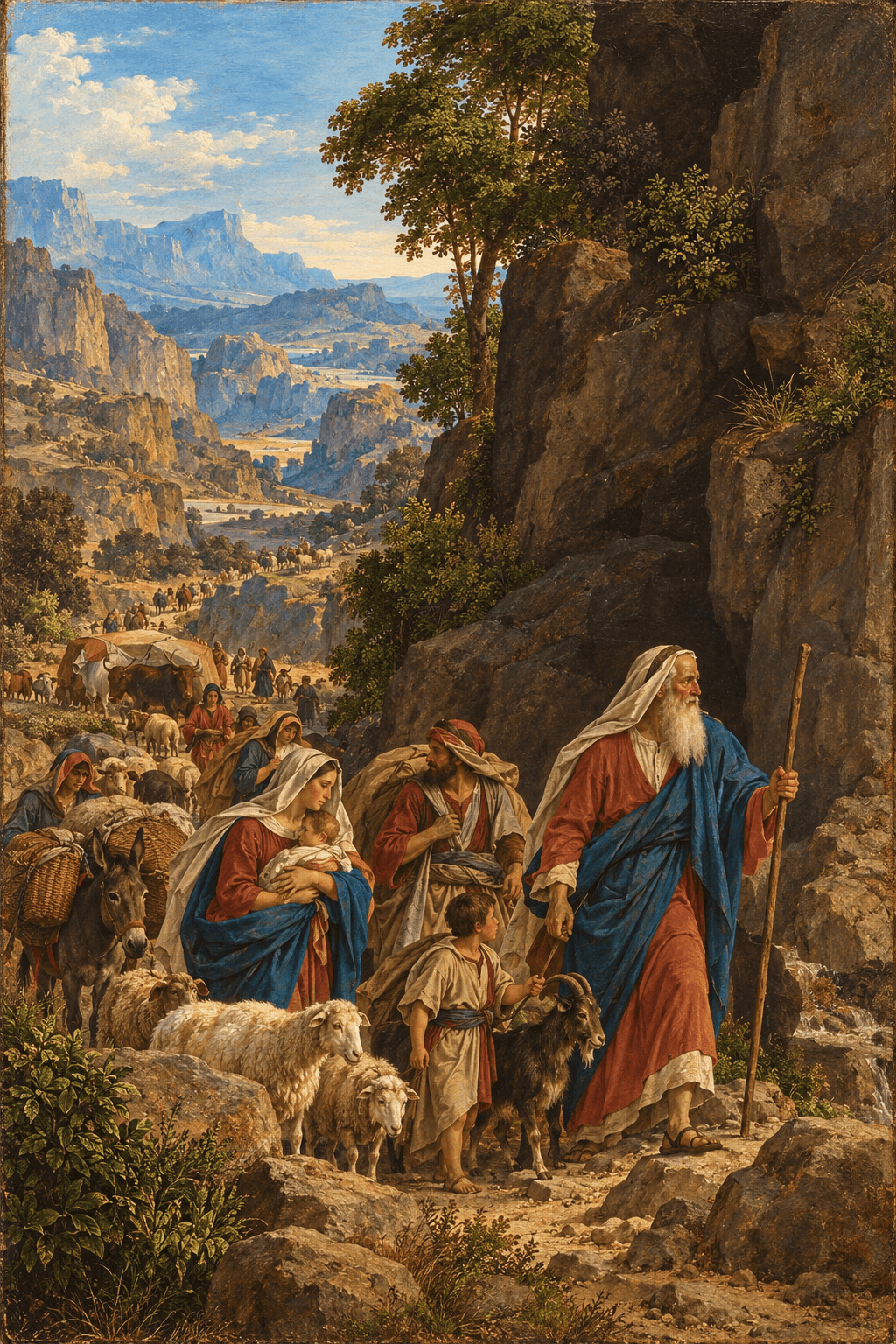
Verse 1 refers briefly to the whole journey of wandering, since the hearers had no need for its details. Verses 2–3 refer to the command concerning the journey from Kadesh to Mount Hor (Numbers 20:22; 33:37), directing them to walk at the far south of Mount Seir to go around the land of Edom (Numbers 21:4), and then north toward the Arnon, that is, “by the way of the wilderness of Moab” (8).
The word “Seir” means “hairy.” It was a land inhabited by the Horites (Genesis 14:6), which Esau and his descendants seized (Genesis 32:3). It was called “Mount Seir” because it is mountainous land on the eastern side of the Arabian wilderness; its highest peak, Mount Hor, rises to 1,600 meters. On their journey the children of Israel had to go around it through harsh, rugged land, walking in a half circle, since the Edomites refused to let them pass through their land.
In the previous chapter the divine command was given to the people not to be slack: “Ye have dwelt long enough in this mount” (Deuteronomy 1:6). Here He tells them, “Ye have compassed this mountain long enough: turn you northward” (3).
Except for Caleb, Joshua, and Moses, the generation that came out of Egypt had died. These were the ones who refused to enter the Promised Land as the Lord commanded (14–15). Moses too was close to death; therefore the Lord said that the circling of the mountain had gone on long enough.
Among the fruits of sin is that a person falls into a state of dullness and does not move; and if he moves, he walks as in a closed circle without progress. The enemy of good first strikes a person with the sin of laziness, slackness, and sluggishness. If he does not respond, he pushes him to move and work without a goal, so that he wastes and squanders his energy.
Saint John Cassian says:
“The believer needs the spirit of heavenly wisdom and discernment so that he does not stop moving; yet as he moves, he walks on the royal road without turning aside.”
2. Not Fighting the Edomites
KJV · Verses 4–8
4 And command thou the people, saying, Ye are to pass through the coast of your brethren the children of Esau, which dwell in Seir; and they shall be afraid of you: take ye good heed unto yourselves therefore: 5 Meddle not with them; for I will not give you of their land, no, not so much as a foot breadth; because I have given mount Seir unto Esau for a possession. 6 Ye shall buy meat of them for money, that ye may eat; and ye shall also buy water of them for money, that ye may drink. 7 For the Lord thy God hath blessed thee in all the works of thy hand: he knoweth thy walking through this great wilderness: these forty years the Lord thy God hath been with thee; thou hast lacked nothing. 8 And when we passed by from our brethren the children of Esau, which dwelt in Seir, through the way of the plain from Elath, and from Eziongaber, we turned and passed by the way of the wilderness of Moab.
Although Jacob obtained the birthright and the blessing, God gave his brother Esau and his descendants Mount Seir to possess. Now God Himself commands His people not to approach the borders of the children of Esau or invade them. He had given them Mount Seir, waiting for their return to Him, so that they might enter the new land, the heavenly Canaan, through faith in the Messiah, the Savior of the world.
God, who loves all humanity, requires that no one transgress the borders of others. As the Apostle Paul says: “And hath made of one blood all nations of men for to dwell on all the face of the earth, and hath determined the times before appointed, and the bounds of their habitation” (Acts 17:26).
And command thou the people, saying, Ye are to pass through the coast of your brethren the children of Esau, which dwell in Seir; and they shall be afraid of you: take ye good heed unto yourselves therefore: Meddle not with them; for I will not give you of their land, no, not so much as a foot breadth; because I have given mount Seir unto Esau for a possession. [4–5]
He gave them the right to pass through the border of their brethren, and placed awe and fear of them in their eyes; but they must not abuse such rights. He insists, “take ye good heed unto yourselves,” not lest the children of Esau defeat them, but lest they lose the spirit of truth and justice and fall into disobedience to the divine commandment.
The man of God is greatly feared; yet let him beware lest he think himself something and lose the spirit of humility before God, so that instead of honor, disgrace comes upon him.
Notice in this chapter that whenever God, the Creator of all and the Lord of all, speaks about a matter, He gives an explanation for His actions; here we see Him repeating the word “because” (5, 9, 19). He is a wonderful Father who wants to speak with His children, not in the language of commands and prohibitions, but in a spirit of understanding, so that they may grasp what lies behind each action and come to know His hidden mysteries. He longs to speak with us as He did with Moses, of whom it is said: “And the Lord spake unto Moses face to face, as a man speaketh unto his friend” (Exodus 33:11).
In this commandment He taught them to respect the property of others with great exactness, asking them not to trespass on Mount Seir, “no, not so much as a foot breadth” (5). We may begin with a foot breadth, but soon we trespass more and more, until we covet what is not ours. Therefore the commandment insists: “Touch not; taste not”; keep entirely away.
Indeed, when God gave the Ten Commandments, He did not explain each one. When He says, “Thou shalt not steal,” He does not explain why, for He gave them to little children unable to grasp the spiritual meaning of the commandment. But soon He offered its explanation: we are not to steal, not merely because a command was issued to us, for otherwise we might steal in our thoughts and hearts even if our hand never reached out to steal. Rather He gave us the reason: “Be ye holy; for I am holy… Be ye therefore perfect, even as your Father which is in heaven is perfect.” Holiness, or perfection, or likeness to God, is the reason for not stealing. Therefore God gives the commandment, followed by the divine revelation.
The descendants of Esau, or Edom, drove out the Horites and settled in their land (12). The rulers of Edom were at first tribal chiefs or dukes (Genesis 36:15–19), and later became kings (Genesis 36:31–39), before the kingdom of Israel arose. The Edomite was considered a brother of the Hebrew, so that one joined to them was counted a Hebrew in the third generation (Deuteronomy 23:7–8). King Saul fought them (1 Samuel 14:47), and King David defeated them (2 Samuel 8:14), yet he did not drive them from their land but set garrisons over them. They regained their independence in the days of Jehoshaphat (2 Kings 8:20–22). The Edomites rejoiced at Nebuchadnezzar’s invasion of Jerusalem, and captured the fugitives and sold them (Obadiah).
Ye shall buy meat of them for money, that ye may eat; and ye shall also buy water of them for money, that ye may drink. For the Lord thy God hath blessed thee in all the works of thy hand: he knoweth thy walking through this great wilderness: these forty years the Lord thy God hath been with thee; thou hast lacked nothing. [6–7]
Though God allowed them to wander about 40 years because of their disobedience and murmuring, He was like One who walked with them on this long journey, knowing their walking and caring for all their needs, so that they lacked none of life’s necessities. So in the midst of our discipline He does not abandon us; He clings to us and provides all our needs, for He wounds and heals!
Although the manna had not yet ceased entirely, not until the first celebration of the Passover in Canaan under Joshua’s leadership (Joshua 5:10–12), for the first time we find the people needing to buy food and water with silver. Before, God had sustained them freely for forty years; but He began to train them in buying before they entered the Promised Land, where they would have to farm and trade. Perhaps God allowed them to buy food and water at the same time He was raining manna on them to assure them that He did not want to deprive them of the foods He had created for them. His sending of manna meant nothing but a declaration of His love and surpassing care. What He forbids is lust and gluttony in food.
These words reveal God’s surpassing love for His people, His care, and His plan. He could have brought them from Egypt to Canaan in a few days, but by divine design He kept them forty years in the great wilderness, so that they might enjoy the blessing of His hands and His walking with them for a longer time, and might perceive His concern for all their needs, even trivial material ones. This is the goodness of God, who turns even the fruit of our sins to our good.
A person can make a huge ladder in a few hours, but he needs years to grow a great tree full of fruit. So God did not want to make His people a huge ladder, but a fruitful tree. He began planting it in Egypt and kept watering and tending it for forty years, so that it might enjoy entering the land of Canaan, a symbol of heaven, as the natural fruit of God’s work in their lives.
We are often impatient for fruit, wanting to bear the fruit of the Spirit from one moment to the next. But God, in His great love for us, works with us quietly and without haste, so that we may sense His work, grasp His mysteries, and experience fellowship with Him; so He walks with us in the great wilderness for years of such length.
During these long years He did not give them lectures in theology; He gave them Himself, walking with them in the wilderness and satisfying all their needs, so that they might taste His love and experience His sweetness.
And when we passed by from our brethren the children of Esau, which dwelt in Seir, through the way of the plain from Elath, and from Eziongaber, we turned and passed by the way of the wilderness of Moab. [8]
Elath or Eloth: a Hebrew name meaning “trees”; the region of Aqaba is still rich in palm trees. Elath is a town at the northern end of the Gulf of Aqaba (the eastern arm of the Red Sea), near Ezion-gaber. It was an important seaport and a center for caravans. King David probably took this town from the Edomites (2 Samuel 8:14), and Solomon used it as a port for his merchant fleet. The Edomites recovered it; then Uzziah king of Judah took it again and rebuilt it (2 Kings 14:22); later Rezin king of Syria took it, and the Edomites returned to it (2 Kings 16:6).
Ezion-gaber lies west of the port of Elath. It was among the last stations of the children of Israel on their journey in the wilderness, shortly before they reached the wilderness of Zin (Numbers 33:35). It is thought to be Tell el-Kheleifeh, 500 feet from the seashore. Recent discoveries show that it was a great commercial center, especially for trade in iron and copper. Its importance appeared in the days of Solomon the Wise, who built his fleet there, and through Ezion-gaber he was able to control trade with the Arabian Peninsula by land and sea. Later its importance declined and Edom took it; then Amaziah recovered it and built the port of Elath in the region (2 Kings 14:22; 2 Chronicles 26:2).
3. Not Fighting the Moabites
KJV · Verses 9–19
9 And the Lord said unto me, Distress not the Moabites, neither contend with them in battle: for I will not give thee of their land for a possession; because I have given Ar unto the children of Lot for a possession. 10 The Emims dwelt therein in times past, a people great, and many, and tall, as the Anakims; 11 Which also were accounted giants, as the Anakims; but the Moabites called them Emims. 12 The Horims also dwelt in Seir beforetime; but the children of Esau succeeded them, when they had destroyed them from before them, and dwelt in their stead; as Israel did unto the land of his possession, which the Lord gave unto them. 13 Now rise up, said I, and get you over the brook Zered. And we went over the brook Zered. 14 And the space in which we came from Kadeshbarnea, until we were come over the brook Zered, was thirty and eight years; until all the generation of the men of war were wasted out from among the host, as the Lord sware unto them. 15 For indeed the hand of the Lord was against them, to destroy them from among the host, until they were consumed. 16 So it came to pass, when all the men of war were consumed and dead from among the people, 17 That the Lord spake unto me, saying, 18 Thou art to pass over through Ar, the coast of Moab, this day: 19 And when thou comest nigh over against the children of Ammon, distress them not, nor meddle with them: for I will not give thee of the land of the children of Ammon any possession; because I have given it unto the children of Lot for a possession.
God gave them the promises to enjoy the Promised Land, and gave them the power to win; yet He set certain limits for them, for they had no right to violate what He had given to the children of Moab. God wanted to make clear to them that, despite the greatness of His love and generosity toward them, they must understand that God has set boundaries for every nation, every tribe, every family, and every person. The believer has no right to exploit the riches of God’s love for him at the expense of others. Therefore He asked them not to destroy the children of Moab, even though the Moabites wanted to destroy them (Deuteronomy 2:9, 29).
Why did He not permit the destruction of the Moabites and Ammonites?
A) Because they were descendants of Lot, the righteous man who vexed his soul with the wicked deeds of Sodom. It is as though God repaid his righteousness in his great-grandchildren, not so that they would escape judgment for their personal sins, but so that they might receive temporal blessings as the fruit of their forefather Lot’s righteousness, in the hope that they would repent, return to God, and imitate their forefather.
B) Because the land they possessed had been promised to them and was not part of the Promised Land He had promised His people. The wicked too have a right to possess land on earth. The tares have a place on earth alongside the wheat, until the time of harvest comes and they are cast into the fire.
God leaves many good things on earth to the wicked, in the hope that they will realize these are not the best things, and seek the heavenly blessings.
Because the people did not trust that God was able to give them victory over these kingdoms, He left them until all the men of war had perished (16), so that when they did conquer, they would know that victory comes from God and not from their own strength. God wants to use all our energies for building up; but if we rely on them, ignoring the hand of God, we are deprived of His blessing until we realize that without Him we are nothing, and then He works powerfully in us and through us.
When the Israelite men of war of the generation that failed to enter the Promised Land had died, God’s hand was no longer against them. So He directed them to cross the brook Zered, at the southeastern end of the Dead Sea, and after that to cross the Arnon (24). In this way they would enter the region of the Amorites.
The Emims dwelt therein in times past, a people great, and many, and tall, as the Anakims; Which also were accounted giants, as the Anakims; but the Moabites called them Emims. The Horims also dwelt in Seir beforetime; but the children of Esau succeeded them, when they had destroyed them from before them, and dwelt in their stead; as Israel did unto the land of his possession, which the Lord gave unto them. Now rise up, said I, and get you over the brook Zered. And we went over the brook Zered. And the space in which we came from Kadeshbarnea, until we were come over the brook Zered, was thirty and eight years; until all the generation of the men of war were wasted out from among the host, as the Lord sware unto them. For indeed the hand of the Lord was against them, to destroy them from among the host, until they were consumed. [10–15]
The origin of the nations they met [33]
The prophet Moses gives us a brief picture of the origin of the nations he speaks of here, the Moabites, Edomites, and Ammonites, showing that they were not the original inhabitants of their lands. The Moabites lived in a land that belonged to a race of giants called the Emims (10), which means “the terrible ones.” They were tall like the Anakims, and perhaps more violent (10–11). It seems they were fearsome, roaming giants who threatened all around them. The Emims were the ancient inhabitants of the region east of the Jordan; at one time they were a strong and numerous people, and they were called Rephaims. Calmet holds that the Emims were crushed in a war between them and Chedorlaomer and his allies (Genesis 14:5), [34] and that Lot went there after the destruction of Sodom and Gomorrah.
Some hold that the Emims, the children of Anak, and the Rephaims were probably the same people bearing different names in different regions, taking a new name wherever they settled. Others hold that all the roaming tribes of giants were called Rephaims. This is the atmosphere the spies lived in when they returned with their report.
In the same way, the Edomites took the place of the Horites of Mount Seir (12, 22). The Horites were called the children of Seir (Genesis 36:20–21); Chedorlaomer and his allies defeated them (Genesis 14:6), and later the children of Esau destroyed them and took their place (12, 22). The Horites were a non-Semitic mountain people who migrated after 2000 B.C. in the north and northeast of Mesopotamia, and later spread into the lands of Mesopotamia and fertile lowland Syria, reaching Palestine and the borders of Egypt. They preceded the Hebrews in Palestine. The middle Euphrates was one of the centers of their culture, and the kingdom of Mitanni, or Hanigalbat, on the upper Euphrates was Horite, though its rulers were at first Aryans and later Hittites. Early Assyrian culture inherited and succeeded Horite culture, and the Assyrians destroyed the Horites of Nuzi around 1400 B.C.
The Ammonites too occupied places once inhabited by the Zamzummims, a wicked people (20–21). Zamzummims is a Semitic name meaning “murmurers,” “noise-makers,” or “buzzers.” They were tall and mighty, living in the land east of the Jordan and the Dead Sea, and were also called Rephaims. Chedorlaomer attacked and defeated them, and then the Ammonites came and drove them out. They were known as the Zuzims.
The prophet mentioned this for the following reasons:
A) As some regions became crowded after the flood, a tribe that grew in number would drive out another to take its place.
B) Victory does not necessarily go to the strong. The giants were driven from their cities by ordinary people, perhaps because these giants were wicked like those before the flood (Genesis 6:4), so that divine discipline came upon them and they were driven out and could not resist.
C) To confirm the instability of the world and the passing away of its affairs. A nation may think itself strong and great, but it soon declines, and its place is taken by one the world thought weak and helpless.
D) To encourage the children of Israel at that time to possess Canaan without regard to the strength of its inhabitants and their military capabilities. If God’s providence did this for the children of Moab and the children of Ammon, how much more would He fulfill His divine promise with them.
As they all set their faces toward the land of Canaan to see up close that the long-delayed divine promise was very near, they all came to realize the following truths:
A) The thirty-eight years in the wilderness were wasted time because of disobedience. Without disobedience their fathers could have inherited the land, and this generation would have been born in the Promised Land itself. Sin wastes a person’s time, energy, abilities, and goal!
B) All the men of war who came out of Egypt had died, men who had perhaps learned the arts of war from the Egyptians, though they did not practice them in Egypt. Now no man of war trained by human arms would enter Canaan to fight, but those born in the wilderness and trained for war as by God Himself. Of the old generation only Joshua and Caleb entered. Though they were born in Egypt, they submitted to the Lord from the beginning and understood that they would possess by the arm of the Lord, not by the arm of man. Therefore they had the right to enter with the new generation!
C) They were all young; there was no old man among them except Joshua and Caleb, and these two knew no spiritual old age, for the Spirit of God renewed their youth like the eagle’s. So no one will enter the kingdom who falls into a spiritual old age marked by despair, submissiveness, and weak faith. We need continual renewal of the spirit, to live in perpetual youth until we cross over into eternity and enter heaven, where there will be no sluggish or despairing being.
The command was given to them to “rise up” and cross the brook Zered (13; see Numbers 21:12). The word “brook” here is nahal, meaning a stream bed in the mountains that may fill with a flood in the rainy season and dry up at other times; such stream beds are common beyond the Jordan. “Zered” is a Hebrew name meaning “luxuriance.” It is a stream flowing from the mountains of Abarim into the Sea of Lot (the Dead Sea) at its southeastern part. It was the natural boundary between Edom and Moab, and one of the last obstacles on the Hebrews’ way from Egypt to Canaan; it is now known as Wadi al-Hasa.
With bitterness the prophet Moses says: “until all the generation of the men of war were wasted out from among the host, as the Lord sware unto them. For indeed the hand of the Lord was against them, to destroy them from among the host, until they were consumed” (14–15).
How hard it was for the soul of this great leader to find himself alone on the field! He had become as in a cemetery where all the men of war lay, and the wilderness had become their burial ground. Had they died in an honorable battle, it would have been a source of pride and comfort to the leader; but to see them all lifeless corpses because the hand of the Lord was against them for their disobedience and rebellion brought bitterness to the heart of the great leader.
Why did God permit the destruction of this great army? They had despised the commandment and lost the holiness and righteousness of the Lord. He wanted to make clear through all generations that He can work and accomplish His will without an army and without preachers, but He does not work without His holiness and righteousness. It was enough that, of the hundreds of thousands who came out of Egypt, two remained, Joshua and Caleb, who carried obedience to God and faith in His promises. Through them He brought the whole new generation into the land of Canaan, better than the hundreds of thousands who disobeyed Him or murmured against Him. Here is God’s mercy and righteousness: He does not seek great numbers or bodily strength, but righteousness and holiness.
So it came to pass, when all the men of war were consumed and dead from among the people, That the Lord spake unto me, saying, Thou art to pass over through Ar, the coast of Moab, this day: And when thou comest nigh over against the children of Ammon, distress them not, nor meddle with them: for I will not give thee of the land of the children of Ammon any possession; because I have given it unto the children of Lot for a possession. [16–19]
Ar: a Semitic name meaning “city,” one of the major cities of Moab, on its northern border at the edge of the Arnon valley. The Greeks called it Areopolis, after their god of war, Ares, and the Jews called it Rabbath Moab. It is Khirbet er-Rabbah, fourteen miles south of the Arnon River, which is Wadi Mujib.
4. Fighting Sihon and Og
KJV · Verses 20–37
20 (That also was accounted a land of giants: giants dwelt therein in old time; and the Ammonites call them Zamzummims; 21 A people great, and many, and tall, as the Anakims; but the Lord destroyed them before them; and they succeeded them, and dwelt in their stead: 22 As he did to the children of Esau, which dwelt in Seir, when he destroyed the Horims from before them; and they succeeded them, and dwelt in their stead even unto this day: 23 And the Avims which dwelt in Hazerim, even unto Azzah, the Caphtorims, which came forth out of Caphtor, destroyed them, and dwelt in their stead.) 24 Rise ye up, take your journey, and pass over the river Arnon: behold, I have given into thine hand Sihon the Amorite, king of Heshbon, and his land: begin to possess it, and contend with him in battle. 25 This day will I begin to put the dread of thee and the fear of thee upon the nations that are under the whole heaven, who shall hear report of thee, and shall tremble, and be in anguish because of thee. 26 And I sent messengers out of the wilderness of Kedemoth unto Sihon king of Heshbon with words of peace, saying, 27 Let me pass through thy land: I will go along by the high way, I will neither turn unto the right hand nor to the left. 28 Thou shalt sell me meat for money, that I may eat; and give me water for money, that I may drink: only I will pass through on my feet; 29 (As the children of Esau which dwell in Seir, and the Moabites which dwell in Ar, did unto me;) until I shall pass over Jordan into the land which the Lord our God giveth us. 30 But Sihon king of Heshbon would not let us pass by him: for the Lord thy God hardened his spirit, and made his heart obstinate, that he might deliver him into thy hand, as appeareth this day. 31 And the Lord said unto me, Behold, I have begun to give Sihon and his land before thee: begin to possess, that thou mayest inherit his land. 32 Then Sihon came out against us, he and all his people, to fight at Jahaz. 33 And the Lord our God delivered him before us; and we smote him, and his sons, and all his people. 34 And we took all his cities at that time, and utterly destroyed the men, and the women, and the little ones, of every city, we left none to remain: 35 Only the cattle we took for a prey unto ourselves, and the spoil of the cities which we took. 36 From Aroer, which is by the brink of the river of Arnon, and from the city that is by the river, even unto Gilead, there was not one city too strong for us: the Lord our God delivered all unto us: 37 Only unto the land of the children of Ammon thou camest not, nor unto any place of the river Jabbok, nor unto the cities in the mountains, nor unto whatsoever the Lord our God forbad us.
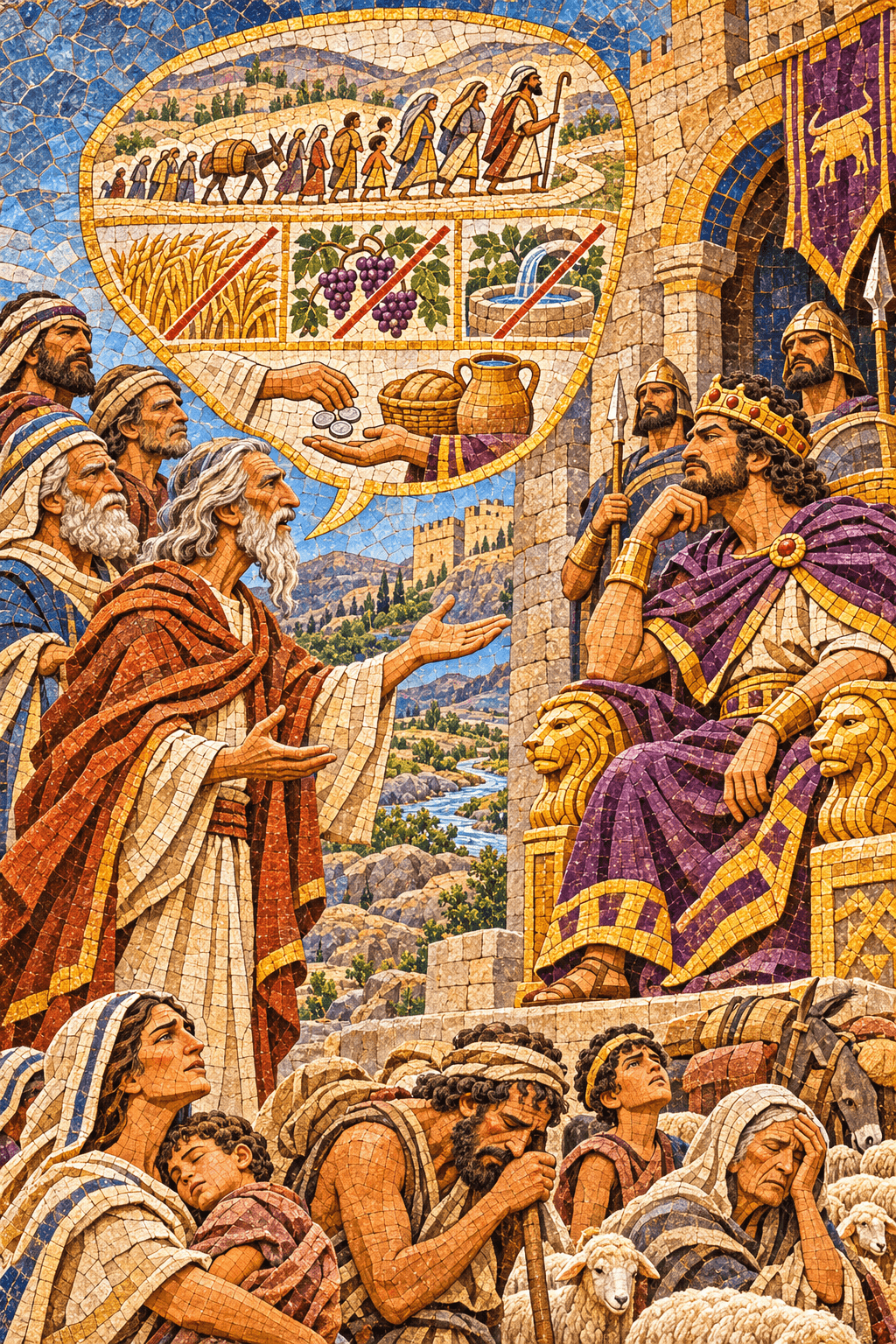
God, who asked His people to restrain themselves and not fight the children of Moab or the children of Ammon, despite their riches and their small number compared with His people, gave them what Sihon possessed as a gift and a grant in return for their obedience to Him.
(That also was accounted a land of giants: giants dwelt therein in old time; and the Ammonites call them Zamzummims; A people great, and many, and tall, as the Anakims; but the Lord destroyed them before them; and they succeeded them, and dwelt in their stead: As he did to the children of Esau, which dwelt in Seir, when he destroyed the Horims from before them; and they succeeded them, and dwelt in their stead even unto this day: And the Avims which dwelt in Hazerim, even unto Azzah, the Caphtorims, which came forth out of Caphtor, destroyed them, and dwelt in their stead.) Rise ye up, take your journey, and pass over the river Arnon: behold, I have given into thine hand Sihon the Amorite, king of Heshbon, and his land: begin to possess it, and contend with him in battle. This day will I begin to put the dread of thee and the fear of thee upon the nations that are under the whole heaven, who shall hear report of thee, and shall tremble, and be in anguish because of thee. [20–25]
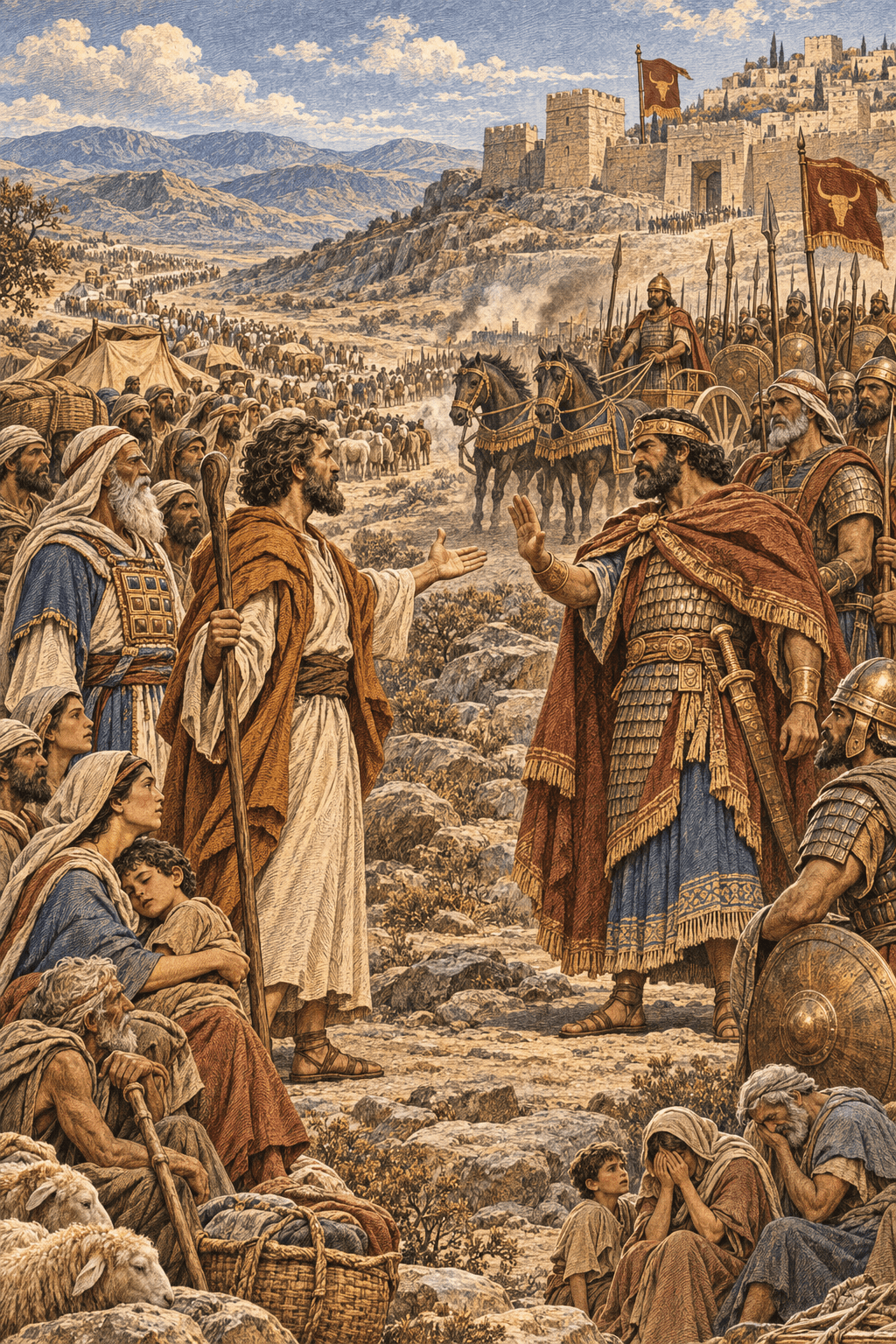
He gave them what belonged to King Sihon, yet they were not to acquire it while asleep; they were to enter the battle and struggle, though the Lord Himself fights for them and grants them victory through the battle, which symbolizes spiritual struggle. First, the enemy that resists the truth collapses; God is revealed in the midst of His children, declaring His presence within them; and finally those who struggle receive the spirit of victory and are glorified, as fear and awe of them, the gift of God Himself, fall upon others (Exodus 15:14).
Now the region from the Arnon in the south to the border of Og in Gilead in the north fell into the hands of the children of Israel, from the upper part of the river Jabbok in the east to the Jordan in the west. They took none of the land of the Ammonites, as the Lord had commanded (19).
The Zamzummims were perhaps the same as the Zuzims (Genesis 14:5). We know little about these ancient peoples.
The word “Azzah” (Gaza) here is derived from the Hebrew word hazerim; it is not the name of a particular town, but means “villages.” After the Caphtorims conquered the Avims, these were scattered in many places (Genesis 10:14), in ruined areas that reveal their condition as a people without strength.
Caphtor: an island or coastland from which the Philistines first came (Jeremiah 47:4; Amos 9:7). One theory holds that the name Caphtor was applied to western and southern Asia Minor, from Lydia to Cilicia; this theory is supported by the Septuagint, which translated Caphtor as “Cappadocia” in Deuteronomy 2:23 and Amos 9:7. The Egyptian words Keftiu and Kaptara were most often used for the island of Crete. Since this theory also has difficulties, the name Caphtor may have applied not only to Crete but to the surrounding islands and to Asia Minor as well. Note that the word “Cherethites,” a synonym for “Philistines” mentioned in Ezekiel 25:16 and Zephaniah 2:5, is translated in the Septuagint as “Cretans.” Genesis 10:14 says the Caphtorims descended from Mizraim, but it may refer to political dependence.
Although the Lord said He had given Sihon into Israel’s hand (24), Moses sent messengers to him asking to pass peacefully through his land. But Sihon, in the hardness of his heart, refused the request and went to battle against the children of Israel.
Moses asked to pass peacefully through Sihon’s land, not in disobedience to God, who had promised to give him his land, but in order to be a man of peace. What befell Sihon was the natural fruit of his violence and evil, so that God might reveal the violence in Sihon’s heart. What befell the Amorites was not because they were Israel’s enemies, but the fulfillment of divine justice.
Og too was defeated before the people of God, despite his power and resources:
A) Og was mighty, of the race of the giants (11); the size of his body is shown by the size of his extraordinary bed (Deuteronomy 3:11).
B) He was brave and bold, and was not shaken by Sihon’s defeat before Israel, but went to battle against them. He did not accept peace, and his evil fell on his own head (Deuteronomy 3:1–13).
Moses did not need assurance from God in order not to fear Og; yet God gave this assurance, not for Moses’ sake but for the people’s.
Bashan fell into Israel’s hands, and all the fruitful region east of the land became theirs. In this way God opened the door of hope before the people: as He had given them what was east of the Jordan, so He would give them what was west of it. And though Moses was denied crossing the Jordan and entering Canaan, he touched for himself the beginning and pledge of the inheritance in what the people received east of the Jordan. So through our struggle on earth we enjoy the heavenly pledge as our inheritance, opening before the eyes of our hearts the hope of crossing from the world to enjoy the heavenly Canaan.
The Amorites under King Sihon had seized part of the land of Moab; therefore God allowed His people to take this land.
And I sent messengers out of the wilderness of Kedemoth unto Sihon king of Heshbon with words of peace, saying, Let me pass through thy land: I will go along by the high way, I will neither turn unto the right hand nor to the left. Thou shalt sell me meat for money, that I may eat; and give me water for money, that I may drink: only I will pass through on my feet; (As the children of Esau which dwell in Seir, and the Moabites which dwell in Ar, did unto me;) until I shall pass over Jordan into the land which the Lord our God giveth us. But Sihon king of Heshbon would not let us pass by him: for the Lord thy God hardened his spirit, and made his heart obstinate, that he might deliver him into thy hand, as appeareth this day. And the Lord said unto me, Behold, I have begun to give Sihon and his land before thee: begin to possess, that thou mayest inherit his land. Then Sihon came out against us, he and all his people, to fight at Jahaz. And the Lord our God delivered him before us; and we smote him, and his sons, and all his people. And we took all his cities at that time, and utterly destroyed the men, and the women, and the little ones, of every city, we left none to remain: Only the cattle we took for a prey unto ourselves, and the spoil of the cities which we took. From Aroer, which is by the brink of the river of Arnon, and from the city that is by the river, even unto Gilead, there was not one city too strong for us: the Lord our God delivered all unto us: Only unto the land of the children of Ammon thou camest not, nor unto any place of the river Jabbok, nor unto the cities in the mountains, nor unto whatsoever the Lord our God forbad us. [26–37]
Kedemoth: a Hebrew name meaning “eastern places.” It was a town in the district east of the Sea of Lot, on the upper course of the Arnon valley, which the prophet Moses occupied and from which he sent messengers to King Sihon. Some hold it is Qasr ez-Za‘faran, two and a half miles northwest of the town. It was given first to the tribe of Reuben (Joshua 13:18), and then to the Levites of the family of Merari (Joshua 21:37; 1 Chronicles 6:79).
Jahaz, or Jahazah (Joshua 13:18; 21:36): a Moabite name meaning “a trodden place.” It was a Moabite town near the desert, where the battle between the Hebrews and Sihon took place; the Hebrews won and took the land between the Arnon and the Jabbok, though it seems the Moabites later recovered it. It is thought to lie a mile south of Zerqa Ma‘in and twelve miles east of the Dead Sea; some say it is the village of Umm el-Walid or Khirbet Iskander. It became the portion of the tribe of Reuben.
Aroer: a Moabite and Hebrew name meaning “bare, naked.” A town north of the Arnon River in Moab, south of the Amorite kingdom of Sihon. It is now called Ara‘ir, twelve miles east of the Dead Sea, a little south of Dhiban. It became the portion of Reuben. Hazael king of Syria seized it after the Gadites and Mesha king of Moab had occupied and fortified it, and it belonged to Moab in the days of the prophet Jeremiah (Jeremiah 48:19).
Arnon: a Hebrew word meaning “roaring,” the name of a river now called Wadi Mujib in the Hashemite Kingdom of Jordan. It is formed by Wadi el-Wala from the northeast, Wadi Enqeila from the east, and Seil es-Sa‘ideh from the south. The Arnon runs in a deep gorge until it reaches the Dead Sea at a point a short distance from the middle of the eastern shore. In the days of the prophet Moses the Arnon was the boundary between the Moabites in the south and the Amorites in the north (Numbers 21:13, 26). In the age of the Judges, the Arnon was the southern boundary of the tribe of Reuben, separating them from Moab (Joshua 13:16). The town of Aroer lies on its northern bank, and nearby is an ancient crossing, perhaps the place called “the fords of Arnon” (Isaiah 16:2).
Jabbok: meaning “flowing,” a river now known as the Zarqa River. It rises near Amman, turns first east and then north, passes the town of Zarqa named after it, then turns west and flows into the Jordan at a point about 13 miles south of the Sea of Galilee and 23 miles north of the Dead Sea. Jacob crossed this river and wrestled there with an angel (Genesis 32:22–30). The Jabbok was a natural boundary between Sihon king of the Amorites and Og king of Bashan. The Hebrews took the lands along its lower course.
Caphtor (23): perhaps Crete. The Caphtorims are the Philistines who came to the southern shores of Palestine around the time of the Exodus (compare Joshua 13:3; Amos 9:7). This name shows that the book was written at an early date.
“Utterly destroyed” (34): what is devoted to destruction here is the thing or person dedicated to the worship of strange gods. These are to be hated as sin must be hated, because they are corrupt and corrupting, like a garment carrying the plague that deserves nothing but burning, lest the curse fall on those who spare them.
“The cities in the mountains” (37): this region is at the sources of the Jabbok, and the Ammonites lived there east of the plain (Deuteronomy 3:10). This description is that of an eyewitness.
5. A Meditation on Deuteronomy 2
I Have Circled the Mountain Long Enough!
In Your surpassing love You cry out to me:
“You have circled this mountain long enough!”
My heart has been bound to the dangerous mountain of the self.
In foolishness I sometimes grow slack and careless for the body’s comfort.
And if I move, I circle around myself,
thinking myself the center of the world,
and my heart closes before everyone for the sake of myself.
Grant me the spirit of wisdom and discernment, that my soul may go forth in love.
I long to walk on Your royal road,
the road of humility with self-giving love!
Your gifts to me and to my brethren are many.
Let me thank You for what You have given me,
and in love respect the rights of my brethren.
Let me not trespass on my brethren’s border, not even a foot breadth!
Nor be careless in my obligations toward You and toward my brethren!
Grant me the spirit of discernment,
O All-Wise One!
Notes and References
[33] Matthew Henry Commentary.
[34] Adam Clarke Commentary.