
Chapters 1–4: The First Sermon
Nothing prepares a person for success like reviewing past events and benefiting from the experience of those who went before. Therefore the prophet Moses spoke with the new generation, born in the wilderness, before it entered the Promised Land, reminding them of God’s dealings with their fathers. His aim was not to present a historical account, but to confirm the following:
1. God’s care for man, especially in the wilderness of this world (Deuteronomy 1:31; 2:7).
2. Disobedience was the reason their fathers were deprived of enjoying the Promised Land; therefore he urges them to obey.
3. Offering thanks to God instead of murmuring and ingratitude for His gifts and care.
4. Through the commandment and worship we enjoy life (Deuteronomy 4).
The people reached Kadesh-barnea on the border of the Promised Land (Deuteronomy 1:9–19). When the people murmured and refused to enter (Deuteronomy 1:16–33), God commanded them to wander in the wilderness until that generation died (Deuteronomy 1:34–40). The tribes set out northward and passed through Edom (Deuteronomy 2:1–18), and reached Moab (Deuteronomy 2:19–25). Then the command was given allowing them to pass through the land of the Amorites, but Sihon king of the Amorites and Og king of Bashan prevented them, so God delivered both into the hands of His people (Deuteronomy 2:26–3:17).
So Moses led his people toward Canaan to stand at its border and hand them over to his disciple Joshua. He himself was not allowed to enter the Promised Land, because of his doubt in God’s promise at Meribah, or because he struck the rock twice (Deuteronomy 3:18–29; 32:51; Numbers 20:11–12).
As a Man Carries His Son
The book opens with an introduction to the farewell sermons of the prophet Moses, describing the circumstances, date, and place of their delivery. It is like a historical preface presented by the King of kings to declare His dealings with His people in the past, when they were in the wilderness without human help. In this way He urges them to accept the divine covenant and respond to the bond between God and His people. The first sermon contains a historical review of the journey from Horeb to the land of Moab (chapters 1–3).
In this chapter he shows God’s care for His people in the midst of the wilderness, and the people’s sharing in decisions with the prophet Moses. God had chosen Moses as leader at a time when the people were unable to make a decisive choice, and He gave them a leader who loved the people and wished them to share with him. Yet the people met all this with disobedience, ingratitude, and mistrust.
1. Introduction
KJV · Verses 1–5
1 These be the words which Moses spake unto all Israel on this side Jordan in the wilderness, in the plain over against the Red sea, between Paran, and Tophel, and Laban, and Hazeroth, and Dizahab. 2 (There are eleven days’ journey from Horeb by the way of mount Seir unto Kadeshbarnea.) 3 And it came to pass in the fortieth year, in the eleventh month, on the first day of the month, that Moses spake unto the children of Israel, according unto all that the Lord had given him in commandment unto them; 4 After he had slain Sihon the king of the Amorites, which dwelt in Heshbon, and Og the king of Bashan, which dwelt at Astaroth in Edrei: 5 On this side Jordan, in the land of Moab, began Moses to declare this law, saying,
In this introduction Moses’ pastoral role appears. Despite his old age, for he had reached about 120 years, and despite knowing that he had fulfilled his mission and must hand the leadership to his disciple Joshua, he delivered three long addresses to the whole people. He is the faithful leader and teacher, who speaks with a tender yet firm fatherly spirit. He would not stop teaching his people until the last moments of his life.
The prophet Moses did not review his own achievements during the forty years of his ministry, though he had much to speak of; rather, he reviewed God’s work with them, concerned for their salvation and their eternity. What occupied him was not his success in the work, but his people’s enjoyment of God, so that the people would accept entering into a covenant with God and not with Moses. He showed that he truly sought, with sincerity, what was for their edification and growth, not for himself.
Although the people were about to enter an unbroken series of battles with the nations living in the Promised Land, Moses did not speak about military matters or the organization of their new life. All that occupied him was their relationship with God, as the living foundation of their victory and growth in every aspect of life.
These be the words which Moses spake unto all Israel on this side Jordan in the wilderness, in the plain over against the Red sea, between Paran, and Tophel, and Laban, and Hazeroth, and Dizahab. [1]
The name of Moses appears 99 times in the New Testament, and each of these sheds light on this book.
“All Israel”: here we find one of the expressions characteristic of the Book of Deuteronomy, “the people of the Lord.” Moses addresses the whole people, all Israel, and calls them to listen. This does not mean that Moses spoke directly to the entire people, which was practically impossible; the Jews hold that Moses spoke to the elders of Israel, and they spoke to the people. The expressions “the elders of Israel” and “the people” are often used as equivalents, as in Exodus 12:3, 21 and Leviticus 9:1, 5.
The repeated use of the expression “all Israel” (1) in this book confirms God’s dealings with them as one people, not because they were descended from Jacob, but because they were bound together in unity in a covenant with God. This covenant is the covenant of the whole community, through which every believer enjoys a personal relationship with God, as though the covenant were made with him personally, yet without isolation, individualism, or selfishness. God establishes His Church as one bride, and makes us members of the one bride united to her Bridegroom.
In saying “on this side Jordan” (1, 5), meaning “east of the Jordan,” it does not necessarily mean that the writer was west of the Jordan when he described the east in this way. It was an old customary expression for “Transjordan,” and it is still used in our own time. Some, however, hold that the introduction and conclusion of the book were written by Joshua the son of Nun or by Eleazar the scribe after Moses’ sermons were recorded.
This expression occurs 18 times in Deuteronomy and Joshua to describe one side of the Jordan, the other side, or the whole region of the Jordan. In 12 of these it means the eastern side, and in the other six the western side. Sometimes explanations are added to specify the side intended.
The writer defines the place where the prophet Moses delivered his sermon as follows:
First: “In the wilderness.” Its literal Hebrew meaning is “a place for driving cattle,” that is, a wide pasture; it is used for any uninhabited place, whether fertile or barren. As long as we are in the wilderness of this world, we need the word of God. The commandment is a companion in our sojourning; we say with the Psalmist, “I am a stranger in the earth: hide not thy commandments from me” (Psalm 119:19).
Origen says:
“Whoever loves earthly things and their lusts does not think of being with Christ after his departure, and cannot say, ‘I am a stranger in the earth,’ since he cares for the things of the earth. But whoever says, ‘Hide not thy commandments from me,’ is a saint… Therefore the prophet asks God to reveal to him the greatness of His commandments for the heavenly life. [19]”
Saint Augustine says:
“Being a stranger on earth, the Psalmist prayed that God’s commandments would not be hidden from him, enjoying love as a unique or principal thing. Now he declares that he longs to have love for the sake of His judgments. This longing deserves praise, not condemnation. [20]”
Second: “In the plain” (the Arabah). “Arabah” is a Hebrew name meaning “desert.” Here it refers to the depression from the Dead Sea to the Gulf of Aqaba and similar lands; the Arabs today still call this region “al-Arabah.” In Ezekiel 47:8 it refers to the area from the north of the Dead Sea to the Gulf of Aqaba, about a hundred miles long. It is also mentioned in Joshua 11:2; 12:1 and Amos 6:14. In the midst of the bitterness of the desert, God offers us His word, and we repeat: “How sweet are thy words unto my taste! yea, sweeter than honey to my mouth!” (Psalm 119:103).
The word of God has a special sweetness, sweeter than all the philosophies, knowledge, and wisdom of the world. How different is the one who studies the word of God in a dry, merely human and rational way from the one who eats it to be nourished by it, finding it satisfying and sweet food, more delightful than honey and the honeycomb! It gives sweetness to the soul and turns the dryness of our hard heart into the sweetness of a broad and gentle love. It is as if the word of God, in its sweetness, transforms the believer into a sweet life, so that others delight in fellowship with him.
Saint Isaac, Bishop of Nineveh says:
“Sometimes certain verses of Scripture have an increasing sweetness in the mouth (Psalm 119:103), so that a person may repeat a simple verse (from the Holy Bible) in prayer many times without being satisfied, or moving on from it to another verse. [21]”
Saint Gregory of Nazianzus says:
“The words of God became sweet to me like honey from the comb; I cried out for knowledge and lifted up my voice for wisdom. [22]”
Third: “Over against Suph” (the Red Sea). The Hebrew word suph means “red,” and it refers to the Red Sea when joined with the word yam, “sea”; it can also mean “whirlwind.” Since that word is not mentioned here, it means a place in or adjoining the plains of Moab called “Suphah.” Ptolemy mentioned a people called the Sophonites who lived in Arabia Petraea, and this people most likely took its name from the place “Suph.” [23]
Wherever the word of God is repeated, it is “over against Suph,” over against the Red Sea, because the aim of the word is to bring us across from the land of bondage into the heavenly Canaan. This cannot happen without the waters of baptism, where we enjoy baptism with the Lord Christ, and receive through His Holy Spirit the spirit of adoption to God.
Fourth: “Paran” is the name of the wilderness on the border of Idumea, where the Israelites encamped (Numbers 10:12; 12:16). It lies south of the Jordan toward Mount Sinai. This wilderness is most likely the Wilderness of Wandering (al-Tih), an irregular flat expanse extending from the al-Tih mountain range in the south to the borders of the Holy Land, and from the Gulf of Aqaba and Wadi Arabah in the east to the Gulf of Suez and the Mediterranean Sea in the west.
The wilderness of Paran holds many memories. Among them, the people journeyed to it from Hazeroth (Numbers 12:16) after Miriam, Aaron’s sister, was healed of her leprosy through her brother’s intercession, despite her murmuring against him. Origen holds that the word “Paran” means “the visible mouth,” pointing to the divine Incarnation. With Miriam healed of the leprosy of unbelief, the procession set out for Paran, that is, toward faith in the divine Incarnation as the way of crossing over to heaven and listening to the incarnate Word of God.
Fifth: “Tophel” is a Hebrew name meaning “lime.” It may be the place now called Tafileh, a large village of about 600 people between Bozrah and Kerak on the eastern side of the mountains of Edom, about 14 miles southeast of the Dead Sea. Lime was used to plaster walls so that the enemy could not climb them during battle. In the same way, the word grants us strength, so that the enemy cannot steal in upon us and climb our walls.
Sixth: “Laban” is a Hebrew name meaning “white.” It is also called Libnah, the second station where the Israelites encamped on their return from Kadesh (Numbers 33:20–21). [24] The color white symbolizes purity, for the aim of the divine word is the enjoyment of purity.
Seventh: “Hazeroth” [25] is perhaps Ain Khadra, about 36 miles northeast of Mount Sinai. There Miriam, and Aaron as well, murmured against Moses, and Miriam became leprous (Numbers 12). The word “Hazeroth” means “settlement.” Origen holds that it means “a complete (settled) building” or “blessedness,” while others hold that it means “courts” or “enclosures.” For the aim of the commandment is to settle in the bosom of the Father.
It is supposed to be the place mentioned in Numbers 11:35; 12:16, from which the Israelites entered the wilderness of Paran. But since the other places named here are on the eastern side of the Arabah, Hazeroth here may be different from the one mentioned in the Book of Numbers, which must be farther from Sinai, perhaps at El-Hudherah. There are probably many places bearing the name Hazeroth.
Eighth: “Dizahab.” This is probably not Dahab on the Gulf of Aqaba, for there are many places called “Dahab.” Its meaning is “one who has gold.” Gold points to heaven, for the aim of the commandment is that the heart set out toward heaven, so that the whole person may enjoy the heavenly life.
There are eleven days’ journey from Horeb by the way of mount Seir unto Kadeshbarnea. [2]
In short, the place where Moses delivered his first farewell sermon, presenting God’s commandment to the new generation, reveals the work of the word of God in the life of the believer:
- “The wilderness” points to man’s need for the commandment as a companion in his sojourning on earth.
- “The plain” (Arabah) points to the sweetness of the commandment in the midst of the desert of this world.
- “Over against Suph” shows our need to enjoy the waters of baptism, as those who cross the Red Sea with the people of God, setting out from the land of bondage toward the heavenly Canaan.
- “Paran” reminds us of the Incarnation of the Word, who came to speak His commandment with us mouth to mouth.
- “Tophel” shows our need for the commandment as a wall plastered with lime, which no enemy can climb.
- “Laban” confirms the aim of the commandment: entering into purity.
- “Hazeroth” declares the inner settledness we enjoy through obedience to the divine commandment.
- “Dizahab” lifts our hearts to heaven, which can only be realized through the commandment as a royal, divine, and heavenly way.
Jewish interpreters hold that the places mentioned here point to the regions where the people clearly sinned. [26] As we said before, the Jews regard Deuteronomy as “the book of reproofs.” It is as if the prophet Moses proclaims the necessity of renewing the covenant with God in the very places of sin, where God alone can lift us up and carry us in His arms to the Promised Land, granting us His rich and satisfying promises.
To this day, distances in the Middle East are sometimes reckoned by the hours or days travelers spend on the road. A day’s journey on foot is about 20 miles; by camel (in the desert) about 3 miles an hour, or 30 miles a day; and by caravan about 25 miles. But since the Israelites traveled with their children and flocks and carried many of their possessions, their journey was slower than the usual rate. Some hold that it did not exceed ten miles a day, and sometimes only five.
“Horeb” literally means “desolation” (compare Jeremiah 44:2). It is a name given to the region around Mount Sinai, where God first appeared to Moses (Exodus 3:1). The prophet Moses distinguishes two main periods in the wilderness journey. The first is the period of the old generation, murmuring, ungrateful, and unbelieving, which lasted nearly forty years of wandering. The second is the eleven-day journey.
Kadesh-barnea: “Kadesh” means “holy,” and there are many places by this name. Kadesh-barnea lies in the far south of Judea. It was Israel’s first station on the journey from Sinai; from there the spies were sent, and there they returned (Numbers 13:26; 20:1). It is an eleven-day journey from the mountain of Moses (165 miles).
The prophet Moses refers to the eleven-day journey from Mount Sinai, or Horeb (Deuteronomy 1:19; 4:10, 15), to Kadesh-barnea, where the people stood at the entrance of the Promised Land. They had made a journey of nearly forty years that was nothing but wandering because of unbelief, whereas an eleven-day journey brought them to the gates of the Promised Land. The eleven-day journey with faith made up for nearly forty years of wandering caused by unbelief. So faith works in our lives to restore the years that the locust has eaten.
Sin, especially unbelief, leads a person into a state of wandering, so that he does not know where he is going. It turns short roads into long wanderings. But the journey of faith carries the soul in a short time to the gates of heaven, to the open, heavenly Canaan.
And it came to pass in the fortieth year, in the eleventh month, on the first day of the month, that Moses spake unto the children of Israel, according unto all that the Lord had given him in commandment unto them. [3]
The address was given on the first day of the eleventh month of the fortieth year. Miriam had died in the first month of the same year (Numbers 20:1), and now Moses was to die in that same year. It is as though entering the Promised Land required new leadership in place of Miriam, Aaron, and Moses, for preparation had to be made for Joshua to take the leadership, so that the new generation might enjoy the new land.
What Moses had done in the wilderness was nothing but God’s work with him, through him, and in him. So, shortly before his departure, what he speaks are God’s words in his mouth, as it says: “according unto all that the Lord had given him in commandment unto them” (3).
After he had slain Sihon the king of the Amorites, which dwelt in Heshbon, and Og the king of Bashan, which dwelt at Astaroth in Edrei. [4]
In our study of Numbers 21, we saw that Origen holds that the name “Sihon” means “haughty” or “barren tree,” pointing to the haughty, fruitless devil. [27] The name “Heshbon” means “thought,” though some hold that it means “reckoning.” Origen says:
“Why is the capital of King Sihon called Heshbon? Because Heshbon means thought, which is the most important part of the kingdom of the devil; it is the foundation of his power. [28]”
Heshbon had been the capital of Moab; Sihon seized it and made it the capital of his kingdom. Bashan lay on the eastern border of the Sea of Galilee. Ashtaroth, the capital of Og, lay a little more than twenty miles east of the Sea of Galilee, and Edrei less than 20 miles southeast of Ashtaroth. Sihon ruled the southern part of Transjordan, while Og ruled the northern part.
On this side Jordan, in the land of Moab, began Moses to declare this law, saying. [5]
“To declare this law” means that he did not intend to repeat the old laws, but to explain them in a way that would build up the new generation entering the land of Canaan. God’s commandment does not change, but it is presented to each generation according to what satisfies it, in keeping with its needs and circumstances.
The word “declare” in Hebrew literally means “to dig” or “to go deep into.” It is as though the prophet Moses saw the divine Law as a mine of riches; the believer must dig in the mine and go into its depths to discover its riches and carry them with him, enjoying them himself as his brethren also enjoy them. There is a difference between someone who hears about the word of God and someone who goes into its depths and acquires it for himself as a true, priceless treasure.
The word “law” comes in the singular, meaning that what is in the book forms one complete, indivisible whole. The word became the name of all five books (Ezra 7:6; Matthew 12:5), and was then applied to the whole Old Testament (John 10:34; 15:25). It occurs 35 times in Psalm 119.
2. God Fulfills His Promise to Their Fathers
KJV · Verses 6–8
6 The Lord our God spake unto us in Horeb, saying, Ye have dwelt long enough in this mount: 7 Turn you, and take your journey, and go to the mount of the Amorites, and unto all the places nigh thereunto, in the plain, in the hills, and in the vale, and in the south, and by the sea side, to the land of the Canaanites, and unto Lebanon, unto the great river, the river Euphrates. 8 Behold, I have set the land before you: go in and possess the land which the Lord sware unto your fathers, Abraham, Isaac, and Jacob, to give unto them and to their seed after them.
Having set out the date and the place of the address, he begins the first sermon, opening it by revealing God’s longing to fulfill His promise to His people.
(See verses 6–8 above.)
The prophet Moses relates God to His people, saying, “The Lord our God” (6), “The Lord your God” (10), “The Lord God of your fathers” (11). For God is the God of the Church (Deuteronomy 5:6), and she is the Church of God, His own people. The relationship between the heavenly Bridegroom and His bride is personal!
If the people long to enter the Promised Land and enjoy its good things, God longs even more to fulfill His promises with us. He urges us to move, to set out on His way and enter the open gates of heaven, to open our mouths that He may fill them, and to stretch out our hands to receive His blessings.
The Amorites and the Canaanites: Palestine was known from ancient times as the land of Canaan, and its inhabitants as the Canaanites (Genesis 10:19; 12:6). The Amorites are mentioned in monuments dating back to the thirtieth century B.C., and they infiltrated Canaan. The name “Amorites” was used to refer to all the inhabitants of Canaan, since they were the strongest nation there.
Indeed, the prophet Moses did not enter the Promised Land, yet he set out its boundaries for his people:
- The plain (Arabah): the valley of the Jordan River from the Sea of Galilee to the region south of the Dead Sea.
- The mount of the Amorites: in the south, toward the Dead Sea. The south (Negev) is the region north of Sinai and south of the mount of the Amorites.
- The land of the Canaanites, that is, Phoenicia, where the city of Sidon lies, and the Mediterranean coast toward the west.
- Lebanon in the north.
- The great river, the river Euphrates, toward the east.
This was fulfilled literally in the days of King Solomon (1 Kings 4:21), so that God’s promise to Abraham, Isaac, Jacob, and his sons, the heirs of the promise, was accomplished (Genesis 12:7; 13:15; 15:18; 26:3–4). This promise was confirmed to the prophet Moses at the burning bush (Exodus 3:8, 17).
Ye have dwelt long enough in this mount. [6]
He had already given them the Law, cared for them all along the way of the wilderness, and led them Himself day and night. Now He gives the command to move, in preparation for entering the Promised Land. God asks us to move at the right time; He knows when we must rest and when we must move. He calls us to go out and set forth toward the mountains of eternity, so that we may find a place for ourselves in His bosom.
Israel lived nearly 40 years wandering in the wilderness, but the cause of the delay was man, slow and disobedient and unprepared to enter. On God’s side, from the beginning He almost takes us by the hand and draws us to set out with Him toward the Promised Land, urging us: “Ye have dwelt long enough in this mount: Turn you, and take your journey… go in and possess the land” (6–8). He wants to hasten us on, carrying us as a son in his father’s bosom (Deuteronomy 1:31), so that we may reign (Deuteronomy 1:21; Revelation 3).
Behold, I have set the land before you. [8]
While God was preparing the people for nearly forty years in the wilderness to enter the Promised Land, He was also preparing for them the land they would inherit, so that it would lie before them, easy and clear. So God prepares our hearts during the journey of this world, so that the heavenly Canaan may be before our eyes, the place of which He said, “I go to prepare a place for you” (John 14:2).
“Which the Lord sware unto your fathers”: the promise confirmed to the fathers by an oath is mentioned again and again (Genesis 22:16). Moses constantly reminds the people that God’s love was not given to them because of any merit in them (Deuteronomy 7:7; 9:4), but out of God’s pure grace and His early promises. The elements of this promise, a multitude of descendants, possession of the holy land, and the gift of a comprehensive blessing, are all repeated here.
3. The People Share in Managing Their Affairs
KJV · Verses 9–18
9 And I spake unto you at that time, saying, I am not able to bear you myself alone: 10 The Lord your God hath multiplied you, and, behold, ye are this day as the stars of heaven for multitude. 11 (The Lord God of your fathers make you a thousand times so many more as ye are, and bless you, as he hath promised you!) 12 How can I myself alone bear your cumbrance, and your burden, and your strife? 13 Take you wise men, and understanding, and known among your tribes, and I will make them rulers over you. 14 And ye answered me, and said, The thing which thou hast spoken is good for us to do. 15 So I took the chief of your tribes, wise men, and known, and made them heads over you, captains over thousands, and captains over hundreds, and captains over fifties, and captains over tens, and officers among your tribes. 16 And I charged your judges at that time, saying, Hear the causes between your brethren, and judge righteously between every man and his brother, and the stranger that is with him. 17 Ye shall not respect persons in judgment; but ye shall hear the small as well as the great; ye shall not be afraid of the face of man; for the judgment is God’s: and the cause that is too hard for you, bring it unto me, and I will hear it. 18 And I commanded you at that time all the things which ye should do.
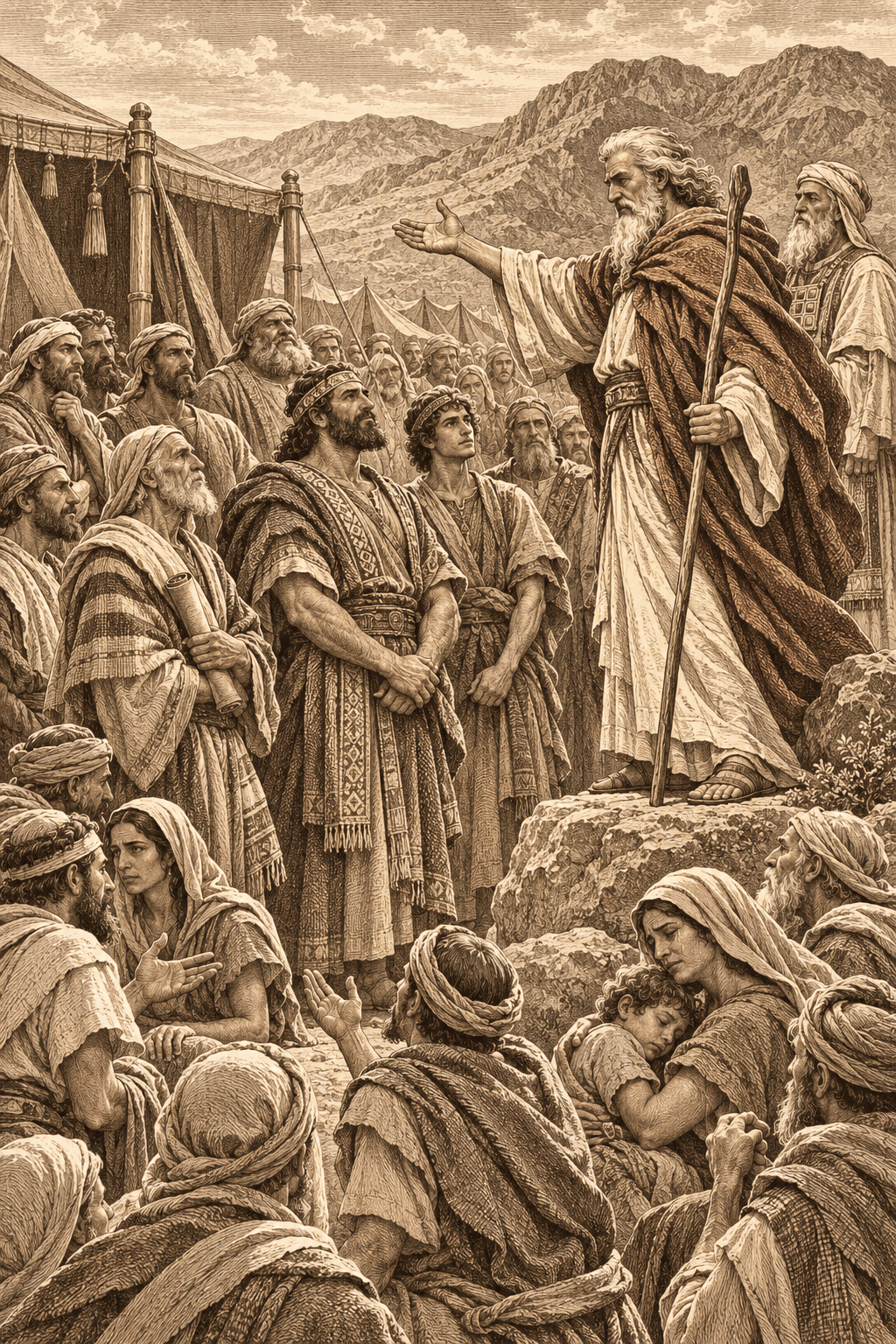
The prophet Moses is a wonderful person. He begins his sermon by revealing God’s tenderness toward His people, and follows this by speaking of his own weakness, for he could not bear the burden of the people.
And I spake unto you at that time, saying, I am not able to bear you myself alone: The Lord your God hath multiplied you, and, behold, ye are this day as the stars of heaven for multitude. (The Lord God of your fathers make you a thousand times so many more as ye are, and bless you, as he hath promised you!) How can I myself alone bear your cumbrance, and your burden, and your strife? Take you wise men, and understanding, and known among your tribes, and I will make them rulers over you. [9–13]
The prophet Moses did not mention that this arrangement had been suggested by his father-in-law Jethro (Exodus 18:13–26); he only mentioned that he asked for seventy elders to be appointed to help him bear the burden of the people. These later became the council of the Sanhedrin, which, instead of bearing the people’s burden with Moses and leading them to the Messiah, the Savior, condemned the Lord Christ to death and resisted the spirit of the Law of Moses under the pretext of defending it and preserving its letter.
The aim of Moses, as the representative of the Law, was to lead the believers to Christ, so that all might experience the sweetness of the evangelical life and enjoy the pledge of heaven; and it was fitting that the council of the Sanhedrin bear the same spirit. So the aim of every priest is to preach the word of God and bring every soul into the experience of the new, risen life. It is fitting for deacons, who represent for the priest what the council was for Moses, to follow the same line as they serve tables, as the seven chosen deacons did in the days of the apostles (Acts 6), and as is clear from the speech of the archdeacon Stephen (Acts 7).
The prophet Moses recorded the choice of the seventy elders as his helpers, perhaps as one of his mistakes, since he felt unable to carry the burden, not realizing that God is the One who carries it. Some hold that he recorded this to show his people that he did not wish to rule alone, but sought partners in the work, and gave the people the right to choose their leaders (13).
As a true leader, the prophet Moses regarded rule or greatness as a burden he was bound to carry on his shoulders. With keen insight he sought help, and asked for capable persons to share with him in bearing this burden. As leader of the people, the prophet Moses did not crave one-man rule, though he deserved that honor and did works no one else could do; rather, he sought those who would support him in governing and share the responsibility and the honor with him.
In the Book of Exodus we see Moses, the great among the prophets, not despising the counsel of a pagan, for “Moses hearkened to the voice of his father in law, and did all that he had said” (Exodus 18:24). Moses, who for love of God and His people despised the royal court with all its possibilities (Hebrews 11:24, 26), listens in a spirit of humility to the voice of Jethro and heeds him. Saint John Chrysostom comments:
“If Moses learned from his father-in-law fitting things he did not know, how much more should this happen within the Church (that is, that we benefit from others)…? How did it happen that an unbeliever perceived things the spiritual man did not perceive? [29]”
And, behold, ye are this day as the stars of heaven for multitude. [10]
God’s promise to Abraham was fulfilled (Genesis 15:5–6). Some may ask: the stars seen through a telescope number more than 75 million; were the people entering Canaan equal to that number? We answer that when God promised Abraham this, He asked him to go out and look at the sky with his eyes, not with a telescope, and the eye usually sees about 3,000 stars. In the second census we find 603,000 Israelite men of war, so the promise was fulfilled beyond what Abraham himself imagined.
He says, “ye are this day as the stars of heaven for multitude” (10), and not “as the sand of the sea,” for he sees them as bright stars enjoying heavenly glory; therefore he counts them as the stars of heaven.
In His care, He blesses His people and keeps increasing their blessing without ceasing (Deuteronomy 1:10–11). In Egypt the people multiplied greatly over about 250 years, which aroused Pharaoh’s envy and fear (Exodus 1:9). Now their number had greatly increased over about forty years, and this was a source of joy to Moses, who asked for them a blessing a thousand times over.
Take you wise men, and understanding, and known among your tribes, and I will make them rulers over you. And ye answered me, and said, The thing which thou hast spoken is good for us to do. So I took the chief of your tribes, wise men, and known, and made them heads over you, captains over thousands, and captains over hundreds, and captains over fifties, and captains over tens, and officers among your tribes. [13–15]
Officers: the officers are those who supervise the practical carrying out of what the chiefs, judges, or other leaders decide. Just before the Exodus, these officers were overseers working under the Egyptian taskmasters, counting bricks (Exodus 5:6). Now they serve as captains of thousands, hundreds, and tens, not under slavery but for justice and victory (Deuteronomy 16:18; 20:5, 8–9; 29:10; 31:28).
He asked them to choose from among themselves those who would take up leadership and bear responsibility, and he set conditions for them:
A) That they be “wise” (chakamim): those who have gained a large share of knowledge through diligence and study.
B) “Understanding” (nebonim): those who have a spirit of discernment and can judge justly.
C) “Known” (yeduim): those who have practical experience and have proved able to do great works.
The prophet Moses did not require that the leaders have worldly honor or wealth, but that they be wise, understanding, and experienced. In the same spirit, the Lord asked the people to choose capable servants (deacons), wise and full of the Spirit, to serve the poor (Acts 6:3–6).
And I charged your judges at that time, saying, Hear the causes between your brethren, and judge righteously between every man and his brother, and the stranger that is with him. [16]
In the tribal system of Israel there were four classes of people:
- “The seed of the fathers,” including the elders and chiefs.
- “Strangers,” those from other nations whom they received to live among them.
- “Sojourners” (Leviticus 25:35), from the defeated peoples.
- “Servants,” those bought with money or born in the house.
There was also the “foreigner,” who lived among them temporarily for trade or other purposes (Deuteronomy 17:15). The stranger was to be treated as a brother, and the same treatment was due to anyone who might be exposed to oppression. This is one of the distinctive features of Deuteronomy, not found in the laws of Egypt and Babylon at that time (see Deuteronomy 10:18–19).
Ye shall not respect persons in judgment; but ye shall hear the small as well as the great; ye shall not be afraid of the face of man; for the judgment is God’s: and the cause that is too hard for you, bring it unto me, and I will hear it. And I commanded you at that time all the things which ye should do. [17–18]
If God, in His love for man, urges him to accept His promises so that he may enjoy them, the prophet Moses, as God’s servant, respects the will of the people. In his love for them he wished to carry all their burdens by himself, alone; but as their number grew he felt very unable. He rejoiced that they had multiplied, and longed for them to increase a thousand times, not only in number but in glory; therefore he called them “the stars of heaven” (10).
The prophet Moses gave the chosen men a rule of work, summarized as follows:
A) That they love to listen (16), not judging hastily without hearing all parties, but listening with all patience and care. The prophet Isaiah says: “The Lord God hath opened mine ear, and I was not rebellious” (Isaiah 50:5).
B) That they be just in judgment, not respecting persons (17), judging justly between their own people and strangers.
C) That they fear no man; as God’s judges they should judge with courage, for God protects and delivers them; otherwise He Himself will judge and condemn them.
D) That they not be ashamed to admit their inability when a matter is too hard for them, but bring it to the prophet Moses in person (17).
E) That they keep the order carefully, for judgment proceeds in the following order:
- God, the King and the supreme Judge.
- Moses, the man of God and His deputy.
- The priests, who consult God by the Urim and Thummim.
- The heads of the tribes, or princes.
- Captains of thousands (chiliarchs).
- Captains of hundreds (centurions).
- Captains of fifties (tribunes).
- Captains of tens (decurions).
- Officers, who are appointed only to carry out decisions.
So all submit first to God, from whom all receive their authority and before whom they are judged, and each submits to the one of higher rank.
For his part, the prophet Moses declared that he could not carry the burdens of God’s people alone. So he appointed leaders from among them for war, for managing the affairs of the tribes, and for judgment (Deuteronomy 1:9–17), without withdrawing from his own responsibility, especially in difficult matters (Deuteronomy 1:17). The people, for their part, met God’s love and Moses’ care with doubt and murmuring.
4. Doubt and the Sending of the Spies
KJV · Verses 19–40
19 And when we departed from Horeb, we went through all that great and terrible wilderness, which ye saw by the way of the mountain of the Amorites, as the Lord our God commanded us; and we came to Kadeshbarnea. 20 And I said unto you, Ye are come unto the mountain of the Amorites, which the Lord our God doth give unto us. 21 Behold, the Lord thy God hath set the land before thee: go up and possess it, as the Lord God of thy fathers hath said unto thee; fear not, neither be discouraged. 22 And ye came near unto me every one of you, and said, We will send men before us, and they shall search us out the land, and bring us word again by what way we must go up, and into what cities we shall come. 23 And the saying pleased me well: and I took twelve men of you, one of a tribe: 24 And they turned and went up into the mountain, and came unto the valley of Eshcol, and searched it out. 25 And they took of the fruit of the land in their hands, and brought it down unto us, and brought us word again, and said, It is a good land which the Lord our God doth give us. 26 Notwithstanding ye would not go up, but rebelled against the commandment of the Lord your God: 27 And ye murmured in your tents, and said, Because the Lord hated us, he hath brought us forth out of the land of Egypt, to deliver us into the hand of the Amorites, to destroy us. 28 Whither shall we go up? our brethren have discouraged our heart, saying, The people is greater and taller than we; the cities are great and walled up to heaven; and moreover we have seen the sons of the Anakims there. 29 Then I said unto you, Dread not, neither be afraid of them. 30 The Lord your God which goeth before you, he shall fight for you, according to all that he did for you in Egypt before your eyes; 31 And in the wilderness, where thou hast seen how that the Lord thy God bare thee, as a man doth bear his son, in all the way that ye went, until ye came into this place. 32 Yet in this thing ye did not believe the Lord your God, 33 Who went in the way before you, to search you out a place to pitch your tents in, in fire by night, to shew you by what way ye should go, and in a cloud by day. 34 And the Lord heard the voice of your words, and was wroth, and sware, saying, 35 Surely there shall not one of these men of this evil generation see that good land, which I sware to give unto your fathers. 36 Save Caleb the son of Jephunneh; he shall see it, and to him will I give the land that he hath trodden upon, and to his children, because he hath wholly followed the Lord. 37 Also the Lord was angry with me for your sakes, saying, Thou also shalt not go in thither. 38 But Joshua the son of Nun, which standeth before thee, he shall go in thither: encourage him: for he shall cause Israel to inherit it. 39 Moreover your little ones, which ye said should be a prey, and your children, which in that day had no knowledge between good and evil, they shall go in thither, and unto them will I give it, and they shall possess it. 40 But as for you, turn you, and take your journey into the wilderness by the way of the Red sea.
Some hold that Moses erred when he asked for a council of elders to support him in the work of leadership, because he felt the weight of the burden; and that the people erred when they asked for a committee of spies to explore the land the Lord had commanded them to enter and possess. [30]
The people’s error differs from Moses’ error, for the people’s action carried unbelief. Therefore ten spies returned speaking of the mighty giants who lived in Canaan, while Joshua and Caleb returned offering the good fruits of the land. The ten fixed their eyes on the resisting giants, while the two fixed their eyes and set their hearts on the truth of His divine promises.
Weak faith or unbelief draws our depths into fear and agitation before Satan, sin, and the world. Faith, however, draws a person’s heart and all his inner energies toward God’s promises, trusting that they can be fulfilled and counting every opposition as something that increases his faith and glory.
The prophet rebukes the people because they asked to send spies before entering the land of Canaan, something not mentioned in the Book of Numbers. They did not trust God’s promise but sought a human report; instead of letting the sun go before them to light their way, they asked to light the candles of the spies.
And when we departed from Horeb, we went through all that great and terrible wilderness, which ye saw by the way of the mountain of the Amorites, as the Lord our God commanded us; and we came to Kadeshbarnea. [19]
The prophet makes clear how dangerous the journey was: “we went through all that great and terrible wilderness” (19). Remembering the dangers that surrounded us moves us to give thanks to God, who led us through the danger.
God brings us into the great and terrible wilderness; it is not only a desert, but great and terrible as well. We enter it to learn spiritual warfare and to enjoy holiness (Kadesh). It is the narrow way of the cross, by which we pass from the desert into the garden of the Lord, full of fruit.
In this wilderness we enter a war not against flesh and blood, but against principalities and powers and the rulers of the darkness of this world (Ephesians 6). With the Apostle Paul we fight beasts at Ephesus, saying with the Lord Christ that this is the hour of the powers of darkness. We shall not cease fighting seven days a week.
And I said unto you, Ye are come unto the mountain of the Amorites, which the Lord our God doth give unto us. Behold, the Lord thy God hath set the land before thee: go up and possess it, as the Lord God of thy fathers hath said unto thee; fear not, neither be discouraged. [20–21]
The Hebrew word “inherit,” translated “possess,” means to enter and take possession of the land in place of another inhabitant, either by conquest or by inheritance. It occurs more than 52 times in Deuteronomy, even in the section on the statutes (for example Deuteronomy 19:2, 14; 23:20). The same original word is translated “possess” in Deuteronomy 2:31; 16:20.
Go up and possess it, as the Lord God of thy fathers hath said unto thee; fear not, neither be discouraged. [21]
God asks every soul to exercise its rights in three main things: going up, possessing, and not fearing. We are called to continual ascent, for whoever does not go up goes down and falls. In other words, unless a person ascends with his Christ to His heavens, enjoying the spirit of victory, he goes down with the devil to his hell.
“Possess”: whoever continually ascends enjoys a “royal” position, so that the King of kings counts him a “king” with authority.
“Fear not, neither be discouraged”: the Christian is a king and a leader; if he collapses in fear and trembling, he loses his position as a son of God. Fear is not the mark of the believer, but trust and certainty in the heavenly Father.
While God called them to ascend, to reign, and not to fear, their attitude was completely different, for they asked to spy out the land promised to their fathers. Instead of going up to become kings, they wanted to be spies; instead of taking pride in the royal authority given to them, and instead of trusting and being certain of God, they feared and trembled. What a painful attitude, and how often we fall into it!
And ye came near unto me every one of you, and said, We will send men before us, and they shall search us out the land, and bring us word again by what way we must go up, and into what cities we shall come. And the saying pleased me well: and I took twelve men of you, one of a tribe: And they turned and went up into the mountain, and came unto the valley of Eshcol, and searched it out. And they took of the fruit of the land in their hands, and brought it down unto us, and brought us word again, and said, It is a good land which the Lord our God doth give us. Notwithstanding ye would not go up, but rebelled against the commandment of the Lord your God: [22–26]
He asks them to enjoy in fullness what they had received as a pledge through the two spies. The two spies came as eyewitnesses to the good things of the land, but the people paid no attention to Caleb’s words and ignored Joshua’s testimony. Caleb and Joshua came offering what they had seen, tasted, and experienced.
The people of the Old Testament needed spies to taste the pledge of the good things of the Promised Land, but the people of the New Testament have enjoyed the incarnate Word of God, who carries them in Himself as members of His body, so that they receive the pledge of heaven. In this way He has brought the believers into the heavenly life, so that they may offer their lives as a living, practical testimony, having tasted in Him the sweetness of the good things to come. They are an embodied teaching of what they preach; their life speaks, and their conduct bears witness to what they proclaim.
The people had heard that the Promised Land flowed with milk and honey, but they needed leaders who enjoyed not merely abstract theoretical knowledge, but knowledge confirmed by sight and experience. The twelve spies went to the Promised Land, and complete information came into their hands about the fertility of the land and its possibilities, the fortifications of the cities, and the enemy’s numbers, size, and military experience. Yet they split into two groups. One group saw the data through a purely human lens, so their souls were crushed and they crushed the souls of the people; the other saw the data through a divine lens of faith, and their hearts burned with longing to cross over. To this day the Church needs leaders who turn knowledge into practical experience and see it through a true divine lens, so that they may cross over with those they serve to the heavenly divine promises.
And ye murmured in your tents, and said, Because the Lord hated us, he hath brought us forth out of the land of Egypt, to deliver us into the hand of the Amorites, to destroy us. Whither shall we go up? our brethren have discouraged our heart, saying, The people is greater and taller than we; the cities are great and walled up to heaven; and moreover we have seen the sons of the Anakims there. [27–28]
The first defense of any ancient city was its walls; if the enemy breached the wall, the city fell easily into his hands (2 Kings 25:4).
The walls of Jericho were known for their strength; therefore they were said to be “walled up to heaven” (28). Excavations show that its walls were double, surrounding the city on every side. The wall was more than 40 feet high and about 66 feet wide, built of stone below and brick above, covered with very smooth lime so that it could not be climbed during an attack. Some hold that the walls collapsed by divine design through a strong earthquake.
Then I said unto you, Dread not, neither be afraid of them. The Lord your God which goeth before you, he shall fight for you, according to all that he did for you in Egypt before your eyes; And in the wilderness, where thou hast seen how that the Lord thy God bare thee, as a man doth bear his son, in all the way that ye went, until ye came into this place. [29–31]
Despite the spies’ report about the fertility of the land (25) which the Lord was giving them, they were in terror and fear (26–29), not trusting the Lord who fights for them. The road is hard, a road of continual war (against the enemy of good), but it is the war of the Lord Himself, who goes before us to face the battle and fights for us (Deuteronomy 1:30). We are not a party in the spiritual war against evil. He assured them that God dwells in their midst, goes before them on the way as their leader and guide, is the One who judges and rules, and is also the One who fights for them.
In the Targum of Onkelos, the word “Lord” is rendered “the Word of the Lord… shall fight for you” (30), the same term that Saint John used of the Lord Christ as the “Logos.” [31]
He showed them God’s work with them: He gave them victory with a mighty arm when they came out of Egypt, and showed them every true tenderness in the wilderness. There is no room for doubting the tenderness of God, who carried them in His arms as a father carries his son. Moses had earlier complained that God had entrusted him to carry this people as a father carries a nursing child (Numbers 11:12).
And in the wilderness, where thou hast seen how that the Lord thy God bare thee, as a man doth bear his son, in all the way that ye went, until ye came into this place. [31]
On more than one occasion God declares His tender fatherhood and His surpassing care for man. He carried His people as on eagles’ wings, not to bring them to the Promised Land, but to Himself, so that they might find in God Himself a unique Promised Land.
Here He reveals Himself as a Father who tenderly carries His son in His arms, not for a while, but “in all the way,” so that the believer feels himself carried on the everlasting arms.
Notice the charges the prophet brought against them:
1. Disobedience and rebellion against the Law of God (26), which is rebellion against God’s authority.
2. They wronged God’s goodness, counting their deliverance from the land of bondage to enjoy the Promised Land as a sign of God’s hatred for them.
3. They carried an unbelieving heart, for they did not believe that the Lord was their God (32). This is the center of evil: disobedience to God’s Law and distrust of His power and goodness spring from unbelief in His word.
Yet in this thing ye did not believe the Lord your God, Who went in the way before you, to search you out a place to pitch your tents in, in fire by night, to shew you by what way ye should go, and in a cloud by day. [32–33]
What deprived their fathers of entering the Promised Land? Unbelief. Every sin can easily be treated, but what makes a person lose his eternity is unbelief! On the way we shall lack nothing; He becomes like a fire that lights the night so that we do not stumble, and like a cloud by day so that we do not stop (Deuteronomy 1:33).
And the Lord heard the voice of your words, and was wroth, and sware, saying, Surely there shall not one of these men of this evil generation see that good land, which I sware to give unto your fathers. Save Caleb the son of Jephunneh; he shall see it, and to him will I give the land that he hath trodden upon, and to his children, because he hath wholly followed the Lord. Also the Lord was angry with me for your sakes, saying, Thou also shalt not go in thither. But Joshua the son of Nun, which standeth before thee, he shall go in thither: encourage him: for he shall cause Israel to inherit it. Moreover your little ones, which ye said should be a prey, and your children, which in that day had no knowledge between good and evil, they shall go in thither, and unto them will I give it, and they shall possess it. But as for you, turn you, and take your journey into the wilderness by the way of the Red sea. [34–40]
Their unbelief hurt Moses himself, for he was deprived with them of entering the Promised Land. Here we must point to what happened at the waters of Meribah (Kadesh), where the Lord said that Moses and Aaron did not sanctify Him (Numbers 20:12). Yet the goodness of God turned even this divine anger to good: instead of Moses, who was prevented from bringing the people into the Promised Land, Joshua would do so. And what the Law could not do, Jesus, “our Joshua,” offers, bringing us into the heavenly Canaan. The door was shut on the old generation, but the grace of God opened it to the new.
We need to review our lives in the recent and also the distant past, to discover God’s surpassing love for us, His overflowing grace, His unique care, and His special concern for us. All this supports us and moves us to trust in God’s promises, to accept entering the heavenly Canaan, and to live the pledge of eternity under the leadership of Jesus Christ. God disciplines the murmurers who have lost their trust by depriving them of the Promised Land, but He does not deprive their children (Deuteronomy 1:39).
5. Persisting in Disobedience
KJV · Verses 41–46
41 Then ye answered and said unto me, We have sinned against the Lord, we will go up and fight, according to all that the Lord our God commanded us. And when ye had girded on every man his weapons of war, ye were ready to go up into the hill. 42 And the Lord said unto me, Say unto them. Go not up, neither fight; for I am not among you; lest ye be smitten before your enemies. 43 So I spake unto you; and ye would not hear, but rebelled against the commandment of the Lord, and went presumptuously up into the hill. 44 And the Amorites, which dwelt in that mountain, came out against you, and chased you, as bees do, and destroyed you in Seir, even unto Hormah. 45 And ye returned and wept before the Lord; but the Lord would not hearken to your voice, nor give ear unto you. 46 So ye abode in Kadesh many days, according unto the days that ye abode there.
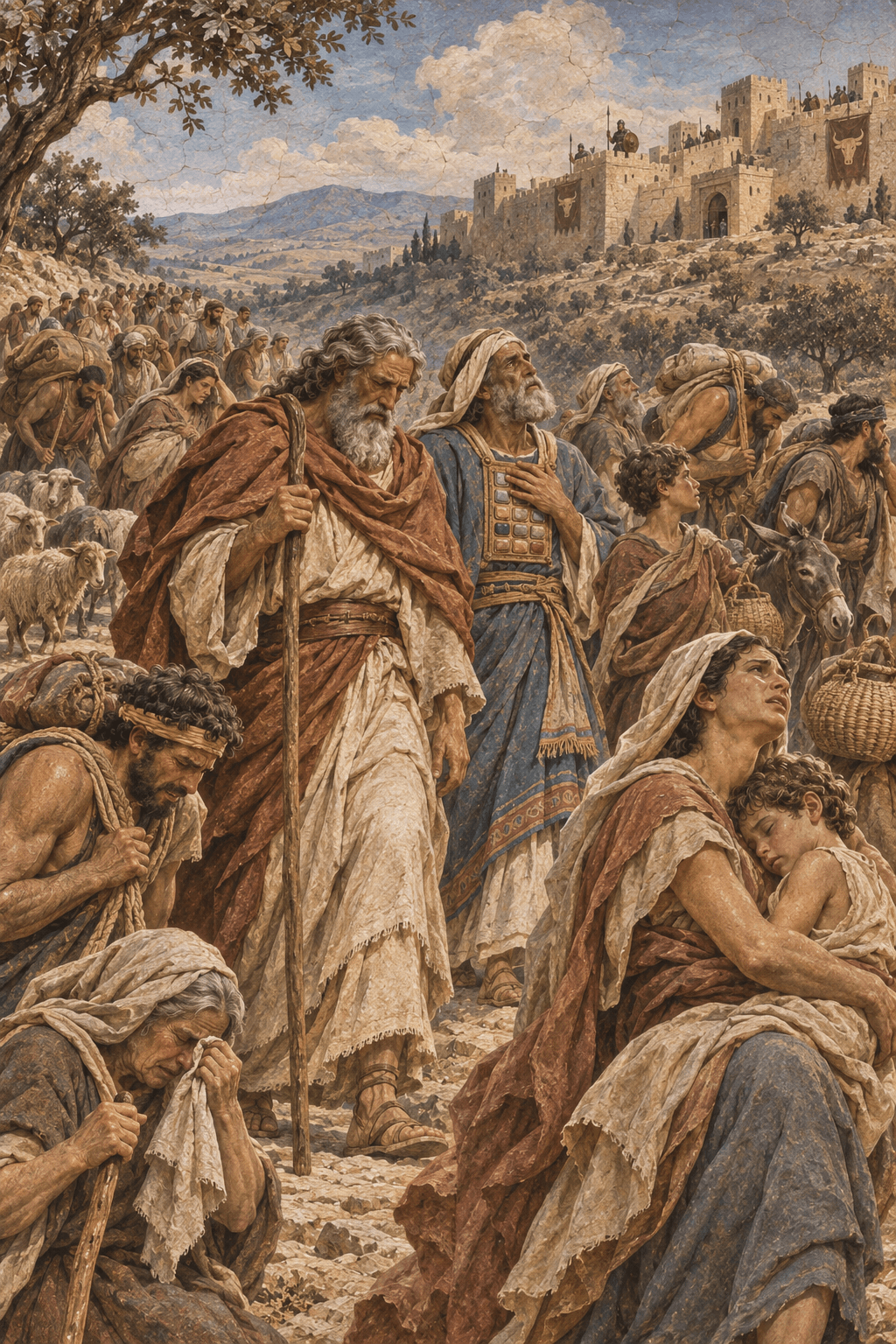
When God asked them to go up to war, they were afraid and refused; and when He declared His anger against them and told them not to go up, they would not listen and went up. Faith was not their leader, but their own will; so both in their withdrawal from going up and in their going up to war, they revealed their disobedience.
Sin makes a person stubborn with God, his Beloved. When God asked them to go up to fight and possess, they refused (Deuteronomy 1:26); and when He asked them not to go up or fight, because He was no longer among them (42), assuring them they would be defeated, they did not listen but went up rashly, foolishly, and arrogantly.
Remarkably, even when He disciplined them for their disobedience, no longer being among them (42), He did not want them to be broken before their enemies. So He asked them not to go up and fight until they had repented, that He might return and dwell among them and give them victory.
They did not grieve because they had disobeyed the Lord, nor in order to return and submit to His will, but because of the defeat that had befallen them. The people wept before the Lord, but these were crocodile tears, offered not in sincere repentance and return to God to walk in the spirit of faith; they returned to Him only because of the loss and shame that had befallen them. Their relationship with God did not concern them, only what had happened to them. They wept, but not with tears of repentance and a humble desire to return to God; rather with tears full of pride and haughtiness, concerned that everyone would regard them as failures.
Here it says that the Amorites chased them (44), while the Book of Numbers says: “Then the Amalekites came down, and the Canaanites which dwelt in that hill, and smote them, and discomfited them, even unto Hormah” (Numbers 14:45). Here he borrows the name “Amorites,” since they were the greatest and strongest nation in Canaan at that time, to refer to all the Canaanites in general, as in Deuteronomy 1:7. [32]
6. A Meditation on Deuteronomy 1
Lead Us on the Journey of Our Sojourning
In Horeb You said to Your people,
“Ye have dwelt long enough in this mount.”
Speak a word, and our souls will set out toward the heavenly Canaan,
and we will not circle the mountains of the world in wandering.
You did not set the land before us as You did for the children of Israel,
but You opened the gates of heaven for us to enter,
and offered us the Father’s bosom to rest in!
Let Your Holy Spirit carry us, and our souls will be at rest!
Moses could not bear the burdens of the people alone.
You carried my sins and my evils.
You brought me out of the great and terrible wilderness,
and led me into the heavenly sanctuaries (Kadesh).
You commanded me: Go up, possess, fear not!
Through You I go up, for You have made me heavenly.
Through You I reign, for I am a king.
I do not fear, for I am Your son!
The people of old refused the sun of Your counsel,
and sent out the candles of the spies.
They despised Your promise and Your wisdom.
They disobeyed You and rejected the Promised Land in their hearts.
Grant me the spirit of obedience, O Son, wonderful in Your obedience.
I look to the past and see You carrying my fathers in Your arms.
You satisfied them with the richness of Your love,
and gave them Your true promises.
They sinned against You,
and did not believe Your faithful promises.
Yet in Your love You carried them as a father carries his son.
Carry me, and lift from me the spirit of disobedience.
Notes and References
[19] See the author’s commentary on Psalm 119: The Riches and Delight of the Word of God.
[20] See the author’s commentary on Psalm 119: The Riches and Delight of the Word of God.
[21] Saint Isaac the Syrian, Discourse 22.
[22] Saint Gregory of Nazianzus, In Defence of His Flight to Pontus, 77.
[23] Adam Clarke, Deuteronomy, 1.
[24] See the author’s commentary on the Book of Numbers, 1995, p. 226.
[25] The author: The Book of Numbers, 1995, p. 225.
[26] Barnes’ Notes.
[27] Origen, On Numbers.
[28] Origen, Homilies on Numbers, 13.
[29] Saint John Chrysostom, Homilies on 1 Corinthians, 1:4.
[30] J. Vernon McGee, Deuteronomy, pp. 15–16.
[31] Adam Clarke, Deuteronomy, 1.
[32] Barnes’ Notes.