
After the prophet Moses mentioned the victory over Sihon king of the Amorites, he speaks here of the victory over Og king of Bashan and the division of his land among the two and a half tribes; and of how Moses besought the Lord to let him enter the land of Canaan, but God allowed him only to go up Mount Nebo and see the land without entering it.
The victory over Og was bound up with the victory over Sihon; both were for the glory of God. As the Psalmist says: “Who smote great nations, and slew mighty kings; Sihon king of the Amorites, and Og king of Bashan, and all the kingdoms of Canaan: And gave their land for an heritage, an heritage unto Israel his people” (Psalm 135:10–12). And also: “To him which smote great kings: for his mercy endureth for ever: And slew famous kings: for his mercy endureth for ever: Sihon king of the Amorites: for his mercy endureth for ever: And Og the king of Bashan: for his mercy endureth for ever: And gave their land for an heritage: for his mercy endureth for ever” (Psalm 136:17–21).
1. The Defeat of Og King of Bashan
KJV · Verses 1–11
1 Then we turned, and went up the way to Bashan: and Og the king of Bashan came out against us, he and all his people, to battle at Edrei. 2 And the Lord said unto me, Fear him not: for I will deliver him, and all his people, and his land, into thy hand; and thou shalt do unto him as thou didst unto Sihon king of the Amorites, which dwelt at Heshbon. 3 So the Lord our God delivered into our hands Og also, the king of Bashan, and all his people: and we smote him until none was left to him remaining. 4 And we took all his cities at that time, there was not a city which we took not from them, threescore cities, all the region of Argob, the kingdom of Og in Bashan. 5 All these cities were fenced with high walls, gates, and bars; beside unwalled towns a great many. 6 And we utterly destroyed them, as we did unto Sihon king of Heshbon, utterly destroying the men, women, and children, of every city. 7 But all the cattle, and the spoil of the cities, we took for a prey to ourselves. 8 And we took at that time out of the hand of the two kings of the Amorites the land that was on this side Jordan, from the river of Arnon unto mount Hermon; 9 (Which Hermon the Sidonians call Sirion; and the Amorites call it Shenir;) 10 All the cities of the plain, and all Gilead, and all Bashan, unto Salchah and Edrei, cities of the kingdom of Og in Bashan. 11 For only Og king of Bashan remained of the remnant of giants; behold his bedstead was a bedstead of iron; is it not in Rabbath of the children of Ammon? nine cubits was the length thereof, and four cubits the breadth of it, after the cubit of a man.
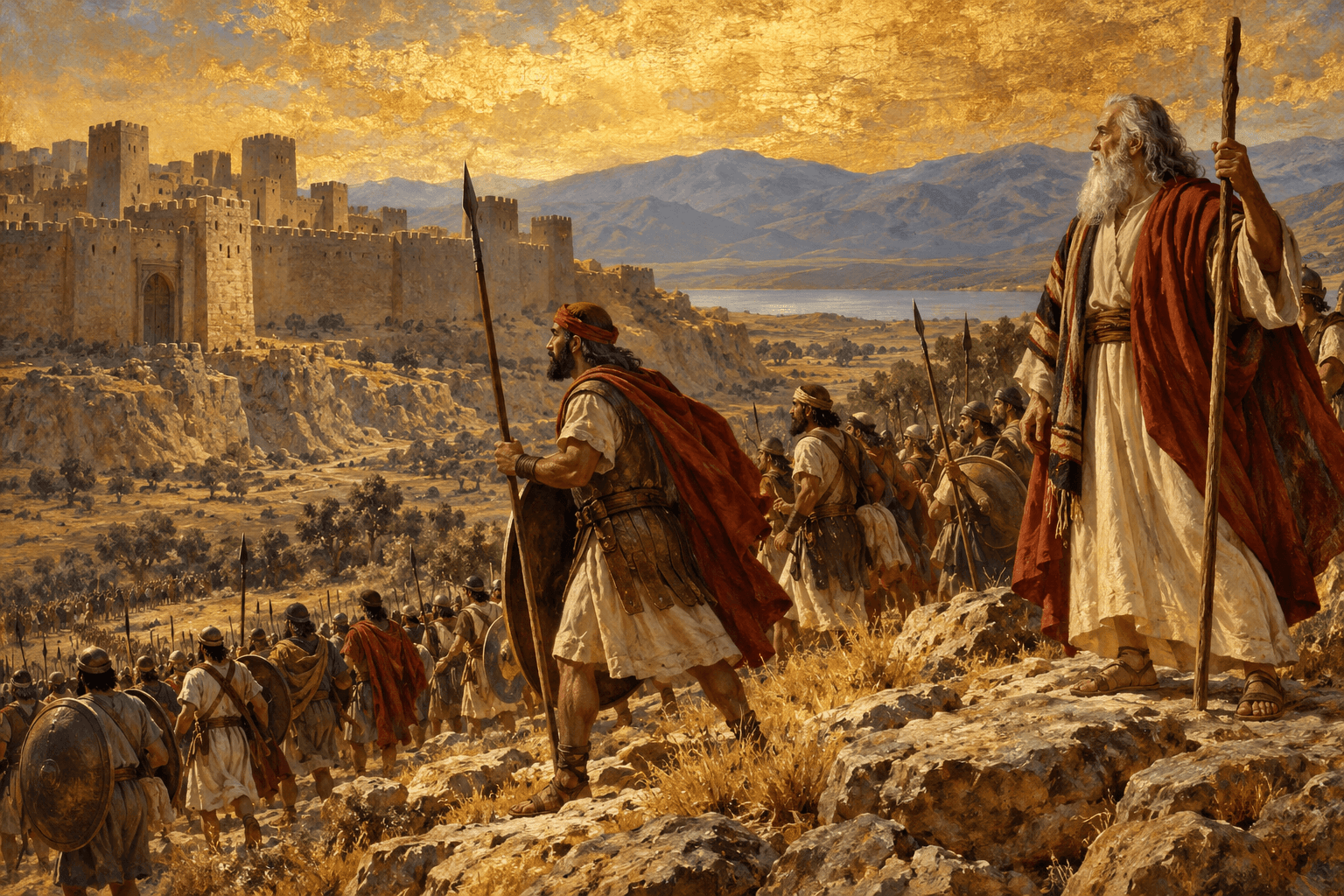
The prophet Moses reminded his people how they had triumphed over Og king of Bashan, so that Gilead and all Bashan, the kingdom of Og, became the possession of two and a half tribes; after that they would fight all the kingdoms to which they would cross over. He says:
Then we turned, and went up the way to Bashan: and Og the king of Bashan came out against us, he and all his people, to battle at Edrei. [1]
Bashan: a Hebrew name meaning “level land” or “smooth land.” It is a district east of the Jordan between Mount Hermon and Gilead (Numbers 21:33), named after a mountain in that region (Psalm 68:15). Bashan included the Hauran, the Golan, and the Leja, all made up of volcanic rock and soil. Its soil is very fertile and its water abundant; wheat, barley, sesame, corn, lentils, and vetch are grown there. It is bounded on the north by the lands of Damascus, on the east by the Syrian desert, on the south by the land of Gilead, and on the west by the Jordan River. Its eastern side is crossed by Jebel Druze, the ancient mountain of Bashan, which passes through the Golan; a chain of hills from north to south consists of ancient extinct volcanoes. The district of the Leja is a field of lava, volcanic rock poured out from Tell Shihan, the mouth of an ancient volcano. Bashan is mentioned about sixty times in the Holy Bible.
So the prophet Moses completes his review of the experience he lived with his people in their dealings with God in the wilderness. He tells us of the resistance of another king of the Amorites, and how God gave them victory over him. The prophet Moses made the following truths clear:
First: The victory over the king of Bashan was not a natural human matter, nor, as some might think, a coincidence, but a divine act. God told Moses not to fear, for He had delivered the king, all his people, and his land into his hand.
And the Lord said unto me, Fear him not: for I will deliver him, and all his people, and his land, into thy hand; and thou shalt do unto him as thou didst unto Sihon king of the Amorites, which dwelt at Heshbon. So the Lord our God delivered into our hands Og also, the king of Bashan, and all his people: and we smote him until none was left to him remaining. [2–3]
The command not to fear was not for Moses’ sake, but for the people’s.
Second: Og king of Bashan was a bold and brave man. He heard of the defeat of Sihon king of Heshbon before Israel, yet he did not seek a covenant or peace treaty with Israel, but went out with all his people to war, confident of victory over this people.
Third: Og’s resources were mighty. He ruled sixty cities fortified with high walls, besides very many unwalled villages (5). His kingdom was strong and seemed impregnable. Victory over him was a sure sign that God Himself gives His people victory. The word “city” here does not necessarily mean a large population, for some had no more than a few hundred people.
Fourth: Og king of Bashan was a giant, perhaps of the race of the giants, and his bed remained as a witness to the size of his body. That the children of Ammon kept it shows how rare a bed of that size was. It seems the bed passed from the Amorites to the Ammonites in a battle won by the Ammonites, and they kept it in Rabbah, the royal city of the children of Ammon (2 Samuel 12:26).
The bed was nine cubits long and four cubits wide, after the cubit of a man (11). If the bed was one cubit longer than the king, the king would be about 12 feet tall, which seems unnatural; so some hold that the bed was a third longer than the king, which would still make him nine feet tall, very tall indeed.
Some Jewish rabbis wove fanciful stories about the size of Og’s body, recorded in the Targum, some even picturing him as several miles tall. [35]
Fifth: If we review the people’s journey, we find that at every stage there was someone who resisted, for the enemy of good cannot bear the way of the Lord. In every generation we see “our Christ rejected by the world,” and in every age we hear His divine voice: “Saul, Saul, why persecutest thou me?”
God gives victory over giants as over weak evildoers. He gives us victory over the sins we think serious and impossible to escape, as over those we think trivial and simple.
And we took all his cities at that time, there was not a city which we took not from them, threescore cities, all the region of Argob, the kingdom of Og in Bashan. [4]
“All the region of Argob” (4): some hold that the literal translation of the word “region” here is “all the line,” that is, cord, cable, or rope, of Argob, an expression for a line used to measure land, as though the people left not an inch of land untaken. Some hold that there was a district called Argob, later called Trachonitis. [36] Some hold that “Argob” is a Hebrew name meaning “a heap of stones,” and that this region lay in Bashan on the border of Geshur and Maachah. Others hold that Argob is the eastern quarter of the Hauran. It was taken by Jair of the tribe of Manasseh.
Resisting God always means loss and deprivation. Og resisted God and lost all his cities and villages. The wicked lose everything, even their inner peace, for “There is no peace, saith the Lord, unto the wicked” (Isaiah 48:22; 57:21).
All these cities were fenced with high walls, gates, and bars; beside unwalled towns a great many. And we utterly destroyed them, as we did unto Sihon king of Heshbon, utterly destroying the men, women, and children, of every city. But all the cattle, and the spoil of the cities, we took for a prey to ourselves. And we took at that time out of the hand of the two kings of the Amorites the land that was on this side Jordan, from the river of Arnon unto mount Hermon; (Which Hermon the Sidonians call Sirion; and the Amorites call it Shenir;) All the cities of the plain, and all Gilead, and all Bashan, unto Salchah and Edrei, cities of the kingdom of Og in Bashan. For only Og king of Bashan remained of the remnant of giants; behold his bedstead was a bedstead of iron; is it not in Rabbath of the children of Ammon? nine cubits was the length thereof, and four cubits the breadth of it, after the cubit of a man. [5–11]
Archaeology has revealed the massive stone fortifications of the cities of Bashan. [37]
What remained of Og’s kingdom? “His bedstead was a bedstead of iron” (11). That is all that remained of that mighty king of Bashan. What unseemly fame! Such is the memory of the wicked, for the Lord laughs at them. Captain Conder discovered a stone throne of the same dimensions on a hill at Rabbah, which he believes is that “bed.”
Salchah (10): about seven hours southeast of Bozrah of Moab. Lying on the eastern border of the kingdom of Bashan, it was no doubt strongly fortified. It became the portion of the tribe of Gad (Joshua 12:5; 1 Chronicles 5:11).
Sirion (9): meaning “glittering,” a Sidonian name, perhaps used by the Sidonian community (Judges 18:7) who lived at the foot of the snow-covered mountains. Some hold that “Sirion” is a Sidonian word meaning “breastplate,” the name the Sidonians gave to Mount Hermon (Psalm 29:6). It seems this name did not refer to a particular part of the Hermon range, but to the part of Hermon seen from the shore of the land of the Sidonians.
“Shenir” is an Amorite name, perhaps meaning “mountain of brightness” or “of light.” It is the name the Amorites gave to Mount Hermon, most likely to a part of Mount Hermon (Jebel esh-Sheikh); therefore we find Shenir and Hermon mentioned as two different mountains in 1 Chronicles 5:23.
For only Og king of Bashan remained of the remnant of giants. [11]
Og was the last king of the Amorites. It seems the name of his kingdom was taken from Mount Bashan; his kingdom was called Batanea. [38]
2. The Division of Og’s Land
KJV · Verses 12–22
12 And this land, which we possessed at that time, from Aroer, which is by the river Arnon, and half mount Gilead, and the cities thereof, gave I unto the Reubenites and to the Gadites. 13 And the rest of Gilead, and all Bashan, being the kingdom of Og, gave I unto the half tribe of Manasseh; all the region of Argob, with all Bashan, which was called the land of giants. 14 Jair the son of Manasseh took all the country of Argob unto the coasts of Geshuri and Maachathi; and called them after his own name, Bashanhavothjair, unto this day. 15 And I gave Gilead unto Machir. 16 And unto the Reubenites and unto the Gadites I gave from Gilead even unto the river Arnon half the valley, and the border even unto the river Jabbok, which is the border of the children of Ammon; 17 The plain also, and Jordan, and the coast thereof, from Chinnereth even unto the sea of the plain, even the salt sea, under Ashdothpisgah eastward. 18 And I commanded you at that time, saying, The Lord your God hath given you this land to possess it: ye shall pass over armed before your brethren the children of Israel, all that are meet for the war. 19 But your wives, and your little ones, and your cattle, (for I know that ye have much cattle,) shall abide in your cities which I have given you; 20 Until the Lord have given rest unto your brethren, as well as unto you, and until they also possess the land which the Lord your God hath given them beyond Jordan: and then shall ye return every man unto his possession, which I have given you. 21 And I commanded Joshua at that time, saying, Thine eyes have seen all that the Lord your God hath done unto these two kings: so shall the Lord do unto all the kingdoms whither thou passest. 22 Ye shall not fear them: for the Lord your God he shall fight for you.
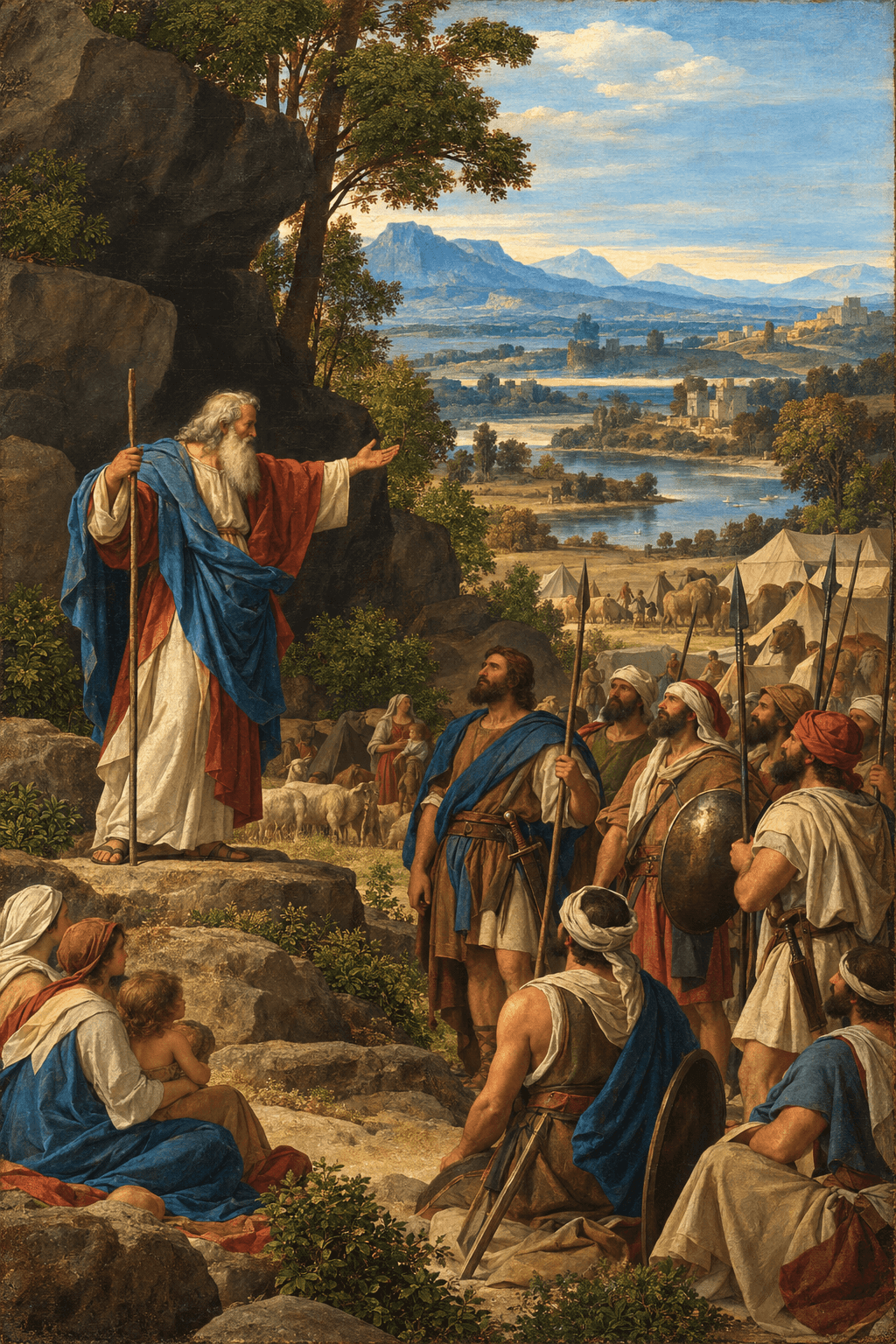
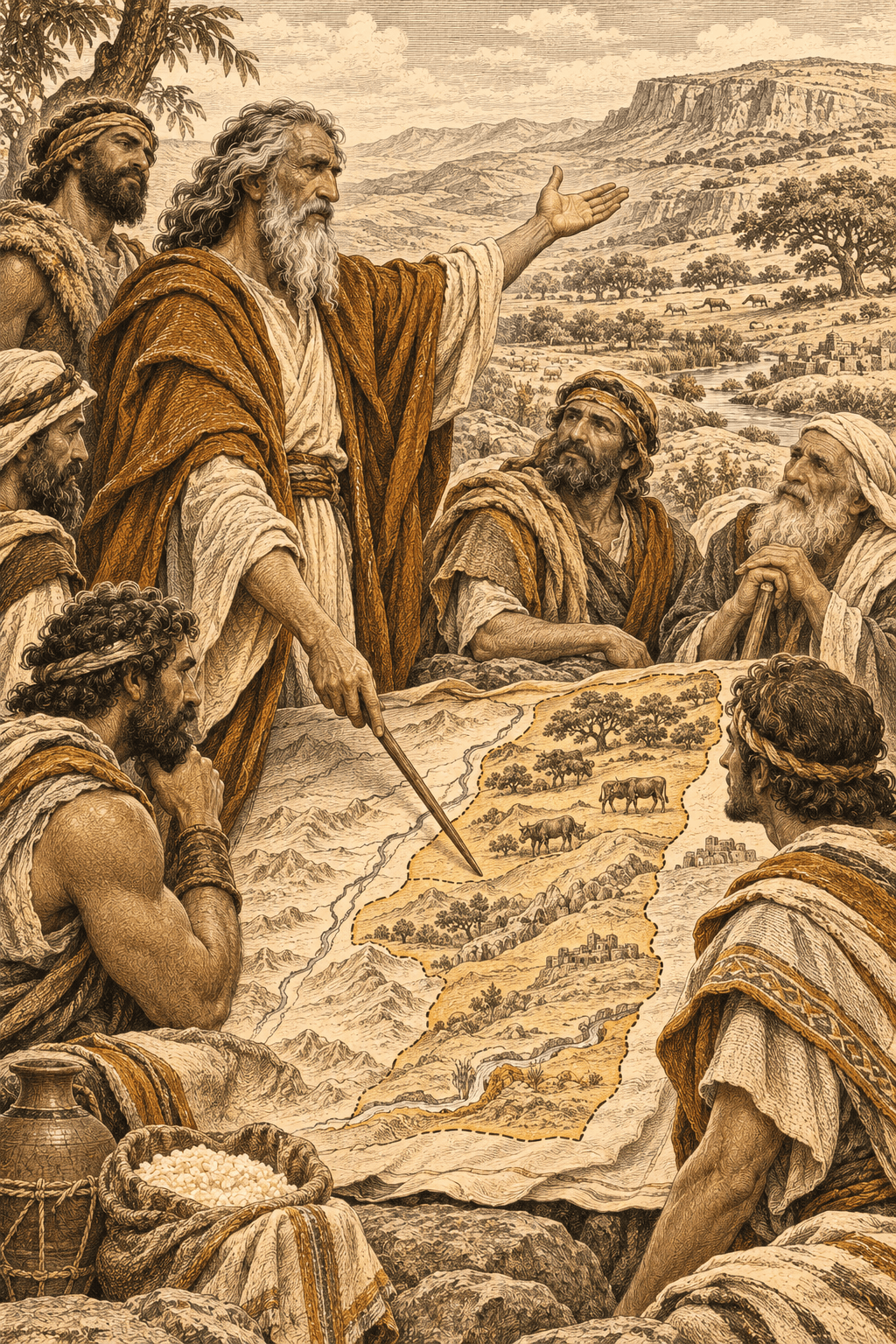
As the time of the prophet Moses’ departure drew near, God did not let him go until He had given him two things that would gladden his heart. The first was the conquest of the region east of the land, so that the prophet Moses might taste the pledge of the gift of the whole Promised Land. The second was his seeing the land west of the Jordan from the top of Mount Pisgah, or Nebo.
This land east of the Jordan was given to Reuben, Gad, and Manasseh. Yet although these tribes had settled, they did not stop helping their brethren in their wars until all had rest and were settled (Numbers 32). So the Church of Christ will not be settled and at rest, nor will her joy be complete, until the last member in her has finished his struggle. Even those who struggled, triumphed, and crossed over to Paradise will not have complete joy until their fellow servants finish their struggle and are crowned with them. They offer their continual prayers before the divine throne for the salvation of the whole world! If the believers struggling on earth feel the obligation of love and pray for their brethren, will those who have crossed over to Love itself abandon their responsibility to help others by their prayers? And shall we count their prayers, which come from love, as a distraction from God, when He and all the heavenly hosts long for the salvation of all humanity?!
Note the following here concerning Joseph:
The sons of Joseph were divided into two tribes, Ephraim and Manasseh. Manasseh was divided into two groups, one receiving its portion east of the Jordan and the other west of the Jordan. The group east of the Jordan was divided into two families: the family of Jair, which had a particular portion (14), and the family of Machir (15). Perhaps in this way the prophecy of our father Jacob about Manasseh was fulfilled. He laid his left hand on him, not his right, although he was the firstborn; and when Joseph tried to move his father’s right hand to Manasseh’s head, his father refused, saying: “I know it, my son, I know it: he also shall become a people, and he also shall be great: but truly his younger brother shall be greater than he, and his seed shall become a multitude of nations” (Genesis 48:17–19). The prophecy was fulfilled, for the tribe of Manasseh was divided into many small families, while Ephraim remained one complete tribe.
The Geshurites and the Maachathites were two small kingdoms that the children of Israel did not take; they left them living under their control.
The Geshurites were the inhabitants of the region of Geshur, a Hebrew name meaning “bridge.” It bordered Argob, east of Maachah, within the portion of Manasseh. Geshur became independent, and Absalom fled there after killing Amnon (2 Samuel 13:37). On its border is a bridge over the Jordan between Tiberias and el-Huleh, called the Bridge of the Daughters of Jacob.
The Maachathites were the inhabitants of Maachah, a Hebrew name meaning “oppression.” The Maachathites joined the Arameans and the Ammonites in war against David, but he defeated them. It may be the modern Beit Jann (Joshua 19:21), in the portion of Issachar west of the Sea of Galilee.
The plain also, and Jordan, and the coast thereof, from Chinnereth even unto the sea of the plain, even the salt sea, under Ashdothpisgah eastward. And I commanded you at that time, saying, The Lord your God hath given you this land to possess it: ye shall pass over armed before your brethren the children of Israel, all that are meet for the war. But your wives, and your little ones, and your cattle, (for I know that ye have much cattle,) shall abide in your cities which I have given you; Until the Lord have given rest unto your brethren, as well as unto you, and until they also possess the land which the Lord your God hath given them beyond Jordan: and then shall ye return every man unto his possession, which I have given you. And I commanded Joshua at that time, saying, Thine eyes have seen all that the Lord your God hath done unto these two kings: so shall the Lord do unto all the kingdoms whither thou passest. Ye shall not fear them: for the Lord your God he shall fight for you. [17–22]
“Until the Lord have given rest” (20): the word “rest” overflows with blessings throughout the Holy Bible. What was promised to Israel here they received in the reign of Solomon (1 Kings 5:4), but the promise was fulfilled more perfectly in the rest the soul finds in Christ (Matthew 11:28; Hebrews 4:5–8).
“And I commanded Joshua” (21): the glimpses we see of the relationship between Moses and Joshua are wonderful. We see Joshua first as commander of the army (Exodus 17:9), as Moses’ minister (Exodus 24:13), and as Moses’ zealous attendant (Numbers 11:28). Moses’ love for Joshua is evident in Deuteronomy 1:38; 31:3 and Numbers 27:18–23.
3. Moses’ Plea to Enter Canaan
KJV · Verses 23–27
23 And I besought the Lord at that time, saying, 24 O Lord God, thou hast begun to shew thy servant thy greatness, and thy mighty hand: for what God is there in heaven or in earth, that can do according to thy works, and according to thy might? 25 I pray thee, let me go over, and see the good land that is beyond Jordan, that goodly mountain, and Lebanon. 26 But the Lord was wroth with me for your sakes, and would not hear me: and the Lord said unto me, Let it suffice thee; speak no more unto me of this matter. 27 Get thee up into the top of Pisgah, and lift up thine eyes westward, and northward, and southward, and eastward, and behold it with thine eyes: for thou shalt not go over this Jordan.
The prophet Moses besought God, pleading that He would let him cross with the people to enjoy the Promised Land. God’s answer came: “Let it suffice thee; speak no more unto me of this matter” (26). The heart of Moses (a symbol of the Law) burned with longing to enter Canaan, and because of the people he was denied entry; but he was not denied going up to the top of Pisgah to see the land with his eyes, until Joshua would come and lead the people across and divide the land among them. So through the Law they looked toward the heavenly Canaan, but through Christ Jesus alone (symbolized by Joshua) we enter it and enjoy the inheritance.
For forty years Moses had been preparing himself, longing for the divine promise to be fulfilled, so that he might enter with the people and distribute the land among them.
God, as a tender Father, could not bear Moses’ pleas and the cries of his heart, so He said to him: “Let it suffice thee!” He granted him to see the land from the top of Mount Pisgah, and left his disciple to cross with the people and distribute the land. About two thousand years later, Moses crossed into the land when he appeared on Mount Tabor, where the Lord was transfigured.
First: In his supplication to God he begins with thanksgiving for God’s wonderful dealings and gifts, praising Him: “O Lord God, thou hast begun to shew thy servant thy greatness, and thy mighty hand: for what God is there in heaven or in earth, that can do according to thy works, and according to thy might?” (24). Having received divine blessings, the prophet Moses praised God, and his heart burned all the more to receive and enjoy God Himself and His surpassing gifts. The more we see God and sense Him in our lives, the more our thirst for Him and our longing to see and enjoy Him increase.
The prophet Moses was not preoccupied with the victories or with the lands and fields his people had acquired; he was occupied with grasping the power and might of God, for there is no God in heaven or on earth like Him. As he had said when crossing the Red Sea: “Who is like unto thee, O Lord, among the gods? who is like thee, glorious in holiness, fearful in praises, doing wonders?” (Exodus 15:11). And as it is said: “Among the gods there is none like unto thee, O Lord; neither are there any works like unto thy works” (Psalm 86:8).
Second: He besought the Lord to let him cross into the land of Canaan. He did not ask to reign or rule, but to see “the good land.” He longed to see the new land as a sanctuary of the Lord, where God dwells in the midst of His people. As the Psalmist says: “And he brought them to the border of his sanctuary, even to this mountain, which his right hand had purchased” (Psalm 78:54). His eyes looked toward the dwelling of the Holy Lord among His people to sanctify them.
Third: God’s answer carried both mercy and justice. God was angry with him because of the people and did not hear him (26); but it was a father’s anger toward his son, full of fatherly love and tenderness. This tenderness appears in many things. As we said before, first He granted him to enjoy the victory over Sihon and Og, so that two and a half tribes might inherit east of the Jordan. Second, He granted him to see the Promised Land west of the Jordan from the top of Mount Nebo. Finally, He granted him to guide his disciple, who was like his son, to bring the people in and distribute the inheritance. It is as though whatever Joshua received, Moses, as a father, counted as received by himself.
If God said to him, “Let it suffice thee,” it was because the prophet Moses had received enough glory. As we said before, he was a symbol of the Law, our schoolmaster to bring us to Christ. He leads the believers to the Lord Christ, but he cannot accomplish for them what the Lord Jesus Himself accomplishes. It is as though God said to him: Let it suffice you, for you have fulfilled your mission and will receive heavenly glories; though you will not take them across the Jordan, you yourself will cross over to the crown of eternal glory. It was fitting for Moses to understand that even the greatest of the prophets has a particular, defined mission that he does not go beyond. Finally, when He asked him to encourage and strengthen Joshua, it was to assure him that the troubles awaiting Joshua the son of Nun would be many. The prophet Moses had received his share of struggle and enjoyed victories along with some weaknesses in his life; now it was his disciple’s turn to share in bearing sufferings for the Lord.
4. Moses’ Charge to Joshua
KJV · Verses 28–29
28 But charge Joshua, and encourage him, and strengthen him: for he shall go over before this people, and he shall cause them to inherit the land which thou shalt see. 29 So we abode in the valley over against Bethpeor.
As the Lord strengthened Moses’ heart, saying to him, “Fear him not” (2), so Moses in turn was bound to charge Joshua, strengthen him, and encourage him not to fear (28).
Joshua listened to the words of his teacher, the prophet Moses, who reminded him, together with all the leaders and the people, of two things. The first was what God had done for them, especially the Exodus from Egypt, His care for them in the wilderness, and the victories over their enemies, especially over Sihon and Og. It is as though the God who began the work and continued it through these forty years would surely complete it to the end. Joshua had seen God’s surpassing works with his own eyes, but he also heard Moses’ words reminding him. The second was what God had promised: that He would fight for them and with them, so that they might possess and inherit. If God is with them, who can be against them?!
So we abode in the valley over against Bethpeor. [29]
Beth-peor was a town in the kingdom of Sihon king of the Amorites. It perhaps took its name from the temple of the god Peor, who was worshiped there; he is probably the same as the Roman god Priapus. The word “Peor” is a Moabite name meaning “opening.”
Perhaps the prophet Moses looked toward the temple of Peor from afar, his soul embittered as he realized what would later befall his people, when they would fall into idol worship with the rest of the nations. If the calf Apis had come out of Egypt with the people in their hearts and minds, so that they cast an image of it and bowed down to it in the very moments when Moses was on the mountain speaking with God, what would become of them after his death and after meeting many nations that practiced many abominations?
5. A Meditation on Deuteronomy 3
Let It Suffice Thee! Speak No More unto Me of This Matter!
Moses Your prophet never ceased asking to enter the Promised Land!
From his calling, his eyes looked toward Canaan,
and his heart cried out: When shall I see You dwelling in Canaan among Your people!
He endured daily hardships, hoping to enter Canaan,
not to inherit land, but to see You revealed in the midst of Your people!
Who is worthy to hear Your eternal voice:
“I have given you continual victories, to overcome and inherit!
I have given you authority even over the devil and his works!
I have opened the gates of the heavenly Canaan before you,
and prepared you to enter and settle there forever!
Let it suffice you. You have received the pledge; now enjoy the fullness of glory.
Let it suffice you. You have endured much for the sake of Canaan;
come, and enter My dwelling!”
Notes and References
[35] Adam Clarke Commentary.
[36] Adam Clarke Commentary.
[37] Barnes’ Notes.
[38] Adam Clarke Commentary.