
After the prophet Moses reviewed God’s dealings with His people through history up to their standing at the gates of the land of Canaan (1–8), he made clear to them the necessity of drawing near to God, especially by accepting the divine commandment and rejecting idol worship. He urged them to remember what God had done with them in the past, so that He might reveal Himself to them as One who loves them (9–14); and that this invisible God, who makes a covenant with them, must not be exchanged for lifeless stones, wood, or any created thing (15–24). Whoever worships idols destroys himself, but whoever serves and worships God frees himself from bondage and enjoys the covenant with Him (32–40). He also declared God’s concern to protect the innocent through the cities of refuge, that is, to purify the land from the shedding of innocent blood.
By reviewing God’s dealings with His people in the wilderness, the prophet Moses presented the following conclusions:
- Through the commandments we enjoy life and enter the Promised Land to possess it (1).
- Through them we realize that God is very near to His people, hearing them (7) and speaking with them (36).
- A warning against images and statues for worship, for “the Lord thy God is a consuming fire, even a jealous God” (24). He does not accept mixing His worship with idol worship; there is no God besides Him (39).
1. Obedience to the Divine Commandment
KJV · Verses 1–8
1 Now therefore hearken, O Israel, unto the statutes and unto the judgments, which I teach you, for to do them, that ye may live, and go in and possess the land which the Lord God of your fathers giveth you. 2 Ye shall not add unto the word which I command you, neither shall ye diminish ought from it, that ye may keep the commandments of the Lord your God which I command you. 3 Your eyes have seen what the Lord did because of Baalpeor: for all the men that followed Baalpeor, the Lord thy God hath destroyed them from among you. 4 But ye that did cleave unto the Lord your God are alive every one of you this day. 5 Behold, I have taught you statutes and judgments, even as the Lord my God commanded me, that ye should do so in the land whither ye go to possess it. 6 Keep therefore and do them; for this is your wisdom and your understanding in the sight of the nations, which shall hear all these statutes, and say, Surely this great nation is a wise and understanding people. 7 For what nation is there so great, who hath God so nigh unto them, as the Lord our God is in all things that we call upon him for? 8 And what nation is there so great, that hath statutes and judgments so righteous as all this law, which I set before you this day?
“Statutes”: the original word huqqim means “engraving,” for one must walk according to what the conscience of the believer and of the nation dictates, where the divine commandment is engraved and time cannot erase it.
“Judgments”: in Hebrew mishpat, meaning “a decisive ruling.” It is linked to the judge who issues the ruling, called in Hebrew shophet (Deuteronomy 1:16–17); the cases decided by judges or courts as described in Exodus 21–22 give us an example. The word is also used for God’s decisive rulings in condemning the wicked and acquitting the innocent. So the words “statutes and judgments” include all laws and ordinances.
What did He ask of them concerning the commandment?
First: Listening to the commandment. The first word of the Law is “Hear,” for the first work of sin is lending the ear to someone other than God, so that the word does not work in the sinner. And the first commandment addressed to us is “Hear,” so that the word of God may find an entrance into the depths of the soul, dwell there, work continually, and establish the heavenly, divine kingdom. The word “hear” does not mean hearing in a mechanical, literal way, but effective, living listening, full of zeal. Such active listening, burning with the spirit of love, is a kind of prayer that does not fail.
The prophet Moses summed up the experience of God’s dealings with their fathers during the period of wandering: there is no way to victory except obedience flowing from love. And he gave the reasons for obedience to God, for God wants life for us, and abundant life: “that ye may live, and go in and possess the land” (1). Obedience is the only foundation for enjoying life and for the fulfillment of God’s surpassing promises to the believer. God wants to give generously, and through obedience we open our hearts and stretch out our hands to receive His wonderful gifts.
If on their part they are bound to listen in a spirit of prayer, on his part he is bound to teach what is the Lord’s; therefore he says:
Ye shall not add unto the word which I command you, neither shall ye diminish ought from it, that ye may keep the commandments of the Lord your God which I command you. [2]
This man, who forty years earlier excused himself from service because he was slow of speech, became a man of words, speaking of the things of the Lord; indeed he gives a whole book that is almost entirely sermons or long addresses to the leaders and the people. He became a teacher of teachers, giving the word of God, not his own word. He asks them neither to add to nor take away from what he commands, so that in this way they keep the commandments of the Lord.
Second: Seeing and doing. He first asked them to listen (1), then to see (3), then to do or touch, using the sense of touch together with hearing and sight, saying: “Keep therefore and do them.” Listening must turn into action: “that ye may do them, that ye may live, and go in and possess the land which the Lord God of your fathers giveth you” (1).
We do not work because God needs our service or work, but because through work we enjoy life: “that ye may live.” Whoever buries the commandment in his mind and does not turn it into action makes his soul like a tomb without the fragrance of life. Through the commandment at work in our conduct we enter into God’s promises, reign, and inherit.
Through his slow tongue the prophet Moses presented the living words of the Lord, so that all might listen to them in a spirit of prayer, together with action. Now, through the events of recent history, the Lord speaks to them in the language of action and reality; so he says:
Your eyes have seen what the Lord did because of Baalpeor: for all the men that followed Baalpeor, the Lord thy God hath destroyed them from among you. [3]
By Baal-peor he means here both the place and the god of the place, for the Canaanite worship of Baal was mixed with impure sexual acts and abominations.
Peter and John asked the people to look at God’s work with them when the lame man at the Beautiful Gate was healed (Acts 3), saying: “why marvel ye at this? or why look ye so earnestly on us, as though by our own power or holiness we had made this man to walk?” (Acts 3:12). Let us look at history with the eyes the Lord has opened, and say with the man born blind: “whereas I was blind, now I see.” Through history and events we see God’s surpassing work and understand His commandment written in the language of love at work in history.
Third: The purity of the commandment.
Ye shall not add unto the word which I command you, neither shall ye diminish ought from it, that ye may keep the commandments of the Lord your God which I command you. … But ye that did cleave unto the Lord your God are alive every one of you this day. Behold, I have taught you statutes and judgments, even as the Lord my God commanded me, that ye should do so in the land whither ye go to possess it. [2, 4–5]
If the commandment is a precious treasure, like silver purified seven times (Psalm 12:6), we must not add anything of our own to it, lest the silver become mixed with dross. As a precious treasure, we neither add to the commandment nor take from it, but keep it pure in our lives. Solomon the Wise says: “I know that, whatsoever God doeth, it shall be for ever: nothing can be put to it, nor any thing taken from it” (Ecclesiastes 3:14).
And near the end of the Holy Bible a wall was set up to guard it from any addition or omission: “For I testify unto every man that heareth the words of the prophecy of this book, If any man shall add unto these things, God shall add unto him the plagues that are written in this book: And if any man shall take away from the words of the book of this prophecy, God shall take away his part out of the book of life, and out of the holy city, and from the things which are written in this book” (Revelation 22:18–19).
The Church must keep the Holy Bible without addition or omission, and in her interpretations of it she must carry the same spirit as the Bible. What, then, is the Christian’s attitude toward the Law of Moses? The answer can be summarized as follows:
1. All that was written was written for our learning. The Law contains symbolic elements whose letter the Christian is not bound to carry out.
2. It contains eternal principles of holiness, justice, and truth, contained in the Ten Commandments and the legislation built on them. These are commands for all ages, for Jews and Christians alike, and they are quoted in the New Testament as commandments with the words “It is written” (see Matthew 4:10; 5:17; Romans 13:9; 1 Peter 1:16).
3. The Holy Bible tells us clearly that Moses wrote of Christ (John 5:46). Let us look for the Lord Christ on every page, for the whole Law was meant to lead us to Him (Galatians 3:24).
Fourth: Through obedience our wisdom and understanding are declared. In keeping and doing the divine commandment we declare the wisdom we enjoy in the Lord.
Keep therefore and do them; for this is your wisdom and your understanding in the sight of the nations, which shall hear all these statutes, and say, Surely this great nation is a wise and understanding people. [6]
If the divine commandment awakens in us the fear of the Lord, it awakens in us divine wisdom; as it is said: “the fear of the Lord, that is wisdom; and to depart from evil is understanding” (Job 28:28).
Let us act, and so bear witness to God’s work in us, that He may be glorified in us, where God’s wisdom shines and His mysteries are revealed in our lives. So we bear witness to God’s statutes and righteous judgments (8), not by argument but by practical life, by the righteousness of Christ at work in us.
Fifth: Through obedience we bear witness to God before all that He is near to us, listening to our prayers and answering the desire of our hearts. The secret of the believer’s greatness is that through prayer he is very near to God: “For what nation is there so great, who hath God so nigh unto them, as the Lord our God is in all things that we call upon him for?” (7).
Sixth: Bearing witness to the superiority of the divine commandment and divine laws over all human laws. By keeping and doing the commandment we bear witness that the divine Law is unique, not to be compared with the laws and constitutions of the nations.
And what nation is there so great, that hath statutes and judgments so righteous as all this law, which I set before you this day? [8]
The Psalmist says: “Therefore I esteem all thy precepts concerning all things to be right; and I hate every false way” (Psalm 119:128). He also says: “He sheweth his word unto Jacob, his statutes and his judgments unto Israel. He hath not dealt so with any nation: and as for his judgments, they have not known them” (Psalm 147:19–20).
If worship with all its rites, and the laws with all their details, are compared with what prevailed in the world at that time, there is no comparison between what God gave His people and what other peoples practiced and believed. Many ancient and modern Asian and European peoples borrowed some of their laws from the Mosaic Law.
As for the fruits of obedience and disobedience:
- The prophet Moses stresses again and again that obedience produces divine blessings (5).
- Witness before the nations to God and His work with His believers (6). So obedience is linked to preaching (Mark 16:15), for every sincere believer is bound to bear witness and preach the Gospel of salvation. Every believer is bound to experience obedience and pass on his experience to his children and grandchildren (9).
After speaking of the people’s history in its dealings with God, he begins to conclude his sermon with the necessity of cleaving to God Himself through obedience to His divine commandment. For the aim of history is that we cleave to the One who holds human history in His hands, who longs to enter history with man in order to carry him to Himself, beyond history. The divine commandment, judgments, and laws were given to man not merely for submission, but for cleaving to the One who can lift him above temporal things and events.
2. The Divine Commandment and the New Generation
KJV · Verses 9–10
9 Only take heed to thyself, and keep thy soul diligently, lest thou forget the things which thine eyes have seen, and lest they depart from thy heart all the days of thy life: but teach them thy sons, and thy sons’ sons; 10 Specially the day that thou stoodest before the Lord thy God in Horeb, when the Lord said unto me, Gather me the people together, and I will make them hear my words, that they may learn to fear me all the days that they shall live upon the earth, and that they may teach their children.
After speaking of the positive aspects, that the believer hears (1), sees (3), and then does (6), he speaks of a serious danger that can destroy all these positive things: forgetting what we have seen with our own eyes, so that the heart becomes corrupt. Therefore he gives us the following warning:
Only take heed to thyself, and keep thy soul diligently, lest thou forget the things which thine eyes have seen, and lest they depart from thy heart all the days of thy life: but teach them thy sons, and thy sons’ sons; [9]
The matter does not stop at listening to the commandment, doing it, and keeping it pure as a precious treasure in the heart; we must also teach it and hand it on, especially to the new generations. Let us always remember what our bodily eyes have seen of the Lord’s temporal blessings and what our inner eyes have seen of spiritual, heavenly blessings. This is the secret of the power in the life of Saint John the Beloved, who remembers what he saw, especially in the spirit: “we beheld his glory, the glory as of the only begotten of the Father, full of grace and truth” (John 1:14). “That which we have seen with our eyes, which we have looked upon, and our hands have handled, of the Word of life; (For the life was manifested, and we have seen it, and bear witness, and shew unto you that eternal life…)” (1 John 1:1–2).
God’s surpassing love, His wonderful care and providence, are things seen by the visible eye and by inner insight. So when we speak with our children and grandchildren, we give a living testimony as eyewitnesses. We assure them that we have seen, heard, touched, and tasted how good and sweet the Lord is!
Ignoring or forgetting God’s work with us is a great crime and ingratitude toward a loving Creator and a wonderful Savior, to whom we owe our life and our rising as from death. Therefore the Apostle Paul presents his Gospel through his living experience, saying, “we who were once in darkness….” Forgetting God’s work turns a person’s life to corruption, so that he becomes ungrateful and a criminal against himself; but remembering God’s dealings turns his life into a daily hymn and a wonderful symphony that gladdens the hearts of the heavenly hosts.
How do we practice remembering God’s dealings?
“Teach them thy sons, and thy sons’ sons” (9). There is no sweeter way of remembering than handing on, or tradition: we hand on to our children the memories of God’s work with us. Let our conversation with our children and grandchildren, according to the flesh or the spirit, be a spiritual conversation about God’s work with us through history. Yet we cannot bear witness to the Lord Christ before our children and grandchildren unless we have seen Him. Speaking about the Savior carries no power unless the speaker has experienced salvation and known the Savior’s power in his life in practice.
Specially the day that thou stoodest before the Lord thy God in Horeb, when the Lord said unto me, Gather me the people together, and I will make them hear my words, that they may learn to fear me all the days that they shall live upon the earth, and that they may teach their children. [10]
Every person surely has special days that will never be erased from memory. The Book of Deuteronomy is full of Moses’ memories, which can be divided into four parts:
- The first: in Egypt and the journey to Sinai (Deuteronomy 4:34).
- The second: the giving of the Law at Sinai.
- The third: the journey from Horeb to Kadesh (Deuteronomy 1:2).
- The fourth: the events of the last two years of the journey (Deuteronomy 23:4).
The second part occupies a large portion of chapters 4, 5, 9, and 11 of the book. It speaks of the Lord’s covenant, the Ten Commandments, the lightning and thunder at Sinai, the apostasy of the golden calf, Moses’ intercession for the people, the writing of the Ten Commandments again, and the setting apart of the tribe of Levi for the priesthood.
Moses asked the people to remember that special day, the day he stood in the presence of the Lord at Horeb. Indeed all the days of Moses’ ministry are unforgettable, all of them very fruitful; but he will never forget that special day, which was marked by the following:
- His standing in the presence of the Lord.
- The Lord’s speaking about His people.
- God asking the people to gather together around His divine word, to hear and keep it.
- The aim of the divine word handed to them: to instill the spirit of divine fear and to teach the new generations.
These are the memories that special day held for Moses, the greatest of the prophets. As for us, we have a special day we shall never forget: the day our Christ was lifted up on the cross so that we might always be found in the presence of the Father. On that day the Father spoke with us, not with the mouth alone, but in the language of active love, offering the blood of His only Son, given for us, as an inexpressible word of love. On that day the whole Church gathers with one heart as members of the body of the crucified Lord; she hears the voice of love, sees the glories prepared for her, and touches the heavenly. On that day the soul grasps the aim of the incarnate and crucified Word of God; through it she enjoys the fear of the Lord, the fear of sons toward their Father, and in it we receive the spirit of preaching and witnessing to the truth before resisting generations.
The new generation should look upon the divine commandment in this way:
A) “Take heed”: a person should be watchful, so as to distinguish truth from falsehood.
B) “Keep thy soul diligently”: a person should be a striver, consecrating his inner depths with longing to carry out the commandment.
C) “Lest thou forget”: his mind should be occupied with the commandment, and he should not forget God’s mercies and His works with him.
D) “Lest they depart from thy heart”: it is not enough for the mind to be occupied with it; the heart must be occupied too, so that he loves the commandment with his whole inner being. He keeps the commandment in his heart, and it keeps his heart, so that he does not fall from God’s hands and his depths are not deprived of the riches of divine grace.
E) As he received it from his fathers, he should hand it on to his children, so that the commandment becomes a living, lived tradition that each generation passes to the next.
3. Rejecting Idol Worship
KJV · Verses 11–22
11 And ye came near and stood under the mountain; and the mountain burned with fire unto the midst of heaven, with darkness, clouds, and thick darkness. 12 And the Lord spake unto you out of the midst of the fire: ye heard the voice of the words, but saw no similitude; only ye heard a voice. 13 And he declared unto you his covenant, which he commanded you to perform, even ten commandments; and he wrote them upon two tables of stone. 14 And the Lord commanded me at that time to teach you statutes and judgments, that ye might do them in the land whither ye go over to possess it. 15 Take ye therefore good heed unto yourselves; for ye saw no manner of similitude on the day that the Lord spake unto you in Horeb out of the midst of the fire: 16 Lest ye corrupt yourselves, and make you a graven image, the similitude of any figure, the likeness of male or female, 17 The likeness of any beast that is on the earth, the likeness of any winged fowl that flieth in the air, 18 The likeness of any thing that creepeth on the ground, the likeness of any fish that is in the waters beneath the earth: 19 And lest thou lift up thine eyes unto heaven, and when thou seest the sun, and the moon, and the stars, even all the host of heaven, shouldest be driven to worship them, and serve them, which the Lord thy God hath divided unto all nations under the whole heaven. 20 But the Lord hath taken you, and brought you forth out of the iron furnace, even out of Egypt, to be unto him a people of inheritance, as ye are this day. 21 Furthermore the Lord was angry with me for your sakes, and sware that I should not go over Jordan, and that I should not go in unto that good land, which the Lord thy God giveth thee for an inheritance: 22 But I must die in this land, I must not go over Jordan: but ye shall go over, and possess that good land.

Of all the commandments, the prophet Moses chose the commandment not to be bound to idol worship. The people had begun to come into contact with the nations in one way or another, and turning aside to idol worship and practicing its abominations had become the gravest danger threatening God’s people.
Perhaps you will say, “There is no idol worship today.” An idol is anything that separates your heart from God or hinders your love for Him; therefore the Apostle Paul called covetousness idolatry (Ephesians 5:5). Whatever occupies first place in the heart and is given priority over God Himself is idol worship, even if it is practicing a certain sport or being absorbed in a television program or the internet, as long as these things take God’s place in the heart.
Wishing to speak about rejecting idol worship, the prophet Moses began with the positive side, which is meeting God Himself. His meeting with Him on Mount Sinai carries immortal memories that time cannot erase. Indeed the prophet Moses regards what happened long ago with the generation that died in the wilderness as if it had happened with the new generation. It is God’s meeting with His people throughout all generations; therefore he says to the new generation:
And ye came near and stood under the mountain; and the mountain burned with fire unto the midst of heaven, with darkness, clouds, and thick darkness. [11]
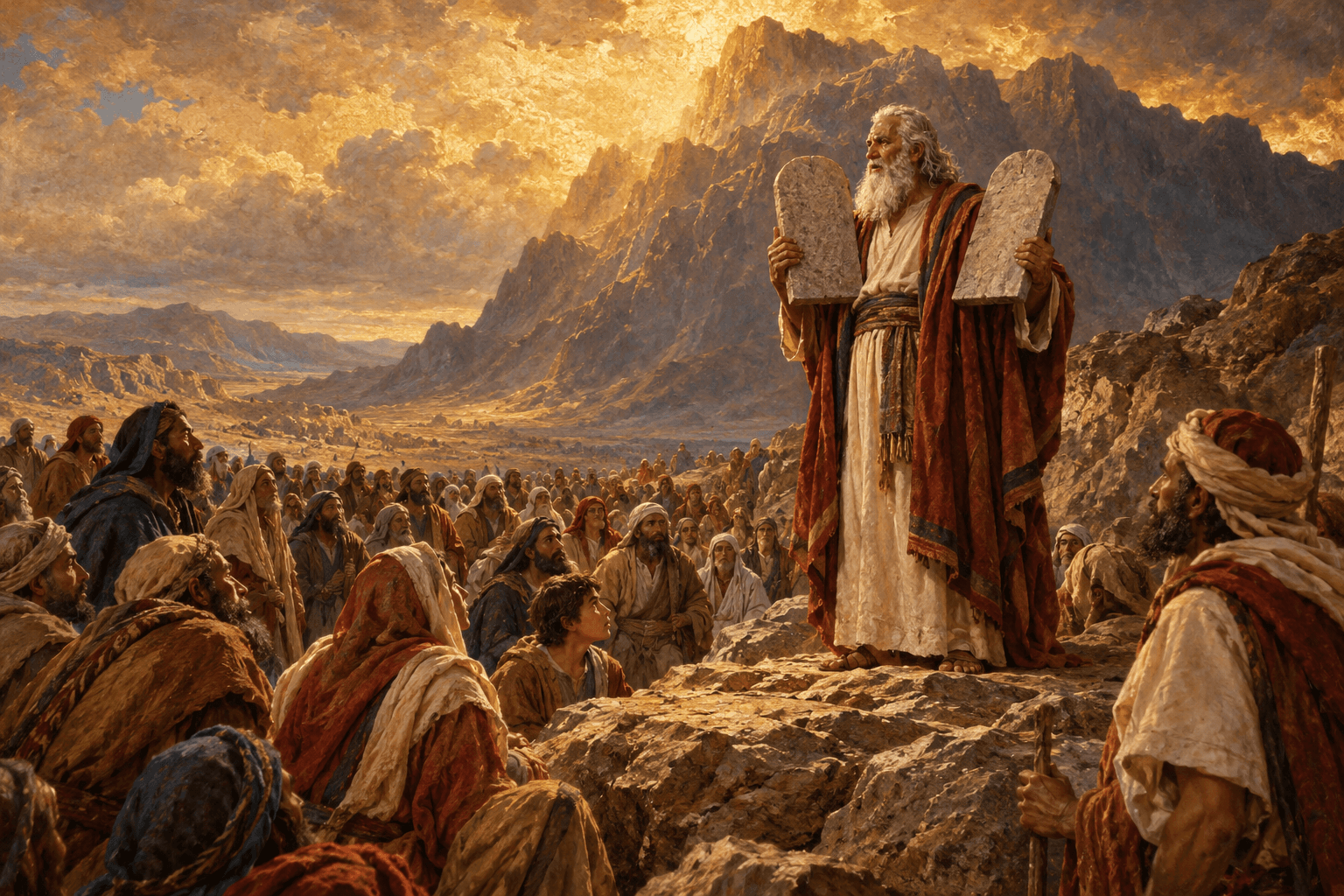
As Moses advanced to go up to the top of the mountain, to meet God face to face and receive from Him the two tablets of the Law written with the finger of God, the people also came near, but they could only stand at the foot of the mountain. Moses was like a beloved son in his father’s bosom, while the people were like those cast down on the ground before Him.
The prophet says, “ye came near and stood.” The prophet Moses speaks to all as though they had been standing and seeing the splendor of God’s great glory at the receiving of the Law, though many of them had not yet been born and the others were under 20 years old. But what happened with their fathers happened on their behalf and on behalf of all coming generations. So when we hear these words, we regard the prophet Moses as speaking to us. We came near, we stood at the foot of the mountain, we saw the mountain burning with fire, we saw the glory of the Lord through the darkness, clouds, and thick darkness, and the Lord spoke to us out of the midst of the fire. We were with Moses at Horeb and heard the divine Law.
And the Lord spake unto you out of the midst of the fire: ye heard the voice of the words, but saw no similitude; only ye heard a voice. And he declared unto you his covenant, which he commanded you to perform, even ten commandments; and he wrote them upon two tables of stone. And the Lord commanded me at that time to teach you statutes and judgments, that ye might do them in the land whither ye go over to possess it. [12–14]
After speaking of their mission to hand on to the new generations what they had received from Him, he wanted to stress that handing on is not by words alone but by deeds as well; therefore in this chapter he repeats the words “that ye might do them.” This is living tradition, in which we hand on to the new generation the living commandment at work in us.
“His covenant”: this word occurs 26 times in the book, and this is the first. The original word berith denotes a deed with conditions, but it also denotes, as here, the establishment of a covenant and a firm bond between two parties. It may be a covenant of brotherhood, like the covenant of David and Jonathan (1 Samuel 18:3); a covenant of sovereignty, like David’s covenant with the people; or a covenant of pure grace, like God’s covenant with Noah (Genesis 9:9). The covenant of Horeb was a covenant of pure grace, in which God took Israel as His own people, and they took Him as their God (Exodus 19:5–8).
The prophet Moses presents his and the people’s meeting with God at the receiving of the Law as a living example of meeting with God throughout the generations. For God is a Spirit, and those who worship Him must worship Him in spirit and in truth. Worship of idols, whatever their form, is not fitting; rather, we meet God on the level of the spirit, so that we may enjoy union with Him.
Idol worship does not harm God Himself, but destroys man and corrupts his life; so he warns them against it, saying:
Take ye therefore good heed unto yourselves; for ye saw no manner of similitude on the day that the Lord spake unto you in Horeb out of the midst of the fire: Lest ye corrupt yourselves, and make you a graven image, the similitude of any figure, the likeness of male or female, The likeness of any beast that is on the earth, the likeness of any winged fowl that flieth in the air, The likeness of any thing that creepeth on the ground, the likeness of any fish that is in the waters beneath the earth: And lest thou lift up thine eyes unto heaven, and when thou seest the sun, and the moon, and the stars, even all the host of heaven, shouldest be driven to worship them, and serve them, which the Lord thy God hath divided unto all nations under the whole heaven. [15–19]
Origen says:
“When you decide to keep this commandment and reject all other gods and lords, so that you have no God or Lord but the one God and one Lord, you declare war on the others without entering into any alliance with them.”
“Therefore, when we come to the grace of baptism, we confess the one God, the Father, the Son, and the Holy Spirit. [40]”
The Egyptian god Anubis had the head of a jackal, and the god Thoth the head of a hawk. There were temples for the worship of the moon in Jerusalem and Haran in the days of Abraham, and the Egyptians worshiped the sun at On (Heliopolis) (Genesis 41:45).
He forbade them to set up gods in the form of a man or woman, like Baal-peor of Moab, Priapus and Ashtaroth among the Romans, and the goddess Venus of the Greeks and Romans. He also forbade them to set up gods in the form of animals or birds, like the Egyptian calf Apis, and the worship of crocodiles, snakes, monkeys, dogs, cats, and so on.
God warns us against worshiping the sun, the moon, and the stars. All these were created for man, not man for them. Some thought that the heavenly bodies, such as the sun, moon, and stars, not only made themselves, but were the source of blessings for humanity. The Hebrew word for “sun,” shemesh, means “servant,” for it is a general servant of the visible world, shining like a candle for every person. It is not fitting for the servant to become a god, nor for what God created as a help for us to become the destruction of our souls.
Saint Athanasius the Apostolic comments on this passage that creation in its surpassing beauty, especially heaven with its stars, is a silent teacher, so that the nations may come to know God, the Creator of all, and not so that these may become gods for them to worship. [39] So when a person’s insight is corrupted, he turns what is beautiful not to the edification of his soul but to its destruction.
When a person compares himself with the sun, his soul may shrink greatly before its size, power, and capabilities. But let him realize that heaven with all its stars and the earth will pass away, while man, by the grace of God, lives in glory forever. Comparing the sun with himself, Pascal said, “I am greater than the sun,” giving this reason: “The sun can cast its heat upon me and destroy me, but I am aware of it and defend myself, while it has no awareness of its victory!”
“Lest thou lift up thine eyes… and when thou seest the sun, and the moon, and the stars” (19). The prophet Moses warns us about our gazing, for the heart often follows the eye. When a person fixes his gaze on something, his heart often opens to it and becomes enslaved to it.
But the Lord hath taken you, and brought you forth out of the iron furnace, even out of Egypt, to be unto him a people of inheritance, as ye are this day. [20]
Some see here a reference to the Jews working in smelting metals, while others see it as a reference to forced labor in hard work such as digging mines.
The use of iron, heating it and then hammering it while glowing, appeared in the Middle East around 3000 B.C., while iron works, especially for making weapons, appeared around 1500 B.C. So the Exodus of the people of Israel from Egypt was like coming out of an iron furnace. The weight of slavery was like the fire for smelting iron, the hottest fire known at that time.
Furthermore the Lord was angry with me for your sakes, and sware that I should not go over Jordan, and that I should not go in unto that good land, which the Lord thy God giveth thee for an inheritance: But I must die in this land, I must not go over Jordan: but ye shall go over, and possess that good land. [21–22]
This is the third time he mentions God’s refusal to let him cross into the land of Canaan (Deuteronomy 1:37; 3:26–27). Each time he speaks of God’s anger with him because of them. This repetition reveals the bitterness deep in his heart at being deprived of this blessing, and his intense longing to enjoy the divine promises.
4. The Divine Covenant and Idol Worship
KJV · Verses 23–31
23 Take heed unto yourselves, lest ye forget the covenant of the Lord your God, which he made with you, and make you a graven image, or the likeness of any thing, which the Lord thy God hath forbidden thee. 24 For the Lord thy God is a consuming fire, even a jealous God. 25 When thou shalt beget children, and children’s children, and ye shall have remained long in the land, and shall corrupt yourselves, and make a graven image, or the likeness of any thing, and shall do evil in the sight of the Lord thy God, to provoke him to anger: 26 I call heaven and earth to witness against you this day, that ye shall soon utterly perish from off the land whereunto ye go over Jordan to possess it; ye shall not prolong your days upon it, but shall utterly be destroyed. 27 And the Lord shall scatter you among the nations, and ye shall be left few in number among the heathen, whither the Lord shall lead you. 28 And there ye shall serve gods, the work of men’s hands, wood and stone, which neither see, nor hear, nor eat, nor smell. 29 But if from thence thou shalt seek the Lord thy God, thou shalt find him, if thou seek him with all thy heart and with all thy soul. 30 When thou art in tribulation, and all these things are come upon thee, even in the latter days, if thou turn to the Lord thy God, and shalt be obedient unto his voice; 31 (For the Lord thy God is a merciful God;) he will not forsake thee, neither destroy thee, nor forget the covenant of thy fathers which he sware unto them.
If he has focused on the commandment concerning the rejection of idol worship, the reason is that “the Lord thy God is a consuming fire, even a jealous God” (24). He will not accept dwelling in the heart with false, vain, and deceptive gods. Whoever makes a covenant with God does not accept another with Him, for the divine kingdom of light has no fellowship with the kingdom of darkness.
God is a consuming fire who kindles the heart with the fire of love, which all the waters of the world cannot quench; and at the same time He burns up all evil and corruption. The Apostle Paul referred to this fire, saying: “fiery indignation, which shall devour the adversaries” (Hebrews 10:27). And when he spoke of the judgment of ministers he said: “Every man’s work shall be made manifest: for the day shall declare it, because it shall be revealed by fire; and the fire shall try every man’s work of what sort it is. If any man’s work abide which he hath built thereupon, he shall receive a reward. If any man’s work shall be burned, he shall suffer loss: but he himself shall be saved; yet so as by fire” (1 Corinthians 3:13–15).
God is a consuming fire. Moses enjoyed Him on the mountain, and the fire became glory and splendor for him; Korah, Dathan, and Abiram collided with Him and perished. The divine fire increases the believer in purity and splendor, and disperses the disobedient one who is determined on his evil and corruption. The fire that purifies precious metals burns up all that is cheap and worthless; so it also symbolizes God’s holiness and just judgment.
If God is a consuming fire, then whoever mixes the worship of the living God with idol worship is like one who brings his idols into a consuming fire, so that the idols lose their being and form.
“A jealous God” (24): God’s love is often compared to the love of a husband who gives himself to his wife without reserve and expects from her complete love in return.
Saint Jerome says:
“If God is fire, He is fire in order to take away the coldness of the devil. [41]”
Pope Athanasius the Apostolic says:
“The servant of the Lord ought to be diligent and careful; indeed, more than this, he should be burning like a flame, so that with a zealous spirit he destroys every carnal sin, and is able to draw near to God, who, in the words of the saints, is called ‘a consuming fire.’ [42]”
Saint Gregory of Nazianzus says, concerning the Holy Spirit who descended in the form of tongues of fire:
“They were of fire, perhaps because of His cleansing power (for our Scripture knows of a purifying fire, which anyone who seeks it will find), or perhaps because of His essence. For our God is a consuming fire, a fire that burns up what is evil. [43]”
Saint Ambrose says:
“Do not marvel when you read that God the Father says, ‘I am a consuming fire’ (24). Again He says, ‘They have forsaken me the fountain of living waters’ (Jeremiah 2:13). The Lord Jesus too is like a fire that kindles the hearts of His hearers, and like a fountain of water that cools them. For He Himself said in His Gospel that He came to cast fire on the earth (Luke 12:49), and that He gives a fountain of living water to the thirsty (John 7:37–38). [44]”
“The prophet Isaiah shows that the Holy Spirit is not only light but also fire, saying, ‘And the light of Israel shall be for a fire’ (Isaiah 10:17). So the prophets call Him a burning fire, because in those three points we have discussed at length we see the greatness of the Godhead: the sanctification that belongs to the Godhead, and illumination as the mark of light and fire. Therefore the Godhead is usually spoken of and seen in the form of fire, as Moses says: ‘God is a consuming fire.’”
“For Moses himself saw the fire in the bush, and heard God when the voice came from the flame of fire saying to him, ‘I am the God of Abraham, the God of Isaac, and the God of Jacob’ (Exodus 3:6). The voice came from the fire, and the voice was in the bush, and the fire did not harm it. The bush was burning but was not consumed, for the mystery of the Lord was being revealed: that He comes to illumine the thorns of our body, not to destroy those who were in misery but to take away their misery. He is the One who baptizes with the Holy Spirit and with fire, giving grace and destroying sin (Matthew 3:11). So in the symbol of fire God keeps His purpose. [45]”
Saint Augustine says:
“You, O Lord, are a consuming fire, burning up their lifeless cares and renewing them forever. [46]”
When thou shalt beget children, and children’s children, and ye shall have remained long in the land, and shall corrupt yourselves, and make a graven image, or the likeness of any thing, and shall do evil in the sight of the Lord thy God, to provoke him to anger: I call heaven and earth to witness against you this day, that ye shall soon utterly perish from off the land whereunto ye go over Jordan to possess it; ye shall not prolong your days upon it, but shall utterly be destroyed. And the Lord shall scatter you among the nations, and ye shall be left few in number among the heathen, whither the Lord shall lead you. And there ye shall serve gods, the work of men’s hands, wood and stone, which neither see, nor hear, nor eat, nor smell. But if from thence thou shalt seek the Lord thy God, thou shalt find him, if thou seek him with all thy heart and with all thy soul. When thou art in tribulation, and all these things are come upon thee, even in the latter days, if thou turn to the Lord thy God, and shalt be obedient unto his voice; (For the Lord thy God is a merciful God;) he will not forsake thee, neither destroy thee, nor forget the covenant of thy fathers which he sware unto them. [25–31]
The matter is extremely serious, for turning away from the worship of the living God is separation from the source of life and peace. Therefore it is said: “ye shall soon utterly perish… And the Lord shall scatter you among the nations, and ye shall be left few in number among the heathen, whither the Lord shall lead you” (26–27). Man perishes when he rejects God, who works in him to build him up, in order to make a god with his own hands; as it is said, “the workman made it; therefore it is not God” (Hosea 8:6). Man turns his gaze from God, the source of his life, to enslave himself to what God created for his sake: animals, birds, reptiles, and fish; or he worships his brother or the heavenly creation. There is no comparison between the living God, who longs to establish His covenant with His people, and senseless idols, which are the work of man (Deuteronomy 5:6; 10:12; 11:13; 26:16; 30:2, 6, 10).
Here he gives a warning to them and to their children after them, lest they leave the worship of the living God and serve idols. This warning carried a kind of prophecy. With prophetic eyes the prophet Moses saw the scattering and captivity among the nations that would befall his people. He saw the coming generations falling into idol worship; therefore he called heaven and earth to witness his warning and the destruction and scattering that would come upon Israel.
God opens the door of hope for His people, as for every believer, that they may return to the Lord their God and enjoy His divine promises. If the people are scattered because of their sins and then return, they find the doors of God’s mercies open and His arms outstretched, waiting for them. The people often forget their covenant with God; but as soon as they return to Him with practical faith expressed in obedience, they find Him receiving them with His mercies and tenderness. He will not forget His covenant with His people.
Here he presents repentance in a wonderful style, full of kindness and gentleness, using the words “turn” (come) (30) and “he will not forsake thee, neither destroy thee” (31). The Old Testament uses the language of warm welcome; God speaks even with the fallen and the resistant to call them back to the friendship they betrayed.
The prophet opens their eyes to the Lord, so that they may see Him as a merciful Father: “For the Lord thy God is a merciful God” (31). This is the testimony of a man who knows that the moments of his departure from the world and his meeting with God are near. He offers his long experience in his last moments. He is like one crying out to his people: “I have known Him! I have lived with Him! I have clung to Him on the mountain while He was wrapped in fire and light! He decided to deprive me of entering the land flowing with milk and honey. All these things are before my eyes; therefore I say: ‘the Lord thy God is a merciful God; he will not forsake thee, neither destroy thee, nor forget the covenant of thy fathers which he sware unto them’ (31). He gave me His commandments, which I in turn have given to you. With the commandments He gave us His heart. He is the Judge, but He is merciful. He sits on a throne of fire, yet He is occupied with man, whom He loves dearly.”
5. The One God Who Loves His People
KJV · Verses 32–40
32 For ask now of the days that are past, which were before thee, since the day that God created man upon the earth, and ask from the one side of heaven unto the other, whether there hath been any such thing as this great thing is, or hath been heard like it? 33 Did ever people hear the voice of God speaking out of the midst of the fire, as thou hast heard, and live? 34 Or hath God assayed to go and take him a nation from the midst of another nation, by temptations, by signs, and by wonders, and by war, and by a mighty hand, and by a stretched out arm, and by great terrors, according to all that the Lord your God did for you in Egypt before your eyes? 35 Unto thee it was shewed, that thou mightest know that the Lord he is God; there is none else beside him. 36 Out of heaven he made thee to hear his voice, that he might instruct thee: and upon earth he shewed thee his great fire; and thou heardest his words out of the midst of the fire. 37 And because he loved thy fathers, therefore he chose their seed after them, and brought thee out in his sight with his mighty power out of Egypt; 38 To drive out nations from before thee greater and mightier than thou art, to bring thee in, to give thee their land for an inheritance, as it is this day. 39 Know therefore this day, and consider it in thine heart, that the Lord he is God in heaven above, and upon the earth beneath: there is none else. 40 Thou shalt keep therefore his statutes, and his commandments, which I command thee this day, that it may go well with thee, and with thy children after thee, and that thou mayest prolong thy days upon the earth, which the Lord thy God giveth thee, for ever.
“The days that are past” (32): Moses calls on the people to remember what God did with them, especially the wonders that took place at the time of the Exodus. He repeats the word “Egypt” 47 times, and there would be no point in these references if Moses were not the true writer of this book.
We ought to ask those who went before us, and seek the knowledge of God from God Himself in a spirit of humility. Isaac Newton compared himself to a child standing on the shore of the ocean of knowledge, gathering a few small, shiny pebbles from among the rocks and stones; in humility he said that before him lay a vast ocean of knowledge he had not yet reached. So who among us can say that he has reached the middle of the ocean of the knowledge of God, and sees all its shores on every side? We ought to say with the boy Samuel: “Speak, Lord; for thy servant heareth.”
Here the prophet Moses gives a living invitation to compare God, the Lover and Savior of mankind, with false gods, saying: “whether there hath been any such thing as this great thing is, or hath been heard like it?” (32).
God has not left Himself without witness, but He asks His beloved man to meditate on God’s work with him. Here he focused on the following points:
First: He asked them to look at the whole history of humanity since man was created: has any people enjoyed the awesome God, the consuming fire, as they did, and lived?
God is a consuming fire, but He does not kill man, His beloved; rather He speaks with him and gives him eternal life. The prophet Moses enjoyed this experience, for he saw God in the midst of the fire, and God spoke with him a wonderful word of love. He experienced the divine fire, the gift of life. Moses saw the fire through the bush burning with fire; he drew near to it, heard the divine voice through it, and lived it on Mount Sinai. Having experienced the sweetness of the divine commandment, the prophet Moses found in all human history, from creation to the moment he spoke with them, no event greater than God’s revelation of Himself at Horeb and His handing of the commandments to His people. He spoke with His people through the fire.
Job heard the voice of God out of the whirlwind, and it was terrifying; but the people of Israel heard Him in the midst of fire, which is more terrifying still, yet it did not burn them.
The fire the prophet Moses speaks of is not a fire he had heard about; he experienced it himself at the beginning of his ministry and during it, and it gave him a fiery heart that all the waters of the world cannot quench.
If God asks them to reject the pagan cults, He deprives them of nothing; rather, He offers Himself to them so that they may draw near to Him, for He is the one God, unique in His love for His people.
Second: He is the God of the impossible, who saves His people with a mighty hand, a stretched-out arm, and great terrors, offering their Exodus from Egypt as a living example of His work with them.
Or hath God assayed to go and take him a nation from the midst of another nation, by temptations, by signs, and by wonders, and by war, and by a mighty hand, and by a stretched out arm, and by great terrors, according to all that the Lord your God did for you in Egypt before your eyes? Unto thee it was shewed, that thou mightest know that the Lord he is God; there is none else beside him. Out of heaven he made thee to hear his voice, that he might instruct thee: and upon earth he shewed thee his great fire; and thou heardest his words out of the midst of the fire. [34–36]
He mentions the slavery, the torment, and the wonders the Lord did to show His glory; and he mentions the Passover and the crossing of the Red Sea, repeating the words “out of Egypt” like a refrain of joyful victory.
“Because he loved… he chose” (37): the Hebrew word “loved” carries the meaning of God’s electing love. It corresponds to the Greek word agapao in the New Testament, the spontaneous love that is entirely of grace, given without any merit in the beloved. Moses finds no reason for God’s choice of Israel other than His sovereign choice.
Third: He is a God who does good to His people: “that it may go well with thee, and with thy children after thee, and that thou mayest prolong thy days upon the earth, which the Lord thy God giveth thee, for ever” (40).
The nations were accustomed to dread God and fear His vengeance, so they offered Him sacrifices to appease Him. Some offered their own sons as human sacrifices to turn away His anger, sometimes offering captives or others, and they cut themselves. But the true God, though He appeared as a consuming fire, did not appear to declare His fiery anger or to take vengeance, but to help and support His people. He kindles their hearts with the fire of His love and is a wall of fire round about them (Zechariah 2:5).
Seven signs of the Almighty God’s role in saving His people
The prophet Moses listed seven signs of the Almighty God’s role in the salvation of His people:
1. “Temptations” (trials): God permits hardships to test their faith in Him and their obedience to Him; the goal is to draw them to Himself.
2. “Signs”: intended to declare His nearness to them, for He went before them as a pillar of light by night and a cloud overshadowing them by day. God gave them laws mixed with signs and wonders, and brought them out of the land of Egypt with a mighty hand, a stretched-out arm, and great terrors (34). The awe God displayed was for the destruction of those who resisted them. He brought them out as from the furnace of slavery; He is a fire that works on behalf of His believers and His people, not for their destruction.
3. “Wonders”: He makes everything serve the building up of His children, nature with its laws, and also the breaking of the laws of nature, as happened in the crossing of the Red Sea and the coming down of manna from heaven.
4. “War”: to enjoy the Promised Land they had to occupy gradually the places of many nations, most of them giants and men of war with mighty resources; therefore God intervenes as the leader of His people, giving them victory and triumph.
5. “A mighty hand”: His mighty hand is on behalf of His believers, able to repel every opposition that stands before them.
6. “A stretched-out arm”: able to crush evil and to embrace souls. The Holy Bible often speaks of God’s hand as a sign of divine work:
- The finger of God, which wrote on the two tablets of the covenant, points to His fiery Holy Spirit.
- The hand of God points to the Incarnation of the Word, who accomplishes the work of salvation and reveals the Father’s practical love in giving His only-begotten Son.
- The arm of God points to God’s power working without limits, doing wonders for the good of the believers without ceasing.
- God’s outstretched arm: God’s longing to embrace those who return to Him.
7. “Great terrors”: He shows these to hard hearts, like Pharaoh and his people in the ten plagues.
The aim of the commandment
A) To realize God’s choice of us and His longing that we enjoy freedom.
And because he loved thy fathers, therefore he chose their seed after them, and brought thee out in his sight with his mighty power out of Egypt; [37]
B) That we may reign and rejoice.
To drive out nations from before thee greater and mightier than thou art, to bring thee in, to give thee their land for an inheritance, as it is this day. Know therefore this day, and consider it in thine heart, that the Lord he is God in heaven above, and upon the earth beneath: there is none else. Thou shalt keep therefore his statutes, and his commandments, which I command thee this day, that it may go well with thee, and with thy children after thee, and that thou mayest prolong thy days upon the earth, which the Lord thy God giveth thee, for ever. [38–40]
The matter does not stop at bringing them out of Egypt with a strong hand and freeing them from the bondage of the devil; He wants to give them a happy dwelling in Canaan and stability there. So God draws us out of the bondage of the devil, crushes all the powers of evil, and seats us with Him in the heavenly places, so that we may settle in the Father’s bosom and find eternal rest.
6. The Cities of Refuge
KJV · Verses 41–43
41 Then Moses severed three cities on this side Jordan toward the sunrising; 42 That the slayer might flee thither, which should kill his neighbour unawares, and hated him not in times past; and that fleeing unto one of these cities he might live: 43 Namely, Bezer in the wilderness, in the plain country, of the Reubenites; and Ramoth in Gilead, of the Gadites; and Golan in Bashan, of the Manassites.
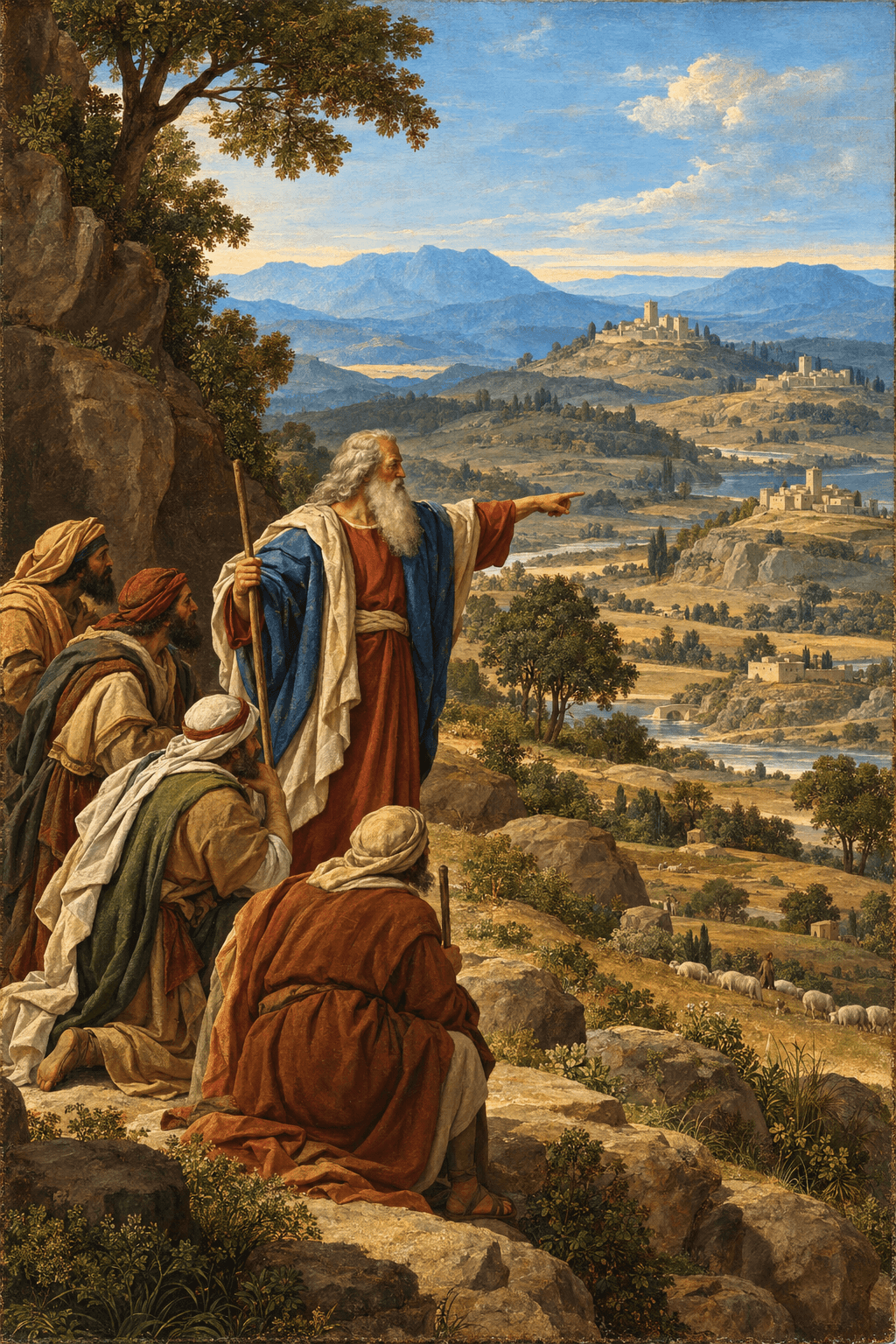
The prophet Moses sees God as a refuge for every soul justified by Him, and the law of the six cities of refuge came as a sign and symbol of God’s work. God established the cities of refuge (Deuteronomy 4:41–43; 19:2–13), whose aim was to free the Promised Land from the shedding of innocent blood.
The three cities of refuge were designated on the eastern bank: one in the portion of Reuben, another in the portion of Gad, and the third in the portion of the half tribe of Manasseh, as a pattern for establishing the other three cities on the western bank.
The cities of refuge on the eastern bank are: Bezer, about 20 miles northeast of the Dead Sea, near those living in the south of the eastern bank; Ramoth in Gilead, for those in the middle, about 30 miles east of the middle of the eastern side of the Sea of Galilee; and Golan, for those in the north.
Some cities that had been centers of idol worship became “cities of refuge,” to which every unintentional killer could flee and find security and peace; they came to represent the house of God, the Giver of comfort. For a study of the cities of refuge, see Numbers 35:6–15.
7. Introduction to the Second Sermon
KJV · Verses 44–49
44 And this is the law which Moses set before the children of Israel: 45 These are the testimonies, and the statutes, and the judgments, which Moses spake unto the children of Israel, after they came forth out of Egypt. 46 On this side Jordan, in the valley over against Bethpeor, in the land of Sihon king of the Amorites, who dwelt at Heshbon, whom Moses and the children of Israel smote, after they were come forth out of Egypt: 47 And they possessed his land, and the land of Og king of Bashan, two kings of the Amorites, which were on this side Jordan toward the sunrising; 48 From Aroer, which is by the bank of the river Arnon, even unto mount Sion, which is Hermon, 49 And all the plain on this side Jordan eastward, even unto the sea of the plain, under the springs of Pisgah.
The writer gave us an opening, an introduction to the farewell sermons of the prophet Moses (Deuteronomy 1:1–5), followed by the first sermon, in which the prophet Moses made clear God’s surpassing care for His people despite their persistence in disobeying Him (Deuteronomy 1). God set a plan for them even in their wars; along with what He gives them generously, He asks them to be committed to responsibility and holiness, so they do not fight the Edomites or the Moabites, but they overcome Sihon and Og (Deuteronomy 2–3). He spoke with them again and again about how much he longed to enjoy the Promised Land, but because of them he was deprived of it, so he handed the leadership to his disciple Joshua (Deuteronomy 34:9). Finally, what occupies him is that they be bound to God by the divine covenant and draw near to Him (Deuteronomy 4).
Having concluded the first sermon, he designated the cities of refuge on the eastern bank, in order to begin the second sermon.
The prophet Moses was about to deliver his second sermon, concerning the testimonies that come from God to declare His will, the statutes that the believers are bound to follow in their conduct, and the judgments that define the rights shared among people.
In this introduction to the sermon the writer stresses the prophet Moses’ concern that the people not be preoccupied with the victory over the two kings of the Amorites and their possession of the land, but rather that they enjoy the divine commandment, so that each believer carries God’s will and not his own, walks as befits a son of His, and keeps the right of every being.
8. A Meditation on Deuteronomy 4
Let Your Commandment Carry Me to You, O Consuming Fire
In the midst of the fire You gave Your Law on the two tablets of the covenant,
and in tongues of fire Your fiery Spirit came upon me!
Welcome to Your fiery commandment.
I bow before it and take up the spirit of obedience;
I see Your wonders in it,
and receive in it Your righteousness and purity,
O You who alone are holy!
Through it I gain You, O Divine Wisdom,
and become wise and enjoy the knowledge of You!
You offered me Yourself as a consuming fire,
not that I should be terrified and flee,
but that I should draw near to You with Moses Your prophet,
and hear Your eternal, surpassing voice.
Your fiery voice terrifies my enemies;
through You I enter Your kingdom free,
and reign and rejoice in You, O secret of my strength.
Notes and References
[39] Saint Athanasius, Contra Gentes, 45.
[40] Origen, Homilies on Exodus, 8:4.
[41] Saint Jerome, Homilies on the Psalms, 57.
[42] Saint Athanasius, Paschal Epistles, 4:3.
[43] Saint Gregory of Nazianzus, On Pentecost, 12.
[44] Saint Ambrose, The Duties of the Clergy, Book 3, 18 (105).
[45] Saint Ambrose, The Duties of the Clergy, Book 1, 14:164–165.
[46] Saint Augustine, Confessions, 5:30:4.