
This chapter contains:
1. His Third Prophecy
KJV · Verses 1–14
1 And when Balaam saw that it pleased the Lord to bless Israel, he went not, as at other times, to seek for enchantments, but he set his face toward the wilderness. 2 And Balaam lifted up his eyes, and he saw Israel abiding in his tents according to their tribes; and the spirit of God came upon him. 3 And he took up his parable, and said, Balaam the son of Beor hath said, and the man whose eyes are open hath said: 4 He hath said, which heard the words of God, which saw the vision of the Almighty, falling into a trance, but having his eyes open: 5 How goodly are thy tents, O Jacob, and thy tabernacles, O Israel! 6 As the valleys are they spread forth, as gardens by the river's side, as the trees of lign aloes which the Lord hath planted, and as cedar trees beside the waters. 7 He shall pour the water out of his buckets, and his seed shall be in many waters, and his king shall be higher than Agag, and his kingdom shall be exalted. 8 God brought him forth out of Egypt; he hath as it were the strength of an unicorn: he shall eat up the nations his enemies, and shall break their bones, and pierce them through with his arrows. 9 He couched, he lay down as a lion, and as a great lion: who shall stir him up? Blessed is he that blesseth thee, and cursed is he that curseth thee. 10 And Balak's anger was kindled against Balaam, and he smote his hands together: and Balak said unto Balaam, I called thee to curse mine enemies, and, behold, thou hast altogether blessed them these three times. 11 Therefore now flee thou to thy place: I thought to promote thee unto great honour; but, lo, the Lord hath kept thee back from honour. 12 And Balaam said unto Balak, Spake I not also to thy messengers which thou sentest unto me, saying, 13 If Balak would give me his house full of silver and gold, I cannot go beyond the commandment of the Lord, to do either good or bad of mine own mind; but what the Lord saith, that will I speak? 14 And now, behold, I go unto my people: come therefore, and I will advertise thee what this people shall do to thy people in the latter days.
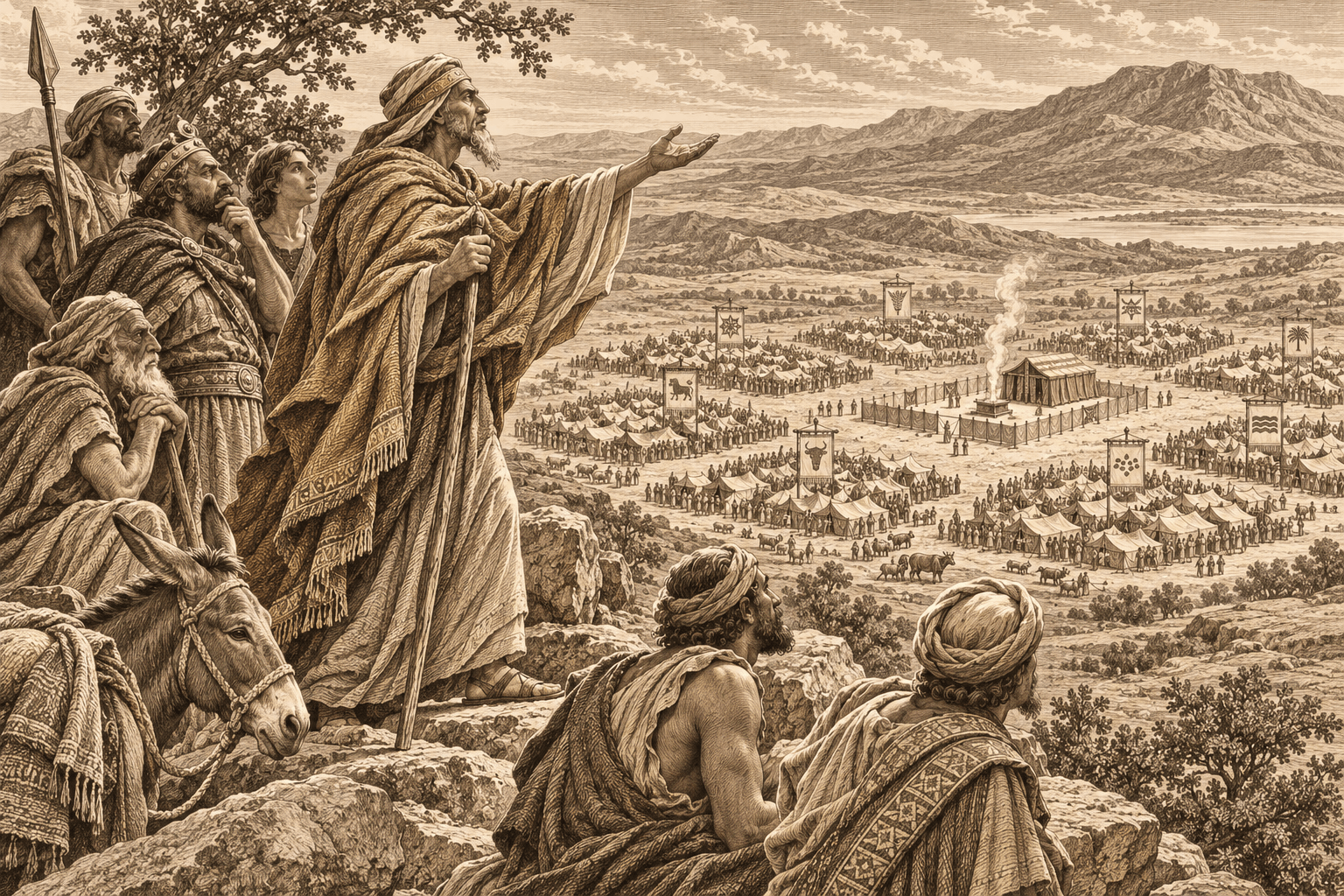
When Balak brought Balaam to the height of pleasures to cut him off from the Lord, so that he would utter his own curses instead of the Lord’s blessing, Balaam on the contrary realized that he could not act of himself; so he prophesied for the third time, in circumstances different from the two previous prophecies, in that:
A) He did not use enchantment, that is, sorcery, as was his custom (1).
B) He did not withdraw to an isolated place, but went straight toward the people and their camp (2).
C) The Spirit of the Lord came upon him, and his eyes were opened to see the situation more clearly (2, 4).
First, his not using enchantment. Balaam stopped using all his arts of sorcery, not out of love for God and faith in Him, but most likely because he realized that his demons were completely unable to help him utter his curses. Origen says:
We may ask: how did Balaam know that it pleased the Lord to bless Israel? He observed that when he burned the sacrifices not a single demon came forward, nor did any hostile power dare to appear near his victims; the ministers of evil, who used to help him offer his curses, had departed. [224]
Perhaps the witness of Scripture, “Balaam saw that it pleased the LORD to bless Israel” (1), first declares God’s longing to bless the new Israel, that is, the Church; and some also see in it a prophecy of the Jews’ turning from their denial and unbelief, so that they receive Christ the Lord at the end of the ages and enjoy the spiritual blessing in place of Zionist racialism.
Second, his setting out to see the camp of the holy congregation. Having prophesied before of the Incarnation (the first prophecy) and then of the events of the crucifixion and resurrection (the second prophecy), his eyes were opened to see the Church united with Christ, enjoying the blessing of salvation; therefore he went straight to behold her.
Third, the coming of the Spirit upon him. Since this prophecy concerns the day of Pentecost, the birthday of the Church that enjoys salvation in Christ Jesus through the work of the Holy Spirit, “the spirit of God came upon him.” But alas, the Spirit revealed to him God’s mysteries in His dealings with mankind, and his eyes were opened but not his heart. Instead of repentance he grew more arrogant and proud; he offered knowledge without humility, and his heart was filled with dryness because of his love of silver.
The subject of the prophecy included two things: the people he saw with his bodily eyes as a holy nucleus, and the people he saw with the eyes of prophecy as the Church of the New Testament, which rises through the Holy Spirit on the day of Pentecost as the body of Christ Jesus.
As for the people he saw before him with his bodily eyes, he sees in it: a people full of beauty, “How goodly are thy tents, O Jacob”; ever fruitful, “As the valleys are they spread forth, as gardens by the river’s side”; bearing honour, “his king shall be higher than Agag, and his kingdom shall be exalted”; full of strength in the past, “God brought him forth out of Egypt,” and in the present, “the strength of an unicorn,” and in the near future, “he shall eat up the nations”; and finally its effect on those around it and God’s care for it. This prophecy was indeed fulfilled at the beginning of this people’s setting out; but it was taken from them when they denied the Messiah, the Saviour, and this prophecy became the inheritance of the new Israel, the Church that came from the Gentiles. The following is a simple explanation of the prophecy.
“Balaam the son of Beor hath said, and the man whose eyes are open hath said: He hath said, which heard the words of God, which saw the vision of the Almighty, falling into a trance, but having his eyes open” (3–4).
Origen comments thus:
It is astonishing that Balaam should be praised with such praise… How can Balaam be one whose eyes are open, he who gave himself to divination and sorcery…? He was worthy of this great praise because it is said of him: “the spirit of God came upon him,” and “the LORD… put a word in his mouth” (Numbers 23:16), something we do not find even in Moses or in another prophet, to be raised to so high a place. [225]
Balaam’s words about himself, “the man whose eyes are open,” point to the state of the believer in the Church of the New Testament, where the veil has been lifted, so that the depths of the Law have been revealed, the truth has come in place of the shadow, and the prophecies have been fulfilled. Man has come to “hear the words of God,” not through letters but written with love on the cross in His only Son, and to “see the vision of the Almighty,” not through dreams like Daniel or symbolic revelations, but as the Apostle said: “But we all, with open face beholding as in a glass the glory of the Lord, are changed into the same image from glory to glory, even as by the Spirit of the Lord” (2 Corinthians 3:18).
By sin man became one whose eyes are open, for he came to know evil and practised it; and in Christ Jesus our Lord he has become one whose eyes are open, coming to know divine, heavenly things and living them in our daily life. Origen says:
The serpent said to Eve that God knew that in the day they ate of it, “your eyes shall be opened” (Genesis 3:5); and she ate, and Scripture says: “And the eyes of them both were opened” (Genesis 3:7). But there are two kinds of eyes: the eyes that are opened by sin, and the eyes with which Adam and Eve saw before these eyes were opened. [226]
Christ the Lord came to open the inner, spiritual sight that was blind, and to blind these eyes that know evil and lust after it. Therefore He says: “For judgment I am come into this world, that they which see not might see (that is, the spiritual sight is opened); and that they which see might be made blind (that is, the eyes of evil which Satan opened by the serpent’s counsel are closed)” (John 9:39). How much we need the Lord to open our eyes to heavenly things and close them to evil!!
Through the serpent’s counsel man’s eyes were opened to evil and he became blind; and through Christ the Lord his eyes are closed to evil, to be opened to divine things, so that he becomes seeing, or enlightened.
When his eyes were opened he said: “How goodly are thy tents, O Jacob, and thy tabernacles, O Israel!” (5). In the Septuagint: “How goodly are thy dwellings, O Jacob, thy tents, O Israel.” If the dwelling points to a state of settledness, the tent points to a state of continual movement. The Church is in a state of settledness as the mystical body of Christ, settled in the bosom of the Father; and at the same time she is ever moving and growing, going forward by the Holy Spirit from glory to glory, so that her members may attain the measure of the stature of the fullness of Christ. By the dwelling He wanted to declare our entry into union with God in His Son Jesus Christ by His Holy Spirit, so that we come to know the mysteries of the knowledge of the Holy Trinity as an experience we live and practise; and by the tents He wanted to affirm the state of continual growth in knowledge: we set out, rising from experience to experience, and enter from knowledge to knowledge… In this way “reaching forth unto those things which are before” (Philippians 3:13), like wandering nomads, we do not stop seeking more of edifying spiritual knowledge until we see Him face to face.
“As the valleys are they spread forth, as gardens by the river’s side, as the trees of lign aloes which the LORD hath planted, and as cedar trees beside the waters. He shall pour the water out of his buckets, and his seed shall be in many waters, and his king shall be higher than Agag, and his kingdom shall be exalted” (6–7).
What a living picture of the day of Pentecost, the birthday of the holy Church of Christ by the Holy Spirit! He gave her settledness as holy dwellings and gave her the vitality of continual growth as ever-moving tents. Now Balaam sees her as valleys without limit and gardens ever fruitful!
The Septuagint reads: “As shady groves (small forests), as gardens by a river, as tents which God pitched, as cedars by the waters. There shall come a man out of his seed, and he shall rule over many nations; and the kingdom of Gog shall be exalted, and his kingdom shall be increased” (6–7). Here the work of the Holy Spirit in the life of the Church stands out: He makes her like shady forests that shelter animals and birds; like gardens by a river that gladden the heart of man and restore his familiar peace; like tents which God pitched, so that they are holy, moving toward their Maker to rest in Him; like lofty, upright cedars; and like a man ruling with authority, whom Satan with all his soldiers cannot overcome!
Origen comments on this text, saying:
Balaam presents a charming and wonderful picture: “As shady groves, as gardens by a river, as tents which God pitched, as cedars by the waters.” Those who grow weary on the way walk among “the shady trees,” which are the company of the righteous and the order of the holy prophets. Their spirits taste refreshment under the shade of the meanings they find in their writings and in walking in their teachings, delighting in the depth of the trees…! They are like gardens by a river, bearing the image of paradise, where the tree of life is by the rivers, that is, the Gospel and Apostolic writings… Our Saviour is the river that makes glad the city of God (Psalm 46:4). By the Holy Spirit He becomes for us not only the river but a well of water given to us in our bellies (John 4:14). The Father too says: “they have forsaken me the fountain of living waters” (Jeremiah 2:13), who is the source of these rivers (waters). Therefore the Israelites pitch their tents to draw from these rivers, these tents which God Himself pitched. [227]
How beautiful and how great is the Church! God Himself pitched her tents by the holy rivers, so that she draws from the springs of the knowledge of the Holy Trinity, rejoicing in the Father, “the fountain of living waters,” in the Son, “the river of life,” and in the Holy Spirit, who makes springs of living water burst forth within the soul!
What does the pitching of the tent by the holy waters mean, if not the planting of the believers in the holy waters of Baptism, where man puts off every stain of sin and bears the new man in the image of his Creator? In the font he is planted as a member of the body of Christ, becomes a temple of the Holy Spirit, and enjoys the right to settle in the bosom of the Father as His son.
In this way the Church becomes shady forests, to which every man takes refuge to rest under their shade from the strokes of the burning sun of temptations. And she becomes like gardens by a river, speaking to her Bridegroom: “Let my beloved come into his garden, and eat his pleasant fruits” (Song of Solomon 4:16). And the Bridegroom answers her, rejoicing: “I am come into my garden, my sister, my spouse: I have gathered my myrrh with my spice; I have eaten my honeycomb with my honey; I have drunk my wine with my milk: eat, O friends; drink, yea, drink abundantly, O beloved” (Song of Solomon 5:1).
She becomes like cedars by the waters. As Origen says:
These tents are also like cedars by the waters. The cedar here does not carry evil pride; it is “the cedar of God,” which supports the branches of the vine brought out of Egypt (Psalm 80:8), so that the fruit may ripen and its shade cover the mountains. [228]
Having seen the work of the Holy Spirit in the life of the Church, he spoke of His role in her preaching life, saying: “There shall come a man out of his seed, and he shall rule over many nations.” For Christ the Lord comes incarnate from the house of Israel, He who reigns spiritually over many nations through the work of God’s Holy Spirit in His Church. Origen says:
It is Christ, who came forth from the offspring of Israel according to the flesh. How does He rule over the nations? This needs no explanation, especially if we read what the Father says: “Ask of me, and I shall give thee the heathen for thine inheritance, and the uttermost parts of the earth for thy possession” (Psalm 2:8). But what does it mean, “his kingdom shall be exalted above Gog”? “Gog” means “upon the roofs”; so let us not take this text as the name of a particular people… rather it means “His kingdom shall be exalted above the roofs, and His kingdom shall grow.” Being exalted above the roofs concerns the perfect, and growing concerns all the believers. In the perfect the kingdom of Christ is exalted above the roofs, that is, above those who occupy the better parts and dwell on the high places… For this reason I think the Saviour says: “Let him which is on the housetop not come down to take any thing out of his house” (Matthew 24:17), warning those who have reached the higher degrees of perfection not to come down from them to the lower and base places of this world… The growth of His kingdom means the increase of the churches and the multiplication of the believers, so that His kingdom rises until the Father “hath put all enemies under his feet. The last enemy that shall be destroyed is death” (1 Corinthians 15:25–26). [229]
So the Church grows in two directions: the growth of each believer toward perfection, to rise above the roofs and reach heavenly places; and growth to gather many into the knowledge of God, that is, preaching in the world.
The signs of this preaching are: “God brought him forth out of Egypt,” as though its goal is the soul’s setting out and passing over from the land of bondage toward the land of promise, as the ancient people set out. Some see in this phrase a reference to Christ the Lord’s flight into the land of Egypt, so that He might be called out of Egypt and so lead the Gentiles over into the way of faith. Origen says:
The Father brought Him out of Egypt and made Him come to Him, to open the way for those who are of the Egypt of this world, so that they may go up toward God. [230]
He continues: “he hath as it were the strength of an unicorn.” We saw in our commentary on the previous chapter (Numbers 23:22) that it points to the preaching of Christ the Lord with power, so that He reigns spiritually to the ends of the earth (Deuteronomy 33:17).
“he shall eat up the nations his enemies, and shall break their bones, and pierce them through with his arrows” (8). Through this preaching the Holy Spirit crushes the thoughts of evil in man, which were like nations hostile to the soul; He breaks their bones, that is, the bodily lusts, and shatters the arrows of evil temptations. In this way the Holy Spirit carries man, soul and body, into the holy life, granting him the spirit of victory and triumph.
The content of the preaching is: “He couched, he lay down as a lion, and as a great lion (the Arabic reads “as a lioness”): who shall stir him up? Blessed is he that blesseth thee, and cursed is he that curseth thee” (9). He speaks of the Bridegroom and the bride together, because they are united: the Bridegroom couched like a lion on the cross, and His bride lay down with Him. Who shall raise them up? The Lord rises by His own authority, for He said: “I have power to lay it down, and I have power to take it again” (John 10:18), granting His bride the power of the resurrection. In this way the Church has come to bear the powers of her Bridegroom, so that whoever blesses her is blessed by her Bridegroom, and whoever curses her bears the wrath of her Bridegroom.
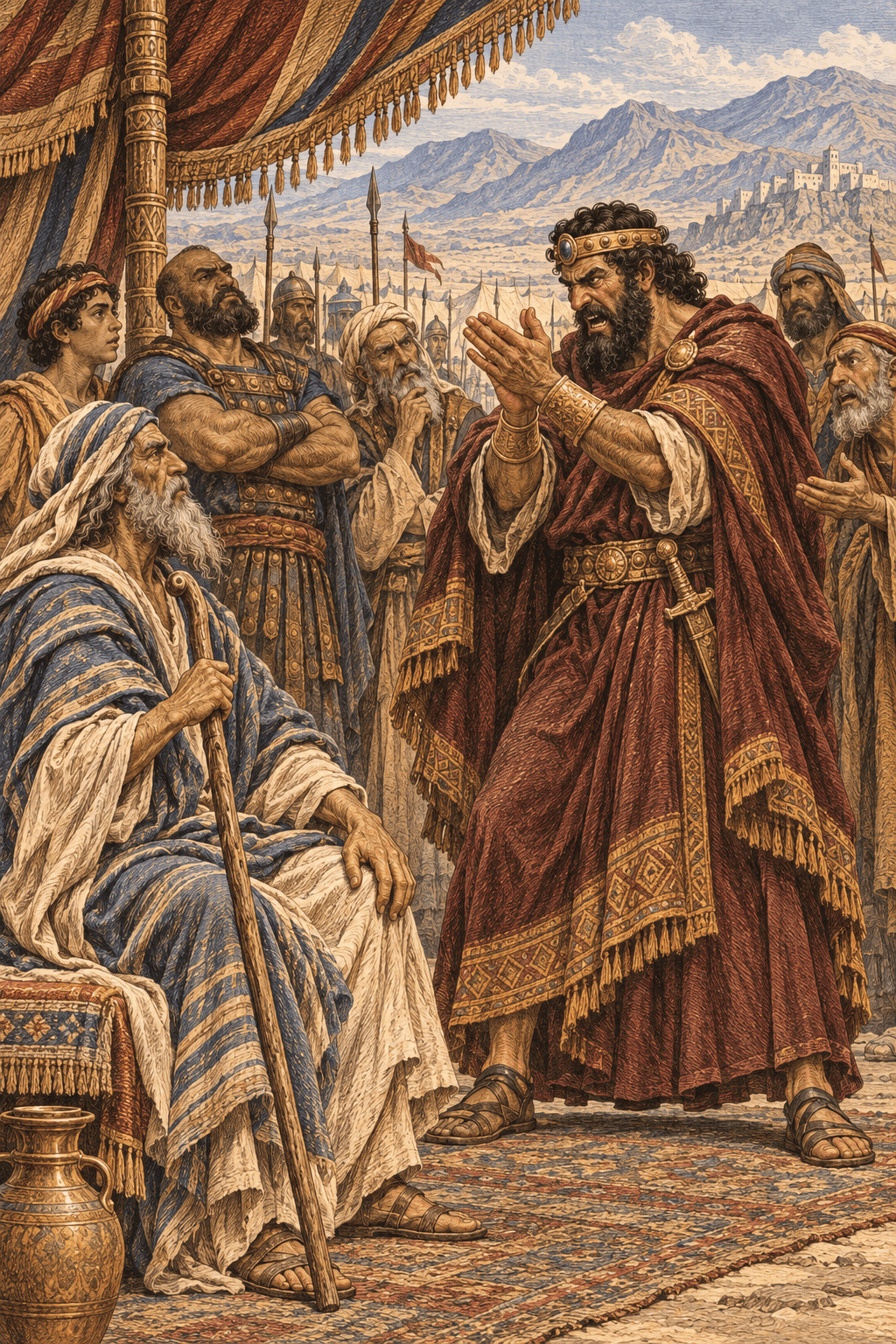
Balak’s anger was kindled against Balaam, and he smote his hands together, a sign of extreme perplexity and inability to act; nothing was left to him but threats: “Therefore now flee thou to thy place… lo, the LORD hath kept thee back from honour” (11). Balaam felt that there was no remedy for the situation, so he decided to return to his people; but before he set out he uttered two more prophecies (the fourth and the fifth), without Balak asking him to speak.
2. The Fourth Prophecy
KJV · Verses 15–19
15 And he took up his parable, and said, Balaam the son of Beor hath said, and the man whose eyes are open hath said: 16 He hath said, which heard the words of God, and knew the knowledge of the most High, which saw the vision of the Almighty, falling into a trance, but having his eyes open: 17 I shall see him, but not now: I shall behold him, but not nigh: there shall come a Star out of Jacob, and a Sceptre shall rise out of Israel, and shall smite the corners of Moab, and destroy all the children of Sheth. 18 And Edom shall be a possession, Seir also shall be a possession for his enemies; and Israel shall do valiantly. 19 Out of Jacob shall come he that shall have dominion, and shall destroy him that remaineth of the city.
We said that the first prophecy focused mostly on seeing the new Israel through the Incarnation, the second through the crucifixion and resurrection, and the third through the Holy Spirit; and now he speaks more of the preaching Church, without separating these saving works from one another.
He began his introduction with the same words he uttered in the introduction of the previous prophecy, but he adds here a wonderful phrase which no prophet dares to utter: “and knew the knowledge of the most High” (16). Why did he utter these words? Was it because what he saw and came to know surpassed all human perception, something he had never expected, so that he thought he had attained the knowledge of the Most High? Or because he came to know the mysteries of the only Son, who said, “neither knoweth any man the Father, save the Son, and he to whomsoever the Son will reveal him” (Matthew 11:27), as though he wanted to affirm that the incarnate and slain Son reveals to him the mysteries of the Father? Or because through prophecy he entered into the day of Pentecost and met the Holy Spirit, who “searcheth all things, yea, the deep things of God” (1 Corinthians 2:10)? Or perhaps, as a man who had enjoyed these gifts and perceived these mysteries, he wanted to distinguish between his former knowledge and his present knowledge: before, he used the arts of sorcery and divination and relied on demons, claiming to know the future; but these prophecies of his are the gift of God; it is the true knowledge of God, not of the deceiving demons. Others hold that Balaam, as a man not pure of heart, when he enjoyed God’s gifts and knowledge, turned to pride and self-esteem instead of humility and contrition.
He says: “I shall see him, but not now: I shall behold him, but not nigh” (17). Who is it that he sees, but as one far away?
“there shall come a Star out of Jacob, and a Sceptre shall rise out of Israel, and shall smite the corners of Moab, and destroy all the children of Sheth. And Edom shall be a possession, Seir also shall be a possession for his enemies; and Israel shall do valiantly. Out of Jacob shall come he that shall have dominion, and shall destroy him that remaineth of the city” (17–19).
He says: “I shall see him, but not now: I shall behold him, but not nigh”; in the Septuagint: “I will point to him, but not now; I bless him, but he has not drawn near.” He saw Him by the spirit of prophecy, or pointed to Him, but He was far from him, for more than 1,500 years remained before His Incarnation when Balaam spoke. He points to Him from afar until the fullness of the time should come (Galatians 4:4), when He would draw near to the Gentiles and the Magi would understand these words. Then they bless the Lord, offering their hearts and lives with their gold, frankincense and myrrh. Balaam says, “I bless,” but He has not yet drawn near; a time will come when the Lord draws near, and the tongues of the Gentiles are opened in words of praise and blessing.
His words, “there shall come a Star out of Jacob, and a Sceptre (a man) shall rise out of Israel,” carry a prophecy of the Lord’s divinity and humanity: He is the heavenly Star who came incarnate to reign (the Sceptre) over the hearts of mankind. As we said before, this prophecy was recorded in the books of the sons of the East; through it the Magi came to know the newborn King when the star appeared to them in the East.
By His appearing as a shining Star in the hearts of the Gentiles through the preaching of the Gospel, He “shall smite the corners (the princes) of Moab.” Smiting the princes of Moab means crushing the work of Satan and his deceits on the right hand (self-righteousness) and on the left (sins and uncleanness). The preaching of the Gospel frees Moab from its princes, or, as Origen says:
This One born of Israel smites them when He spoils principalities and powers, making a show of them openly, triumphing over them on His cross (Colossians 2:15); and so He saves the Moabites and leads them to the knowledge of the Lord. [231]
“and destroy all the children of Sheth” (the Arabic reads “the sons of tumult”). Origen holds that after Abel was killed Eve bore “Seth,” from whom the whole human race came forth, while the seed of Cain was destroyed by the flood. This race became a spoil of the demons. So when the Lord came and the word of the Gospel was preached, He crushed Satan and took captive those who were in his grip, so that they became as a spoil for the Lord (Ephesians 4:8). Here the Lord destroys the evil in them and acquires them as captives of salvation, to bring them into His heavens. Therefore Origen says:
I long to be myself a captive of Christ, that He may lead me with His spoils and keep me bound with His bonds, so that I may be worthy to be called “the prisoner of Jesus Christ” (Ephesians 3:1), as the Apostle Paul used to say with pride. [232]
Balaam says: “And Edom shall be a possession, Seir also shall be a possession for his enemies” (18). We said before that Edom is the same as Seir, which is Esau. If the word “Edom” means a bloody man who loves fighting, and Seir means “hair,” then Edom perhaps points to the human soul corrupted by sin so that it loves fighting, and Seir points to the body full of hair; as though by the preaching of the Gospel God reigns over soul and body together, taking from us the old man working in our souls and bodies, and we are granted the new man as God’s inheritance in us.
Origen holds that Edom and Seir both point to the body, since Edom points to blood (the body) and Seir to hair. Therefore he comments:
Edom is the flesh that lusts against the Spirit (Galatians 5:17), the enemy of the Spirit. But at the coming of Christ, when we subject the flesh to the Spirit in the hope of the resurrection, the flesh too obtains the inheritance. For not only was the soul an enemy of the Spirit, but the flesh too; by obeying the Holy Spirit it has a share in the inheritance to come. [233]
As for his words, “and Israel shall do valiantly” (18): the believer, having submitted his soul and body to the work of the Holy Spirit and become the Lord’s inheritance, becomes a man of valour whom the enemy of good cannot resist. Truly he no longer fights his body, his emotions and his senses; rather, all of these are enlisted, not to fight the soul, but to fight sin, and the body, which was a burden to the soul, becomes a help to it.
Therefore he continues: “Out of Jacob shall come he that shall have dominion (shall appear), and shall destroy him that remaineth of the city” (19). Who is this who appears or has dominion but Christ the Lord, who came forth from Israel and shines in the life of the believing man in the splendour of His glory, while Satan, the fugitive, flees from the city of God (the heart)? Christ the Lord enters the heart by His cross and destroys Satan, so that he has no place within the soul. The new man, bearing the marks of the Crucified, has dominion, and the old man with his deeds flees.
3. The Fifth Prophecy
KJV · Verses 20–25
20 And when he looked on Amalek, he took up his parable, and said, Amalek was the first of the nations; but his latter end shall be that he perish for ever. 21 And he looked on the Kenites, and took up his parable, and said, Strong is thy dwellingplace, and thou puttest thy nest in a rock. 22 Nevertheless the Kenite shall be wasted, until Asshur shall carry thee away captive. 23 And he took up his parable, and said, Alas, who shall live when God doeth this! 24 And ships shall come from the coast of Chittim, and shall afflict Asshur, and shall afflict Eber, and he also shall perish for ever. 25 And Balaam rose up, and went and returned to his place: and Balak also went his way.
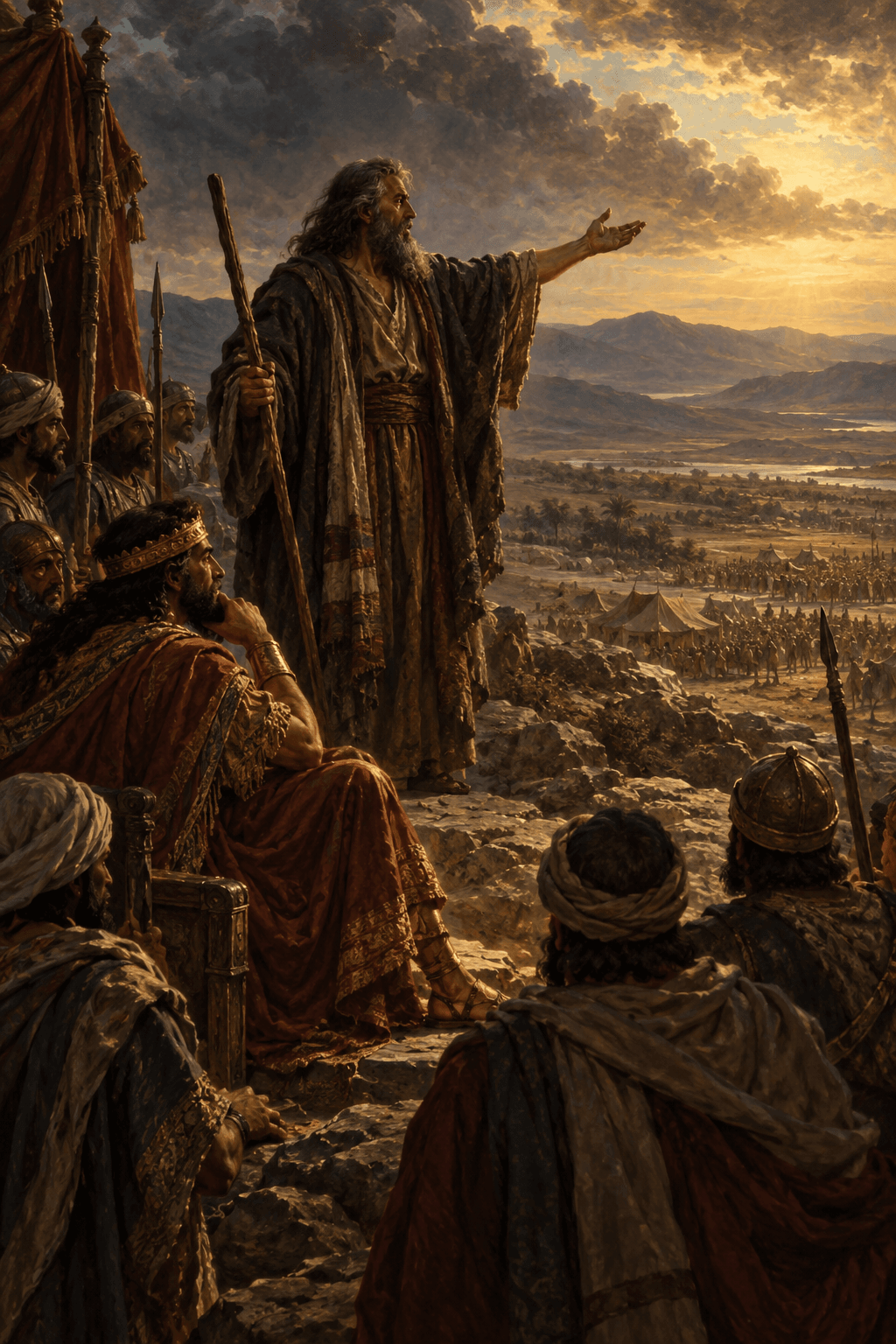
He looked on Amalek and uttered the fifth and last prophecy, though some consider it an inseparable part of the fourth.
He says: “Amalek was the first of the nations; but his latter end shall be that he perish for ever” (20). The first war fought in the wilderness was against Amalek, the first of the nations, and they remained in continual war with this people until Amalek came to an end in the days of Hezekiah (1 Chronicles 4:43).
If we go back to the Book of Genesis (Genesis 14:7), we hear that the kings returned to En-mishpat (judgment), which is Kadesh (holy), and smote all the country of the Amalekites. So where judgment stands and evil is separated from righteousness, and uncleanness from sanctification, the Amalekites are slain in Kadesh, that is, in the holy places; as though where there is holiness the Amalekites (the soldiers of evil) cannot be. Origen says:
So those who gather around the holy things (Kadesh) and are led to sanctification and purity slay Amalek and remove him, who quickly snatches the people and turns them aside… In holiness (Kadesh), which is En-mishpat (judgment)… with a pure heart one contemplates the punishment of sinners and the happiness of the righteous, and so one wrestles to cast down the princes of Amalek. But those who are not led to Kadesh, that is, holiness, nor to the spring of judgment, who do not contemplate the coming day of judgment, submit to the princes of Amalek. Amalek snatches them quickly, devours them and turns them far away from God. [234]
If we go back to Genesis (Genesis 36:11–12), we also hear of Amalek the son of Eliphaz, the firstborn of Esau, whom Timna his mother bore. This is the Amalek who opposes God’s children and must be resisted. His father Eliphaz means “my God has scattered me,” [235] and his mother Timna means “withholding”… Here Amalek is the fruit of turmoil and scattering far from God, and of refusing to return to Him. He represents the state of estrangement from God and refusing to meet Him. Therefore he was counted the first enemy of God’s people, because he opposes God and His people, meeting God’s children in the wilderness to destroy them.
If Amalek represents the firstfruits of opposition to God in His people, Christ the Lord represents the firstfruits of obedience to God in them. Therefore the Lord, who is the firstfruits (1 Corinthians 15:20), came to destroy the firstfruits of evil, that is, Amalek. Therefore Balaam says, “but his latter end shall be that he perish for ever”; in the Septuagint, “and his seed shall perish.” This seed, as Origen says, is:
the belief which he fixed firmly in men’s minds, that they should turn away from the Lord. This is the corrupt spirit and the hateful doctrine, the seed he planted in them. It perishes through turning with sighs to be saved (Isaiah 45:22). [236]
Balaam continues the prophecy, saying: “And he looked on the Kenites… and said, Strong is thy dwellingplace, and thou puttest thy nest in a rock” (21). What does “Kenite” mean but one who acquires or possesses (Genesis 4:1)? For if we must destroy the spirit of evil, Amalek, and all his seed, that is, his beliefs and his evils, we must acquire Another, or be the object of His acquiring, namely Christ the Lord, the Rock; in Him we find a strong dwelling, and we enter into Him like the sparrow that finds a nest in Him! Origen says:
The Kenite can be saved if he sets his nest on the rock, that is, puts his hope in Christ, and does not turn to the deceits of the heretics around him… [237]
He says: “Nevertheless the Kenite shall be wasted, until Asshur shall carry thee away captive” (22). He warns the one who has entered into Christ the Lord and found a dwelling in Him: if he turns again to look toward Asshur (the heretics), he turns away from the truth and perishes. If Amalek represents the danger outside the Church (sin and evil), Asshur represents the danger inside the Church through heresies under the name of Christ.
He says: “Alas, who shall live when God doeth this!” (23). He realized that he was prophesying of the messianic age, more than 1,500 years away from him, and he also realized that it was far from belief, for things beyond reason would happen.
He concludes his prophecy by saying: “And ships shall come from the coast of Chittim (Crete), and shall afflict Asshur, and shall afflict Eber, and he also shall perish for ever” (24). By the spirit of prophecy he saw many events, among them:
A) What Alexander of Macedon did, coming from the island of Crete (the Greek ruler); some see in it a reference to the Roman occupation coming from the west, since Chittim referred not to Crete alone but to the whole west.
B) The subjection of the Hebrews (Eber) to the Babylonian captivity (Asshur).
C) Some see in Eber’s subjection to destruction a reference to the Hebrews’ rejection of the Person of Christ the Lord and their entering into destruction through unbelief.
Notes and References
[224] Origen, Homilies on Numbers 17.
[225] Ibid.
[226] Ibid.
[227] Ibid.
[228] Ibid.
[229] Ibid.
[230] Ibid.
[231] Origen, Homilies on Numbers 18.
[232] Ibid.
[233] Ibid.
[234] Origen, Homilies on Numbers 19.
[235] Ibid.
[236] Ibid.
[237] Ibid.