
This chapter speaks of:
1. The Building of Seven Altars
KJV · Verses 1–6
1 And Balaam said unto Balak, Build me here seven altars, and prepare me here seven oxen and seven rams. 2 And Balak did as Balaam had spoken; and Balak and Balaam offered on every altar a bullock and a ram. 3 And Balaam said unto Balak, Stand by thy burnt offering, and I will go: peradventure the Lord will come to meet me: and whatsoever he sheweth me I will tell thee. And he went to an high place. 4 And God met Balaam: and he said unto him, I have prepared seven altars, and I have offered upon every altar a bullock and a ram. 5 And the Lord put a word in Balaam's mouth, and said, Return unto Balak, and thus thou shalt speak. 6 And he returned unto him, and, lo, he stood by his burnt sacrifice, he, and all the princes of Moab.
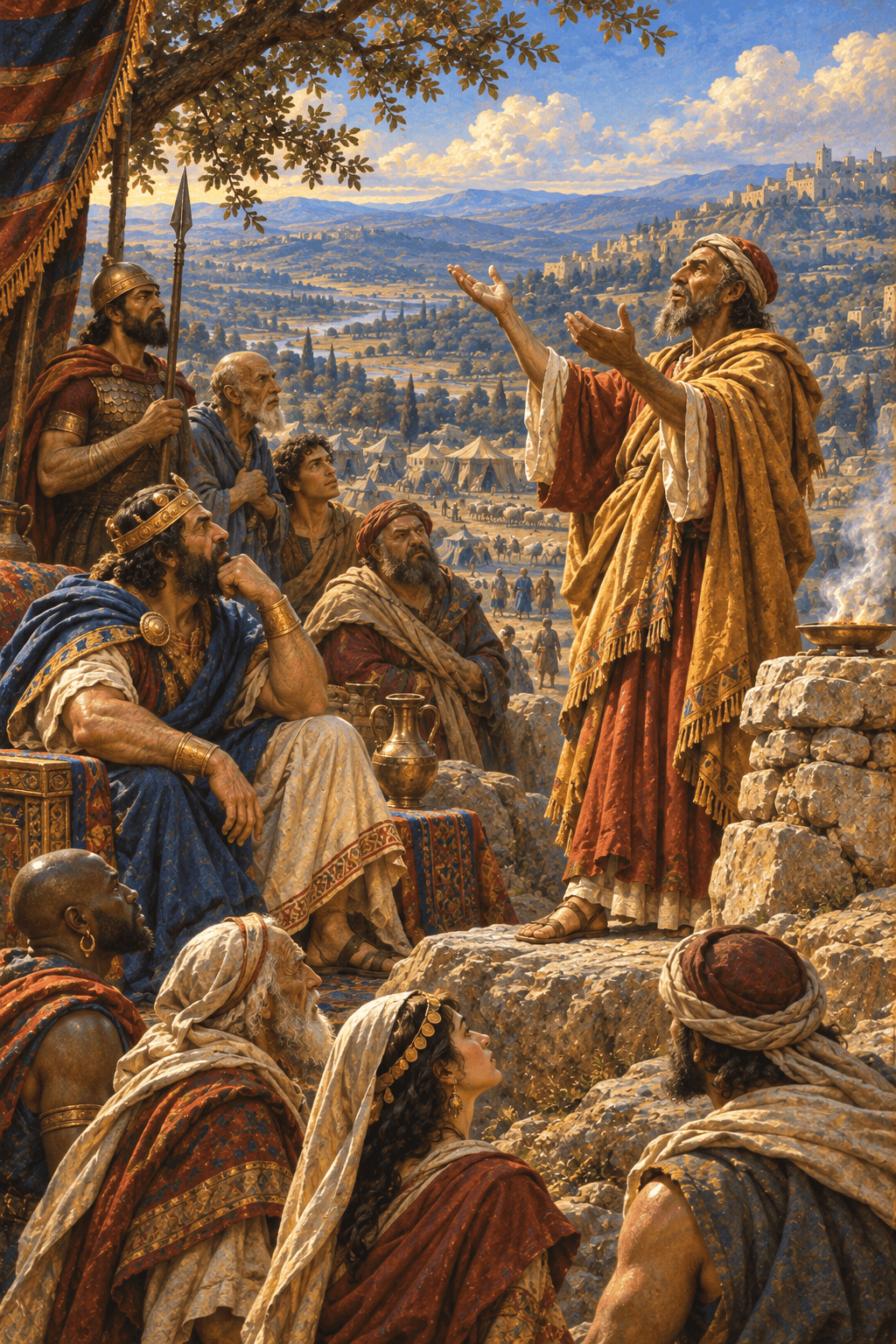
Balak took Balaam up into the high places of Baal, and there the latter asked Balak to build him seven altars and prepare seven oxen and seven rams. Balak and Balaam offered a bullock and a ram on every altar (Numbers 22:41; 23:1), before he went to a high place to hear the voice of the Lord. Balaam sinned in building altars and offering sacrifices on them to demons; yet “the LORD put a word in Balaam’s mouth” (5). For God wanted to bear witness to the truth before the Gentiles, even through a soothsayer.
2. His First Prophecy
KJV · Verses 7–10
7 And he took up his parable, and said, Balak the king of Moab hath brought me from Aram, out of the mountains of the east, saying, Come, curse me Jacob, and come, defy Israel. 8 How shall I curse, whom God hath not cursed? or how shall I defy, whom the Lord hath not defied? 9 For from the top of the rocks I see him, and from the hills I behold him: lo, the people shall dwell alone, and shall not be reckoned among the nations. 10 Who can count the dust of Jacob, and the number of the fourth part of Israel? Let me die the death of the righteous, and let my last end be like his!
God used this situation to give the Gentiles five prophecies by the mouth of Balaam, which remained in the records of the nations:
- The first prophecy (Numbers 23:7–10) speaks of the divine Incarnation.
- The second prophecy (Numbers 23:18–24) speaks of the Lord’s sufferings and resurrection.
- The third prophecy (Numbers 24:3–9) speaks of the day of Pentecost.
- The fourth prophecy (Numbers 24:15–19) speaks of the preaching of Christ the Lord.
- The fifth prophecy (Numbers 24:20–24) speaks of possessing Christ Jesus our Lord.
So the prophecies, in what they contained, gave a quick survey of God’s saving works in the fullness of time: the Incarnation of the only Son, His sufferings, death and resurrection, the coming of the Holy Spirit upon the Church, the preaching among the Gentiles, and finally the goal of our faith, “possessing Christ the Lord.”
The text of the first prophecy is the passage above (7–10).
Before entering into the detailed symbolic meanings of these words, I want to make clear that the heart of this prophecy is that Balaam could not curse this people or defy them, because he had been raised to the top of the rocks, to Christ the Lord Himself, the true Rock. He looked at the people, and behold, it was not like the other peoples: he saw it as the mystical body of Christ Jesus, having a new nature in the image of its Creator, which cannot be cursed or defied, justified and sanctified in the blood of Christ the Lord. He saw the dust of Jacob, that is, its earthly affairs, blessed and sanctified. For the believers are sanctified in spirit and body; even their death, in Christ Jesus, has become a blessing which Balaam longs to enjoy.
He says: “Balak the king of Moab hath brought me from Aram, out of the mountains of the east” (7). “Aram,” an Akkadian word meaning “the high land,” was the name given to this region, rendered in the Septuagint as “Mesopotamia” or “Syria.” Several Aramean states arose at the time a kingdom arose in the land of Israel, among them “Aram of the two rivers” (Genesis 24:10), the two rivers being the Tigris and the Euphrates; some think they are the Khabur and the Euphrates. “Padan-aram” lay in this region (Genesis 29:4–5). In this region lay the two cities of Nisibis and Edessa, which became famous as centres of Syriac culture and letters.
Origen meditates on this text, seeing that Balak brought Balaam to Mesopotamia, on the mountains toward the east. He brought him among the rivers: not the holy rivers that spring from the river of life, as the Lord says, “He that believeth on me, as the scripture hath said, out of his belly shall flow rivers of living water” (John 7:38), the rivers that ever praise God with holy works, as the Psalmist says, “Let the floods clap their hands” (Psalm 98:8); rather, he took him to the rivers of Babylon, of which it is written: “By the rivers of Babylon, there we sat down, yea, we wept, when we remembered Zion” (Psalm 137:1). Origen calls them “the rivers of slackness,” saying:
When he brings us among these rivers of Babylon, when the streams of pleasure overflow and we bathe in the waves of incontinence… there they took us captive in this place. [212]
He brought him from the rivers of slackness and pleasures, from the mountains… What mountains are these? They are not the holy mountains of which it is written: “His foundation is in the holy mountains” (Psalm 87:1); and elsewhere: “Jerusalem is builded as a city that is compact together… As the mountains are round about Jerusalem, so the LORD is round about his people” (Psalm 122:3; 125:2). They are the mountains of slackness (standing between the rivers), called the dark mountains (Jeremiah 13:16), of which it is said: “O destroying mountain” (Jeremiah 51:25). They are the mountains set apart for this work, “every high thing that exalteth itself against the knowledge of God” (2 Corinthians 10:5). These are the mountains to which Balaam was taken. [213]
As for “of the east,” they too “have their light that rises,” for he “is transformed into an angel of light” (2 Corinthians 11:14). They have this light, of which it is said: “the light of the wicked shall be put out” (Job 18:5)… and it is opposed to the Light who says: “I am the light of the world” (John 8:12). It is from an east opposed to the East of which it is written in Zechariah: “Behold the man whose name is The BRANCH (the East)” (Zechariah 6:12). [214]
Balak says to him: “Come, curse me Jacob, and come, defy Israel” (7). Perhaps he wanted to stress that he would curse Jacob and heap up curses on Israel. When Jacob received the blessing from his father Isaac, the enemy raged against him so that he was obliged to flee; and when he wrestled, after seeing the visions, the enemy’s rage increased. So the more the soul meets with God and a man wrestles, striving for the kingdom, the more the spiritual war against him increases.
Balaam answers: “How shall I curse, whom God hath not cursed? or how shall I defy, whom the LORD hath not defied?” (8). Origen says:
Balaam’s mouth was full of cursing; “under his tongue is mischief and vanity” (Psalm 10:7). He was found in plots with the rich, for he was waiting for the king’s wages for killing the innocent in a hidden way. But God, “who alone doeth great wonders” (Psalm 136:4), uses even His enemies to make peace. He put His words in Balaam’s mouth, though his heart could not receive the words of God… Balaam did not carry the word of God in his heart, but only on his tongue. Yet in any case he spoke the word of God… [215]
Someone may ask: Does God curse? Origen answers thus:
I believe that God does curse some person (or being), for we read that the Lord says to the serpent: “thou art cursed above all cattle, and above every beast of the field” (Genesis 3:14); and to Adam: “cursed is the ground for thy sake” (Genesis 3:17); and to Cain: “And now art thou cursed from the earth, which hath opened her mouth to receive thy brother’s blood from thy hand” (Genesis 4:11); and elsewhere He says: “Cursed be the man that maketh any graven or molten image” (Deuteronomy 27:15). Do not think that these expressions are found only in the Old Testament, for we find their like in the Gospels. For it is said there that the Lord says to those on His left: “Depart from me, ye cursed, into everlasting fire” (Matthew 25:41); and when He says, “Woe unto you, scribes and Pharisees” (Matthew 23:29), “But woe unto you that are rich!” (Luke 6:24), what is He doing but pronouncing curses on them? What then of the commandment given by the Apostle: “bless, and curse not” (Romans 12:14)…? When God curses, it is because they deserve the curse; He pronounces judgment, for He does not err, either in His judgment of the nature of the sin or of the intention of the sinners. But man cannot enter into the depths; he cannot see or perceive the will of another. If we utter a curse as the Judge who passes sentence does, we do so beyond our right, since we do not know the sinner’s mind. [216]
“For from the top of the rocks I see him, and from the hills I behold him: lo, the people shall dwell alone, and shall not be reckoned among the nations” (9). Though Balak had brought him to the mountains of slackness, to the deceits of the demons, the Lord carried him to the mountains of God, to “the top of the rocks” and to the holy hills; there he sees God’s people and perceives its mysteries. Origen says:
For (spiritual) Israel lies on the lofty mountains and on the high hills, that is, it lives a virtuous and difficult life, which we cannot easily be worthy to look upon or perceive unless we climb the heights and summits of knowledge; therefore God did not curse him. His life is high and lofty, not base or low. But it seems to me that God does not say this of Israel according to the flesh, but of the one who walks on the earth while his conversation is in heaven (Philippians 3:20). [217]
So on the high places Balaam saw God’s children, or the Church of God, founded on Christ the Lord, the true “Rock.”
If we want to look upon God’s Church, the new spiritual Israel, let us rise on the mountains of the holy Law and climb the high hills of the prophecies; through them we see the Head of the Church Himself, Christ the Lord, and through Him we see His holy Church, as His mystical body. Therefore he says: “lo, the people shall dwell alone, and shall not be reckoned among the nations.” It dwells in Christ Jesus, bearing the new nature that distinguishes it. He does not see it as a people in the temporal sense, to be counted among the peoples; he sees it as the one holy Church, living in heavenly places. So Balaam sees the Incarnation clearly through the shadows of the Law and the prophecies, and sees the Church clearly through the Incarnation, yet beyond all comprehension.
“Who can count the dust of Jacob, and the number of the fourth part of Israel?” (10). In the Septuagint: “Who has exactly counted the seed of Jacob, and who shall number the families of Israel?” Origen says:
This reminds us of the words: “And he brought him forth abroad, and said, Look now toward heaven, and tell the stars, if thou be able to number them: and he said unto him, So shall thy seed be. And he believed in the LORD; and he counted it to him for righteousness” (Genesis 15:5–6). Neither Abraham nor any other man, nor angel, nor the higher principalities can count the number of the stars or the seed of Abraham, for it is written of it: “So shall thy seed be.” But of God it is said: “He telleth the number of the stars; he calleth them all by their names” (Psalm 147:4). He who said, “all their host have I commanded” (Isaiah 45:12), can count the dust of Jacob and the number of the fourth part of Israel. He alone knows truly who is the true Jacob and who is the true Israel. For outward Jewishness counts for nothing, nor outward circumcision in the flesh, but “he is a Jew, which is one inwardly” (Romans 2:28–29), the circumcision of the heart, not of the flesh. He alone is able to count and to register, according to His wisdom, beyond description and beyond comprehension… This census is holy and wonderful only if it is made by divine command. But if anyone wants to make a census other than as the Lord commanded, even if it is David the great prophet who orders it (2 Samuel 24), this act is counted against the Law, and the person becomes an object of accusation and falls under punishment. [218]
“Let me die the death of the righteous, and let my last end be like his!” (10). In the Septuagint: “Let my soul die among the souls of the righteous.” It is as though Balaam, having seen the holy Church of the New Testament through the divine Incarnation, longed not only for membership in her but also to enjoy her life through the enjoyment of death with Christ the Lord. It is as though he perceived, through the shadow, the words of the Apostle Paul: “Know ye not, that so many of us as were baptized into Jesus Christ were baptized into his death? Therefore we are buried with him by baptism into death” (Romans 6:3–4); and “For if we be dead with him, we shall also live with him” (2 Timothy 2:11). Origen says:
Concerning this death Balaam offers an astonishing prophecy, and by the word of God he made for himself a wonderful prayer: for he asks to die to sin so as to live to God. [219]
And Saint Ambrose says:
Balaam longed for this by the spirit of prophecy, for he saw in it the eternal resurrection of mankind; so he did not fear to die, since he would rise again. So let my soul not die in sin nor commit evil, but die in the soul of the righteous, so that it receives his righteousness. For whoever dies in Christ becomes a sharer of His grace within the font. [220]
Alas, this request was not fulfilled for Balaam, for he ended his life with his satanic counsel, which he gave to Balak to make God’s children fall into fornication, so that God’s wrath came upon them (chapter 25). His life ended in slaughter by the sword (Numbers 31:8, 16; Jude 11). Saint Irenaeus says:
Balaam the son of Beor was slain with the sword because he no longer spoke according to the Spirit of God, but set up another law, the law of fornication, opposed to the law of God (Revelation 2:14). He was no longer counted a prophet, but as a soothsayer, since he did not continue to proclaim God’s commandment, but received the just reward of his evil counsel. [221]
This request was not fulfilled in his own life, but it was fulfilled in his disciples, the company of the Magi, who came from the east and received Christ the Lord as King, offering Him gold, frankincense and myrrh, affirming His spiritual kingdom, His priesthood and His sufferings. Balaam prophesied in his own person of the Gentiles who accepted death with Christ the Lord.
Finally, it was not easy for Balaam to utter these words, longing for death, at a time when death, among the Jews as among the Gentiles, was a sign of God’s wrath and a sign of uncleanness. But his seeing, by the spirit of prophecy, the death of Christ the Lord made “death” a desire sought by whoever wishes to be justified by the blood of the Lord.
3. The Change of Place
KJV · Verses 11–15
11 And Balak said unto Balaam, What hast thou done unto me? I took thee to curse mine enemies, and, behold, thou hast blessed them altogether. 12 And he answered and said, Must I not take heed to speak that which the Lordhath put in my mouth? 13 And Balak said unto him, Come, I pray thee, with me unto another place, from whence thou mayest see them: thou shalt see but the utmost part of them, and shalt not see them all: and curse me them from thence. 14 And he brought him into the field of Zophim, to the top of Pisgah, and built seven altars, and offered a bullock and a ram on every altar. 15 And he said unto Balak, Stand here by thy burnt offering, while I meet the Lordyonder.
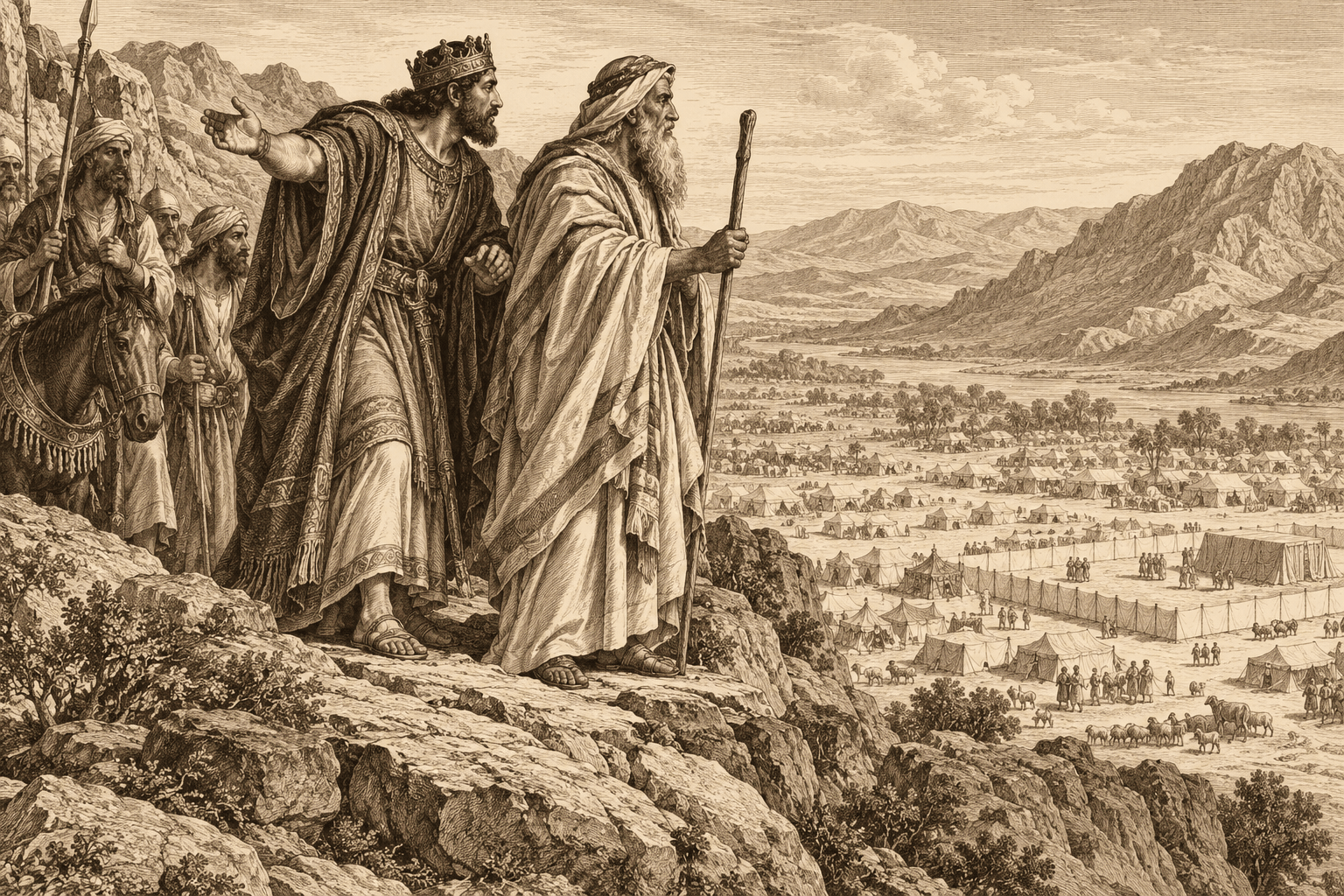
The king was struck with alarm when he saw Balaam saying other than what he expected. He heard him blessing instead of cursing, and could not bear it; he reproached him, saying: “What hast thou done unto me? I took thee to curse mine enemies, and, behold, thou hast blessed them altogether” (11). When Balaam insisted on speaking the words the Lord put in his mouth, Balak took him to another place from which he could see Israel, but could see only the utmost part of them and not the whole congregation, so that he might curse them from there. He took him into the field of Zophim, to the top of Pisgah, and built there seven altars, and offered a bullock and a ram on every altar.
He took him to a new place, in case God might change His mind; and Balaam obeyed without hesitation, hoping for the wages. The choice of the place was strange: from it he could see the utmost part of the congregation but not the whole multitude. The reason was that Balak perhaps thought Balaam was terrified by the size of the multitude, and feared to curse it lest the people harm him when Moab was defeated. He wanted Balaam to be like the ostrich that hides its head in the sand when it sees danger surrounding it, instead of fleeing the danger or facing it.
“The field of Zophim” in Hebrew means “the field of watchers,” on the top of Pisgah, which means “a portion” or “a region.” The latter is part of the region of the mountains of Abarim, lying at the north-eastern end of the Dead Sea. The sea lies beneath its slopes; its summit overlooks the wilderness, and at the same time from its summit a large part of the land of Canaan west of the Jordan can be seen. There Moses looked upon the land of promise (Deuteronomy 3:17; 34:1–4); today it is most likely Ras es-Siyagha.
On the top of Pisgah, on the mountains of Abarim, Balaam looked toward the wilderness to see the people in its utmost parts, and not see it all, so that he might curse it; and on the same mountains Moses looked toward the land of promise, and his heart was opened to heaven and he longed to pass over to it! I say: with the evil eye a man looks at earthly things, and his heart is filled with evil and longs for curses on others; and with the single eye the believer looks at heavenly things, and his heart is opened to blessing and peace. How much we need, not to change the places or circumstances in which we live, but to change our outlook and sanctify it, so that instead of being focused on the world and temporal things, it rises upward toward God and heavenly things.
4. His Second Prophecy
KJV · Verses 16–24
16 And the Lord met Balaam, and put a word in his mouth, and said, Go again unto Balak, and say thus. 17 And when he came to him, behold, he stood by his burnt offering, and the princes of Moab with him. And Balak said unto him, What hath the Lord spoken? 18 And he took up his parable, and said, Rise up, Balak, and hear; hearken unto me, thou son of Zippor: 19 God is not a man, that he should lie; neither the son of man, that he should repent: hath he said, and shall he not do it? or hath he spoken, and shall he not make it good? 20 Behold, I have received commandment to bless: and he hath blessed; and I cannot reverse it. 21 He hath not beheld iniquity in Jacob, neither hath he seen perverseness in Israel: the Lord his God is with him, and the shout of a king is among them. 22 God brought them out of Egypt; he hath as it were the strength of an unicorn. 23 Surely there is no enchantment against Jacob, neither is there any divination against Israel: according to this time it shall be said of Jacob and of Israel, What hath God wrought! 24 Behold, the people shall rise up as a great lion, and lift up himself as a young lion: he shall not lie down until he eat of the prey, and drink the blood of the slain.
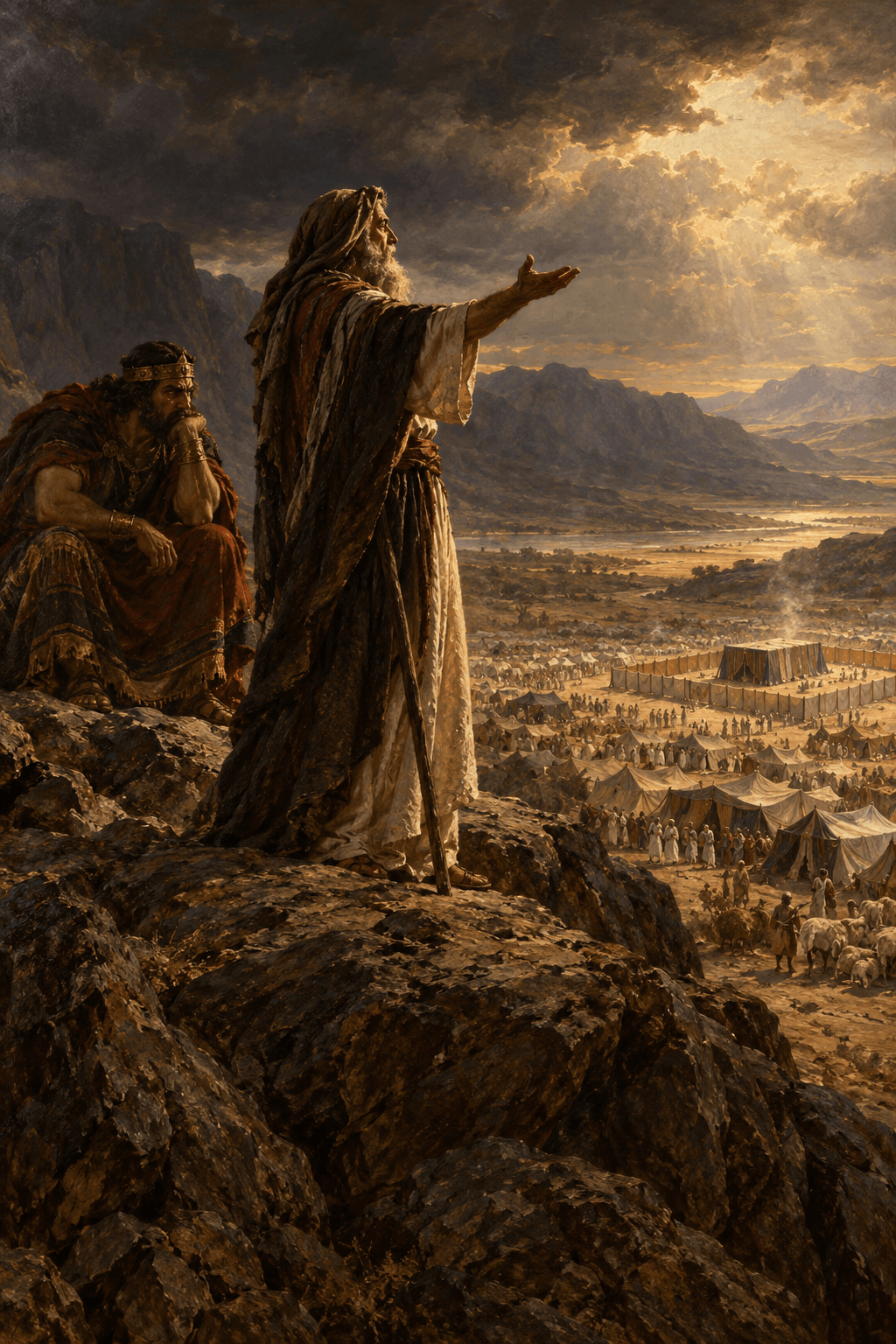
If the first prophecy focused on the divine Incarnation, through which he looked at the new Israel, or the Church of the New Testament, which bore a new nature, so that it became not a people among the peoples but had its own nature and its own blessing, so that no one can count it but God alone, now he focuses on the work of redemption: the Lord’s sufferings, His crucifixion and His resurrection. The text of the second prophecy is the passage above (18–24).
Though this people murmured much and was exposed to very harsh and bitter chastisements during its journey in the wilderness, yet through the cross and the resurrection God saw in His people neither iniquity nor perverseness; rather, He finds in it the righteousness of Christ and the secret of His rest, and it becomes the object of His pleasure. He brought it out of the land of bondage and passed with it into rest, granting it victory over the powers of darkness (enchantment and divination). He set it up as a holy bride, as the wife of the Lion of the tribe of Judah, a lioness giving birth to strong cubs, and so on.
He begins his second prophecy, concerning the saving works of Christ the Lord, by saying: “Rise up, Balak.” Though Balak was standing by his burnt offering with the princes of Moab (17), he commands him: “Rise up, Balak.” If the word “Balak” means “waster” or “destroyer,” then the call here is directed to the community of the Gentiles, which lived a long time worshipping idols, so that with all its energy it was in a state of fall and collapse, and even became a destroyer of the soul and a waster of the heart. Therefore the call came to it to rise with Christ the Lord, risen from the dead, so that it would no longer be a destroyer or a waster, but bear the nature of the risen life within it.
This is the call that Saul of Tarsus heard, who was wasting the Church of God and destroying it beyond measure: “Arise, and go into the city, and it shall be told thee what thou must do” (Acts 9:6). The Lord called the man lying on the road, crushed in soul, and invited him to enjoy the resurrection with Him, to enter the new city and there learn how to walk in the Lord. The Apostle enjoyed the power of the resurrection; therefore his preaching revolved around the experience of the resurrection, for he says: “Awake thou that sleepest, and arise from the dead, and Christ shall give thee light” (Ephesians 5:14).
“Hearken unto me, thou son of Zippor.” If the word “Zippor” means “sparrow,” then Balak, like a sparrow falling without price in men’s eyes, is not forgotten before God (Luke 12:6).
“God is not a man, that he should lie; neither the son of man, that he should repent: hath he said, and shall he not do it? or hath he spoken, and shall he not make it good?” (19).
He promised to bless His people, and He is bound by the promise, not merely to utter words of blessing but bound “to do it, and to make it good.” His blessing of His people costs Him much, for He is bound to bear the wages of the curse under which they fell, bearing the shame of the cross for them, and to rise and raise them to the new blessed life. He brings them into the power of His resurrection, so that no iniquity appears in them and no perverseness is found in them. They enjoy His righteousness in place of their iniquity, and His rest in place of their toil.
He continues the prophecy thus: “the LORD his God is with him, and the shout of a king is among them” (21). He dwelt in the midst of His people and reigned in them by His cross, declaring the fullness of their freedom in Him and through Him. Therefore he says: “God brought them out of Egypt” (22). This is freedom: that He granted them a true Passover by passing with them from the land of bondage to the glorious liberty of the children of God.
This divine passing over in the life of the believers takes place with power and surpassing swiftness: “he hath as it were the strength of an unicorn” (22). The “unicorn” (the Arabic re’em) is an animal most probably the aurochs, a kind of wild ox now extinct, noted for its surpassing swiftness and great strength (Numbers 24:8); its neck cannot be bowed to the yoke, nor can it be harnessed for man’s service in farm work (Job 39:9–12). The re’em points to Christ the Lord, risen from the dead, for it has a horn, the sign of kingship (Daniel 8:21). It is said: “his horns are like the horns of unicorns: with them he shall push the people together to the ends of the earth” (Deuteronomy 33:17). It is as though the risen Lord reigns spiritually over the peoples, and of His kingdom there shall be no end (Luke 1:33).
When the Lord reigns spiritually over the nations, He crushes all the powers of Satan under their feet, for he says: “Surely there is no enchantment against Jacob, neither is there any divination against Israel” (23).
If God forbade His people the use of enchantment and divination, that is, knowing hidden things through sorcery, using certain animals and birds for this, which Scripture counted unclean, not for their own sake but because of man’s misuse of them, at the same time the Lord gives His children assurance that no one can use sorcery to harm them as long as they are kept in His hand.
When the Lord reigns over His people, Satan with all his arts of sorcery cannot dominate them; and the Church is found as the wife of the Lion (a lioness), enjoying her Bridegroom’s resurrection and rising with Him to His heavens: “Behold, the people shall rise up as a great lion (in the Arabic, “as a lioness”), and lift up himself as a young lion”… This is the picture of the living Church and her strong children, like lion cubs bearing the strength of their Christ, the conquering Lion.
Origen says:
In fact the lion and the lion’s whelp fear no other animal… but all animals submit to them. So when the perfect Christian takes up his cross and follows Christ (Matthew 16:24), he can say: “the world is crucified unto me, and I unto the world” (Galatians 6:14), and he treads everything under his feet, overcoming everything. Truly he despises and rejects everything in the world, imitating the Lion of the tribe of Judah (Revelation 5:5). [222]
He ends the second prophecy by saying: “he shall not lie down until he eat of the prey, and drink the blood of the slain” (24). This people, which has become the bride of the Lion, does not rest until it eats prey, that is, until it takes the kingdom of heaven by force (Matthew 11:12). It strives all the days of its sojourning, to its last breath, to enjoy the kingdom. As for the words “drink the blood of the slain,” they carry no literal meaning; rather, as it is said in the Book of Deuteronomy, “thou didst drink the pure blood of the grape” (Deuteronomy 32:14), pointing to the enjoyment of the blood of Christ the Lord, who was slain for our salvation.
If Christ the Lord crouched on the cross and crushed the devil as a prey and destroyed his evil soldiers, so by union with Him we bear the spirit of victory over Satan and all his opposing spirits.
Finally, we note that in the first prophecy he declared the secret of this people’s blessing: it is raised on lofty mountains, which the arrows of satanic curses cannot approach; it is a unique people (spiritually), growing and multiplying spiritually. In this prophecy he affirms the impossibility of cursing it; he despaired of it completely, first because God’s promises to it are firm and do not change; and because it is now without blame or evil; and because it is strong in its past works (its exodus from Egypt) and its present works (it rises as a lioness and lifts itself up as a lion). So there was no longer any hope for Balak.
5. The Second Change of Place
KJV · Verses 25–30
25 And Balak said unto Balaam, Neither curse them at all, nor bless them at all. 26 But Balaam answered and said unto Balak, Told not I thee, saying, All that the Lord speaketh, that I must do? 27 And Balak said unto Balaam, Come, I pray thee, I will bring thee unto another place; peradventure it will please God that thou mayest curse me them from thence. 28 And Balak brought Balaam unto the top of Peor, that looketh toward jeshimon. 29 And Balaam said unto Balak, Build me here seven altars, and prepare me here seven bullocks and seven rams. 30 And Balak did as Balaam had said, and offered a bullock and a ram on every altar.
Balak had nothing left but to ask Balaam to change his place once more, in case God would permit him to curse them. As Origen says:
The wretched king thought that the places suitable for Balaam’s sorcery had not been prepared for accomplishing the curses, and he did not perceive that the matter depends on the will. He thought he would succeed by changing the place. [223]
He invited him to the top of Peor, which means the height of debauchery and pleasures. He wanted to draw his gaze away from God to debauchery and pleasures. Wonderfully, this place, as Scripture makes clear, “looketh toward Jeshimon” (the wilderness); for where temporal pleasures are, there is spiritual dryness and estrangement from God.
Notes and References
[212] Origen, Homilies on Numbers 15.
[213] Ibid.
[214] Ibid.
[215] Ibid.
[216] Ibid.
[217] Ibid.
[218] Ibid.
[219] Origen, Dialogue with Heraclides 171.
[220] St. Ambrose, On Belief in the Resurrection 2.43.
[221] St. Irenaeus, Fragment 45.
[222] Origen, Homilies on Numbers 16.
[223] Origen, Homilies on Numbers 17.