
When Balaam could not curse the people, he gave Balak an evil counsel: to cast a stumblingblock before this people through the women of Moab, so that God’s wrath would come upon them and they would be defeated:
1. The Fall with the Women of Moab
KJV · Verses 1–5
1 And Israel abode in Shittim, and the people began to commit whoredom with the daughters of Moab. 2 And they called the people unto the sacrifices of their gods: and the people did eat, and bowed down to their gods. 3 And Israel joined himself unto Baalpeor: and the anger of the Lord was kindled against Israel. 4 And the Lord said unto Moses, Take all the heads of the people, and hang them up before the Lord against the sun, that the fierce anger of the Lord may be turned away from Israel. 5 And Moses said unto the judges of Israel, Slay ye every one his men that were joined unto Baalpeor.
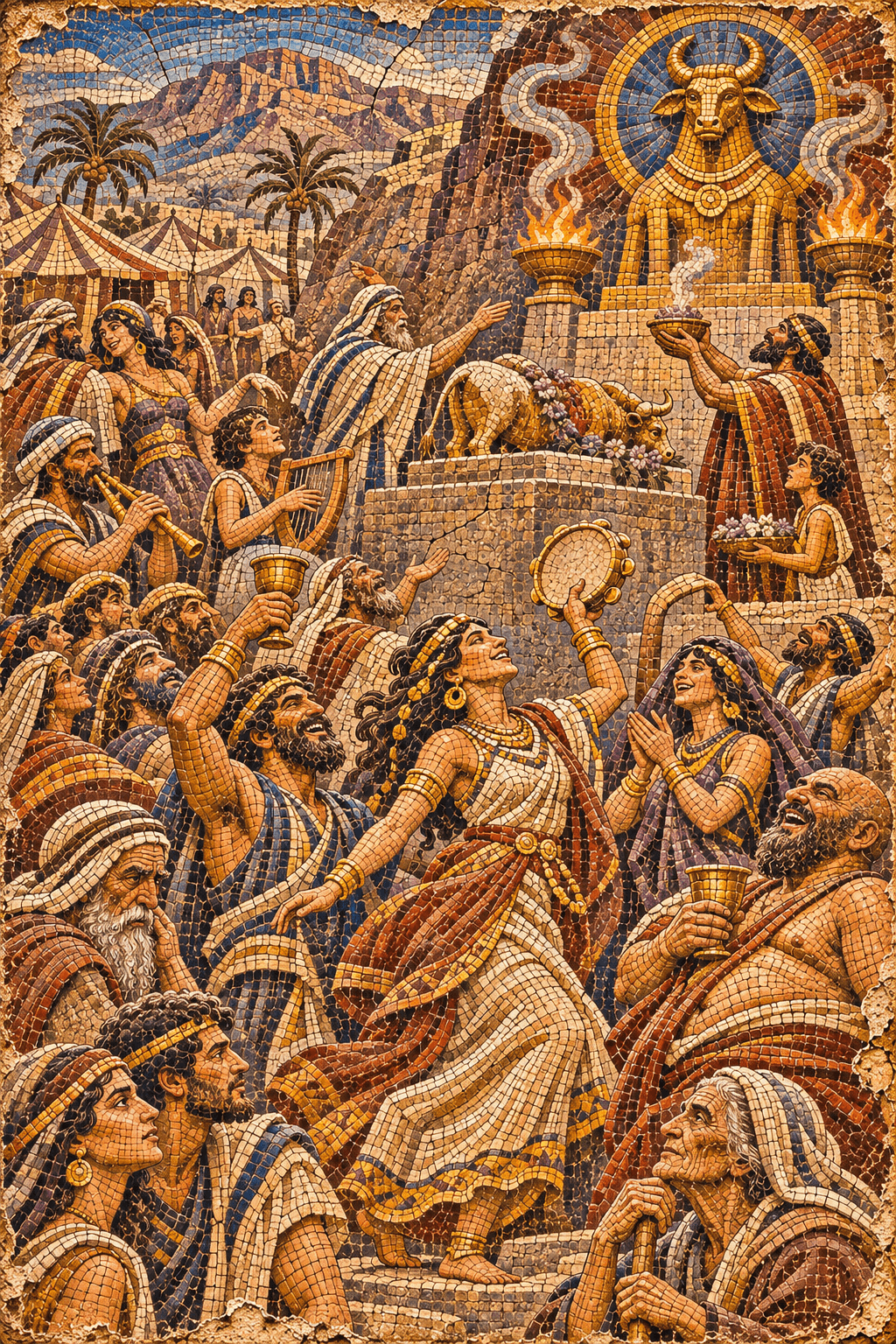
Origen says that when the divine will prevented Balaam from cursing the people, he wanted to please King Balak, so he gave him this counsel:
This people does not win victory by its own strength, but by its worship of God and its life of purity. If you want to defeat it, begin by destroying its purity, and it will be defeated by its own weapons. It is defeated by feminine beauty, not by the strength of armies; by the softness of women, not by the toughness of men of war. Set aside the hands of the warriors and gather a choice company of beautiful women, walking to the tunes of dancing and clapping their hands. For beauty takes the weapons away from warriors; set aside the swords; men who are unconquerable in war are conquered by beauty. When the women of Moab notice that the men have given themselves over to lusts and bowed their necks to sin, they should not satisfy their desires, but feed them of the sacrifices of the idols. So, under the power of lust, they will submit to the will of the women and come to know the mysteries of Peor, [238] which are the idols (of debauchery). [239]
This counsel came from Balaam to please the king and receive the wages, for Scripture says of these women: “Behold, these caused the children of Israel, through the counsel of Balaam, to commit trespass against the LORD in the matter of Peor, and there was a plague among the congregation of the LORD” (Numbers 31:16). And more clearly it is said in the Book of Revelation: “But I have a few things against thee, because thou hast there them that hold the doctrine of Balaam, who taught Balac to cast a stumblingblock before the children of Israel, to eat things sacrificed unto idols, and to commit fornication” (Revelation 2:14). And in the Epistle of Jude: “ran greedily after the error of Balaam for reward” (Jude 11).
We return to the text in Numbers chapter 25, which says: “And Israel abode in Shittim, and the people began to commit whoredom with the daughters of Moab” (1). This evil took place in Shittim, and as Origen says, (Shittim) in the Hebrew dictionaries means “answer” or “response.” [240] At the very time God was wrestling with Balaam and Balak so that he would not curse this people with a word, sending His angel to meet him on the way and revealing His mysteries to a hired sorcerer because of His love for His people, the people’s response was that they committed whoredom with the daughters of Moab and worshipped their gods! Truly, how hard is the heart of man; he is ever ungrateful to God, who shepherds him and cares for him.
Saint Gregory of Nyssa comments on this evil counsel, saying:
When the inventor of evil failed in this (in stirring up Balaam to curse God’s people), he never ceased to confront those who resisted him; he resorts to a device suited to his nature, using pleasures to draw nature toward evil. Truly pleasures are like an evil bait, cast lightly to draw greedy souls toward the deadly hook; for by lewd lust nature, which has no firm foundation, is drawn toward evil. This is truly what happened on this occasion. Those who had overcome the weapons of the enemy, and proved that every attack made against them with iron weapons was weak before their strength, who were able to endure mightily in the battle their enemies stirred up, were themselves wounded by the arrows of feminine pleasures. Those who were stronger than men were defeated by women. No sooner did the women appear before them, displaying their beauty instead of weapons, than they forgot their manly strength, and their resolve was scattered before pleasure. [241]
And again Saint Gregory says:
It seems to me that history offers us here a useful counsel for men. It teaches us that among the great passions that war against man’s mind, nothing is stronger than the disease of pleasure. These Israelites, who were clearly stronger than the horsemen of Egypt, who had overcome Amalek and become terrifying to other nations, and had conquered the troops of the Midianites, became slaves to this disease the moment they saw the foreign women. As I said before, pleasure is our enemy, hard to fight and overcome.
By the victory of pleasure over those whom weapons did not overcome, she set up a monument to the shame that befell them, proclaiming their disgrace before the crowd. Pleasure showed that it turned men into wild beasts… drawing them to lewdness so that they forget their human nature. They do not hide their recklessness, but adorn themselves with the shame of lust and beautify themselves with the stain of disgrace, wallowing like swine in the mire of defilement openly for all to see.
What then do we learn from this? Now that we know the great power of evil in the disease of pleasures, let us direct our life as far away from it as we can, so that the disease finds no opening in us through which to enter, like fire, whose nearness causes an evil flame. Solomon taught us this when he said wisely that a man should not walk barefoot on burning coals, nor hide fire in his bosom (Proverbs 6:27–28). So it is within our power to remain unaffected by the passion as long as we keep away from what inflames it. If we draw near to it and stand on the burning fire, the fire of lust is kindled in our breasts, and burns our feet and our breasts together.
To keep us from such an evil, the Lord in the Gospel cut off the root of the evil itself, I mean the desire that stirs the sight, teaching us that the man who welcomes passion through his looks opens the door to the disease that harms him. For evil passions, like a plague, once they take hold of a place, do not stop until they cause death! [242]
We return to the people who fell into whoredom with the daughters of Moab, for Scripture says: “And they called the people unto the sacrifices of their gods: and the people did eat, and bowed down to their gods” (2). By bodily fornication they were swept along to their gods and to bodily pleasures; their bellies were filled with heathen sacrifices and they bowed down to strange gods, that is, they turned aside to spiritual fornication in its most hideous form, which is idolatry. Origen says:
They were not content with eating; they also bowed down. See how they advanced in evil: the servants of the Lord gave themselves first to lust, then to gluttony, and finally to ungodliness. Ungodliness is the wages of harlotry. We read on another occasion the texts concerning Solomon: every wise man, whoever he may be, who gives his embraces to many women turns his heart away from God, for the Law says: “Neither shall he multiply wives to himself, that his heart turn not away” (Deuteronomy 17:17). Though he was very wise and gained great merits before God, he turned aside because he gave himself to many women.
What we call a great number of women I think is the great number of heresies and different philosophies taught among many nations. He wanted to come to know them and study them deeply as a scholar and a wise man, and he could not keep himself in the divine Law. The Moabite philosophy enticed Solomon and persuaded him to sacrifice to their gods; so did the philosophy of the children of Ammon, and so the philosophies of the nations from whom it is said he took women; so he honoured the idols by building temples and offering victims. It is a great divine work to be familiar with many beliefs, as with women, without turning aside from the root of the truth, so that we may say faithfully: “There are threescore queens, and fourscore concubines, and virgins without number. My dove, my undefiled is but one; she is the only one of her mother, she is the choice one of her that bare her” (Song of Solomon 6:8–9). [243]
It is as though Origen, while preferring that a man not bind himself to many philosophies lest they draw him away from the word of God, then allows the use of philosophies, but with caution and with divine power, so that they are in his view like the many concubines and virgins, while the word of God remains as the soul’s only bride, with no rival! [244]
We return to the ancient people whom the daughters of Moab seduced, for it is said: “And Israel joined himself unto Baalpeor” (3). They found pleasure in these lusts and joined themselves to Baal-peor, that is, “the lord of debauchery” or “the lord of shameful things”; they cling to uncleanness for its own sake and become its slaves, and it becomes their master. Origen says:
Let us learn that fornication wars against us, for we are exposed to the arrows of uncleanness; but they cannot hit us if we do not lack the weapons with which the Apostle calls us to arm ourselves: “Stand therefore, having your loins girt about with truth, and having on the breastplate of righteousness; And your feet shod with the preparation of the gospel of peace; Above all, taking the shield of faith, wherewith ye shall be able to quench all the fiery darts of the wicked” (Ephesians 6:14–16). These are the weapons that protect us in this war. If we neglect them, we leave our side open to the blows of Satan, and all kinds of demons take us captive (2 Timothy 2:26); the wrath of the Lord comes upon us, and we are punished in this world as in the world to come. [245]
He also says:
We should know that every man who commits any debauched act and falls into any form of shameful things is counted as sharing in the worship of Baal-peor, the demon of the Midianite women. [246]
Do not come near the doors of the houses of evil. If you feel that an evil spirit speaks to you in your heart and wants to lead you to the act of sin, understand well that he wants you to join yourself to the worship of Satan. He wants to lead you to receive the mysteries of Satan, the mysteries of harlotry. [247]
Scripture continues: “and the anger of the LORD was kindled against Israel. And the LORD said unto Moses, Take all the heads of the people, and hang them up before the LORD against the sun, that the fierce anger of the LORD may be turned away from Israel” (3–4).
The people sinned, but the Lord commands that all the heads of the people be slain and hanged before the sun, so that the fierce anger of the Lord may be turned away from them. For the heads are the ones responsible for the sins of the people, since they neglected to teach and warn them. Their being slain and hanged before the sun points to the terrible judgment on the great day of the Lord, which takes place in the presence of “the Sun of righteousness.”
2. The Zeal of Phinehas the Priest
KJV · Verses 6–15
6 And, behold, one of the children of Israel came and brought unto his brethren a Midianitish woman in the sight of Moses, and in the sight of all the congregation of the children of Israel, who were weeping before the door of the tabernacle of the congregation. 7 And when Phinehas, the son of Eleazar, the son of Aaron the priest, saw it, he rose up from among the congregation, and took a javelin in his hand; 8 And he went after the man of Israel into the tent, and thrust both of them through, the man of Israel, and the woman through her belly. So the plague was stayed from the children of Israel. 9 And those that died in the plague were twenty and four thousand. 10 And the Lord spake unto Moses, saying, 11 Phinehas, the son of Eleazar, the son of Aaron the priest, hath turned my wrath away from the children of Israel, while he was zealous for my sake among them, that I consumed not the children of Israel in my jealousy. 12 Wherefore say, Behold, I give unto him my covenant of peace: 13 And he shall have it, and his seed after him, even the covenant of an everlasting priesthood; because he was zealous for his God, and made an atonement for the children of Israel. 14 Now the name of the Israelite that was slain, even that was slain with the Midianitish woman, was Zimri, the son of Salu, a prince of a chief house among the Simeonites. 15 And the name of the Midianitish woman that was slain was Cozbi, the daughter of Zur; he was head over a people, and of a chief house in Midian.
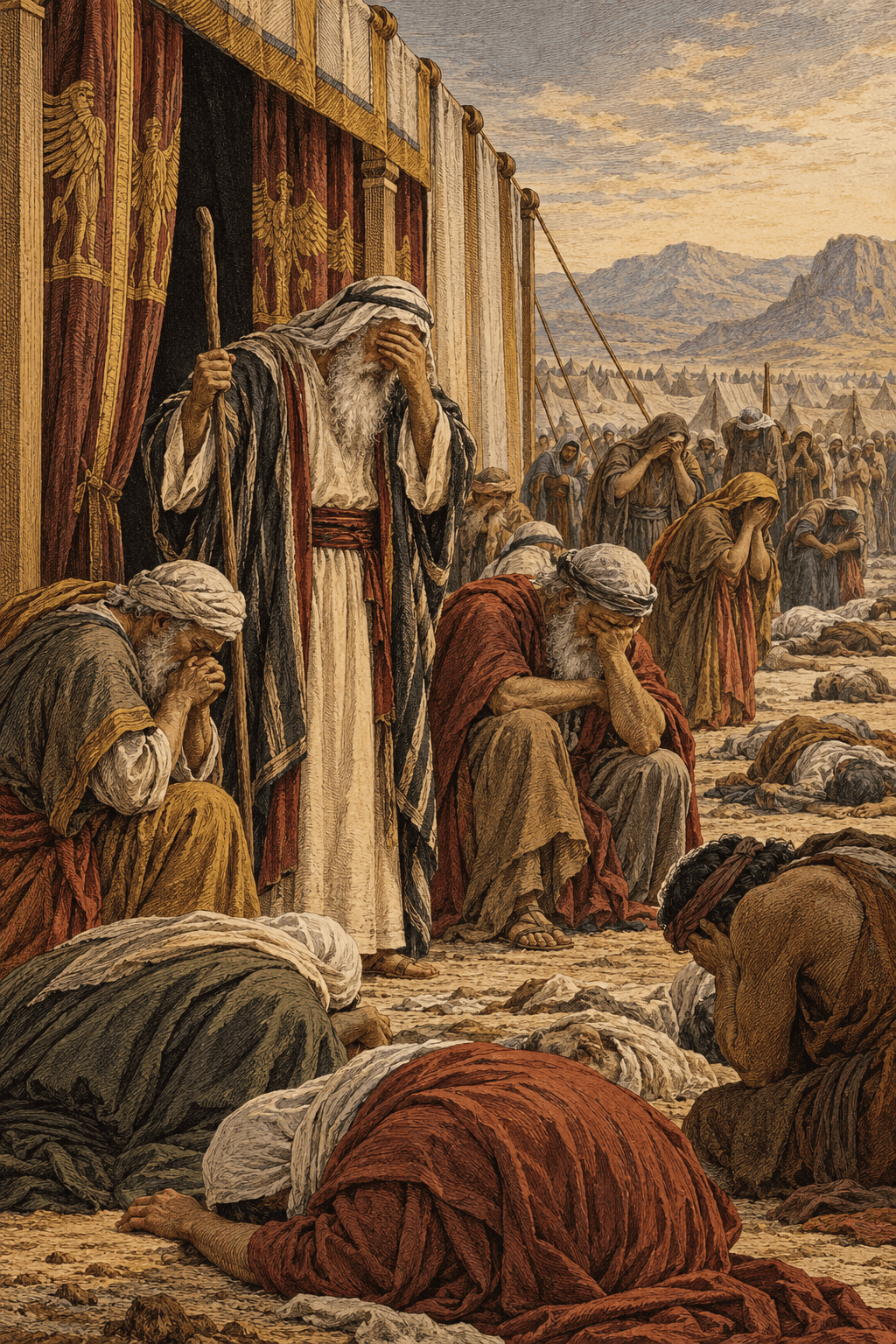
When Phinehas the priest saw that an Israelite had brought a Midianitish woman to his brethren in the sight of Moses and the whole congregation at the door of the tabernacle of the congregation, he took a javelin in his hand and went after the man into the tent and thrust both of them through, the man and the Midianitish woman. So the plague was stayed from the people, after twenty and four thousand had died. The Lord spoke to Moses, saying: “Phinehas, the son of Eleazar, the son of Aaron the priest, hath turned my wrath away from the children of Israel, while he was zealous for my sake among them, that I consumed not the children of Israel in my jealousy. Wherefore say, Behold, I give unto him my covenant of peace: And he shall have it, and his seed after him, even the covenant of an everlasting priesthood…” (11–13).
This story drew the hearts of the Fathers, for they saw in it a living picture of holy zeal for God’s holy things; it revealed the hideousness of the sin of fornication in God’s eyes, and it was a symbol of the divine work in man’s life within the holy waters of Baptism.
As for zeal, Origen says that the Jews believed that Phinehas was the very same as Elijah, and that God had greatly lengthened his life because of his zeal for God’s house. [248] Though we cannot accept this view, it reflects the feelings of the Jewish church toward the one who was zealous with the Lord’s zeal against whoever defiles the Lord’s holy things with his unclean bodily lusts. Saint Augustine praised Phinehas, saying:
Had he done this out of hatred for them, and not out of love through his zeal for God’s house, which inflamed him, it would not have been counted unto him for righteousness. [249]
And Saint Gregory the Theologian says: “Phinehas was called the zealous, for he ran after the Midianitish woman and the man who committed fornication with her, and took away the reproach of the children of Israel.” Origen also comments on the conduct of the zealous Phinehas, saying:
O you who have been redeemed by Christ, who took the material sword from your hands and gave you the sword of the Spirit, take this sword, so that when you see an Israelite thought defiled with Midianite harlots, that is, mingling with satanic thoughts, you do not hesitate, but strike at once, kill at once… take away the very source of sin, so that it never conceives and never gives birth… If you do this, you quench the wrath of the Lord at once. [250]
So we ought to be filled with zeal, striking down the sin that wants to unite with us in our thoughts, in its very womb, leaving it no room in us! On the contrary, making a truce with sin and dialoguing with it kindles God’s wrath against us and lets it unite with us, so that it bears fruits that are hard for us to avoid!

As for the hideousness of the sin of fornication, Saint Clement of Alexandria says:
In any case, in the Book of Numbers it is clear that the man who aimed his javelin at the fornicator was counted blessed by God. [251]
And Saint Jerome warns us against it thus:
See that Phinehas does not aim his javelin at you while you commit fornication with the Midianitish woman. [252]
As for the symbol of God’s work in the sacrament of Baptism which this story bears, Saint Gregory of Nyssa holds that Phinehas represents the death of Christ the Lord, who strikes us with His javelin and kills our old man, that is, the sin that reigned over us, so that we may become a holy temple for the Lord:
Now if we are conformed to His death, the sin that is in us surely becomes a corpse, pierced by the javelin of Baptism, as the zeal of Phinehas pierced the fornicator. [253]
If Phinehas killed the man together with the Midianitish woman, this points to the soul and body together enjoying death to the old man; for we spoke in our commentary on the Book of Exodus of the man pointing to the soul and the woman to the body. [254] It is as though the soul committed spiritual fornication by submitting to the lusts of the body instead of rising with it into the sphere of the Holy Spirit. Therefore the true Phinehas, Christ the Lord, the great High Priest, sent forth His cross like a javelin, killing the works of the old man and creating in us by His Holy Spirit the new man, so that we live holy in soul and body.
3. The Command to Slay the Wicked
KJV · Verses 16–18
16 And the Lord spake unto Moses, saying, 17 Vex the Midianites, and smite them: 18 For they vex you with their wiles, wherewith they have beguiled you in the matter of Peor, and in the matter of Cozbi, the daughter of a prince of Midian, their sister, which was slain in the day of the plague for Peor's sake.
If Phinehas the priest was zealous with the Lord’s zeal and killed Zimri, which perhaps means “one who is like a wild ox,” a prince of the tribe of Simeon, and also killed Cozbi, which means “lying,” the daughter of Zur, head of the tribes of Midian, this points to the destruction of sin. The man was lustful, behaving like a wild ox without thought or reason, and the woman was lying and deceitful… These are the marks of fornication: rashness and recklessness, together with lying and deceit.
The Lord commanded that all Midian be smitten because of the evil they had set as a snare for the destruction of the people.
Notes and References
[238] The word “Peor” means “debauchery” or “shameful things.”
[239] Origen, Homilies on Numbers 20.
[240] Ibid.
[241] St. Gregory of Nyssa, The Life of Moses 2.297–298.
[242] Ibid. 2.301–304.
[243] Origen, Homilies on Numbers 20.
[244] See Origen’s view of philosophy in our book The Fathers of the School of Alexandria.
[245] Origen, Homilies on Numbers 20.
[246] Ibid.
[247] Ibid.
[248] Origen, Commentary on John 7.
[249] St. Augustine, On Psalm 106.
[250] Origen, Homilies on Numbers 20.
[251] St. Clement of Alexandria, On Marriage (Stromata 3) 32.
[252] St. Jerome, Epistle 147.9.
[253] St. Gregory of Nyssa, On the Baptism of Christ.
[254] The author, The Book of Exodus, 1981.