
The preparation for entering the land of promise and settling in it after the period of wandering in the wilderness does not stop at taking the census for dividing the land, laying down the laws of inheritance, and appointing the new leader who would bring them into the land of promise and divide the land. Just before their entry God wanted to make clear the meaning of the rest they would enjoy in the new land: it is not a rest of laziness and slackness, but a rest of continual joy through the sacrifices of reconciliation and love offered daily every morning and evening, and weekly, monthly and yearly. He wanted their life to be feasts without ceasing, the sign of constant joy.
1. The Daily Sacrifices
KJV · Verses 1–8
1 And the Lord spake unto Moses, saying, 2 Command the children of Israel, and say unto them, My offering, and my bread for my sacrifices made by fire, for a sweet savour unto me, shall ye observe to offer unto me in their due season. 3 And thou shalt say unto them, This is the offering made by fire which ye shall offer unto the Lord; two lambs of the first year without spot day by day, for a continual burnt offering. 4 The one lamb shalt thou offer in the morning, and the other lamb shalt thou offer at even; 5 And a tenth part of an ephah of flour for a meat offering, mingled with the fourth part of an hin of beaten oil. 6 It is a continual burnt offering, which was ordained in mount Sinai for a sweet savour, a sacrifice made by fire unto the Lord. 7 And the drink offering thereof shall be the fourth part of an hin for the one lamb: in the holy place shalt thou cause the strong wine to be poured unto the Lord for a drink offering. 8 And the other lamb shalt thou offer at even: as the meat offering of the morning, and as the drink offering thereof, thou shalt offer it, a sacrifice made by fire, of a sweet savour unto the Lord.
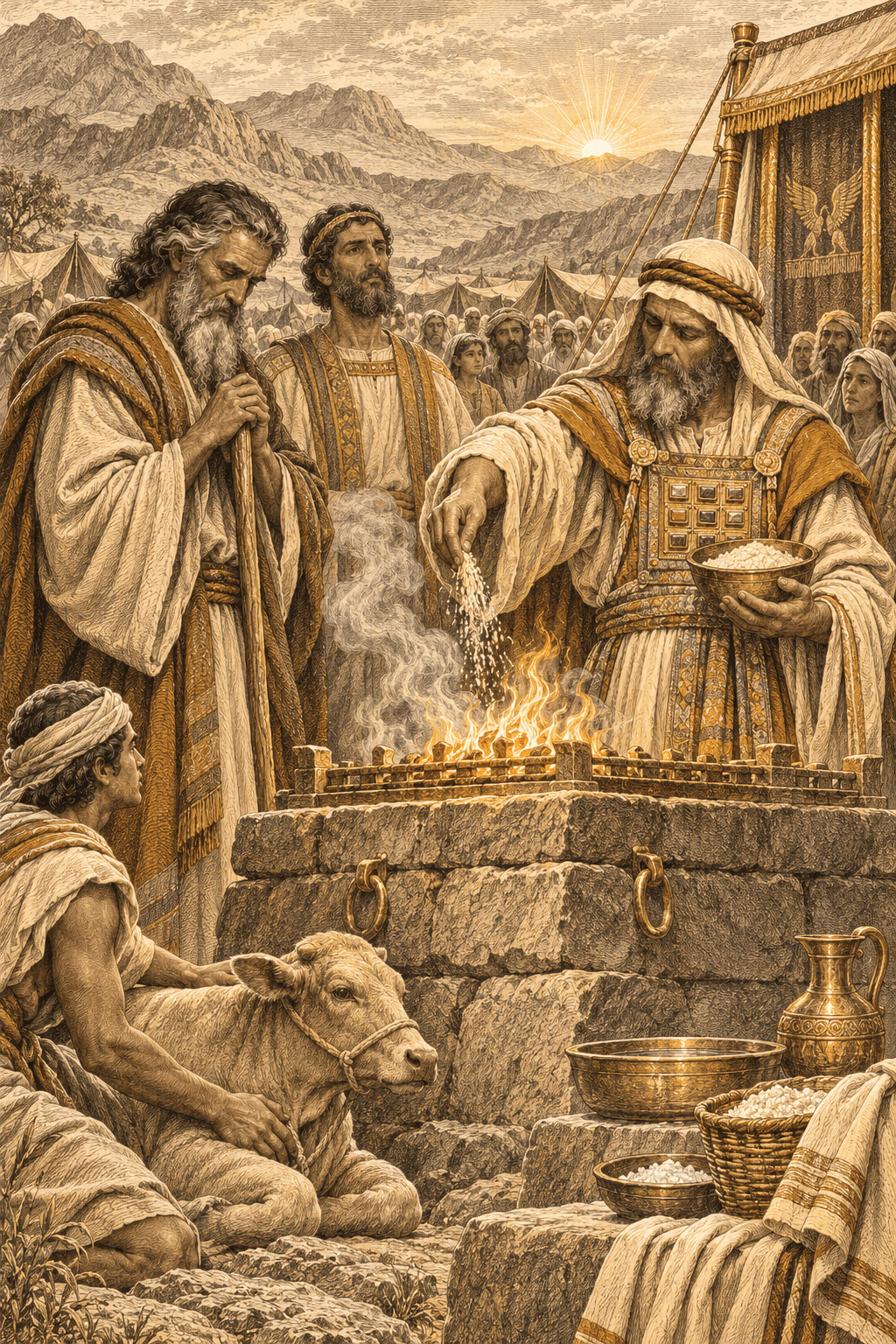
I want to leave the discussion of the symbolism of the sacrifices, in the details of their rites, with reference to the cross, to our commentary on the Book of Leviticus, if the Lord permits and we live, to avoid repetition and length. Note that the two chapters (28–29), which speak of the continual sacrifices and offerings, contain 71 verses, of which 13 verses speak of the sin offering, and the rest, about 58 verses, speak of a sweet savour to the Lord. This brings out for us what revelation wanted to emphasize in our view of the sacrifice of the cross. For the cross has as its aim the forgiveness of our sins: “For God so loved the world, that he gave his only begotten Son, that whosoever believeth in him should not perish, but have everlasting life” (John 3:16). But the other, complementary side, which has its important role in the life of the Church, is that the cross is “the sweet savour of the Father”: in it God smells the savour of good pleasure toward us in Christ Jesus. Alas, many ignore this in their attachment to the cross. If the cross has forgiven our sins, what completes it, or, if the expression is permitted, what is more important, is that it has moved us from a state of enmity to a state of the Father’s joy in us, His pleasure and His good will toward us through His Son. Therefore the cross has become a banquet of joy and gladness, indeed a holy convocation in which the Father gathers us into His bosom, so that we may find in it an eternal place! This is what we perceive in these two chapters.
The Lord began His words thus: “Command the children of Israel, and say unto them, My offering, and my bread for my sacrifices made by fire, for a sweet savour unto me, shall ye observe to offer unto me in their due season” (2). He gave them this commandment because most of those entering the land of promise had not heard the laws given to the people at the beginning of their journey, for the old generation had died and a new generation had come. Therefore He stressed offering the oblations and sacrifices in their due season. His stressing “in their due season” was necessary because they were entering into wars with the peoples of these nations; so they should not think that these wars excused them from the offerings, but rather that the wars made them need offerings, since they are a sweet savour to the Lord, without which they would not enjoy victory and triumph.
They are His offering, His bread, His sacrifices made by fire and His sweet savour. All these expressions reveal God’s longing for man and His pleasure in him through His beloved slain Son. This on the one hand; on the other, what man offers is not of his own, but of God’s gifts to him: it is the Lord’s offering and His sacrifices made by fire. The Septuagint is clearer: “Observe to offer to me in my feasts my gifts, my presents, my burnt offerings, a sweet savour.” Pope Athanasius the Apostolic comments on this thus:
When we render to our Lord according to our ability, we render to Him not of our own, but of the things we received from Him, which are His grace; for He asks of us His gifts which He gave us. And He bore witness to this, saying: “Offer to me my gifts”; for what you offer to me as though it were from you, you have received from me, since it is a gift from God. [266]
He began with the continual burnt offering: offering two lambs of the first year every day, one lamb in the morning and the other at even, as though we need a burnt offering without ceasing, so that we may be reconciled with God night and day without stopping. This is the continual burnt offering, or “the continual feast of the Lord”: He rejoices and is pleased with our reconciliation with Him all the days of our life, day and night. Therefore He began with this continual burnt offering as the introduction to the offerings He commands us, as “a sacrifice made by fire, of a sweet savour unto the LORD” (8).
Origen says:
The first feast of the Lord is “the continual feast”; truly an offering is required in the morning and the evening, continually, without ceasing. In legislating the feasts here, the Lord did not begin with the feast of the Passover, nor the feast of unleavened bread, nor the feast of the holy offering, nor any other feast; He set as the first feast the feast of “the continual burnt offering.” For He wants the one who perseveres to perfection and holiness not to have feast days and days without holy feasts to God, but to celebrate a continual feast. The sacrifice that must be offered morning and evening continually means the necessity of meditating on the Law and the Prophets, who represent the morning, and meditating on the Gospel, which was proclaimed in the evening, that is, the coming of Christ in the last days. These are the festivals of which the Lord said: “ye shall keep my feasts.” So there is a feast of the Lord if we offer the sacrifice continually, that is, if we “Pray without ceasing” (1 Thessalonians 5:17), if the lifting up of our hands to Him rises like incense before Him (Psalm 141:2), in the morning, and an evening sacrifice in the evening. So the first festival is the continual burnt offering, which the disciples of the Gospel must offer, as we have explained. But the feasts of sinners are turned into mourning, as the prophet says (Amos 8:10), and their songs into lamentations. Without doubt the sinner who celebrates the day of sin cannot celebrate a feast. On the days he sins he cannot offer the eternal sacrifice. For he cannot offer it unless he follows righteousness and guards against sin; on the day he practises sin he does not offer the eternal sacrifice to the Lord. [267]
2. The Weekly Sacrifices
KJV · Verses 9–10
9 And on the sabbath day two lambs of the first year without spot, and two tenth deals of flour for a meat offering, mingled with oil, and the drink offering thereof: 10 This is the burnt offering of every sabbath, beside the continual burnt offering, and his drink offering.
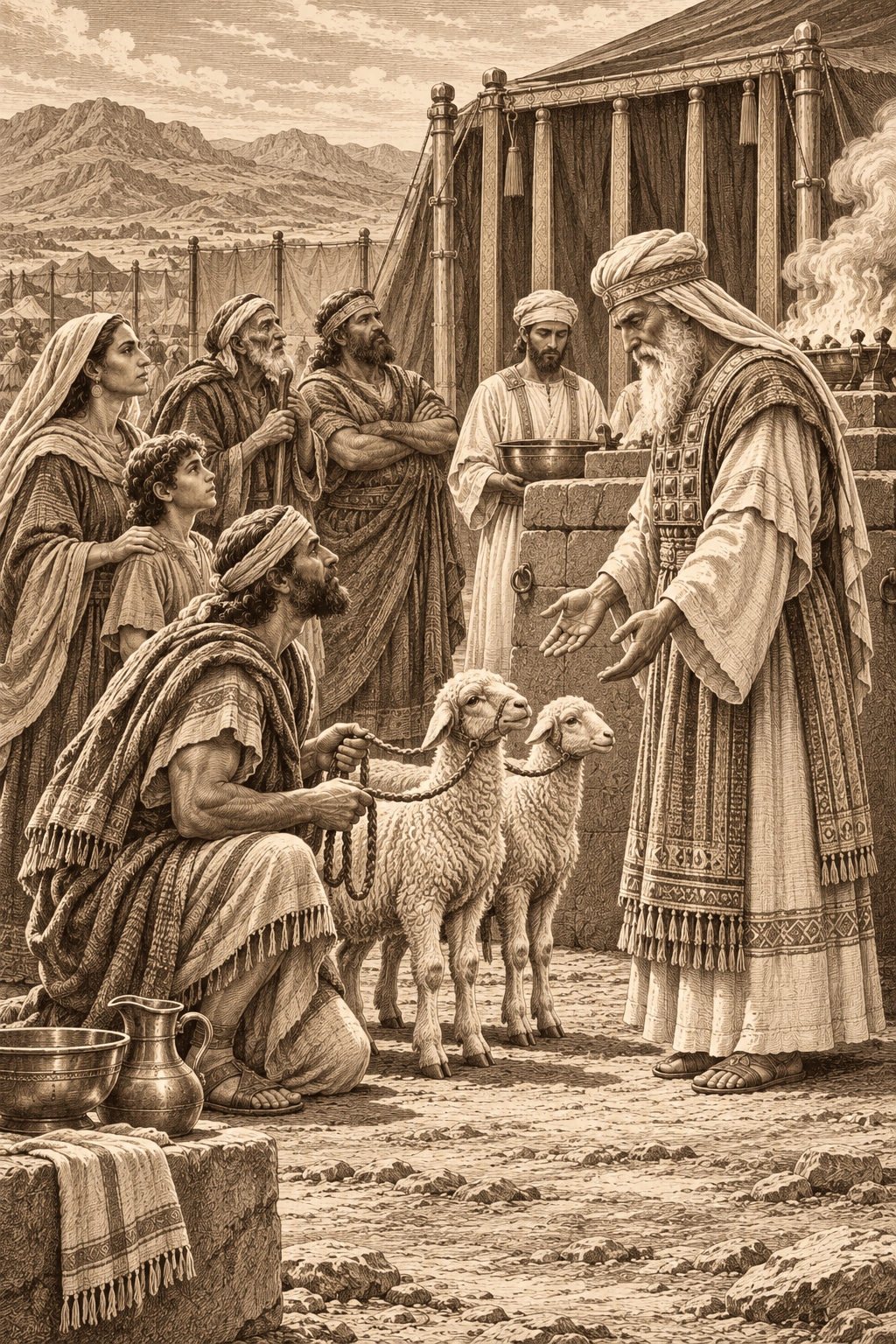
If God wants all our days to be feasts to Him, in which He rejoices in us through the sacrifice of His only Son and accepts our prayers by day and by night, so that there is not a single day in our days that is not a feast, He also established for us a weekly feast, “the feast of the Sabbath” or “the feast of rest.” Therefore the Apostle says: “There remaineth therefore a rest to the people of God” (Hebrews 4:9).
We said that the Lord rested on the seventh day, not by ceasing from work, but by His joy in man and His rest. We too, enjoying Sunday, the day of the resurrection of Christ the Lord, as the day of rest, find in His unceasing sacrifice the secret of our enjoyment of the risen life; so we rest in God, who raised us with Him and made us sit in heavenly places, and God rests in us, for He finds a place for Himself in us.
Sunday remains a weekly feast, a true Sabbath for God and the Church, or for God and man in Christ Jesus risen from the dead, until we meet Him face to face on the great day of rest, when our body enjoys the resurrection from the dead and bears a new spiritual nature, and man is with God, glorified in His bosom. It is as though all our present feasts are an earnest of the eternal feast, or, as Origen says:
The true Sabbath, in which God rests from all His works, will be in the age to come, when sufferings, sorrows and sighs are defeated and God is all in all. On this Sabbath God grants us to keep the feast with Him and to celebrate it with His holy angels, offering the sacrifice of praise and paying the vows which our lips uttered here. [268]
On this weekly feast the people were bound to offer “the burnt offering of every sabbath, beside the continual burnt offering, and his drink offering” (10). It is one sacrifice, not repeated; but it is the sacrifice of Christ, standing and effective without ceasing, around which the Church gathers on Sunday, celebrating the rest of the resurrection, besides the daily sacrifices of love, prayers and praises offered through the cross!
3. The Monthly Sacrifices
KJV · Verses 11–15
11 And in the beginnings of your months ye shall offer a burnt offering unto the Lord; two young bullocks, and one ram, seven lambs of the first year without spot; 12 And three tenth deals of flour for a meat offering, mingled with oil, for one bullock; and two tenth deals of flour for a meat offering, mingled with oil, for one ram; 13 And a several tenth deal of flour mingled with oil for a meat offering unto one lamb; for a burnt offering of a sweet savour, a sacrifice made by fire unto the Lord. 14 And their drink offerings shall be half an hin of wine unto a bullock, and the third part of an hin unto a ram, and a fourth part of an hin unto a lamb: this is the burnt offering of every month throughout the months of the year. 15 And one kid of the goats for a sin offering unto the Lord shall be offered, beside the continual burnt offering, and his drink offering.
At the beginning of every month we celebrate a feast of the Lord, in which a burnt offering of a sweet savour is offered (13), with a sin offering unto the Lord (15), besides the daily continual burnt offering, morning and evening.
Note here His saying “in the beginnings of your months,” whereas when He speaks of the Sabbath He delights to say “my sabbaths” (Exodus 31:13; Leviticus 19:3, 30; 26:2), as though He prizes them as the secret of His own joy; but in the case of doing evil He likes to call them “your sabbaths” (Leviticus 26:35). [269] Truly, how beautiful it is that God calls the Sabbath “my sabbaths,” the feasts “my feasts,” and the offerings “my offerings,” because they all point to entering into eternal rest, the continual feast and the eternal offering of Christ the Lord, in which man rests in God, as man in God’s bosom. But the months He calls “your months,” because the month points to time, changing from month to month, which ends with the end of the world. For our sake time was created with the existence of the heavenly bodies, and for our sake the times will end; there will no longer be months and years, but we will be in one day without ceasing, in which the sun never sets, an unceasing Sabbath day, a day of eternal rest.
At the beginning of our months we celebrate a third feast of the Lord, besides the continual feast and the feast of the Sabbath, in which we rejoice in the slain Lord, who has given us “eternal life” in Him. Origen comments on this feast, saying:
The third celebration is the feast of the new moon, the day on which a sacrifice is also offered. This celebration takes place when the moon appears anew. We say that the moon has become new when it draws very near to the sun by joining it… What benefit is there in celebrating the feast of the new moon? It means that the moon draws very near to the sun and is united with it. Christ is “the Sun of righteousness,” and the new moon means His Church, filled with His light, joining Him and united with Him in power, as the Apostle says: “But he that is joined unto the Lord is one spirit” (1 Corinthians 6:17). She celebrates the feast of the new moon by becoming new, leaving the old man and putting on the new man, which after God is created in righteousness and true holiness (Ephesians 4:24). In this way she is worthy to celebrate the feast of renewal, or the feast of the new moon… The soul that has been united with God and come to know His splendour and light, which has no earthly thought, that is, no preoccupation with worldly affairs or lust for men’s admiration, which has given itself to the light of wisdom and the warmth of the Spirit and has become not material but spiritual, which men cannot see and which does not cling to men’s looking at it (the natural man does not perceive the spiritual man nor reach him): such a soul truly deserves to celebrate the feast and offer the sacrifice of the new moon to the Lord who renewed it. [270]
4. Yearly Feasts: The Passover
KJV · Verses 16–25
16 And in the fourteenth day of the first month is the passover of the Lord. 17 And in the fifteenth day of this month is the feast: seven days shall unleavened bread be eaten. 18 In the first day shall be an holy convocation; ye shall do no manner of servile work therein: 19 But ye shall offer a sacrifice made by fire for a burnt offering unto the Lord; two young bullocks, and one ram, and seven lambs of the first year: they shall be unto you without blemish: 20 And their meat offering shall be of flour mingled with oil: three tenth deals shall ye offer for a bullock, and two tenth deals for a ram; 21 A several tenth deal shalt thou offer for every lamb, throughout the seven lambs: 22 And one goat for a sin offering, to make an atonement for you. 23 Ye shall offer these beside the burnt offering in the morning, which is for a continual burnt offering. 24 After this manner ye shall offer daily, throughout the seven days, the meat of the sacrifice made by fire, of a sweet savour unto the Lord: it shall be offered beside the continual burnt offering, and his drink offering. 25 And on the seventh day ye shall have an holy convocation; ye shall do no servile work.
The Lord gave them two groups of yearly feasts: one group celebrated at the beginning of the year, and another group beginning in the second half of the year, that is, the seventh month. In the first half of the year He celebrated the feast of the Passover (the fourteenth day of the first month) and the feast of firstfruits, or of the fiftieth day (Pentecost). The feast of the Passover, or of the passing over, we have spoken of before in chapter 12 of the Book of Exodus and chapter 9 of the Book of Numbers.
Here He focused on the seven days of unleavened bread, in which they abstained from eating and using leaven, so that a new year might begin not bound to the old leaven. Origen says:
You are worthy to celebrate this feast if you remove from your soul all the leaven of malice (1 Corinthians 5:8) and sin, keeping the unleavened bread of sincerity and truth.
For we must not imagine that God Almighty legislates for man laws concerning the use of leaven, and cuts off that soul from its people (Numbers 9:13) if it forgot to sweep out the leaven it had… But what God rightly hates is the leaven of the evil spirit, murmuring and unjust, which has been leavened with the leaven of evil. This is what God wants of the soul: if it does not remove this leaven from its dwelling, it is cut off…! For whoever leaves in his soul the least seed of evil, it grows from day to day and he becomes more evil. If you want to celebrate the feast of unleavened bread with God, do not leave in your soul the least leaven of evil. [271]
Pope Athanasius the Apostolic says:
So let us keep the feast, not with old leaven, neither with the leaven of malice and wickedness; but with the unleavened bread of sincerity and truth (1 Corinthians 5:8). And putting off the old man and his deeds, let us put on the new man, which after God is created (Ephesians 4:22, 24), meditating in the law of God day and night, with a humble mind and a pure conscience. Let us cast away from us all hypocrisy and guile, keeping far from all pride and deceit. Let us take on ourselves love toward God and love toward our neighbour, so that we may become a new creature, taking new wine. So let us keep the feast as is fitting. [272]
Saint Augustine sees in the unleavened bread the rejection of the old leaven and the acceptance of the new, so that we have new life, new praise and so on:
If we have a new life, let us sing a new song and chant to the Lord a new hymn. [273]
5. Yearly Feasts: The Feast of Weeks
KJV · Verses 26–31
26 Also in the day of the firstfruits, when ye bring a new meat offering unto the Lord, after your weeks be out, ye shall have an holy convocation; ye shall do no servile work: 27 But ye shall offer the burnt offering for a sweet savour unto the Lord; two young bullocks, one ram, seven lambs of the first year; 28 And their meat offering of flour mingled with oil, three tenth deals unto one bullock, two tenth deals unto one ram, 29 A several tenth deal unto one lamb, throughout the seven lambs; 30 And one kid of the goats, to make an atonement for you. 31 Ye shall offer them beside the continual burnt offering, and his meat offering, (they shall be unto you without blemish) and their drink offerings.
For the sanctification of time, so that all of man’s days might be holy to the Lord, the Lord made the last or seventh day among the Jews “a sabbath of the Lord”; by sanctifying the seventh day the whole week is sanctified, for the word “week” comes from the number “seven,” especially in Hebrew, where it is called shabua, that is, “seven.”
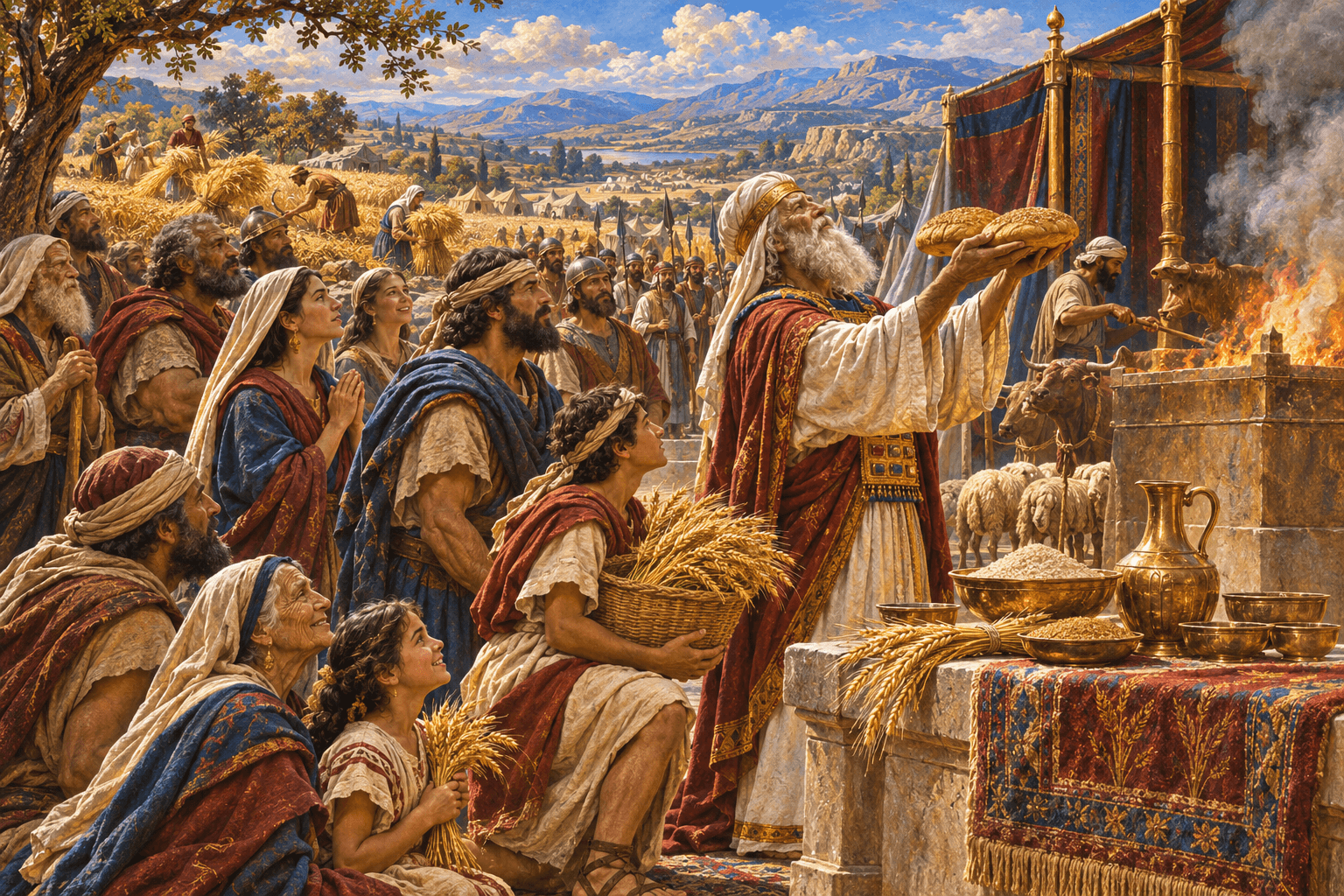
The Lord also sanctified the weeks by establishing “the feast of weeks,” which is the feast of the fiftieth day, because after seven weeks from the beginning of the harvest it is counted a sabbath to the Lord. It was a feast bound up with agriculture; and since it was difficult to fix the beginning of the day of harvest, it was settled that it be counted from the feast of the Passover, so that it became the fiftieth day from the Passover. On this feast the people appeared before God not empty (Exodus 23:15), but offering to the Lord of the new harvest; therefore He says: “when ye bring a new meat offering unto the LORD, after your weeks be out” (26). What is this new offering? Saint John Chrysostom says:
It is not fitting for you to enter the house of God without sacrifices; so do not go to the assembly without bringing your brethren with you. For this sacrifice and offering is better than that, when you offer to God a soul with you in the church. [274]
On the day of Pentecost the Holy Spirit came upon the disciples in the upper room of Zion, the fiery Spirit able to draw new offerings to the Lord; for Peter the apostle offered on that day about three thousand souls to the Lord (Acts 2:41). This is the offering of the believers on the feast of weeks: bringing weary souls in, so that they may rest in the bosom of the Lord.
Notes and References
[266] St. Athanasius, Festal Letters 5.4.
[267] Origen, Homilies on Numbers 23.
[268] Origen, Homilies on Numbers 23.
[269] See the author, The Book of Exodus, chapter 31.
[270] Origen, Homilies on Numbers 23.
[271] Ibid.
[272] St. Athanasius, Paschal (Festal) Letter 1.
[273] St. Augustine, On Psalm 40.14.
[274] St. John Chrysostom, To Those Who Had Not Attended the Assembly 4.