
This chapter contains two matters that came at the close of the life of Moses, the great among the prophets: the story of the daughters of Zelophehad and the appointment of Joshua as leader of the people.
1. The Daughters of Zelophehad
KJV · Verses 1–5
1 Then came the daughters of Zelophehad, the son of Hepher, the son of Gilead, the son of Machir, the son of Manasseh, of the families of Manasseh the son of Joseph: and these are the names of his daughters; Mahlah, Noah, and Hoglah, and Milcah, and Tirzah. 2 And they stood before Moses, and before Eleazar the priest, and before the princes and all the congregation, by the door of the tabernacle of the congregation, saying, 3 Our father died in the wilderness, and he was not in the company of them that gathered themselves together against the Lord in the company of Korah; but died in his own sin, and had no sons. 4 Why should the name of our father be done away from among his family, because he hath no son? Give unto us therefore a possession among the brethren of our father. 5 And Moses brought their cause before the Lord.
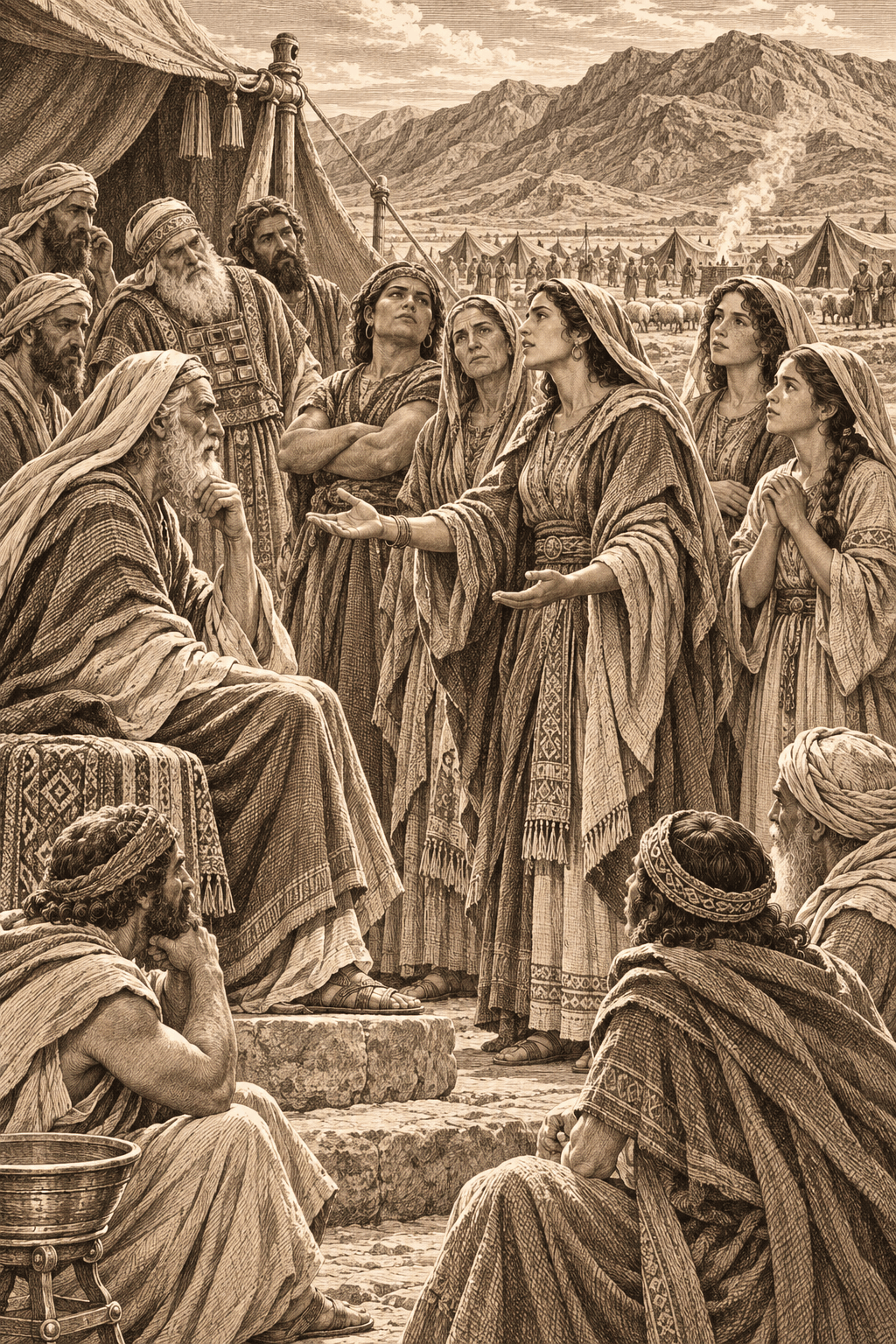
During the preceding census a single and unique case appeared: the sons of Gilead had become families including males who entered the census, except Zelophehad, for it is said: “And Zelophehad the son of Hepher had no sons, but daughters: and the names of the daughters of Zelophehad were Mahlah, and Noah, Hoglah, Milcah, and Tirzah” (Numbers 26:33). So Zelophehad did not enter the census. But his five daughters were courageous, full of faith and hope of receiving a portion with the rest of the people. They stood before Moses and Eleazar the priest, before the princes and all the congregation at the door of the tabernacle of the congregation, setting out their case with strong argument, saying: “Our father died in the wilderness, and he was not in the company of them that gathered themselves together against the LORD in the company of Korah; but died in his own sin, and had no sons. Why should the name of our father be done away from among his family, because he hath no son? Give unto us therefore a possession among the brethren of our father” (3–4). They spoke with courage, but with reverence and humility, confessing that their father died in his own sin, as the whole previous generation died in its sin; but he was not one of the usurpers of the priesthood like Korah and his company. Why then should his name be removed from among the heirs of the new land?
These are words of faith and of holding fast to God’s promises, which open heaven to an answer. So God bound the whole congregation by a law of inheritance, in which the son inherits from his father; if the deceased had no son, then his daughter; if he had no daughter, then his brothers, or his uncles, or his nearest kinsman in his family.
This unique story, recorded by divine revelation, also carries a symbolic meaning which Origen recorded for us. He holds that “Zelophehad” means “a shadow in his mouth,” or a shadow in which there is protection from fear. He represents the man who utters the grace of the Law as a shadow of the truth, without coming to know it in his depths as life, the literal man who does not beget sons:
This man, who perceives no spiritual meaning or any deep thought, has only the shadow of the Law in his mouth; so he cannot beget living and spiritual thoughts, but he begets acts and works (daughters), which serve the common people. [258]
He carries no thoughts, because male children point to thought or the mind, but works, because daughters point to the body and work.
We can also see in it a living symbolic picture of the believer’s life. If “Zelophehad” means “a shadow in the mouth” or “a shadow in fear,” he points to the body, which like a shadow appears in the world only to disappear. When the body dies with Christ the Lord, as Zelophehad died, it bears blessed daughters, the five senses, which are sanctified through enjoying death with Christ. These daughters confess that their father died in Christ the Lord and did not perish with Korah and his company. For such holy senses, crucified with Christ the Lord, God’s mercies and His judgment full of love and kindness rise up, so that the body together with the soul may enjoy the eternal inheritance, and its name not be removed from among the family of the heavenly ones!
2. The Law of Inheritance
KJV · Verses 6–11
6 And the Lord spake unto Moses, saying, 7 The daughters of Zelophehad speak right: thou shalt surely give them a possession of an inheritance among their father's brethren; and thou shalt cause the inheritance of their father to pass unto them. 8 And thou shalt speak unto the children of Israel, saying, If a man die, and have no son, then ye shall cause his inheritance to pass unto his daughter. 9 And if he have no daughter, then ye shall give his inheritance unto his brethren. 10 And if he have no brethren, then ye shall give his inheritance unto his father's brethren. 11 And if his father have no brethren, then ye shall give his inheritance unto his kinsman that is next to him of his family, and he shall possess it: and it shall be unto the children of Israel a statute of judgment, as the Lord commanded Moses.
Because of the case of the daughters of Zelophehad, the law of inheritance came, declaring the lawful heirs, as we said: the son, then the daughter, then the brothers, then the uncles or the nearest in the family. Origen sees in this law a shadow of heavenly good things, seeing in these five heirs on earth symbols of the heirs in heaven. In the first degree, the degree of sons, are those who have spiritual knowledge. The second degree, “the daughter,” points to those of excellent work; for, as we have repeated before, the male points to thought, the mind or knowledge, while the female points to the body, or work and service. The former represent those of contemplation, and the latter those who strive in service and work. The third degree, the degree of brothers, represents those who strive by imitating others as their brothers. The fourth degree, the uncle, in his view represents the company of the simple, who practise good customs without depth of thought. Finally, the degree of any kinsman points to the heirs whom the Lord gathers in for any work they do in simplicity, for the Lord longs for the salvation of all.
3. The Appointment of Joshua as Leader
KJV · Verses 12–23
12 And the Lord said unto Moses, Get thee up into this mount Abarim, and see the land which I have given unto the children of Israel. 13 And when thou hast seen it, thou also shalt be gathered unto thy people, as Aaron thy brother was gathered. 14 For ye rebelled against my commandment in the desert of Zin, in the strife of the congregation, to sanctify me at the water before their eyes: that is the water of Meribah in Kadesh in the wilderness of Zin. 15 And Moses spake unto the Lord, saying, 16 Let the Lord, the God of the spirits of all flesh, set a man over the congregation, 17 Which may go out before them, and which may go in before them, and which may lead them out, and which may bring them in; that the congregation of the Lord be not as sheep which have no shepherd. 18 And the Lord said unto Moses, Take thee Joshua the son of Nun, a man in whom is the spirit, and lay thine hand upon him; 19 And set him before Eleazar the priest, and before all the congregation; and give him a charge in their sight. 20 And thou shalt put some of thine honour upon him, that all the congregation of the children of Israel may be obedient. 21 And he shall stand before Eleazar the priest, who shall ask counsel for him after the judgment of Urim before the Lord: at his word shall they go out, and at his word they shall come in, both he, and all the children of Israel with him, even all the congregation. 22 And Moses did as the Lord commanded him: and he took Joshua, and set him before Eleazar the priest, and before all the congregation: 23 And he laid his hands upon him, and gave him a charge, as the Lordcommanded by the hand of Moses.
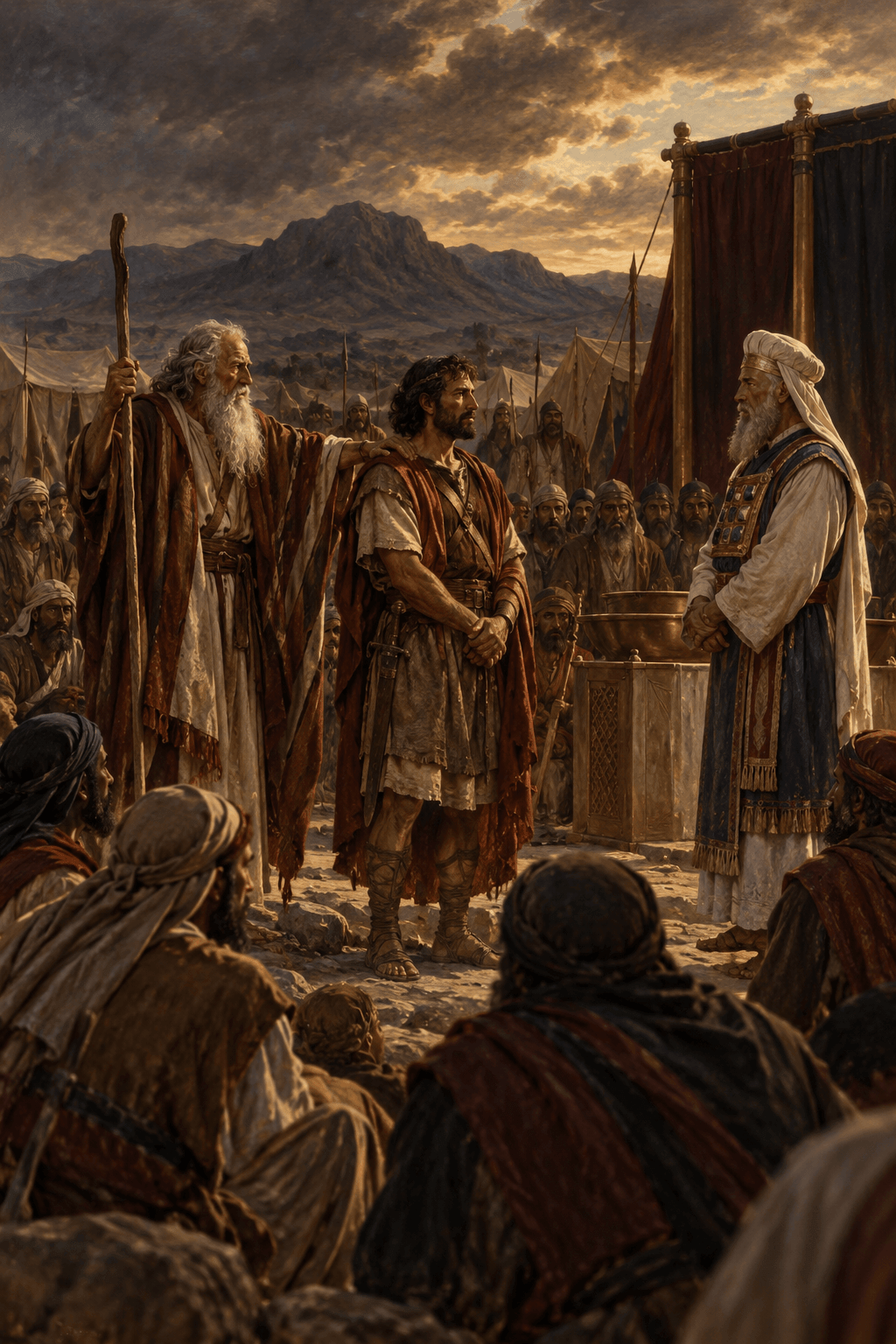
The figure of Moses the prophet grows in splendour and glory with every day he lives in the service, until the last moments in which he gave up his spirit into the hands of God. Before us is a call from God to this great prophet to go up into the mountains of Abarim, to cast a look at the land of promise from afar and be gathered to his fathers… And here the soul of this mighty man shone out through his wise conduct, full of spirituality and far removed from any spirit of selfishness or arrogance…
The Lord’s words to Moses were: “Get thee up into this mount Abarim, and see the land which I have given unto the children of Israel. And when thou hast seen it, thou also shalt be gathered unto thy people, as Aaron thy brother was gathered” (12–13).
His call was to go up into Mount Abarim, as his brother Aaron had gone up before into Mount Hor, and there departed in peace and joy, after taking off the priestly garments for his son Eleazar to put on (Numbers 20). So Moses the prophet goes up on Mount Abarim, that is, the mountain of passing over, and there he sees God’s promises fulfilled and falls asleep in peace and joy. As we said of Aaron that he did not go down into the pit like Korah and his company but went up into Mount Hor, so Moses also went up. For him death is a rising and an ascent, not a descent and a loss!
Origen has a beautiful comment:
See first how the perfect man and master does not die in a valley or a plain, nor on a hill, but on the mountain, that is, on a high place hard to reach; for the end of his life had the heights as its ground. And there he looks with his eyes on the land of promise, considering everything from a high and distant place. Truly the man who wants to attain the summit of perfection should not remain ignorant (of the land), but should come to know all things, seeing and hearing them. When he enters the world of the spirit and the purity of thought, he returns to the things he came to know in their material form while he was in the body, listens to the lessons of wisdom, stays in her school and quickly perceives her reasons and causes. What other benefit is there for him like seeing, before his departure from this world, the lands and places whose difficulties he will not have to overcome (since he rests from toil), without obtaining their advantages (since he leaves them)! [259]
Truly, what he had striven for over decades, that he and his people might enjoy it, he now sees from afar, so that his soul may rest in it!
He sees the land of promise from afar and is gathered to his people like Aaron. He does not see it to be rebuked, but so that his soul may rejoice within because of his people’s entering it; therefore he is gathered to his people, that is, to the ranks of the fathers of this congregation, and he rests with the fathers without being separated from the congregation.
The Lord reminded Moses that he and his brother were deprived of entering the land because of what happened at the water of Meribah (chapter 20), not to rebuke him, but so that Moses would be approved all the more before God. For he does not intercede for himself or for his brother in this matter, but cares for the congregation, crying out for the choice of the fitting leader whom “the God of the spirits of all flesh” sees fit! What wonderful love, when the spiritual leader forgets, even to his last breath, everything that concerns himself personally, for the sake of building up the congregation, its peace and its growth!
Perhaps God allowed Moses’ weakness to be affirmed to the last moments in order to declare the inability of the Law to sanctify, for the Apostle says: “death reigned from Adam to Moses” (Romans 5:14); “by one man sin entered into the world, and death by sin; and so death passed upon all men, for that all have sinned” (Romans 5:12)… There came to be need of Another than Moses, able not only to see the land from afar but to bring His people into it. The Law declared heavenly things, but from afar, through the shadow; but the true Joshua has made us sit in heavenly places.
Moses was concerned with prayer, asking God to choose Himself the man who would lead the congregation… He did not think of his two sons or his relatives to take his place; he cared first and above all for the congregation, which he loved with all his heart. Origen says:
The heads of the Church, instead of recommending their relatives by blood and flesh… must learn to return to the judgments of God, and instead of choosing according to their human feelings, leave the appointment of their successor to the decision of God.
Could not Moses have chosen a leader for the people with true wisdom and by a good and just decision, he to whom God said, “Gather unto me seventy men of the elders of Israel, whom thou knowest to be the elders of the people” (Numbers 11:16), and who chose them according to the Spirit of God, who came upon them so that they all prophesied? But Moses did not do this, nor did he appoint anyone. He did not dare to do it. Why? So as not to leave the coming generations an example in which a man relies on his own opinion. He says: “Let the LORD, the God of the spirits of all flesh, set a man over the congregation, Which may go out before them, and which may go in before them, and which may lead them out, and which may bring them in; that the congregation of the LORD be not as sheep which have no shepherd” (16–17). If a man as great as Moses did not leave to his own judgment the matter of appointing a leader over the people and installing a successor, who among this people… or even among the ranks of the priests would dare to consider himself able to give his opinion in this matter, except in the case of an inspiration obtained through many prayers and supplications offered to God? [260]
God answered his request by commanding him to lay his hand on his disciple Joshua the son of Nun. Truly, how great was Moses’ joy at this divine command, for the Lord chose the man who had long been Moses’ right arm, who did not depart from the tabernacle (Exodus 33:11), steeped in the deep, inner spirit of the Church; the man who had entered the land of promise and came to offer his brethren the earnest of the new life, with assurances of entering the land and enjoying its good things… I leave the discussion of this new leader to the commentary on Joshua, if the Lord permits and we live, contenting myself here with revealing the rites of his installation as head of the congregation:
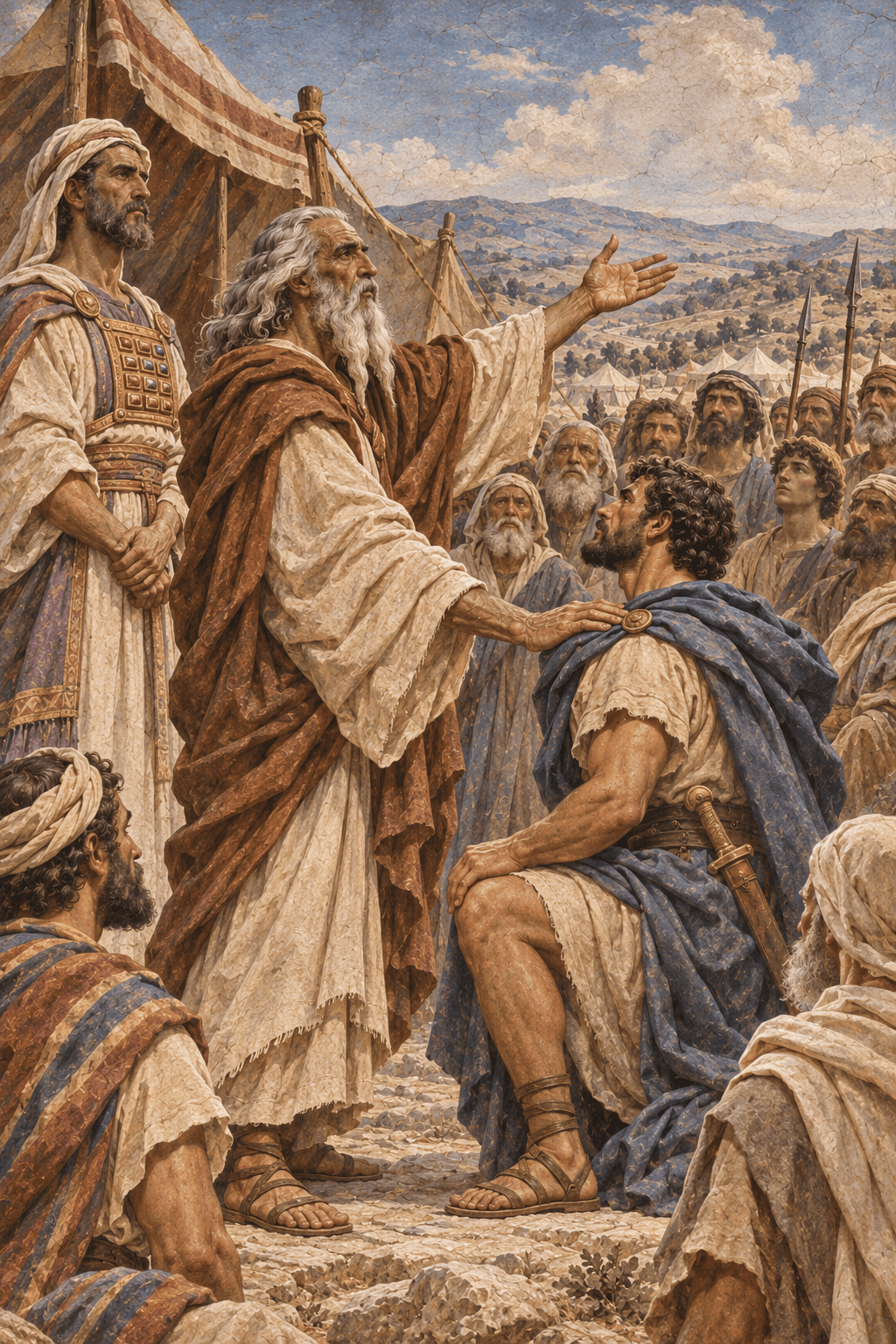
The divine command came to Moses: “lay thine hand upon him” (18). And the Book of Deuteronomy made clear the effect of this act: “And Joshua the son of Nun was full of the spirit of wisdom; for Moses had laid his hands upon him” (Deuteronomy 34:9). He received the work and was filled with the spirit of wisdom, or the spirit of leadership. Therefore the laying on of hands was usually bound up with the ordination of God’s ministers.
In Holy Scripture “the laying on of hands” was used in many matters, the most important being:
A) “The laying on of hands” was used to hand on a divine blessing, as our father Jacob did with the two sons of Joseph: he put his right hand on the younger, Ephraim, standing on his left, and his left hand on the elder, Manasseh, standing on his right, as though he stretched out his hands in the shape of a cross, so that the Lord’s blessing might come upon them… And when Christ the Lord blessed the children, “he laid his hands on them” (Matthew 19:13, 15). Therefore the bishop laid his hands on those seeking Baptism during the prayers over them before Baptism, [261] and especially during the prayers for casting out Satan. [262]
B) As this rite is used to hand on the Lord’s blessing, so it is used as a sign of laying the burden of a man’s sins on another, so that it becomes a sacrifice for him (Leviticus 1:3–4; 4:24; 16:21), as a symbol of what happened with Christ the Lord: “the LORD hath laid on him the iniquity of us all” (Isaiah 53:6).
C) In healing the sick it is said: “he laid his hands upon a few sick folk, and healed them” (Matthew 9:18; Mark 6:5; 8:23; Luke 4:40; 13:13); and the apostles sometimes used the same rite (Acts 28:8). Saint Cyprian [263] says that the ministers of the Church imitate Christ the Lord, who laid His hands on the sick and healed them, for those who are spiritually sick, who come repenting. This rite still stands, for the priest lays his hand on the head when he prays the “absolution” for a penitent.
D) Saint Clement of Alexandria mentions the laying of hands on the bride and bridegroom at marriage to bless them. [264]
E) In the Book of Acts “the laying on of hands” came when asking for the coming of the Holy Spirit upon the baptized (Acts 8:17). The early Church practised this rite until it replaced it with the anointing with the Myron, though bishops have the right to return to this rite when necessary, as in the case of the baptism of women, when the bishop lays his hands on them and breathes into their faces the breath of the Holy Spirit.
F) Finally, “the laying on of hands” was bound up most of all with the ordinations of the Church. At the ordination of the deacons it is said: “Whom they set before the apostles: and when they had prayed, they laid their hands on them” (Acts 6:6); and when Barnabas and Saul were set apart for the ministry it is said: “And when they had fasted and prayed, and laid their hands on them” (Acts 13:3). And when the Apostle Paul gave instructions about ordination, he said: “Lay hands suddenly on no man, neither be partaker of other men’s sins” (1 Timothy 5:22); and he said: “I put thee in remembrance that thou stir up the gift of God, which is in thee by the putting on of my hands” (2 Timothy 1:6). So “the laying on of hands” came to carry the meaning of “ordination,” and the Orthodox and Catholic Churches still look at it through this evangelical lens; and in the Church of England “the laying on of hands” is considered the principal rite in the consecration of bishops. [265]
We return to the installation of Joshua the son of Nun in place of Moses the prophet, to hear the divine voice: “And set him before Eleazar the priest, and before all the congregation; and give him a charge in their sight” (19). We saw in the ordination of the Levites (chapter 8) the positive role of the priests and the people in ordination. The people, like the priests, do not stand as spectators, but are bound to share in this work and cooperate with them.
The Lord says: “And thou shalt put some of thine honour upon him, that all the congregation of the children of Israel may be obedient” (20). Though Moses lays on hands, it is God, who gave Moses His Spirit and his honour, who gives Joshua the same gifts.
Though Joshua is installed as head to lead the people into the land of promise, it is in cooperation with the high priest Eleazar, who asks counsel for him before the Lord by the judgment of Urim (21).
The Urim and the Thummim, which mean “lights and perfections,” were most likely two precious stones on the breastplate of the high priest (Exodus 28:30; Leviticus 8:8), which he used to know the will of God. They point to the work of the Holy Spirit, who grants man enlightenment (lights) and perfection (perfections), so that the believer walks in the way of the Lord without turning aside.
Notes and References
[258] Origen, Homilies on Numbers 22.
[259] Ibid.
[260] Ibid.
[261] Eusebius, Life of Constantine 4.61; Tertullian, On the Crown 3 (PL 2.79).
[262] Origen, Homilies on Joshua 24.1 (PG 22.940 as given in the source).
[263] St. Cyprian, On the Lapsed 16.
[264] St. Clement of Alexandria, The Instructor 3.11.
[265] J. G. Davies, A Dictionary of Liturgy and Worship, p. 189.