
The Lord completes His words about the feasts and offerings, mentioning here the second group of yearly feasts, held in the second half of the year, with a conclusion about the personal offerings which a man offers without being bound by a particular commandment.
1. The Day of Blowing the Trumpets
KJV · Verses 1–6
1 And in the seventh month, on the first day of the month, ye shall have an holy convocation; ye shall do no servile work: it is a day of blowing the trumpets unto you. 2 And ye shall offer a burnt offering for a sweet savour unto the Lord; one young bullock, one ram, and seven lambs of the first year without blemish: 3 And their meat offering shall be of flour mingled with oil, three tenth deals for a bullock, and two tenth deals for a ram, 4 And one tenth deal for one lamb, throughout the seven lambs: 5 And one kid of the goats for a sin offering, to make an atonement for you: 6 Beside the burnt offering of the month, and his meat offering, and the daily burnt offering, and his meat offering, and their drink offerings, according unto their manner, for a sweet savour, a sacrifice made by fire unto the Lord.
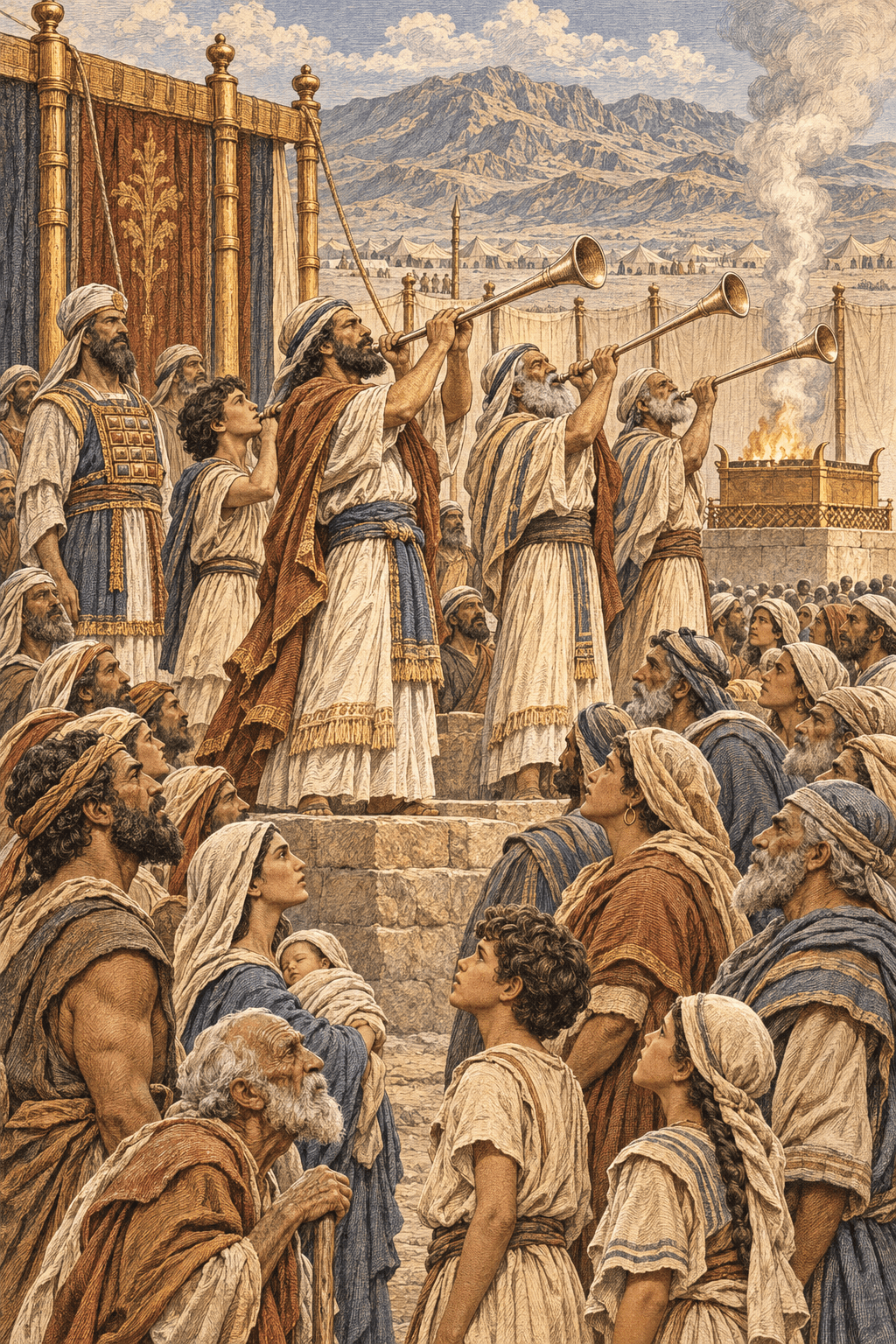
In the seventh month three great feasts, bound together, were celebrated: the feast of trumpets, or of the shout; the feast of atonement; and the feast of tabernacles. The choice of this month for these feasts is explained as follows:
A) As the days of the week are sanctified by sanctifying the seventh day, and the weeks are sanctified by sanctifying the feast of weeks in the seventh week, so the months are sanctified by holding these three feasts in the seventh month, as though it were the sabbath of the months. The Lord took care to sanctify everything seventh in time on every level.
B) This month is called by the Jews “Tishri,” that is, October; it is the beginning of the civil year, which the rabbis call the birthday of the world.
C) This period was a time of rest for those working in agriculture, between the harvest and the sowing of seed, as though God wanted to free them for joyful worship in this period.
D) As God begins the year with the Passover in the first month, as a sign that it is God who passed with them from the past year to bring them into a new year, a symbol of our passing from temporal life to the other life, so He wanted to sanctify the seventh month, that is, the end of the half-year, so that man might feel that God, who began, completes to the end. It is not enough to offer God the firstfruits of our life; we hand over the whole of life to Him, that He Himself may lead it.
The feast of trumpets, or the feast of the great shout, is called a holy convocation, in which the trumpets are blown, as though God declares to His people that they should prepare for the two great and complementary feasts: the great feast of atonement and the feast of tabernacles. According to Jewish tradition, on this day it was not the two silver trumpets mentioned in chapter 10 that were blown, but the shofar, that is, the ram’s horn, used on special solemn occasions such as the proclamation of the year of Jubilee (Joshua 6).
2. The Day of Atonement
KJV · Verses 7–11
7 And ye shall have on the tenth day of this seventh month an holy convocation; and ye shall afflict your souls: ye shall not do any work therein: 8 But ye shall offer a burnt offering unto the Lord for a sweet savour; one young bullock, one ram, and seven lambs of the first year; they shall be unto you without blemish: 9 And their meat offering shall be of flour mingled with oil, three tenth deals to a bullock, and two tenth deals to one ram, 10 A several tenth deal for one lamb, throughout the seven lambs: 11 One kid of the goats for a sin offering; beside the sin offering of atonement, and the continual burnt offering, and the meat offering of it, and their drink offerings.
On the tenth day of the seventh month they have a holy convocation, in which they afflict their souls and offer a burnt offering to the Lord for a sweet savour (8). So their affliction is mingled with joy, for God is pleased with them, not because of their affliction, but because of the reconciliation achieved between Him and them through the burnt offering on the great day of atonement.
The Book of Leviticus spoke at great length of this great day (Leviticus 16; 23:26–32). It is a day of fasting, humility and atonement for the sins of the whole people, without the high priest forgetting to make atonement for himself as well. This drew the attention of the Apostle Paul in his comparison between Christ the Lord, the great High Priest, who without sin entered with us into heaven itself, and the Jewish high priest, who entered the shadow of heavenly things once a year after offering blood for himself as for the errors of the people (Hebrews 9:1–12, 24–28). I hope to return to the details of its rite in our study of the Book of Leviticus, if the Lord wills and we live.
3. The Feast of Tabernacles
KJV · Verses 12–38
12 And on the fifteenth day of the seventh month ye shall have an holy convocation; ye shall do no servile work, and ye shall keep a feast unto the Lordseven days: 13 And ye shall offer a burnt offering, a sacrifice made by fire, of a sweet savour unto the Lord; thirteen young bullocks, two rams, and fourteen lambs of the first year; they shall be without blemish: 14 And their meat offering shall be of flour mingled with oil, three tenth deals unto every bullock of the thirteen bullocks, two tenth deals to each ram of the two rams, 15 And a several tenth deal to each lamb of the fourteen lambs: 16 And one kid of the goats for a sin offering; beside the continual burnt offering, his meat offering, and his drink offering. 17 And on the second day ye shall offer twelve young bullocks, two rams, fourteen lambs of the first year without spot: 18 And their meat offering and their drink offerings for the bullocks, for the rams, and for the lambs, shall be according to their number, after the manner: 19 And one kid of the goats for a sin offering; beside the continual burnt offering, and the meat offering thereof, and their drink offerings. 20 And on the third day eleven bullocks, two rams, fourteen lambs of the first year without blemish; 21 And their meat offering and their drink offerings for the bullocks, for the rams, and for the lambs, shall be according to their number, after the manner: 22 And one goat for a sin offering; beside the continual burnt offering, and his meat offering, and his drink offering. 23 And on the fourth day ten bullocks, two rams, and fourteen lambs of the first year without blemish: 24 Their meat offering and their drink offerings for the bullocks, for the rams, and for the lambs, shall be according to their number, after the manner: 25 And one kid of the goats for a sin offering; beside the continual burnt offering, his meat offering, and his drink offering. 26 And on the fifth day nine bullocks, two rams, and fourteen lambs of the first year without spot: 27 And their meat offering and their drink offerings for the bullocks, for the rams, and for the lambs, shall be according to their number, after the manner: 28 And one goat for a sin offering; beside the continual burnt offering, and his meat offering, and his drink offering. 29 And on the sixth day eight bullocks, two rams, and fourteen lambs of the first year without blemish: 30 And their meat offering and their drink offerings for the bullocks, for the rams, and for the lambs, shall be according to their number, after the manner: 31 And one goat for a sin offering; beside the continual burnt offering, his meat offering, and his drink offering. 32 And on the seventh day seven bullocks, two rams, and fourteen lambs of the first year without blemish: 33 And their meat offering and their drink offerings for the bullocks, for the rams, and for the lambs, shall be according to their number, after the manner: 34 And one goat for a sin offering; beside the continual burnt offering, his meat offering, and his drink offering. 35 On the eighth day ye shall have a solemn assembly: ye shall do no servile work therein: 36 But ye shall offer a burnt offering, a sacrifice made by fire, of a sweet savour unto the Lord: one bullock, one ram, seven lambs of the first year without blemish: 37 Their meat offering and their drink offerings for the bullock, for the ram, and for the lambs, shall be according to their number, after the manner: 38 And one goat for a sin offering; beside the continual burnt offering, and his meat offering, and his drink offering.
If the feast of atonement is a feast of fasting and affliction, the feast of tabernacles, which follows it on the fifteenth day of the same month and continues eight days, is the feast of joy and exultation. If atonement points to the cross, and so is bound up with fasting and affliction, the feast of tabernacles points to the fruits of the cross, with the power of resurrection, ascension and the enjoyment of the Holy Spirit that it carries. The continuing of the feast for eight days points to the risen life, that is, the other life; for the eighth day is the first day after the week, that is, the entry into a new week.
In this feast every man was bound to appear before the Lord in the temple (Deuteronomy 16:16). They lived in booths which they set up during the feast in the squares of the city, on the roofs of the houses and their courts, in the courts of the temple (Nehemiah 8:16) and on the mountains near Jerusalem. So it was the summit of the feasts, for it points to the Church’s setting out beyond the earthly dwelling. The Law was read before the people every seven years, at the time of the year of release, at the feast of tabernacles (Deuteronomy 31:9–13). Many rites were added to the feast besides the sacrifices and offerings, which we will speak of in our study of the Book of Leviticus, if the Lord permits. At the time of the morning sacrifice the people carried palm branches, branches of myrtle and willow and fruit, and went around the altar once each day, and seven times on the seventh day. [275] Another custom also appeared: a priest filled a golden vessel with water from the pool of Siloam and carried it to the temple at the morning and evening sacrifice every day of the feast; and they received it with the blowing of the trumpet and the words of Isaiah the prophet: “Therefore with joy shall ye draw water out of the wells of salvation” (Isaiah 12:3). Perhaps the Lord of glory pointed to this when He said: “If any man thirst, let him come unto me, and drink. He that believeth on me, as the scripture hath said, out of his belly shall flow rivers of living water” (John 7:37–38). It is as though the Lord turned their eyes to the Holy Spirit, whom they would receive within them. They were also accustomed, on the evening following the first day of the feast, to light the court of the women from two high candlesticks, each bearing four large lamps, which cast their light over the city, pointing to the work of the Holy Spirit, “inner enlightenment.”
It is as though the feast of tabernacles is the feast of joy in the resurrection and of setting out toward heavenly things through enjoying the Holy Spirit, who makes springs of living water burst forth within us and enlightens our inner sight.
The use of booths also points to the state of the people after setting out from the land of bondage and journeying in the wilderness in tents, to pass over to Jerusalem, the city of the great King. As Saint Augustine says:
Now, before we enter the land of promise, I mean the eternal kingdom, we live in the wilderness in tabernacles… The man who perceives that he is passing through this world is in tabernacles. This man understands that he is journeying in a strange city, for he sees himself groaning, longing for his homeland. [276]
As for the sacrifices and offerings at this feast, we note the following:
First: the abundance of sacrifices and offerings. In the days of the feast, as burnt offerings of a sweet savour to the Lord, there were offered seventy-one bullocks, fifteen rams and one hundred and five lambs of the first year without blemish, and so on… The greater the joy, the more the sacrifice is declared; for our joy springs from our reconciliation with God through His sacrifice, and His pleasure in us through it! In other words, the more we discover the power of the sacrifice, the more we enjoy heavenly joy!
Second: though the joy of the feast moved them to offer sacrifices and offerings, it was without neglecting the daily continual burnt offering, morning and evening. It is as though the feast, while urging us all the more to enjoy fellowship with God and practise our liturgical worship, does not mean that we stop the exercises of our daily life.
Third: in the days of the feast the sacrifices do not differ, except on the eighth day, the solemn assembly. The number of bullocks begins with thirteen and ends on the seventh day with seven, decreasing by one bullock each day from the day before.
Fourth: each day a sin offering was offered, as at all the feasts, joined with the burnt offerings of a sweet savour to the Lord… as though the Father’s pleasure in us is joined with the forgiveness of our sins through the one saving work: the cross!
4. Personal Offerings
KJV · Verses 39–40
39 These things ye shall do unto the Lord in your set feasts, beside your vows, and your freewill offerings, for your burnt offerings, and for your meat offerings, and for your drink offerings, and for your peace offerings. 40 And Moses told the children of Israel according to all that the Lordcommanded Moses.
Besides these communal sacrifices and offerings, on the level of every day, every week, every month and every year, there are the vows, offerings, drink offerings and sacrifices which a man offers by his personal will, so that the communal work may be joined with the personal, and the worship of the community with the worship of each of its members.
Notes and References
[275] Josephus, Antiquities.
[276] St. Augustine, Tractates on the Gospel of John 28.9.