
God commanded Moses the prophet to fight the Midianites, who had hired wicked women to make the children of Israel stumble; this was the last chapter in the struggle of Moses the prophet.
1. The War against the Midianites
KJV · Verses 1–7
1 And the Lord spake unto Moses, saying, 2 Avenge the children of Israel of the Midianites: afterward shalt thou be gathered unto thy people. 3 And Moses spake unto the people, saying, Arm some of yourselves unto the war, and let them go against the Midianites, and avenge the Lord of Midian. 4 Of every tribe a thousand, throughout all the tribes of Israel, shall ye send to the war. 5 So there were delivered out of the thousands of Israel, a thousand of every tribe, twelve thousand armed for war. 6 And Moses sent them to the war, a thousand of every tribe, them and Phinehas the son of Eleazar the priest, to the war, with the holy instruments, and the trumpets to blow in his hand. 7 And they warred against the Midianites, as the Lord commanded Moses; and they slew all the males.
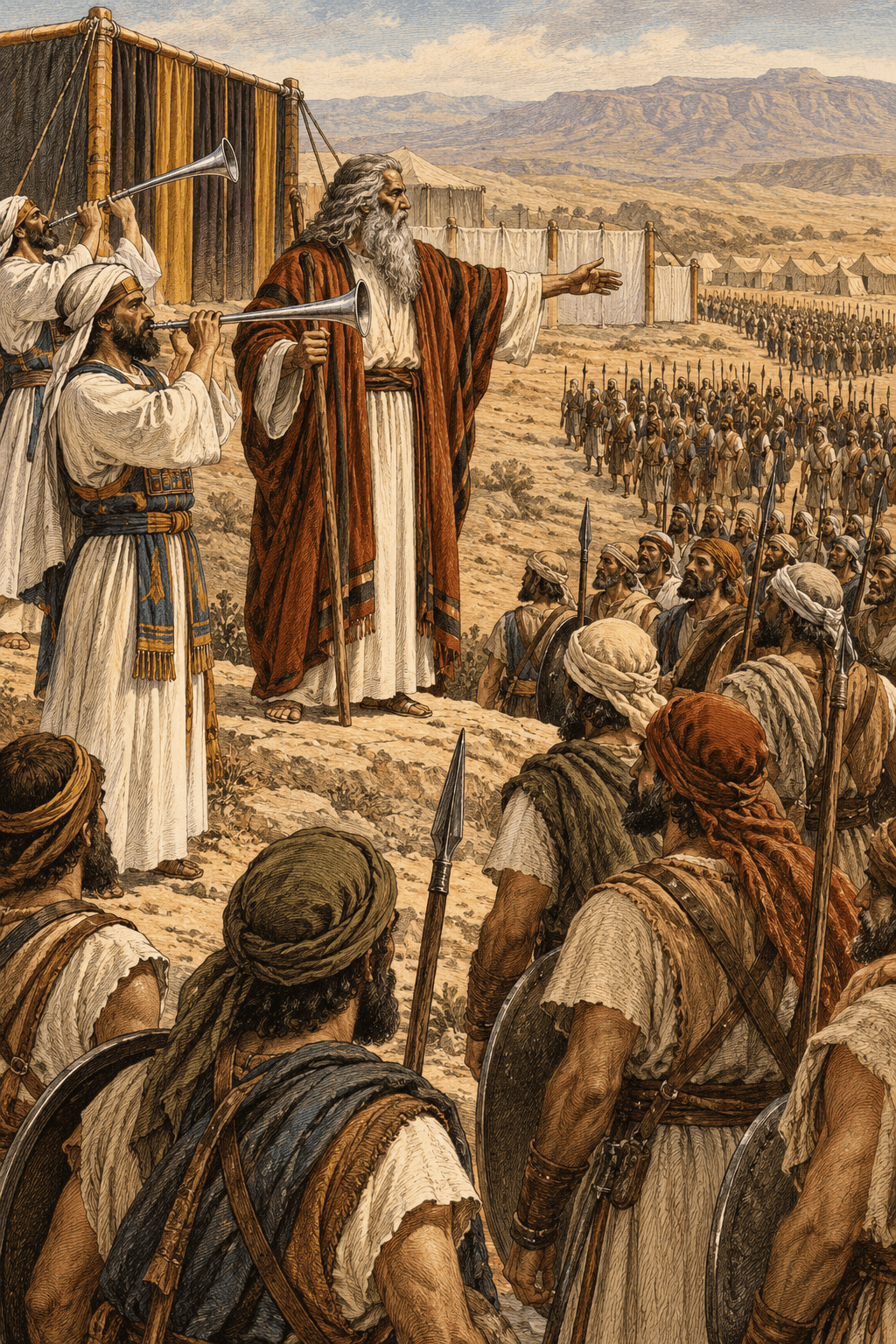
God wanted Moses the prophet to close his life and his struggle with a war whose goal was “sanctification,” by destroying the stumblingblock that had broken the people. The aim of the war was neither attack nor plunder; He wanted to kill those who had listened to Balaam’s words and hired women to fight the people with their beauty. Defilement with them had to be fought, so that the stumbling would not be repeated. This pointed to the necessity of cutting off the stumblingblock in the life of the believers, so that they may live in the spirit of victory and triumph.
This is the end of every work of Moses the prophet before he went up into the mountain of Abarim and saw the holy land from afar. It is the goal of the work of the Law: it exposes the stumblingblock and supports the struggle against it, but it cannot give righteousness, nor bring the believers over to the borders of the holy land. It stirs up in us the spirit of struggle and lifts us up through the shadow and the symbol to see heaven from afar, but it is unable to carry us into it.
The features of this holy spiritual struggle are:
First: removing the stumblingblock. Origen says:
The stumblingblocks cast before the children of Israel were caused by the plot of the Midianites, who hired the women to steal their hearts so that they would sin before the Lord. The children of Israel suffered punishment for committing the sin; but the Midianites, since they caused the fall into sin, became the object of a heavier punishment. We learn from this that when we cause others to stumble and fall, we are in a worse state than if we committed the sin ourselves. This is what the Lord teaches us when He says: “It were better for him that a millstone were hanged about his neck, and he cast into the sea, than that he should offend one of these little ones” (Luke 17:2). [279]
Second: when the people fell into sin, Israel was defeated without visible fighters, for we hear of no war between it and the Midianites and Moabites; yet twenty and four thousand died of the plague without war (Numbers 25:9). Had it not been for the zeal of the priest Phinehas for the holy things, the whole people would have been consumed (Numbers 25:11). But now that the people had been sanctified, there was no need for the men of war, more than six hundred thousand men, to go out; it was enough to choose a thousand men from each tribe, so that twelve thousand men went out and conquered and triumphed. It is not a war of great numbers nor of military means, weapons and military plans; it is the power of godliness and holiness over evil and sin. Origen says:
He did not obtain the victory by the great number of soldiers, but by his righteousness and godliness… For it is said: if they follow the law of the Lord, one alone shall chase a thousand, and two shall put two thousand to flight (Leviticus 26:8). So you see that a single saint in his prayers is stronger than a countless army of the wicked. The prayer of the righteous pierces heaven; how then shall we not obtain victory on earth? Therefore you must seek first the righteousness of God (Matthew 6:33); for if we find it and keep it, we subdue all enemies, on condition that we put on the breastplate of righteousness, have our loins girt about with truth, take the helmet of salvation and the sword of righteousness, and above all take the shield of faith, with which we can quench all the fiery darts of the wicked (Ephesians 6:14–17)… With these weapons the whole camp of the demons and its army is defeated, and we sing with confidence, saying: “Though an host should encamp against me, my heart shall not fear: though war should rise against me, in this will I be confident” (Psalm 27:3). [280]
Third: if the number (12) points to the kingdom of God on earth, where the Holy Trinity reigns in all the quarters of the world (3 × 4), the number (1,000) points to the heavenly life, for one day with the Lord is as a thousand years. So the number (12,000) points to the heavenly kingdom of God on earth, which has victory over the spirit of evil and stumbling. Before whoever joins the membership of Christ’s spiritual kingdom, bearing the heavenly features, the devil and all his soldiers are defeated.
Fourth: in this war we hear of no military commanders or preparations with weapons; rather, we read: “And Moses sent them to the war, a thousand of every tribe, them and Phinehas the son of Eleazar the priest, to the war, with the holy instruments, and the trumpets to blow in his hand” (6). The forces of the war were the thousand men, that is, the heavenly life that rises above sin and above all its enticements, under the leadership of Phinehas the priest, zealous for God’s holy things, who points to fiery worship by the Holy Spirit, burning without ceasing; the holy instruments, especially the ark of the covenant, which points to God’s presence as the secret of our sanctification and victory; and the trumpets of alarm, which point to the word of God, for it is “quick, and powerful, and sharper than any twoedged sword, piercing even to the dividing asunder of soul and spirit, and of the joints and marrow, and is a discerner of the thoughts and intents of the heart” (Hebrews 4:12). These are the true preparations for victory in the spiritual war: living with a heavenly mind, burning and unceasing worship, the sense of God’s constant presence, and holding fast to the word of God.
Fifth: the war was directed against “all the males.” We have said that the male points to thought, the mind or the soul, as the female points to the body, work or emotion. In our war against sin we aim our spiritual arrows at every evil thought, which corrupts soul and body together. We are not hostile to the body; we resist the thought that corrupts it, its emotions and its senses.
2. The Slaying of the Kings and of Balaam
KJV · Verses 8
8 And they slew the kings of Midian, beside the rest of them that were slain; namely, Evi, and Rekem, and Zur, and Hur, and Reba, five kings of Midian: Balaam also the son of Beor they slew with the sword.
Besides every male, that is, every evil thought, they slew the five kings named above, together with Balaam… Who are these five kings, and who is Balaam?
First: who are these five kings but the senses, which must die to sin so as to enjoy the holy life! There is no life for these senses unless they first die by the cross to the works of the old man. Origen speaks of the five kings, saying:
In short, those who rule over the vices, according to Holy Scripture, are five kings; by this we learn clearly that every vice that rules over the body follows one of the five senses. So the five senses in the kingdom of the Midianites must be killed, so that righteousness may rule over them instead of the vices, and, instead of the work of stumbling, the good work that edifies; for these senses were used for stumbling among the Midianites. Therefore the Lord commanded: “if thy right eye offend thee, pluck it out, and cast it from thee” (Matthew 5:29–30). Here we see the Lord commanding the five kings to be removed and killed, “for it is profitable for thee that one of thy members should perish, and not that thy whole body should be cast into hell.” He does not command us to pluck out the bodily eye or cut off the bodily hand or foot; He commands us to cut off the carnal sense, perverted by bodily lusts, so that “thine eyes look right on, and… thine eyelids look straight before thee” (Proverbs 4:25), so that your ears may hear the word of God and devour it, and your hands touch the word of God and cleave to it. In this way, when the kings of the Midianites die and the stumbling vices are uprooted, the righteousness of our Lord Jesus Christ reigns, for “of him are ye in Christ Jesus, who of God is made unto us wisdom, and righteousness, and sanctification, and redemption” (1 Corinthians 1:30). [281]
So the five kings die, so that Satan has no authority over our senses, not that we may live without senses in ingratitude, but that our senses may go forth burning with the Holy Spirit for the new King, the Lord of glory Jesus.
Second: these kings bear names with symbolic meanings. The king “Evi” points, as some hold, to desire. It is as though the first of the kings after “thought” is “desire”: when the devil takes control of it and reigns, he wrecks man’s life and enslaves it. The work of the Holy Spirit in people’s lives is to transfer “desire” from the kingdom of sin to the kingdom of righteousness, or from the devil’s captivity to the freedom of life in Christ Jesus our Lord.
But Origen holds that the word “Evi” means “a wild beast”; so, along with killing every evil thought, “every male,” the believer must scatter wild, beastly habits. He says:
How can you enjoy the beatitude, “Blessed are the meek” (Matthew 5:5), unless you first kill Evi and hand over savage anger to death? In my opinion Holy Scripture does not mention these names to tell a story, but presents them for the knowledge of truths… The heavenly text, I fully believe, is the teaching of souls, for it wants us to fight these kinds of vices. Let us drive them out of their dwelling within our bodies; let us drive these kings out of the kingdom of our bodies. This is what the Apostle says clearly: “Let not sin therefore reign in your mortal body.” [282]
Third: the second king to be killed is “Rekem,” which means “variegation” or “colouring.” [283] If the first king represents violence and savagery, this king fights the spirit in the opposite direction, by changing colour, going along with people and flattering, to ensnare the soul. The first kills the soul with violence, and the second kills it with deceitful gentleness. Therefore Saint Augustine urges us to beware of the wolf even if he caresses or embraces us, and not to fear the dove even if it enters into a struggle with us, for he says:
The dove loves even in its struggle, and the wolf hates even as it embraces. [284]
Let us kill this wolf (Satan) even in his caressing us. Of this deceitful king David the prophet says: “The words of his mouth were smoother than butter, but war was in his heart: his words were softer than oil, yet were they drawn swords” (Psalm 55:21).
Fourth: the third king is called “Zur,” that is, “rock,” [285] who makes man lose his humanity, so that he has a heart hard as rock. Therefore the Lord says: “A new heart also will I give you, and a new spirit will I put within you: and I will take away the stony heart out of your flesh, and I will give you an heart of flesh” (Ezekiel 36:26). He kills the king “Zur” so as to reign by His Holy Spirit, setting up a heart of flesh and a kingdom full of love instead of violence and hardness.
Fifth: the fourth king is Hur, most likely an Egyptian name derived from the god Horus, though some see it as an Akkadian name meaning “child.” He resists man not, like the previous king, by turning his heart to stone, but by making him like a child playing without seriousness, practising his worship carelessly and lightly, not looking to the salvation of his soul and his eternity with mature manhood.
Sixth: the fifth king is “Reba,” which means “the fourth”; perhaps it points to the bodily, temporal life, since the number (4) points to the earth with its four directions. This is the evil king who binds man’s heart to the earth, so that the soul cannot go forth with the wings of the dove to the heights, but is always drawn toward the passing things of this world.
As for Balaam, he is the one who gave Balak the evil counsel of casting a stumblingblock before the people through the wicked women… We must destroy every room for stumbling!
3. The Spoils
KJV · Verses 9–12
9 And the children of Israel took all the women of Midian captives, and their little ones, and took the spoil of all their cattle, and all their flocks, and all their goods. 10 And they burnt all their cities wherein they dwelt, and all their goodly castles, with fire. 11 And they took all the spoil, and all the prey, both of men and of beasts. 12 And they brought the captives, and the prey, and the spoil, unto Moses, and Eleazar the priest, and unto the congregation of the children of Israel, unto the camp at the plains of Moab, which are by Jordan near Jericho.
What did the victors do with the children of Midian?
First: they took captive the women and their little ones, all the cattle and flocks and all the goods. This was a symbolic act for the spiritually victorious man: he takes captive the body (“the women”) to work for God in agreement with the soul. The little ones point to the fruits: instead of the body with its works serving Satan, it becomes an instrument of righteousness for God, holy and pure. The cattle and all the goods point to the instincts and energies… which were defiled and become holy, and instead of being a burden become a help to us in our worship of God.
Our faith carries no hostility against the body, nor against its senses, emotions, works, energies and gifts; it carries a radical transformation of it, with all its possessions and works, to work for the kingdom of Christ.
Second: burning all the cities and castles with fire. When a man conquers spiritually, he does not despise small things, but destroys every place where there is a stumblingblock, cutting off all the roots of sin from his heart, so that the enemy of good has no right to enter him anew. Every negligence in cleaning the heart completely of all the traces of sin gives it the right to return to its place at the time that suits it.
Third: they took the spoil and brought it to Moses and Eleazar the priest and to the congregation, “unto the camp at the plains of Moab, which are by Jordan near Jericho” (12).
We said that these spoils point to the sanctification of the body with all its energies, so that it turns from enmity against the spirit (Galatians 5:17) to become with its members “instruments of righteousness unto God” (Romans 6:13)… But what is the secret of their sanctification?
A) They brought the spoils to Moses, the receiver of the Law, declaring that the commandment, or the word of God, is the secret of man’s sanctification with all his members. “For the word of God is quick, and powerful…” (Hebrews 4:12); man keeps it in his heart, and it sanctifies all that is his and takes sin from him: “Thy word have I hid in mine heart, that I might not sin against thee” (Psalm 119:11). The Psalmist found in it the secret of his spiritual life, for he says: “My soul cleaveth unto the dust: quicken thou me according to thy word” (Psalm 119:25); that is, his soul cleaved to the body with all its lusts, and nothing helps this soul but the word of God, which gives him life after death in sin.
B) They brought them to Eleazar the priest, to the congregation, beside the Jordan. Here is a reference to the sanctification of the body with all its energies through the holy waters of Baptism, the Jordan, by the priesthood in the midst of the congregation, that is, the Church. In the holy font Christ the Lord crushes the devil and gives man the possibility of the new life, the life risen with Him (Colossians 3:1).
4. The Slaying of the Wicked Women
KJV · Verses 13–20
13 And Moses, and Eleazar the priest, and all the princes of the congregation, went forth to meet them without the camp. 14 And Moses was wroth with the officers of the host, with the captains over thousands, and captains over hundreds, which came from the battle. 15 And Moses said unto them, Have ye saved all the women alive? 16 Behold, these caused the children of Israel, through the counsel of Balaam, to commit trespass against the Lord in the matter of Peor, and there was a plague among the congregation of the Lord. 17 Now therefore kill every male among the little ones, and kill every woman that hath known man by lying with him. 18 But all the women children, that have not known a man by lying with him, keep alive for yourselves. 19 And do ye abide without the camp seven days: whosoever hath killed any person, and whosoever hath touched any slain, purify both yourselves and your captives on the third day, and on the seventh day. 20 And purify all your raiment, and all that is made of skins, and all work of goats' hair, and all things made of wood.
Moses was wroth with the captains of thousands and captains of hundreds, who, though they had defeated the Midianites and brought much spoil, had kept the wicked women who had been the cause of stumbling for the people. Therefore he commanded that every woman who had given her body to evil for the people be killed. It is as though Moses wanted to leave no room for falling again through the stumblingblock hidden within the people. The wicked women were killed, and their children, who were the fruit of uncleanness. It is as though he did not want to leave any trace even of the memory of evil, lest man return to it anew.
5. The Purifying of Metals and Garments
KJV · Verses 21–24
21 And Eleazar the priest said unto the men of war which went to the battle, This is the ordinance of the law which the Lord commanded Moses; 22 Only the gold, and the silver, the brass, the iron, the tin, and the lead, 23 Every thing that may abide the fire, ye shall make it go through the fire, and it shall be clean: nevertheless it shall be purified with the water of separation: and all that abideth not the fire ye shall make go through the water. 24 And ye shall wash your clothes on the seventh day, and ye shall be clean, and afterward ye shall come into the camp.
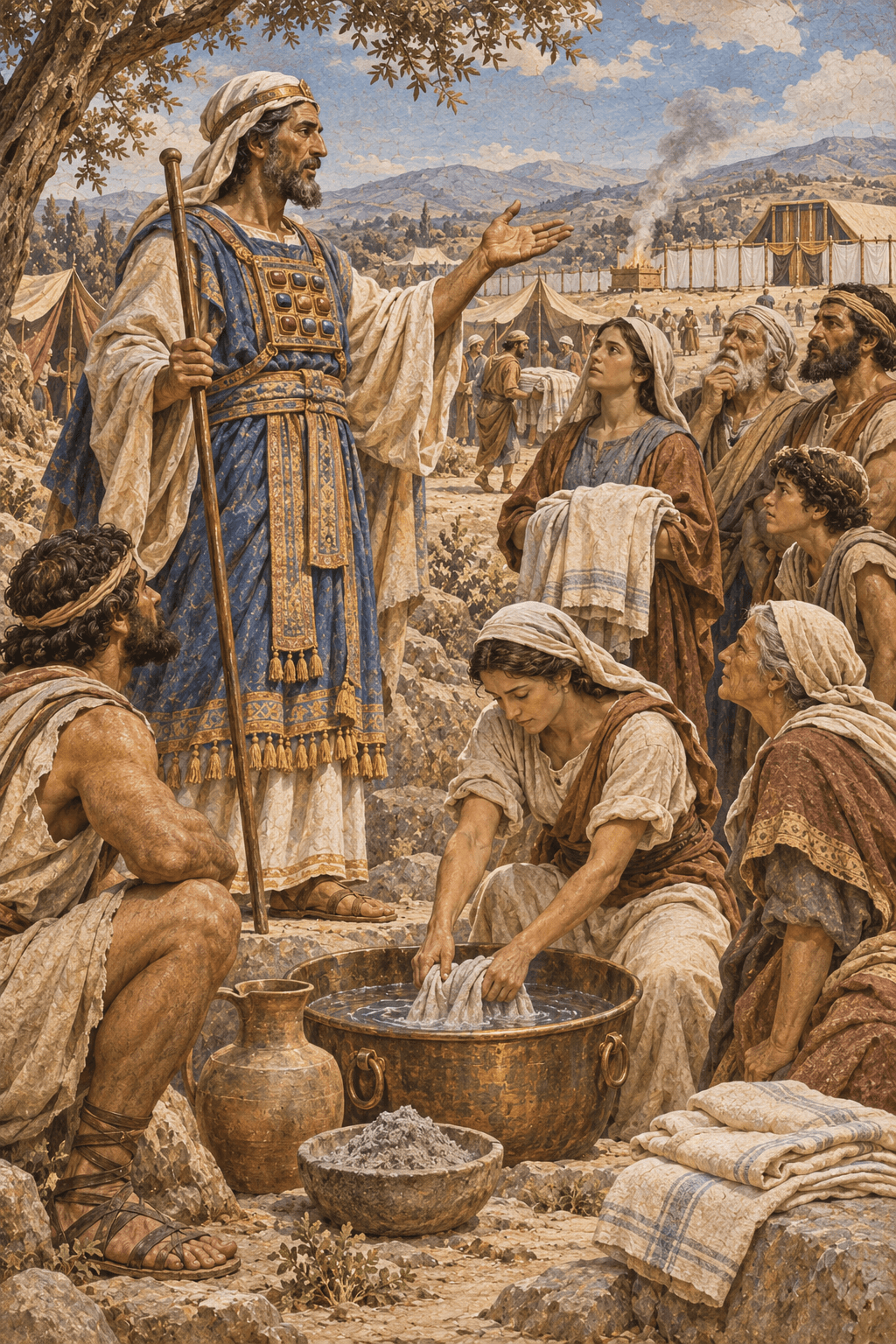
Eleazar the high priest asked the soldiers coming from the battle to bring the metals that could pass through the fire, “the gold, and the silver, the brass, the iron, the tin, and the lead” (22), so as to make them pass through the fire, and it would be clean; nevertheless it was to be purified with the water of separation (the water that cleanses from uncleanness, 23). What could not abide the fire they were to make pass through the water. And the men of war themselves, having touched the Midianites and killed them, were to wash their clothes on the seventh day to be clean, and then come into the camp (24).
We note in this law:
First: a wonderful symbolic picture of God’s spiritual army, which has conquered and triumphed over sin, setting out toward the true camp, Jerusalem, “the tabernacle of God… with men” (Revelation 21:3). They set out toward their Bridegroom to rest with Him and in Him in the bosom of His holy Father, and their works follow them. They carry with them gold, silver, brass, iron, tin and lead; they carry their garments, which they have washed and made white in the blood of the Lamb (Revelation 7:14). What is this gold that has passed through the fire, if not the heavenly life poured out in the life of those who strive, through the fiery Holy Spirit? And what is the silver, if not the preaching of the word of God, refined as in fire seven times (Psalm 12:6)? So the believers enter the heavenly camp carrying the labours of their love, offering them as precious fruit to the Bridegroom, who rejoices in His bride, holy in Him. The garments washed in the blood point to our bodies, which rise on the great day of the Lord, sanctified in the blood of Christ, to share with the souls their eternal crown and heavenly glories.
Second: wonderfully, the law counted these strivers, who wrestled with sin and conquered, as being in a state of uncleanness: their garments had to be washed on the seventh day for them to enter the camp. It is as though the Lord wanted to affirm that all who strive, whatever their spiritual stature, are exposed to weakness and need to be covered in the blood of Christ the Lord, which cleanses from all sin. Though they are counted heroes, their entering the camp will not be lawful except through Christ the Lord, who cleanses mankind from all uncleanness.
6. The Division of the Spoils
KJV · Verses 25–54
25 And the Lord spake unto Moses, saying, 26 Take the sum of the prey that was taken, both of man and of beast, thou, and Eleazar the priest, and the chief fathers of the congregation: 27 And divide the prey into two parts; between them that took the war upon them, who went out to battle, and between all the congregation: 28 And levy a tribute unto the Lord of the men of war which went out to battle: one soul of five hundred, both of the persons, and of the beeves, and of the asses, and of the sheep: 29 Take it of their half, and give it unto Eleazar the priest, for an heave offering of the Lord. 30 And of the children of Israel's half, thou shalt take one portion of fifty, of the persons, of the beeves, of the asses, and of the flocks, of all manner of beasts, and give them unto the Levites, which keep the charge of the tabernacle of the Lord. 31 And Moses and Eleazar the priest did as the Lord commanded Moses. 32 And the booty, being the rest of the prey which the men of war had caught, was six hundred thousand and seventy thousand and five thousand sheep, 33 And threescore and twelve thousand beeves, 34 And threescore and one thousand asses, 35 And thirty and two thousand persons in all, of women that had not known man by lying with him. 36 And the half, which was the portion of them that went out to war, was in number three hundred thousand and seven and thirty thousand and five hundred sheep: 37 And the Lord'S tribute of the sheep was six hundred and threescore and fifteen. 38 And the beeves were thirty and six thousand; of which the Lord'S tribute was threescore and twelve. 39 And the asses were thirty thousand and five hundred; of which the Lord'S tribute was threescore and one. 40 And the persons were sixteen thousand; of which the Lord'S tribute was thirty and two persons. 41 And Moses gave the tribute, which was the Lord'S heave offering, unto Eleazar the priest, as the Lord commanded Moses. 42 And of the children of Israel's half, which Moses divided from the men that warred, 43 (Now the half that pertained unto the congregation was three hundred thousand and thirty thousand and seven thousand and five hundred sheep, 44 And thirty and six thousand beeves, 45 And thirty thousand asses and five hundred, 46 And sixteen thousand persons;) 47 Even of the children of Israel's half, Moses took one portion of fifty, both of man and of beast, and gave them unto the Levites, which kept the charge of the tabernacle of the Lord; as the Lord commanded Moses. 48 And the officers which were over thousands of the host, the captains of thousands, and captains of hundreds, came near unto Moses: 49 And they said unto Moses, Thy servants have taken the sum of the men of war which are under our charge, and there lacketh not one man of us. 50 We have therefore brought an oblation for the Lord, what every man hath gotten, of jewels of gold, chains, and bracelets, rings, earrings, and tablets, to make an atonement for our souls before the Lord. 51 And Moses and Eleazar the priest took the gold of them, even all wrought jewels. 52 And all the gold of the offering that they offered up to the Lord, of the captains of thousands, and of the captains of hundreds, was sixteen thousand seven hundred and fifty shekels. 53 (For the men of war had taken spoil, every man for himself.) 54 And Moses and Eleazar the priest took the gold of the captains of thousands and of hundreds, and brought it into the tabernacle of the congregation, for a memorial for the children of Israel before the Lord.
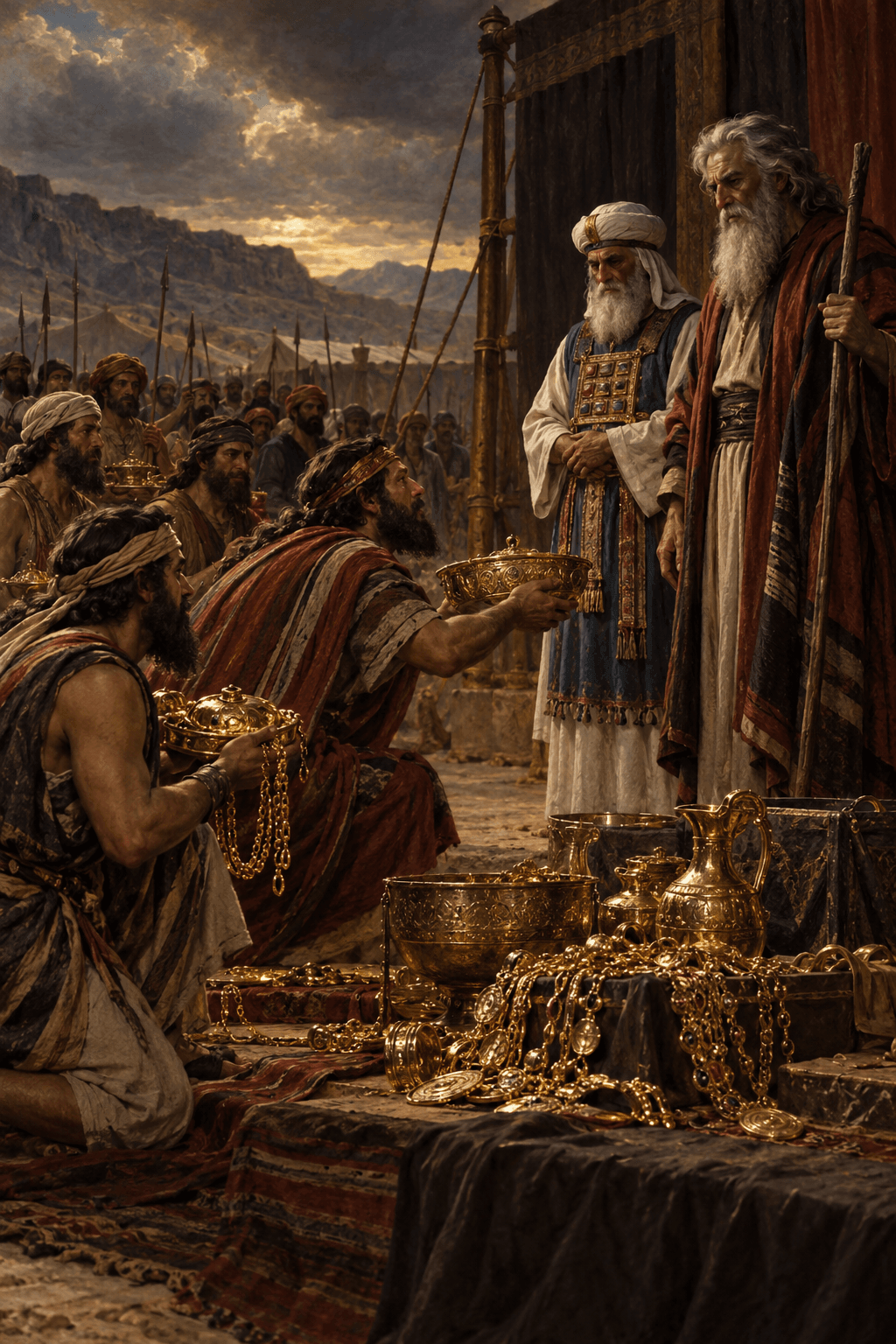
We note in the division of the spoils the following:
First: half of the spoils was divided among the men of war (12,000), while the other half went to the rest of the people (more than 600,000 men less 12,000). It is as though the victorious man of war took more than fifty times what an ordinary man took. So God crowns those who strive and conquer with special privileges, for the Lord Himself says: “In my Father’s house are many mansions” (John 14:2); and the Apostle Paul says: “for one star differeth from another star in glory” (1 Corinthians 15:41). We have seen this clearly even in the division of the land of promise (see the commentary on Numbers 26:55).
Second: though the spoils were divided among them as a divine reward, all were bound to offer from them a tribute, or heave offerings, to the Lord (28). The victorious strivers offered one soul of every five hundred, and one animal of every five hundred, while the rest offered one of every fifty. So in our victory, as we receive divine gifts, we offer Him of His gifts offerings of love, a sign of mutual love. On the one hand; on the other, the giving here affirms that the true leadership in this war belonged to the Lord Himself: He conquered through them, so we offer His share of the spoil to His priests and the ministers of His house. Here the numbers (500) and (50) remind us of the parable Christ the Lord told of the creditor who forgave two debtors, the first owing five hundred pence and the second fifty (Luke 7:41–42), and the first loved the creditor more. These two numbers, as we said before, [286] point to freedom: at the age of fifty the Levite is freed from the service of the visible tabernacle to prepare for the invisible tabernacle; on the day of Pentecost the Holy Spirit came to give mankind freedom from sin through the merits of the Blood; and in the Jubilee (the fiftieth year) the land is freed, the slaves are freed, and man is freed from every judgment, and so on…
So what these pay makes them free in disposing of what remains to them.
Third: the spoils included human souls (women and children) together with animals, pointing to bringing into captivity every thought in us to the obedience of Christ (2 Corinthians 10:5). What was under the authority of the kings of Midian is taken from them to come under the leadership of Christ the Lord Himself.
Fourth: Moses and Eleazar took the gold and brought it into the tabernacle of the congregation for a memorial for the people before the Lord (54). If gold points to the heavenly life, it alone of all the spoils remains in the presence of the Lord; for everything that is not heavenly, even if it is a gift from God, will come to an end, while the heavenly mind and the heavenly life working in us remain for us before the Lord, bearing witness to our victory and triumph for His sake.
Notes and References
[279] Origen, Homilies on Numbers 25.
[280] Ibid.
[281] Ibid.
[282] Ibid.
[283] The New Westminster Dictionary of the Bible, p. 797.
[284] St. Augustine, Sermons on New Testament Lessons 14.4.
[285] J. Hastings, Dictionary of the Bible, p. 1059.
[286] See the commentary on chapter 4.