
When Aaron was established in the priesthood by tangible divine confirmations, when his rod produced almonds, the Lord went on to affirm to him, to his sons and to the rest of the tribe of Levi their obligations, the limits of their work, and also their rights as ministers of the Lord.
1. The Responsibility of the Priests
KJV · Verses 1–7
1 And the Lord said unto Aaron, Thou and thy sons and thy father's house with thee shall bear the iniquity of the sanctuary: and thou and thy sons with thee shall bear the iniquity of your priesthood. 2 And thy brethren also of the tribe of Levi, the tribe of thy father, bring thou with thee, that they may be joined unto thee, and minister unto thee: but thou and thy sons with thee shall minister before the tabernacle of witness. 3 And they shall keep thy charge, and the charge of all the tabernacle: only they shall not come nigh the vessels of the sanctuary and the altar, that neither they, nor ye also, die. 4 And they shall be joined unto thee, and keep the charge of the tabernacle of the congregation, for all the service of the tabernacle: and a stranger shall not come nigh unto you. 5 And ye shall keep the charge of the sanctuary, and the charge of the altar: that there be no wrath any more upon the children of Israel. 6 And I, behold, I have taken your brethren the Levites from among the children of Israel: to you they are given as a gift for the Lord, to do the service of the tabernacle of the congregation. 7 Therefore thou and thy sons with thee shall keep your priest's office for everything of the altar, and within the vail; and ye shall serve: I have given your priest's office unto you as a service of gift: and the stranger that cometh nigh shall be put to death.
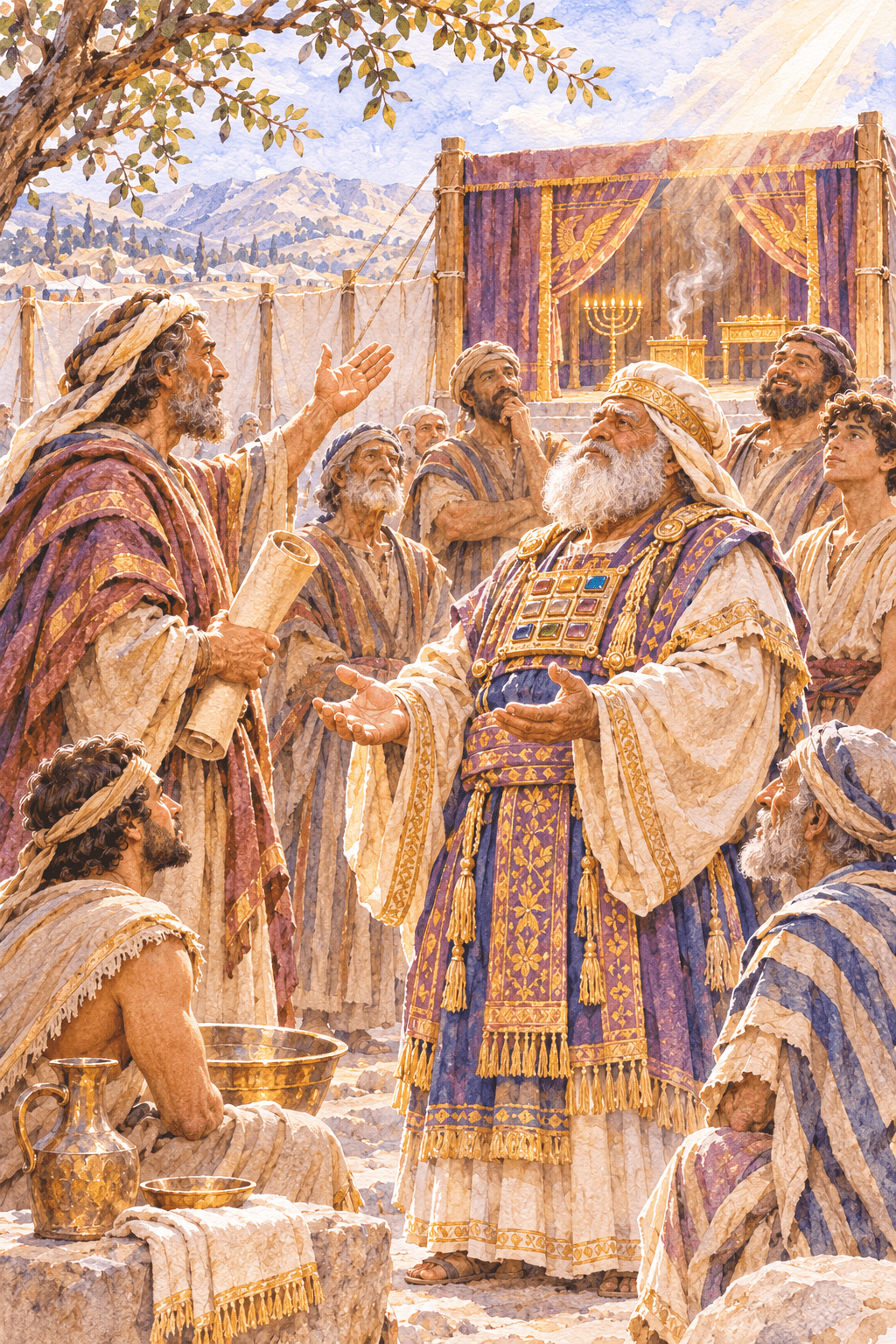
When the people fell under chastisement, and fourteen thousand and seven hundred died of the plague because of their murmuring over the destruction of Korah and his company (Numbers 16:49), and God confirmed to them the choice of Aaron for the priesthood, the people spoke to Moses, saying: “Behold, we die, we perish, we all perish. Whosoever cometh any thing near unto the tabernacle of the LORD shall die: shall we be consumed with dying?” (Numbers 17:12–13). God’s answer to their complaint came by declaring to them that they would draw near to His tabernacle, but through the priests, making clear the work of the priests and the work of the Levites and their limits.
“And the LORD said unto Aaron, Thou and thy sons and thy father’s house with thee shall bear the iniquity of the sanctuary” (1). On the literal side, Aaron, his priests and the Levites bear responsibility for any defilement that befalls the sanctuary through a stranger’s approaching it; they are bound before God to guard it.
On the pastoral side, the high priest and the priests, with the deacons, are the spiritual guardians who are asked about every fault committed by the people, who are God’s sanctuary and His holy dwelling. Origen comments on this phrase, saying:
The blessed are asked about the faults and sins of those under them. In this sense the Apostle says: “We then that are strong ought to bear the infirmities of the weak” (Romans 15:1). [134]
In Origen’s days it seems that some thought the saints do not sin; so he commented at some length on the words “shall bear the iniquity of the sanctuary” (1), making clear that the saints are not infallible. We quote from it the following words:
If it were true that the saint can never sin, and that we must regard him as infallible… it would not have been written, “shall bear the iniquity of the sanctuary (the holy).”… If the saints were infallible, why did the Apostle say to the Romans, “For meat destroy not the work of God” (Romans 14:20), to those to whom he wrote at the beginning of his epistle, “To all that be in Rome, beloved of God, called to be saints” (Romans 1:7)?…
The same Apostle says in his epistle to the Corinthians: “Unto the church of God which is at Corinth, to them that are sanctified in Christ Jesus, called to be saints” (1 Corinthians 1:2). See with what sins he rebukes them, for he writes afterwards: “for whereas there is among you envying, and strife, and divisions, are ye not carnal, and walk as men?” (1 Corinthians 3:3). And he says: “Now ye are full, now ye are rich, ye have reigned as kings without us: and I would to God ye did reign, that we also might reign with you” (1 Corinthians 4:8). And also: “Now some are puffed up, as though I would not come to you” (1 Corinthians 4:18). A little later he says: “It is reported commonly that there is fornication among you, and such fornication as is not so much as named among the Gentiles” (1 Corinthians 5:1). He excepted no one: he accuses one of fornication and the others of pride. After this he reproaches them for going to law with one another: “Now therefore there is utterly a fault among you, because ye go to law one with another” (1 Corinthians 6:7).
He accuses those whom he called saints of eating things sacrificed to idols, and he judges them: “But when ye sin so against the brethren, and wound their weak conscience, ye sin against Christ” (1 Corinthians 8:12). He accuses them not only of eating things sacrificed to idols but also of drinking the cup of devils (1 Corinthians 10:21). And because of these faults he says: “For this cause many are weak and sickly among you, and many sleep. For if we would judge ourselves, we should not be judged” (1 Corinthians 11:30–31)… Moreover, the sins did not stop at conduct, but there were also faults against the faith, for he accuses them thus: “how say some among you that there is no resurrection of the dead?” (1 Corinthians 15:12); and he says: “And if Christ be not raised, your faith is vain; ye are yet in your sins” (1 Corinthians 15:17). It would take very long to bring here all the testimonies that those who are called saints must not, because of this name, be considered infallible, as is believed by one who reads Holy Scripture superficially and carelessly. [135]
When the Lord lays on the priests and Levites the responsibility of “the iniquity of the sanctuary,” it is not only in the sense of guarding the tabernacle and its contents in a material, tangible way, but their spiritual responsibility toward the people as His spiritual sanctuary and holy temple. He does not say only, “shall bear the iniquity,” but “the iniquity of the sanctuary (the holy),” as though the priests are asked about the iniquities of the saints, not about every iniquity committed.
Origen explains this by saying that the priests are bound to responsibility for sinners who seek holiness; these are counted as saints, and every fault they commit the priests are bound by. But sinners who do not aim at holiness and persist in sin, the priests do not bear their iniquity.
Origen says that those who study a science or a philosophy are counted scholars or philosophers in the subject of their research and study, not in the sense that they understand all its details, but that they research it and study it, and also err, yet they persevere in studying it. So the saints are those who aim at the life of holiness, persevering in it. Therefore Origen says:
When a man commits himself to (practical) studies in holiness, he must be given the title of saint according to the goal he aims at; but since he necessarily commits faults, he is called a sinner until the habit of sin is taken from him. [136]
The saints regret their sins, feel their falls and their wounds and perceive them; so they go to the priest asking for healing, and seek to be made pure by the great High Priest. [137]
So if the priests bear the iniquity of their children, the iniquity of the people, the people too are bound in their repentance to meet their fathers, who pray for them that they may enjoy the Holy Spirit for the holy life.
The Lord continues His words with Aaron thus: “and thou and thy sons with thee shall bear the iniquity of your priesthood” (1), as though every strange thing a priest commits binds all the priests. If the sin of one of the people in Corinth threatened the Church, so that the Apostle hastened to say: “Purge out therefore the old leaven, that ye may be a new lump, as ye are unleavened… But now I have written unto you not to keep company, if any man that is called a brother be a fornicator, or covetous, or an idolater, or a railer, or a drunkard, or an extortioner; with such an one no not to eat. For what have I to do to judge them also that are without? do not ye judge them that are within? But them that are without God judgeth. Therefore put away from among yourselves that wicked person” (1 Corinthians 5:7–13).
It is not for us to judge those who are without, but the Church is bound to put away the wicked person if he is one of the people. What then if he is a priest, whatever his priestly rank? This is what the Lord meant by saying that Aaron and the priests his sons bear the iniquity of their priesthood. If because of the sin of Achan the whole people fell and all were counted transgressors of God’s covenant (Joshua 7:11), what if the priest sins? Pope Athanasius the Apostolic says that if a priest sins without repentance, God is angry with mankind because of him. And if the priest, who is a father to mankind, is corrupted, as Saint John Chrysostom says, he destroys everyone!
Origen has a beautiful meditation concerning man’s inner life. He sees the priest who works inside the sanctuary as caring for inner things; so the believer commits “the iniquity of the priesthood” if he lets anything defiled enter the depths of his soul. He says:
The care and watchfulness of the priests must be directed especially toward what is covered within, behind the veil, so that nothing defiled or unclean is found there; that is, care must be given to the inner man and the inner parts of the heart, so that they may be without blemish. [138]
It is as though the high priest and the priests are bound not to bring anything strange or defiled into the Holy of Holies and the holy place, with the ark of the covenant and its cherubim, the altar of incense, the golden candlestick, the table of shewbread and so on. If “cherub” means “knowledge,” the believer should not allow a defiled knowledge of evil to come near God’s sanctuary within him; rather, the Lord’s two cherubim should remain in their splendour in the heart, declaring God’s presence in it. He does not lift up strange incense on the altar of his heart, nor offer prayers with defiled hands, for the prayer of the wicked is an abomination before the Lord (Proverbs 15:8), but “The effectual fervent prayer of a righteous man availeth much” (James 5:16). So he keeps the Lord’s candlestick, which is Holy Scripture, in his heart, always shining with the fiery Holy Spirit, giving the soul unceasing enlightenment, and his feelings always burn with divine love. The soul finds in Christ Jesus her Lord her food on the table of shewbread in her depths, and so on. Everything in the holy place and the Holy of Holies was of pure gold, with no brass, lead or any other metal; so the believer keeps his heart with the heavenly (golden) nature, and does not allow the love of the world, the lusts of the body and earthly things to seize his heart!
Having spoken with the priests, He turned His words toward the Levites, saying: “And thy brethren also of the tribe of Levi, the tribe of thy father, bring thou with thee, that they may be joined unto thee, and minister unto thee: but thou and thy sons with thee shall minister before the tabernacle of witness” (2). They work with the priests and the high priest as those consecrated to the Lord, the people’s gift to God and God’s gift to His people. They work in agreement and harmony with the priests, but they do not see the inner holy things or touch them while they are uncovered, as we saw in the earlier chapters.
In short, He wanted to define the work of the ministers in His holy tabernacle, declaring that the holiness of His ministers does not stop at their commitment to a holy life in their personal conduct, but includes their responsibility for the people and for one another, and finally their harmony together in one spirit, the spirit of nearness of heart, mind and spirit, and mutual support through the shared service. The priestly work is not a job; it is a fellowship of love and a spiritual work for guarding the holy tabernacle and its furnishings, that is, keeping souls as holy temples for the Lord.
2. The Support of the Priests
KJV · Verses 8–20
8 And the Lord spake unto Aaron, Behold, I also have given thee the charge of mine heave offerings of all the hallowed things of the children of Israel; unto thee have I given them by reason of the anointing, and to thy sons, by an ordinance for ever. 9 This shall be thine of the most holy things, reserved from the fire: every oblation of their's, every meat offering of their's, and every sin offering of their's, and every trespass offering of their's which they shall render unto me, shall be most holy for thee and for thy sons. 10 In the most holy place shalt thou eat it; every male shall eat it: it shall be holy unto thee. 11 And this is thine; the heave offering of their gift, with all the wave offerings of the children of Israel: I have given them unto thee, and to thy sons and to thy daughters with thee, by a statute for ever: every one that is clean in thy house shall eat of it. 12 All the best of the oil, and all the best of the wine, and of the wheat, the firstfruits of them which they shall offer unto the Lord, them have I given thee. 13 And whatsoever is first ripe in the land, which they shall bring unto the Lord, shall be thine; every one that is clean in thine house shall eat of it. 14 Every thing devoted in Israel shall be thine. 15 Every thing that openeth the matrix in all flesh, which they bring unto the Lord, whether it be of men or beasts, shall be thine: nevertheless the firstborn of man shalt thou surely redeem, and the firstling of unclean beasts shalt thou redeem. 16 And those that are to be redeemed from a month old shalt thou redeem, according to thine estimation, for the money of five shekels, after the shekel of the sanctuary, which is twenty gerahs. 17 But the firstling of a cow, or the firstling of a sheep, or the firstling of a goat, thou shalt not redeem; they are holy: thou shalt sprinkle their blood upon the altar, and shalt burn their fat for an offering made by fire, for a sweet savour unto the Lord. 18 And the flesh of them shall be thine, as the wave breast and as the right shoulder are thine. 19 All the heave offerings of the holy things, which the children of Israel offer unto the Lord, have I given thee, and thy sons and thy daughters with thee, by a statute for ever: it is a covenant of salt for ever before the Lord unto thee and to thy seed with thee. 20 And the Lord spake unto Aaron, Thou shalt have no inheritance in their land, neither shalt thou have any part among them: I am thy part and thine inheritance among the children of Israel.
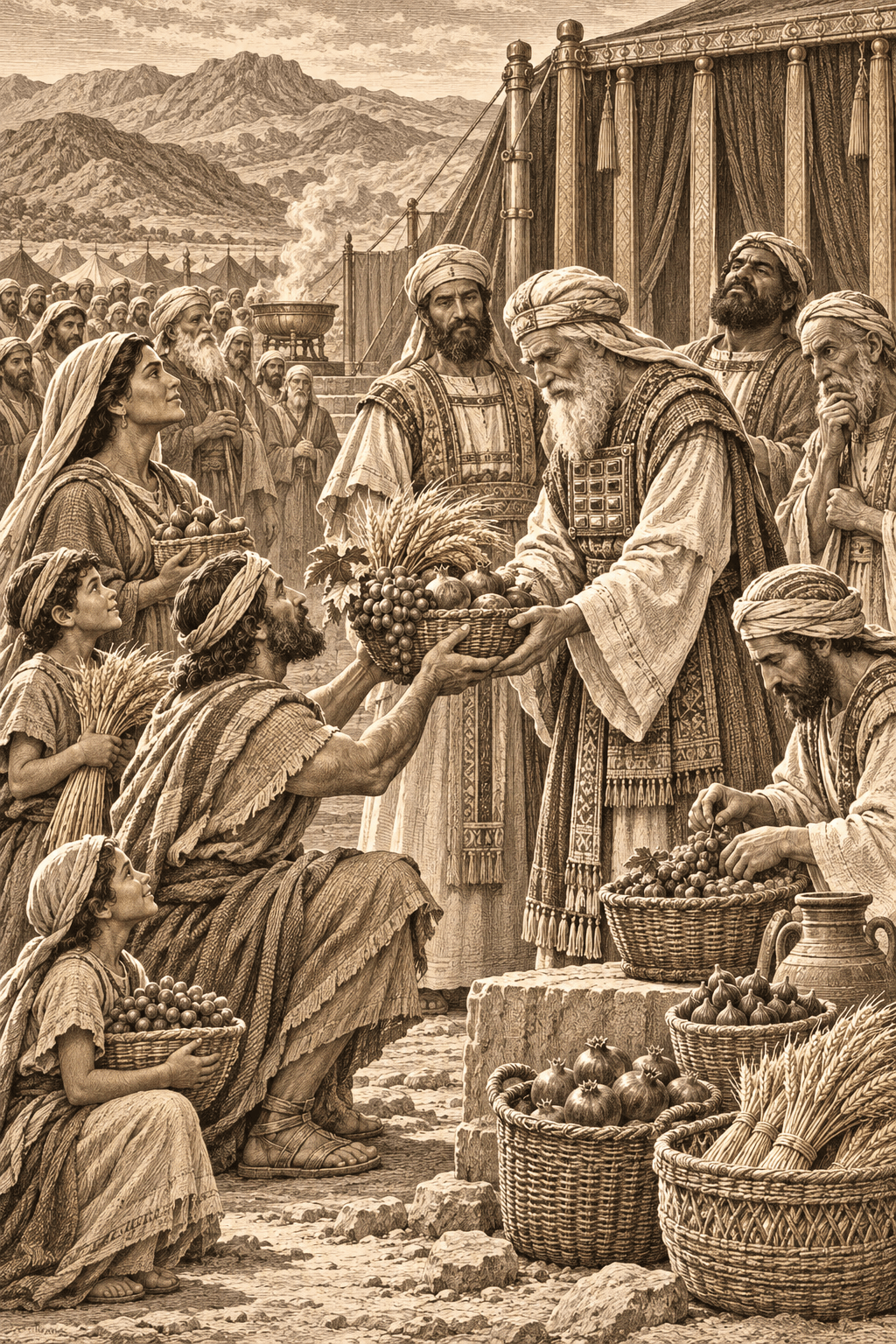
Since God had set apart His priests for the holy service, and they were bound to the charge of the sanctuary, He wanted to free all their concerns for the spiritual work, so that they would not be entangled in material things, even those concerning their own livelihood. Therefore He provided all their material needs through the service, not as wages for their work but because they were devoted to the work. The Apostle Paul says: “Do ye not know that they which minister about holy things live of the things of the temple? and they which wait at the altar are partakers with the altar? Even so hath the Lord ordained that they which preach the gospel should live of the gospel. But I have used none of these things: neither have I written these things, that it should be so done unto me: for it were better for me to die, than that any man should make my glorying void” (1 Corinthians 9:13–15).
What He forbade to the people, the firstfruits, tithes and vows, He set apart for His priests and Levites, so that they might be free for the spiritual work.
Wonderfully, God concluded His words about the support of the priests by saying to Aaron: “Thou shalt have no inheritance in their land, neither shalt thou have any part among them: I am thy part and thine inheritance among the children of Israel” (20). It is as though He wanted to conclude His words with them about their rights, not because He wanted to deprive them of the earthly inheritance, but so that they might enjoy Himself as their eternal inheritance. He wants to satisfy them and enrich them, not with passing earthly things, but with Himself, the eternal and boundless!
In the New Testament the priests are called “clergy” (kleros), which in Greek means “lot” or “portion,” as though they have chosen the Lord as their portion, or the Lord has chosen them from among the people as His portion. On this Saint Jerome says:
Let the clergyman, as he serves the Church of Christ, first understand what his title means, and then fulfil the meaning, striving to do what he has been called. For the Greek word kleros means “lot” or “inheritance.” The clergy are so called either because they are the Lord’s portion, or because the Lord Himself is their portion; he must possess the Lord and the Lord possess him. For whoever possesses the Lord says with the prophet: “The LORD is the portion of mine inheritance” (Psalm 16:5; 73:26), and he cannot possess anything beside the Lord; otherwise the Lord would not be his portion. [139]
It is as though God does not intend to deprive them of anything, but to centre all their gaze, feelings and longings on Him alone as their portion… I hope to return to this point in our study of the twenty-sixth chapter, where all prepare to receive their portion in the land of promise (Numbers 26:53–56).
Since the Lord knew that the people were still children in spiritual things, even the tribe of Levi consecrated to His service, He did not begin with the preceding words about depriving them of a portion in the land so that they might enjoy God alone as their portion; He made them the conclusion of His words with the priests (20), first establishing for them their rights to enjoy what belongs to God Himself: firstfruits, vows, offerings and so on. It is as though He asks them to give up nothing until He has given them what they take! For there is no emptying of earthly things except as far as the heart is satisfied with God and what is His. Though He forbade them what the people enjoy of earthly inheritance, He first gave them to enjoy what He had forbidden to the people (14): firstfruits, vows and offerings. He gives first before He takes away!
He emphasized especially the priests’ right to the firstfruits. We have already spoken of the spiritual meanings of the firstfruits in more than one place; [140] we add here the following remarks:
First: at harvest the people were bound to offer God, through His priests, the firstfruits of their harvest! It is a joyful picture of the great day of the Lord, or the day of harvest, when the angels come forward and reap, to offer to the great High Priest Jesus Christ the holy firstfruits, which are the souls of the believers.
Second: the Lord says to Aaron: “Behold, I also have given thee the charge of mine heave offerings” (8). But how did they keep the Lord’s heave offerings, when they ate them and consumed them? It is a symbol of the holy firstfruits that are not consumed, that is, “Christ the Lord Himself,” who is “the firstfruits of them that slept” (1 Corinthians 15:20), the Firstborn who comes before the Father as Firstborn of mankind to sanctify us, and comes to us as the Father’s gift to make us firstborn in Him. This is the Firstborn whom we enjoy and who is not consumed; on the contrary, He raises us from our consumption, or our death, so that we may live through Him and in Him forever.
The Church in her priesthood has become bound to carry out the divine commandment: “Behold, I also have given thee the charge of mine heave offerings,” as though she is bound to be faithful in her keeping, so that Christ the Firstborn, God’s heave offering, may shine forth in the life of the believers.
Third: the Lord commands Aaron not to accept the firstborn of unclean animals, but to take a ransom for them; while for clean animals he does not accept a ransom, but takes their firstborn: “they are holy” (17). It is as though He required that the firstfruits be holy. In the canons of the Church the offerings of heathens or of unrepentant wicked people are not accepted; rather, firewood is bought with them to be burned in the fire! The firstfruits are a symbol of the holy Christ, whom the Father accepts as an offering of love for mankind, for its sanctification in Him, for the Lord says: “And for their sakes I sanctify myself, that they also might be sanctified through the truth” (John 17:19).
3. The Support of the Levites
KJV · Verses 21–24
21 And, behold, I have given the children of Levi all the tenth in Israel for an inheritance, for their service which they serve, even the service of the tabernacle of the congregation. 22 Neither must the children of Israel henceforth come nigh the tabernacle of the congregation, lest they bear sin, and die. 23 But the Levites shall do the service of the tabernacle of the congregation, and they shall bear their iniquity: it shall be a statute for ever throughout your generations, that among the children of Israel they have no inheritance. 24 But the tithes of the children of Israel, which they offer as an heave offering unto the Lord, I have given to the Levites to inherit: therefore I have said unto them, Among the children of Israel they shall have no inheritance.
If the priests enjoy the firstfruits, the Levites enjoy the tithes, the Lord affirming that by this they receive God’s own right, since they have no portion in the earthly inheritance.
4. The Levites’ Obligation to Give
KJV · Verses 25–32
25 And the Lord spake unto Moses, saying, 26 Thus speak unto the Levites, and say unto them, When ye take of the children of Israel the tithes which I have given you from them for your inheritance, then ye shall offer up an heave offering of it for the Lord, even a tenth part of the tithe. 27 And this your heave offering shall be reckoned unto you, as though it were the corn of the threshingfloor, and as the fulness of the winepress. 28 Thus ye also shall offer an heave offering unto the Lord of all your tithes, which ye receive of the children of Israel; and ye shall give thereof the Lord'S heave offering to Aaron the priest. 29 Out of all your gifts ye shall offer every heave offering of the Lord, of all the best thereof, even the hallowed part thereof out of it. 30 Therefore thou shalt say unto them, When ye have heaved the best thereof from it, then it shall be counted unto the Levites as the increase of the threshingfloor, and as the increase of the winepress. 31 And ye shall eat it in every place, ye and your households: for it is your reward for your service in the tabernacle of the congregation. 32 And ye shall bear no sin by reason of it, when ye have heaved from it the best of it: neither shall ye pollute the holy things of the children of Israel, lest ye die.
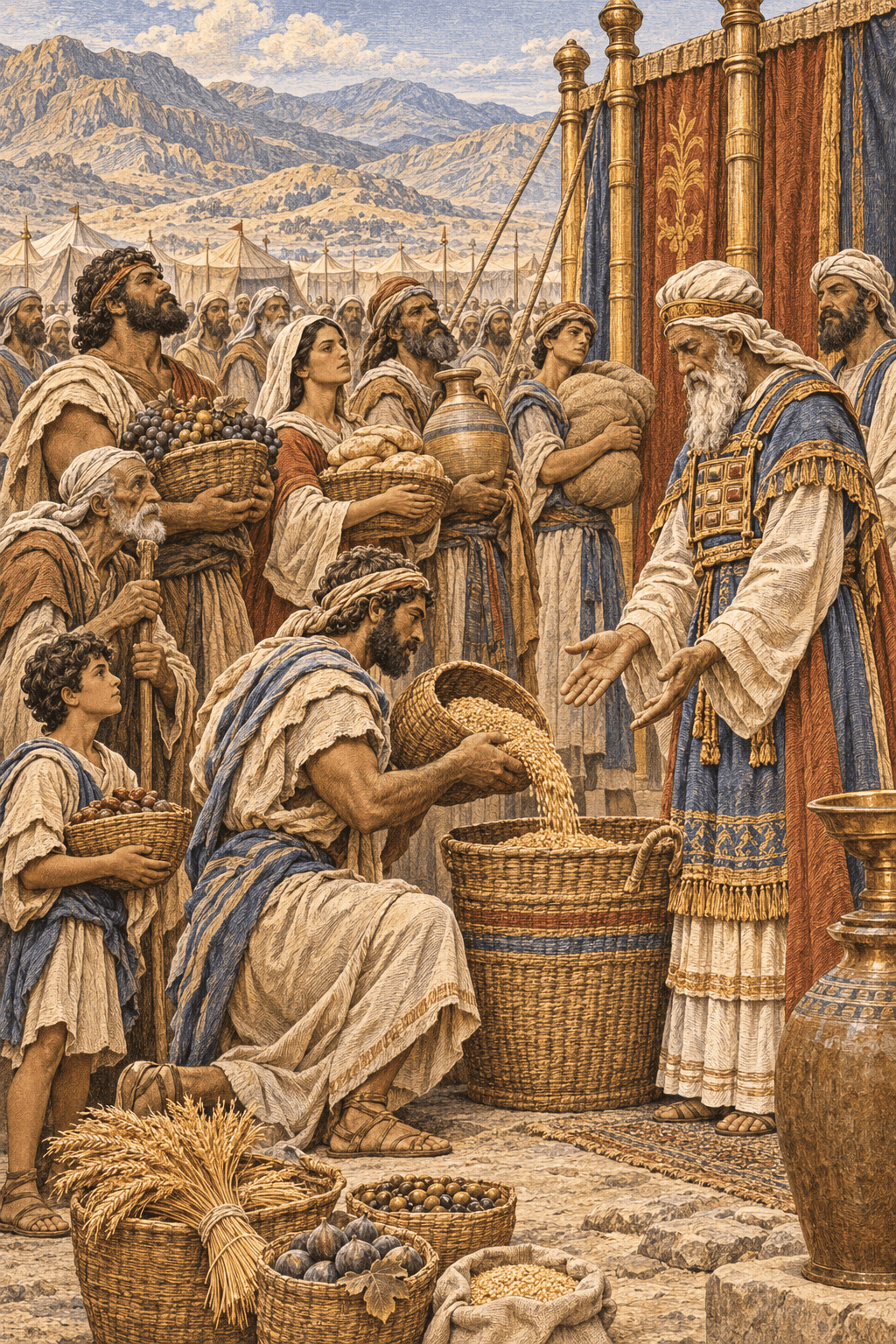
If the Levites enjoy the tithes of the people, they in turn are bound to offer a tenth of the tithes to Aaron the priest. He wants to train everyone, people and priests, in giving. Though the priest is bound to heartfelt and spiritual giving, spending his whole life for the Lord in the service of his people, he is also bound to material giving like the rest of his brethren and his spiritual children. He did not want to deprive any tribe of giving, not even the Levites themselves!
Finally, by this divine arrangement God wanted two things from the priests and Levites. First, while honouring them with the enjoyment of God’s rights, offerings, firstfruits, devoted things and tithes, He removes from them the excessive wealth that the heathen priests had at that time. They are honoured in the Lord, but they do not seize the people’s right; therefore they cannot acquire a portion of the land of promise for themselves or their children. Second, in this way they live as a community bound together. The Levites feel that the earthly gifts they enjoy are from God personally, but given through the holy community, the people God has acquired; and the priests too, receiving the tithe of the tithes from the Levites, perceive the same thing. It is as though God wanted to remove every spirit of superiority from the priests and Levites, whether over the people, or of the priests over the Levites themselves. By this order the priesthood does not turn into an aristocratic class isolated from the people; they are its servants, working for its sanctification in the Lord.
Notes and References
[134] Origen, Homilies on Numbers 10.
[135] Origen, Homilies on Numbers 10.
[136] Ibid.
[137] Ibid.
[138] Ibid.
[139] St. Jerome, Epistle 52.5.
[140] No reference is given for this note in the source (St-Takla notes the same).